iShares Ethereum Trust ETF ETHA
New risk paragraphs, branching off last year
Each branch is a paragraph in Risk Factors with nothing like it in the 10-K filed Mar 5, 2025. A box jumps to the paragraph as filed, below.
Paragraphs with nothing like them in last year's 10-K
29 paragraphs in Risk Factors of the 10-K filed Feb 27, 2026 with nothing like them in the 10-K filed Mar 5, 2025. Quoted exactly. Paragraphs that were only edited are under 10-K change.
On March 6, 2025, President Trump issued an executive order for the “Establishment of the Strategic Bitcoin Reserve and United States Digital Asset Stockpile” (the “Order”). The Order requires the Secretary of the U.S. Department of Treasury to establish two offices to administer and maintain a “Strategic Bitcoin Reserve” (the “Bitcoin Reserve”) and a U.S. Digital Asset Stockpile (the “Digital Asset Stockpile”), respectively. The Bitcoin Reserve will be capitalized with bitcoin forfeited as part of U.S. criminal or civil proceedings or in satisfaction of penalties imposed by executive agencies. The Order directs the Secretaries of the U.S. Treasury Department and the U.S. Department of Commerce to develop budget-neutral strategies for acquiring additional bitcoin for the Bitcoin Reserve. As established by the Order, the Bitcoin Reserve will not contain ether, and there can be no assurance, and there is no present indication, that it would be changed to include ether in the future. The Digital Asset Stockpile will be capitalized initially with digital assets other than bitcoin forfeited as part of criminal or civil asset forfeiture proceedings, which could include ether; however, there will be no new acquisitions of ether as part of the Digital Asset Stockpile. The anticipation of a U.S. government-funded strategic cryptocurrency reserve may have motivated large-scale purchases of ether in the expectation of the U.S. government potentially acquiring ether to fund such an expected reserve, and the market price of ether may have decreased as a result of the ultimate content of the Order, which did not ultimately provide for acquisition of ether as part of the Bitcoin Reserve, though ether could be held as part of the Digital Asset Stockpile. While legislation has been introduced in the U.S. Senate and the U.S. House of Representatives, which would direct the acquisition of one million bitcoin by the federal government over a five-year period, no such similar federal legislation has been introduced that would provide for acquiring ether. Even if such legislation providing for the acquisition of ether were to be introduced at the federal level, it could fail to pass. Bills have also been introduced in several state legislatures to authorize the acquisition of bitcoin by state governments or their instrumentalities, some of which have failed to pass; however, the Sponsor is not aware as of the date of this report that similar legislation at the state level has been introduced in respect of ether, in the same quantity as legislation in respect of bitcoin. If now or in the future, the U.S. federal government or any state government or any instrumentality thereof does not announce ether acquisition plans or does announce such plans, but these plans fall short of market expectations, the price of ether may decline, which may impact Share value. Even if government acquisitions of ether were to occur or if legislation requiring acquisitions of ether is enacted, the price of ether may decline if there are implementation challenges, unexpected difficulties, or policy or legal reversals, any of which may negatively impact Share value. Further, executive orders such as the Order are subject to change and can be reversed or overturned. The enduring existence and size of the Digital Asset Stockpile is subject to complex challenges and uncertainty that makes it difficult to evaluate its effect on the value of ether and the Shares, now or in the future. There can be no assurance that any particular legislation will ever be introduced or passed at either the federal or state level providing for the acquisition of ether by governmental instrumentalities.
The Ethereum core developers have agreed on December 2025 as the date of the upcoming Fusaka hard fork, which is designed to expand data capacity, reinforce defenses against denial-of-service attacks, and introduce new tools for developers and users, among others. The main feature of the Fusaka upgrade is a new way of handling the data in the blobs introduced by the Dencun upgrade, which is expected to create improvements for Layer 2s to store data on the main Ethereum network. As with any change to software code, planned forks such as Fusaka could introduce bugs, coding defects, unanticipated or undiscovered problems, flaws, security risks, problematic incentive structures, or otherwise fail to work as intended or achieve the expected benefits that proponents hope for in the short term or the long term, which could also have an adverse effect on adoption of the Ethereum network and the value of ether, and therefore the Shares.
The complexity and interconnectedness of digital asset networks, applications, and economic systems enables new forms of malicious attacks that leverage a feature or vulnerability of one system to attack another. Such an attack may take the form of a temporary manipulation of the price of certain digital assets that trigger second order behaviors, such as automatic collateral liquidations on decentralized applications or digital asset trading platforms. Such an attack could adversely affect investments. A malicious actor can exploit the structure of one or a series of smart contracts or applications in ways that do not technically constitute exploitation of a “bug” or flaw in the smart contract or application. For example, such an exploit has occurred repeatedly in the Ethereum DeFi ecosystem, whereby a decentralized trading platform or lending application is designed to reference an external pricing source of a particular digital asset to determine when to liquidate collateral. By manipulating the price of the particular digital asset on a third-party platform (such as a digital asset trading platform), the pricing source used by the decentralized trading platform or application is consequently manipulated, which then leads to uneconomic collateral liquidations on the decentralized trading platform or application. Such liquidations may be processed automatically and could have a material adverse effect on our investments and trading strategies.
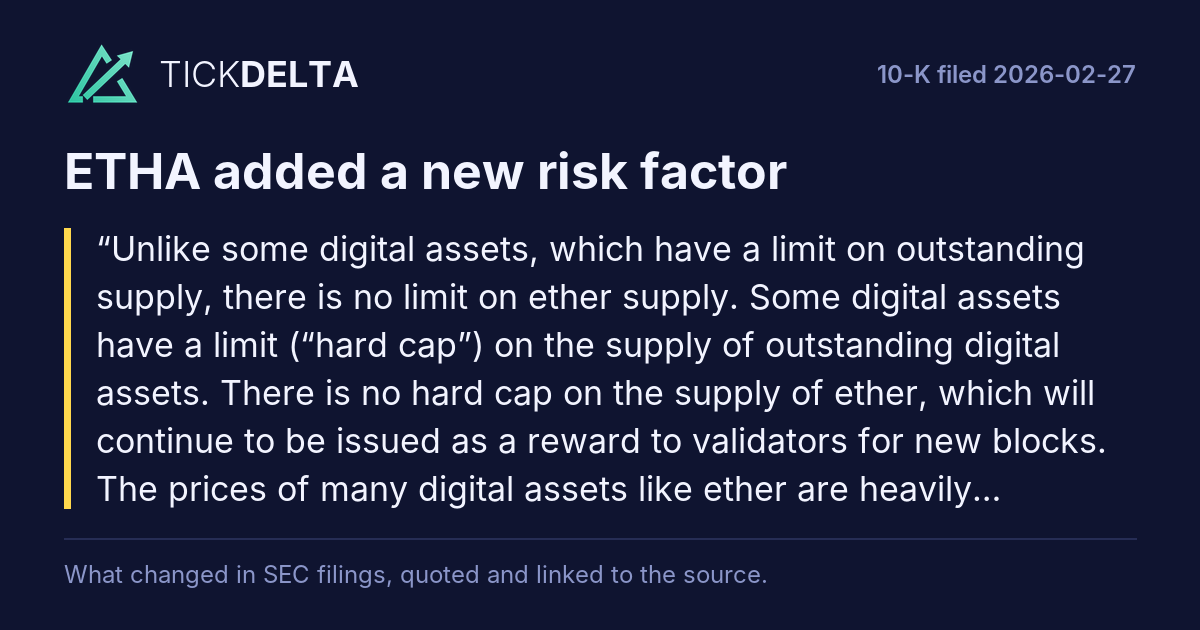
Unlike some digital assets, which have a limit on outstanding supply, there is no limit on ether supply.
Some digital assets have a limit (“hard cap”) on the supply of outstanding digital assets. There is no hard cap on the supply of ether, which will continue to be issued as a reward to validators for new blocks. The prices of many digital assets like ether are heavily influenced by supply and demand. If the supply of ether is inflationary, then in the absence of deflationary forces, ether could lose value, assuming the same amount of demand.
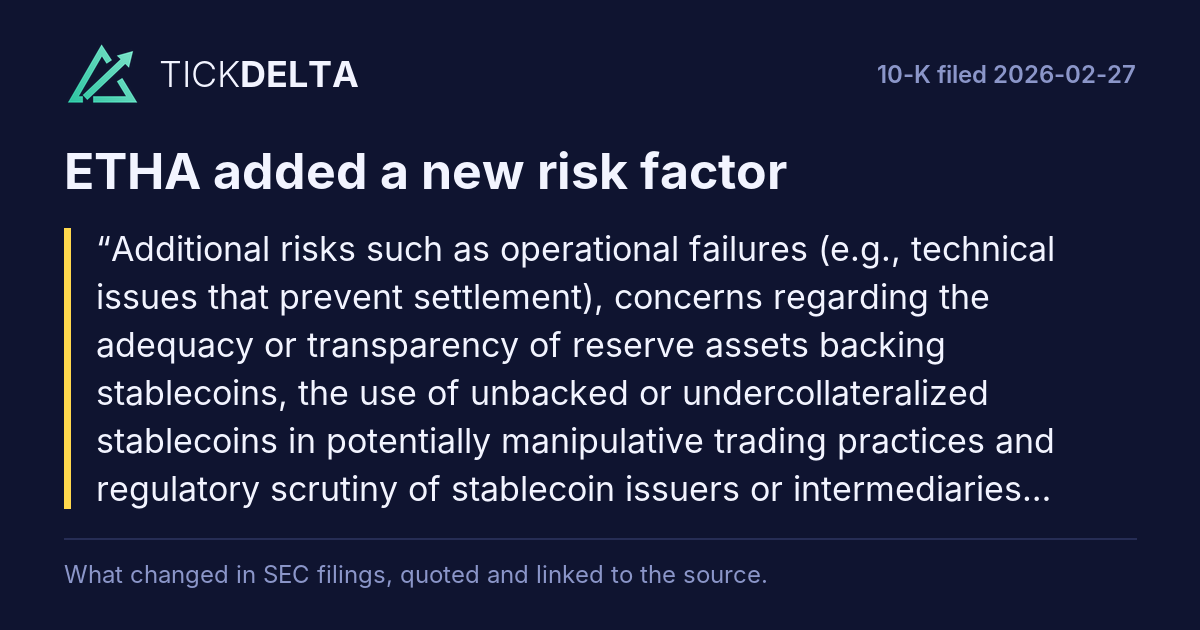
Additional risks such as operational failures (e.g., technical issues that prevent settlement), concerns regarding the adequacy or transparency of reserve assets backing stablecoins, the use of unbacked or undercollateralized stablecoins in potentially manipulative trading practices and regulatory scrutiny of stablecoin issuers or intermediaries, including exchanges that facilitate stablecoin transactions, may also adversely affect market confidence and liquidity. Further, these risks are underscored by recent legislative developments. On July 18, 2025, the Guiding and Establishing National Innovation for U.S. Stablecoins Act of 2025 (“GENIUS Act”) was enacted, establishing a federal regulatory framework for payment stablecoins. The GENIUS Act will become effective on July 18, 2028. The GENIUS Act prohibits the issuance or use of payment stablecoins unless the issuer obtains a qualifying license and complies with a range of regulatory requirements, including reserve backing with liquid assets, redemption rights, governance standards, and operational transparency. The GENIUS Act also restricts the payment of interest on stablecoins and imposes oversight on both bank and nonbank issuers. The enactment of the GENIUS Act, or the removal or migration of prominent stablecoins from the Ethereum network, could reduce the willingness of market participants to engage in digital asset transactions that rely on stablecoins, diminish liquidity in the ether market, and adversely affect the price of ether. Any such developments could, in turn, materially and adversely impact the value of the Shares.
Show the other 6
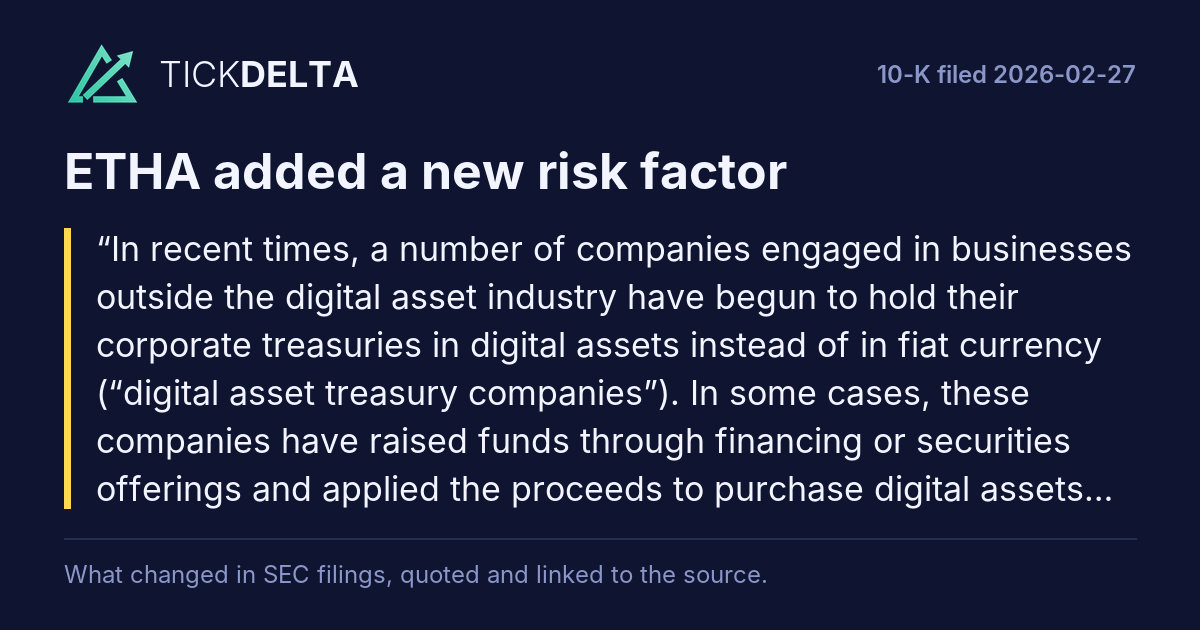
In recent times, a number of companies engaged in businesses outside the digital asset industry have begun to hold their corporate treasuries in digital assets instead of in fiat currency (“digital asset treasury companies”). In some cases, these companies have raised funds through financing or securities offerings and applied the proceeds to purchase digital assets, including ether.
Digital asset treasury companies are a relatively new phenomenon and it is difficult to predict their long-term sustainability, and therefore their impact to digital asset markets, and to the Trust. Digital asset treasury companies may increase procyclical dynamics in the market because they may purchase digital assets, such as ether, when prices are rising and they may in certain circumstances be forced to sell such assets when prices are decreasing, potentially causing downward pressure on ether prices in a falling market (causing prices to fall faster than they otherwise would). Digital asset treasury companies could cause greater volatility in digital asset markets, including markets for ether. Negative events or sentiment surrounding digital asset treasury companies could affect the market for ether. The increase of consolidated positions in ether held by digital asset treasury companies could affect the operation of the Ethereum blockchain. One digital asset treasury company, BitMine Immersion Technology Inc. (“BitMine Immersion”), held approximately 2.8% of ether’s supply as of November 3, 2025. If BitMine Immersion or another similarly situated digital asset treasury company begins to operate validators, it could gain influence in how the Ethereum blockchain operates. The foregoing or similar events involving digital asset treasury companies could adversely affect holders of Shares in the Trust.
Operational cost may exceed the award for validating transaction, and increased transaction fees may adversely affect the usage of the Ethereum network.
If transaction confirmation fees become too high, the marketplace may be reluctant to use ether. This may result in decreased usage and limit expansion of the Ethereum network in the retail, commercial and payments space, adversely impacting investment in the Trust. Conversely, if the reward for validators or the value of the transaction fees is insufficient to motivate validators, they may cease to validate transactions.
Ultimately, if the awards of new ether costs of validating transactions grow disproportionately, validators may operate at a loss, transition to other networks, or cease operations altogether. Each of these outcomes could, in turn, slow transaction validation and usage, which could have a negative impact on the Ethereum network and could adversely affect the value of the ether held by the Trust. As a result of Ethereum’s fee burning mechanism, the incentives for validators to validate transactions with higher gas fees may be reduced, since fee burning changes the gas fee split between users, validators, and token holders.
An acute cessation of validator operations would reduce the collective processing power on the Ethereum network, which would adversely affect the transaction verification process by temporarily decreasing the speed at which blocks are added to the blockchain and make the blockchain more vulnerable to a malicious actor obtaining control in excess of 50% of the processing power on the blockchain. Reductions in processing power could result in material, though temporary, delays in transaction confirmation time. Any reduction in confidence in the transaction verification process may adversely impact the value of Shares of the Trust or the ability of the Sponsor to operate.
If regulators or public utilities take actions that restrict or otherwise impact mining activities, such actions could result in decreased security of a digital asset network, including the Ethereum network, which could adversely affect the value of the Shares.
Concerns have been raised about the electricity required to secure and maintain digital asset networks. Although measuring the electricity consumed by the process of securing and maintaining digital asset networks is difficult because these operations are performed by various machines with varying levels of efficiency, the process consumes a significant amount of energy. Driven by concerns around energy consumption and the impact on public utility companies, various states and cities have implemented, or are considering implementing, moratoriums on mining activity in their jurisdictions.
Ethereum uses a system called proof-of-stake to validate transaction information. Anyone that owns the specific proof-of-stake digital asset can participate in staking, subject to certain minimum amounts as determined by the applicable proof-of-stake digital asset. Generally, the higher the amount staked by any actor, the higher the chances of being chosen by the applicable blockchain to act as validator and reaping validator rewards; in other words, the higher the stake, the higher the chances of earning a staking reward. This has led to the creation of staking pools, where third parties combine smaller stakes into large pools, which leads to higher returns for owners of small stakes, in return for a fee collected by the third parties.
Other digital asset networks may use a system called proof-of-work to validate transaction information. It’s called proof-of-work because solving the encrypted hash takes time and energy, which acts as proof that work was done. Proof of work requires users to mine or complete complex computational puzzles before submitting new transactions to the network.
Proof-of-stake digital assets allow people to pledge or lock up some of their holdings as a way of vouching for the accuracy of newly added information. Meanwhile, proof-of-work digital assets require people to solve complex cryptographic puzzles — which can incur significant energy costs — before they’re allowed to propose a new block. This expenditure of time, computing power and energy is intended to make the cost of fraud higher than the potential rewards of a dishonest action.
The operations of digital asset networks can consume significant amounts of electricity, which may have a negative environmental impact and give rise to public opinion against allowing, or government regulations restricting, the use of electricity for mining operations, in the case of proof-of-work networks.
Additionally, miners on proof-of-work networks may be forced to cease operations during an electricity shortage or power outage, or if electricity prices increase where the mining activities are performed.
The operations of the Ethereum network and other digital asset networks may also consume significant amounts of energy, even though the Ethereum blockchain is generally considered to consume significantly less energy than other digital asset networks, such as the Bitcoin blockchain, due to its proof- of-stake, rather than proof-of-work, transaction validation mechanism. Further, in addition to the direct energy costs of performing calculations on any given digital asset network, there are indirect costs that impact a network’s total energy consumption, including the costs of cooling the machines that perform these calculations.
Notwithstanding Ethereum’s move to proof-of-stake, if regulators or public utilities take actions that restrict or otherwise impact mining activities, such actions could result in decreased security of digital asset networks that rely on proof-of-stake. This could create negative sentiment around digital assets generally and, consequently, adversely impact the value of the Shares.
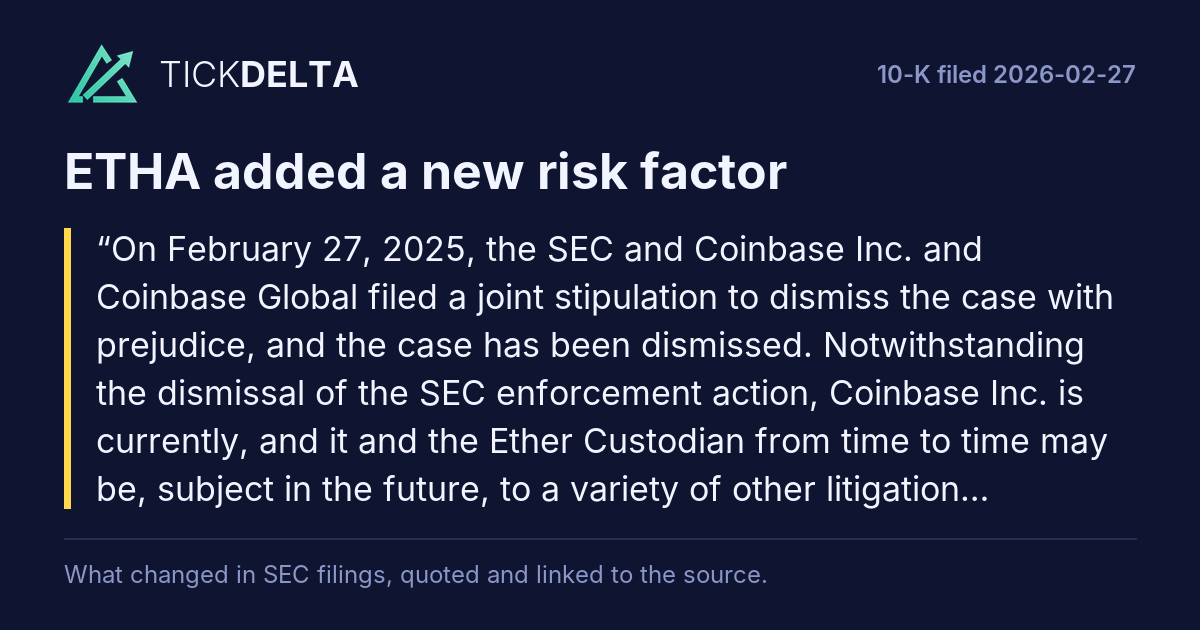
On February 27, 2025, the SEC and Coinbase Inc. and Coinbase Global filed a joint stipulation to dismiss the case with prejudice, and the case has been dismissed. Notwithstanding the dismissal of the SEC enforcement action, Coinbase Inc. is currently, and it and the Ether Custodian from time to time may be, subject in the future, to a variety of other litigation. Although the Trust does not presently anticipate such an outcome, there can be no assurance that in the future Coinbase Inc., as Prime Execution Agent, or Coinbase Custody, as the Ether Custodian, will not be required, as a result of a judicial determination, or will not choose, to restrict or curtail the services they offer, or their financial condition and ability to provide services to the Trust will not be negatively affected. If in the future the Prime Execution Agent or the Ether Custodian were to be required or choose to restrict or curtail the services they offer for any reason, whether related to litigation or otherwise, it could negatively affect the Trust’s ability to operate or process creations or redemptions of Baskets, which could force the Trust to liquidate or adversely affect the price of the Shares.
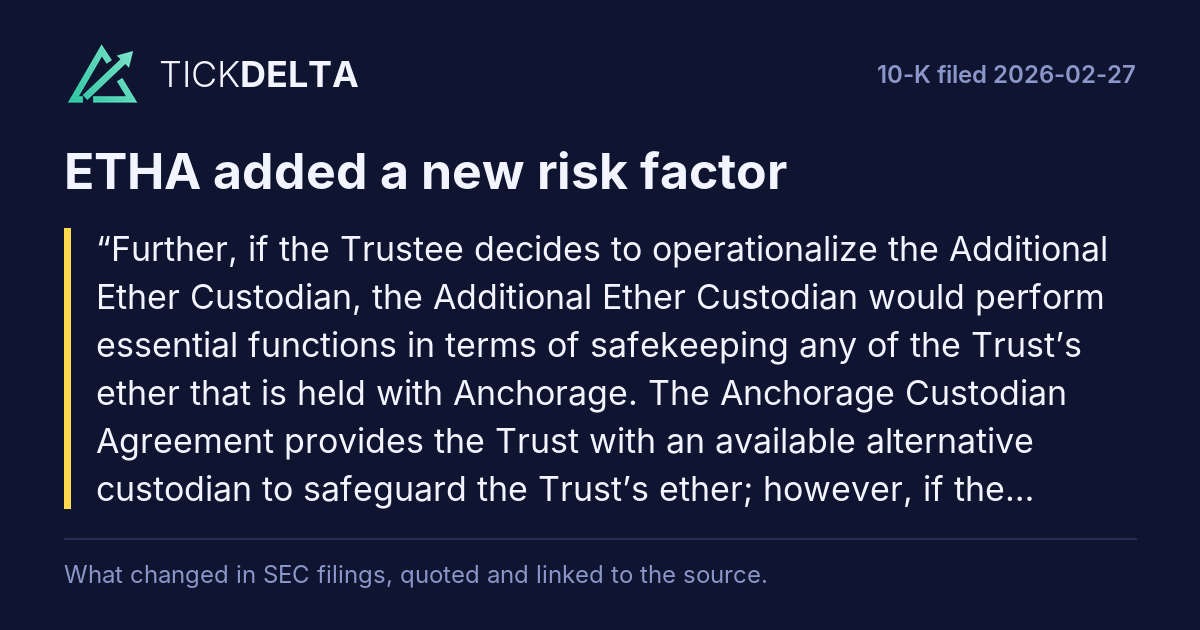
Further, if the Trustee decides to operationalize the Additional Ether Custodian, the Additional Ether Custodian would perform essential functions in terms of safekeeping any of the Trust’s ether that is held with Anchorage. The Anchorage Custodian Agreement provides the Trust with an available alternative custodian to safeguard the Trust’s ether; however, if the Trustee does not operationalize the Additional Ether Custodian, or if Anchorage fails to perform the functions of the Anchorage Custodian Agreement once operationalized, the Trust may be unable to operate or create or redeem Baskets, or may suffer losses, which could force the Trust to liquidate or adversely affect the price of the Shares. Anchorage could terminate services under the Anchorage Custodian Agreement upon providing the applicable notice to the Trust for any reason, or immediately for Cause. A “Termination for Cause” is defined in the Anchorage Custodian Agreement as: (i) the Trust materially breaches any provision of the Additional Ether Custodian Agreement, and such breach remains uncured for a period of 30 calendar days after notice of such breach is provided by Anchorage to the Trust; or (ii) the Trust becomes bankrupt or insolvent. If Anchorage were to terminate services under the Anchorage Custodian Agreement, the Trustee may need to find and appoint a replacement ether custodian.
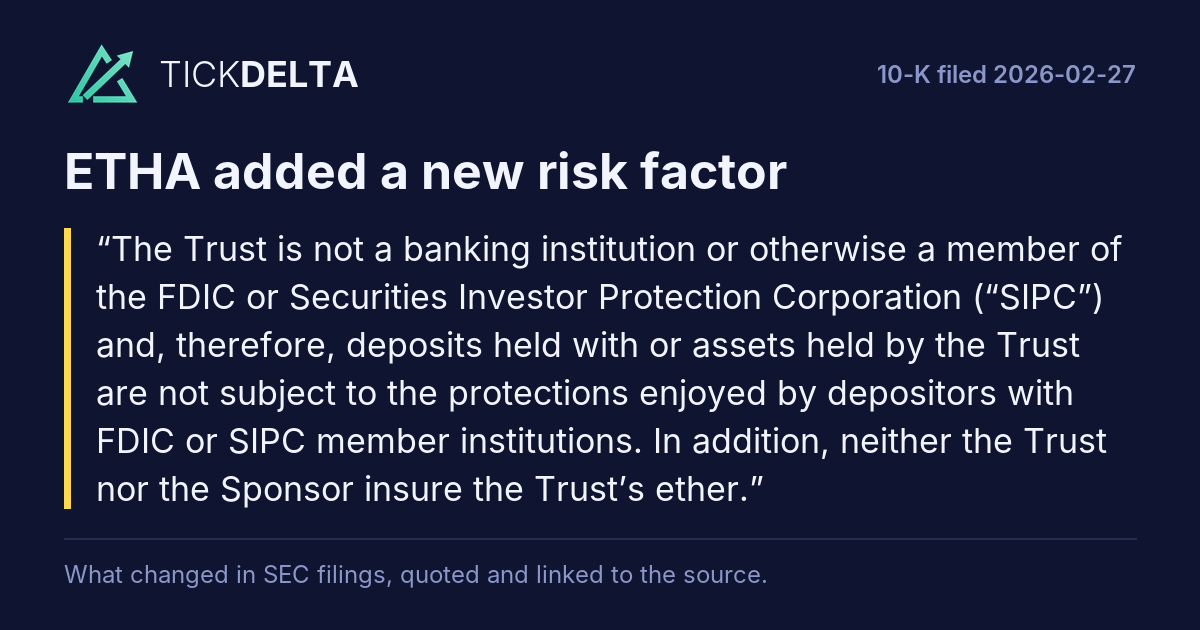
The Trust is not a banking institution or otherwise a member of the FDIC or Securities Investor Protection Corporation (“SIPC”) and, therefore, deposits held with or assets held by the Trust are not subject to the protections enjoyed by depositors with FDIC or SIPC member institutions. In addition, neither the Trust nor the Sponsor insure the Trust’s ether.
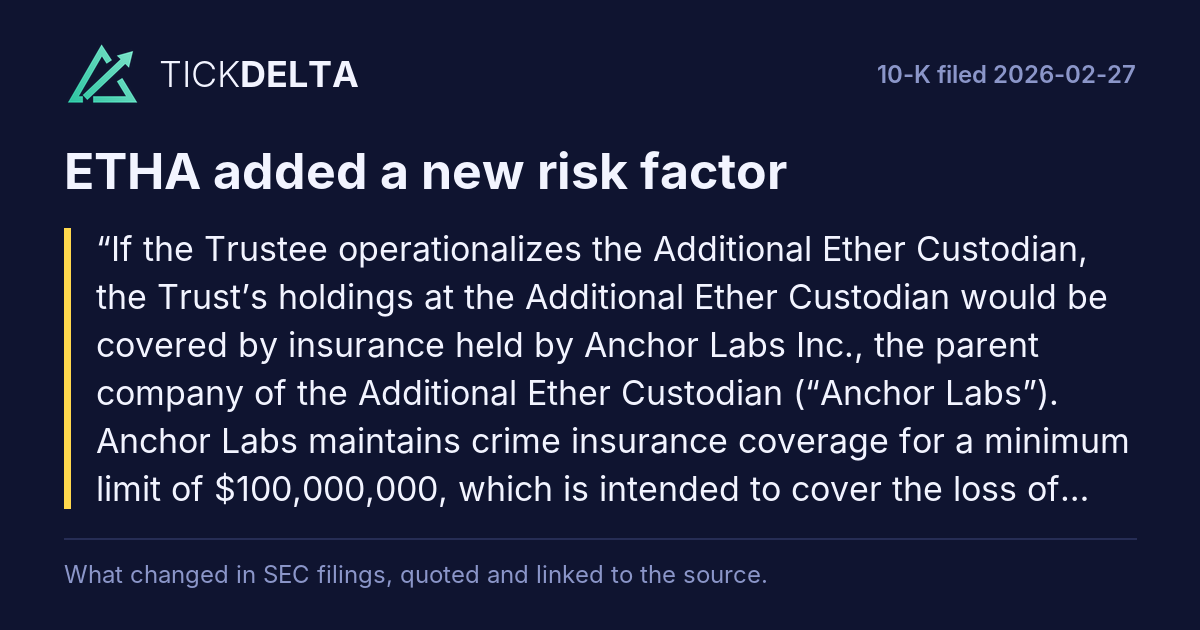
If the Trustee operationalizes the Additional Ether Custodian, the Trust’s holdings at the Additional Ether Custodian would be covered by insurance held by Anchor Labs Inc., the parent company of the Additional Ether Custodian (“Anchor Labs”). Anchor Labs maintains crime insurance coverage for a minimum limit of $100,000,000, which is intended to cover the loss of Trust assets held by the Additional Ether Custodian, including from dishonest or fraudulent acts committed by Anchor Labs and all of its subsidiaries, including the Additional Ether Custodian (collectively Anchor Labs and its subsidiaries are referred to as the “Anchor Labs Insureds”) employees, its agents and subcontractors; forgery and alteration; computer crime; wire transfer coverage; physical damage or theft of private key data; social engineering coverage; and security breaches or hacking. The insurance maintained by Anchor Labs may be shared among Anchor Labs Insureds’ other customers, is not necessarily exclusive to the Trust or to customers holding ether with the Additional Ether Custodian and may not be available or sufficient to protect the Trust from all possible losses or sources of losses. Alternatively, the Trust may be forced to share such insurance proceeds with other clients or customers of the Anchor Labs Insureds, which could reduce the amount of such proceeds that are available to the Trust. In addition, the digital asset insurance market is limited, and the level of insurance maintained by Anchor Labs may be substantially lower than the assets of the Trust. While the Additional Ether Custodian maintains certain capital reserve requirements depending on the assets under custody, and such capital reserves may provide additional means to cover client asset losses, the Trust cannot be assured that the Additional Ether Custodian will maintain capital reserves sufficient to cover actual or potential losses with respect to the Trust’s digital assets. The insurance program does not cover, insure or guarantee the performance of the Trust. The Additional Ether Custodian is neither FDIC-insured nor SIPC-insured.
With respect to the Anchorage Custodian Agreement, other than with respect to claims and losses arising from: (i) fraud or willful misconduct of the Additional Ether Custodian and (ii) the Anchorage Mutually Capped Liabilities (defined below), in no event will the Additional Ether Custodian’s liability exceed the value of the cash or affected ether giving rise to such liability. With respect to Anchorage Mutually Capped Liabilities, other than with respect to claims and losses arising from fraud or willful misconduct of the Additional Ether Custodian, in no event will the Additional Ether Custodian’s liability exceed the greater of $5 million and the aggregate amount of fees paid by client to the Additional Ether Custodian in the 12-month period prior to the event giving rise to such liability. “Anchorage Mutually Capped Liabilities” means (i) claims and losses arising from a party’s breach of its confidentiality obligations under the Anchorage Custodian Agreement, (ii) a party’s indemnity obligations under the Anchorage Custodian Agreement (except with respect to the full amount of any Trust ether lost, which shall not constitute an Anchorage Mutually Capped Liability), and (iii) claims and losses arising from the violation, misappropriation, or infringement by a party of any third party intellectual and/or industrial property rights, including patent rights, copyrights, moral rights, trademarks, trade names, service marks, trade secrets, rights in inventions (including applications for, and registrations, extensions, renewals, and re‑issuances of the foregoing).
With respect to claims and losses related to a withdrawal or transfer of ether, if the Trust has operationalized Anchorage, the value of such digital assets shall be determined by reference to the benchmark valuation on the date delivery of such ether in connection with such withdrawal or transfer is due in accordance with the terms of the Anchorage Custodian Agreement. In respect of any incidental, indirect, special, punitive, consequential or similar losses, the Additional Ether Custodian is not liable, even if the Additional Ether Custodian has been advised of or knew or should have known of the possibility thereof. The Additional Ether Custodian is not liable for delays, suspension of operations, failure in performance, or interruption of service to the extent it is directly due to a cause or condition beyond the reasonable control of the Additional Ether Custodian.
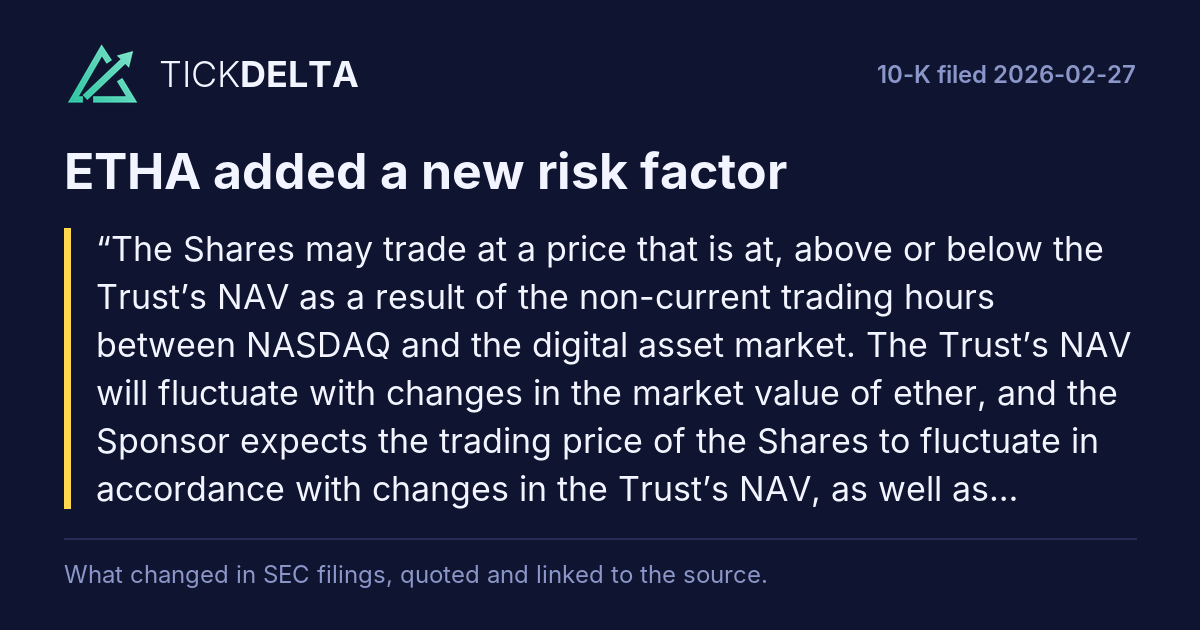
The Shares may trade at a price that is at, above or below the Trust’s NAV as a result of the non-current trading hours between NASDAQ and the digital asset market.
The Trust’s NAV will fluctuate with changes in the market value of ether, and the Sponsor expects the trading price of the Shares to fluctuate in accordance with changes in the Trust’s NAV, as well as market supply and demand. However, the Shares may trade on NASDAQ at a price that is at, above or below the Trust’s NAV for a variety of reasons. For example, NASDAQ is open for trading in the Shares for a limited period each day, but the digital asset market is a 24-hour marketplace. During periods when NASDAQ is closed but constituent trading platforms are open, significant changes in the price of ether on the digital asset market could result in a difference in performance between the value of ether as measured by the Index and the most recent NAV or closing trading price. For example, if the price of ether on the digital asset market, and the value ether as measured by the Index, move significantly in a negative direction after the close of NASDAQ, the trading price of the Shares may “gap” down to the full extent of such negative price shift when the Exchange reopens. If the price of ether on the digital asset market drops significantly during hours the NASDAQ is closed, Shareholders may not be able to sell their Shares until after the “gap” down has been fully realized, resulting in an inability to mitigate losses in a negative market. Even during periods when the NASDAQ is open, large constituent trading platforms (or a substantial number of smaller constituent trading platforms) may be lightly traded or closed for any number of reasons, which could increase trading spreads and widen any premium or discount on the Shares.
Paragraphs in the 10-Q filed Nov 6, 2026 that were not in the one before
New in the latest 10-Q
25 paragraphs in the 10-Q filed Nov 6, 2026 with nothing like them in the 10-Q filed Aug 6, 2026 (at least half the words must differ; new numbers alone do not count). Quoted exactly, grouped by the item heading above them. This is text that changed, not a judgement of how serious it is.
Financial statements and notes
(b) Share and per-Share amounts have been retroactively adjusted to reflect the one-for-three reverse split of the Shares effective October 6, 2026 (see Note 1).
Read in the 10-Q
(h) Per-Share amounts for all periods presented have been retroactively adjusted to reflect the Reverse Split (see Note 1).
Read in the 10-Q
(a) Share amounts for periods prior to October 6, 2026 have been retroactively adjusted to reflect the Reverse Split (see Note 1).
Read in the 10-Q
(a) Share amounts for periods prior to October 6, 2026 have been retroactively adjusted to reflect the Reverse Split (see Note 1).
Read in the 10-Q
On October 6, 2026, the Trust effected a one-for-three reverse split of the Shares (the “Reverse Split”), pursuant to which each three Shares outstanding as of the October 5, 2026 record date were combined into one Share. The Reverse Split proportionately decreased the number of Shares outstanding and increased the NAV, but did not change the aggregate value of the Trust’s assets. No fractional Shares were issued in connection with the Reverse Split; each Shareholder’s proportional fractional Share interest was redeemed, and the proceeds were paid in cash to the Shareholder’s brokerage account of record. The number of Shares outstanding and per-Share amounts disclosed for periods prior to October 6, 2026 have been retroactively adjusted to reflect the effects of the Reverse Split, as applicable.
Read in the 10-Q
Show the other 20
(a) Per-Share amounts for all periods presented have been retroactively adjusted to reflect the Reverse Split (see Note 1).
Read in the 10-Q
Risk Factors
In September 2026, Bitget, a digital asset platform, reported that a security breach resulted in unauthorized transfers of approximately $388 million in digital assets and the temporary suspension of withdrawals. According to reports from blockchain security firms, hacks and exploits across the digital asset industry resulted in approximately $768 million in reported gross losses during September 2026, some of which were subsequently recovered. According to the FBI, on October 29, 2026, unauthorized third parties transferred more than $6 billion in digital assets from wallets attributed to Binance, the largest digital asset trading platform by trading volume. Blockchain analytics firm TRM Labs characterized the incident as the largest theft of digital assets on record. A security incident involving a major trading platform may affect confidence in, and trading activity across, the broader ether and crypto markets, including on the Constituent Platforms. Because the Index is based on prices from a limited number of Constituent Platforms, any resulting disruption on those platforms could affect the Index price. To the extent that ether is compromised in a hack or is acquired by exchanging other stolen assets for ether, that ether cannot be frozen by an issuer, and any sale of that ether in the market could exert downward pressure on the price of ether or lead to the suspension of key ether markets, including decentralized finance protocols. Such incidents, particularly one of this scale, may undermine confidence in digital asset platforms, networks and markets, adversely affect liquidity and trading activity, lead to withdrawal suspensions or other disruptions at digital asset platforms, increase regulatory and enforcement scrutiny, affect the liquidity or value of ether held by the Trust, and contribute to volatility or declines in the price of ether and the value of the Shares.
Read in the 10-Q
Since 2020, a number of companies engaged in businesses outside the digital asset industry have begun to hold their corporate treasuries in digital assets instead of in fiat currency (“digital asset treasury companies”). In some cases, these companies have raised funds through financing or securities offerings and applied the proceeds to purchase digital assets, including ether.
Read in the 10-Q
Digital asset treasury companies are a relatively new phenomenon and it is difficult to predict their long-term sustainability, and therefore their impact to digital asset markets, and to the Trust. In 2026, certain digital asset treasury companies have experienced significant declines in their market valuations, which may limit their ability to raise additional financing to acquire digital assets, including ether, or increase pressure to sell their existing holdings. Digital asset treasury companies may increase procyclical dynamics in the market because they may purchase digital assets, such as ether, when prices are rising and they may in certain circumstances be forced to sell such assets when prices are decreasing, potentially causing downward pressure on ether prices in a falling market (causing prices to fall faster than they otherwise would). Digital asset treasury companies could cause greater volatility in digital asset markets, including markets for ether. Negative events or sentiment surrounding digital asset treasury companies could affect the market for ether. The increase of consolidated positions in ether held by digital asset treasury companies could affect the operation of the Ethereum blockchain. One digital asset treasury company, BitMine Immersion Technology Inc. (“BitMine Immersion”), held approximately 2.8% of
Read in the 10-Q
ether’s supply as of November 3, 2025. If BitMine Immersion or another similarly situated digital asset treasury company begins to operate validators, it could gain influence in how the Ethereum blockchain operates. The foregoing or similar events involving digital asset treasury companies could adversely affect holders of Shares in the Trust.
Read in the 10-Q
Tokenization of the Shares by unaffiliated third parties could adversely affect the liquidity and trading price of the Shares.
Read in the 10-Q
On September 17, 2026, the SEC issued temporary, conditional exemptive relief permitting certain Tokenized Securities Venues (“TSVs”) to facilitate trading in tokenized NMS stocks, including exchange-traded products such as the Shares. Under this relief, the Shares may be tokenized by an unaffiliated third party and made available for trading on a TSV without the Trust’s or Sponsor’s affirmative consent, provided that the TSV gives the Trust prior written notice and the Trust does not object within 30 calendar days after receiving such notice. The Trust may not receive the notice sent by a TSV or may choose not to object to one or more of such notices. The Trust may also consider whether it will tokenize the Shares using an on-chain transfer agent. On September 1, 2026, the SEC also proposed amendments to its rules governing registered transfer agents, including changes addressing tokenized securities recordkeeping and the processing and safeguarding of securities. The proposal has not been adopted, and any final rules could affect the manner in which tokenized Shares are recorded or transferred, potentially creating additional costs or operational risks for the intermediaries involved.
Read in the 10-Q
Unaffiliated third parties, including issuers and trading platforms located outside the United States, also offer tokens and other digital instruments that are designed to track the price of, or provide economic exposure to, U.S.-listed equity securities, including exchange-traded products, and such instruments may reference the Shares. These instruments are not issued, sponsored or endorsed by the Trust or the Sponsor, are not subject to the notice and objection process that applies to TSVs, are generally not offered to U.S. persons and may not be registered with, or subject to oversight by, the SEC. As a result, the Trust and the Sponsor may not be aware that such instruments exist. Depending on their structure, they may take the form of derivative contracts with, or debt securities issued by, the third party, and they may or may not be backed by Shares held by a third party’s custodian. Such instruments may not confer any rights to assets held by the Trust or the Sponsor, and a holder’s rights instead are tied to the third party’s assets, custody and recordkeeping arrangements or its creditworthiness and performance.
Read in the 10-Q
If tokenized Shares were made available for trading on a TSV, or tokens referencing the Shares were offered outside the TSV framework, the Trust and the Sponsor would not control the trading or pricing mechanisms of the relevant venue or issuer or the custody arrangements for such tokens. Trading on separate venues, including at times when NASDAQ is closed, could fragment liquidity or cause such tokens to trade at prices that significantly differ from the market price of the Shares on NASDAQ or the Trust’s NAV, potentially adversely affecting the liquidity or trading price of the Shares. In addition, investors may not understand how such tokens differ from the Shares, and any failure, mispricing, insolvency, security breach, regulatory action or other adverse development involving such tokens or the venues or issuers that offer them, or any confusion about their relationship to the Trust, could adversely affect the reputation of the Trust or the Sponsor or the price or demand for the Shares.
Read in the 10-Q
cold storage is generally considered a more secure means of safeguarding private keys, it does not eliminate the risk of theft or compromise, including through vulnerabilities in the hardware or software used to generate or safeguard private keys. For example, beginning in July 2026, attackers reportedly exploited a firmware vulnerability affecting certain Coldcard hardware wallets to derive private keys and steal approximately $116 million in bitcoin without physically accessing the affe...
Read in the 10-Q
result in unforeseen problems or issues, and such upgrades may fail, resulting in potentially irreparable damage to the Ethereum network and the value of ether.
Read in the 10-Q
which would adversely affect the value of the Shares. Moreover, normal operations and functionality of the Ethereum network may be negatively affected. Such losses of functionality could lead to the Ethereum network losing attractiveness to users, nodes, validators, or other stakeholders, thereby dampening demand for ether. Even if another digital asset other than ether were affected by similar circumstances, any reduction in confidence in the source code or cryptography underlying digita...
Read in the 10-Q
solve its scaling challenges or increase its throughput, may discourage such decentralized application and smart contract developers from using the Ethereum network as the foundational infrastructure layer for building their applications and smart contracts. If decentralized application and smart contract developers abandon the Ethereum blockchain for other blockchain or digital asset networks or protocols for whatever reason, the value of ether could be negatively affected.
Read in the 10-Q
interoperate effectively with any other individual Execution Client or any Consensus Client, the Ethereum network as a whole could suffer an unplanned fork, major disruption, catastrophic outage, system failure, loss of confidence or adoption among users or validators, or a variety of other problems. Any of these events could cause ether to decline in value, adversely affecting the price of Shares.
Read in the 10-Q
On August 18, 2026, the SEC proposed Regulation Crypto Assets, which would establish registration exemptions for certain investment contracts involving crypto assets and a conditional safe harbor addressing when a crypto asset ceases to be subject to an investment contract. The proposal has not been adopted, may be revised or withdrawn, and does not address exchange-traded products such as the Trust. The Sponsor cannot predict whether Regulation Crypto Assets will be adopted or how these or other regulatory developments could affect digital asset markets, the price of ether or the value of the Shares.
Read in the 10-Q
Notwithstanding the SEC’s current interpretation that ether is not itself a security, a court could reach a different conclusion under existing law, or future legislative or regulatory developments could result in ether being treated as a security under the federal securities laws. Any such determination or development could materially adversely affect the Trust and the value of the Shares.
Read in the 10-Q
court appeals, which has largely been viewed as positive in the digital assets market, there remains continued uncertainty as to the regulatory framework that will be applied by the SEC and courts to digital assets. Such uncertainty may remain until legislation providing a regulatory framework is adopted.
Read in the 10-Q
Moreover, other events, such as the interruption in telecommunications or internet services, cyber-related terrorist acts, civil disturbances, war or other catastrophes, could also negatively affect the digital asset economy in one or more jurisdictions. For example, Russia’s invasion of Ukraine on February 24, 2022 led to volatility in digital asset prices, with an initial steep decline followed by a sharp rebound in prices. The effect of any future regulatory change or other events on the Trust or ether is impossible to predict, and such change could be substantial and adverse to the Trust and the value of the Shares.
Read in the 10-Q
On October 5, 2026, the CFTC issued an advance notice of proposed rulemaking concerning Regulation Crypto Asset Transactions (“Regulation CTX”) and Regulation Crypto Asset Markets (“Regulation CAM”), seeking comment on potential rules governing certain retail crypto asset transactions and an optional federal registration framework for crypto asset trading venues. The CFTC has not proposed or adopted rules through this notice, and any subsequent rulemaking could affect the operation of digital asset trading platforms, trading activity or liquidity in ether markets, which could adversely affect the price of ether and the value of the Shares.
Read in the 10-Q
Other information
Pursuant to Section 219 of the Iran Threat Reduction and Syria Human Rights Act of 2012, which added Section 13(r) of the Exchange Act, the Trust hereby incorporates by reference herein Exhibit 99.1 of this report, which includes information provided by Malaysia Airports Holdings Berhad.
Read in the 10-Q
The 10-Q's risk factors against the 10-K
Item 1A of the 10-Q filed Nov 6, 2026 against Item 1A of the 10-K filed Feb 27, 2026.
A 10-Q repeats only the risks that changed, so a 10-K paragraph that is missing from it is not counted as removed.
Added is a paragraph with nothing like it in the 10-K, Reworded a sentence that is in both with several words changed,
Quiet changes a sentence in both where one to four words changed and one is a hedge or a modal
(cut words struck through, new words highlighted).
Text on the page, not a score; each links to the filing at sec.gov.
What the 10-Q itself says about its risk factors:Except as set forth below, there have been no material changes to the Risk Factors last reported under Part I, Item 1A of the registrant’s Annual Report on Form 10-K for the year ended December 31, 2025, filed with the Securities and Exchange Commission on February 27, 2026.
Read in the 10-Q
Show the other 21
The first 26 of 44 are shown (at most 12 of each type).
Phrases used for the first time
Two-word phrases in Risk Factors of the 10-K filed Feb 27, 2026 that are in none of the 1 earlier 10-Ks stored, back to Mar 5, 2025
Where each one is used
- asset treasury: In recent times, a number of companies engaged in businesses outside the digital asset industry have begun to hold their corporate treasuries in digital assets instead of in fiat currency (“digital asset treasury companies”). In some cases, these companies have raised funds through financing or securities offerings...
- anchor labs: If the Trustee operationalizes the Additional Ether Custodian, the Trust’s holdings at the Additional Ether Custodian would be covered by insurance held by Anchor Labs Inc., the parent company of the Additional Ether Custodian (“Anchor Labs”). Anchor Labs maintains crime insurance coverage for a minimum limit of...
- anchorage custodian: Further, if the Trustee decides to operationalize the Additional Ether Custodian, the Additional Ether Custodian would perform essential functions in terms of safekeeping any of the Trust’s ether that is held with Anchorage. The Anchorage Custodian Agreement provides the Trust with an available alternative...
- sponsor authorized: If regulators subject the Trust, the Trustee, the Sponsor, Authorized Participants or Ether Trading Counterparties to regulation as a money services business or money transmitter, this could result in extraordinary expenses to the Trust, the Trustee, the Sponsor or the Ether Trading Counterparties and also result...
- bitcoin reserve: On March 6, 2025, President Trump issued an executive order for the “Establishment of the Strategic Bitcoin Reserve and United States Digital Asset Stockpile” (the “Order”). The Order requires the Secretary of the U.S. Department of Treasury to establish two offices to administer and maintain a “Strategic Bitcoin...
- asset stockpile: On March 6, 2025, President Trump issued an executive order for the “Establishment of the Strategic Bitcoin Reserve and United States Digital Asset Stockpile” (the “Order”). The Order requires the Secretary of the U.S. Department of Treasury to establish two offices to administer and maintain a “Strategic Bitcoin...
- genius act: Additional risks such as operational failures (e.g., technical issues that prevent settlement), concerns regarding the adequacy or transparency of reserve assets backing stablecoins, the use of unbacked or undercollateralized stablecoins in potentially manipulative trading practices and regulatory scrutiny of...
- mining activities: If regulators or public utilities take actions that restrict or otherwise impact mining activities, such actions could result in decreased security of a digital asset network, including the Ethereum network, which could adversely affect the value of the Shares.
Used at least twice, small words left out. Counted, not picked: a phrase can be new because the company renamed something.
What was taken out
5 paragraphs of last year's Risk Factors with nothing like them now. The longest are quoted.
Sources
Item 1A of each 10-K and 10-Q on EDGAR, quoted exactly. Each paragraph links to the filing at sec.gov.
Also
10-K change: what was reworded or cut, section by section.
Work with it
Excel workbook · CSV. Google Sheet that stays up to date: paste =IMPORTDATA("https://tickdelta.com/company/ETHA/export.csv") into a cell.