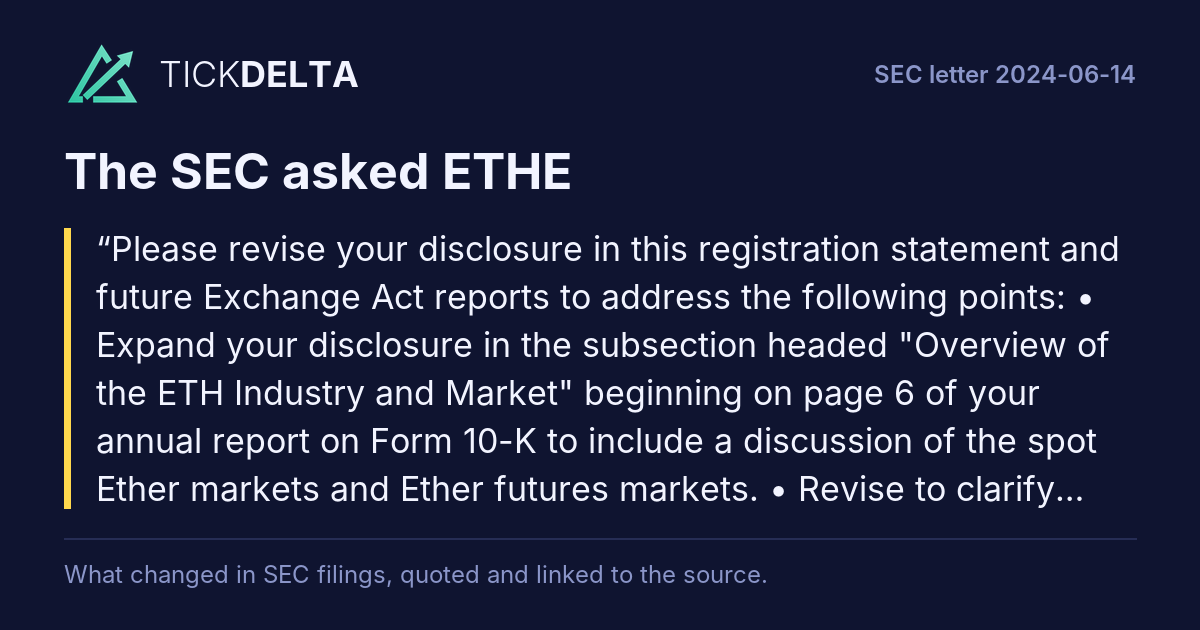
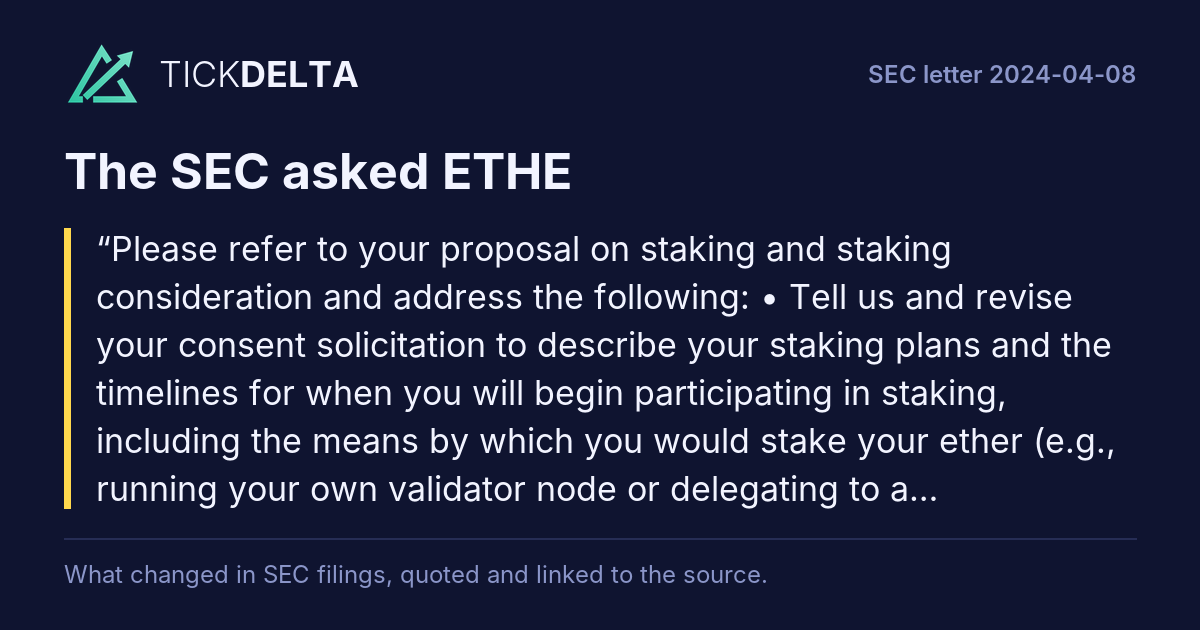
will begin participating in staking, including the means by which you would stake your ether (e.g., running your own validator node or delegating to a third-party).
The Sponsor advises the Staff that the overall goal of the Trust is to preserve the value of the Trust’s assets and provide investors with economic exposure that is as nearly as possible the same as the economic exposure the investor could have if it held the underlying Ether directly.
Rest of the answer
Given the ease with which direct holders of Ether may engage in staking, the Sponsor advises the
Staff that it believes a significant amount of the circulating supply of Ether is already being staked, and the Sponsor expects the proportion of staked Ether to continue to increase over time. In addition, the regular creation of new Ether as block rewards (all else being equal) creates inflationary pressure on the value of each existing Ether. The Sponsor believes that the combination of these two factors could effectively operate to reduce the relative value of Ether holdings which are not staked.
Accordingly, the Sponsor would seek to preserve the value of the Trust Estate for the benefit of the Shareholders via the
Trust’s entry into arrangements to stake a portion of the Trust’s Ether and receive staking rewards, provided that such arrangements are consistent with the continued qualification of the Trust as a grantor trust for U.S. federal income tax purposes.
All Shareholders would share in staking rewards received by the Trust in strict proportion to their ownership of Shares.
The Sponsor additionally advises the Staff that the Trust intends to stake only Ether tokens, and does not intend to stake any other digital assets.
The Sponsor describes its current staking plans for the Trust in more detail below.
Staking Arrangements and Provider-Facilitated Staking Model
If and when the Staking Condition is satisfied, the Sponsor anticipates that the Trust will enter into written arrangements (the “Staking
Arrangements”) with Coinbase Custody Trust Company, LLC (the “Custodian”) and one or more third party staking service providers (each, a “Staking Provider”), which may be affiliates of the Custodian or other trusted institutional validators, to stake the Trust’s Ether through a Staking Provider’s validator software and associated hardware designed to allow a holder of Ether to participate in the validation process on the Ethereum Network
(“Provider-Facilitated Staking”). The Sponsor anticipates that the Trust’s Ether will be staked exclusively by means of Provider-Facilitated Staking.
The Staking Provider will be the node operator and will be obligated to operate the validators through which the Trust’s Ether is staked to ensure that validation occurs. The Staking Provider would stake the Trust’s Ether directly from the Trust’s wallets administered by the Custodian and perform any related validation activities, and the Trust will retain control of its staked Ether, retaining the ability to un-stake its Ether from the applicable smart contract . The Trust’s Ether will therefore not be commingled with the Ether of any other Ether holder, either with respect to the particular wallet that controls it or the validator that utilizes it, including the Staking Provider or the Staking Provider’s other customers and would not be controllable by any entity other than the Trust even when staked. The Trust will not itself undertake any validation activities, and the Sponsor will not be required to perform any services. Moreover, the Sponsor will not be required to make any decisions or take any actions, other than
(i) selecting the Staking Providers and entering into the corresponding Staking Arrangements, and (ii) determining, from time to time, what portion of the Trust’s Ether tokens to stake and un-stake, and informing the Staking Providers of those determinations.
The Sponsor anticipates that it will instruct a Staking Provider to stake the substantial majority of the
Trust’s Ether at all times. The Trust’s Ether would be un-staked (or not staked in the first instance) only (i) as necessary to pay the Sponsor’s Fee, (ii) to pay any additional Trust expenses, (iii) to be able to satisfy existing and reasonably foreseen potential redemption requests (assuming the Trust is then permitted to operate an ongoing redemption program), (iv) to reduce the Ether obtained by the Trust as staking consideration to cash for distribution at regular intervals, (v) if the Sponsor determines that staking raises significant governmental, policy or regulatory concerns, (vi) if the Sponsor determines there exist vulnerabilities in the source code or cryptography underlying the Ethereum Network, (vii) if the Custodian or Staking Provider discontinues their arrangements with the Trust, (viii) if the Sponsor otherwise determines that continued staking of such portion of the Trust’s assets would be inconsistent with the Trust’s purpose of protecting and preserving the value of the Trust Estate, or (ix) in accordance with any other exception that is expressly contemplated by an opinion or ruling that satisfies the Staking
Condition. Ether received by the Trust in connection with the creation of new Shares, or as staking rewards, must also be staked upon receipt by the Trust, except as required to not be staked in the first instance pursuant to the exceptions described in clauses (i)-(ix) above. Moreover, any staked Ether which must be un-staked in order to fulfill a distribution in connection with a redemption (to the extent such distribution cannot be fulfilled utilizing the portion of the
Trust’s Ether that has not been staked) will be un-staked only after the redemption request is approved by the Trust, the Sponsor executes an un-stake or withdrawal transaction, and such transaction is processed by the Ethereum Network. The
Staking Provider will not be able to change the address on the Ethereum Network to which staked Ether is to be withdrawn or to which Ether rewards shall be sent.
Under the Staking Arrangements, any staking rewards and/or transaction fees earned will be paid automatically on a periodic basis by the
Ethereum Network to one or more designated wallet addresses in the Trust’s custodial account, as specified by the Sponsor on behalf of the Trust. Periodically, the Trust will either (i) distribute Ether received as staking consideration to the Trust’s beneficiaries (likely using a liquidating agent), (ii) sell that Ether for cash and distribute the proceeds to the Trust’s beneficiaries, (iii) retain the Ether in the Trust or (iv) a combination of the foregoing. Subject to any slashing risk, the Trust (through the Custodian) will maintain control and remain the record and beneficial owner of the staked tokens at all times, and the tokens will remain associated with the Trust’s wallet.
The Staking Arrangements are expected to generally be on market terms, consistent with those typically offered by leading digital asset firms that offer staking functionality. However, the Trust will negotiate certain provisions as necessary or helpful to preserve the Trust’s status as a grantor trust and the security of the Trust’s Ether, as well as to address governmental, policy or regulatory concerns. For example, unlike certain digital asset firms that offer staking functionality through which a customer’s Ether is pooled with that of other customers (including, potentially, the Staking Provider in its general staking offerings), the Staking Arrangements would not permit the Trust’s Ether to be pooled with that of other Ether holders, including the Staking Provider or the Staking Provider’s other customers, as described above. In addition, the
Staking Provider’s compensation is expected to be an agreed percentage of block rewards and transaction fees generated by the validating activities, unlike certain alternative staking arrangements under which a staking provider may be compensated as an agreed percentage of Ether staked.
The Trust will have no right to direct the Staking Provider in the conduct of validation activities, except to stake, un-stake and withdraw its staked Ether, and will not bear any expenses incurred by the Staking Provider in conducting those activities. In particular, the amount of any staking consideration that the Trust receives will not be determined with reference to any expenses incurred by the Custodian or the Staking Provider. The Staking Arrangements will not include any obligation of the Trust to continue staking its Ether, or for the Custodian or the Staking Provider to continue the Staking Arrangements, other than to the extent the Trust’s Ether cannot immediately be un-staked due to requirements of the Ethereum protocol. There may also be instances where the Staking Provider may pause or terminate its staking activities due to its own independent assessment of the vulnerabilities of the Ethereum Network which would result in the Trust’s Ether not being staked for a period of time. The Sponsor anticipates that the Ethereum protocol and the
Staking Arrangements will permit withdrawal of staked Ether at regular intervals. The Sponsor believes that market practice for Provider-Facilitated Staking arrangements has largely become standardized, with little variation in terms, and therefore, the Sponsor anticipates that the Staking Arrangements will generally align with the current practice of Staking Providers’ arrangements with other similarly situated third parties, subject to the negotiation of certain bespoke terms outlined above. Accordingly, and because transitioning to a new Staking Provider would involve friction costs, the Sponsor does not expect the Trust to change Staking Providers frequently, if at all. In addition, while the Trust may enter into Staking
Arrangements with multiple Staking Providers, the Sponsor anticipates that any such arrangements would be substantively identical in all material respects to the Staking Arrangements described herein and in the Amended Preliminary Proxy Statement, including, for the avoidance of doubt, the bespoke terms of the Staking Arrangements outlined above. Any material deviation from the Staking Arrangements as described herein would be disclosed in the Trust’s subsequent filings with the
Commission.
The Staking Arrangements will not involve a disposition of the Trust’s Ether unless the Staking Provider commits a slash-worthy offense. Slashing would only occur if the Staking Provider fails to act timely and accurately in validating new transactions or takes other proscribed actions, and the occurrence of such events is exceedingly rare. In light of the mechanical and standardized nature of validation activities, the Sponsor does not anticipate that the Staking Provider, which is expected to be an institution of recognized and trusted standing in the digital asset marketplace, with whom the Sponsor has had extensive prior interaction, will commit any slash-worthy offenses in the conduct of the Provider-Facilitated Staking activities. While the Trust generally bears the risk of slashing if the Staking Provider were to commit a slash-worthy offense while the Trust’s Ether is staked, the Trust expects that the Staking Arrangements will include contractual commitments from the Staking Provider to the effect that, if any of the Trust’s Ether is slashed, the Staking Provider will
(i) provide prompt notice to the Sponsor and (ii) deliver replacement Ether to the Sponsor up to a cap (the “indemnity cap”). The Sponsor will have the right to direct the Staking Provider to cease staking the Trust’s Ether at any time, subject to the extent the Trust’s Ether cannot immediately be un-staked due to technical considerations, and the Sponsor expects that notice of any slashing event will be timely and permit the Sponsor to halt the staking of the
Trust’s Ether before the indemnity cap is reached, thereby mitigating the risk of permanent loss of the Trust’s Ether without replacement.
Security and Controls
The Trust’s Custodian has multiple layers of security protocols designed to protect the Trust’s assets from unauthorized access or transfer, which will remain in place when the Trust’s Ether is staked.
The Trust’s Ether will be staked directly from the Trust’s wallets and will not be transferred to any other wallet to be staked. The smart contract that governs staking on the Ethereum Network (a) mandates that the executor of the staking transaction (i.e., the Sponsor on behalf of the Trust) can execute the withdraw function at any time through the Trust’s wallets administered by the Custodian and (b) limits the activities of the Staking Provider to executing only those activities specified by the smart contract, such as staking, un-staking and performing validation activities. Accordingly, the Staking Provider will not have any control over the Trust’s staked Ether other than to stake or un-stake Ether at the direction of the Sponsor. In particular, the Staking Provider will not be authorized to leverage or rehypothecate the Trust’s Ether tokens. The Staking Provider will also not be able to change the designated wallet addresses on the Ethereum Network to which staked Ether is to be withdrawn or to which Ether rewards shall be sent.
In addition, the proposed Staking Arrangements will not alter the Trust’s current custody environment or security procedures.
The Sponsor expects that the Staking Arrangements will serve as an addendum to the Custodial Services Agreement between the Trust and the Custodian, and the controls currently in place between the Sponsor and the Custodian will also govern the activities related to staking and un-staking Ether, as outlined in the Staking Arrangements. These controls and procedures include:
Private Key Management (“Shards”): The Custodian manages Ether for the Trust using offline storage, or cold storage, which means that the keys to the Trust’s Ether are disconnected and/or deleted entirely from the internet. Transfers from the Trust’s wallet require compliance with certain security procedures that will remain in place when the Trust’s Ether is staked, including but not limited to, multiple encrypted private key “shards,” usernames, passwords and 2-step verification. Multiple private key shards held by the Custodian must be combined to reconstitute the private key to sign any transaction and transfer the Trust’s assets. Private key shards are distributed geographically in secure vaults around the world, including in the United States. The Custodian’s system architecture requires the involvement of the Sponsor to reconstruct the private keys and access the Trust’s assets, and it is not possible for the Custodian’s employees to access the Trust’s assets without the Sponsor’s involvement and approval. This architecture is part of the Custodian’s service organizational controls (“SOC”) Type I and Type II reports, which are authored by leading assurance providers to confirm to the Custodian’s clients that the Custodian is compliant with a variety of security and reporting standards, and which are delivered to the Sponsor for review on an annual basis.
General Controls on the Custodian’s Custody Environment: Data related to transaction activity executed on the Custodian’s platform is backed-up and saved to both an alternative location (besides the primary location) and to a “Disaster Recovery” Amazon Web Services (“AWS”) Account to enable recoverability in an event one of the regions becomes unavailable. Authentication requirements for the Custodian’s platform are restricted through two-factor authentication and encrypted network protocols, among others.
User Entity Controls: In addition to security controls in place at the Custodian, the Sponsor expects to implement additional controls and procedures, including, but not limited to, (i) reviewing the Custodian’s SOC report to ensure private key management and other general controls are consistently applied and operating without exceptions,
(ii) periodically reviewing Sponsor team members’ access to the custodial wallet environment to ensure appropriateness, and (iii) reviewing the Custodian’s third party management control.
The Sponsor also reviews the SOC report for one of the key sub-service providers, AWS, including specifically sections related to availability, security and confidentiality. Under its third party risk management framework, the Sponsor also performs other ongoing monitoring of the Custodian, including the completion of an assessment of the Custodian’s cybersecurity controls. In addition, the Sponsor expects to screen all eligible Staking Providers in a manner consistent with its practices in screening eligible custodians, including, but not limited to, by (i) conducting initial and, thereafter, annual reviews of the Staking Provider’s SOC report to assess controls relevant to the staking services environment, (ii) conducting initial and, thereafter, annual reviews of the SOC reports of the Staking
Provider’s cloud-based infrastructure service provider (for example, AWS) covering availability, security and confidentiality principles to ensure necessary controls governing continued service and “uptime” (i.e., the ratio of signatures provided by the Staking Provider to the total number of signatures it should have provided during a given time period), (iii) reviewing authority levels and access rights within the Staking Provider’s staking services environment, and (iv) performing other ongoing diligence procedures, including periodic assessments of the Staking Provider’s cybersecurity policies and controls, monitoring the Staking Provider’s online environment for major security events and periodic discussions with the Staking Provider’s client-facing teams regarding new company initiatives.
Anticipated
Timeline
As discussed in response to Bullet 4 below, the Sponsor advises the Staff that it intends to engage in staking as soon as certain conditions relating to the qualification of the Trust as a grantor trust for U.S. federal income tax purposes and certain related requirements are met, and following the filing of the Trust’s Definitive Proxy Statement on Schedule 14A and solicitation of requisite shareholder consents thereunder.
The Sponsor has revised pages 10-12 of the Amended Preliminary Proxy
Statement to provide a summary of the description above in response to the Staff’s comment. The Sponsor advises the Staff that it will, as necessary to supplement the disclosure herein and in our Amended Preliminary Proxy Statement, describe in all material respects the manner in which it expects to implement the Trust’s staking program in subsequent filings with the Commission in connection with, and prior to, the commencement of any staking program.
The Sponsor has revised pages 13-15 of the Amended Preliminary Proxy Statement in response to the Staff’s comment.
requirements” that must be satisfied in order for the Trust to engage in staking and how the Trust will ensure that there is sufficient certainty that those conditions and requirements can be met.
The Sponsor advises the Staff that the term “certain conditions” is meant to describe such conditions relating to the qualification of the Trust as a grantor trust for U.S. federal income tax purposes, which per the terms of the proposed amendments to the Trust Agreement, must be satisfied prior to the Sponsor being permitted to cause the Trust to engage in staking. In particular, the proposed amendments to the Trust Agreement specify that the Trust will engage in any form of staking only if (and, then, only to the extent that) the Staking Condition has been satisfied with respect thereto. “Staking
Condition” is defined in the Trust Agreement as, with respect to a particular form of Staking, the condition that (i) engaging in such form of Staking will not cause the Trust to be treated as other than a grantor trust for U.S. federal income tax purposes and (ii) the Trust shall have received (x) a written opinion from an independent law firm that is recognized as being expert in tax matters or (y) a binding ruling issued by the U.S. Internal Revenue Service
(“Tax Ruling”), in each case, to that effect.
The Sponsor advises the Staff that the term “certain requirements” refers to any additional requirements that may arise in connection with the satisfaction of such Staking Condition. The Sponsor anticipates that a written opinion or Tax Ruling in satisfaction of the Staking Condition may impose certain additional related requirements for compliance, which cannot be fully known by the Sponsor at this time, and would be described in all material respects in the Trust’s subsequent filings with the Commission in connection with, and prior to, the commencement of any staking program.
The Sponsor advises the Staff that the Sponsor does not intend to cause the Trust to engage in Staking prior to satisfaction of the above-mentioned “certain conditions” and “certain requirements,” and will not proceed to cause the Trust to engage in staking based solely on an anticipation or expectation that those conditions and requirements can or will be met in the future.
The Sponsor has revised pages 3, 6, 9, 10 and 12 of the Amended Preliminary Proxy
Statement, to describe the conditions and requirements that must be satisfied in order for the Trust to engage in staking, in response to the Staff’s comment.
a spot ether exchange-traded product and the reference in your proposal to maintaining parity with any similarly situated investment products that provide for the staking of ether, advise whether you plan to wait until that conversion is completed
The Sponsor acknowledges the Staff’s comment and submits that, to the extent the above-mentioned “certain conditions” and “certain requirements” have been satisfied prior to the approval of NYSE Arca’s pending listing standard application under Rule 19b-4 to convert the
Trust to a spot Ether exchange-traded product (“ETP”), the Trust may engage in staking prior to the effectiveness of such application. As discussed in response to Bullet 1 above, in order to preserve the assets of the Trust and provide investors with economic exposure that is as nearly as possible the same as the economic exposure the investor could have if it held the underlying Ether directly, the Sponsor intends to commence the Trust’s staking program as soon as such conditions and requirements are met, and does not intend to wait until its proposed ETP uplisting has been completed and Shares of the Trust are trading on NYSE Arca to begin staking.
In particular, the Sponsor notes that other Ether investment vehicles in the marketplace already engage in staking activities, although no spot Ether ETPs have yet been approved. The Sponsor anticipates that the number of investment products in the marketplace engaging in staking activities will continue to increase, and believes that if the Trust can do so in a manner that satisfies the Staking Condition, then it would be in the best interest of Shareholders for the Trust to engage in staking activities to maintain parity with such investment products in order to preserve the value of the Trust Estate for the ultimate benefit of Shareholders, notwithstanding the status of the pending listing standard application under Rule 19b-4.
Therefore, to the extent the certain conditions relating to the qualification of the Trust as a grantor trust for U.S. federal income tax purposes and certain related requirements are met, and following the filing of the Trust’s Definitive Proxy Statement on Schedule 14A and solicitation of requisite shareholder consents thereunder, prior to approval of NYSE Arca’s pending listing standard application under Rule 19b-4, the Sponsor intends to cause the Trust to begin engaging in staking activities.
* * *
In connection with its response to the
Staff’s comments, the Sponsor acknowledges that the Sponsor and its management are responsible for the accuracy and adequacy of its disclosures, notwithstanding any review, comments, action or absence of action by the Staff.