Grayscale Ethereum Staking ETF ETHE
New risk paragraphs, branching off last year
Each branch is a paragraph in Risk Factors with nothing like it in the 10-K filed Feb 28, 2025. A box jumps to the paragraph as filed, below.
Paragraphs with nothing like them in last year's 10-K
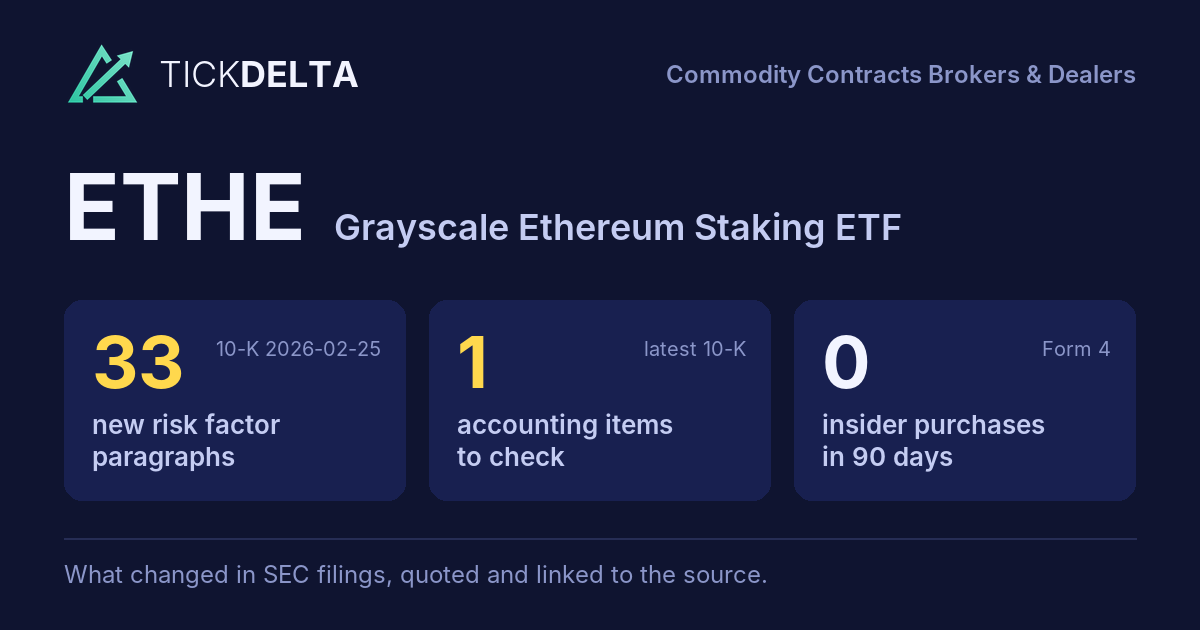
33 paragraphs in Risk Factors of the 10-K filed Feb 25, 2026 with nothing like them in the 10-K filed Feb 28, 2025. Quoted exactly. Paragraphs that were only edited are under 10-K change.
Furthermore, changes in U.S. political leadership and economic policies may create uncertainty that materially affects the price of Ether and the Trust’s Shares. For example, on March 6, 2025, President Trump signed an Executive Order to establish a Strategic Bitcoin Reserve and a United States Digital Asset Stockpile. Pursuant to this Executive Order, the Strategic Bitcoin Reserve will be capitalized with Bitcoin owned by the U.S. Department of the Treasury that was forfeited as part of criminal or civil asset forfeiture proceedings, and the Secretaries of Treasury and Commerce are authorized to develop budget-neutral strategies for acquiring additional Bitcoin, provided that those strategies impose no incremental costs on American taxpayers. Conversely, the Digital Asset Stockpile will consist of all digital assets other than Bitcoin owned by the U.S. Department of the Treasury that were forfeited in criminal or civil asset forfeiture proceedings, but the U.S. government will not acquire additional assets for the U.S. Digital Asset Stockpile beyond those obtained through such proceedings. The anticipation of a U.S. government-funded strategic cryptocurrency reserve had motivated large-scale purchases of Bitcoin in the expectation of the U.S. government acquiring such assets to fund such reserve, and the market price of Bitcoin decreased significantly as a result of the ultimate content of the Executive Order. Any similar action or omission by the U.S. federal administration or other government authorities with respect to Ether or other digital assets may negatively and significantly impact the price of Ether and the Trust’s Shares.
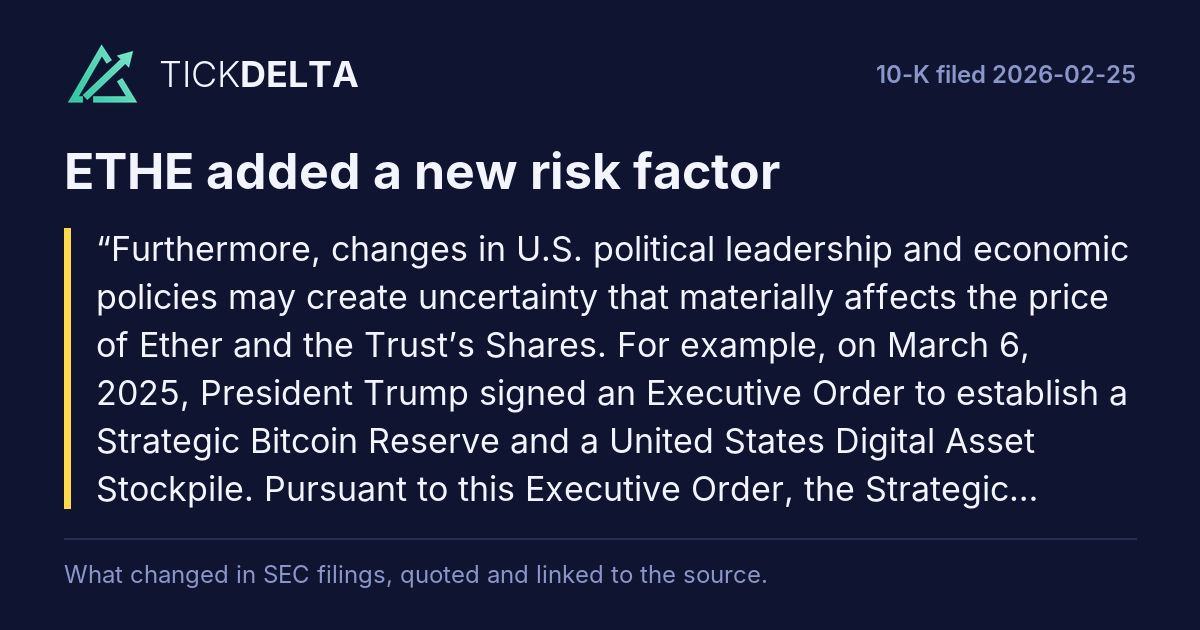
the Ethereum Network to be less attractive to users and application developers than competing blockchain networks, which could cause the price of Ether to decrease.
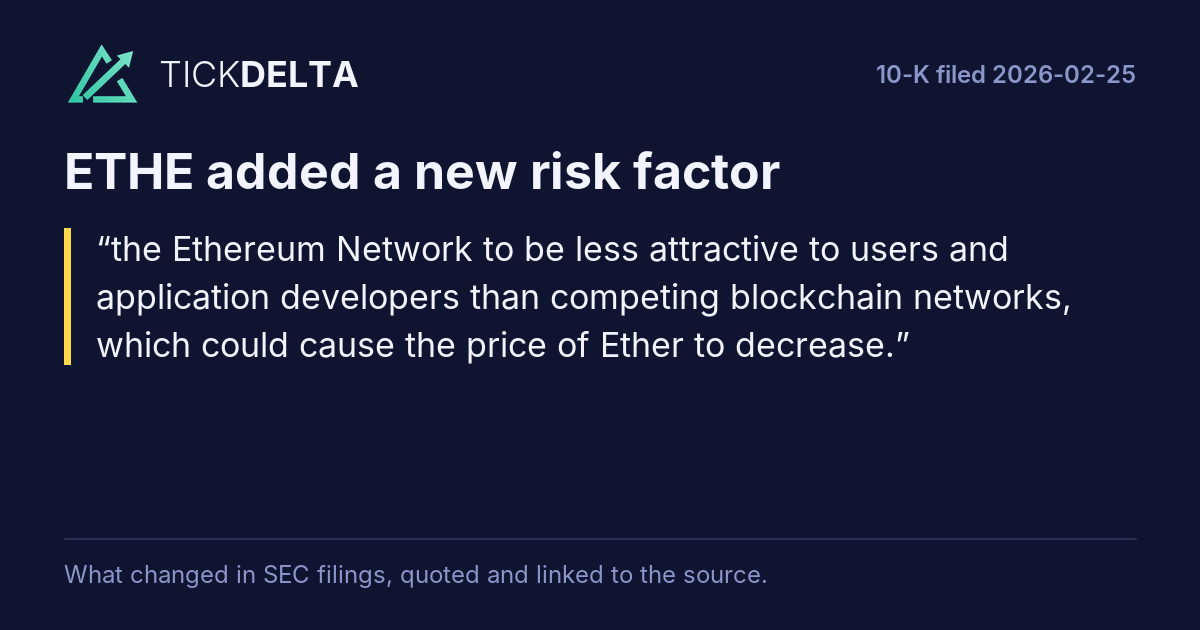
counterparty. The Authorized Participant is a registered broker-dealer and therefore subject to AML and countering the financing of terrorism obligations under the Bank Secrecy Act as administered by FinCEN and further overseen by the SEC and FINRA.
On January 17, 2025, DCG agreed to entry of a cease-and-desist order and payment of a $38 million civil money penalty arising out of the SEC’s allegations that (i) DCG negligently engaged in conduct that misled investors about the impact of the default on Genesis Capital’s financial condition and (ii) DCG’s failure to exercise reasonable care in connection with certain statements concerning Genesis Capital’s financial condition created a materially false impression to the public regarding Genesis Capital’s financial health.
Congestion or delay on the Ethereum Network may delay purchases or sales of Ether by the Trust.
Increased transaction volume could result in delays in the recording of transactions on the Ethereum Network. Moreover, unforeseen system failures, disruptions in operations, or poor connectivity may also result in delays in the recording of transactions on the Blockchain. Any delay in the Blockchain could affect an Authorized Participant’s ability to buy or sell Ether at an advantageous price resulting in decreased confidence in the Blockchain. Over the longer term, delays in confirming transactions could reduce the attractiveness to merchants and other commercial parties as a means of payment. As a result, the Ethereum Network and the value of the Trust would be adversely affected.
Show the other 14
Central banks in various countries have introduced digital forms of legal tender (“CBDCs”). China’s CBDC project, known as Digital Currency Electronic Payment, has reportedly been tested in a live pilot program conducted in multiple cities in China. Central banks representing at least 130 countries have published retail or wholesale CBDC work ranging from research to pilot projects. Whether or not they incorporate blockchain or similar technology, CBDCs, as legal tender in the issuing jurisdiction, could have an advantage in competing with, or replace, Ether and other cryptocurrencies as a medium of exchange or store of value. Central banks and other governmental entities have also announced cooperative initiatives and consortia with private sector entities, with the goal of leveraging blockchain and other technology to reduce friction in cross-border and interbank payments and settlement, and commercial banks and other financial institutions have also recently announced a number of initiatives of their own to incorporate new technologies, including blockchain and similar technologies, into their payments and settlement activities, which could compete with, or reduce the demand for, Ether. As a result of any of the foregoing factors, the price of Ether could decrease, which could adversely affect an investment in the Trust.
Further, because a significant portion of transaction activity and gas usage on the Ethereum Network is associated with stablecoin transfers and stablecoin-based decentralized finance applications, disruptions or failures affecting major stablecoins could diminish network activity and adversely affect the price of Ether. Moreover, stablecoin issuers may also exert significant or disproportionate influence in the event of a fork of the Ethereum Network because stablecoins are widely used as collateral and settlement assets in DeFi and other on-chain transactions. If a stablecoin issuer supports only one forked network, the stablecoins on the unsupported network may become worthless or illiquid, which could materially affect the viability of that fork and negatively impact the price of Ether and the value of the Shares. In addition, recent federal legislation establishing a regulatory framework for fully reserved payment stablecoins, such as the GENIUS Act, may increase the adoption of regulated stablecoins as digital payment instruments. While this could increase overall transactional activity on the Ethereum Network, greater reliance on stablecoins for payments may reduce the use of Ether itself as a medium of exchange and for certain on-chain transactions, which could adversely affect demand for Ether and therefore the value of the Shares.
June 2025, however, the SEC formally withdrew that proposed rulemaking and stated that it does not intend to issue final rules based on the proposal. However, there can be no assurance that the Custodian would continue to qualify as a “qualified custodian” under a final rule that may be proposed or adopted by the SEC in the future.
Although the Trust is permitted to engage in Staking as of the date hereof, the Trust is only permitted to engage in Staking to the extent that the Staking Condition is satisfied with respect thereto. There can be no assurance that the Trust will be permitted to engage in any different form of Staking in the future. The Trust Agreement provides that the Trust may engage in Staking, but only if (and, then, only to the extent that) the Staking Condition has been satisfied.
Shareholders that are not Authorized Participants may only purchase or sell their Shares in secondary trading markets, and the conditions associated with trading in secondary markets may adversely affect investors’ investment in the Shares.
Only Authorized Participants may purchase or redeem Baskets. All other investors that desire to purchase or sell Shares must do so through NYSE Arca or in other markets, if any, in which the Shares may be traded. Shares may trade at a premium or discount to the NAV per Share.
On January 23, 2025, President Trump issued an executive order titled “Strengthening American Leadership in Digital Financial Technology” aimed at supporting “the responsible growth and use of digital assets, blockchain technology, and related technologies across all sectors of the economy.” The Executive Order also established an interagency working group that is tasked with “proposing a Federal regulatory framework governing the issuance and operation of digital assets” in the United States. Pursuant to this Executive Order, the working group released a report in July 2025 outlining the administration's recommendations to Congress and various agencies reflecting the administration’s “pro-innovation mindset toward digital assets and blockchain technologies.” In particular, the report recommends that Congress enact legislation regarding self custody of digital assets, clarifying the applicability of Bank Secrecy Act obligations with respect to digital asset service providers, granting the CFTC authority to regulate spot markets in non-security digital assets, prohibiting the adoption of a CBDC, and clarifying tax laws as relevant to digital assets. In addition, the report recommends that agencies reevaluate existing guidance on digital asset activities, use existing authorities to enable the trading of digital assets at the federal level, embrace DeFi, launch or relaunch crypto innovation efforts, and promote U.S. private sector leadership in the responsible development of cross-border payments and financial markets technologies, among others.
In particular, the Staking Condition has been satisfied as to the particular form of Staking described herein, and the Sponsor intends to continue to take the position that the Trust is properly treated as a grantor trust for U.S. federal income tax purposes and that any Staking activity undertaken by the Trust in compliance with the opinion, ruling or other guidance relied upon to satisfy the Staking Condition will not prevent the Trust from continuing to qualify as a grantor trust for such purposes. The IRS recently issued a revenue procedure providing a staking safe harbor for certain grantor trust vehicles whose beneficial interests are listed and traded on a national securities exchange (the “2025 Revenue Procedure”), but certain aspects of the 2025 Revenue Procedure are unclear, and therefore the Trust may not currently satisfy all conditions of the safe harbor. Accordingly, due to the uncertainty regarding the ability of a grantor trust to engage in Staking activities, there can be no assurance that the Internal Revenue Service (“IRS”) or any court would agree with this position (or with any opinion of counsel delivered to the Sponsor in support thereof). Therefore, the Trust might cease to qualify as a grantor trust for U.S. federal income tax purposes.
Guidance and the 2025 Revenue Procedure do not address other significant aspects of the U.S. federal income tax treatment of digital assets. For example, for a non-U.S. Holder (as defined below), there currently is no guidance directly addressing whether or in what circumstances engaging in certain activities to generate yield on digital assets, including Staking, could give rise to income that is effectively connected with a trade or business in the United States. Similarly, for a U.S. tax-exempt shareholder, there currently is no guidance directly addressing whether or in what circumstances such activities could give rise to UBTI. Moreover, although the Ruling & FAQs address the treatment of hard forks, there continues to be uncertainty with respect to the timing and amount of the income inclusions. While the Ruling & FAQs do not address most situations in which airdrops occur, it is clear from the reasoning of the Ruling & FAQs that the IRS generally would treat an airdrop as a taxable event giving rise to ordinary income.
Because Ether is a new technological innovation, the tax treatment of Ether for state and local tax purposes, including, without limitation state and local income and sales and use taxes, is not settled. It is uncertain what guidance, if any, on the treatment of Ether for state and local tax purposes may be issued in the future. A state or local government authority’s treatment of Ether may have negative consequences, including the imposition of a greater tax burden on investors in Ether or the imposition of a greater cost on the acquisition and disposition of Ether generally. Any such treatment may have a negative effect on prices of Ether and may adversely affect the value of the Shares.
In addition, the Trust may enter into Staking Arrangements with Staking Providers organized in, or that have operations in, a non-U.S. jurisdiction. Non-U.S. jurisdictions may seek to impose withholding tax on Staking Consideration received by the Trust as staking rewards, which may negatively affect a shareholder’s investment in the Trust.”
•On March 2, 2022, the board of directors of the Sponsor (the “Board”) approved the purchase by DCG, the indirect parent company of the Sponsor, of up to an aggregate total of $200 million worth of Shares of the Trust and shares of any of
•While the Index Provider does not currently utilize data from over-the-counter markets or derivatives platforms, it may decide to include pricing from such markets or platforms in the future;
•The Sponsor may appoint an agent to act on behalf of the shareholders, and such agent may be the Sponsor or an affiliate of the Sponsor; and
Although the Trust is permitted to engage in Staking, the Trust is only permitted to engage in Staking to the extent that the Staking Condition is satisfied with respect thereto. There can be no assurance that the Trust will be permitted to engage in any different form of Staking in the future. The Trust Agreement provides that the Trust may engage in Staking, but only if (and, then, only to the extent that) the Staking Condition has been satisfied.
There can be no guarantee that these penalties and resulting losses will not occur as a result of the activities of a Staking Provider. Furthermore, a Staking Provider’s liability to the Trust is expected to be limited, and a Staking Provider may lack the assets or insurance in order to support the recovery of any losses incurred. While the Staking Arrangements may provide for indemnification up to a specified cap, insurance or other reimbursement programs, there can be no guarantee that the Trust would recover any of its staked assets, or the value thereof, if it is subject to penalties imposed by the Ethereum Network.
Staked Ether will be inaccessible for a variable period of time, determined by a range of factors, which could result in certain liquidity risk to the Trust.
Under current Ethereum Network protocols, staked Ether are permitted to be un-staked by the holder of the private keys for the withdrawal address of such Ether. However, staked Ether will be inaccessible for a variable period of time determined by a range of factors, resulting in certain liquidity risks that the Sponsor plans to manage. Un-staking can take between hours, days or weeks to complete. This can result in certain liquidity risk to the Trust, which the Sponsor will seek to manage through a range of risk management methods.
The Sponsor anticipates that it will engage in staking with respect to all of the Trust’s Ether at all times, except (i) as necessary to pay the Sponsor’s Fee, (ii) as necessary to pay any additional Trust expenses, (iii) as necessary to satisfy existing and reasonably foreseen potential redemption requests (assuming the Trust is then permitted to operate an ongoing redemption program) as determined by the Sponsor, (iv) as necessary to reduce the Ether obtained by the Trust as Staking Consideration to cash for distribution at regular intervals, (v) if the Sponsor determines that Staking raises significant governmental, policy or regulatory concerns or is subject or likely subject to a specialized regulatory regime, (vi) if the Sponsor determines there exists vulnerabilities in the source code or cryptography underlying the Ethereum Network and any associated software, (vii) if the Custodian or Staking Provider discontinues their arrangements with the Trust, (viii) if the Sponsor otherwise determines that continued Staking of such portion of the Trust’s assets would be inconsistent with the Trust’s purpose of protecting and preserving the value of the Trust Estate, (ix) to fund or replenish the Liquidity Sleeve or (x) in accordance with any other exception that is expressly contemplated by an opinion, ruling or tax guidance that satisfies the Staking Condition. All Ether received by the Trust in connection with the creation of new Shares, or as Staking Consideration, would also be staked upon receipt by the Trust, unless one or more of the exceptions described in clauses (i)-(ix) above applies. As of the date of this filing, and subject to the satisfaction of the Staking Condition, the Sponsor generally seeks to stake as much of the Trust’s Ether as is practicable (i.e., up to 100%) at all times, with the remainder of the Trust’s Ether remaining unstaked in order to address the various exceptions and other considerations described herein. The approximate percentage of the Trust’s Ether that is staked each day will be reported the following day at 4:00 p.m., New York time, on etfs.grayscale.com/ethe.
Due to the time involved in “exiting” the staking process, there is a risk that the Trust could become unable to timely meet excessive redemption requests in amounts that are greater than the portion of the Trust’s Ether that remains un-staked, leading to temporary delays in settlement and, in extreme scenarios, the temporary unavailability of the Trust’s redemption program. Moreover, any staked Ether which must be un-staked in order to fulfill a redemption (to the extent such redemption cannot be fulfilled utilizing the portion of the Trust’s Ether that has not been staked, or through another mechanism to manage liquidity in connection with Redemption Orders contemplated by an opinion of a Tax Advisor, a Tax Ruling or Tax Guidance that satisfies the Staking Condition) will be un-staked only after the redemption request is approved by the Trust, the Sponsor executes an un-stake or withdrawal transaction through the Custodian, and such transaction is processed by the Ethereum Network. The Staking Provider will not be able to transfer unstaked Ether or Staking Consideration to another address on the Ethereum Network.
Although the Sponsor anticipates that the Trust may enter into financing arrangements to borrow Ether in order to fulfill redemption requests if the Trust’s unstaked Ether is insufficient to do so, there can be no assurance that such arrangements will be available as intended or provide sufficient liquidity to satisfy redemption requests.
The Trust will be dependent on third parties or intermediary technical systems to effectively execute the Trust’s Staking Arrangements.
Staking is carried out by the third-party Staking Providers, the amount of Staking Consideration that the Trust’s staking activity generates is dependent on the performance of the Staking Provider, including the adequacy and reliability of the hardware and software utilized by the Staking Provider. If the Custodian or the Staking Provider experience service outages or otherwise are unable to optimally execute the Staking of the Trust’s Ether, the Trust’s Staking Consideration may be adversely affected. Moreover, the Trust’s Staking Arrangements may rely on smart contracts, wallet infrastructure, validator clients, or other intermediary technical systems that could malfunction, contain vulnerabilities, or be subject to cyberattacks, any of which could result in loss or inaccessibility of Ether.
The regulatory landscape surrounding Staking is highly uncertain, and may expose the Sponsor, Custodian, third-party Staking Providers and the Trust and its shareholders to unforeseen regulatory risks or potential enforcement actions. For example, there is a risk that the Staking Arrangements could constitute an “investment contract” under the federal securities laws, such that it is a security, and thus needs to be registered or eligible for an exemption from registration. In May 2025, staff at the SEC Division of Corporation Finance issued a statement (the “SEC Staking Statement”) expressing the view that certain staking activities do not involve the offer and sale of securities within the meaning of the federal securities laws, and we believe the Staking Arrangements satisfy the criteria in this guidance. However, the SEC Staking Statement is not a rule, regulation, guidance, or statement of the SEC, and has no legal force or effect. There is accordingly a risk that a court could disagree with the views expressed in the SEC Staking Statement. In that case, or if Ether were deemed a security, there would also be a risk that a Staking Provider could be deemed to be acting as a broker-dealer, on the basis that the Staking Provider is receiving a commission for effecting the staking transactions and receipt of Staking Consideration.
The Sponsor is permitted to cause the Trust to engage in Staking only if certain conditions set forth in the Trust Agreement relating to the qualification of the Trust as a grantor trust for U.S. federal income tax purposes are satisfied. Due to the lack of authority regarding the ability of a grantor trust to engage in activities such as Staking, there can be no assurance whether or when these conditions will be satisfied or the Trust will be permitted to engage in Staking.
Beneficial owners of Shares could incur tax liabilities without receiving corresponding distributions from the Trust.
As of the date of this filing, the Staking Condition has been satisfied as to the particular form of Staking described in this Annual Report. Shareholders may suffer adverse tax consequences as a result. In particular, the IRS has indicated that the receipt of Staking Consideration gives rise to current, ordinary income for U.S. federal income tax purposes. Assuming that the Trust is properly treated as a grantor trust for U.S. federal income tax purposes, beneficial owners of Shares will be required to take their ratable share of any such income into account in determining their own tax liability, regardless of whether the Trust makes any corresponding distributions. Shareholders should therefore expect that other sources of funds may be needed to satisfy any associated tax liability. Moreover, if the Trust were to sell Ether to fund cash distributions in respect of that tax liability, a Shareholder generally would be treated as having sold its pro rata share of those Ether for their fair market value at that time (which, in the case of Ether sold by the Trust, generally will be equal to the cash proceeds received by the Trust in respect thereof), and the Shareholder generally would recognize gain or loss on such sale as described in the section entitled “Item 1. Business—Material U.S. Federal Income Tax Consequences.”
Paragraphs in the 10-Q filed Nov 5, 2026 that were not in the one before
New in the latest 10-Q
14 paragraphs in the 10-Q filed Nov 5, 2026 with nothing like them in the 10-Q filed Aug 7, 2026 (at least half the words must differ; new numbers alone do not count). Quoted exactly, grouped by the item heading above them. This is text that changed, not a judgement of how serious it is.
10-Q
Number of Shares of the registrant outstanding as of November 2, 2026: 84,688,500
Read in the 10-Q
Financial statements and notes
Investment in Ether includes $ 1,566,150 and $ 1,950,410 of staked Ether at September 30, 2026 and December 31, 2025, respectively.
Read in the 10-Q
Net change in unrealized appreciation/depreciation 753,851 1,314,604 (735,415) (568,532)
Read in the 10-Q
Net increase (decrease) in net assets resulting from operations 819,931 1,840,062 (358,201) 607,590
Read in the 10-Q
Net decrease in net assets resulting from capital share transactions (90,972) (251,797) (371,461) (918,372)
Read in the 10-Q
Show the other 9
CSC Delaware Trust Company is the trustee of the Trust (the “Trustee”), The Bank of New York Mellon is the transfer agent (in such capacity, the “Transfer Agent”) and the administrator (in such capacity, the “Administrator”) of the Trust, Continental Stock Transfer & Trust Company is the co-transfer agent of the Trust (the “Co-Transfer Agent”), Coinbase, Inc. is the prime broker (the “Prime Broker”) of the Trust, Coinbase Custody Trust Company, LLC is the custodian of the Trust (the “Custodian”), Anchorage Digital Bank N.A. (the “Additional Custodian”) is an available alternative custodian of the Trust, and Foreside Fund Services, LLC is the marketing agent of the Trust (the “Marketing Agent”).
Read in the 10-Q
On November 5, 2026, the Sponsor, on behalf of the Trust, and Grayscale Securities, LLC (the “Advertising Review and Filing Agent”), an affiliate of the Sponsor, entered into an advertising review and filing agent agreement (the “Advertising Review and Filing Agent Agreement”), pursuant to which, effective November 5, 2026, the Advertising Review and Filing Agent reviews and approves marketing materials for compliance with applicable SEC and Financial Industry Regulatory Authority, Inc. (“FINRA”) advertising rules, files applicable marketing materials with FINRA, and provides certain additional marketing-related services. The fees of the Advertising Review and Filing Agent under the Advertising Review and Filing Agent Agreement are paid on behalf of the Trust by the Sponsor.
Read in the 10-Q
Also on November 5, 2026, the Sponsor, on behalf of the Trust, and the Marketing Agent entered into Amendment No. 1 (the “Marketing Agent Amendment”) to the Marketing Agent Agreement, dated as of May 14, 2024 (as amended, the “Marketing Agent Agreement”). Pursuant to the Marketing Agent Amendment, effective November 5, 2026, the Marketing Agent no longer reviews marketing materials or files marketing materials with FINRA on behalf of the Trust. The Marketing Agent continues to provide its other services under the Marketing Agent Agreement, including working with the Transfer Agent to review and approve orders placed by Authorized Participants for the creation or redemption of Baskets.
Read in the 10-Q
Pursuant to the Trust’s staking arrangements and the Trust’s Fourth Amended and Restated Declaration of Trust and Trust Agreement, as amended (the “Trust Agreement”), a portion of gross Staking Consideration is allocated to the Custodian and the applicable staking providers. A separate portion payable to the Sponsor for facilitating Staking accrues daily in U.S. dollars, is calculated as a per annum percentage of Staking Consideration received by the Trust and is payable in Ether daily in arrears (the “Sponsor’s Staking Fee”). As of the date of this Report, the Sponsor’s Staking Fee, the Custodian’s fee and the applicable staking providers’ share comprise an aggregate of 23% of gross Staking Consideration generated under the Trust’s staking arrangements, with the remainder retained by the Trust. Staking Consideration retained by the Trust increases the Trust’s Ether holdings, while distributions or sales of Ether reduce the Trust’s Ether holdings. The Trust is required under the Trust Agreement to convert Staking Consideration held by the Trust to cash no less often than quarterly and promptly distribute the cash proceeds, net of the Sponsor’s Staking Fee and other applicable Trust expenses, to shareholders. The Trust currently intends to make such distributions on a monthly, but no less than quarterly, basis. The amount of future distributions will depend on the Staking Consideration received by the Trust and applicable deductions and therefore cannot be predicted with certainty.
Read in the 10-Q
Financial Highlights for the Three and Nine Months Ended September 30, 2026 and 2025
Read in the 10-Q
Item 6
10.2† Amendment No. 1 to the Marketing Agent Agreement, dated as of November 5, 2026, between the Sponsor and Foreside Fund Services, LLC.
Read in the 10-Q
10.3† Advertising Review and Filing Agent Agreement, dated as of November 5, 2026, by and between each entity listed on Appendix I thereto, Grayscale Investments Sponsors, LLC, and Grayscale Securities, LLC.
Read in the 10-Q
† Portions of this exhibit (indicated by asterisks) have been omitted as the Registrant has determined that (i) the omitted information is not material and (ii) the omitted information is of the type that the Registrant treats as private or confidential.
Read in the 10-Q
Pursuant to Rule 406T of Regulation S-T, these interactive data files are deemed not filed or part of a registration statement or prospectus for purposes of Sections 11 or 12 of the Securities Act of 1933, as amended, are deemed not filed for the purposes of Section 18 of the Securities and Exchange Act of 1934, as amended, and otherwise are not subject to liability under those sections.
Read in the 10-Q
The 10-Q's risk factors against the 10-K
Item 1A of the 10-Q filed Nov 5, 2026 against Item 1A of the 10-K filed Feb 25, 2026.
A 10-Q repeats only the risks that changed, so a 10-K paragraph that is missing from it is not counted as removed.
Added is a paragraph with nothing like it in the 10-K, Reworded a sentence that is in both with several words changed,
Quiet changes a sentence in both where one to four words changed and one is a hedge or a modal
(cut words struck through, new words highlighted).
Text on the page, not a score; each links to the filing at sec.gov.
What the 10-Q itself says about its risk factors:Except for the risk factors disclosed in Item 8.01/Exhibit 99.2 of the Trust’s Current Report on Form 8-K filed on July 17, 2026, there have been no material changes to the Risk Factors last reported under “Part I, Item 1A. Risk Factors” of our Annual Report.
Read in the 10-Q
1 paragraph in the 10-Q's Item 1A, and none of them adds, rewords or quietly edits a paragraph of the 10-K's.
Phrases used for the first time
Two-word phrases in Risk Factors of the 10-K filed Feb 25, 2026 that are in none of the 1 earlier 10-Ks stored, back to Feb 28, 2025
Where each one is used
- staking consideration: If the Trust is not properly classified as a grantor trust, the Trust might be classified as a partnership for U.S. federal income tax purposes. However, due to the uncertain treatment of digital assets for U.S. federal income tax purposes (as discussed in “Material U.S. Federal Income Tax Consequences—Uncertainty...
- trust’s staking: If the Trust is not properly classified as a grantor trust, the Trust might be classified as a partnership for U.S. federal income tax purposes. However, due to the uncertain treatment of digital assets for U.S. federal income tax purposes (as discussed in “Material U.S. Federal Income Tax Consequences—Uncertainty...
- staking provider: The Ruling & FAQs do not address whether income recognized by a non-U.S. person as a result of a fork, airdrop or similar occurrence or staking could be subject to the 30% withholding tax imposed on U.S.-source “fixed or determinable annual or periodical” income. Based on the current manner in which the Trust’s...
- staking rewards: If the Trust is not properly classified as a grantor trust, the Trust might be classified as a partnership for U.S. federal income tax purposes. However, due to the uncertain treatment of digital assets for U.S. federal income tax purposes (as discussed in “Material U.S. Federal Income Tax Consequences—Uncertainty...
- staking arrangements: The Ruling & FAQs do not address whether income recognized by a non-U.S. person as a result of a fork, airdrop or similar occurrence or staking could be subject to the 30% withholding tax imposed on U.S.-source “fixed or determinable annual or periodical” income. Based on the current manner in which the Trust’s...
- modified form: Subject to the Staking Condition being satisfied and subject to compliance with certain related requirements, in the future the Sponsor may modify the form of Staking in which the Trust engages, but only if (and, then, only to the extent that) the Staking Condition has been satisfied with respect to any such...
- revenue procedure: In particular, the Staking Condition has been satisfied as to the particular form of Staking described herein, and the Sponsor intends to continue to take the position that the Trust is properly treated as a grantor trust for U.S. federal income tax purposes and that any Staking activity undertaken by the Trust in...
- staking activities: In particular, the Staking Condition has been satisfied as to the particular form of Staking described herein, and the Sponsor intends to continue to take the position that the Trust is properly treated as a grantor trust for U.S. federal income tax purposes and that any Staking activity undertaken by the Trust in...
Used at least twice, small words left out. Counted, not picked: a phrase can be new because the company renamed something.
What was taken out
16 paragraphs of last year's Risk Factors with nothing like them now. The longest are quoted.
Sources
Item 1A of each 10-K and 10-Q on EDGAR, quoted exactly. Each paragraph links to the filing at sec.gov.
Also
10-K change: what was reworded or cut, section by section.
Work with it
Excel workbook · CSV. Google Sheet that stays up to date: paste =IMPORTDATA("https://tickdelta.com/company/ETHE/export.csv") into a cell.