Paragraph 146 · 48% changed
Every version of it
Screener
/
SEC EDGAR
/CIK 0001370637
/10-K filed Feb 19, 2026, compared with Feb 19, 2025
/Numbers from the XBRL of the 10-Ks
NYSE
Industrials · Business Services
Etsy Inc ETSY
The 10-K against last year's
239 changes: 49 added, 56 removed, 130 reworded, 4 quiet changes
10-K Feb 19, 2026 vs Feb 19, 2025
Risk Factors
23.3%
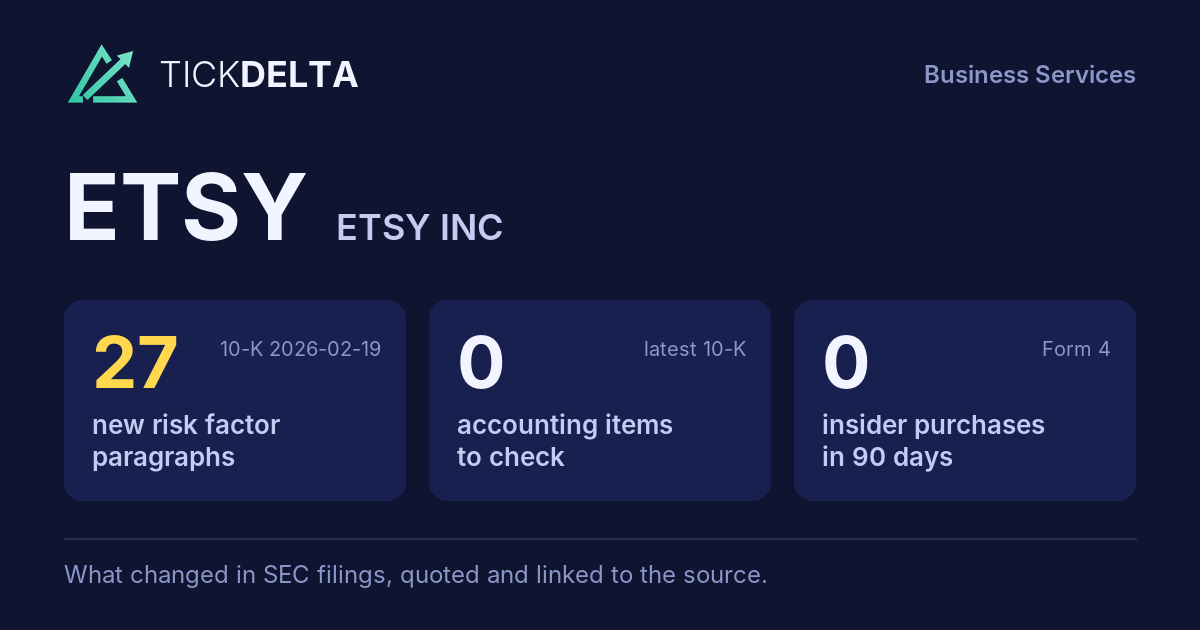
of the text changed · 21,560 words now · 27 new paragraphs, 26 gone
MD&A
46.0%
of the text changed · 5,624 words now · 22 new paragraphs, 30 gone
Legal Proceedings
5.9%
of the text changed · 273 words now
Accounting Policies
33.1%
of the text changed · 4,185 words now
10-K 0001370637-26-000019 (Feb 19, 2026) vs 10-K 0001370637-25-000017 (Feb 19, 2025)
Every paragraph, and how much of it changed
One bar per paragraph, in the order of the 10-K. Height and colour show the share of its words not in the closest paragraph a year earlier; the tallest bars are new paragraphs.
Risk Factors
268 paragraphs · 27 new · 114 reworded · 26 gone · 10-K Feb 19, 2026 against Feb 19, 2025
New paragraph
Reworded (5% of its words or more)
Same or nearly
Paragraph 208 · 47% changed
Every version of it
Various jurisdictions (including the U.S. states and E.U. member states) are seeking to, to impose, or have recently imposed imposed, additional reporting, record-keeping, indirect tax collection and remittance obligations, or revenue-based taxes on businesses like ours that facilitate online commerce. For example, the American Rescue Plan Act of 2021 included a provision which significantly increases the number of sellers for whom we must report payment transactions in the United States. Recent regulatory and legislative proposals in the European Union and the United States could change rules which allow packages containing goods valued under a de minimis threshold to enter a country without paying customs duties and may require platforms to collect these custom duties at checkout. If requirements like these become applicable in additional jurisdictions, then our business, collectively with our sellers’ businesses, could be harmed. For example, taxing authorities in many U.S. states and in other countries have targeted e-commerce platforms as a means to calculate, collect, and remit indirect taxes for transactions taking place over the internet, and others are considering similar legislation. Such changes to current law or new legislation could adversely affect our business and our sellers’ businesses. This legislation could also require us or our sellers to incur substantial costs in order to comply, including costs associated with tax calculation, collection, remittance, and audit requirements, which could make selling on our marketplaces less attractive.
Paragraph 43 · 47% changed
Every version of it
Like all online services, we are vulnerable to power outages, telecommunications failures, phishing, social engineering, malware, credential stuffing, account takeover, and catastrophic events, other attempts to gain unauthorized access to member accounts or data, as well as computer viruses, break-ins, intentional or accidental actions or inaction by employees or others with authorized access to our networks, phishing cyber attacks, denial-of-service attacks, malicious or destructive code, malware, ransomware or other extortion attacks, breaches, and other cyber attacks, breaches and security incidents. We also rely on service providers and other third-party vendors, who are subject to the same vulnerabilities, and whose security and data protection practices we do not control. We and our third-party vendors regularly experience data incidents and cyber-related events that may result in technology disruptions and/or security breaches, including intentional, inadvertent, or social engineering breaches occurring through Etsy or third-party service provider technical issues, vulnerabilities, or employees. breaches. Any of these occurrences could lead to to, among other things, interruptions or shutdowns of one or more of our platforms, loss of data, unauthorized disclosure or use of our employees’ or members’ personal or financial information of our members or employees, or data, theft of our intellectual property or user data. Furthermore, if data, unauthorized access to member accounts, or disruption of transactions. As we strive to reignite growth in our employees, contractors, or third-party service providers fail business, expand internationally, and gain greater public visibility, we may continue to comply with our internal security policies and practices, member or employee data may be improperly accessed, used, or disclosed. Additionally, employees, contractors, or service providers have and may inadvertently misconfigure resources or misdirect certain communications in manners that may lead to security incidents, which face a higher risk of being targeted by cyber attacks.
Paragraph 46 · 46% changed
Every version of it
A successful cyber attack could occur and persist for an extended period of time before being detected. Because We may not anticipate or implement adequate measures to prevent a cyber attack for a number of reasons, including because of the rapidly changing threat vectors and techniques used by hackers change frequently, we may be unable bad actors, potential adverse impacts to anticipate these techniques or implement adequate preventive measures. In addition, because any investigation of a cybersecurity incident would be inherently unpredictable, the extent of a particular cybersecurity incident employee productivity and/or user experience, and the path of investigating the incident may not be immediately clear. It may take a significant amount of time before an investigation can be completed cost and full and reliable information about the incident is known. While an investigation is ongoing, we may not necessarily know the extent of the harm or how best to remediate it, certain errors or actions could be repeated or compounded before they are discovered and remediated, and communication to the public, regulators, members of our communities, and other stakeholders may be inaccurate or incomplete, any or all of which could further increase the costs and consequences of a cybersecurity incident. Applicable resources that these efforts require. Further, applicable rules regarding how to respond, required notices to users, and reporting to regulators and investors are subject to change and vary by jurisdiction, and may subject us to additional liability and reputational harm.
Paragraph 140 · 45% changed
Every version of it
Paragraph 211 · 42% changed
Every version of it
We are subject to a variety of laws and regulations in the United States and around the world, including those relating to traditional businesses, such as employment laws, accessibility requirements, taxation, trade, product liability, marketing, intellectual property, and consumer protection laws, and laws and regulations focused on e-commerce and online marketplaces, such as those governing online payments, privacy, anti-spam, data security and protection, online platform liability, platforms, content moderation, online child safety, social media regulation, marketplace seller regulation, artificial intelligence, AI, automated decision-making, and machine learning. Additional examples include data localization requirements, limitations on marketplace scope or ownership, intermediary liability protections, regulation of online speech and content moderation such as under the E.U. Digital Services Act (“DSA”), packaging and recycling requirements, seller certification and representative requirements, know-your-customer/business regulations such as under the U.S. INFORM Consumers Act, and rules related to security, privacy, or national security, which may regulate us, our users, or our vendors. In light of our international operations, we need to comply with various laws associated with doing business outside of the United States, including anti-money laundering, sanctions, anti-corruption, and export control laws. In some cases, non-U.S. privacy, data security, consumer protection, e-commerce, and other laws and regulations are more detailed or comprehensive than those in the United States and, in some countries, are more actively enforced. In addition, regulations, laws, policies, and international accords relating to environmental and social matters, including sustainability, due diligence, climate change, human capital, forced labor, and diversity, have been enacted or are being developed and formalized in Europe, the United States (both at the federal level and on a state-by-state basis), and elsewhere, some of which include specific disclosure requirements, target-driven frameworks, and/or due diligence obligations to which we may be subject.
Paragraph 178 · 41% changed
Every version of it
result, we may not be able to engage in any of these activities or engage in these activities on desirable terms, which could result in a default on our debt obligations. Based on the daily closing prices of the Company’s stock during the quarter ended December 31, 2024, 2025, holders of the Notes are not eligible to convert their Notes during the first quarter of 2025. 2026. See Part II, Item 8, “Notes to Consolidated Financial Statements—”Note “Financial Statements and Supplementary Data—Note 12—Debt” for more information on the Notes.
Paragraph 76 · 39% changed
Every version of it
Paragraph 146 · 48% changed
Every version of it
10-K Feb 19, 2025Continuing to expand our operations outside of the United States is part of our strategy, and our business could be harmed if our expansion efforts do not succeed.
10-K Feb 19, 2026
Growing the Etsy marketplace globally is part of our strategy, and our business could be harmed by the continued imposition of barriers to international trade.
Paragraph 208 · 47% changed
Every version of it
10-K Feb 19, 2025
Various jurisdictions (including the U.S. states and E.U. member states) are seeking to, or have recently imposed additional reporting, record-keeping, indirect tax collection and remittance obligations, or revenue-based taxes on businesses like ours that facilitate online commerce. For example, the American Rescue Plan Act of 2021 included a provision which significantly increases the number of sellers for whom we must report payment transactions in the United States. Recent regulatory and legislative proposals in the European Union and the United States could change rules which allow packages containing goods valued under a de minimis threshold to enter a country without paying customs duties and may require platforms to collect these custom duties at checkout. If requirements like these become applicable in additional jurisdictions, then our business, collectively with our sellers’ businesses, could be harmed. For example, taxing authorities in many U.S. states and in other countries have targeted e-commerce platforms as a means to calculate, collect, and remit indirect taxes for transactions taking place over the internet, and others are considering similar legislation. Such changes to current law or new legislation could adversely affect our business and our sellers’ businesses. This legislation could also require us or our sellers to incur substantial
10-K Feb 19, 2026
Various jurisdictions (including the U.S. states and E.U. member states) are seeking to impose, or have recently imposed, additional reporting, record-keeping, indirect tax collection and remittance obligations, or revenue-based taxes on businesses like ours that facilitate online commerce. Such changes to current law or new legislation could adversely affect our business and our sellers’ businesses. This legislation could also require us or our sellers to incur substantial costs in order to comply, including costs associated with tax calculation, collection, remittance, and audit requirements, which could make selling on our marketplaces less attractive.
Paragraph 43 · 47% changed
Every version of it
10-K Feb 19, 2025
Like all online services, we are vulnerable to power outages, telecommunications failures, and catastrophic events, as well as computer viruses, break-ins, intentional or accidental actions or inaction by employees or others with authorized access to our networks, phishing attacks, denial-of-service attacks, malicious or destructive code, malware, ransomware or other extortion attacks, and other cyber attacks, breaches and security incidents. We regularly experience cyber-related events that may result in technology disruptions and/or security breaches, including intentional, inadvertent, or social engineering breaches occurring through Etsy or third-party service provider technical issues, vulnerabilities, or employees. Any of these occurrences could lead to interruptions or shutdowns of one or more of our platforms, loss of data, unauthorized disclosure of personal or financial information of our members or employees, or theft of our intellectual property or user data. Furthermore, if our employees, contractors, or third-party service providers fail to comply with our internal security policies and practices, member or employee data may be improperly accessed, used, or disclosed. Additionally, employees, contractors, or service providers have and may inadvertently misconfigure resources or misdirect certain communications in manners that may lead to security incidents, which
10-K Feb 19, 2026
Like all online services, we are vulnerable to power outages, telecommunications failures, phishing, social engineering, malware, credential stuffing, account takeover, and other attempts to gain unauthorized access to member accounts or data, as well as cyber attacks, breaches, and other security incidents. We also rely on service providers and other third-party vendors, who are subject to the same vulnerabilities, and whose security and data protection practices we do not control. We and our third-party vendors regularly experience data incidents and cyber-related events that may result in technology disruptions and/or security breaches. Any of these occurrences could lead to, among other things, interruptions or shutdowns of one or more of our platforms, loss of data, unauthorized disclosure or use of our employees’ or members’ personal or financial data, theft of our intellectual property or user data, unauthorized access to member accounts, or disruption of transactions. As we strive to reignite growth in our business, expand internationally, and gain greater public visibility, we may continue to face a higher risk of being targeted by cyber attacks.
Paragraph 46 · 46% changed
Every version of it
10-K Feb 19, 2025
A successful cyber attack could occur and persist for an extended period of time before being detected. Because the techniques used by hackers change frequently, we may be unable to anticipate these techniques or implement adequate preventive measures. In addition, because any investigation of a cybersecurity incident would be inherently unpredictable, the extent of a particular cybersecurity incident and the path of investigating the incident may not be immediately clear. It may take a significant amount of time before an investigation can be completed and full and reliable information about the incident is known. While an investigation is ongoing, we may not necessarily know the extent of the harm or how best to remediate it, certain errors or actions could be repeated or compounded before they are discovered and remediated, and communication to the public, regulators, members of our communities, and other stakeholders may be inaccurate or incomplete, any or all of which could further increase the costs and consequences of a cybersecurity incident. Applicable rules regarding how to respond, required notices to users, and reporting to regulators and investors vary by jurisdiction, and may subject us to additional liability and reputational harm.
10-K Feb 19, 2026
A successful cyber attack could occur and persist for an extended period of time before being detected. We may not anticipate or implement adequate measures to prevent a cyber attack for a number of reasons, including because of the rapidly changing threat vectors and techniques used by bad actors, potential adverse impacts to employee productivity and/or user experience, and the significant cost and resources that these efforts require. Further, applicable rules regarding how to respond, required notices to users, and reporting to regulators and investors are subject to change and vary by jurisdiction, and may subject us to additional liability and reputational harm.
Paragraph 140 · 45% changed
Every version of it
10-K Feb 19, 2025We maintain and enforce these policies in order to uphold the safety and integrity of our marketplaces, comply with laws and regulations, engender trust in the use of our services, and encourage positive connections among members of our communities. We strive to enforce these policies in a consistent and principled manner that is transparent and explicable to stakeholders. However, even with a principled and objective approach, this work involves a combination of human judgment and technological and manual review. As a result, there could be errors or inconsistencies in, or disagreement with, our policy determinations; policy enforcement could be subject to different, inconsistent, or conflicting regional consensus or regulatory standards in different jurisdictions; and our policy decisions could be perceived to be arbitrary, unfair, unclear, or inconsistent. Similarly, the tools and processes in place at the other marketplaces that make up our “House of Brands” portfolio differ from those used by the Etsy marketplace, and our tools and processes may not be as sophisticated or mature as those of our competitors. Shortcomings and errors in our policy enforcement across our marketplaces could lead to negative public perception, distrust from our members, or lack of confidence in the use of our services, and could negatively impact the reputation of our brands.
10-K Feb 19, 2026
policy decisions could be perceived to be arbitrary, unfair, unclear, offensive, objectionable, or inconsistent. Similarly, the tools and processes in place at our Depop marketplace differ from those used by the Etsy marketplace, and, at each marketplace, our tools and processes may not be as sophisticated or mature as those of our competitors. Shortcomings and errors in our policies, policy enforcement, and/or any perceived or actual concerns regarding transparency of our policy enforcement decisions across our marketplaces could lead to negative publicity, distrust from our members, legal or regulatory risks, or lack of confidence in the use of our services, and could negatively impact the reputation of our brands.
Paragraph 211 · 42% changed
Every version of it
10-K Feb 19, 2025
We are subject to a variety of laws and regulations in the United States and around the world, including those relating to traditional businesses, such as employment laws, accessibility requirements, taxation, trade, product liability, marketing, intellectual property, and consumer protection laws, and laws and regulations focused on e-commerce and online marketplaces, such as those governing online payments, privacy, anti-spam, data security and protection, online platform liability, content moderation, online child safety, social media regulation, marketplace seller regulation, artificial intelligence, automated decision-making, and machine learning. Additional examples include data localization requirements, limitations on marketplace scope or ownership, intermediary liability protections, regulation of online speech and content moderation such as under the E.U. Digital Services Act (“DSA”), packaging and recycling requirements, seller certification and representative requirements, know-your-customer/business regulations such as under the U.S. INFORM Consumers Act, and rules related to security, privacy, or national security, which may regulate us, our users, or our vendors. In light of our international operations, we need to comply with various laws associated with doing business outside of the United States, including anti-money laundering, sanctions, anti-corruption, and export control laws. In some cases, non-U.S. privacy, data security, consumer protection, e-commerce, and other laws and regulations are more detailed or comprehensive than those in the United States and, in some countries, are more actively enforced. In addition, regulations, laws, policies, and international accords relating to environmental and social matters, including sustainability, due diligence, climate change, human capital, forced labor, and diversity, have been enacted or are being developed and formalized in Europe, the United States (both at the federal level and on a state-by-state basis), and elsewhere, some of which include specific disclosure requirements, target-driven frameworks, and/or due diligence obligations to which we may be subject.
10-K Feb 19, 2026
We are subject to a variety of laws and regulations in the United States and around the world, including those relating to traditional businesses, such as employment laws, accessibility requirements, taxation, trade, product liability, marketing, intellectual property, and consumer protection laws, and laws and regulations focused on e-commerce and online marketplaces, such as those governing online payments, privacy, anti-spam, data security and protection, online platforms, content moderation, online child safety, social media regulation, marketplace seller regulation, AI, automated decision-making, and machine learning. Additional examples include data localization requirements, limitations on marketplace scope or ownership, intermediary liability protections, regulation of online
Paragraph 178 · 41% changed
Every version of it
10-K Feb 19, 2025
quarter ended December 31, 2024, holders of the Notes are not eligible to convert their Notes during the first quarter of 2025. See Part II, Item 8, “Notes to Consolidated Financial Statements—”Note 12—Debt” for more information on the Notes.
10-K Feb 19, 2026
result, we may not be able to engage in any of these activities or engage in these activities on desirable terms, which could result in a default on our debt obligations. Based on the daily closing prices of the Company’s stock during the quarter ended December 31, 2025, holders of the Notes are not eligible to convert their Notes during the first quarter of 2026. See Part II, Item 8, “Financial Statements and Supplementary Data—Note 12—Debt” for more information on the Notes.
Paragraph 76 · 39% changed
Every version of it
10-K Feb 19, 2025Disruptions related to our third-party service providers could also potentially affect our sellers’ ability to receive orders, our buyers’ ability to complete purchases, and our ability to operate our payments program, including maintaining certain compliance measures, including fraud prevention and detection tools. This could decrease revenue, increase costs, lead to potential legal liability, and negatively impact our brands and business. If we (or a third-party payment processor) suffer a security breach affecting payment card information, we could be subjected to fines, penalties, and assessments arising out of the major card brands’ rules and regulations, contractual indemnification obligations or other obligations contained in merchant agreements and similar contracts, and we may lose our ability to accept payment cards as payment for our services and our sellers’ goods and services.
10-K Feb 19, 2026
to fines, penalties, and assessments arising out of the major card brands’ rules and regulations, contractual indemnification obligations or other obligations contained in merchant agreements and similar contracts, and we may lose our ability to accept payment cards as payment for our services and our sellers’ goods and services.
MD&A
89 paragraphs · 22 new · 52 reworded · 30 gone · 10-K Feb 19, 2026 against Feb 19, 2025
New paragraph
Reworded (5% of its words or more)
Same or nearly
Paragraph 30 · 49% changed
Paragraph 85 · 48% changed
Paragraph 29 · 47% changed
The decrease increase in cost of revenue was primarily driven by a decrease an increase in cost of refunds. Additionally, cost of revenue decreased, to a lesser extent, due to reduced employee compensation-related expenses and refunds, cloud-related hosting and bandwidth costs, and were largely and, to a lesser extent, Etsy Insider loyalty program costs, which launched in beta form in the third quarter of 2024. These increases are partially offset by an increase in amortization due to increases in capitalized website the sale of Reverb on June 2, 2025 and app development costs. There was also a slight net decrease in payments processing fees driven by Etsy marketplace a net GMS decrease and cost optimization efforts and GMS decrease, which were largely offset by an increase due to the Etsy and Depop payments expansion and Depop marketplace GMS increase. We gained leverage as cost of revenue did not increase as fast as revenue. efforts.
Paragraph 10 · 47% changed
Paragraph 62 · 45% changed
The following table reflects the reconciliation of net income (loss) cash provided by operating activities to Adjusted EBITDA and the calculation of Adjusted EBITDA margin free cash flow for each of the periods indicated: indicated (in thousands):
Paragraph 24 · 44% changed
Marketplace revenue increased decreased primarily due to a mix of volume and pricing, primarily driven by Etsy and Depop payments expansion as well as higher payments revenue in locations in which we charge a higher payments fee for both the Etsy and Depop marketplaces. As part of the payments expansion, the share of Etsy marketplace GMS processed through our Etsy Payments platform increased to 98% for 2024 compared to 94% for 2023. The net increase in payments revenue includes a $47.1 million decrease related to the sale of the Reverb marketplace on June 2, 2025 and a decrease of $16.8 million in transaction fee revenue, which was driven by a decline in Etsy marketplace GMS in 2024 compared to 2023. Additionally, marketplace revenue increased due to pricing, driven by the launch of a seller set-up fee for the Etsy marketplace in 2024, under which a seller pays a set-up fee when they open a shop. These increases were partially offset by a decrease in transaction fee revenue due to a mix of volume and pricing, and primarily driven by a decline in GMS for the Etsy marketplace. The decline in net transaction fee revenue was partially offset by an increase in GMS for the Depop marketplace and GMS. These decreases were partially offset by an increase in transaction fee revenue from offsite advertising that generates a higher transaction fee. Overall, payments revenue increased 5.4% of $27.0 million, primarily related to an increase in 2024 compared to 2023 Depop GMS and transaction a $18.4 million increase in Etsy marketplace seller set-up fee revenue decreased 1.5% in 2024 compared to 2023. revenue.
Paragraph 21 · 42% changed
Our revenue is diversified and generated from a mix of marketplace activities and other optional services we provide primarily to sellers to help them generate more sales and scale their businesses. Marketplace revenue is primarily comprised of the fees a seller pays for marketplace activities, including transaction fees (inclusive of offsite advertising), payments processing fees, and listing fees. Services revenue is primarily comprised of the fees a marketplace seller pays us for our optional services, including on-site advertising and shipping labels.Year Ended Change Y/Y December 31, (in thousands, except percentages) 2025 2024 $ % Revenue: Marketplace $ 2,007,164 $2,020,744 $ (13,580) (0.7)% Percentage of total revenue 69.6 % 72.0% Services $ 876,337 $787,588 $ 88,749 11.3% Percentage of total revenue 30.4 % 28.0% Total revenue $ 2,883,501 $2,808,332 $ 75,169 2.7%
Paragraph 86 · 41% changed
Paragraph 30 · 49% changed
10-K Feb 19, 2025Marketing: Marketing expenses primarily consist of direct marketing expenses, which largely includes digital marketing and television ad and digital video expenses. Digital marketing, also referred to as performance marketing, primarily consists of targeted promotional campaigns through electronic channels, such as product listing ads, search engine marketing, social channels, and affiliate programs, which are focused on buyer acquisition and retargeting. To a lesser extent, direct marketing expenses also include brand marketing, public relations and communications, marketing partnerships, and customer relationship management. Marketing expenses also include employee compensation-related expenses to support our marketing initiatives and amortization expense related to acquired customer relationships and trademark intangible assets.
10-K Feb 19, 2026
Marketing expenses primarily consist of performance marketing and television ad and digital video expenses. Performance marketing primarily consists of paid digital marketing which is focused on buyer acquisition and retargeting. To a lesser extent, marketing expenses also include brand marketing, as well as our owned marketing channels. Marketing expenses also include amortization expense related to acquired customer relationships and trademark intangible assets. We track “Paid GMS” for the Etsy marketplace and define it as Etsy marketplace GMS that is attributable to our performance marketing efforts, which excludes most of our marketing investments focused on brand awareness like TV and digital video ads.Year Ended Change Y/Y December 31, (in thousands, except percentages) 2025 2024 $ % Marketing $ 914,830 $ 856,565 $ 58,265 6.8% Percentage of total revenue 31.7 % 30.5 %
Paragraph 85 · 48% changed
10-K Feb 19, 2025Goodwill is tested for impairment at the reporting unit level annually, or more frequently if triggering events occur. We have the option to first perform a qualitative assessment to determine whether it is more likely than not that the fair value of the reporting unit is less than its carrying value. The qualitative assessment includes certain significant judgments including assessments of macroeconomic conditions, industry and market considerations, cost factors, overall financial performance of the reporting unit, and other relevant considerations impacting the reporting unit. If we elect to bypass the qualitative assessment, or if the qualitative assessment indicates that it is more likely than not that the fair value of the reporting unit is less than its carrying amount, then we are required to perform a quantitative assessment for impairment. Under the quantitative goodwill impairment test, if a reporting unit’s carrying amount exceeds its fair value, we record an impairment charge based on that difference, not exceeding the carrying amount of goodwill. To determine a reporting unit’s fair value, we apply the income approach, which uses management’s forecasts to estimate future net available cash flows. Significant judgments inherent in this analysis include, but are not limited to, estimates of future revenue, operating margins, long-term growth rates, and discount rates. Our estimates of fair value are based upon assumptions believed to be reasonable, but which are inherently uncertain and unpredictable. If actual results are materially lower than originally estimated, or if we experience significant, adverse changes to long-term growth rate or discount rate assumptions, it could result in a material impact on our consolidated financial statements in future periods.
10-K Feb 19, 2026
estimates of fair value are based upon assumptions believed to be reasonable, but which are inherently uncertain and unpredictable. If actual results are materially lower than originally estimated, or if we experience significant, adverse changes to long-term growth rate or discount rate assumptions, it could result in a material impact on our consolidated financial statements in future periods.
Paragraph 29 · 47% changed
10-K Feb 19, 2025
The decrease in cost of revenue was primarily driven by a decrease in cost of refunds. Additionally, cost of revenue decreased, to a lesser extent, due to reduced employee compensation-related expenses and cloud-related hosting and bandwidth costs, and were largely offset by an increase in amortization due to increases in capitalized website and app development costs. There was also a slight net decrease in payments processing fees driven by Etsy marketplace cost optimization efforts and GMS decrease, which were largely offset by an increase due to the Etsy and Depop payments expansion and Depop marketplace GMS increase. We gained leverage as cost of revenue did not increase as fast as revenue.
10-K Feb 19, 2026
The increase in cost of revenue was driven by an increase in cost of refunds, cloud-related hosting and bandwidth costs, and, to a lesser extent, Etsy Insider loyalty program costs, which launched in beta form in the third quarter of 2024. These increases are partially offset by the sale of Reverb on June 2, 2025 and a net decrease in payments processing fees driven by a net GMS decrease and cost optimization efforts.
Paragraph 10 · 47% changed
10-K Feb 19, 2025Gross merchandise sales (“GMS”) is the dollar value of items sold in our marketplaces, excluding shipping fees and net of refunds, within the applicable period. GMS does not represent revenue earned by us. GMS is largely driven by transactions in our marketplaces and is not directly impacted by Services activity. However, because our revenue and cost of revenue depend significantly on the dollar value of items sold in our marketplace, we believe that GMS is an indicator of the success of our sellers, the satisfaction of our buyers, and the health and scale of our business. We track “Paid GMS” for the Etsy marketplace and define it as Etsy marketplace GMS that is attributable to our performance marketing efforts, which excludes most of our marketing investments focused on brand awareness like TV and digital video.
10-K Feb 19, 2026
(2)Gross merchandise sales (“GMS”) for 2025 includes Etsy marketplace GMS of $10,460.7 million, Depop GMS of $1,074.9 million, and Reverb GMS of $381.3 million. GMS is the dollar value of items sold in our marketplaces, excluding shipping fees and net of refunds, within the applicable period. GMS does not represent revenue earned by us.
Paragraph 62 · 45% changed
10-K Feb 19, 2025
The following table reflects the reconciliation of net income (loss) to Adjusted EBITDA and the calculation of Adjusted EBITDA margin for each of the periods indicated:
10-K Feb 19, 2026
The following table reflects the reconciliation of net cash provided by operating activities to free cash flow for each of the periods indicated (in thousands):
Paragraph 24 · 44% changed
10-K Feb 19, 2025
Marketplace revenue increased due to a mix of volume and pricing, primarily driven by Etsy and Depop payments expansion as well as higher payments revenue in locations in which we charge a higher payments fee for both the Etsy and Depop marketplaces. As part of the payments expansion, the share of Etsy marketplace GMS processed through our Etsy Payments platform increased to 98% for 2024 compared to 94% for 2023. The net increase in payments revenue includes a decrease related to the decline in Etsy marketplace GMS in 2024 compared to 2023. Additionally, marketplace revenue increased due to pricing, driven by the launch of a seller set-up fee for the Etsy marketplace in 2024, under which a seller pays a set-up fee when they open a shop. These increases were partially offset by a decrease in transaction fee revenue due to a mix of volume and pricing, and primarily driven by a decline in GMS for the Etsy marketplace. The decline in net transaction fee revenue was partially offset by an increase in GMS for the Depop marketplace and an increase in transaction fee revenue from offsite advertising that generates a higher transaction fee. Overall, payments revenue increased 5.4% in 2024 compared to 2023 and transaction fee revenue decreased 1.5% in 2024 compared to 2023.
10-K Feb 19, 2026
Marketplace revenue decreased primarily due to a $47.1 million decrease related to the sale of the Reverb marketplace on June 2, 2025 and a decrease of $16.8 million in transaction fee revenue, which was driven by a decline in Etsy marketplace GMS partially offset by an increase in Depop GMS. These decreases were partially offset by an increase in payments revenue of $27.0 million, primarily related to an increase in Depop GMS and a $18.4 million increase in Etsy marketplace seller set-up fee revenue.
Paragraph 21 · 42% changed
10-K Feb 19, 2025
Our revenue is diversified and generated from a mix of marketplace activities and other optional services we provide primarily to sellers to help them generate more sales and scale their businesses.
10-K Feb 19, 2026
Our revenue is diversified and generated from a mix of marketplace activities and other optional services we provide primarily to sellers to help them generate more sales and scale their businesses. Marketplace revenue is primarily comprised of the fees a seller pays for marketplace activities, including transaction fees (inclusive of offsite advertising), payments processing fees, and listing fees. Services revenue is primarily comprised of the fees a marketplace seller pays us for our optional services, including on-site advertising and shipping labels.Year Ended Change Y/Y December 31, (in thousands, except percentages) 2025 2024 $ % Revenue: Marketplace $ 2,007,164 $2,020,744 $ (13,580) (0.7)% Percentage of total revenue 69.6 % 72.0% Services $ 876,337 $787,588 $ 88,749 11.3% Percentage of total revenue 30.4 % 28.0% Total revenue $ 2,883,501 $2,808,332 $ 75,169 2.7%
Paragraph 86 · 41% changed
10-K Feb 19, 2025Asset impairment charges were $68.1 million in 2023 related to the impairment of intangible assets and property and equipment of Elo7. See Part II, Item 8, “Financial Statements and Supplementary Data—Note 6—Goodwill and Intangible Assets” and “Note 9—Property and Equipment” for more information. There were no asset impairment charges in 2024.
10-K Feb 19, 2026
During the first quarter of 2025, we recorded a non-cash goodwill impairment charge of $101.7 million related to the Reverb reporting unit. We sold Reverb in the second quarter of 2025. No impairment charges were recorded within our Etsy reporting unit as of our annual impairment test in the fourth quarter of 2025 and no indication of goodwill impairment was identified in 2024 or 2023. See Part II, Item 8, “Financial Statements and Supplementary Data—Note 6—Goodwill and Intangible Assets” and “Note 5—Sale of Business” for further information.
A paragraph is matched with the one last year that shares the most of its words; under half in common makes it new. The paragraphs shown are the 8 reworded the most in each section.
The paragraph that changed most in each section
The redline
Marked against last year's 10-K: cut words struck through, new words highlighted.
Risk Factors227 words changed in this paragraph; it is 54% similar to last year's version.
We track certain operational metrics, including active buyers and active sellers, GMS, GMS from specific categories of goods, classes of buyers or sellers, or specific platforms, and other information about our communities and the performance of our platforms, with internal systems and tools or manual processes. These metrics are not independently verified by a third party. The methodologies used to measure certain of these metrics require significant judgment, are susceptible to errors, may change over time, and may differ from estimates or metrics published by third parties due to differences in sources, methodologies, or the underlying assumptions. We also use surveys to collect and track information about our buyers and sellers and rely on third-party data, which we do not independently verify, to evaluate and report on our opportunity. Our internal systems, tools, processes, and processes and our surveys or data collection methodologies have a number of limitations, may have errors or could change over time, any of which could result in unexpected changes to our metrics, including the metrics we publicly disclose. Similarly, our third-party data sources have in the past and may in the future revise the historical data provided as a result of adjustments to their prior estimates or for other reasons. If the internal systems and tools, processes, or surveys we use to track these metrics under count or over count performance or contain algorithmic or other technical errors, the data we report may not be accurate. While these numbers are based on what we believe to be reasonable estimates of our metrics, there are inherent challenges in measuring this data. In addition, limitations or errors with respect to how we measure data or with respect to the data that we measure or obtain from third parties may affect our understanding of certain details of our business or our opportunity, which could affect our long-term strategies. If our operating metrics are not accurate, or if investors do not perceive them to be accurate, investors may lose confidence in our operating metrics and business, and we expect that we could be subject to legal claims, and our business, reputation, financial condition, and results of operations would be adversely affected.
Source: Item 1A, 10-K 0001370637-26-000019 vs Item 1A, 10-K 0001370637-25-000017
Accounting Policies183 words changed in this paragraph; it is 62% similar to last year's version.
The Company performs its annual goodwill impairment test in the fourth quarter, or more frequently if an interim triggering event occurs that may indicate potential impairment. The Company has the option to first assess qualitative factors to determine whether the existence of events or circumstances leads to a determination that it is more likely than not that the fair value of the reporting unit is less than its carrying amount. If, after assessing the totality of events or circumstances, the Company determines it is not more likely than not that the fair value of the reporting unit is less than its carrying amount, then additional impairment testing is not required. If the Company determines that it is more likely than not that the fair value of the reporting unit is less than its carrying amount, then the Company is required to perform a quantitative assessment for impairment. Under the quantitative goodwill impairment test, if a reporting unit’s carrying amount exceeds its fair value, an impairment loss is recognized in an amount equal to the excess, not to exceed the total amount of goodwill allocated to that reporting unit. The determination of whether it is more likely than not that our reporting units’ fair values are greater than their carrying values involves significant judgments which include, but are not limited to, estimates of future revenue, operating margins, long-term growth rates, and discount rates. Our estimates of fair value are based upon assumptions believed to be reasonable, but which are inherently uncertain and unpredictable. If actual results are materially lower than originally estimated, or if we experience significant, adverse changes to long-term growth rate or discount rate assumptions, it could result in a material impact on our consolidated financial statements in future periods. Further, it is reasonably possible that changes in the strategic direction of one or more of our reporting units could occur in the near term, which could have a material impact on the fair value determination of our reporting units.
Source: Item 8, Note 1 – Basis of Presentation and Summary of Significant Accounting Policies, 10-K 0001370637-26-000019 vs Item 8, Note 1 – Basis of Presentation and Summary of Significant Accounting Policies, 10-K 0001370637-25-000017
MD&A135 words changed in this paragraph; it is 43% similar to last year's version.
Source: Item 7, 10-K 0001370637-26-000019 vs Item 7, 10-K 0001370637-25-000017
Legal Proceedings32 words changed in this paragraph; it is 82% similar to last year's version.
The Company had reserves of $31.6 $32.2 million and $26.2 $31.6 million at December 31, 2024 2025 and 2023, 2024, respectively, for certain non-income tax obligations, representing management’s best estimate of its potential liability. The reserves as of December 31, 2024 and 2023 include $7.6 million and $11.5 million, respectively, due to the acquisitions of subsidiaries. These amounts were primarily recorded as part of purchase accounting. The Company could also be subject to examination in various jurisdictions related to income tax and non-income tax matters. The resolution of these types of matters, if in excess of the recorded reserve, could have an adverse impact on the Company’s consolidated financial statements.
Source: Item 3, via Note 13 – Commitments and Contingencies, 10-K 0001370637-26-000019 vs Item 3, via Note 13 – Commitments and Contingencies, 10-K 0001370637-25-000017
Sentences and paragraphs added, removed or reworded
Every change, by type
Sentences and paragraphs of ETSY's Risk Factors and MD&A, 10-K Feb 19, 2026 against 10-K Feb 19, 2025. Each links to the text at sec.gov.
Quiet changes are sentences kept from last year with one to four words changed, at least one of them a hedge, a modal or a qualifier (may, could, will, not, significant, material…). A year or date rolling forward is not counted.
The full word list
adverse, adversely, all, although, anticipate, anticipates, any, approximately, believe, believes, can, cannot, certain, could, expect, expects, generally, however, if, intend, intends, largely, likely, many, material, materially, may, might, most, must, never, no, not, possible, primarily, probable, should, significant, significantly, some, substantial, substantially, unlikely, will, would
AddedRisk Factors
Our business also depends on our ability to provide a safe experience for our buyers and sellers. For example, we are and may continue to be an attractive target to bad actors and fraudsters targeting our marketplaces, users, and our communities. These bad actors use a variety of tactics, including social engineering, coordinated phishing attacks, spam, and website and social media spoofing, which frequently involve attempts to exploit, defraud, obtain financial or other data from our buyers and sellers, or otherwise harm them. These tactics may be amplified by advances in artificial intelligence and generative artificial intelligence, machine learning, and similar tools and technologies (collectively, “AI”), including the use of automated content generation and impersonation techniques.
Read it in 10-K Feb 19, 2026 at sec.gov
AddedRisk Factors
performance. Further, if trends supporting self-employment and the desire for supplemental income were to reverse, the number of sellers offering their goods in our marketplaces and the number of goods listed in our marketplaces could decline.
Read it in 10-K Feb 19, 2026 at sec.gov
AddedRisk Factors
We use AI-enabled systems, which could expose us to liability or adversely affect our business.
Read it in 10-K Feb 19, 2026 at sec.gov
AddedRisk Factors
We use AI in connection with our business. The use of AI, a relatively new and emerging technology in the early stages of commercial use, exposes us to additional risks, such as damage to our reputation, competitive
Read it in 10-K Feb 19, 2026 at sec.gov
AddedRisk Factors
position, and business, legal, and regulatory risks and additional costs. For example, generative AI has been known to produce false or “hallucinatory” inferences or output, and certain generative AI uses machine learning and predictive analytics, which can create inaccurate, incomplete, or misleading content, unintended biases and other discriminatory or unexpected results, errors, or inadequacies, any of which may not be easily detectable by us or our related service providers. Accordingly, while AI-enabled applications may help provide more tailored or personalized user experiences, if the content, analyses, or recommendations that AI-enabled applications assist in producing in
Read it in 10-K Feb 19, 2026 at sec.gov
AddedRisk Factors
our products and solutions are, or are perceived to be, deficient, inaccurate, biased, unethical, or otherwise flawed, our reputation, competitive position, and business may be materially and adversely affected.
Read it in 10-K Feb 19, 2026 at sec.gov
AddedRisk Factors
Additionally, if any of our employees, contractors, consultants, vendors, or service providers use any third-party AI-enabled systems and software in connection with our business or the services they provide to us, it may lead to the inadvertent disclosure or incorporation of our confidential information into training sets, which may impact our ability to realize the benefit of, or adequately maintain, protect, and enforce our intellectual property or confidential information, harming our competitive position and business. Any outputs that we create using AI-enabled tools may not be subject to copyright protection, which may adversely affect our intellectual property rights in, or ability to commercialize or use, any such content. To the extent that we do not have sufficient rights to use the data or other material or content used in or produced by the AI-enabled systems used in our business, or if we experience cybersecurity incidents in connection with our use or any third party’s use of AI-enabled applications, it could adversely affect our reputation and expose us to legal liability or regulatory risk, including with respect to third-party intellectual property, data privacy, cybersecurity, publicity, contractual or other rights. Further, our competitors or other third parties may incorporate AI into their products more quickly or more successfully than us, which could impair our ability to compete effectively.
Read it in 10-K Feb 19, 2026 at sec.gov
AddedRisk Factors
On July 4, 2025, the One Big Beautiful Bill Act (“OBBBA”) was enacted in the U.S. OBBBA includes significant corporate tax changes, including a restoration of the current deductibility for domestic research expenditures beginning in 2025, with transition options for previously capitalized amounts. OBBBA also includes changes to certain U.S. international provisions beginning in 2026. While certain provisions of OBBBA are currently expected to favorably change the timing of our cash tax payments in the near term, we do not expect the legislation to have a material impact on our provision for income taxes. We will continue to assess and monitor OBBBA’s potential impact on our consolidated financial statements.
Read it in 10-K Feb 19, 2026 at sec.gov
Show the other 68
AddedRisk Factors
•the value, awareness, trustworthiness, reputation, and perception of our brands;
Read it in 10-K Feb 19, 2026 at sec.gov
AddedRisk Factors
•the breadth, value, and quality of items that sellers list in our marketplaces;
Read it in 10-K Feb 19, 2026 at sec.gov
AddedRisk Factors
Many of our competitors and potential competitors have longer operating histories, greater resources, better name recognition, or more customers than we do. They may invest more to develop and promote their services than we
Read it in 10-K Feb 19, 2026 at sec.gov
AddedRisk Factors
We have entered into strategic relationships with certain third-party platforms, including AI–enabled applications, that surface our sellers’ products within those platforms and, in some cases, enable buyers to complete purchases directly through those applications. These arrangements represent an additional channel through which buyers may discover and purchase items from our sellers, and we rely on these third parties to operate their platforms in a manner that supports accurate product presentation and reliable transaction completion. These platforms are operated by parties outside of our control and may experience outages, disruptions, errors, or changes to functionality, policies, or business practices that could impair product discovery, reduce buyer engagement, or negatively affect the marketing and sale of our sellers’ products. We cannot control the availability of such third-party AI-enabled applications, especially in a highly competitive environment, and we may be unable to negotiate
Read it in 10-K Feb 19, 2026 at sec.gov
RemovedRisk Factors
RemovedRisk Factors
RemovedRisk Factors
RemovedRisk Factors
RemovedRisk Factors
RemovedRisk Factors
RemovedRisk Factors
RemovedRisk Factors
RemovedRisk Factors
RemovedRisk Factors
RemovedRisk Factors
RemovedRisk Factors
RewordedRisk Factors
If we experience, or are perceived to experience, security breaches that result in marketplace performance or availability problems or the loss, compromise or unauthorized disclosure of personal data or other sensitive information, or if we or our vendors fail to respond appropriately to any security breaches that we or they may experience, or are perceived to do so, people may become unwilling to provide us the information necessary to set up an account with us to become a new seller or buyer.
Read it in 10-K Feb 19, 2026 at sec.gov
RewordedRisk Factors
Our cost to refund qualifying orders of refunds may exceed our expectations, and despite our efforts, we are do not always, and in the future may not be, able to always recover the funds we expend for reimbursements unrelated to qualified orders, both of reimbursed, which could impact our financial performance.
Read it in 10-K Feb 19, 2026 at sec.gov
RewordedRisk Factors
RewordedRisk Factors
Any of these occurrences could lead to to, among other things, interruptions or shutdowns of one or more of our platforms, loss of data, unauthorized disclosure or use of our employees’ or members’ personal or financial information of our members or employees, or data, theft of our intellectual property or user data. data, unauthorized access to member accounts, or disruption of transactions.
Read it in 10-K Feb 19, 2026 at sec.gov
RewordedRisk Factors
We and our third-party vendors regularly experience data incidents and cyber-related events that may result in technology disruptions and/or security breaches, including intentional, inadvertent, or social engineering breaches occurring through Etsy or third-party service provider technical issues, vulnerabilities, or employees. breaches.
Read it in 10-K Feb 19, 2026 at sec.gov
RewordedRisk Factors
In addition, ongoing legal and regulatory changes in the data privacy, social media and technology spheres in U.S. states and countries throughout the world – and the interpretation of these laws by major search, social, and operating system providers – have and may continue to impact the scope and effectiveness of marketing and advertising services generally, including those used on our platforms.
Read it in 10-K Feb 19, 2026 at sec.gov
RewordedRisk Factors
If we experience increased voluntary attrition in the future, and/or if we are unable to attract and retain qualified employees in a timely fashion or on reasonable terms, particularly in critical areas of operations such as engineering, and/or if we are otherwise not able to place the right employees in the right roles to drive execution of our business plans, we may not achieve our strategic goals goals, and our business and operations could be harmed.
Read it in 10-K Feb 19, 2026 at sec.gov
RewordedRisk Factors
Our ability to pay our debt when due or to refinance our outstanding indebtedness, including the 0.125% Convertible Senior Notes due 2026 we issued in September 2019 (the “2019 Notes”), the 0.125% Convertible Senior Notes due 2027 we issued in August 2020 (the “2020 Notes”), and the 0.25% Convertible Senior Notes due 2028 we issued in June 2021 (the “2021 Notes”) and the 1.00% Convertible Senior Notes due 2030 we issued in June 2025 (the “2025 Notes” and and, together with the 2019 Notes Notes, the 2020 Notes, and the 2020 2021 Notes, the “Notes”), depends on our future performance, which is subject to economic, financial, competitive, and other factors beyond our control.
Read it in 10-K Feb 19, 2026 at sec.gov
RewordedRisk Factors
The costs and effort to respond to a security breach and/or to mitigate any security vulnerabilities that may be identified could be significant, and our efforts to address these problems may not be successful, and these problems which could result in unexpected interruptions, delays, cessation of service, negative publicity, negative seller or buyer sentiment, impair our ability to operate our marketplaces, and cause other harm to our business and our competitive position.
Read it in 10-K Feb 19, 2026 at sec.gov
RewordedRisk Factors
Shortcomings and errors in our policies, policy enforcement, and/or any perceived or actual concerns regarding transparency of our policy enforcement decisions across our marketplaces could lead to negative public perception, publicity, distrust from our members, legal or regulatory risks, or lack of confidence in the use of our services, and could negatively impact the reputation of our brands.
Read it in 10-K Feb 19, 2026 at sec.gov
RewordedRisk Factors
RewordedRisk Factors
Quiet changesRisk Factors
Quiet changesRisk Factors
Any changes to existing frameworks may require us to adapt our existing arrangements or could impede our ability to effectively transfer data to our users, vendors, and partners in other jurisdictions.
Read it in 10-K Feb 19, 2026 at sec.gov
Quiet changesRisk Factors
We are subject to the terms of open source licenses because our platforms incorporate, and we contribute to, certain open source software, potentially impairing our ability to adequately protect some of our intellectual property.
Read it in 10-K Feb 19, 2026 at sec.gov
Quiet changesRisk Factors
We also issue common stock to our employees, directors, and certain other service providers pursuant to our equity incentive plans.
Read it in 10-K Feb 19, 2026 at sec.gov
AddedMD&A
Etsy operates two-sided online marketplaces that connect millions of creative entrepreneurs with buyers around the world.
Read it in 10-K Feb 19, 2026 at sec.gov
AddedMD&A
The Etsy marketplace is the global destination for unique, creative goods from independent sellers, connecting artisans with thoughtful consumers seeking items that reflect their tastes and values. We also operate Depop Limited (“Depop”), a leading fashion resale marketplace acquired in 2021.
Read it in 10-K Feb 19, 2026 at sec.gov
AddedMD&A
On February 15, 2026 Etsy and eBay Inc. (“eBay”) entered into a Sale and Purchase Agreement (the “Purchase Agreement”) for eBay to purchase Depop, for $1.2 billion in cash, subject to certain adjustments as set forth in the Purchase Agreement. The sale is currently expected to close in the second quarter of 2026, subject to regulatory approval and certain other closing conditions as set forth in the Purchase Agreement. Etsy will continue to own and operate Depop through such time as the transaction is completed, with Depop’s financial results classified as discontinued operations on Etsy’s consolidated financial statements for both current and prior periods beginning in the first quarter of fiscal year 2026. In keeping with our current capital allocation approach, Etsy plans to utilize the proceeds from this transaction for general corporate purposes, continued share repurchases, and investment in the Etsy marketplace.
Read it in 10-K Feb 19, 2026 at sec.gov
AddedMD&A
Our financial measures and key operating metrics are (in thousands, except percentages):
Read it in 10-K Feb 19, 2026 at sec.gov
AddedMD&A
We disclose key operating metrics because they provide meaningful insight into the performance and health of our business. GMS, active sellers, and active buyers each reflect core drivers of our business—seller success, buyer engagement, and the overall scale of our platforms. We believe these measures help investors and management evaluate our growth potential and the underlying strength of our marketplace.
Read it in 10-K Feb 19, 2026 at sec.gov
AddedMD&A
There is considerable uncertainty regarding the evolving tariff landscape, how recent changes to de minimis exemptions may play out, and the impact higher tariffs might have on consumer demand and discretionary wallet share. Any circumstances that reduce consumer demand or hinder our sellers' cross-border trade may adversely affect our business. See Part I, Item 1A, “Risk Factors - Growing the Etsy marketplace globally is part of our strategy, and our business could be harmed by the continued imposition of barriers to international trade.” for further detail.
Read it in 10-K Feb 19, 2026 at sec.gov
AddedMD&A
Year-to-Date Period Ended As Reported Currency-Neutral FX Impact December 31, 2025 (5.3)% (5.8)% 0.5% December 31, 2024 (4.4)% (4.5)% 0.1%
Read it in 10-K Feb 19, 2026 at sec.gov
AddedMD&A
Total revenue increased primarily due to an increase in services revenue, partially offset by a decrease in marketplace revenue.
Read it in 10-K Feb 19, 2026 at sec.gov
AddedMD&A
Year Ended Change Y/Y December 31, (in thousands, except percentages) 2025 2024 $ % Cost of revenue $ 817,800 $ 774,554 $ 43,246 5.6% Percentage of total revenue 28.4 % 27.6 %
Read it in 10-K Feb 19, 2026 at sec.gov
AddedMD&A
Product developmentYear Ended Change Y/Y December 31, (in thousands, except percentages) 2025 2024 $ % Product development $ 450,192 $ 443,056 $ 7,136 1.6% Percentage of total revenue 15.6 % 15.8 %
Read it in 10-K Feb 19, 2026 at sec.gov
AddedMD&A
Product development expenses increased primarily due to increased employee compensation-related expenses. This increase was partially offset by the sale of Reverb on June 2, 2025 and an increase in the amount of employee-related costs capitalized as a result of several larger projects.
Read it in 10-K Feb 19, 2026 at sec.gov
AddedMD&A
Year Ended Change Y/Y December 31, (in thousands, except percentages) 2025 2024 $ % General and administrative $ 332,766 $ 353,949 $ (21,183) (6.0)% Percentage of total revenue 11.5 % 12.6 %
Read it in 10-K Feb 19, 2026 at sec.gov
RemovedMD&A
RemovedMD&A
RemovedMD&A
RemovedMD&A
RemovedMD&A
RemovedMD&A
RemovedMD&A
RemovedMD&A
RemovedMD&A
RemovedMD&A
RemovedMD&A
RemovedMD&A
RewordedMD&A
Stock-based compensation expense and related payroll taxes (1) 252,986 282,847 284,558 230,888 Depreciation and amortization 101,845 108,074 91,323 96,702 Provision (benefit) for income taxes 83,683 107,494 (14,748) 32,310 Interest and other non-operating (income) expense, income, net (23,940) (17,176) (21,957) 3,212 Foreign exchange loss (gain) loss 40,428 (13,391) 6,348 206 Retroactive non-income tax expense (1) 6,124 — — Restructuring and other exit costs 2,807 26,577 Asset impairment charge 101,703 — Acquisition, divestiture, and corporate structure-related expenses 7,156 1,478 3,921 2,830 Asset impairment charges — 68,091 1,045,022 Loss on sale of business 5,097 — 2,630 Restructuring and other exit costs 2,571 2,807 Retroactive non-income tax expense (2) — 6,124 Adjusted EBITDA $ 734,511 $ 781,538 $ 754,311 $ 716,882 Divided by Revenue $ 2,883,501 $ 2,808,332 $ 2,748,377 $ 2,566,111 Adjusted EBITDA margin 25.5 % 27.8 % 27.4 % 27.9 %
Read it in 10-K Feb 19, 2026 at sec.gov
RewordedMD&A
Adjusted EBITDA represents our net income (loss) adjusted to exclude: stock-based compensation expense; expense and related payroll taxes; depreciation and amortization; provision (benefit) for income taxes; interest and other non-operating (income) expense, income, net; foreign exchange (gain) loss; retroactive non-income tax expense; restructuring and other exit costs; loss (gain); asset impairment charge; acquisition, divestiture, and corporate structure-related expenses; asset impairment charges; and loss on sale of business. business; restructuring and other exit costs; and retroactive non-income tax expense.
Read it in 10-K Feb 19, 2026 at sec.gov
RewordedMD&A
RewordedMD&A
Other expense in 2025 decreased from other income increased, in 2024, primarily driven by the remeasurement of changes in exchange rates that negatively impacted our non-functional currency cash and intercompany balances as changes in exchange rates balances, which resulted in a noncash gain loss for 2024 2025 as compared to a noncash loss gain for 2023. 2024.
Read it in 10-K Feb 19, 2026 at sec.gov
RewordedMD&A
The primary drivers of our income tax provision for 2024 2025 were tax expense on income before income taxes taxes, excluding the non-deductible impairment charge and current year losses before income tax in jurisdictions with a full valuation allowance, and tax deficiencies from stock-based compensation due to a lower stock price at vesting of restricted stock units compared to the stock price upon grant. grant, partially offset by a tax benefit related to research and development tax credits.
Read it in 10-K Feb 19, 2026 at sec.gov
RewordedMD&A
The decrease increase in 2024 2025 of $20.2 $85.2 million, compared to the same period in 2023, 2024, was primarily due to a decrease the proceeds from the sale of Reverb, net of cash, offset in net purchases of investments. part by investments in website and app development.
Read it in 10-K Feb 19, 2026 at sec.gov
RewordedMD&A
RewordedMD&A
Our cash flows from operations are largely dependent on the amount of revenue generated on our platforms, generation and net income, as well as cash payments for direct marketing expenses, employee compensation-related expenses, working capital movements and payments processing fees. non-cash items.
Read it in 10-K Feb 19, 2026 at sec.gov
RewordedMD&A
The increase decrease in 2024 2025 of $47.0 $59.1 million, compared to the same period in 2023, 2024, was primarily due to timing of the payment of prepaid expenses and other current assets, partially offset by a decrease in cash net income.
Read it in 10-K Feb 19, 2026 at sec.gov
RewordedMD&A
RewordedMD&A
The following table reflects the reconciliation of net income (loss) cash provided by operating activities to Adjusted EBITDA and the calculation of Adjusted EBITDA margin free cash flow for each of the periods indicated: indicated (in thousands):
Read it in 10-K Feb 19, 2026 at sec.gov
RewordedMD&A
Net cash used in provided by (used in) investing activities corresponds with results from purchases and sales and maturities of investments and cash capital expenditures, including investments in website and app development and purchases of property and equipment to support our overall business growth. initiatives, and any proceeds from sale of business.
Read it in 10-K Feb 19, 2026 at sec.gov
Sources
The two latest 10-Ks on EDGAR, section by section. Each change links to the text at sec.gov.
Also
New risk factors: paragraphs with nothing like them last year, quoted in full.
Work with it
Excel workbook · CSV. Google Sheet that stays up to date: paste =IMPORTDATA("https://tickdelta.com/company/ETSY/export.csv") into a cell.