Added10-Q Oct 28, 2026 vs 10-K Feb 19, 2026
• potential negative public perception regarding our use, or our sellers’ use, of AI;
Each branch is a paragraph in Risk Factors with nothing like it in the 10-K filed Feb 19, 2025. A box jumps to the paragraph as filed, below.
27 paragraphs in Risk Factors of the 10-K filed Feb 19, 2026 with nothing like them in the 10-K filed Feb 19, 2025. Quoted exactly. Paragraphs that were only edited are under 10-K change.
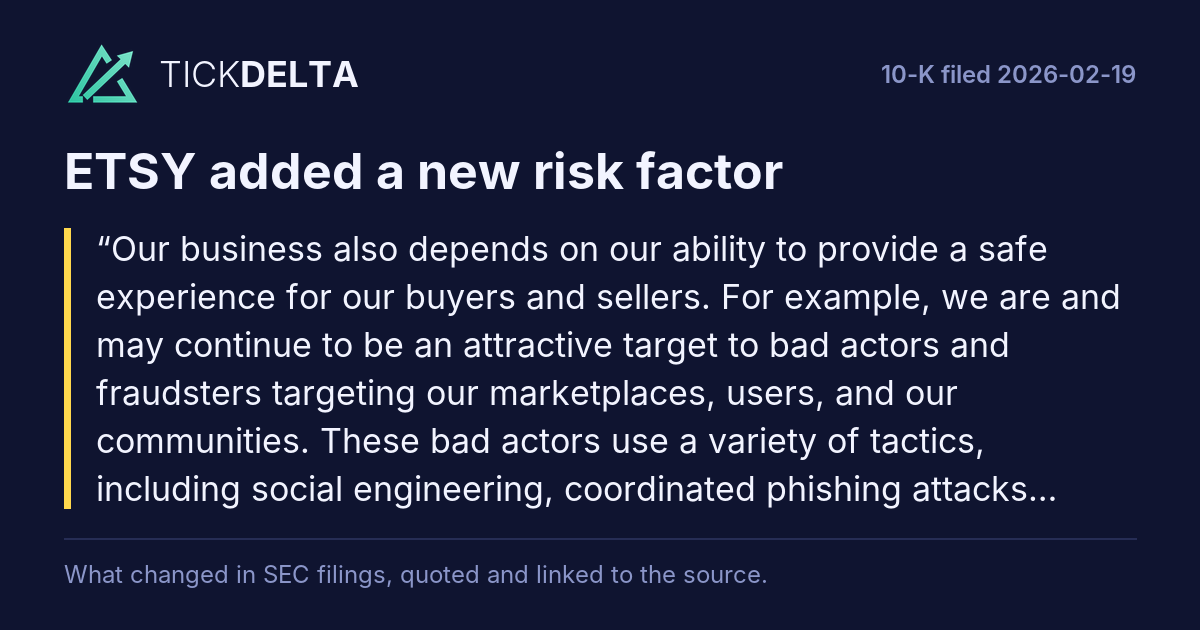
Our business also depends on our ability to provide a safe experience for our buyers and sellers. For example, we are and may continue to be an attractive target to bad actors and fraudsters targeting our marketplaces, users, and our communities. These bad actors use a variety of tactics, including social engineering, coordinated phishing attacks, spam, and website and social media spoofing, which frequently involve attempts to exploit, defraud, obtain financial or other data from our buyers and sellers, or otherwise harm them. These tactics may be amplified by advances in artificial intelligence and generative artificial intelligence, machine learning, and similar tools and technologies (collectively, “AI”), including the use of automated content generation and impersonation techniques.
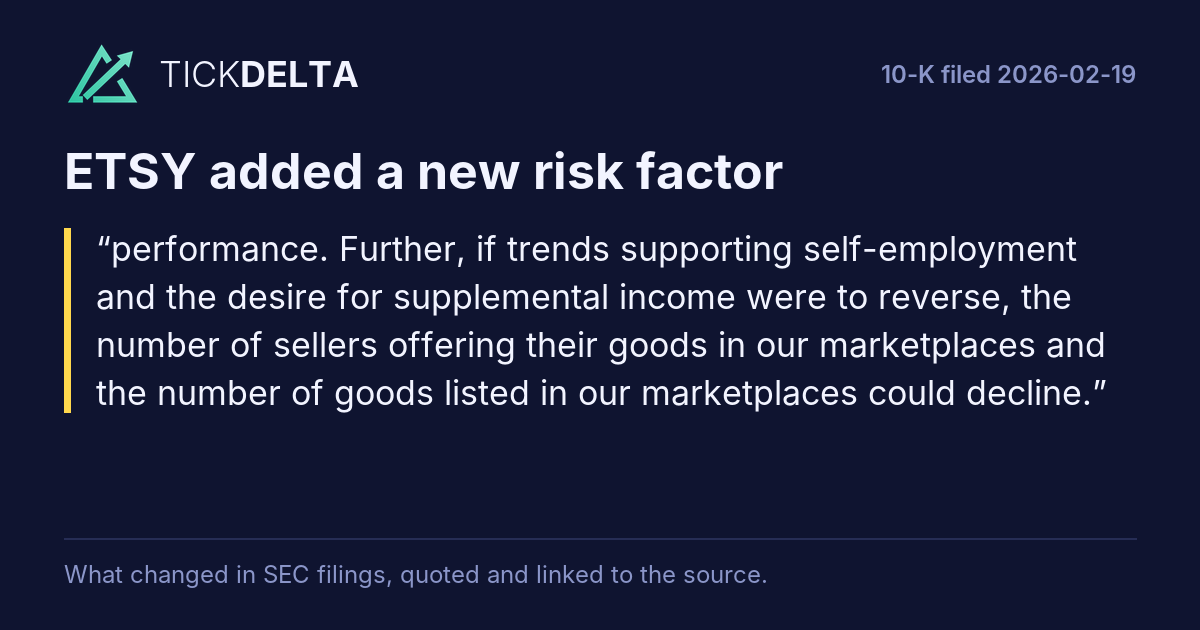
performance. Further, if trends supporting self-employment and the desire for supplemental income were to reverse, the number of sellers offering their goods in our marketplaces and the number of goods listed in our marketplaces could decline.
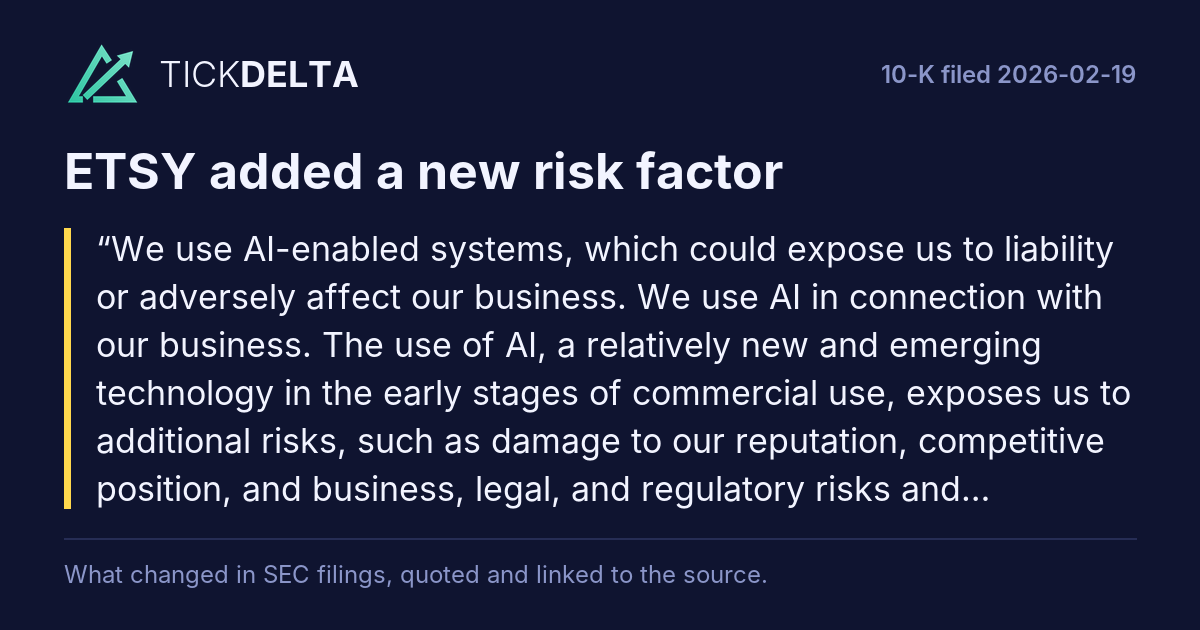
We use AI-enabled systems, which could expose us to liability or adversely affect our business.
We use AI in connection with our business. The use of AI, a relatively new and emerging technology in the early stages of commercial use, exposes us to additional risks, such as damage to our reputation, competitive
position, and business, legal, and regulatory risks and additional costs. For example, generative AI has been known to produce false or “hallucinatory” inferences or output, and certain generative AI uses machine learning and predictive analytics, which can create inaccurate, incomplete, or misleading content, unintended biases and other discriminatory or unexpected results, errors, or inadequacies, any of which may not be easily detectable by us or our related service providers. Accordingly, while AI-enabled applications may help provide more tailored or personalized user experiences, if the content, analyses, or recommendations that AI-enabled applications assist in producing in
our products and solutions are, or are perceived to be, deficient, inaccurate, biased, unethical, or otherwise flawed, our reputation, competitive position, and business may be materially and adversely affected.
Additionally, if any of our employees, contractors, consultants, vendors, or service providers use any third-party AI-enabled systems and software in connection with our business or the services they provide to us, it may lead to the inadvertent disclosure or incorporation of our confidential information into training sets, which may impact our ability to realize the benefit of, or adequately maintain, protect, and enforce our intellectual property or confidential information, harming our competitive position and business. Any outputs that we create using AI-enabled tools may not be subject to copyright protection, which may adversely affect our intellectual property rights in, or ability to commercialize or use, any such content. To the extent that we do not have sufficient rights to use the data or other material or content used in or produced by the AI-enabled systems used in our business, or if we experience cybersecurity incidents in connection with our use or any third party’s use of AI-enabled applications, it could adversely affect our reputation and expose us to legal liability or regulatory risk, including with respect to third-party intellectual property, data privacy, cybersecurity, publicity, contractual or other rights. Further, our competitors or other third parties may incorporate AI into their products more quickly or more successfully than us, which could impair our ability to compete effectively.
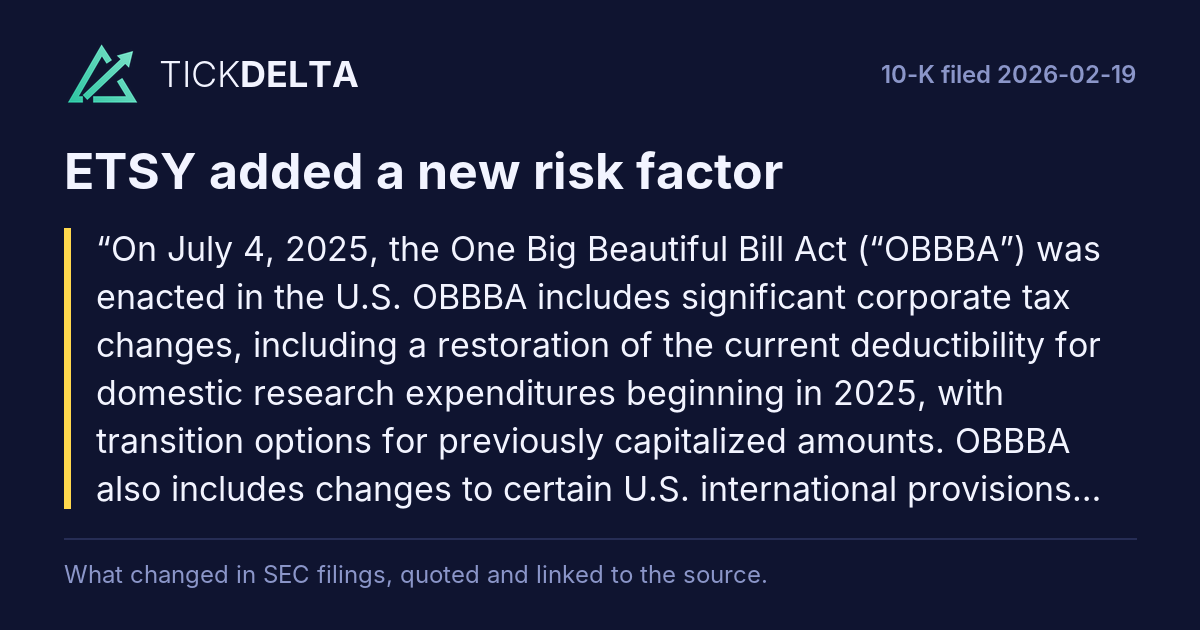
On July 4, 2025, the One Big Beautiful Bill Act (“OBBBA”) was enacted in the U.S. OBBBA includes significant corporate tax changes, including a restoration of the current deductibility for domestic research expenditures beginning in 2025, with transition options for previously capitalized amounts. OBBBA also includes changes to certain U.S. international provisions beginning in 2026. While certain provisions of OBBBA are currently expected to favorably change the timing of our cash tax payments in the near term, we do not expect the legislation to have a material impact on our provision for income taxes. We will continue to assess and monitor OBBBA’s potential impact on our consolidated financial statements.
•the value, awareness, trustworthiness, reputation, and perception of our brands;
•the breadth, value, and quality of items that sellers list in our marketplaces;
Many of our competitors and potential competitors have longer operating histories, greater resources, better name recognition, or more customers than we do. They may invest more to develop and promote their services than we
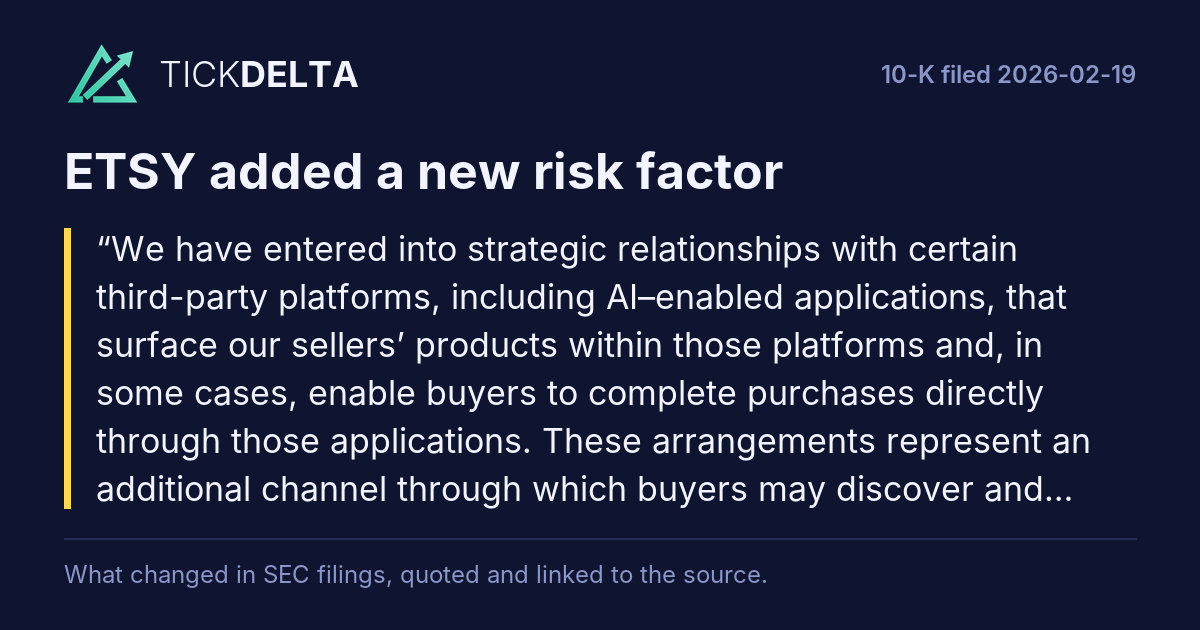
We have entered into strategic relationships with certain third-party platforms, including AI–enabled applications, that surface our sellers’ products within those platforms and, in some cases, enable buyers to complete purchases directly through those applications. These arrangements represent an additional channel through which buyers may discover and purchase items from our sellers, and we rely on these third parties to operate their platforms in a manner that supports accurate product presentation and reliable transaction completion. These platforms are operated by parties outside of our control and may experience outages, disruptions, errors, or changes to functionality, policies, or business practices that could impair product discovery, reduce buyer engagement, or negatively affect the marketing and sale of our sellers’ products. We cannot control the availability of such third-party AI-enabled applications, especially in a highly competitive environment, and we may be unable to negotiate
favorable economic terms with the applicable providers. If any such third-party AI-enabled applications become incompatible with our solutions or unavailable for use, or if the providers of such models unfavorably change the terms on which such AI-enabled platforms are offered or terminate their relationship with us, our solutions may become less appealing to our customers and our business will be harmed.
We do not control the user interface, ranking, prompts, rates of updates or information fields through which our sellers’ products are displayed on these third-party platforms and rely on our partners to surface complete and accurate product information. If product information is displayed inaccurately or incompletely, or if automated or AI–driven outputs produce unexpected results, buyers may have a negative experience or be confused about the source of a transaction. Such outcomes could result in reputational harm, reduced trust in our marketplace, increased customer support costs, or claims from consumers, payments partners/networks, or regulators.
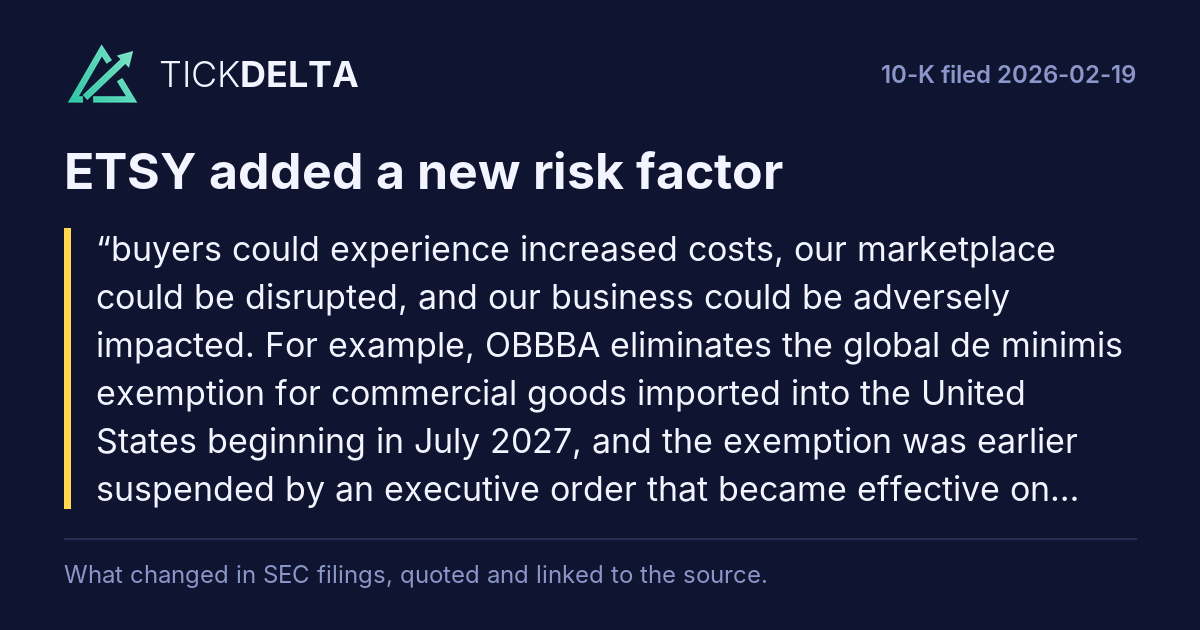
buyers could experience increased costs, our marketplace could be disrupted, and our business could be adversely impacted. For example, OBBBA eliminates the global de minimis exemption for commercial goods imported into the United States beginning in July 2027, and the exemption was earlier suspended by an executive order that became effective on August 29, 2025. This change has impacted certain Etsy orders that were previously able to use the de minimis exemption.
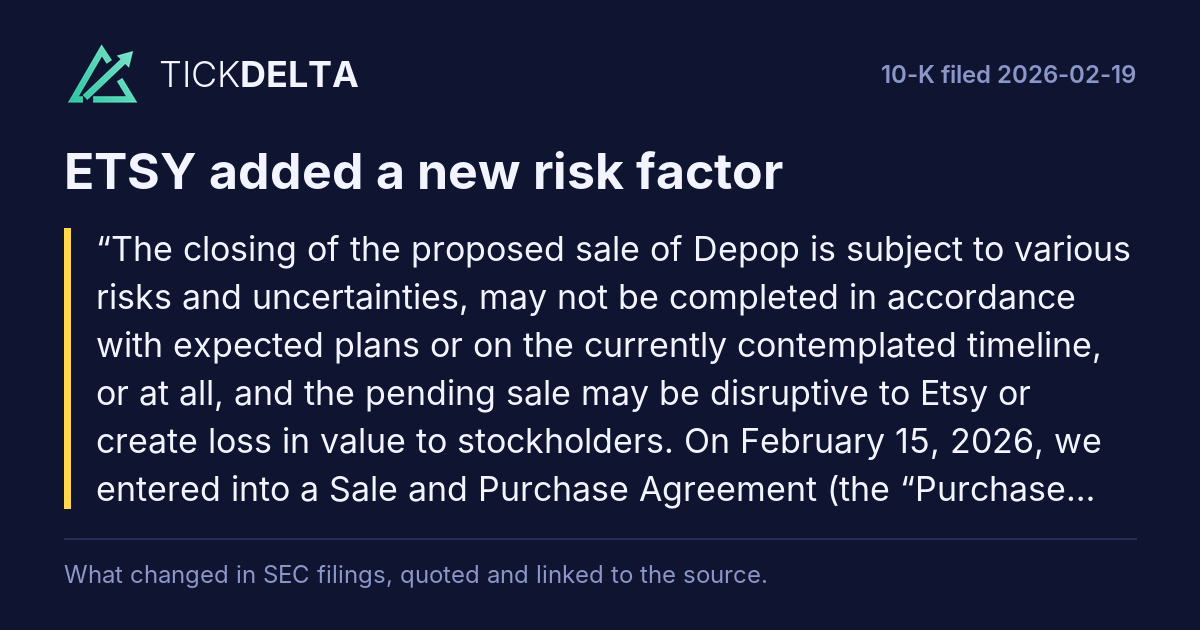
The closing of the proposed sale of Depop is subject to various risks and uncertainties, may not be completed in accordance with expected plans or on the currently contemplated timeline, or at all, and the pending sale may be disruptive to Etsy or create loss in value to stockholders.
On February 15, 2026, we entered into a Sale and Purchase Agreement (the “Purchase Agreement”) to sell Depop to eBay Inc. The sale is currently expected to close in the second quarter of 2026, subject to regulatory approval and certain other closing conditions as set forth in the Purchase Agreement. If the conditions to the closing of the sale of Depop are neither satisfied nor, where permissible, waived on a timely basis or at all, we may be unable to complete the sale of Depop, or such sale may be delayed beyond our expected timeline.
Whether or not the proposed sale of Depop is completed, the pending Depop sale may be disruptive to Etsy. Uncertainties regarding the pending sale of Depop may impair Etsy or Depop’s ability to attract, retain, and motivate key personnel and could divert the attention of Etsy or Depop’s management and other employees from day-to-day business and operations in preparation for the sale. If we are unable to effectively manage these risks, our business, results of operations, financial conditions, and prospects could be adversely affected.
If the proposed sale of Depop is delayed or not completed for any reason, investor confidence could decline, and we could face negative publicity and potential litigation. In addition, in the event of a failed sale, we will have expended significant management resources in an effort to complete the sale and, although in some circumstances the buyer may be obligated to pay us a termination fee of $90 million, we will have incurred significant transaction costs. The Purchase Agreement also provides that, upon certain termination events, eBay will be required to pay Etsy an additional termination fee of $70 million. Further, in the event of a failed sale, we may need to spend significant resources to reintegrate the Depop business, and we could face a loss in the value of our stock price if a failed transaction is negatively perceived by investors. Accordingly, if the proposed sale of Depop is not completed on the terms set forth in the Purchase Agreement, or at all, our business, results of operations, financial condition, cash flows, and stock price may be adversely affected.
in which we report, or we fail to demonstrate that our commitment to our Impact strategy enhances our overall financial performance.
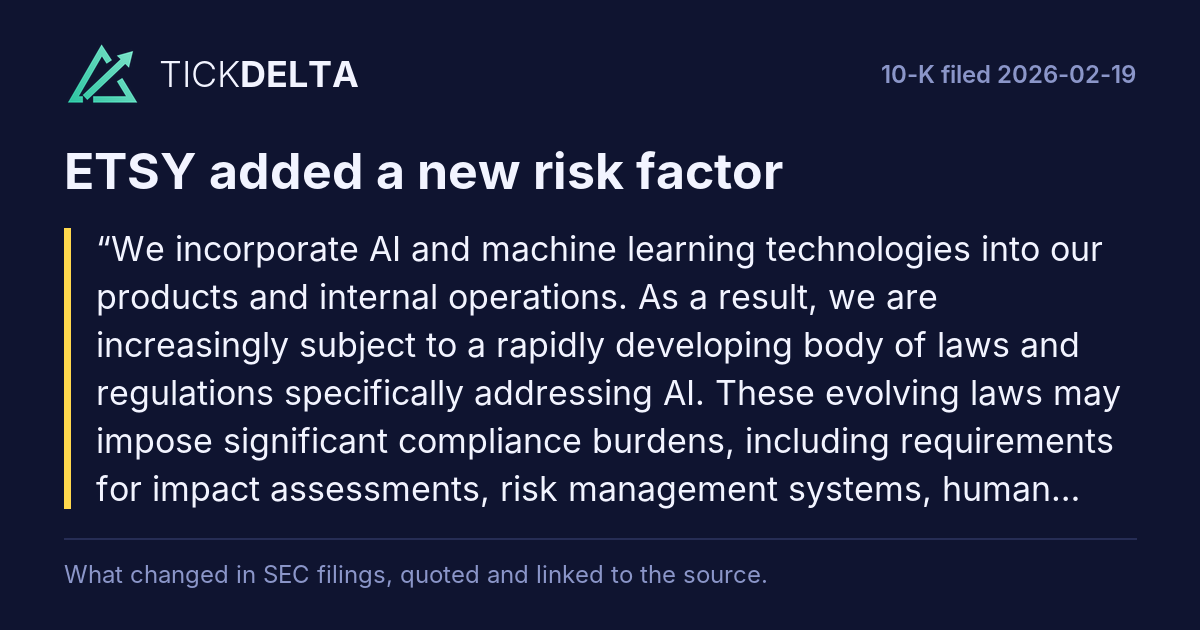
We incorporate AI and machine learning technologies into our products and internal operations. As a result, we are increasingly subject to a rapidly developing body of laws and regulations specifically addressing AI. These evolving laws may impose significant compliance burdens, including requirements for impact assessments, risk management systems, human review of AI outputs, and disclosures to users. Moreover, because these technologies are themselves highly complex and rapidly developing, it is not possible to predict all of the legal or regulatory risks that may arise relating to our use of such technologies. Our failure to comply with these emerging AI laws and regulations could result in significant fines, restrictions on the deployment or use of AI systems, reputational harm, and legal liability.
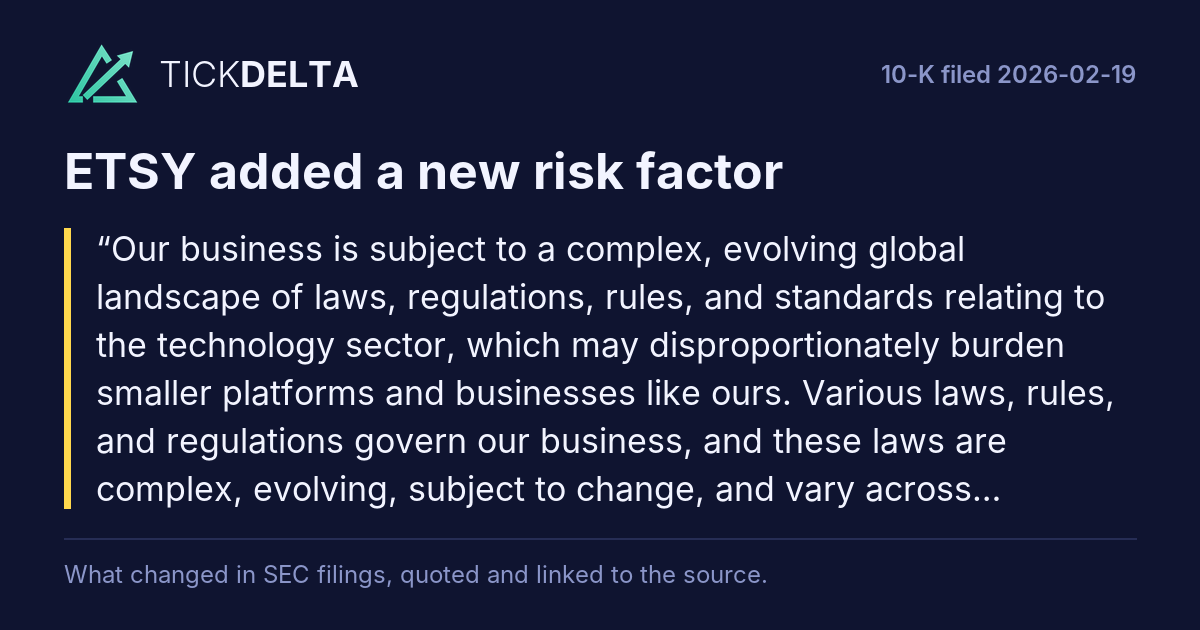
Our business is subject to a complex, evolving global landscape of laws, regulations, rules, and standards relating to the technology sector, which may disproportionately burden smaller platforms and businesses like ours.
Various laws, rules, and regulations govern our business, and these laws are complex, evolving, subject to change, and vary across jurisdictions in the United States and globally. These regimes cover diverse areas, including payments services, platform obligations and liability, marketplace regulation, artificial intelligence, data protection, cybersecurity, product safety, online and minors’ safety, consumer protection, intellectual property, anti-money laundering, taxation, and competition. As the technology sector faces increased scrutiny, new legislation, and regulatory inquiries—even those targeted at the largest technology platforms—may disproportionately burden smaller platforms and businesses, including Etsy and our sellers.
These evolving laws and regulations create significant legal and financial risks, compliance obligations, and complexity for our products and business. For example, regulations such as the U.S. Integrity, Notification, and Fairness in Online Retail Marketplaces for Consumers Act (INFORM), the Digital Services Act (DSA), the General Product Safety Regulation, and the U.K. Online Safety Act subject Etsy to obligations with respect to seller verification, minors’ safety, product safety, and consumer protection, among other things, and in many cases impose
obligations and requirements on our sellers or third-party vendors and service providers. Similarly, there are and have been various efforts, both in the U.S. and internationally, to impose more obligations on platforms with respect to product and user safety and intellectual property, for example, and to restrict the scope of intermediary liability protections or roll back safe harbors that are available to online platforms that host third-party content. These evolving laws and regulations, including regulatory and court interpretations of them, may subject us to legal and financial exposure, and may require us to implement costly compliance measures, restrict sellers’ ability to ship into certain jurisdictions, modify our products and services, or change how and/or where we operate our business. They also could impose requirements that our sellers find difficult or impossible to meet, which in turn, could drive sellers away from our platform or require us to refuse service to them.
Our payments systems are also subject to complex and evolving financial regulations and obligations. We act as a regulated payment institution in the European Economic Area through our subsidiary Etsy Payments Ireland Limited, we are registered as a payments services provider in Canada through our subsidiary Etsy Canada Limited, and we may in the future apply for registration or licensure in additional jurisdictions. Each authorization subjects us to additional regulation, compliance burdens, and oversight. Further, through our agreements and arrangements with our third-party payments service providers, we are subject to evolving rules and requirements, like the Visa and Mastercard network rules and Payment Card Industry Data Security Standard, rules governing electronic funds transfers, and various fee arrangements, all of which are subject to change in ways that may adversely affect our business.
If we, our sellers, or our third-party service providers fail to comply with applicable legal, regulatory, licensure, registration, contractual, or other requirements, including judicial and regulatory interpretations of those requirements, we could face substantial fines, liabilities, litigation, enforcement actions, reputational damage, and/or be forced to substantially change, curtail, or suspend our services or features in key markets. We and our sellers could similarly be harmed by changes to rules and regulations that affect our business, or changes to the rules and fees imposed by our third-party payment partners or payment card providers. Additionally, compliance with these evolving regimes may require significant investment of resources, necessitate changes to our business model and offerings, reduce the attractiveness of our platforms for buyers and sellers, increase our costs, or make our business less profitable.
New in the latest 10-Q
16 paragraphs in the 10-Q filed Oct 28, 2026 with nothing like them in the 10-Q filed Aug 5, 2026 (at least half the words must differ; new numbers alone do not count). Quoted exactly, grouped by the item heading above them. This is text that changed, not a judgement of how serious it is.
As previously disclosed, on February 15, 2026, the Company executed a Sale and Purchase Agreement, as supplemented on May 21, 2026 and as amended on July 12, 2026 (collectively, the "Purchase Agreement"), to sell all of the outstanding equity interests of Depop to eBay Inc. ("eBay"), a Delaware corporation. The Company entered into the Purchase Agreement in an effort to focus on driving growth in the core Etsy marketplace.
Read in the 10-Q
The gain on sale includes aggregate cash consideration of $ 1.4 billion less (i) derecognition of Depop net assets of $ 313.1 million; (ii) a reclassification out of accumulated other comprehensive loss of $ 236.4 million related to cumulative translation adjustment associated with Depop, which was a non-cash component of the gain on sale; and (iii) costs incurred to sell the business of $ 10.7 million.
Read in the 10-Q
Net cash provided by investing activities of discontinued operations for the nine months ended September 30, 2026 includes $ 1.4 billion of proceeds from the sale of Depop, net of $ 78.8 million of cash and cash equivalents.
Read in the 10-Q
The following table is a summary of the changes in the Company’s liability for severance, employee benefits, and related costs associated with the Restructuring Plan, included in accrued expenses in the Consolidated Balance Sheet (in thousands):
Read in the 10-Q
Restructuring and Other Exit Costs Balance as of December 31, 2025 $ — Severance and employee-related benefits 33,864 Cash payments (27,349) Balance as of September 30, 2026 $ 6,515
Read in the 10-Q
Payments related to the Restructuring Plan are included within net cash provided by operating activities of continuing operations within the Condensed Consolidated Statement of Cash Flows for the nine months ended September 30, 2026.
Read in the 10-Q
(1) Percent U.S. Buyer GMS - Etsy marketplace was 74% for nine months ended September 30, 2025.
Read in the 10-Q
(1) As reported and currency-neutral GMS for the Etsy marketplace declined (2.4)% and (3.2)%, respectively, for the three months ended September 30, 2025. This resulted in an FX impact of 0.8%.
Read in the 10-Q
General and administrative expenses for the three months ended September 30, 2026 were flat when compared to the three months ended September 30, 2025.
Read in the 10-Q
On October 1, 2026, we paid $10.8 million in cash and recorded $1.3 million to additional paid-in capital to settle conversion notices of $12.1 million aggregate principal amount of outstanding 2019 Notes and paid $637.8 million in cash to settle the remaining aggregate principal amount of our outstanding 2019 Notes. The 2019 Capped Call Transactions expired on September 29, 2026, the second scheduled trading day immediately preceding the October 1, 2026 maturity date of the 2019 Notes. The 2019 Capped Call Transactions expired unexercised, and no shares of our common stock or cash were delivered to us. Our ability to pay our debt when due or to refinance our outstanding indebtedness, including the 2020 Notes, the 2021 Notes, and the 2025 Notes depends on our future performance, which is subject to economic, financial, competitive, and other factors beyond our control. See Part II, Item 1A, “Risk Factors.”
Read in the 10-Q
Net cash provided by (used in) investing activities of discontinued operations primarily consists of cash inflows of $1.4 billion from the sale of Depop, net of cash sold of $78.8 million, in the third quarter of 2026.
Read in the 10-Q
expand our technology infrastructure or supply chain successfully, then our ability to run our marketplace could be significantly impacted, which could harm our business.
Read in the 10-Q
Our ability to pay our debt when due or to refinance our outstanding indebtedness, including the 2020 Notes, the 2021 Notes, and the 2025 Notes, depends on our future performance, which is subject to economic, financial, competitive, and other factors beyond our control. Our business may not continue to generate cash flow from operations in the future sufficient to service our debt and make necessary capital expenditures. While we used a portion of the net proceeds from certain of the Notes offerings to enter into separate privately negotiated capped
Read in the 10-Q
• U.S. state laws governing the processing of biometric information, broadly defined, as well as laws governing our use of cookies, trackers, web beacons, and similar technologies.
Read in the 10-Q
we gain greater public recognition and scale worldwide, we may face a higher risk of being the subject of intellectual property claims.
Read in the 10-Q
regulatory developments, and the prevailing price and trading volumes of our common stock. If our financial condition deteriorates or we decide to use our cash for other purposes, we may suspend repurchase activity at any time.
Read in the 10-Q
Item 1A of the 10-Q filed Oct 28, 2026 against Item 1A of the 10-K filed Feb 19, 2026.
A 10-Q repeats only the risks that changed, so a 10-K paragraph that is missing from it is not counted as removed.
Added is a paragraph with nothing like it in the 10-K, Reworded a sentence that is in both with several words changed,
Quiet changes a sentence in both where one to four words changed and one is a hedge or a modal
(cut words struck through, new words highlighted).
Text on the page, not a score; each links to the filing at sec.gov.
The first 21 of 65 are shown (at most 12 of each type).
Two-word phrases in Risk Factors of the 10-K filed Feb 19, 2026 that are in none of the 1 earlier 10-Ks stored, back to Feb 19, 2025
Used at least twice, small words left out. Counted, not picked: a phrase can be new because the company renamed something.
26 paragraphs of last year's Risk Factors with nothing like them now. The longest are quoted.
Item 1A of each 10-K and 10-Q on EDGAR, quoted exactly. Each paragraph links to the filing at sec.gov.
10-K change: what was reworded or cut, section by section.
Excel workbook · CSV. Google Sheet that stays up to date: paste =IMPORTDATA("https://tickdelta.com/company/ETSY/export.csv") into a cell.