Screener / SEC EDGAR /CIK 0000939767 /10-K filed Feb 10, 2026, compared with Feb 11, 2025 /Numbers from the XBRL of the 10-Ks
Nasdaq Health care · Biotechnology

Exelixis, Inc. EXEL

Compare with peers Embed
The 10-K against last year's

186 changes: 32 added, 30 removed, 120 reworded, 4 quiet changes

10-K Feb 10, 2026 vs Feb 11, 2025

10-K 0000939767-26-000021 (Feb 10, 2026) vs 10-K 0000939767-25-000019 (Feb 11, 2025)

Every paragraph, and how much of it changed

One bar per paragraph, in the order of the 10-K. Height and colour show the share of its words not in the closest paragraph a year earlier; the tallest bars are new paragraphs.

Risk Factors

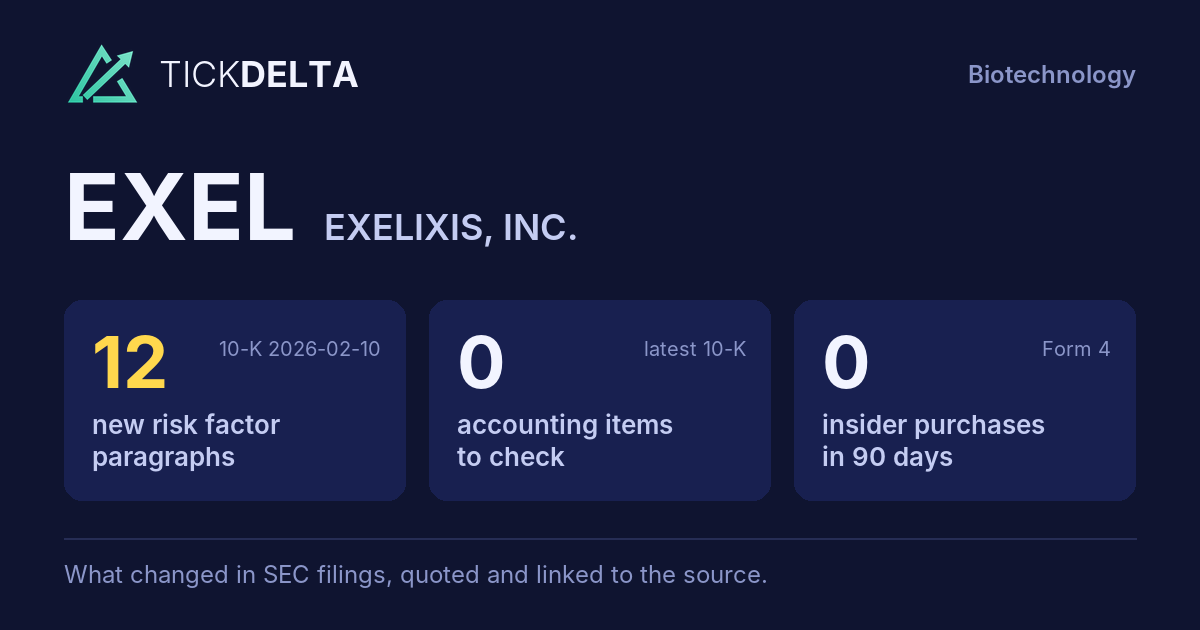
171 paragraphs · 12 new · 57 reworded · 6 gone · 10-K Feb 10, 2026 against Feb 11, 2025
New paragraph Reworded (5% of its words or more) Same or nearly
Paragraph 41 · 49% changed Every version of it
Act if they improperly list patents in the Orange Book, and it subsequently initiated, and continues to initiate, challenges against patents held by brand pharmaceutical companies and listed in the Orange Book under the FDA’s patent listing dispute process. In December 2024, the Federal Circuit ruled that, to be listed in the Orange Book, a patent must claim the active ingredient of the drug product. If affirmed on appeal, this This decision may limit the number of patents brand pharmaceutical companies may list in the Orange Book. In April 2025, the U.S. administration issued an executive order that, among other things, directs the FDA to issue a report with recommendations to accelerate the approval of generics, biosimilars, combination products, and second-in-class brand name medications, and, in October 2025, the FDA announced a pilot prioritization program that makes generic drugs for which required bioequivalence testing is conducted in the U.S. and that are made in the U.S. using domestic sources for active pharmaceutical ingredient(s) eligible for priority review. It remains to be seen what effect these may have on potential generic competition for our products, if any.
Paragraph 106 · 38% changed Every version of it
Our third-party contract manufacturers may not be able to produce or deliver material on a timely basis or manufacture material with the required quality standards, or in the quantity required to meet our preclinical, clinical development and commercial needs and applicable regulatory requirements. Although we have not yet experienced significant production delays or seen significant impairment to our supply chain as a result of the ongoing hostilities conflicts between Russia and Ukraine and in Eastern Europe and the Middle East East, the political, economic and social instability in Venezuela or other global events, including as a result of tariffs or the imposition of new tariffs, trade wars, barriers, restrictions, or threats of such actions and the related uncertainty thereof, our third-party contract manufacturers, distributors and suppliers could experience operational delays due to lack of capacity or resources, facility closures and other hardships as a result of these types of global events, which could impact our supply chain by potentially causing delays to or disruptions in the supply of our preclinical, clinical or commercial products. If our third-party contract manufacturers, distributors and suppliers do not continue to supply us with our products or product candidates in a timely fashion and in compliance with applicable quality and regulatory requirements, or if they otherwise fail or refuse to comply with their obligations to us under our manufacturing, distribution and supply arrangements, we may not have adequate remedies for any breach. Furthermore, their failure to supply us could impair or preclude meeting commercial or clinical product supply requirements for us or our partners, which could delay product development and future commercialization efforts and have a material adverse impact on our business, financial condition and results of operations. In addition, through our third-party contract manufacturers and data service providers, we continue to provide serialized commercial products as required to comply with the DSCSA and its foreign equivalents where applicable. If our third-party contract manufacturers or data service providers fail to support our efforts to continue to comply with DSCSA and its foreign equivalents, as well as any future electronic pedigree requirements, we may face legal penalties or be restricted from selling our products.
Paragraph 115 · 36% changed Every version of it
•state and federal pharmaceutical price and price reporting laws and regulations; regulations, including the provisions enacted through the IRA;
Paragraph 171 · 36% changed Every version of it
could have a material adverse impact on our business, including specifically market perception and the market price of our common stock. Such risks may be outside of our control and the criteria by which our ESG practices and disclosures are assessed may change due to the evolving regulatory requirements affecting ESG standards and disclosures, which could result in increased changed expectations for us with respect to ESG matters (including those in support of or in opposition to ESG principles). In addition, state attorneys general and cause us other governmental authorities may take action against certain ESG policies or practices, and we may become subject to undertake costly initiatives to satisfy such new criteria. restrictions on ESG initiatives. Our failure or perceived failure to pursue or achieve our ESG objectives, or to maintain our ESG practices that meet evolving stakeholder expectations or expanding legal requirements, requirements (which are continually evolving and may emphasize different priorities than the ones we focus on or none at all), could have a material adverse impact on our market perception and stock price, as well as expose us to government enforcement actions and private litigation.
Paragraph 4 · 35% changed Every version of it
We anticipate that for the foreseeable future, our ability to maintain or meaningfully increase cash flow to fund our business operations and growth will depend upon the continued commercial success of CABOMETYX, both alone and in combination with other therapies, as a treatment for the highly competitive indications for which it is approved, and possibly for other indications for which cabozantinib is currently being or will be evaluated in potentially label-enabling clinical trials, if warranted by the data generated from these trials. In this regard, part of our strategy is to pursue additional indications for CABOMETYX and increase the number of cancer patients who could potentially benefit from this medicine. However, we We cannot be certain that the these clinical trials we and our collaboration partners are conducting will demonstrate adequate safety and efficacy in these additional indications to receive regulatory approval in the major commercial markets where CABOMETYX is approved. Even approval, and even if the required regulatory approvals to market CABOMETYX for additional indications are achieved, we and our collaboration partners may not be able to commercialize CABOMETYX effectively and successfully in these additional such indications. If revenue from CABOMETYX decreases or remains flat, or if we are unable or our collaboration partners fail to expand the achieve anticipated product royalties and collaboration milestones, we may need to reduce our operating expenses, access other sources of cash or otherwise modify our business plans, which could have a material adverse impact on our business, financial condition and results of operations.
Paragraph 66 · 35% changed Every version of it
Any clinical trial may fail to produce results satisfactory to the FDA or regulatory authorities in other jurisdictions. The FDA has substantial discretion in the approval process and may refuse to approve any NDA or sNDA or require additional preclinical, clinical, safety or other non-clinical studies. In addition, policy-based activities could delay the approval of an application for cabozantinib, zanzalintinib, or our other product candidates. For example, the FDA’s OCE has many initiatives aimed at improving oncology drug development, some of which may lead to the need for additional studies, such as dose optimization. Many of these initiatives are based on guidance issued by OCE. If the FDA chooses to withdraw those guidance documents for any reason it may affect our ability to gain regulatory approval based on studies that relied on those guidance documents. The FDA also continues to develop and finalize guidance documents that further refine the development process for oncology drug products. products, although the FDA’s rate of issuing guidance has slowed significantly under the current U.S. administration. And, as this market expands, it becomes increasingly difficult to demonstrate benefit over the standard of care, which can be a hurdle for approval. Moreover, the development of our product candidates may be delayed by other events beyond our control. For example, action by the new Trump Administration current U.S. administration to further limit federal agency budgets or personnel, may result in reductions to the FDA’s budget, employees, workforce, and operations, which may lead to slower response times and longer review periods, potentially affecting our ability to progress development of our product candidates or obtain regulatory approval for our product candidates. Pursuant to a February 2025 executive order on workforce optimization, on March 27, 2025, the HHS announced that it was initiating a restructuring of the department, including reducing the FDA’s workforce by approximately 3,500 full-time employees, which began on April 1, 2025. The termination of these employees has been preceded and accompanied by the resignation of senior and mid-level leaders within the FDA, which could result in the potential loss of certain institutional knowledge and experience. Terminations, and resignations at the FDA have continued and there has been notable turnover and instability in key leadership positions. Although the full impact of these events remains unclear, there could be an adverse effect on the FDA’s ability to efficiently carry out its functions, including conducting inspections and timely reviewing drug product applications, and a potential impact on how it interprets and enforces its authorities, which may be also exacerbated by other events, such as a U.S. federal government shutdown. Further, ongoing deregulation and transparency efforts at the FDA could create regulatory uncertainty for biopharmaceutical companies. Additionally, uncertainty remains as to how the FDA’s use of artificial intelligence (AI) and deployment of agentic AI capabilities, including for review of drug product applications, will impact the outcomes and timeliness of FDA reviews and other activities.
Paragraph 21 · 34% changed Every version of it
The IRA, which, among other things: enables CMS to assert control over the prices of certain single-source drugs and biotherapeutics reimbursed under the Medicare Drug Price Negotiation Program; subjects drug manufacturers to potential civil monetary penalties and a significant excise tax for offering a price that is not equal to or less than the government-imposed MFP under the law; imposes Medicare rebates for certain Part B and Part D drugs where relevant pricing metrics associated with the products increase faster than inflation; and redesigns the funding and benefit structure of the Medicare Part D program, potentially increasing manufacturer liability while capping annual out-of-pocket drug expenses for Medicare beneficiaries. These provisions started taking effect incrementally in late 2022 and currently are subject to various legal challenges. As of the date of this report, for example, CMS has begun to implement aspects of the IRA and finalized regulations addressing the Medicare Part B and Medicare Part D inflation rebate provisions of the IRA. These provisions generally require manufacturers of Medicare Part B and Part D rebatable drugs to pay inflation rebates to the Medicare program if pricing metrics associated with their products increase faster than the rate of inflation. In addition, in October 2024, September 2025, CMS released issued final guidance setting forth the requirements and procedures for implementing the Medicare Drug Price Negotiation Program for the second third round of drug pricing evaluations (which commences (for which the next 15 selected products were announced January 27, 2026, with negotiations to follow over the course of the year, resulting in 2025 and will result in maximum fair prices MFPs that will become effective beginning in 2027), 2028), as well as requirements for manufacturers effectuating MFPs in effectuating maximum fair prices in 2026 2026, 2027, and 2027. 2028. The IRA also contains the limited small biotech exception, which applies on a drug-specific basis. Qualifying drugs may be exempt from possible pricing negotiation through 2028 and eligible for a lower limit (i.e., a price floor) on the potential maximum fair price MFP in 2029 and 2030, if the manufacturers of those drugs continue to qualify each year. We have qualified for the small biotech exception with respect to our cabozantinib franchise products through 2027. We intend to apply to CMS to maintain Initial Price Applicability Year (IPAY) 2027, and we reapplied for the small biotech exception through 2030. In January for IPAY 2028. Additionally, in July 2025, Congress enacted legislation that expands the orphan drug exclusion under the IRA. Starting with price evaluations for 2028, CMS announced the list cannot select a drug if all of 15 drugs selected its approved indications are for rare diseases or conditions. Moreover, if a drug no longer qualifies for the second round orphan drug exclusion because it is approved for a non-rare disease or condition, the 7-year or 9-year timeline before it may be selected will begin upon approval of the drug pricing evaluations. for such non-rare disease or condition. Separately, in November 2023, December 2024, CMS released final guidance on the Part D Discount Program, which will require requires manufacturers to take on more of the beneficiary cost previously subsidized by the federal government through the application of increased drug discounts. As we received notice from CMS that we qualify for the "specified small manufacturer” designation, we are eligible for a phase-in of the increased manufacturer discounts under the Part D Discount Program from 2025 to 2031. Beginning in In November 2025, we will be required to pay CMS issued a 1% discount in proposed rule on the initial and catastrophic phases, and provided that we maintain the specified small manufacturer designation, we will be required to increase our rebates to Part D payers until we are required to pay Discount Program that largely codifies the full 10% discount (initial phase) in 2029 and the 20% discount (catastrophic phase) in 2031. final guidance. In April 2025, CMS is also in the process of finalized regulations implementing the Medicare Prescription Payment Plan, under which Medicare Part D beneficiaries may opt to make their cost-sharing payments in capped monthly installments; CMS expects that this program will most likely benefit those beneficiaries with high cost-sharing early in their respective plan years.
Paragraph 29 · 33% changed Every version of it
In addition, certain a growing number of states have also enacted laws requiring manufacturers to provide the 340B Program pricing through contract pharmacy arrangements; arrangements, and additional states may adopt similar laws. We believe these laws laws, which are also being challenged in ongoing litigation. litigation, are invalid or are otherwise inapplicable to our 340B Program Integrity Initiative, but we have carved out covered entities in certain states while litigation challenging these laws proceeds. We also believe that our 340B Program Integrity Initiative complies with the 340B Program statute, as supported by the federal appellate court decision decisions in Sanofi Aventis U.S. LLC v. United States Department of Health and Human Services (U.S. Court of Appeals for the Third Circuit) and Novartis v. Johnson, and that Johnson (U.S. Court of Appeals for the state laws regarding contract pharmacy arrangements are invalid or are otherwise inapplicable to our 340B Program Integrity Initiative. With particular respect to AR Act 1103 (the Arkansas law concerning the 340B Program contract pharmacy arrangements), following the federal appellate court ruling in Pharmaceutical Research and Manufacturers District of America v. McClain, we are voluntarily complying with AR Act 1103 and certain other state laws. Columbia).

MD&A

144 paragraphs · 20 new · 74 reworded · 24 gone · 10-K Feb 10, 2026 against Feb 11, 2025
New paragraph Reworded (5% of its words or more) Same or nearly
Paragraph 75 · 49% changed
Collaboration services revenues include the recognition Recognition of deferred revenues for the portion of upfront and milestone payments that have been allocated to research and development services performance obligations, development cost reimbursements earned under our collaboration agreements obligations were not material for the year ended December 31, 2025 and product supply revenues, which are net of product supply costs and the royalties we pay to Royalty Pharma on sales by Ipsen and Takeda of products containing cabozantinib. 2024, respectively.
Paragraph 74 · 48% changed
Development cost reimbursements were $25.8 $3.7 million for the year ended December 31, 2024, 2025, as compared to $35.6 $25.8 million for 2023. 2024. The decrease in development cost reimbursements during the year ended December 31, 2024 were 2025 was primarily attributable due to decreases a decrease in spending on the CONTACT-02, CheckMate -9ER and COSMIC-021 studies, partially offset by Ipsen’s decision studies evaluating cabozantinib that are subject to opt-in and co-fund CABINET development costs in the second quarter of 2024, which includes a cumulative catch-up for Ipsen’s share of global development costs incurred since the beginning of the study and through the opt-in date. reimbursement.
Paragraph 34 · 47% changed
•In January May 2025, we presented preliminary results from a randomized an expansion cohort of patients with metastatic CRC previously untreated advanced ccRCC from STELLAR-001, and results STELLAR-002, along with data from a subgroup analysis of patients in the epNET cohort with advanced gastrointestinal NET in CABINET, were presented multiple dose-escalation cohorts, at the ASCO GI 2025.
Paragraph 110 · 46% changed
The Tax Cuts and Jobs Act, signed into law on December 22, 2017, modified the tax treatment of research and development experimental (R&E) expenditures beginning in fiscal year 2022. Research and development expenditures are no longer currently deductible but instead 2022, requiring that they must be capitalized and amortized ratably over five years for domestic R&E expenditures or 15 years for foreign R&E expenditures. As a result, we generated a higher The One Big Beautiful Bill Act (OBBBA) was signed into law on July 4, 2025, which, among other provisions, permanently repeals the requirement to capitalize domestic R&E expenditures for federal income tax liability in purposes for taxable years beginning after December 31, 2024, and allows for the accelerated deduction of any remaining unamortized domestic R&E expenditures. Foreign R&E expenditures are still required to be capitalized and amortized ratably over 15 years. The federal cash tax benefit for this provision of the OBBBA was $191 million for our fiscal year 2024, which required higher estimated federal tax payments by 2025, with no corresponding impact to the end of 2024. We will realize a reduction of our federal income tax liability in future years as the capitalized research and development expenditures are amortized for tax purposes. provision.
Paragraph 64 · 43% changed
We recognize product revenues net of discounts and allowances that are described in “Note 1. Organization and Summary of Significant Accounting Policies” of the “Notes to Consolidated Financial Statements” in Part II, Item 8 of this Annual Report on Form 10-K. Discounts and allowances have generally increased over time as the number of patients participating in government programs has increased and as the discounts given and rebates paid to government payers have also increased. The increase in the amount of discounts and allowances for the year ended December 31, 2024, 2025, as compared to 2023, 2024, was primarily the result of an increase in the volume of units sold, and the increase in utilization and dollar amount of chargebacks under the Federal Supply Schedule 340B Drug Pricing program.
Paragraph 8 · 42% changed
The IRA introduced numerous substantial changes to drug pricing, reimbursement and access support in the U.S., including enabling the CMS to assert control over the prices of certain single-source drugs and biotherapeutics reimbursed under the Medicare Drug Price Negotiation Program. CMS has begun to announce rounds of drugs eligible for negotiation and establish so-called MFP under the Medicare Drug Price Negotiation Program. The IRA also contains the limited small biotech exception. As exception, which applies on a drug-specific basis, and provides that qualifying drugs will be exempt from possible pricing negotiation through 2028 and eligible for a lower limit (i.e., a price floor) on the potential MFP in 2029 and 2030, if the manufacturers of the date of this Annual Report on Form 10-K, CMS has informed us that we those drugs continue to qualify each year. We have qualified for the small biotech exception with respect to our cabozantinib franchise products through 2027 and we intend to apply to CMS to maintain the small biotech exception each year through 2030. Separately, in November 2023, CMS released final guidance on another program, the Part D Discount Program, which will require manufacturers to take on more of the beneficiary cost previously subsidized by the federal government through the application of increased drug discounts. We have since received notice from CMS that we qualify for the "specified small manufacturer” designation and are thereby eligible for a phase-in of the increased manufacturer discounts under the Part D Discount Program, from 2025 to 2031. We expect the increase in manufacturer
Paragraph 69 · 42% changed
•For the year ended December 31, 2023, $10.0 2025, milestone revenues included $4.7 million in license revenues was recognized in connection with a commercial $5.0 million regulatory milestone payment from Ipsen, upon approval by the EC for the treatment of $11.0 million from Takeda upon their achievement of $150.0 million of cumulative net sales of cabozantinib in Japan. patients with either advanced pNET or advanced epNET.
Paragraph 98 · 41% changed
We project our selling, general and administrative expenses may increase in fiscal year 2025, 2026, as compared to 2024, 2025, as a result of an increase increases in personnel expenses for the Branded Prescription Drug Fee due to higher revenues salesforce expansion in support for the commercial sale of CABOMETYX for the treatment of patients with previously treated advanced NET, marketing activities in support of the anticipated commercial launch of zanzalintinib and an increase in marketing legal and advisory fees.

A paragraph is matched with the one last year that shares the most of its words; under half in common makes it new. The paragraphs shown are the 8 reworded the most in each section.

The paragraph that changed most in each section

The redline

Marked against last year's 10-K: cut words struck through, new words highlighted.

Risk Factors401 words changed in this paragraph; it is 59% similar to last year's version.
The IRA, which, among other things: enables CMS to assert control over the prices of certain single-source drugs and biotherapeutics reimbursed under the Medicare Drug Price Negotiation Program; subjects drug manufacturers to potential civil monetary penalties and a significant excise tax for offering a price that is not equal to or less than the government-imposed MFP under the law; imposes Medicare rebates for certain Part B and Part D drugs where relevant pricing metrics associated with the products increase faster than inflation; and redesigns the funding and benefit structure of the Medicare Part D program, potentially increasing manufacturer liability while capping annual out-of-pocket drug expenses for Medicare beneficiaries. These provisions started taking effect incrementally in late 2022 and currently are subject to various legal challenges. As of the date of this report, for example, CMS has begun to implement aspects of the IRA and finalized regulations addressing the Medicare Part B and Medicare Part D inflation rebate provisions of the IRA. These provisions generally require manufacturers of Medicare Part B and Part D rebatable drugs to pay inflation rebates to the Medicare program if pricing metrics associated with their products increase faster than the rate of inflation. In addition, in October 2024, September 2025, CMS released issued final guidance setting forth the requirements and procedures for implementing the Medicare Drug Price Negotiation Program for the second third round of drug pricing evaluations (which commences (for which the next 15 selected products were announced January 27, 2026, with negotiations to follow over the course of the year, resulting in 2025 and will result in maximum fair prices MFPs that will become effective beginning in 2027), 2028), as well as requirements for manufacturers effectuating MFPs in effectuating maximum fair prices in 2026 2026, 2027, and 2027. 2028. The IRA also contains the limited small biotech exception, which applies on a drug-specific basis. Qualifying drugs may be exempt from possible pricing negotiation through 2028 and eligible for a lower limit (i.e., a price floor) on the potential maximum fair price MFP in 2029 and 2030, if the manufacturers of those drugs continue to qualify each year. We have qualified for the small biotech exception with respect to our cabozantinib franchise products through 2027. We intend to apply to CMS to maintain Initial Price Applicability Year (IPAY) 2027, and we reapplied for the small biotech exception through 2030. In January for IPAY 2028. Additionally, in July 2025, Congress enacted legislation that expands the orphan drug exclusion under the IRA. Starting with price evaluations for 2028, CMS announced the list cannot select a drug if all of 15 drugs selected its approved indications are for rare diseases or conditions. Moreover, if a drug no longer qualifies for the second round orphan drug exclusion because it is approved for a non-rare disease or condition, the 7-year or 9-year timeline before it may be selected will begin upon approval of the drug pricing evaluations. for such non-rare disease or condition. Separately, in November 2023, December 2024, CMS released final guidance on the Part D Discount Program, which will require requires manufacturers to take on more of the beneficiary cost previously subsidized by the federal government through the application of increased drug discounts. As we received notice from CMS that we qualify for the "specified small manufacturer” designation, we are eligible for a phase-in of the increased manufacturer discounts under the Part D Discount Program from 2025 to 2031. Beginning in In November 2025, we will be required to pay CMS issued a 1% discount in proposed rule on the initial and catastrophic phases, and provided that we maintain the specified small manufacturer designation, we will be required to increase our rebates to Part D payers until we are required to pay Discount Program that largely codifies the full 10% discount (initial phase) in 2029 and the 20% discount (catastrophic phase) in 2031. final guidance. In April 2025, CMS is also in the process of finalized regulations implementing the Medicare Prescription Payment Plan, under which Medicare Part D beneficiaries may opt to make their cost-sharing payments in capped monthly installments; CMS expects that this program will most likely benefit those beneficiaries with high cost-sharing early in their respective plan years.

Source: Item 1A, 10-K 0000939767-26-000021 vs Item 1A, 10-K 0000939767-25-000019

Legal Proceedings253 words changed in this paragraph; it is 45% similar to last year's version.
offer for sale within the U.S., and importation into the U.S., of MSN’s proposed ANDA product prior to the expiration of U.S. Patents No. 7,579,473 and 8,497,284 would also infringe certain claims of each patent, if those claims are not found to be invalid. Then, on October 12, 2021, pursuant to a separate stipulation between us and MSN, the Delaware District Court entered an order dismissing MSN’s counterclaim with respect to U.S. Patent No. 9,809,549. In our MSN I complaints, we sought, among other relief, an order that the effective date of any FDA approval of MSN’s ANDA be a date no earlier than the expiration of all of U.S. Patents No. 7,579,473, 8,497,284 and 8,877,776, the latest of which expires on October 8, 2030, and equitable relief enjoining MSN from infringing these patents. To streamline the case, the parties narrowed their assertions. On April 8, 2022, MSN withdrew its validity challenge to U.S. Patent No. 8,877,776. On April 14, 2022, we agreed not to assert U.S. Patent No. 8,497,284 at trial and MSN, correspondingly, agreed to withdraw its validity challenges to U.S. Patent No. 8,497,284, as well as claims 1-4 and 6-7 of U.S. Patent No. 7,579,473. As a result of this narrowing, the trial addressed two issues: (1) infringement of claim 1 of the U.S. Patent No. 8,877,776; and (2) validity of claim 5 of the U.S. Patent No. 7,579,473. A bench trial for MSN I occurred in May 2022, and on January 19, 2023, the Delaware District Court issued a ruling rejecting MSN’s invalidity challenge to U.S. Patent No. 7,759,473. the ’473 Patent. The Delaware District Court also ruled that MSN’s proposed ANDA product does not infringe U.S. Patent No. 8,877,776. the ’776 Patent. In accordance with these rulings, the Delaware District Court entered judgment that the effective date of any final FDA approval of MSN’s ANDA shall not be a date earlier than August 14, 2026, the expiration date of U.S. Patent No. 7,759,473. the ’473 Patent. Final judgment was entered on January 30, 2023. This ruling in MSN I did not impact our separate MSN II lawsuit (as defined below).

Source: Item 3, via Note 12 – COMMITMENTS AND CONTINGENCIES, 10-K 0000939767-26-000021 vs Item 3, via Note 12 – COMMITMENTS AND CONTINGENCIES, 10-K 0000939767-25-000019

MD&A199 words changed in this paragraph; it is 31% similar to last year's version.
We have also initiated three pivotal trials evaluating zanzalintinib in combination with ICIs. Our first such trial, STELLAR-303, was initiated in June 2022 and is evaluating zanzalintinib in combination with atezolizumab versus regorafenib in patients with metastatic, refractory non-microsatellite instability-high or non-mismatch repair-deficient CRC; we announced completion of enrollment into STELLAR-303 in August 2024, and preliminary results are expected in the second half of 2025. The second pivotal trial, STELLAR-304, was initiated in December 2022 and is evaluating zanzalintinib in combination with nivolumab versus sunitinib in previously untreated patients with advanced nccRCC; we anticipate completing enrollment into STELLAR-304 by mid-2025. program. In December 2023, we initiated STELLAR-305, a phase 2/3 pivotal trial evaluating zanzalintinib in combination with pembrolizumab, an anti-PD-1 ICI developed by Merck & Co., versus monotherapy placebo in combination with pembrolizumab in patients with previously untreated PD-L1-positive recurrent or metastatic SCCHN; enrollment into STELLAR-305 is ongoing. We intend squamous cell carcinoma of the head and neck. Based on our evaluation of emerging data from the phase 2 portion of STELLAR-305, competition in this indication, and assessment of other, potentially larger, commercial opportunities, in July 2025 we announced that the study will not proceed to initiate additional pivotal trials evaluating zanzalintinib across a broad array of future potential indications, including in STELLAR-311, a planned phase 3 pivotal trial evaluating zanzalintinib versus everolimus as a first oral therapy in patients with advanced NET, regardless of site of origin, which we anticipate initiating in the first half of 2025. 3.

Source: Item 7, 10-K 0000939767-26-000021 vs Item 7, 10-K 0000939767-25-000019

Accounting Policies177 words changed in this paragraph; it is 38% similar to last year's version.
Allowances for rebates also include amounts related to the Medicare Part D Coverage Gap Discount and Manufacturer Discount programs. Our estimates for expected Program (MDP), which replaced the Medicare Part D Coverage Gap Discount, effective on January 1, 2025. The MDP was implemented under the Inflation Reduction Act of 2022 and eliminates the coverage gap benefit phase, introduces pharmaceutical manufacturer discount obligations in both the initial coverage and catastrophic phases, and lowers the annual cap on enrollee out-of-pocket costs. We estimate our MDP rebate liabilities based on the portion of our product sales expected to be attributable to patients enrolled in Medicare Part D plans. These rebate amounts are based on Customer recorded in the same period in which the related revenue is recognized, resulting in a reduction of product revenues and payer data received from specialty pharmacies the establishment of a current liability included in rebates and distributors and historical utilization rates. The coverage gap is fees due to customers in the accompanying Consolidated Balance Sheets. MDP rebates are invoiced and paid in arrears so that the accrual balance consists of an estimate of the amount expected to be incurred for the current quarter’s shipments to Customers, plus an accrual balance for prior quarters’ unpaid claims. arrears. If invoiced amounts vary from estimates, we may need to adjust our accruals, which would affect net product revenues in the period of adjustment.

Source: Item 8, Note 1 – ORGANIZATION AND SUMMARY OF SIGNIFICANT ACCOUNTING POLICIES, 10-K 0000939767-26-000021 vs Item 8, Note 1 – ORGANIZATION AND SUMMARY OF SIGNIFICANT ACCOUNTING POLICIES, 10-K 0000939767-25-000019

Sentences and paragraphs added, removed or reworded

Every change, by type

Sentences and paragraphs of EXEL's Risk Factors and MD&A, 10-K Feb 10, 2026 against 10-K Feb 11, 2025. Each links to the text at sec.gov.

Quiet changes are sentences kept from last year with one to four words changed, at least one of them a hedge, a modal or a qualifier (may, could, will, not, significant, material…). A year or date rolling forward is not counted.

The full word list

adverse, adversely, all, although, anticipate, anticipates, any, approximately, believe, believes, can, cannot, certain, could, expect, expects, generally, however, if, intend, intends, largely, likely, many, material, materially, may, might, most, must, never, no, not, possible, primarily, probable, should, significant, significantly, some, substantial, substantially, unlikely, will, would

AddedRisk Factors
We anticipate that for the foreseeable future, our ability to maintain or meaningfully increase cash flow to fund our business operations and growth will depend upon the continued commercial success of CABOMETYX, both alone and in
Read it in 10-K Feb 10, 2026 at sec.gov
AddedRisk Factors
Concern over access to and affordability of pharmaceutical products continues to spur debate and action by U.S. federal and state government authorities in an effort to contain healthcare costs. Such proposals and actions include:
Read it in 10-K Feb 10, 2026 at sec.gov
AddedRisk Factors
•use of mandated discounts, rebates, restrictive formularies, or other reference-based price controls, such as most favored nation (MFN) or international reference pricing, direct-to-consumer sales of prescription drugs, as well as price transparency reporting obligations;
Read it in 10-K Feb 10, 2026 at sec.gov
AddedRisk Factors
In addition, the current U.S. administration has indicated that it plans to pursue additional policies aimed at lowering prescription drug costs. For example, on May 12, 2025, the current administration published an executive order that expressed support for equalizing the prices paid for drugs in the United States and other developed countries by employing an MFN approach to drug pricing. The May 12 executive order directs the Secretary of the HHS to communicate MFN price targets to pharmaceutical manufacturers, which the Secretary announced on May 20, 2025. If significant progress towards MFN pricing targets is not delivered, the executive order directs the Secretary to propose a rulemaking plan to impose MFN pricing. On September 25, 2025 and October 2, 2025, CMS submitted proposed rules for Center for Medicare and Medicaid Innovation (CMMI) models, called the Global Benchmark for Efficient Drug Pricing (GLOBE) Model and Guarding U.S. Medicare Against Rising Drug Costs (GUARD) Model, to the White House for review. These models, if implemented, may allow CMS to pursue formalized approaches to MFN pricing for prescription drugs. In addition, on November 6, 2025, CMS published a request for applications for another CMMI model, the GENEROUS (GENErating cost Reductions fOr U.S. Medicaid) Model. This is a voluntary model that tests the effect of supplemental rebate agreements between manufacturers and CMS, which align Medicaid prices with a defined MFN price. The scope of these models and the impact that they could have on Exelixis’ products is unclear at this time.
Read it in 10-K Feb 10, 2026 at sec.gov
AddedRisk Factors
It is also unclear which authorities the current administration could use to effectuate an MFN approach beyond the CMMI models, although the May 12 executive order makes reference to using waivers on import restrictions under section 804(j)(2)(B) of the Federal Food, Drug, and Cosmetic Act (FDCA) and also to various authorities, including the antitrust laws. And, previously, on April 15, 2025, the current administration published a separate executive order that, among other things, directs specified agency heads to pursue a range of drug policy reforms, including, among other things, innovative payment models to obtain better value for high-cost prescription drugs and biologics, increasing access to drugs imported from Canada, and accelerating the approval of generics. Because the specifics of these proposals are unclear, there is uncertainty about how these and other potential legal or regulatory changes may affect our business.
Read it in 10-K Feb 10, 2026 at sec.gov
AddedRisk Factors
On March 17, 2025, April 24, 2025, and May 27, 2025, we received notice letters (collectively, Notices) from the West Virginia Board of Pharmacy (WV Board) of complaints filed against us for purported violations of laws related to distribution of drugs to 340B facilities (West Virginia Code § 60A-8-6a (WV Statute)). The WV Statute provides for civil
Read it in 10-K Feb 10, 2026 at sec.gov
AddedRisk Factors
monetary penalties, in addition to investigative demands, remedies, and other penalties for violations. We acknowledged receipt of the Notices, and there have been no further communications. Other pharmaceutical manufacturers are challenging the WV Statute in court.
Read it in 10-K Feb 10, 2026 at sec.gov
AddedRisk Factors
Increasingly, states are enacting legislation requiring manufacturers to report drug pricing information. However, states have not always clearly defined their reporting requirements, which may result in manufacturers inadvertently failing to properly disclose the required pricing information. Complying with federal and state programs and future changes to these programs can be complex and cost-and resource-intensive and could have a material adverse effect on our business, prospects, operating results, and financial condition.
Read it in 10-K Feb 10, 2026 at sec.gov
Show the other 62
AddedRisk Factors
Any clinical trial may fail to produce results satisfactory to the FDA or foreign regulatory authorities; moreover, these regulatory authorities have substantial discretion and influence over clinical trial design and conduct, as well as the drug approval process. As such, approval outcomes are difficult to predict. Even if late-state, registrational clinical trials for our new products are positive, the FDA or foreign regulatory authorities may refuse to approve any NDA or sNDA or their foreign equivalents, or require additional preclinical, clinical, safety or other non-clinical studies.
Read it in 10-K Feb 10, 2026 at sec.gov
AddedRisk Factors
The FDA has also been tightening the requirements for confirmatory studies for drugs approved via accelerated approval under additional authorities the FDA received in Section 3210 of the FDORA (incorporated in Section 3222 of the
Read it in 10-K Feb 10, 2026 at sec.gov
AddedRisk Factors
The FDA may also choose to convene an advisory committee of independent experts to evaluate the adequacy of the safety and efficacy data supporting a drug candidate’s approvability. The outcome of such advisory committee meetings is inherently uncertain and may have a significant impact on the likelihood, timing, and scope of regulatory approval for our product candidates. In addition, while influential, advisory committee decisions are not binding on the FDA and there have been instances in the oncology space where the FDA chose not to take an advisory committee’s recommendation. There is also the risk that an advisory committee may recommend against approval, suggest a narrower indication, or require additional studies or safety labeling, and the FDA may or may not accept these recommendations. This uncertainty is heightened by recent leadership changes at OCE, which may result in shifts in regulatory priorities, review standards, or interpretations of clinical data, further complicating the approval process. As a result, the regulatory pathway for our drug candidates may be even more unpredictable, complex, and lengthy, and any adverse outcome in the advisory committee process or final FDA decision could materially and adversely affect our business, financial condition, results of operations, and prospects.
Read it in 10-K Feb 10, 2026 at sec.gov
AddedRisk Factors
The U.S. government has made and continues to make significant additional changes in U.S. trade policy and may continue to take future actions that could negatively impact U.S. trade. For example, the United States has announced tariffs on many goods imported from specified nations. In addition, there are currently discussions concerning potential increased tariffs for pharmaceutical products, which may impact our supply chain and create uncertainty in the broader pharmaceutical industry. While certain tariffs have been suspended, modified or temporarily reduced, we cannot predict the results of the U.S. government’s trade negotiations or the outcome of ongoing legal challenges to specific tariff policies. Changes in U.S. trade policy, including recently announced tariffs, related to countries where we or our suppliers operate could result in increased costs for raw materials, components, or finished goods for us, or challenges for our third-party contract manufacturers, distributors and suppliers to continue to meet demands for our products at current prices. These cost increases may reduce our margins, require us to raise prices, or make our products less competitive in the marketplace. Additionally, retaliatory tariffs imposed by other countries on U.S. exports could adversely impact demand for our products in international markets or increase the costs of conducting business. If we are unable to mitigate these risks through supply chain adjustments, pricing strategies, or other measures, our financial performance and growth prospects could be negatively affected.
Read it in 10-K Feb 10, 2026 at sec.gov
RemovedRisk Factors
There continue to be U.S. Congressional inquiries, hearings and proposed and enacted federal legislation and rules, as well as executive orders and sub-regulatory guidance, that may impact pricing for pharmaceutical products. These initiatives include, among others:
Read it in 10-K Feb 11, 2025 at sec.gov
RemovedRisk Factors
and the length of time required to enroll eligible patients. Any delay could limit our ability to generate revenues, cause us to incur additional expenses and cause the market price of our common stock to decline significantly.
Read it in 10-K Feb 11, 2025 at sec.gov
RemovedRisk Factors
Our third-party contract manufacturers may not be able to produce or deliver material on a timely basis or manufacture material with the required quality standards, or in the quantity required to meet our preclinical, clinical
Read it in 10-K Feb 11, 2025 at sec.gov
RemovedRisk Factors
These federal and state healthcare laws and regulations govern drug marketing practices, including off-label promotion, and also impact our current and future business arrangements with third parties, including various healthcare
Read it in 10-K Feb 11, 2025 at sec.gov
RemovedRisk Factors
privacy or data security protections or maintain compliance with these laws and regulations, including the CCPA, as amended by the CPRA, as well as the GDPR, we could be subject to sanctions or other penalties, litigation, an increase in our cost of doing business and questions concerning the validity of our data processing activities, including clinical trials.
Read it in 10-K Feb 11, 2025 at sec.gov
RemovedRisk Factors
compliance with environmental laws and regulations may be expensive, and current or future environmental regulations may impair our research, development and production efforts.
Read it in 10-K Feb 11, 2025 at sec.gov
RewordedRisk Factors
Likewise, as a result of significant changes in U.S. or global political and macroeconomic conditions, including the potential for local and/or global economic downturn or recession, inflation, fluctuating interest rates, as well as policies governing foreign trade, including tariffs or the imposition of new tariffs, trade (including tariffs) wars, barriers, restrictions, or threats of such actions and the related uncertainty thereof, and healthcare spending and delivery, or the ongoing hostilities conflicts between Russia and Ukraine and in Eastern Europe and the Middle East, or the political, economic and social instability in Venezuela, the financial markets could continue to experience significant volatility that could also continue to negatively impact the markets for biotechnology and pharmaceutical stocks.
Read it in 10-K Feb 10, 2026 at sec.gov
RewordedRisk Factors
Although we have not yet experienced significant production delays or seen significant impairment to our supply chain as a result of the ongoing hostilities conflicts between Russia and Ukraine and in Eastern Europe and the Middle East East, the political, economic and social instability in Venezuela or other global events, including as a result of tariffs or the imposition of new tariffs, trade wars, barriers, restrictions, or threats of such actions and the related uncertainty thereof, our third-party contract manufacturers, distributors and suppliers could experience operational delays due to lack of capacity or resources, facility closures and other hardships as a result of these types of global events, which could impact our supply chain by potentially causing delays to or disruptions in the supply of our preclinical, clinical or commercial products.
Read it in 10-K Feb 10, 2026 at sec.gov
RewordedRisk Factors
If patents covering technologies required by our operations are issued to others, we may have to obtain licenses from third parties, which may not be available on commercially reasonable terms, or at all, and may require us to pay substantial royalties, grant a cross-license to some of our patents to another patent holder or redesign the formulation of a product candidate so that we do not infringe third-party patents, which may
Read it in 10-K Feb 10, 2026 at sec.gov
RewordedRisk Factors
Due to general uncertainty with respect to this litigation and in the current regulatory and healthcare policy environment, and specifically regarding positions that the Trump Administration may take with respect to these issues, we are unable to predict the impact of any future legislative, regulatory, third-party payer payer, or policy actions, including potential cost containment and healthcare reform measures. actions at this time.
Read it in 10-K Feb 10, 2026 at sec.gov
RewordedRisk Factors
It is possible that MSN or Sun MSN, Azurity, Handa, or other companies, following will obtain FDA approval of an ANDA or 505(b)(2) NDA, could and introduce generic or otherwise competitor versions of our marketed products cabozantinib before our patents expire if they do not infringe our patents or if it is determined that our patents are invalid or unenforceable, and we expect that generic cabozantinib products would be offered at a significantly lower price compared to our marketed cabozantinib products. unenforceable.
Read it in 10-K Feb 10, 2026 at sec.gov
RewordedRisk Factors
If our third-party contract manufacturers, distributors and suppliers do not continue to supply us with our products or product candidates in a timely fashion and in compliance with applicable quality and regulatory requirements, or if they otherwise fail or refuse to comply with their obligations to us under our manufacturing, distribution and supply arrangements, we may not have adequate remedies for any breach.
Read it in 10-K Feb 10, 2026 at sec.gov
RewordedRisk Factors
Moreover, in September 2023, the FTC issued a policy statement, supported by the FDA, warning brand pharmaceutical companies that they could face legal action under the FTC Act if they improperly list patents in the Orange Book, and it subsequently initiated challenges against patents held by brand pharmaceutical companies and listed in the Orange Book
Read it in 10-K Feb 10, 2026 at sec.gov
RewordedRisk Factors
At the In addition to such drug pricing and transparency matters, other state level, legislatures legislative and regulatory agencies have increasingly passed legislation and implemented regulations initiatives include proposals designed to control pharmaceutical and biotherapeutic product pricing, including restrictions on pricing or reimbursement at the state government level, limitations on discounts to patients, advance notices of price increases, marketing cost disclosure and transparency measures, and, in some cases, policies to encourage importation from other countries (subject to federal approval) and bulk purchasing.
Read it in 10-K Feb 10, 2026 at sec.gov
RewordedRisk Factors
(individually For example, we received Paragraph IV certification notice letters from MSN, Teva, Cipla, Sun, and collectively referred to as Cipla) and Sun Biocon concerning the respective ANDAs that each had filed with the FDA seeking approval to market their respective generic versions of CABOMETYX tablets.
Read it in 10-K Feb 10, 2026 at sec.gov
RewordedRisk Factors
Even We cannot be certain that these clinical trials will demonstrate adequate safety and efficacy to receive regulatory approval, and even if the required regulatory approvals to market CABOMETYX for additional indications are achieved, we and our collaboration partners may not be able to commercialize CABOMETYX effectively and successfully in these additional such indications.
Read it in 10-K Feb 10, 2026 at sec.gov
RewordedRisk Factors
In addition, certain a growing number of states have also enacted laws requiring manufacturers to provide the 340B Program pricing through contract pharmacy arrangements; these laws are also being challenged in ongoing litigation. arrangements, and additional states may adopt similar laws.
Read it in 10-K Feb 10, 2026 at sec.gov
RewordedRisk Factors
If we are unable to maintain or scale our commercial function appropriately, we may not be able to maximize product revenues, which could have a material adverse impact on our business, financial condition and results of operations.
Read it in 10-K Feb 10, 2026 at sec.gov
Quiet changesRisk Factors
Many Some of our competitors have greater capital resources, larger research and development staff and facilities, deeper organizational regulatory experience and more extensive product manufacturing and commercial capabilities than we do, which may afford them a competitive advantage.
Read it in 10-K Feb 10, 2026 at sec.gov
Quiet changesRisk Factors
Depending on the outcome of the ongoing litigation or any specific proceedings involving us, however, we may be required to modify or suspend our 340B Program Integrity Initiative.
Read it in 10-K Feb 10, 2026 at sec.gov
AddedMD&A
There have also been proposals from the current U.S. administration that aim to lower prescription drug costs, both through formal regulatory action and by encouraging voluntary compliance from manufacturers. These proposals include efforts to equalize the prices of drugs in the U.S. with the prices of those drugs in other developed countries (also known as MFN drug pricing policy), as well as efforts to sell prescription drugs directly to consumers. In 2025, an executive order issued by the White House directed HHS and other federal agencies to implement MFN pricing through new models and potential regulatory actions. CMS has announced a pilot program in this regard for the Medicaid Program, but the full scope, timing, and impact of these initiatives remain uncertain. Adoption of these and other controls and measures and tightening of restrictive policies in jurisdictions with existing controls and measures, could limit reimbursement of pharmaceuticals. As a result, the business case for any product that receives regulatory approval for commercial sale in the U.S. may suffer if the government and third-party payers fail to provide adequate coverage and reimbursement.
Read it in 10-K Feb 10, 2026 at sec.gov
AddedMD&A
We also have three ongoing pivotal trials, two evaluating zanzalintinib in combination with ICIs and one evaluating zanzalintinib as a monotherapy. Our first such trial, STELLAR-303, was initiated in June 2022 and is evaluating zanzalintinib in combination with atezolizumab versus regorafenib in patients with metastatic, refractory non-MSI-H/dMMR CRC. In June 2025, we announced positive top-line results demonstrating a statistically significant improvement in OS versus regorafenib
Read it in 10-K Feb 10, 2026 at sec.gov
AddedMD&A
in the ITT population, and in October 2025, announced that the study demonstrated a 20% reduction in the risk of death versus regorafenib in the ITT population at the final analysis (stratified hazard ratio [HR]: 0.80; 95% confidence interval [CI]: 0.69-0.93; P=0.0045). At a prespecified interim analysis, data pertaining to the other dual primary endpoint, OS in patients without liver metastases, showed a trend in OS favoring the combination (15.9 months versus 12.8 months; stratified HR: 0.79; 95% CI: 0.61-1.03; P=0.0875) at a median follow-up of 16.8 months. Detailed findings from the study, including OS and PFS in the ITT population and in the subset of patients without liver metastases, were presented at ESMO 2025 and simultaneously published in The Lancet. The trial will proceed to the planned final analysis for the dual primary endpoint of OS in patients without liver metastases, expected in mid-2026, depending on event rates. In December 2025, we submitted a NDA to the FDA for zanzalintinib in combination with atezolizumab for the treatment of previously treated metastatic colorectal cancer. In January 2026, we announced that the FDA had accepted our NDA and assigned a standard review, with a PDUFA target action date of December 3, 2026.
Read it in 10-K Feb 10, 2026 at sec.gov
AddedMD&A
The second pivotal trial, STELLAR-304, was initiated in December 2022 and is evaluating zanzalintinib in combination with nivolumab versus sunitinib in previously untreated patients with advanced nccRCC. We expect top-line results in mid-2026, depending on event rates.
Read it in 10-K Feb 10, 2026 at sec.gov
AddedMD&A
In June 2025, we initiated STELLAR-311, a phase 2/3 pivotal trial evaluating zanzalintinib versus everolimus in patients with advanced NET, regardless of site of origin, who had received up to one prior line of therapy. The primary endpoint of the trial is PFS per RECIST 1.1 as assessed by blinded independent central review. Enrollment is currently ongoing.
Read it in 10-K Feb 10, 2026 at sec.gov
AddedMD&A
Beyond STELLAR-001, STELLAR-002, STELLAR-303, STELLAR-304 and STELLAR-311, we intend to initiate additional early-stage and pivotal trials evaluating zanzalintinib across a broad array of potential future indications, including: STELLAR-201, a planned, single-arm phase 2 study that will evaluate zanzalintinib in patients with Grade I/II/III meningioma with relapse or progression following surgery and radiation, or who are not candidates for radiation/surgery, anticipated to commence in the first half of 2026, and STELLAR-316, a planned phase 3 pivotal trial, in collaboration with Natera, which we anticipate will commence in mid-2026. STELLAR-316 will evaluate zanzalintinib, with and without an ICI, in patients with resected stage II/III CRC who, following completion of definitive therapy, have tested positive for MRD+ and have no radiographic evidence of disease. Natera will provide its Signatera™ assay to identify MRD+ for trial enrollment.
Read it in 10-K Feb 10, 2026 at sec.gov
AddedMD&A
program. In December 2023, we initiated STELLAR-305, a phase 2/3 pivotal trial evaluating zanzalintinib in combination with pembrolizumab, an anti-PD-1 ICI developed by Merck & Co., versus placebo in combination with pembrolizumab in patients with previously untreated PD-L1-positive recurrent or metastatic squamous cell carcinoma of the head and neck. Based on our evaluation of emerging data from the phase 2 portion of STELLAR-305, competition in this indication, and assessment of other, potentially larger, commercial opportunities, in July 2025 we announced that the study will not proceed to phase 3.
Read it in 10-K Feb 10, 2026 at sec.gov
AddedMD&A
We have made significant progress under our research collaborations and in-licensing arrangements and believe we will continue to do so in 2026 and in future years. For example, in April 2025, we initiated the phase 1 study of XB628, a first-in-class bispecific antibody discovered, in part, in collaboration with Invenra, and in August 2025, we initiated a phase 1 study of XB371, a next-generation tissue factor-targeting ADC with a topoisomerase inhibitor payload, which was discovered, in part, in collaboration with Catalent. As part of our rational and disciplined approach to investment, we have decided to discontinue further development of the XB064 and XB033 programs.
Read it in 10-K Feb 10, 2026 at sec.gov
AddedMD&A
•In June 2025, we announced positive top-line results from the STELLAR-303 phase 3 pivotal trial that the study met one of its dual primary endpoints, OS in the ITT population, with the OS benefit of the zanzalintinib and atezolizumab combination consistently observed across pre-specified subgroups.
Read it in 10-K Feb 10, 2026 at sec.gov
RemovedMD&A
We are also pursuing other indications for cabozantinib that have the potential to increase the number of cancer patients who could potentially benefit from this medicine. In August 2023, we announced positive results from CABINET, a phase 3 pivotal study that evaluated cabozantinib versus placebo in patients with NET who experienced progression after prior systemic therapy in two independently powered cohorts: one for patients with advanced pNET and another for patients with advanced epNET. The trial was unblinded and stopped early due to the dramatic improvement in efficacy with respect to the primary endpoint of PFS observed at interim analysis. Data from CABINET demonstrated that cabozantinib substantially prolonged PFS as assessed by blinded independent central review in both pNET and epNET cohorts, and that the safety profile of cabozantinib observed in the trial was consistent with its known safety profile. In August 2024, we announced that the FDA had accepted our sNDA seeking approval for cabozantinib to treat adult patients with previously treated, locally advanced/unresectable or metastatic, well- or moderately differentiated pNET or epNET, granted standard review in the U.S., and assigned a PDUFA target action date of April 3, 2025. The FDA also granted orphan drug designation to cabozantinib for the treatment of pNET. Detailed final results from CABINET were presented during the NETs and Endocrine Tumours Proffered Paper Session at the ESMO 2024 and were concurrently published in NEJM. In November 2024, we announced that our sNDA would be discussed at an ODAC meeting in March 2025; however, in January 2025, we announced that the FDA had notified us that our sNDA would no longer be the subject of discussion at an ODAC. CABINET was conducted by the Alliance through our CRADA with the NCI-CTEP, which along with our investigator-sponsored trial program, provides an avenue for independent investigations of cabozantinib. The Alliance presented results from a subgroup analysis of patients in the epNET cohort with advanced gastrointestinal NET in CABINET at the ASCO GI 2025.
Read it in 10-K Feb 11, 2025 at sec.gov
RemovedMD&A
Building on preclinical and clinical observations that cabozantinib in combination with ICIs may promote a more immune-permissive tumor environment, we have initiated several pivotal studies to further explore these combination regimens, including collaborations with Roche and BMS. In August 2023, we announced positive top-line results from CONTACT-02, a phase 3 pivotal trial sponsored by us and co-funded by Roche, evaluating the combination of cabozantinib and Roche’s ICI, atezolizumab, versus a second NHT in patients with measurable, extra-pelvic mCRPC who have progressed after treatment with one prior NHT. The trial met one of two primary endpoints, demonstrating a statistically significant improvement in PFS in the predefined PFS intent-to-treat population (i.e., the first 400 randomized patients), and these data were presented at the American Society of Clinical Oncology Genitourinary Cancers Symposium in January 2024. For the second primary endpoint of OS, the final analysis for CONTACT-02, which was presented during the GU Tumours Proffered Paper Session at ESMO 2024, showed a trend that favored the combination of cabozantinib and atezolizumab but was not statistically significant. Of note, the trend in OS benefit was consistently observed in key subgroups, including in patients with liver metastases—a subgroup of mCRPC patients with the poorest prognosis in need of new treatment options, and one we anticipate will grow in the coming years. The safety profile observed in the trial was reflective of the known safety profiles for each single agent and was consistent with the known tolerability profile of approved ICI-TKI combinations in advanced solid tumors. We continue to evaluate the timing of a potential regulatory submission with the FDA. Both Ipsen and Takeda opted into and are co-funding the trial.
Read it in 10-K Feb 11, 2025 at sec.gov
RemovedMD&A
In August 2024, we announced the final analysis for the secondary endpoint of OS for COSMIC-313, a phase 3 pivotal trial evaluating the combination of cabozantinib, nivolumab and ipilimumab versus the combination of nivolumab and ipilimumab in patients with previously untreated advanced intermediate- or poor-risk RCC. At the final analysis, the experimental arm did not demonstrate an OS benefit over the control arm. Based on these results and the evolution of the
Read it in 10-K Feb 11, 2025 at sec.gov
RemovedMD&A
first-line RCC treatment landscape since this study was initiated in May 2019, Exelixis will not pursue marketing authorization for COSMIC-313. Data from the final analysis of OS in COSMIC-313 will be presented at the ASCO GU 2025.
Read it in 10-K Feb 11, 2025 at sec.gov
RemovedMD&A
We have also initiated three pivotal trials evaluating zanzalintinib in combination with ICIs. Our first such trial, STELLAR-303, was initiated in June 2022 and is evaluating zanzalintinib in combination with atezolizumab versus regorafenib in patients with metastatic, refractory non-microsatellite instability-high or non-mismatch repair-deficient CRC; we announced completion of enrollment into STELLAR-303 in August 2024, and preliminary results are expected in the second half of 2025. The second pivotal trial, STELLAR-304, was initiated in December 2022 and is evaluating zanzalintinib in combination with nivolumab versus sunitinib in previously untreated patients with advanced nccRCC; we anticipate completing enrollment into STELLAR-304 by mid-2025. In December 2023, we initiated STELLAR-305, a phase 2/3 pivotal trial evaluating zanzalintinib in combination with pembrolizumab, an anti-PD-1 ICI developed by Merck & Co., versus monotherapy pembrolizumab in patients with previously untreated PD-L1-positive recurrent or metastatic SCCHN; enrollment into STELLAR-305 is ongoing. We intend to initiate additional pivotal trials evaluating zanzalintinib across a broad array of future potential indications, including in STELLAR-311, a planned phase 3 pivotal trial evaluating zanzalintinib versus everolimus as a first oral therapy in patients with advanced NET, regardless of site of origin, which we anticipate initiating in the first half of 2025.
Read it in 10-K Feb 11, 2025 at sec.gov
RemovedMD&A
We have made significant progress under our research collaborations and in-licensing arrangements and believe we will continue to do so in 2025 and in future years. For example, in August 2024, we announced the initiation of a phase 1 clinical trial evaluating XB010, both as a monotherapy and in combination with pembrolizumab, in patients with advanced solid tumors, following the FDA’s acceptance of our IND application, and enrollment is ongoing. XB010 is our first ADC advanced internally and consists of an MMAE payload conjugated to a mAb targeting the tumor antigen 5T4. XB010 was constructed using Catalent’s SMARTag site-specific bioconjugation platform, and its 5T4-targeting mAb was discovered in collaboration with Invenra. Over the next two years, we also intend to advance four additional biotherapeutic candidates toward potential IND filings, and each of these candidates was discovered, in part, in connection with our research collaborations and in-licensing arrangements, including: XB628, a bispecific antibody that targets both PD-L1 and NKG2A; XB371, a next-generation TF-targeting ADC that consists of a topoisomerase inhibitor payload conjugated to a mAb targeting TF; XB064, a high-affinity mAb that targets ILT2; and XB033, an ADC targeting the tumor antigen IL13Rα2.
Read it in 10-K Feb 11, 2025 at sec.gov
RemovedMD&A
In August 2024, we announced that we will discontinue the development of XB002, our TF-targeting ADC, as part of our portfolio prioritization efforts. Based on available data, the compound is unlikely to improve upon tisotumab vedotin or other competitor TF-targeting ADCs currently in development. We plan to disclose data from the phase 1 JEWEL-101 study, evaluating XB002 in advance solid tumors, at a later date. We plan to reallocate resources to new pivotal trials with zanzalintinib, advancing XL309 and our growing pipeline.
Read it in 10-K Feb 11, 2025 at sec.gov
RemovedMD&A
we expect to progress up to three new development candidates into preclinical development during 2025. We will continue to engage in pipeline expansion initiatives with the goal of discovering, acquiring and/or in-licensing promising investigational oncology assets and then further characterize and develop them utilizing our established preclinical and clinical development infrastructure.
Read it in 10-K Feb 11, 2025 at sec.gov
RemovedMD&A
•In January 2024, we appointed Mary C. Beckerle, Ph.D. and S. Gail Eckhardt, M.D. to our Board of Directors. Dr. Beckerle currently serves as Chief Executive Officer of the Huntsman Cancer Institute and Distinguished Professor of Biological and Oncological Sciences at the University of Utah. Dr. Eckhardt currently serves as Associate Dean of Experimental Therapeutics at Baylor College of Medicine and Associate Director of Translational Research at the College’s Dan L. Duncan Comprehensive Cancer Center.
Read it in 10-K Feb 11, 2025 at sec.gov
RemovedMD&A
•In January 2024, we announced that our Board of Directors had authorized a corporate restructuring plan (the 2024 Restructuring Plan) to reduce our workforce and rebalance our cost structure in alignment with our strategic priorities, including reducing real estate commitments and costs, and terminating certain licensing partnerships. The 2024 Restructuring Plan was initiated in the first quarter of 2024, and substantially completed in the second quarter of 2024.
Read it in 10-K Feb 11, 2025 at sec.gov
RewordedMD&A
The increase decrease in cash, cash equivalents and marketable securities at December 31, 2024, 2025, as compared to December 31, 2023, 2024, was primarily due to cash inflows generated by our operations from sales of our products and our commercial collaboration arrangements, including $164.7 million in cash received from Ipsen for regulatory and commercial milestone payments earned, partially offset by cash payments to repurchase our common stock, cash payments to support our development and discovery programs, including acquisition of in-process research and development technology, tax payments and operating cash payments for employee-related expenditures and restructuring. restructuring, partially offset by cash inflows generated by our operations from sales of our products and our commercial collaboration arrangements.
Read it in 10-K Feb 10, 2026 at sec.gov
RewordedMD&A
In addition to RCC, in January 2019, the FDA approved CABOMETYX for the treatment of patients with HCC previously treated with sorafenib, and then in September 2021, March 2025, the FDA approved CABOMETYX for the treatment of adult and pediatric patients 12 years of age and older with previously treated, unresectable, locally advanced or metastatic DTC that has progressed following prior VEGF receptor-targeted therapy metastatic, well-differentiated pNET and who are RAI-refractory or ineligible. epNET.
Read it in 10-K Feb 10, 2026 at sec.gov
RewordedMD&A
The increase decrease in working capital as of December 31, 2024, 2025, as compared to December 31, 2023, 2024, was primarily due to the payments for repurchases of our common stock, partially offset by the favorable impact to our net current assets resulting from our increase in net product revenues and collaboration revenues, including a total of $164.7 million in milestone payments earned from Ipsen and reduction of the duration of our investments, partially offset by repurchases of our common stock. revenues.
Read it in 10-K Feb 10, 2026 at sec.gov
RewordedMD&A
The decrease in research and development expenses for the year ended December 31, 2024, 2025, as compared to 2023, 2024, was primarily related to decreases in license and other collaboration costs, clinical trial costs and other drug discovery costs, partially offset by an increase in other development costs, primarily related to manufacturing costs to support Exelixis’ our development candidates (presented as part of other development costs), partially offset by increases in consulting and clinical trial costs. outside services and stock-based compensation.
Read it in 10-K Feb 10, 2026 at sec.gov
RewordedMD&A
Utilizing its regulatory expertise and established international oncology marketing network, Ipsen has continued to execute on its commercialization plans for CABOMETYX, having received regulatory approvals and launched in multiple territories outside of the U.S., including in the EU, the United Kingdom K. and Canada, as a treatment for advanced RCC (both as a monotherapy and in combination with nivolumab) and for previously treated HCC and DTC indications.
Read it in 10-K Feb 10, 2026 at sec.gov
RewordedMD&A
Cabozantinib is an inhibitor of multiple tyrosine kinases, including MET, AXL, VEGF receptors and RET and has been approved by the FDA FDA, and in 67 68 other countries: countries for all or a combination of, the following indications: as CABOMETYX® (cabozantinib) tablets for advanced RCC (both alone and in combination with BMS’ nivolumab (OPDIVO®)), for previously treated HCC and for HCC, previously treated, RAI-refractory DTC; DTC and previously treated, unresectable, locally advanced or metastatic, well-differentiated pNET and epNET; and as COMETRIQ® (cabozantinib) capsules for progressive, metastatic medullary thyroid cancer. progressive MTC.
Read it in 10-K Feb 10, 2026 at sec.gov
RewordedMD&A
Beyond these biotherapeutics assets, we continue to make progress on multiple lead optimization preclinical programs for inhibitors of molecules that address a variety of targets targets, and that we believe play have significant roles in tumor growth, and we anticipate that some of these other programs could reach development candidate status in 2025 and beyond. potential for clinical differentiation.
Read it in 10-K Feb 10, 2026 at sec.gov
RewordedMD&A
Beyond these small molecule assets, we continue to make progress on multiple lead optimization programs for inhibitors of molecules that address a variety of targets targets, and that we believe play have significant roles in tumor growth, and we anticipate that some of these other programs could reach development candidate status in 2025 and beyond. potential for clinical differentiation.
Read it in 10-K Feb 10, 2026 at sec.gov
RewordedMD&A
Clinical trial costs, which include services performed by third-party contract research organizations and other vendors who support our clinical trials, increased decreased for the year ended December 31, 2025, as compared to 2024, primarily due to lower costs associated with studies evaluating cabozantinib and XB002, partially offset by higher costs associated with zanzalintinib, XB628, XL309 and XB010 studies.
Read it in 10-K Feb 10, 2026 at sec.gov
RewordedMD&A
We project our license collaboration services revenues may decrease in fiscal year 2025, 2026, as compared to 2024, 2025, primarily as a result of the anticipated achievement of fewer milestones a decrease in 2025, partially offset by development cost reimbursements and an increase in royalty revenues related to an increase in product payments on the sales of cabozantinib by Ipsen and Takeda.
Read it in 10-K Feb 10, 2026 at sec.gov
RewordedMD&A
Under this program, as As of the end of fiscal year 2024, December 31, 2025, we have repurchased $205.6 $1,159.7 million of our common stock, at an average price of $33.62 $38.39 per share. share under these SRPs and have completed the SRPs authorized in August 2024 and February 2025.
Read it in 10-K Feb 10, 2026 at sec.gov
RewordedMD&A
Beyond these assets, we continue to make progress on multiple lead optimization programs for inhibitors of a variety of targets that we believe play significant roles in tumor growth, and we We anticipate that some of these other programs could reach development candidate status in 2025 2026 and beyond.
Read it in 10-K Feb 10, 2026 at sec.gov

Sources

The two latest 10-Ks on EDGAR, section by section. Each change links to the text at sec.gov.

Also

New risk factors: paragraphs with nothing like them last year, quoted in full.

Work with it

Excel workbook · CSV. Google Sheet that stays up to date: paste =IMPORTDATA("https://tickdelta.com/company/EXEL/export.csv") into a cell.

Next:Related parties
Esc

Type a ticker such as AAPL, a name, an investor such as Buffett, or a topic such as tariffs. ↑ ↓ to move, Enter to open.