Form 10-K for the Year Ended December 29, 2023
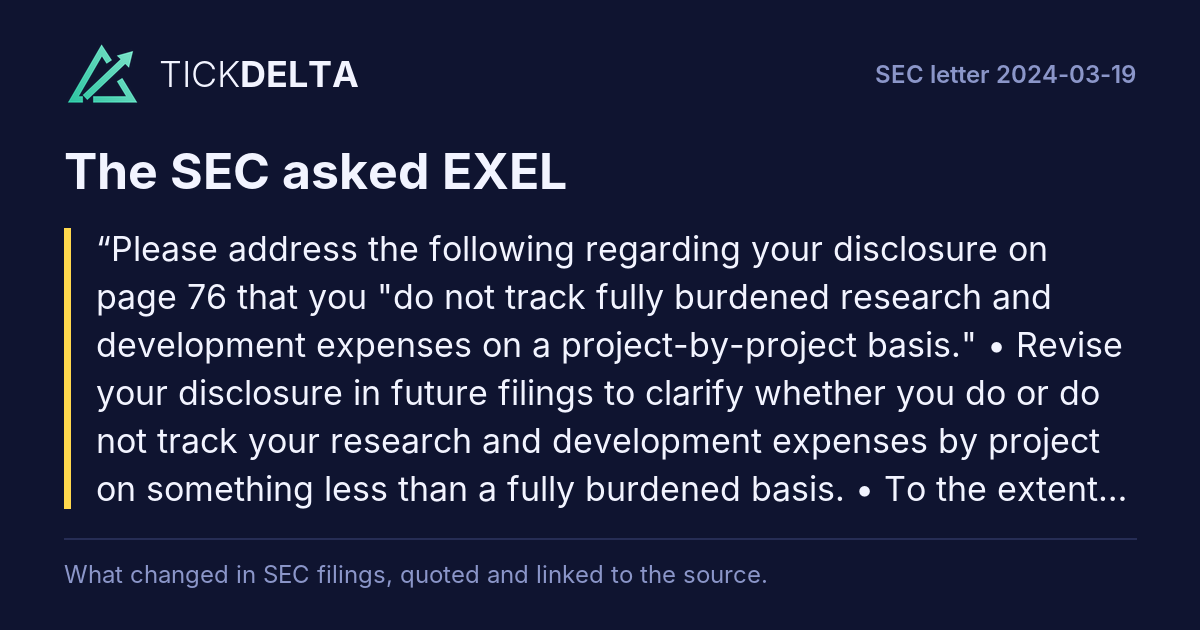
Please address the following regarding your disclosure on page 76 that you "do not track fully burdened research and development expenses on a project-by-project basis." • Revise your disclosure in future filings to clarify whether you do or do not track your research and development expenses by project on something less than a fully burdened basis.Rest of the question
• To the extent you do track any research and development expenses on a project-byproject basis, revise to provide a breakdown of the expenses tracked by project. • Please provide us with your proposed disclosure.
Acknowledging the Staff’s comment, we respectfully advise the Staff that the Company groups its research and development expenses into three categories: (1) development; (2) drug discovery; and (3) other research and development. Within these categories, there are internal expenses that are not tracked on a program or project basis and external third-party expenses, certain of which are tracked at a program level as detailed below.Read in the reply
•Because internal research and development expenses, including salaries and personnel expenses and facilities overhead expenses, are shared across research andRest of the answer
development categories, the Company does not track these expenses by program or project.
•External research and development expenses include clinical trial activities, contract manufacturing, license and collaboration costs, and certain consulting and outside services. The company tracks clinical trial services costs by scientific modalities, meaning whether they are within the categories of small molecule or biotherapeutics programs. This level of expense tracking facilitates the Company’s effective financial planning and analysis, enabling evaluation of the relative success of different scientific approaches and appropriate prioritization towards identifying targets that the Company believes have the greatest chance of yielding impactful cancer medicines.
In consideration of the Staff’s comment, in future filings beginning with the quarter ended March 29, 2024, the Company will enhance its disclosure to include a tabular presentation regarding Clinical trial costs by scientific modalities, small molecule and biotherapeutics programs, in the Management Discussion and Analysis of Financial Condition and Results of Operations section of its Annual Reports on Form 10-K and Quarterly Reports on Form 10-Q. The Company will also include narrative disclosure to accompany the table that will discuss the underlying reasons for material changes from period to period.
Set forth below is an illustrative example of the disclosure enhancements described above, using the relevant disclosure in our Annual Report on Form 10-K for the fiscal year ended December 31, 2023 (changes that are in response to the Staff’s comments are marked).
Research and Development Expenses
We do not track fully burdened research and development expenses on a project-by-project basis. We group our research and development expenses into three categories: (1) development; (2) drug discovery; and (3) other research and development. Our development group leads the development and implementation of our clinical and regulatory strategies and prioritizes disease indications in which our compounds are being or may be studied in clinical trials. Development expenses include license and other collaboration costs, primarily comprised of upfront license fees, development milestones and other payments associated with our clinical-stage in-licensing collaboration programs, clinical trial costs, personnel expenses, consulting and outside services and other development costs, including manufacturing costs of our drug development candidates. Our drug discovery group utilizes a variety of technologies, including in-licensed technologies, to enable the rapid discovery, optimization and extensive characterization of lead compounds and biotherapeutics such that we are able to select development candidates with the best potential for further evaluation and advancement into clinical development. Drug discovery expenses include license and other collaboration costs primarily comprised of upfront license fees, research funding commitments, development milestones and other payments associated with our in-licensing collaboration programs in preclinical development stage. Other drug discovery costs include personnel expenses, consulting and outside services and laboratory supplies. Other research and development expenses include the allocation of general corporate costs to research and development services and development cost reimbursements in connection with certain of our collaboration arrangements.
Research and development expenses by category were as follows (dollars in thousands):
Year Ended December 31, Percent Change
2023 2022
Development:
Clinical trial costs $ 281,338 $ 253,519 11 %
Personnel expenses 167,879 137,831 22 %
License and other collaboration costs 80,036 49,500 62 %
Consulting and outside services 43,586 35,651 22 %
Other development costs
96,401 45,121 114 %
Total development 669,240 521,622 28 %
Drug discovery:
License and other collaboration costs 92,970 154,412 -40 %
Other drug discovery costs
122,115 95,301 28 %
Total drug discovery 215,085 249,713 -14 %
Stock-based compensation 34,320 45,350 -24 %
Other research and development 125,426 75,128 67 %
Total research and development expenses $ 1,044,071 $ 891,813 17 %
In addition, we track our external clinical trial costs by scientific modalities, which are categorized as small molecule and biotherapeutics programs. Small molecule clinical development for the reported periods was primarily composed of Cabozantinib, Zanzalintinib and XL309. Biotherapeutics clinical development for the reported periods was composed of XB002.
Clinical trial costs by scientific modalities were as follows (dollars in thousands):
Clinical trial costs:
Small molecules $ 250,816 $ 240,430 4 %
Biotherapeutics 30,522 13,059 133 %
Total clinical trial costs $ 281,338 $ 253,519 11 %
The increase in research and development expenses for the year ended December 31, 2023, as compared to 2022, was primarily related to manufacturing costs to support Exelixis’ development candidates (presented as part of other development costs), personnel expenses, clinical trial costs and other research and development expenses, partially offset by decreases in license and other collaboration costs and stock-based compensation expense. Personnel expenses increased primarily due to an increase in headcount to support our discovery and development organization. Clinical trial costs, which include services performed by third-party contract research organizations and other vendors who support our clinical trials, increased primarily due to higher costs associated with our biotherapeutics program studies and to a lesser extent our small molecule program. The increase in small molecule clinical trial costs was attributed to increases in costs for studies evaluating zanzalintinib including STELLAR-303, STELLAR-002, and STELLAR-304 XB002, partially offset by decreases in costs associated with cabozantinib studies, primarily CONTACT-02 and COSMIC-312. Other research and development costs increased primarily related to technology costs, including our investments in digital transformation initiatives to support productivity and efficiency in our organization, and an increase in facility expenses. License and other collaboration costs decreased primarily due to lower upfront payments from new in-licensing collaboration arrangements, partially offset by higher development milestone achievement. Stock-based compensation expense decreased primarily due to higher forfeitures.
In addition to reviewing the three categories of research and development expenses described above, we principally consider qualitative factors in making decisions regarding our research and development programs. These factors include enrollment in clinical trials for our product candidates, preliminary data and final results from clinical trials, the potential market indications and overall clinical and commercial potential for our product candidates, and competitive dynamics. We also make our research and development decisions in the context of our overall business strategy.
We project that clinical trial costs may continue to increase with higher costs associated with various studies evaluating zanzalintinib, XB002 and XL309, partially offset by decreases in costs associated with cabozantinib studies. We continue our development efforts with cabozantinib to maximize the therapeutic and commercial potential of this compound. Notable ongoing company-sponsored cabozantinib studies include: CONTACT-02, for which Roche is sharing the development costs and providing atezolizumab free of charge; and COSMIC-313, for which BMS is providing nivolumab and ipilimumab free of charge.
To continue growing our pipeline, we are prioritizing investment in new molecules that are clinically differentiated with the potential to improve the standard of care for our cancer patients, including current and planned clinical trial programs evaluating zanzalintinib, XB002 and XL309. We are also working to expand our oncology product pipeline through drug discovery efforts, which encompass our diverse biotherapeutics and small molecule programs exploring multiple modalities and mechanisms of action. As part of our strategy, our drug development activities have included and continue to include research collaborations, in-licensing arrangements and other strategic transactions that collectively incorporate a wide range of technology platforms and assets and increase our probability of success. We will continue to engage in pipeline expansion initiatives with the goal of acquiring and in-licensing promising oncology assets and then further characterize and develop them utilizing our established preclinical and clinical development infrastructure.
We project our research and development expenses may decrease in fiscal year 2024, as compared to 2023, primarily driven by decreases in license and collaboration expenses and personnel expenses that result from the implementation of a corporate restructuring plan announced in January 2024 to prioritize the advancement of clinical and near-clinical programs, partially offset by higher manufacturing costs to support development candidates and clinical trial costs, including the current and planned trials evaluating zanzalintinib, XB002 and XL309.
A discussion of the risks and uncertainties with respect to our research and development activities, and the consequences to our business, financial position, and growth prospects can be found in “Risk Factors” in Part I, Item 1A of this Annual Report on Form 10-K.
First report after the company's reply of Apr 8, 2024: 10-Q filed Apr 30, 2024 ↗, against the 10-Q filed Nov 1, 2023 ↗.
Tickdelta does not hold the text of both reports, so they are not compared here.
Also in this review: company letter, Apr 29, 2024, company letter, May 17, 2024, closing letter, 2024-05-21