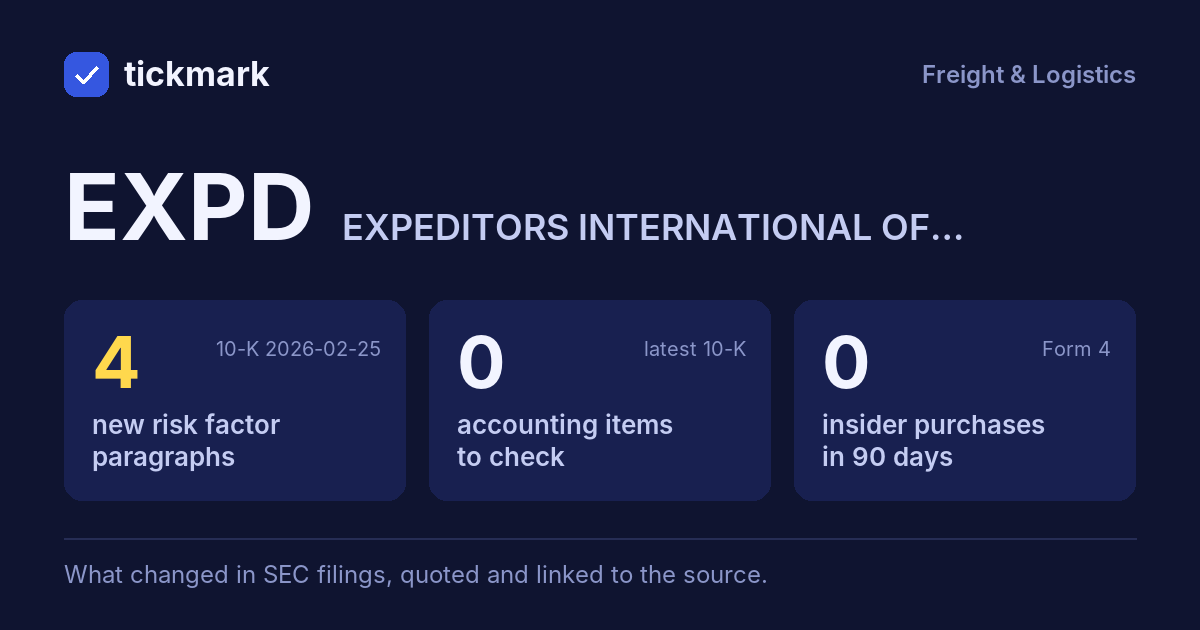
10-K 0001193125-26-071569 (2026-02-25) vs 10-K 0000950170-25-024750 (2025-02-21)
| Section | Compared text | Words now | Changed |
|---|
| Risk Factors | Item 1A | 4,446 |
14.5% |
| MD&A | Item 7 | 6,941 |
21.7% |
| Legal Proceedings | Item 3, via Note 9 – CONTINGENCIES | 129 |
not compared |
| Accounting Policies | 10-K text (note not found) | 0 |
not compared |
The redline: what was cut and what was added
In each section, the paragraph that changed most, marked against last year's 10-K:
cut words struck through, new words highlighted and underlined.
MD&A 529 words changed in this paragraph; it is 32% similar to last year's version.
We operate in over 60 countries in the competitive global logistics industry and our activities are closely tied to the global economy. International trade is influenced by many factors, including economic and political conditions in the United States and abroad, currency exchange rates, laws and policies relating to tariffs, trade restrictions, foreign investment, and taxation. Periodically, governments Governments periodically consider various changes to tariffs tariffs, and impose trade restrictions and accords. Currently, the United States Government has undertaken a substantial global trade rebalancing effort resulting in significantly higher tariffs on imports. Increased tariffs on certain sectors for Canada, China, and Mexico took effect in the first quarter of 2025. Additionally, reciprocal tariffs on certain countries were expected to take effect in April 2025, and were later postponed to July and August 2025, while trade negotiations by country were taking place. In the third quarter additional tariffs were imposed on imports from most countries including India, Brazil, and Japan. The United States has also imposed increased significantly higher tariffs on China, and is considering imposing increased goods made in China. Additionally, sectoral tariffs on imports from Canada, Mexico, steel, aluminum and their derivative products, as well as investigations were launched on other countries. commodities since the second quarter of 2025. These measures will likely face have led to threatened or actual retaliatory tariffs and trade actions from these countries. several countries, including China and Canada. The "de minimis" exemption, which exempted goods made in China and Hong Kong of less than $800 in commercial value from tariffs and entry submission, was terminated on May 2, 2025, and expanded to all countries on August 29, 2025. The potential for further tariff increases changes and trade restrictions remains high, creating an unpredictable environment for international trade. Additionally, changes to Changes in import and export regulations may further impact the flow of trade. trade and the global economy. On February 20, 2026, the United States Supreme Court issued a ruling on certain tariffs imposed in the United States under the International Emergency Economic Powers Act (IEEPA). The ruling invalidates many of the tariffs imposed on imports to the United States in 2025. The decision also allows for potential refunds; however the process to issue any such refunds is uncertain and likely subject to pending formal implementation, collection instructions and Court of International Trade decisions. We are currently assessing the impact this ruling and resulting tariff changes will have on our customs brokerage services, including post-entry activity. This decision could spur new sectoral tariffs in the United States and introduce additional uncertainty with respect to current and future U.S. trade policy and impact global trade flows. We cannot predict how changes in tariffs, tariffs and trade restrictions, and accords restrictions will affect our business. As governments impose import and export restrictions, shippers may adjust their sourcing patterns and potentially shift manufacturing to other countries over time. Doing business in foreign locations also subjects us to a variety of risks and considerations not normally encountered by domestic enterprises. In addition to being influenced by governmental policies and inter-governmental disputes concerning international trade, our business may also be negatively affected by political developments and Additionally, the constant changes in government personnel or policies in trade regulations since the United States and other countries, as well as economic turbulence, political unrest and security concerns in beginning of 2025 are adding complexity to the nations and on the trade shipping lanes in which we conduct business and the future impact that these events may have on international trade, oil prices and security costs. We do not have employees, assets, or operations in Russia, Ukraine, Israel, the Gaza Strip or the West Bank. While limited, any shipment activity is conducted with independent agents in those countries in customs declarations process, making compliance with all applicable trade sanctions, laws and regulations. We have a branch and employees in Lebanon but no significant assets. regulations increasingly challenging.
Source: Item 7, 10-K 0001193125-26-071569 vs Item 7, 10-K 0000950170-25-024750
Risk Factors 215 words changed in this paragraph; it is 54% similar to last year's version.
As our employees, our customers and suppliers continue to increase reliance on systems, and as additional features are added, the risks also increase. Any significant disruptions or unapproved third-party access to our global systems or the internet for any reason, which could include equipment or network failures; co-location facility failures; power outages; sabotage; government interference, employee error or other actions; cyber-attacks or other security breaches; reliance on third party technology; geo-political activity or natural disasters; all of which could have a material negative effect on our results. Significant disruptions to, or unapproved third‑party access into our networks and systems could materially harm our business and financial results by interrupting critical operations and degrading systems continuity. Potential disruption vectors include equipment or network failures, co‑location facility outages, power interruptions, sabotage, government interference, employee error, cyber‑attacks or other security breaches, dependencies on third‑party technologies, geopolitical events, and natural disasters, any of which could sever connectivity to our global systems or the internet and impede execution of core processes. In such circumstances, we may be compelled to shut down systems to protect the environment, as we did during a cyber-attack in February 2022, we were the subject of a targeted cyber-attack. Upon discovering the incident, we shut down most of our operating systems globally leading to manage the safety of our overall global systems environment. This shutdown lost revenue; shipment‑processing delays and any such future events are likely to result in loss of revenue; other business disruptions (such as the inability to timely process shipments); and interruptions; significant remediation costs. This cyber-attack, or any future cyber-attack could also result in increased vulnerability and incremental security costs; heightened exposure to attempts of fraud, fraud; legal claims and proceedings including (including potential breach of contract claims, breach‑of‑contract assertions); reporting delays or errors; errors, including interference with regulatory reporting; an increase in costs to protect our systems and technology; or damage to our reputation. regulators. A future cyber-attack may also result in the destruction or exfiltration of our data as well as that of our customers and service providers.
Source: Item 1A, 10-K 0001193125-26-071569 vs Item 1A, 10-K 0000950170-25-024750
Every change, by type
Sentences and paragraphs of EXPD's Risk Factors and MD&A, 10-K 2026-02-25 against 10-K 2025-02-21.
Each links to the text at sec.gov.
Quiet changes are sentences kept from last year with one to four words changed, at least one of them a hedge, a modal or a qualifier
(may, could, will, not, significant, material…). A year or date rolling forward is not counted.
The full word list
adverse, adversely, all, although, anticipate, anticipates, any, approximately, believe, believes, can, cannot, certain, could, expect, expects, generally, however, if, intend, intends, largely, likely, many, material, materially, may, might, most, must, never, no, not, possible, primarily, probable, should, significant, significantly, some, substantial, substantially, unlikely, will, would
AddedRisk Factors
The current volatile international trade environment as a result of intergovernmental disputes, trade actions, increased tariffs and other geo-political risks may adversely impact our business and operating results.
Read it in 10-K 2026-02-25 at sec.gov ↗
AddedRisk Factors
The United States has undertaken a substantial global tariff rebalancing effort, resulting in higher tariffs on imports, including significantly higher tariffs on goods made in China and sectoral tariffs on a range of materials and products. These measures led to threatened or actual retaliatory tariffs on goods made in the United States from several countries, including China and Canada. This created an unpredictable trade environment for shippers to determine if and how to adapt their sourcing patterns given these new and fast-changing regulations. If these conditions result in a significant, short-term or longer-term, decrease or redistribution of international trade volumes, it could negatively affect our business volumes and revenues. Expeditors' activity is particularly exposed to trade volume impacts from trade actions and tariff disputes between China and the United States, as we generated 19% and 22% of our revenues and 15% and 17% of our operating income in 2025 and 2024, respectively, on exports from China and Hong Kong. Uncertainty and changes to trade volumes could also affect air and ocean freight carriers because they may adjust capacity and transportation schedules, which could result in volatility in available capacity, and average sell and buy rates, all of which could adversely impact our operations and financial results. While some of those volumes are shifting to other routes, as customers look to mitigate their exposure to China-specific tariffs, it is too early to know what the overall decline in volumes might be. Many of our customers are subject to the increased tariffs and may experience increased costs of conducting business. This could result in a loss of business, bad debt or increased expenses in the future if our customers were to abandon cargo, enter into bankruptcy or insolvency proceedings, or their ability to pay deteriorates. Additionally, the increased complexity of trade regulations and customs declaration processes challenges our ability to be in compliance with such ever-changing regulations and may require us to dedicate additional resources to our customs brokerage operations.
Read it in 10-K 2026-02-25 at sec.gov ↗
AddedRisk Factors
We are exposed to risks relating to evaluations of internal control over financial reporting and disclosure controls and procedures.
Read it in 10-K 2026-02-25 at sec.gov ↗
AddedRisk Factors
Management is required to assess the effectiveness of internal control over financial reporting and disclosure controls and procedures. If we are unable to maintain effective internal control over financial reporting or disclosure controls and procedures, we may be unable to record, process and report financial information accurately or timely, which could result in misstatements in our financial statements, subject us to litigation or regulatory investigations, require significant management attention and resources, and adversely affect investor confidence in our financial reporting and our stock price. In addition, uncertainties related to the design and operation of controls over operational and financial systems in connection with further development of our IT systems and processes and could further increase these risks.
Read it in 10-K 2026-02-25 at sec.gov ↗
RemovedRisk Factors
•changes in and application of international and domestic customs, trade and security regulations;
Read it in 10-K 2025-02-21 at sec.gov ↗
RemovedRisk Factors
We identified material weaknesses in our internal control over financial reporting related to ineffective information technology general controls which, if not remediated appropriately or timely, could result in loss of investor confidence and adversely impact our stock price.
Read it in 10-K 2025-02-21 at sec.gov ↗
RemovedRisk Factors
Internal controls related to the operation of technology systems are critical to maintaining adequate internal control over financial reporting. As disclosed in Part II, Item 9A, during the fourth quarter of 2022, management identified material weaknesses in internal control related to certain database changes made to information technology (IT) systems that support the Company’s financial reporting processes. As management continued the remediation process and reviews, we identified additional IT controls that were not designed or operated appropriately that relate to these material weaknesses. Management concluded that unauthorized access and changes to databases and related applications could have gone undetected as controls to review and authorize access and direct changes that support several key operational and accounting systems excluded certain changes from review or were not captured, and as such were either not designed properly or did not operate effectively as designed. In addition, the system logic used to record direct changes excluded certain changes from being captured for review. As a result, management concluded that our internal control over financial reporting was not effective as of December 31, 2022, 2023 and 2024. We are currently unable to estimate when full remediation of these material weaknesses will be completed. The material weaknesses will not be considered fully remediated, until the applicable controls operate for a sufficient period of time and management has concluded through additional testing that these controls are operating effectively. To the extent management is unable to ultimately conclude that the identified issues have been remediated, our ability to record, process and report financial information accurately, and to prepare financial statements within required time periods, could be adversely affected, which could subject us to litigation or investigations requiring management resources and payment of legal and other expenses, negatively affect investor confidence in our financial statements and adversely impact our stock price.
Read it in 10-K 2025-02-21 at sec.gov ↗
RewordedRisk Factors
Tax Governmental authorities frequently implement new taxes tax laws, including the One, Big, Beautiful Bill Act (Public Law 119-21), (the 2025 Tax Act), enacted in July of 2025 in the U.S., and change their tax rates and rules, including interpretations of those rules.
Read it in 10-K 2026-02-25 at sec.gov ↗
RewordedRisk Factors
We face material risks associated with the handling, transporting, and storing of customer inventory including some products classified as hazardous materials, dangerous goods and goods, and/or high value commodities. products.
Read it in 10-K 2026-02-25 at sec.gov ↗
RewordedRisk Factors
We are continually improving and enhancing our systems and processes, including meaningful upgrades to core operating and accounting systems and remediation of internal control deficiencies. systems.
Read it in 10-K 2026-02-25 at sec.gov ↗
RewordedRisk Factors
A significant portion of Expeditors' revenues is derived from customers in retail and technology industries whose shipping patterns are tied closely to consumer demand, as well as the scaling of AI infrastructure, and from customers in industries whose shipping patterns are dependent upon just-in-time production schedules.
Read it in 10-K 2026-02-25 at sec.gov ↗
RewordedRisk Factors
We believe that ITA’s positions are without merit, and we are have thus far been successful in defending our position vigorously in Indian courts.
Read it in 10-K 2026-02-25 at sec.gov ↗
RewordedRisk Factors
Under some of our agreements, we maintain and transport the inventory of our customers, some of which may be is classified as hazardous materials, dangerous goods or is high value in nature.
Read it in 10-K 2026-02-25 at sec.gov ↗
RewordedRisk Factors
The Indian tax authority (ITA) has asserted that additional tax applies principally related to transfer pricing and transactions between and amongst the Company and its Indian subsidiary and the applicability to that, an Indian service tax applicable applies to ocean and air imports and exports.
Read it in 10-K 2026-02-25 at sec.gov ↗
Quiet changesRisk Factors
Our failure to properly handle and safeguard such inventory exposes us to potential material claims and expenses as well as harm to our business and reputation.
Read it in 10-K 2026-02-25 at sec.gov ↗
Quiet changesRisk Factors
If However, if these matters are adversely resolved, we would recognize significant additional tax expense including interest and penalties.
Read it in 10-K 2026-02-25 at sec.gov ↗
AddedMD&A
•Revenues increased 4% as strong demand for most of our services was partially offset by a drop in ocean revenues.
Read it in 10-K 2026-02-25 at sec.gov ↗
AddedMD&A
•The dynamic environment of changing trade tariffs throughout 2025 resulted in shifts in trade volumes to different locations and importers and exporters managing timing of shipments in anticipation of higher trade tariffs. As a result, carriers had to adapt to changing demand creating volatility in average sell rates and buy rates.
Read it in 10-K 2026-02-25 at sec.gov ↗
AddedMD&A
•Customs brokerage and other services and airfreight services revenues increased 13% and 9%, respectively.
Read it in 10-K 2026-02-25 at sec.gov ↗
AddedMD&A
•Growing complexity in customs brokerage due to the dynamic trade environment has resulted in high demand for our brokerage services resulting in growth in revenues from customs declarations fees, as well as increases in the resources to support that activity.
Read it in 10-K 2026-02-25 at sec.gov ↗
AddedMD&A
•Airfreight services, road freight and warehousing and distribution services (included with customs brokerage and other services) all benefited from strong demand from our technology customers investing in artificial intelligence infrastructure.
Read it in 10-K 2026-02-25 at sec.gov ↗
AddedMD&A
•Revenue from ocean freight and other services decreased 11% resulting from significant decreases in average ocean sell rates and buy rates due to overall imbalance between demand and available capacity for ocean transportation due to global trade dynamics.
Read it in 10-K 2026-02-25 at sec.gov ↗
AddedMD&A
•Operating income increased 1% and net earnings to shareholders remained flat, while earnings per share increased 4%.
Read it in 10-K 2026-02-25 at sec.gov ↗
AddedMD&A
We operate in over 60 countries in the competitive global logistics industry and our activities are closely tied to the global economy. International trade is influenced by many factors, including economic and political conditions in the United States and abroad, currency exchange rates, laws and policies relating to tariffs, trade restrictions, foreign investment, and taxation. Governments periodically consider changes to tariffs, and impose trade restrictions and accords. Currently, the United States Government has undertaken a substantial global trade rebalancing effort resulting in significantly higher tariffs on imports. Increased tariffs on certain sectors for Canada, China, and Mexico took effect in the first quarter of 2025. Additionally, reciprocal tariffs on certain countries were expected to take effect in April 2025, and were later postponed to July and August 2025, while trade negotiations by country were taking place. In the third quarter additional tariffs were imposed on imports from most countries including India, Brazil, and Japan. The United States has also imposed significantly higher tariffs on goods made in China. Additionally, sectoral tariffs on steel, aluminum and their derivative products, as well as investigations were launched on other commodities since the second quarter of 2025. These measures have led to threatened or actual retaliatory tariffs and trade actions from several countries, including China and Canada. The "de minimis" exemption, which exempted goods made in China and Hong Kong of less than $800 in commercial value from tariffs and entry submission, was terminated on May 2, 2025, and expanded to all countries on August 29, 2025. The potential for further tariff changes and trade restrictions remains high, creating an unpredictable environment for international trade. Changes in import and regulations may further impact the flow of trade and the global economy. On February 20, 2026, the United States Supreme Court issued a ruling on certain tariffs imposed in the United States under the International Emergency Economic Powers Act (IEEPA). The ruling invalidates many of the tariffs imposed on imports to the United States in 2025. The decision also allows for potential refunds; however the process to issue any such refunds is uncertain and likely subject to pending formal implementation, collection instructions and Court of International Trade decisions. We are currently assessing the impact this ruling and resulting tariff changes will have on our customs brokerage services, including post-entry activity. This decision could spur new sectoral tariffs in the United States and introduce additional uncertainty with respect to current and future U.S. trade policy and impact global trade flows. We cannot predict how changes in tariffs and trade restrictions will affect our business. Additionally, the constant changes in trade regulations since the beginning of 2025 are adding complexity to the customs declarations process, making compliance with regulations increasingly challenging.
Read it in 10-K 2026-02-25 at sec.gov ↗
AddedMD&A
Containers shipped grew modestly in 2025, up 1% for the full period. Shippers accelerated shipments in the first half of the year in anticipation of tariff changes, but volumes softened from August onward. Declines in North Asia to the United States shipments were mitigated by increases on other routes.
Read it in 10-K 2026-02-25 at sec.gov ↗
AddedMD&A
Salaries and related costs increased 9% in 2025, as compared with 2024, principally due to an 8% increase in headcount and increases in base salaries and benefits along with increases in incentive compensation commensurate with higher revenues and operating income. We hired employees in operations to support the added complexity and higher demand for customs brokerage services, primarily in North America, and support the growth in volumes transacted in certain services and regions such as South Asia and Europe. We also continued to hire IT personnel to support essential investments which further strengthens our critical information systems.
Read it in 10-K 2026-02-25 at sec.gov ↗
AddedMD&A
On July 4, 2025, the United States enacted into law the 2025 Tax Act. The 2025 Tax Act provides for several corporate tax changes including, but not limited to, restoring an election to recognize full expensing of domestic research and development costs, restoring immediate deductibility of certain capital expenditures, and changes to the computations of U.S. taxation on international earnings.
Read it in 10-K 2026-02-25 at sec.gov ↗
AddedMD&A
We have lease arrangements primarily for office and warehouse space in all districts where we conduct business. As of December 31, 2025, we had fixed lease payment obligations of $733 million, with $139 million payable within 12 months.
Read it in 10-K 2026-02-25 at sec.gov ↗
RemovedMD&A
•Strong demand for ocean transportation combined with longer transit times and capacity issues caused by the disruptions in the Red Sea resulted in significant increases in overall average buy rates and sell rates.
Read it in 10-K 2025-02-21 at sec.gov ↗
RemovedMD&A
•Demand for airfreight out of Asia was high due in part to direct e-commerce business demand on airfreight capacity and increased demand in the technology sector. This resulted in growth in volumes and overall increases in buy and sell rates.
Read it in 10-K 2025-02-21 at sec.gov ↗
RemovedMD&A
•Ocean containers shipped increased 7%, airfreight tonnage was up 12% and volumes transacted for customs brokerage and other services grew as well, compared to a slow 2023.
Read it in 10-K 2025-02-21 at sec.gov ↗
RemovedMD&A
•Cash from operations was $723 million, down from $1,053 million in 2023. This decrease in cash from operations was driven by a significant investment in working capital to finance our growth in the second half of 2024.
Read it in 10-K 2025-02-21 at sec.gov ↗
RemovedMD&A
Containers shipped were higher in most regions, most significantly on exports out of North Asia and South Asia. North Asia ocean services revenues and expenses increased 66% and 79%, respectively, due to a 7% increase in containers shipped and higher average rates. South Asia ocean services revenues and expenses increased 85% and 109%, respectively, due to a 19% increase in containers shipped and higher average rates due to the factors above.
Read it in 10-K 2025-02-21 at sec.gov ↗
RemovedMD&A
Salaries and related costs increased 4% in 2024, as compared with 2023, principally due to increases in commissions and bonuses earned from higher revenues and operating income. Base salaries and benefits and headcount both increased 2% in 2024.
Read it in 10-K 2025-02-21 at sec.gov ↗
RewordedMD&A
Customs brokerage and other services revenues and expenses increased 2% 13% and 1%, 14%, respectively, in 2024 2025 as compared with 2023, 2024, primarily due to increases double-digit growth rates in customs clearances, import services and services, road freight and warehousing and distribution from higher shipment volumes, principally in Europe from shipments into North America and MAIR offset by decreases in warehousing and distribution primarily in North America. Europe.
Read it in 10-K 2026-02-25 at sec.gov ↗
RewordedMD&A
North Asia revenues and expenses increased 16% 11% and 17%, 12%, respectively, in 2024 2025 as compared with 2023 2024 due to a 9% 10% increase in tonnage driven by demand in technology sectors and higher average sell and buy rates driven by high demand from international direct e-commerce. e-commerce in the first quarter and increased market demand, in part from technology customers investing in artificial intelligence infrastructure.
Read it in 10-K 2026-02-25 at sec.gov ↗
RewordedMD&A
Additionally, continued uncertainty in the economy, geopolitical concerns, as well as potential inter-governmental trade disputes As shippers and tariff changes could carriers react to these volatile conditions, it may negatively affect demand for airfreight services which could significantly reduce our volumes and average sell rates. and buy rates in the future.
Read it in 10-K 2026-02-25 at sec.gov ↗
RewordedMD&A
Tonnage increased in all regions, with the largest increase increases coming from exports out of South Asia and North Asia. Asia due to strong demand in the first half of 2025 in anticipation of higher tariffs going into effect and demand from technology customers in the second half of the year.
Read it in 10-K 2026-02-25 at sec.gov ↗
RewordedMD&A
During 2024 2025 and 2023, 2024, we used cash to repurchase 5.6 million shares of common stock at an average price of $118.01 per share and 7.1 million shares of common stock at an average price of $119.47 per share and 12.1 million shares of common stock at an average price of $114.68 per share, respectively.
Read it in 10-K 2026-02-25 at sec.gov ↗
RewordedMD&A
The increase in 2024 2025 is primarily due to higher rental and occupancy expenses, travel, and technology related expenses partially offset by a $24 million decrease in expenses related to as well as consulting, and travel, and indirect tax and other contingencies and lower depreciation expense. taxes.
Read it in 10-K 2026-02-25 at sec.gov ↗
RewordedMD&A
Import services, including charges at ports such as detention, drayage, terminal charges and delivery, decreased delivery increased significantly in the first quarter 2024 due to residual effects from the supply chain congestion. 2025 because of higher volumes.
Read it in 10-K 2026-02-25 at sec.gov ↗
RewordedMD&A
Some elements of the recorded impacts Elements of enacted tax laws and regulation regulations could be impacted by further legislative action as well as additional interpretations and guidance issued by the Internal Revenue Service or Treasury in the U.S. and by similar governmental bodies in jurisdictions outside of the U.S.
Read it in 10-K 2026-02-25 at sec.gov ↗
RewordedMD&A
In addition to being influenced by governmental policies and inter-governmental disputes concerning international trade, our business may also be negatively affected by political developments and changes in government personnel or policies in the United States and other countries, as well as economic turbulence, political unrest and security concerns in the nations and on the trade shipping lanes routes in which we conduct business and the future impact that these events may have on international trade, oil prices and security costs. business.
Read it in 10-K 2026-02-25 at sec.gov ↗
RewordedMD&A
In 2024 2025 ocean freight consolidation revenues and expenses increased decreased by 46% 17% and 58% 19% respectively, as compared with 2023, 2024, primarily due to 38% 18% and 48% increases 20% decreases in average sell and buy rates, respectively, and offset by a 7% 1% increase in containers shipped.
Read it in 10-K 2026-02-25 at sec.gov ↗
RewordedMD&A
We Though we are unable to predict how these uncertainties and any future disruptions will may affect our operations or financial results prospectively. prospectively, these conditions could result in decreases in our revenues, expenses and operating income.
Read it in 10-K 2026-02-25 at sec.gov ↗
RewordedMD&A
We have a Discretionary Stock Repurchase Plan under which management is allowed to repurchase shares to reduce the issued and outstanding stock to 130 million shares of common stock, down from 140 million at December 31, 2023, as authorized by the Board of Directors in February 2024. stock.
Read it in 10-K 2026-02-25 at sec.gov ↗
Quiet changesMD&A
In addition, if If safe passage through the Red Sea resumes, additional capacity will become available due to shorter transit times.
Read it in 10-K 2026-02-25 at sec.gov ↗