Rest of the answer
The sales, operational execution and expenditure decisions necessary to provide our logistics services are the responsibility of management at the district and geographic regional operating leaders. Though we have supporting functions categorized by products (air, ocean, order management, customs brokerage, Transcon and distribution) and support services (i.e. legal, finance and accounting, information technology, and sales and marketing) these product and support functions are present in each of our operating segments and each report to the geographic leadership for that specific region. There are also global product and support services that assist the geographic regions and teams. However, the geographic leadership has the full responsibility for executing their business including all products and services. As an example, within our products category we have an air product team in our South Asia operating segment that reports directly to the geographic leader of South Asia. Our Global Air product team assists the geographic leadership as needed primarily by helping to negotiate favorable arrangements with our service providers (air carriers). Our global product teams primarily ensure the alignment of our services and processes across our network, facilitate compliance with regulations, and support relations with authorities and our service providers where they are used across various operating segments. These global product teams consist of only a few personnel and have no direct revenue responsibility or policy making ability.
Also please provide us the following information:
•
Please tell us the title and describe the role of the CODM and each of the individuals who report to the CODM.
Response: The following individuals report directly to our CODM, Jeffrey Musser, who is our President, Chief Executive Officer and a Director of the Company and is responsible for setting company strategies and initiatives, establishing company policies, allocating company resources and assessing the performance of the Company’s segments:
o
Richard Rostan is our President, Global Geographies & Operations, and is responsible for the operations, customer sales and financial results of our entire network and oversees nearly 17,000 full time equivalent employees globally.
Eugene Alger is our President, Global Services, and oversees our marketing and communications, sales administration, account management, risk management and insurance, training programs and administration, health and safety functions
Daniel Wall is our President, Global Products, and oversees our global product policy, standards and development, along with service provider management and innovation of our core products.
Bradley Powell is our Senior Vice President & Chief Financial Officer, and oversees our finance and accounting along with real estate functions.
Christopher McClincy is our Senior Vice President & Chief Information Officer, and oversees the development, performance and security of our information technology systems.
Benjamin Clark is our Senior Vice President General Counsel & Corporate Secretary, and oversees our legal and compliance functions.
Philip Coughlin is our Senior Vice President & Chief Strategy Officer, and leads the investigation into and development of strategic ventures outside our core business.
We determined that in his capacity, because Mr. Musser is responsible for setting company strategies and initiatives, establishing company policies, allocating company resources and assessing the performance of the Company’s segments that he is therefore the CODM in accordance with ASC 280-10-50-5.
Please identify and describe the role of each of your segment managers. Specifically, please tell us if there are managers for your service lines as well as your geographic areas.
Response: Our segment managers report to our President Global Geographies & Operations as follows:
Senior Vice President, The Americas
Senior Vice President, North Asia
Senior Vice President, South Asia
Executive Vice President, Europe
Senior Vice President, Middle East, Africa and Indian Subcontinent
Each segment manager is fully responsible for all aspects of the business including: all product offerings, sales and marketing efforts, operations, capital expenditures (to the extent delegated by the Board of Directors and the Chief Executive Officer) and ultimately the financial results and overall performance of all our logistics operations for their region. These segment managers are directly accountable for the performance of their region for all products and services offered by the Company. Within each district and segment there are managers for each product. At the district level, these product managers report to the district manager. The district manager reports to a regional manager. The regional manager reports to a segment manager. At the segment level, product managers report to a segment manager. As of June 30, 2019, there were nearly 17,000 full time equivalent employees reporting up to our President Global Geographies & Operations.
As discussed above under Background and Overview, we have Global product managers that are primarily responsible for alignment of our services and processes across our network, facilitate compliance with regulations and company policies approved by the CODM, support relations with regulatory authorities and help with service provider relationships. Recommendations made by global product teams must be approved by the President of Global Geographies & Operations and by the CODM. The President of Global Geographies & Operations and his geographic team have full responsibility for the performance of the business.
Our Global Products team has managers for each product offered by the Company:
Senior Vice President, Global Air
Senior Vice President, Global Ocean
Senior Vice President, Global Order Management
Senior Vice President, Global Customs
Senior Vice President, Global Transcon
Senior Vice President, Global Distribution
These global product teams consist of only 100 full time equivalent employees and have no direct revenue responsibility or policymaking ability.
Tell us how often the CODM meets with his/her direct reports, the financial information the CODM reviews to prepare for those meetings, the financial information discussed in those meetings, and who else attends those meetings.
Response: The CODM meets at least bi-weekly with his direct reports and covers many topics including but not limited to employee development, financial performance, strategic initiatives and enablers and technology programs. Typically, these meetings are one-on-one meetings but additional personnel will attend if needed for a specific topic. Additionally, the CODM holds a monthly staff meeting with his direct reports.
The Company prepares financial results on a monthly basis. Monthly profit and loss information is available to the CODM at a consolidated level and on a geographical basis by operating segments. The CODM also has the ability to access similar information down to the district level at his discretion.
Primary monthly information presented to the CODM consists of:
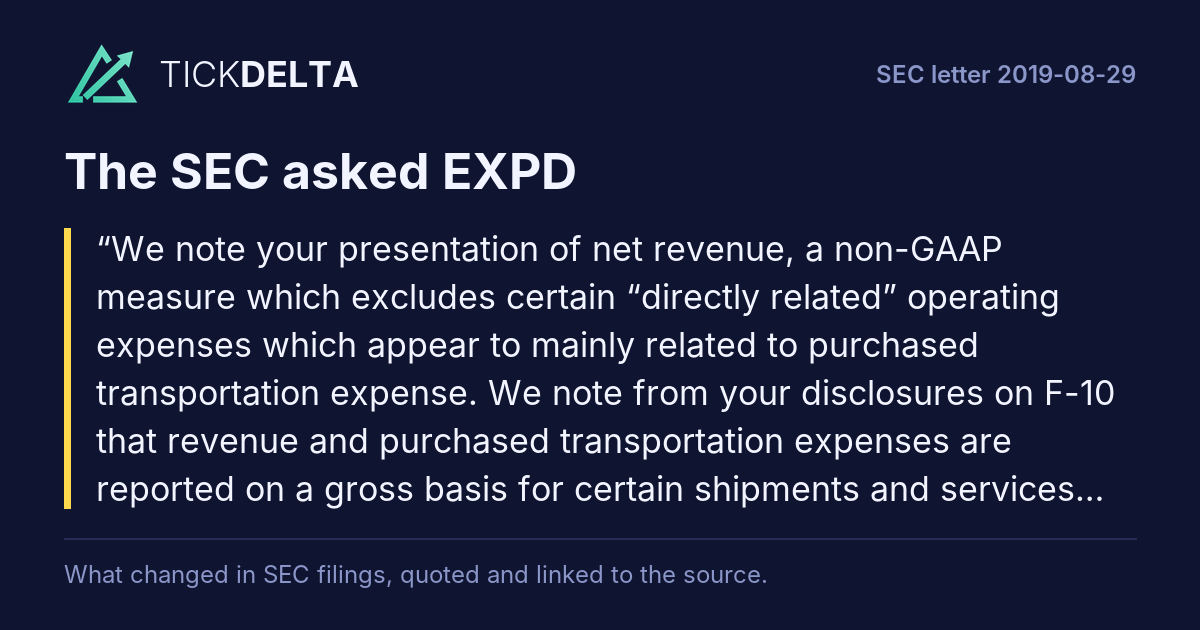
Consolidated summary of operations for the total Company and for each region of segment managers. The profit and loss information, however, does not include gross revenues nor directly attributable operating expenses but only net revenues (i.e. gross revenues less directly related operating expenses) with line items for net revenues for each of our primary products, plus detail of other operating expenses (salary and related expenses, rent and occupancy costs, depreciation and amortization, selling and promotion expenses and other operating expenses). The information includes variances of the monthly results compared to budget and year-to-date variances to budget and prior year and productivity metrics, key performance indicators and ratios.
Profit and loss statements with monthly, and year-to-date results on a comparative basis to the prior year for each geographic operating segment including gross revenues, directly attributable operating expenses and net revenues for each primary service as well as other operating expenses (salary and related expenses, rent and occupancy costs, depreciation and amortization, selling and promotion expenses and other operating expenses) as well as operating income. Within each region, this information is also available for each district that comprises that geographic region.
A monthly and year-to-date comparative to the prior year for each category of expenses for corporate and regional cost centers.
Tell us if anyone is held accountable for the Airfreight Services, Ocean freight and ocean services, and customs brokerage and other services service lines, and if so, who they report to.
The district managers are held accountable for airfreight services, ocean freight and other ocean services and customs brokerage and other services results within the district. The district managers report to regional managers. Regional managers report to segment managers. Segment managers report to the President, Global Geographies & Operations.
As described under Background and Overview we do have global product teams, reporting to the President, Global Products that are dedicated to supporting our different products for the segment manager of that region. However, those teams are not accountable for the global or the specific geographic performance of those product lines.
Describe the information regularly provided to the CODM and how frequently it is prepared.
In addition to the weekly and monthly financial information described above, on a quarterly basis, the CODM reviews the information included in our earnings release and in our Form 10-Q or 10-K and the financial information provided to the Board of Directors listed below.
Describe the information regularly provided to the Board of Directors and how frequently it is prepared.
In addition to the information included in our earnings release and our Form 10-Q or 10-K , the Board of Directors receives the following information on a quarterly basis:
Executive analytical review of the consolidated balance sheet with comments on variances compared to prior year.
Executive analytical review of quarterly and year-to-date consolidated statement of earnings and cash flows with comments on variances compared to the prior period.
Executive analytical review of year-to-date statement of earnings compared to budget.
Executive geographic analysis of net revenues by operating segments and by primary services and by type of customers.
Performance graphs of each primary services net revenues by operating segments, and including volume and margin trends in total, by operating segment and sub categories of services, other operating expenses by category and by operating segment.
Quarterly statement of earnings, balance sheet and statement of cash flows by operating segment.
Describe the basis for determining the compensation for each of the individuals that report to the CODM.
The compensation of each individual reporting to the CODM consist of a (1) base salary; (2) equity incentives; (3) and a quarterly cash bonus.
The base salary, equity incentives and quarterly cash bonuses are approved by the Compensation Committee of the Board of Directors based on recommendations from the CODM.
For individuals reporting directly to the CODM, the quarterly cash bonus is granted under the Company’s Executive Incentive Compensation Plan, which is described in the Company’s proxy statement. Each individual receives an allocated percentage of the incentive pool. The incentive pool total is approved by the Compensation Committee of the Board of Directors and is limited to 10% of quarterly pre-bonus U.S. GAAP consolidated operating income.
The fact that the CODM and his direct reports have their compensation tied to consolidated results of the entire Company further supports our conclusion that each service does not constitute an operating segment. Consistent with this, operating segment managers and teams’ compensation is tied to their locations operating income. Specific product performance does not impact the formula for compensation paid out for bonuses other than better overall performance increases operating income which would then increase the total pool of bonus earned and eligible to be paid out for that region.
Conclusion
The guidance in ASC 280-10-50-6 requires that a company consider whether it has more than a single set of operating segments when it evaluates the reports that are produced, which may present its business activities in a variety of different ways. As discussed above, in addition to our geographical operating segments, we do produce certain information for each of our primary services in our consolidated financial statements and in reports that are received on a regular basis by the CODM. We believe that information is valuable for our management and our shareholders to understand our revenues, operating expenses and margins as our primary services present different economic factors such as pricing mechanisms, capacity challenges from our service providers and regulations. However, those services do not have an identifiable leader that meets the characteristics of operating segment manager as described in ASC 280-10-50-7 & 8.
We also considered ASC 280-10-50-1 and ASC 280-10-50-9 in determining that our primary services air, ocean freight and other and customs brokerage and other did not constitute operating segments.
ASC 280-10-50-1 states that:
“An operating segment is a component of a public entity that has all of the following characteristics:
a.
It engages in business activities from which it may recognize revenues and incur expenses (including revenues and expenses relating to transactions with other components of the same public entity).
b.
Its operating results are regularly reviewed by the public entity's chief operating decision maker to make decisions about resources to be allocated to the segment and assess its performance.
c.
Its discrete financial information is available.”
The operating results reviewed by the CODM and the discrete financial information available are limited to revenues, directly related operating expenses (which primarily consist of transportation costs and ancillary charges directly attributable to a given transaction) and net revenues. We do not prepare financial information that would include other operating expenses, such as salaries and related expenses, or allocation of assets to each of our primary products. Financial information that allows the CODM to make decisions related to the allocation of resources and the investment in capital expenditures is only prepared on a geographical basis (and never on a product basis), which further supports that we only have geographical operating segments. This is additionally supported by the fact that we are a non-asset based carrier and we do not have a need to make significant capital investments in transportation assets used by our different services.