Form 10-K
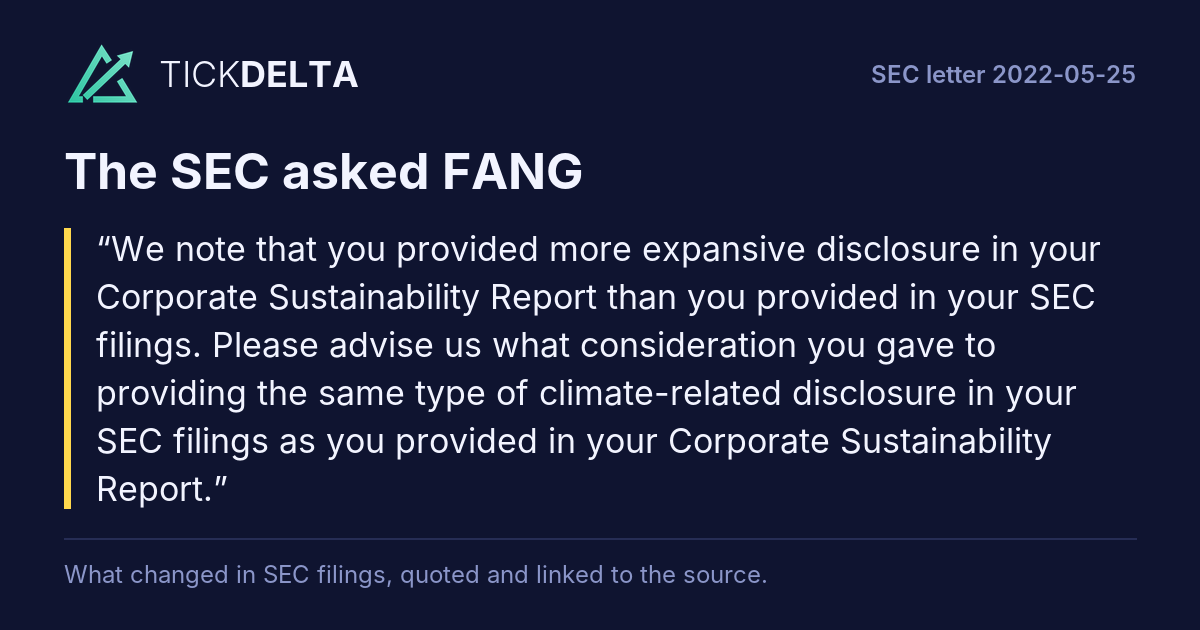
We note that you provided more expansive disclosure in your Corporate Sustainability Report than you provided in your SEC filings. Please advise us what consideration you gave to providing the same type of climate-related disclosure in your SEC filings as you provided in your Corporate Sustainability Report.
Your response to prior comment 2 states that the primary effect of transition risks related to climate change is the risk of reduced demand for oil and natural gas, which could reduce the prevailing price for oil and natural gas. Please tell us how you considered providing disclosure that addresses the effect of transition risks related to climate change on your business and financial strategy more generally.
In considering disclosure addressing the effect of transition risks related to climate change on our business and financial strategy more generally, we considered our existingRead in the reply ↗Rest of the answer
disclosures, including those contained in Risk Factors and Management’s Discussion and Analysis of Financial Condition and Results of Operations, which (among other things) address risks that can create lower demand and lower prices, as well as the effects that lower demand and lower prices can have on our business.
Further, in response to the Staff’s comments, we will include in our Quarterly Report on Form 10-Q for the quarter ended June 30, 2022 and in future Annual Reports on Form 10-K an
500 West Texas, Suite 1200, Midland, Texas 79701, tel. (432) 221-7400/diamondbackenergy.com additional risk factor providing comprehensive disclosure with respect to the effects of transition risks relating to climate change. The risk factor that we intend to include in our upcoming Quarterly Report on Form 10-Q would read substantially as follows:
Transition risks relating to climate change may have a material and adverse effect on us.
Governmental and regulatory bodies, investors, consumers, industry and other stakeholders have been increasingly focused on climate change matters in recent years. This focus, together with changes in consumer and industrial/commercial behavior, preferences and attitudes with respect to the generation and consumption of energy, the use of hydrocarbons, and the use of products manufactured with, or powered by, hydrocarbons, may result in:
•the enactment of climate change-related regulations, policies and initiatives by governments, investors, and other companies, including alternative energy or “zero carbon” requirements and fuel or energy conservation measures;
•technological advances with respect to the generation, transmission, storage and consumption of energy (including advances in wind, solar and hydrogen power, as well as battery technology);
•increased availability of, and increased demand from consumers and industry for, energy sources other than oil and natural gas (including wind, solar, nuclear, and geothermal sources as well as electric vehicles); and
•development of, and increased demand from consumers and industry for, lower-emission products and services (including electric vehicles and renewable residential and commercial power supplies) as well as more efficient products and services.
Any of these developments, which relate to the transition from hydrocarbon energy sources to alternative energy sources and therefore to a lower-carbon economy, may reduce the demand for products manufactured with (or powered by) hydrocarbons and the demand for, and in turn the prices of, the oil and natural gas that we produce and sell, which would likely have a material and adverse impact on us. Please see the risk factor in our Annual Report on Form 10-K for the year ended December 31, 2021 titled “Market conditions for oil and natural gas, and particularly volatility in prices for oil and natural gas, have in the past adversely affected, and may in the future adversely affect, our revenue, cash flows, profitability, growth, production and the present value of our estimated reserves” for more information regarding the potential impact on us of reduced demand for oil and natural gas.
If any of these developments reduce the desirability of participating in the oilfield services, midstream or downstream portions of the oil and gas industry, then these developments may also reduce the availability to us of necessary third-party services and facilities that we rely on, which could increase our operational costs and adversely affect our ability to explore for, produce, transport and process oil and natural gas and successfully carry out our business and financial strategy. These developments could also reduce the number of customers willing to purchase the oil and natural gas we produce. Please see the risk factors in our Annual Report on Form 10-K for the year ended December 31, 2021 titled (i) “The unavailability, high cost or shortages of rigs, equipment, raw materials, supplies, oilfield services or personnel may restrict our operations” for more information regarding the effect on us of reduced availability of oilfield services, and (ii) “We depend upon several significant purchasers for the sale of most of our oil and natural gas production. The loss of one or more of these purchasers could, among other factors, limit our access to suitable markets for the oil and natural gas we produce” for more information regarding the potential impact on us of reduced availability of midstream or downstream customers for our oil and natural gas.
In addition to potentially reducing demand for our oil and natural gas and potentially reducing the availability of oilfield services and midstream and downstream customers, any of these developments may also create reputational risks associated with the exploration for, and production of, hydrocarbons, which may adversely affect the availability and cost to us of capital. For example, a number of prominent investors have publicly announced their intention to no longer invest in the oil and gas sector in response to concerns related to climate change, and other financial institutions and investors may decide to do likewise in the future. If financial institutions and other investors refuse to invest in or provide capital to the oil and gas sector in the future because of these reputational risks, that could result in capital being unavailable to us, or only at significantly increased cost. Please see the risk factor in our Annual Report on Form 10-K for the year ended December 31, 2021 titled “Our development and exploration operations and our ability to complete acquisitions require substantial capital and we may be unable to obtain needed capital or financing on satisfactory terms or at all, which could lead to a loss of properties and a decline in our oil and natural gas reserves” for more information regarding our need for capital and the potential impact on us of an increased cost of, or unavailability of, capital.
In addition, the enactment of climate change-related regulations, policies and initiatives may also result in increases in our compliance costs and other operating costs and have other adverse effects, such as a greater potential for governmental investigations or litigation. For further discussion regarding the risks to us of climate change-related regulations, policies and initiatives, please see the discussion in our Annual Report on Form 10-K for the year ended December 31, 2021 in the section entitled “Business—Regulation—Climate Change.” Please also see the risk factors in our Annual Report on Form 10-K for the year ended December 31, 2021 titled “Our operations are subject to various governmental laws and regulations which require compliance that can be burdensome and expensive” and “Changes in environmental laws could increase our operating costs and adversely impact our business, financial condition and cash flows” for more information regarding the potential impact on us of increased environmental regulations.
In our future filings we will also revise, as appropriate, the “Business—Regulation” and/or “Management’s Discussion and Analysis of Financial Condition and Results of Operations” sections of our filings to reference such transition risks and this additional risk factor disclosure.
It appears that you have identified technological advances in fuel economy and energy generation devices, growing alternative energy sources, and the transition to a lowercarbon economy as transition risks related to climate change. Explain how your disclosure details the effects of these transition risks on your business, financial condition, and results of operations.
We note from your response to prior comment 3 that you disclosed the risk of litigation related to the achievement of your climate-change related initiatives in your Form 10-Q for the three-month period ended March 31, 2022. Please tell us how you considered providing expanded disclosure addressing the broader risks associated with the possibility of litigation related to climate change and its potential impact or revise to provide this type of disclosure.
In considering disclosure of the risk of climate change-related litigation, we considered the likelihood of climate change-relatedRead in the reply ↗Rest of the answer
litigation that could be brought in the future, and whether any such litigation could reasonably be expected to have a material adverse effect on us. Given the expectation of continued legal, political and shareholder pressure on companies, including companies in the oil and natural gas business, relating to climate change-related matters, we will include in our Quarterly Report on Form 10-Q for the quarter ended June 30, 2022 and future Annual Reports on Form 10-K an additional risk factor substantially as follows:
Continuing political and social concerns relating to climate change may result in significant litigation and related expenses.
Increasing attention to global climate change has resulted in increased investor attention and an increased risk of public and private litigation, which could increase our costs or otherwise adversely affect us. For example, shareholder activism has recently been increasing in our industry, and shareholders may attempt to effect changes to our business or governance to deal with climate change-related issues, whether by shareholder proposals, public campaigns, proxy solicitations or otherwise, which may result in significant management distraction and potentially significant expense.
Additionally, cities, counties, and other governmental entities in several states in the U.S. have filed lawsuits against energy companies seeking damages allegedly associated with climate change. Similar lawsuits may be filed in other jurisdictions. If any such lawsuits were to be filed against us, we could incur substantial legal defense costs and, if any such litigation were adversely determined, we could incur substantial damages.
Any of these climate change-related litigation risks could result in unexpected costs, negative sentiments about our company, disruptions in our operations, and increases to our operating expenses, which in turn could have an adverse effect on our business, financial condition and results of operations.
In our future filings we will also revise, as appropriate, the “Legal Proceedings” and/or “Management’s Discussion and Analysis of Financial Condition and Results of Operations” sections of our filings to reference such risks and this additional risk factor disclosure.
First report after the company's reply of 2022-07-07: 10-Q filed 2022-08-03 ↗, against the 10-Q filed 2022-05-05 ↗.
Tickdelta does not hold the text of both reports, so they are not compared here.
We note that you are a party to various routine legal proceedings, disputes, and claims arising in the ordinary course of your business, including those that arise from environmental claims. Disclose any material litigation risks related to climate change and explain the potential impact to the company.
Your response to prior comment 5 cites disclosure in your Form 10-K discussing the impacts of increased competition to introduce new products and services using new technologies. Tell us how you considered including disclosure specifically referencing competition to develop products that result in lower emissions.
We acknowledge the Staff’s comment and note that the proposed additional disclosure discussed in response to comment 1 above specifically references the development of, and increased demand from consumers and industry for, lower-emission products and services as a factor that couldRead in the reply ↗Rest of the answer
decrease demand for, and prices of, oil and natural gas, as well as have other negative effects on us.
First report after the company's reply of 2022-07-07: 10-Q filed 2022-08-03 ↗, against the 10-Q filed 2022-05-05 ↗.
Tickdelta does not hold the text of both reports, so they are not compared here.
We note that your 2022 capital budget includes amounts that will be spent on infrastructure and environmental expenditures. We also note the reference in your Corporate Sustainability Report to projects designed to reduce your carbon footprint. Tell us how you considered providing more detailed disclosure regarding past and future capital expenditures for these types of projects.Rest of the question
Include quantitative information for each of the periods covered by your Form 10-K and for future periods as part of your response.
From your response to prior comment 5, we note that to the extent that your core business carries reputational risks, you would experience that risk through reduced demand for oil and natural gas or through an increased cost of capital. Acknowledging the portion of your response regarding your recent experiences, provide us with additional information explaining your disclosure considerations related to the effect of climate-related reputational risks on the availability of capital on terms acceptable to you or at all.Read in the reply ↗Rest of the answer
In this connection, we note that the section of your Corporate Sustainability Report regarding climate-related risks states that your “perceived reputation could decrease or increase [y]our cost of doing business.”
We acknowledge the Staff’s comment and note that the proposed additional disclosure discussed in response to comment 1 above specifically references the potential for climate-related reputational risks to increase our cost of capital or result in the unavailability of capital.
First report after the company's reply of 2022-07-07: 10-Q filed 2022-08-03 ↗, against the 10-Q filed 2022-05-05 ↗.
Tickdelta does not hold the text of both reports, so they are not compared here.
To the extent material, discuss the indirect consequences of climate-related regulation or business trends, such as the following; • increased competition to develop innovative new products that result in lower emissions; • any anticipated reputational risks resulting from operations or products that produce material greenhouse gas emissions; and • developments that create new opportunities such as the use ofRest of the question
lower-emission sources of energy and increased revenues through gas captured rather than flared.
In response to prior comment 6 you state that weather events may have a significant and immediate impact on the exploration and production sector and/or the energy industry generally with varying impacts on individual companies, including on your customers and suppliers. Further explain to us how you considered providing disclosure regarding the potential for indirect weather-related impacts that have affected or may affect your customers or suppliers.
As discussed in our June 23 letter, historically the most significant weather-related events for our operations have been extreme heat,Read in the reply ↗Rest of the answer
severe winter storms, and lightning strikes, flooding, and hail around our facilities. These events can affect certain of our service providers, most specifically suppliers of electrical power (who were affected by the severe winter storms in February 2021) and suppliers of oilfield services (whose ability to provide those services can be weather-dependent). However, to date we have not found that any such effects on our service providers have had a material effect on our business. For example, Winter Storm Uri in February 2021 was likely the most significant weather event in the Permian Basin in recent years, and the ultimate effect of that storm on us was four to five days of lost total net production in February 2021, which we made up through the remainder of 2021 and which accordingly had an immaterial impact on our Company.
While we sell production into well-established markets with numerous purchasers, much of the demand for oil from the Permian Basin is primarily derived from the Gulf Coast of Texas and Louisiana. It is therefore possible that significant named windstorms, like hurricanes, could damage refining or other facilities on the Gulf Coast and significantly reduce our customers’ demand for Permian Basin oil, at least temporarily, which could affect our production and results of operations.
Accordingly, we acknowledge the Staff’s comment and we will update our existing risk factor disclosure in future filings as follows (new text compared to the corresponding text in our Annual Report on Form 10-K for the year ended December 31, 2021 is underlined; deleted text is struck through):
Our producing properties are located in the Permian Basin of West Texas, making us vulnerable to risks (including weather-related risks) associated with operating in a single geographic area. In addition, we have a large amount of proved reserves attributable to a small number of producing horizons within this area.
Our producing properties are currently geographically concentrated in the Permian Basin of West Texas. As a result of this concentration, we may be disproportionately exposed to the impact of regional supply and demand factors, delays or interruptions of production from wells in this area caused by governmental regulation, processing or transportation capacity constraints, availability of equipment, facilities, personnel or services market limitations or interruption of the processing or transportation of crude oil, natural gas or natural gas liquids, and extreme weather conditions, such as the severe winter storms in the Permian Basin in February 2021, and their adverse impact on production volumes, availability of electrical power, road accessibility and transportation facilities.
Extreme regional weather events may occur that can affect our suppliers or customers, which could adversely affect us. For example, a significant hurricane or similar weather event could damage refining and other oil and natural gas-related facilities on the Gulf Coast of Texas and Louisiana, which (if significant enough) could limit the availability of gathering and transportation facilities across Texas and could then cause production in the Permian Basin (including potentially our production) to be curtailed or shut in or (in the case of natural gas) flared. Further, any increase in flaring of our natural gas production due to weather-related events or otherwise could make it difficult for us to achieve our publicly-announced sustainability and emissions reduction targets, which could expose us to reputational risks and adversely impact our contractual and other business relationships. Any of the above-referenced events could have a material adverse effect on us. Likewise, a weather event like the severe winter storms in the Permian Basin in February 2021 could reduce the availability of electrical power, road accessibility, and transportation facilities, which could have an adverse impact on our production volumes (and therefore on our financial condition and results of operations).
In addition, the effect of fluctuations on supply and demand may become more pronounced within specific geographic oil and natural gas producing areas such as the Permian Basin, which may cause these conditions to occur with greater frequency or magnify the effects of these conditions. Due to the concentrated nature of our portfolio of properties, a number of our properties could experience any of the same conditions at the same time, resulting in a relatively greater impact on our results of operations than they might have on other companies that have a more diversified portfolio of properties. Such delays or interruptions could have a material adverse effect on our financial condition and results of operations.
In addition to the geographic concentration of our producing properties described above, as of December 31, 2021, most of our proved reserves are concentrated in the Wolfberry play in the Midland Basin. This concentration of assets within a small number of producing horizons exposes us to additional risks, such as changes in field-wide rules and regulations that could cause us to permanently or temporarily shut-in all of our wells within a field.
First report after the company's reply of 2022-07-07: 10-Q filed 2022-08-03 ↗, against the 10-Q filed 2022-05-05 ↗.
Tickdelta does not hold the text of both reports, so they are not compared here.
We note that extreme weather conditions can interfere with your production and increase your costs and that damages resulting from extreme weather may not be fully insured. Disclose in greater detail the physical effects of climate change on your operations and results, including as it relates to the potential for indirect weather-related impacts that have affected or may affect your major customers or suppliers.Rest of the question
In your response, tell us about and quantify weather-related damages to your property or operations and any weather-related impacts on the cost or availability of insurance for each of the last three fiscal years and explain whether changes are expected in future periods.
Your response to comment 6 states that you are unaware of any impact on the cost or availability of insurance stemming from weather-related events. Our prior comment is re-issued in part as it does not appear that you provided the quantitative information previously requested.
We acknowledge the Staff’s comment.Read in the reply ↗Rest of the answer
The following table sets forth the amounts of insurance premiums incurred covering our properties and our operating assets for the last three fiscal years, our total assets as of the end of each such fiscal year, and our total revenues for each such fiscal year.
Coverage Year Insurance Premiums Paid Total Assets at December 31 Total Revenues for Year Ended December 31
2019-20
$1.15 million
$23.53 billion
$3.96 billion
2020-21
$1.22 million
$17.62 billion
$2.81 billion
2021-22
$1.23 million
$22.90 billion
$6.80 billion
We believe that the 6% premium increase from the 2019 coverage year to the 2020 coverage year was primarily the result of supply and demand dynamics in the insurance market, and we have not received any indication from our insurance providers that that increase was the result of weather-related events. In addition, we have not received any indication that weather-related events will drive rate increases for our properties and operating assets in future periods. We do not expect changes in the cost or availability of insurance in future periods, other than changes in cost driven by general cost inflation and supply and demand dynamics in the insurance market generally.
First report after the company's reply of 2022-07-07: 10-Q filed 2022-08-03 ↗, against the 10-Q filed 2022-05-05 ↗.
Tickdelta does not hold the text of both reports, so they are not compared here.
You state on page 16 that you are in “substantial compliance with applicable environmental laws and regulations.” Tell us about and quantify compliance costs related to climate change for each of the periods covered by your most recent Form 10-K and whether increased amounts are expected to be incurred in future periods.
No numbered answer found in the reply. Read the reply ↗
First report after the company's reply of 2022-07-07: 10-Q filed 2022-08-03 ↗, against the 10-Q filed 2022-05-05 ↗.
Tickdelta does not hold the text of both reports, so they are not compared here.
We note that you have purchased carbon credits to offset emissions. Provide us with quantitative information regarding your purchase or sale of carbon credits or offsets during the last three fiscal years and amounts budgeted for future periods.Rest of the question
We remind you that the company and its management are responsible for the accuracy and adequacy of their disclosures, notwithstanding any review, comments, action or absence of action by the staff.
No numbered answer found in the reply. Read the reply ↗
First report after the company's reply of 2022-07-07: 10-Q filed 2022-08-03 ↗, against the 10-Q filed 2022-05-05 ↗.
Tickdelta does not hold the text of both reports, so they are not compared here.
Your response to prior comment 2 states that the primary effect of transition risks related to climate change is the risk of reduced demand for oil and natural gas, which could reduce the prevailing price for oil and natural gas. Please tell us how you considered providing disclosure that addresses the effect of transition risks related to climate change on your business and financial strategy more generally.
No reply letter found.
First report after the SEC's letter of 2022-07-01: 10-Q filed 2022-08-03 ↗, against the 10-Q filed 2022-05-05 ↗.
Tickdelta does not hold the text of both reports, so they are not compared here.
We note from your response to prior comment 3 that you disclosed the risk of litigation related to the achievement of your climate change-related initiatives in your Form 10-Q for the three-month period ended March 31, 2022.Rest of the question
Please tell us how you considered providing expanded disclosure addressing the broader risks associated with the possibility of litigation related to climate change and its potential impact or revise to provide this type of disclosure.
No reply letter found.
First report after the SEC's letter of 2022-07-01: 10-Q filed 2022-08-03 ↗, against the 10-Q filed 2022-05-05 ↗.
Tickdelta does not hold the text of both reports, so they are not compared here.
Your response to prior comment 5 cites disclosure in your Form 10-K discussing the impacts of increased competition to introduce new products and services using new technologies. Tell us how you considered including disclosure specifically referencing competition to develop products that result in lower emissions.
No reply letter found.
First report after the SEC's letter of 2022-07-01: 10-Q filed 2022-08-03 ↗, against the 10-Q filed 2022-05-05 ↗.
Tickdelta does not hold the text of both reports, so they are not compared here.
From your response to prior comment 5, we note that to the extent that your core business carries reputational risks, you would experience that risk through reduced demand for oil and natural gas or through an increased cost of capital.Rest of the question
Acknowledging the portion of your response regarding your recent experiences, provide us with additional information explaining your disclosure considerations related to the effect of climaterelated reputational risks on the availability of capital on terms acceptable to you or at all. In this connection, we note that the section of your Corporate Sustainability Report regarding climate-related risks states that your "perceived reputation could decrease or increase [y]our cost of doing business."
No reply letter found.
First report after the SEC's letter of 2022-07-01: 10-Q filed 2022-08-03 ↗, against the 10-Q filed 2022-05-05 ↗.
Tickdelta does not hold the text of both reports, so they are not compared here.
In response to prior comment 6 you state that weather events may have a significant and immediate impact on the exploration and production sector and/or the energy industry generally with varying impacts on individual companies, including on your customers and suppliers.Rest of the question
Further explain to us how you considered providing disclosure regarding the potential for indirect weather-related impacts that have affected or may affect your customers or suppliers.
No reply letter found.
First report after the SEC's letter of 2022-07-01: 10-Q filed 2022-08-03 ↗, against the 10-Q filed 2022-05-05 ↗.
Tickdelta does not hold the text of both reports, so they are not compared here.
Your response to comment 6 states that you are unaware of any impact on the cost or availability of insurance stemming from weather-related events. Our prior comment is reissued in part as it does not appear that you provided the quantitative information previously requested.
No reply letter found.
First report after the SEC's letter of 2022-07-01: 10-Q filed 2022-08-03 ↗, against the 10-Q filed 2022-05-05 ↗.
Tickdelta does not hold the text of both reports, so they are not compared here.
Also in this review: request for more time, 2022-06-09, closing letter, 2022-07-15