Screener / SEC EDGAR /CIK 0000840489 /10-K filed Feb 9, 2026, compared with Feb 3, 2025 /Numbers from the XBRL of the 10-Ks
Nasdaq Consumer discretionary · Miscellaneous Retail

FirstCash Holdings, Inc. FCFS

Compare with peers Embed
The 10-K against last year's

194 changes: 29 added, 19 removed, 144 reworded, 2 quiet changes

10-K Feb 9, 2026 vs Feb 3, 2025

10-K 0000840489-26-000032 (Feb 9, 2026) vs 10-K 0000840489-25-000032 (Feb 3, 2025)

Every paragraph, and how much of it changed

One bar per paragraph, in the order of the 10-K. Height and colour show the share of its words not in the closest paragraph a year earlier; the tallest bars are new paragraphs.

Risk Factors

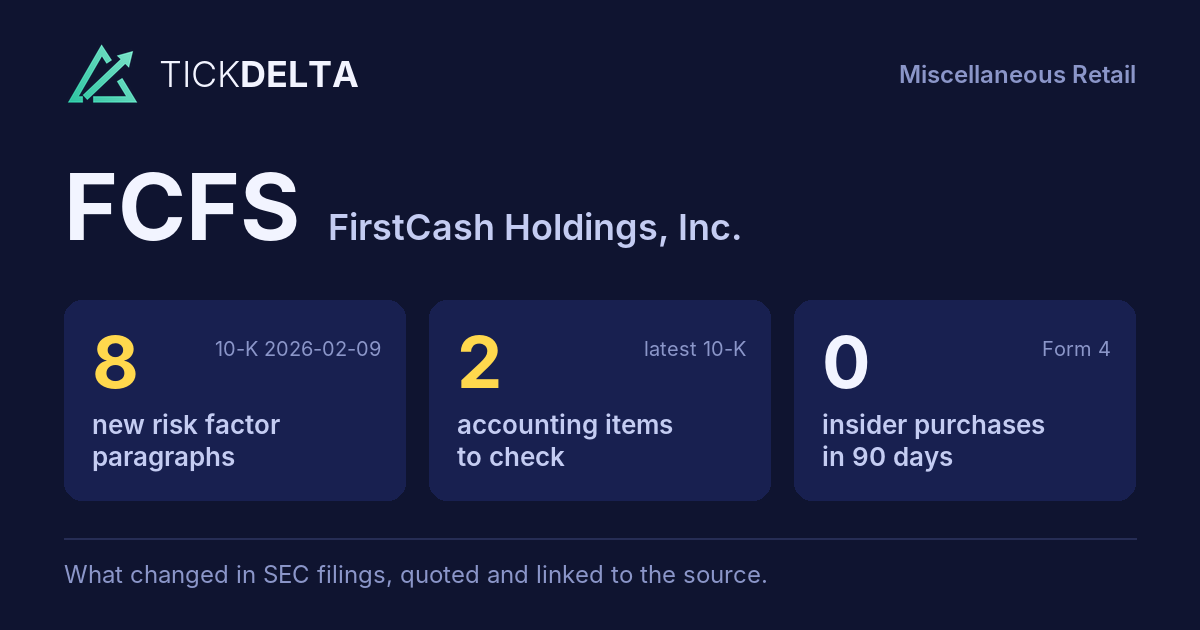
172 paragraphs · 8 new · 51 reworded · 10 gone · 10-K Feb 9, 2026 against Feb 3, 2025
New paragraph Reworded (5% of its words or more) Same or nearly
Paragraph 54 · 47% changed Every version of it
Additionally, the regulatory environment related to information security and data collection, retention, use and privacy is increasingly rigorous, with new and constantly changing requirements applicable to the Company’s business, and compliance with those requirements could result in additional costs, such as increased investment in technology or investigative expenses, the costs of compliance with privacy laws, and fines, penalties and costs incurred to prevent or remediate information security or cyber breaches. Furthermore, federal For example, the GDPR imposes strict data protection requirements and state regulators and many federal and state laws and regulations require notice of any data security breaches that involve personal information. These mandatory disclosures are costly to implement and often lead to widespread negative publicity, which may cause consumers to lose confidence in the effectiveness of the Company’s data security measures. Any security breach suffered by the Company or its vendors, any unauthorized, accidental, or unlawful access or loss of data, or the perception that any such event has occurred, could result in a disruption to the Company’s operations, litigation, an obligation to notify regulators and affected individuals, the triggering of indemnification and other contractual obligations, regulatory investigations, government fines and penalties, reputational damage, and loss of customers and ecosystem partners, and its business could be materially and adversely affected. For additional information on cybersecurity, see “Item 1C. Cybersecurity.” significant penalties for
Paragraph 87 · 40% changed Every version of it
Reports and statements made by consumer advocacy groups, members of the media, regulators and elected officials often focus on the annual or monthly cost to a consumer of pawn, LTO and certain retail finance transactions, which are higher than the interest typically charged by banks to consumers with better credit histories. These reports and statements typically characterize these products as predatory or abusive and often focus on alleged instances of pawn operators purchasing or accepting stolen property as pawn collateral. If the negative characterization of the Company’s businesses becomes increasingly accepted by consumers, demand for its products could significantly decrease, which could materially affect the Company’s results of operations and financial condition. Additionally, if the negative characterization of these types of transactions becomes increasingly accepted by legislators and regulators, the Company could become subject to more restrictive laws and regulations that could have a material adverse effect on the Company’s financial condition and results of operations. Furthermore, any negative public perception of pawnshops generally would also likely have a material negative impact on the Company’s retail operations, including reducing the number of consumers willing to shop at the Company’s stores.
Paragraph 42 · 34% changed Every version of it
The Company has historically grown in large part through strategic acquisitions, and the Company’s strategy is to continue to pursue attractive acquisition opportunities if and when they become available. The success of an acquisition is subject to numerous internal and external factors, such as competition rules, the ability to consolidate information technology and accounting functions, the management of additional sales, administrative, operations and management personnel, overall management of a larger organization, competitive market forces, and general economic and regulatory factors. It is possible that the integration process could result in unrealized administrative and operational synergies, the loss of key employees, the disruption of ongoing businesses, tax costs or inefficiencies, or inconsistencies in standards, controls, information technology systems, procedures and policies, any of which could adversely affect the Company’s ability to maintain relationships with customers, employees, or other third parties or the Company’s ability to achieve the anticipated benefits of such acquisitions and could harm its financial performance. Furthermore, future acquisitions may be in jurisdictions in which the Company does not currently operate or in lines of business that are new to the Company, which could make the successful consummation and integration of any such acquisitions more difficult. Acquisition targets may also become increasingly scarce in future periods or harder to acquire at attractive valuations. Failure to successfully integrate an acquisition could have an adverse effect on adversely affect the Company’s business, results of operations and financial condition, and failure to successfully identify attractive acquisition targets and complete such acquisitions on favorable terms could have an adverse effect on the Company’s growth. Additionally, any acquisition carries the risk that the Company may not realize a return on the acquisition or the Company’s investment.
Paragraph 104 · 34% changed Every version of it
Most states The Company’s pawn businesses are subject to significant registration and many local jurisdictions, both licensing requirements from various federal, state and municipal governmental entities in the U.S. U.S., Latin America and in Latin America, in which the Company operates U.K. Many of these regulatory bodies require registration and licenses of stores and employees to conduct the Company’s business. These states or their respective regulatory bodies business and have established criteria the Company must meet in order to obtain, maintain, and renew those licenses. In addition, the AFF business is also subject to certain states’ laws which regulate and require licensing, registration, notice filing or other approval by parties that engage in certain activity regarding consumer finance transactions, including facilitating and assisting such transactions in certain circumstances. Furthermore, certain states and localities have also adopted laws requiring licensing, registration, notice filing, or other approval for consumer debt collection or servicing, and/or purchasing or selling consumer loans. From time to time, the Company is subject to audits in various states to ensure it is meeting the applicable requirements to maintain the applicable licenses and registrations.
Paragraph 155 · 30% changed Every version of it
AFF’s continued success is dependent on its ability to maintain and expand its merchant partner base and the volume of transactions from these merchants in order to grow revenue on its platform. Its ability to retain and grow its relationships with its merchant partners depends on the willingness of merchants to partner with AFF. The attractiveness of AFF’s platform to merchants depends upon, among other things, the size of its consumer base, its brand and reputation, the amount of merchant premium or discounts paid or received by AFF, its ability to sustain its value proposition to merchants for customer acquisition by demonstrating higher conversion at checkout, the attractiveness to merchants of AFF’s technology and data-driven platform, services and products offered by competitors, and its ability to perform under, and maintain, its merchant agreements. It is also important that AFF partner with merchants with growing sales across a diverse mix of retail channels to mitigate risk associated with changing consumer spending behavior, economic conditions and other factors that may affect a particular type of merchant or industry. Additionally, AFF’s agreements with its merchant partners are generally terminable for convenience.
Paragraph 105 · 29% changed Every version of it
Most states and many local jurisdictions, both in the U.S. and in Latin America, in which the Company operates require registration and licenses of stores and employees to conduct the Company’s business. These states or their respective regulatory bodies have established criteria the Company must meet in order to obtain, maintain, and renew those licenses. In addition, the AFF business is also subject to certain states’ laws which regulate and require licensing, registration, notice filing or other approval by parties that engage in certain activity regarding consumer finance transactions, including facilitating and assisting such transactions in certain circumstances. Furthermore, certain states and localities have also adopted laws requiring licensing, registration, notice filing, or other approval for consumer debt collection or servicing, and/or purchasing or selling consumer loans. From time to time, the Company is subject to audits in various states jurisdictions to ensure it is meeting the applicable requirements to maintain the applicable licenses and registrations.
Paragraph 154 · 23% changed Every version of it
AFF’s continued success is dependent on its ability to maintain and expand its merchant partner base and the volume of transactions from these merchants in order to grow revenue on its platform. Its ability to retain and grow its relationships with its merchant partners depends on the willingness of merchants to partner with AFF. The attractiveness of AFF’s platform to merchants depends upon, among other things, the size of its consumer base, its brand and reputation, the amount of merchant premium or discounts paid or received by AFF, its ability to sustain its value proposition to merchants for customer acquisition by demonstrating higher conversion at checkout, the attractiveness to merchants of AFF’s technology and data-driven platform, services and products offered by competitors, and its ability to perform under, and maintain, its merchant agreements. It is also important that AFF partner with merchants with growing sales across a diverse mix of retail channels to mitigate risk associated with changing consumer spending behavior, economic conditions and other factors that may affect a particular type of merchant or industry. Additionally, AFF’s agreements with its merchant partners are generally terminable for convenience.
Paragraph 41 · 20% changed Every version of it
The Company has historically grown in large part through strategic acquisitions, and the Company’s strategy is to continue to pursue attractive acquisition opportunities if and when they become available. The success of an acquisition is subject to numerous internal and external factors, such as competition rules, the ability to consolidate information technology and accounting functions, the management of additional sales, administrative, operations and management personnel, overall management of a larger organization, competitive market forces, and general economic and regulatory factors. It is possible that the integration process could result in unrealized administrative and operational synergies, the loss of key employees, the disruption of ongoing businesses, tax costs or inefficiencies, or inconsistencies in standards, controls, information technology systems, procedures and policies, any of which could adversely affect the Company’s ability to maintain relationships with customers, employees, or other third parties or the Company’s ability to achieve the anticipated benefits of such acquisitions and could harm its financial performance. Furthermore, future acquisitions may be in jurisdictions in which the Company does not currently operate or in lines of business that are new to the Company, which could make the successful consummation and integration of any such acquisitions more difficult. Acquisition targets may also become increasingly scarce in future periods or harder to acquire at attractive valuations. Failure to successfully integrate an acquisition could have an adverse effect on the Company’s business, results of operations and financial condition, and failure to successfully identify attractive acquisition targets and complete such acquisitions on favorable terms could have an adverse effect on the Company’s growth. Additionally, any acquisition carries the risk that the Company may not realize a return on the acquisition or the Company’s investment.

MD&A

132 paragraphs · 21 new · 74 reworded · 9 gone · 10-K Feb 9, 2026 against Feb 3, 2025
New paragraph Reworded (5% of its words or more) Same or nearly
Paragraph 79 · 50% changed
Provision for lease losses Operating expenses decreased 8% 31% to $163.9 $94.8 million during 2024 2025 compared to $177.4 $138.0 million during 2023, which 2024. The decrease was primarily due to the 9% decrease elimination of certain expenses associated with supporting the A-Freight and Conn’s relationships along with continued realization of operating synergies, primarily in gross transaction volumes. technology and development infrastructure, coupled with other cost reduction initiatives. As a percentage of gross transaction volume, the provision for lease losses increased segment revenues, operating expenses decreased to 29% 11% during 2024 compared to 28% 2025 from 14% during 2023. 2024.
Paragraph 124 · 50% changed
Constant Currency Basis As of December 31, As of December 31, 2024 Increase 2024 2023 (Decrease) 2025 Currency Constant Currency Exchange Rate Basis U.S. Dollar Basis Fluctuations (Non-GAAP) (Non-GAAP) Latin America Pawn Segment Earning assets: Pawn loans $167,438 $ 121,200 (17,990) $ 127,694 (5)% 149,448 Inventories 129,269 (13,933) 115,336 $296,707 $ 143,805 13% Inventories 89,088 90,246 (1)% 105,686 17% (31,923) $ 210,288 $ 217,940 (4)% $ 249,491 14% 264,784 Average outstanding pawn loan amount (in ones) $112 $ 87 (12) $ 95 (8)% $ 103 8% Composition of pawn collateral: General merchandise 58 % 63 % Jewelry 42 % 37 % 100 % 100 % Composition of inventories: General merchandise 65 % 67 % Jewelry 35 % 33 % 100 % 100 % Percentage of inventory aged greater than one year 1 % 1 % Inventory turnover (trailing twelve months cost of merchandise sales divided by average inventories) 4.2 times 4.4 times Store count 1,826 1,814 1% Average store count 1,821 1,791 2%
Paragraph 123 · 47% changed
The following table details presents earning assets, which consist of assets and average outstanding pawn loans and inventories as well as other earning asset metrics of loan amount for the Latin America pawn segment, segment as of December 31, 2024 as compared to December 31, 2023 (dollars 2025 using the exchange rate from the prior-year comparable period (unaudited, in thousands, except as otherwise noted):
Paragraph 33 · 42% changed
The following charts present net income, adjusted net income, diluted earnings per share, adjusted diluted earnings per share, EBITDA, adjusted EBITDA, revenue share repurchases, dividends paid, operating cash flow and adjusted revenue free cash flow for the years ended December 31, 2024, 2025, 2024 and 2023 and 2022 (in millions, except per share amounts): millions):
Paragraph 85 · 39% changed
Consolidated effective income tax rates for 2025 and 2024 were 26.2% and 2023 were 24.5% and 25.1%, 24.5%, respectively. The decrease increase in the effective tax rate was primarily due to an increase certain non-deductible expenses incurred in U.S.-sourced income as a result 2025 related to the settlement of the U.S. store CFPB lawsuit and certain acquisition activity since costs associated with the beginning of 2023, which is taxed at a lower rate than the Latin American countries in which the Company operates. H&T Acquisition. See Note 12 of Notes to Consolidated Financial Statements.
Paragraph 84 · 36% changed
U.S. store operating Merger and acquisition expenses increased 12% 545% to $503.6 $14.4 million during 2024 2025 compared to $451.5 $2.2 million during 2023 while same-store operating 2024. The increase was due primarily to expenses increased 5% compared associated with the prior year. The increase in operating expenses was primarily due to an increase in the average store count. H&T Acquisition.
Paragraph 96 · 36% changed
In July 2023, the Board authorized a common stock repurchase program for up to $200.0 million of the Company’s outstanding common stock. During 2024, 2025, the Company repurchased a total of 721,000 912,000 shares of common stock at an aggregate cost of $85.0 $115.0 million and an average cost per share of $117.90. During 2023, $126.03, which completed the Company repurchased 1,248,000 shares of common stock at an aggregate cost of $114.4 million and an average cost per share of $91.58. The aggregate cost and average cost per share do not include the effect of the 1% excise tax on certain share repurchases enacted under the inflation Reduction Act of 2022. repurchase program authorized in July 2023. The Company incurred $0.9 $1.2 million and $1.1 $0.9 million of excise taxes during 2024 2025 and 2023, 2024, respectively.
Paragraph 82 · 35% changed
Depreciation and amortization decreased 11% increased 7% to $56.6 million during 2025 compared to $52.8 million during 2024 compared to $59.2 million during 2023, 2024, primarily due to a scheduled $6.9 million decrease in the addition of depreciation and amortization expenses of acquired AFF intangible assets. H&T during 2025.

A paragraph is matched with the one last year that shares the most of its words; under half in common makes it new. The paragraphs shown are the 8 reworded the most in each section.

The paragraph that changed most in each section

The redline

Marked against last year's 10-K: cut words struck through, new words highlighted.

Legal Proceedings249 words changed in this paragraph; it is 40% similar to last year's version.
On November 12, 2021, the CFPB initiated a civil action in the United States District Court for the Northern District of Texas (the “District Court”) against FirstCash, Inc. and Cash America West, Inc., and later amended the complaint to include numerous Company subsidiaries as defendants. The CFPB’s lawsuit alleges alleged violations of the MLA in connection with pawn transactions. The CFPB also alleges that these same alleged violations of the MLA constitute breaches of a 2013 CFPB consent order entered into by its predecessor company that, among other things, allegedly required the company and its successors to cease and desist from further MLA violations. The CFPB is seeking sought an injunction, redress for affected borrowers and a civil monetary penalty. After an initial period of pre-trial activity, On July 11, 2025, with the case was stayed on November 4, 2022, pending District Court’s approval and without admitting or denying the Supreme Court review allegations, the Company and the CFPB agreed to settle and resolve all matters in dispute. As part of the Fifth Circuit's decision in Community Financial v. CFPB, where settlement, the Fifth Circuit held the CFPB’s funding mechanism was unconstitutional and its actions were void. The Supreme Court reversed that decision through an opinion issued on May 16, 2024. The stay Company agreed to offer a new pawn lending product for covered members of the CFPB case was lifted, U.S. military and active litigation ensued. On November 7, 2024, the District Court denied the Company’s motion for partial summary judgement. The District Court has also ordered the parties to mediation. After an initial session, the mediation is currently postponed pending the leadership transition at the CFPB. Unless resolved by agreement, their covered dependents. Additionally, the Company intends will pay consumer redress in fees or principal returned to vigorously defend affected customers, which is estimated by the action. Company to be no more than $ 7.0 million. The Company paid a $ 4.0 million fine to the CFPB victims' relief fund in July 2025.

Source: Item 3, via Note 13 – COMMITMENTS AND CONTINGENCIES, 10-K 0000840489-26-000032 vs Item 3, via Note 13 – COMMITMENTS AND CONTINGENCIES, 10-K 0000840489-25-000032

Accounting Policies169 words changed in this paragraph; it is 38% similar to last year's version.
In November 2023, December 2025, the FASB issued ASU No 2023-07, “Segment 2025-11 “Interim Reporting (Topic 280): Improvements 270): Narrow-Scope Improvements” (“ASU 2025-11”). ASU 2025-11 clarifies the applicability of the interim reporting guidance, the types of interim reporting, and the form and content of interim financial statements in accordance with GAAP. Per the FASB, the amendment does not intend to Reportable Segment Disclosures” (“ASU 2023-07”). change the fundamental nature of interim reporting or expand or reduce current interim disclosure requirements but rather provide clarity and improve navigability of the existing interim reporting requirements. ASU 2023-07 expands disclosures about a public entity’s reportable segments and requires more enhanced information about a reportable segment’s expenses, interim segment profit or loss, and how a public entity’s chief operating decision maker uses reported segment profit or loss information in assessing segment performance and allocating resources. ASU 2023-07 2025-11 is effective for fiscal years interim periods within annual reporting periods beginning after December 15, 2023 and interim periods within fiscal years beginning after December 15, 2024. Early 2027, with early adoption is permitted. ASU 2023-07 should 2025-11 may be applied either prospectively or retrospectively to for all prior periods presented in presented. The Company is currently evaluating the financial statements. The adoption impact of ASU 2023-07 did not have a material effect adopting this guidance on the Company’s current Company's financial position, results of operations or financial statement disclosures. See Note 17.

Source: 10-K text, Note 2 – SUMMARY OF SIGNIFICANT ACCOUNTING POLICIES, 10-K 0000840489-26-000032 vs 10-K text, Note 2 – SUMMARY OF SIGNIFICANT ACCOUNTING POLICIES, 10-K 0000840489-25-000032

Risk Factors151 words changed in this paragraph; it is 49% similar to last year's version.
Additionally, the regulatory environment related to information security and data collection, retention, use and privacy is increasingly rigorous, with new and constantly changing requirements applicable to the Company’s business, and compliance with those requirements could result in additional costs, such as increased investment in technology or investigative expenses, the costs of compliance with privacy laws, and fines, penalties and costs incurred to prevent or remediate information security or cyber breaches. Furthermore, federal For example, the GDPR imposes strict data protection requirements and state regulators and many federal and state laws and regulations require notice of any data security breaches that involve personal information. These mandatory disclosures are costly to implement and often lead to widespread negative publicity, which may cause consumers to lose confidence in the effectiveness of the Company’s data security measures. Any security breach suffered by the Company or its vendors, any unauthorized, accidental, or unlawful access or loss of data, or the perception that any such event has occurred, could result in a disruption to the Company’s operations, litigation, an obligation to notify regulators and affected individuals, the triggering of indemnification and other contractual obligations, regulatory investigations, government fines and penalties, reputational damage, and loss of customers and ecosystem partners, and its business could be materially and adversely affected. For additional information on cybersecurity, see “Item 1C. Cybersecurity.” significant penalties for

Source: Item 1A, 10-K 0000840489-26-000032 vs Item 1A, 10-K 0000840489-25-000032

MD&A97 words changed in this paragraph; it is 35% similar to last year's version.
U.S. retail merchandise sales Operating expenses increased 13% 5% (10% on a constant currency basis) to $969.4 $272.1 million during 2024 2025 compared to $854.2 $259.3 million for 2023. during 2024. Same-store retail sales operating expenses also increased 6% during 2024 5% (10% on a constant currency basis) compared to 2023. the prior year. The constant currency increase in total retail sales and same-store operating expenses was primarily due to incremental sales contributions from acquired stores driven by general inflationary impacts and an increase in same-store sales. During 2024, the gross profit margin on retail merchandise sales continued increases in the U.S. was 42% compared to a margin of 43% during 2023, reflecting continued demand for value-priced, pre-owned merchandise and low levels of aged inventory. federally mandated minimum wage.

Source: Item 7, 10-K 0000840489-26-000032 vs Item 7, 10-K 0000840489-25-000032

Sentences and paragraphs added, removed or reworded

Every change, by type

Sentences and paragraphs of FCFS's Risk Factors and MD&A, 10-K Feb 9, 2026 against 10-K Feb 3, 2025. Each links to the text at sec.gov.

Quiet changes are sentences kept from last year with one to four words changed, at least one of them a hedge, a modal or a qualifier (may, could, will, not, significant, material…). A year or date rolling forward is not counted.

The full word list

adverse, adversely, all, although, anticipate, anticipates, any, approximately, believe, believes, can, cannot, certain, could, expect, expects, generally, however, if, intend, intends, largely, likely, many, material, materially, may, might, most, must, never, no, not, possible, primarily, probable, should, significant, significantly, some, substantial, substantially, unlikely, will, would

AddedRisk Factors
•The Company’s future growth is dependent on its ability to keep pace with technological advances, including the adoption of generative artificial intelligence and other machine learning technologies, to remain competitive.
Read it in 10-K Feb 9, 2026 at sec.gov
AddedRisk Factors
The Company’s future growth is dependent on its ability to keep pace with the adoption of technological advances, including generative artificial intelligence and other machine learning technologies, to remain competitive.
Read it in 10-K Feb 9, 2026 at sec.gov
AddedRisk Factors
The Company’s industry is marked by rapid technological developments and innovations, such as the use of artificial intelligence and machine learning, to conform to evolving industry standards. The Company may be required to make significant investments in its information technology systems, including those related to artificial intelligence and machine learning, in order to maintain its competitive position in the market. If the Company is unable to provide enhancements and new features and integrations for its existing products, develop new products that achieve market acceptance, or innovate quickly enough to keep pace with these rapid technological developments, its business could be harmed. Furthermore, the technical challenges associated with developing this technology may be significant, leading to risk of equipment failures, customer disruptions, or vulnerabilities that could compromise the integrity, security, or privacy of certain customer information. These failures could result in reputational damage, legal liabilities, or loss in customer confidence. Moreover, transitioning to these new or upgraded systems or technological developments requires significant capital investments and personnel resources. Implementation is also highly dependent on the coordination of numerous associates, contractors and software and system providers. If the Company’s information technology systems, upgrades and associated change management are not adequate to support its business and its strategic initiatives, the Company’s financial condition and results of operations could be adversely affected, and its business may become less competitive.
Read it in 10-K Feb 9, 2026 at sec.gov
AddedRisk Factors
Many of the foreign countries in which the Company operates impose costs on non-domestic companies through the use of local regulations, tariffs, labor controls and other federal or state requirements or legislation. In addition, the U.S., China, Canada, Mexico, European Union and other countries have imposed, or threatened to impose, new or enhanced tariffs, quotas, trade barriers and other restrictions on imports into their respective territories. Numerous trade restrictions are currently in
Read it in 10-K Feb 9, 2026 at sec.gov
AddedRisk Factors
effect and such restrictions, coupled with the risk of retaliatory steps taken in response to such restrictions, could potentially serve to depress economic activity generally in the U.S., adversely affecting consumers and contributing to general market volatility.
Read it in 10-K Feb 9, 2026 at sec.gov
AddedRisk Factors
Furthermore, Mexico’s judiciary is undergoing a substantial overhaul via a 2024 constitutional reform, transitioning from an appointed system to one where federal judges, magistrates, and even Supreme Court justices are popularly elected by vote, starting with 2025 elections, to combat corruption but raising concerns about independence, expertise, and potential political influence from the ruling party. Key changes include popular elections, restructuring governing bodies (replacing the Federal Judiciary Council), reducing Supreme Court size, and lowering qualifications for some judges, creating significant debate over the rule of law and stability. There is no guarantee as to the impact these reforms may have on our Mexican operations if at all.
Read it in 10-K Feb 9, 2026 at sec.gov
AddedRisk Factors
For example, on July 4, 2025, the One Big Beautiful Bill Act (“OBBBA”) was enacted, introducing broad changes to the U.S. tax code, including modifications to corporate and international provisions, which are primarily effective for the Company beginning in 2026 and 2027. The Company is continuing to assess OBBBA’s impact on its financial results. In addition, various foreign taxing jurisdictions enacted local legislation formally adopting the Global Anti-Base Erosion Model Rules (“Pillar
Read it in 10-K Feb 9, 2026 at sec.gov
AddedRisk Factors
Two”), which generally provides for a minimum effective tax rate of 15%, as established by the Organization for Economic Co-operation and Development Pillar Two Framework. The effective dates were generally January 1, 2024, and January 1, 2025 for different aspects of the rules and vary by jurisdiction. More jurisdictions are expected to implement the model rules under local law in the future, with varying effective dates. Additionally, OBBBA includes modifications to the international tax framework. While the Company continues to evaluate the effect of these legislative changes as additional guidance becomes available, uncertainty remains regarding the timing and interpretation by tax authorities in affected jurisdictions.
Read it in 10-K Feb 9, 2026 at sec.gov
Show the other 57
RemovedRisk Factors
•The Company is the subject of a lawsuit initiated by the CFPB alleging (1) violations of the MLA and (2) violations of a consent order the Company’s predecessor entered into with the CFPB.
Read it in 10-K Feb 3, 2025 at sec.gov
RemovedRisk Factors
An important component of the Company’s business involves collection, storage, use, disclosure, processing, transfer and other handling of a wide variety of sensitive, regulated and/or confidential information, including personally identifiable information, for various purposes in its business with customers. While the Company’s pawn business has historically acquired and maintained minimal personal information (primarily name, address, government identification numbers and date of birth). AFF obtains additional personal information, including social security numbers, dates of birth, bank account and payment card information and data from consumer reporting agencies (including credit report information) from its customers, increasing the
Read it in 10-K Feb 3, 2025 at sec.gov
RemovedRisk Factors
Donald Trump became president on January 20, 2025, and at this juncture, it is unclear whether a new CFPB Director appointed by the Trump Administration will be less aggressive in its regulatory and enforcement approach. In addition to the specific laws described above, it is anticipated that the Trump administration will promulgate a number of executive orders and propose legislation that could directly impact the regulation of the financial services industry. These orders and legislation could change banking statutes and our operating environment in substantial and unpredictable ways by increasing or decreasing the cost of doing business, limiting or expanding permissible activities, or affecting the competitive balance among financial institutions.
Read it in 10-K Feb 3, 2025 at sec.gov
RemovedRisk Factors
Consequently, it is difficult to assess the likelihood of the enactment of any unfavorable federal or state legislation or local ordinances, and there can be no assurance that additional legislative, administrative or regulatory initiatives will not be enacted that would severely restrict, prohibit, or eliminate the Company’s ability to offer certain products and services.
Read it in 10-K Feb 3, 2025 at sec.gov
RemovedRisk Factors
On November 12, 2021, the CFPB initiated a civil action in the United States District Court for the Northern District of Texas (the “District Court”) against FirstCash, Inc. and Cash America West, Inc., and later amended the complaint to include numerous Company subsidiaries as defendants. The CFPB lawsuit alleges violations of the MLA in connection with pawn transactions. The CFPB also alleges that these same alleged violations of the MLA constitute breaches of a 2013 CFPB consent order entered into by the Company’s predecessor that, among other things, allegedly required such predecessor company and its successors to cease and desist from further MLA violations. The CFPB is seeking an injunction, redress for affected borrowers and a civil monetary penalty. After an initial period of pre-trial activity, the case was stayed on November 4, 2022, pending the Supreme Court review of the Fifth Circuit's decision in Community Financial v. CFPB, where the Fifth Circuit held the CFPB’s funding mechanism was unconstitutional and its actions were void. The Supreme Court reversed that decision through an opinion issued on May 16, 2024. The stay of the CFPB case was lifted, and active litigation ensued. On November 7, 2024, the District Court denied the Company’s motion for partial summary judgement. The District Court has also ordered the parties to mediation. After an initial session, the mediation is currently postponed pending the anticipated leadership transition at the CFPB. Unless resolved by agreement, the Company intends to vigorously defend the action. While the Company intends to vigorously defend itself against the allegations in the case, it cannot predict or determine the timing or final outcome of this matter, or the effect that any adverse determinations from the lawsuit may have on the Company. An unfavorable determination in the lawsuit could result in the payment of substantial monetary damages, which could have a material effect on the Company’s business, results of operations or financial condition. The Company may also be required to modify its business practices in the event of an unfavorable determination in the lawsuit, which could result in increased operational costs and could negatively impact demand for its products and customer satisfaction. Further, the legal costs associated with the lawsuit, which may not be covered by insurance, and the amount of time required to be spent by management and the Board on this matter, even if the Company is ultimately successful, could have a material effect on its business, financial condition and results of operations. Following the announcement of the CFPB’s action, the Company became the subject to a purported shareholder class action and derivative action related to the CFPB’s lawsuit. While both the securities class action and derivative action
Read it in 10-K Feb 3, 2025 at sec.gov
RemovedRisk Factors
have been dismissed, there is no guarantee that the Company will not become subject to future securities litigation related to the CFPB lawsuit, including in the event of an adverse outcome in the CFPB lawsuit.
Read it in 10-K Feb 3, 2025 at sec.gov
RemovedRisk Factors
In addition to the specific laws described above, it is anticipated that the Trump administration will promulgate a number of executive orders and propose legislation that could directly impact the regulation of the financial services industry. These orders and legislation could change applicable statutes and the Company’s operating environment in substantial and unpredictable ways by increasing or decreasing the cost of doing business, limiting or expanding permissible activities, or affecting the competitive balance among financial services institutions.
Read it in 10-K Feb 3, 2025 at sec.gov
RemovedRisk Factors
Many of the foreign countries in which the Company operates impose costs on non-domestic companies through the use of local regulations, tariffs, labor controls and other federal or state requirements or legislation. In addition, the 2024 presidential and congressional election results may have a significant impact on U.S. domestic and global trade policies. As the Company derives significant revenue, earnings and cash flow from operations in Latin America, primarily in Mexico, there are some inherent risks regarding the overall stability of the trading relationship between Mexico and the U.S. and the burdens imposed thereon by any changes to (or the adoption of new) regulations, tariffs or other federal or state legislation. Specifically, the Company has significant exposure to fluctuations and devaluations of the Mexican peso and the health of the Mexican economy, which, in each case, may be negatively impacted by changes in U.S. trade treaties, including the United States-Mexico-Canada Agreement and corporate tax policy. In some cases, there have been negative reactions to the enacted and/or proposed policies as expressed in the media and by politicians in Mexico, which could potentially negatively impact U.S. companies operating in Mexico. In particular, there is continued uncertainty around Mexico’s current federal administration and how the policies as applied by its administration, including conducting aggressive corporate tax and other regulatory audits, adverse government discretion, and support of increased employee minimum wages, profit sharing and benefit programs, may impact U.S. companies doing business in Mexico generally and pawn and consumer finance companies in particular. Any such changes in regulations, trade treaties, corporate tax policy, import taxes or adverse court or administrative interpretations of the foregoing could adversely and significantly affect the Mexican economy and ultimately the Mexican peso, which could adversely and significantly affect the Company’s financial position and results of the Company’s Latin America pawn operations.
Read it in 10-K Feb 3, 2025 at sec.gov
RemovedRisk Factors
potential errors or inaccuracies in AFF’s decisioning platform and models may be material and affect a significant number of transactions, which could have a material and adverse effect on AFF’s business.
Read it in 10-K Feb 3, 2025 at sec.gov
RewordedRisk Factors
Certain of AFF’s larger furniture-focused merchant partners have experienced lagging sales, store closures and, in some instances, including Conn’s Appliances, Inc. and American Freight, Inc., (“A-Freight”), bankruptcies, which has and is expected to continue to negatively impact AFF’s originations.
Read it in 10-K Feb 9, 2026 at sec.gov
RewordedRisk Factors
As of December 31, 2024, 2025, the Company had 1,826 1,837 pawn store locations in Latin America, including 1,725 1,732 in Mexico, 72 75 in Guatemala, 17 18 in El Salvador and 12 in Colombia, and the Company plans to open or acquire additional pawn 286 stores in Latin America in the future. U.K.
Read it in 10-K Feb 9, 2026 at sec.gov
RewordedRisk Factors
The application of indirect taxes, such as sales tax, and value-added taxes, is a complex and evolving issue, particularly with respect to the LTO industry generally and AFF’s virtual and e-commerce LTO businesses more specifically. issue.
Read it in 10-K Feb 9, 2026 at sec.gov
RewordedRisk Factors
These states or their respective Many of these regulatory bodies require registration and licenses of stores and employees to conduct the Company’s business and have established criteria the Company must meet in order to obtain, maintain, and renew those licenses.
Read it in 10-K Feb 9, 2026 at sec.gov
RewordedRisk Factors
The Company derives significant revenue, earnings and cash flow from operations in Latin America, America and the U.K., where business operations are transacted primarily in Mexican pesos, pesos and British pounds sterling, and to a lesser extent in Guatemalan quetzales and Colombian pesos to a lesser extent. pesos.
Read it in 10-K Feb 9, 2026 at sec.gov
RewordedRisk Factors
The Company maintains an allowance for lease and loan losses and a liability for off-balance sheet credit exposure related to the OBS Loans at a level believed to be sufficient to cover estimated lifetime losses expected to be incurred in the lease and loan portfolio. incurred.
Read it in 10-K Feb 9, 2026 at sec.gov
RewordedRisk Factors
As of December 31, 2024, including the Company's senior unsecured notes and the Company’s unsecured credit facilities, 2025, the Company had outstanding principal indebtedness of $1,748.0 $2,224.0 million and availability of $528.9 $178.0 million under its unsecured credit facilities, subject to certain financial covenants.
Read it in 10-K Feb 9, 2026 at sec.gov
RewordedRisk Factors
Certain of AFF’s larger furniture-focused merchant partners have experienced lagging sales, store closures and, in some instances, including Conn’s Appliances, Inc. and American Freight, Inc., bankruptcies, which has and is expected to continue to negatively impact AFF’s originations.
Read it in 10-K Feb 9, 2026 at sec.gov
RewordedRisk Factors
The attractiveness of AFF’s platform to merchants depends upon, among other things, the size of its consumer base, its brand and reputation, the amount of merchant premium or discounts paid or received by AFF, its ability to sustain its value proposition to merchants for customer acquisition by demonstrating higher conversion at checkout, the attractiveness to merchants of AFF’s technology and data-driven platform, services and products offered by competitors, and its ability to perform under, and maintain, its merchant agreements.
Read it in 10-K Feb 9, 2026 at sec.gov
RewordedRisk Factors
Furthermore, H&T’s and AFF’s senior management team provides teams provide the Company with significant experience with the U.K. pawn market and retail POS payment solutions for credit-constrained customers. industry, respectively.
Read it in 10-K Feb 9, 2026 at sec.gov
RewordedRisk Factors
Failure to comply with such tax provisions or a successful assertion by a jurisdiction requiring AFF the Company to collect taxes in a location or for transactions where or for which AFF the Company presently does not, could result in substantial tax liabilities, including those for past sales and leases, liabilities as well as penalties and interest.
Read it in 10-K Feb 9, 2026 at sec.gov
RewordedRisk Factors
In addition, the AFF business is also subject to certain states’ laws which regulate and require licensing, registration, notice filing or other approval by parties that engage in certain activity regarding consumer finance transactions, including facilitating and assisting such transactions in certain circumstances.
Read it in 10-K Feb 9, 2026 at sec.gov
Quiet changesRisk Factors
The success of the Company’s organic expansion strategy is subject to numerous many external factors, including regulatory restrictions, general economic conditions and acceptance of the Company’s products.
Read it in 10-K Feb 9, 2026 at sec.gov
AddedMD&A
The Company completed the acquisition of H&T, the leading pawn operator in the United Kingdom with 286 store locations, on August 14, 2025, the date which the balance sheet and operating results of H&T were included in the Company’s consolidated financial results. For further detail, see Note 3 of Notes to Consolidated Financial Statements.
Read it in 10-K Feb 9, 2026 at sec.gov
AddedMD&A
losses is maintained at a level considered appropriate to cover expected lifetime losses on the finance receivable portfolio, and the appropriateness of the allowance is evaluated at each period end.
Read it in 10-K Feb 9, 2026 at sec.gov
AddedMD&A
Off-balance sheet installment loans — During the third quarter of 2025, the Company began assisting certain customers in applying for an OBS Loan that is underwritten and fully retained by a bank partner. After origination of the OBS Loan by the bank, the Company assumes responsibility for servicing the loan on behalf of the bank for the remaining term of the loan. The Company does not purchase the loan or the rights to a portion of the cash flows of the loan from the bank. As such, these loans are not reflected on the Company’s balance sheet as a finance receivable.
Read it in 10-K Feb 9, 2026 at sec.gov
AddedMD&A
The Company receives certain servicing and other fees associated with performing OBS Loans from the bank, which are included in interest and fees on finance receivables in the accompanying consolidated statements of income. However, if an OBS Loan becomes 90 days contractually past due, the Company is obligated to reimburse the bank for the outstanding principal amount plus accrued interest. This obligation constitutes an off-balance sheet credit exposure for which the Company is required to recognize, upon inception of the obligation, a liability for the expected lifetime losses, which is included in accrued liabilities in the accompanying consolidated balance sheets.
Read it in 10-K Feb 9, 2026 at sec.gov
AddedMD&A
The segment contribution reflects the results of operations of H&T for the period August 14, 2025 to December 31, 2025 as a result of the completion of the H&T Acquisition on August 14, 2025. See Note 3 of Notes to Consolidated Financial Statements for additional information about the H&T Acquisition.
Read it in 10-K Feb 9, 2026 at sec.gov
AddedMD&A
Administrative expenses increased 31% to $232.8 million during 2025 compared to $178.0 million during 2024, primarily due to the CFPB litigation settlement in 2025, the incremental administrative expenses of H&T since the acquisition date, increased variable compensation expense and general inflationary impacts, partially offset by a 5% change in the average value of the Mexican peso resulting in lower U.S. dollar translated administrative expenses in Latin America. As a percentage of revenue, administrative expenses increased to 6% during 2025 compared to 5% during 2024.
Read it in 10-K Feb 9, 2026 at sec.gov
RemovedMD&A
Year Ended December 31, Increase / 2024 2023 (Decrease) Consolidated Results of Operations Segment pre-tax operating income: U.S. pawn $ 397,293 $ 336,306 18% Latin America pawn 150,220 156,222 (4)% Retail POS payment solutions 128,629 132,016 (3)% Intersegment eliminations (1) 280 581 (52)% Consolidated segment pre-tax operating income 676,422 625,125 8% Corporate expenses and other income: Administrative expenses 173,199 176,315 (2)% Depreciation and amortization 52,809 59,196 (11)% Interest expense 105,226 93,243 13% Interest income (1,935) (1,469) 32% Loss (gain) on foreign exchange 2,641 (1,529) (273)% Merger and acquisition expenses 2,228 7,922 (72)% Other expenses (income), net (522) (1,402) (63)% Total corporate expenses and other income 333,646 332,276 —% Income before income taxes 342,776 292,849 17% Provision for income taxes 83,961 73,548 14% Net income $ 258,815 $ 219,301 18%
Read it in 10-K Feb 3, 2025 at sec.gov
RemovedMD&A
The Company has certain leases in Mexico which are denominated in U.S. dollars. The lease liability of these U.S.-dollar-denominated leases, which is considered a monetary liability, is remeasured into Mexican pesos using current period exchange rates, resulting in the recognition of foreign currency exchange gains or losses. The Company has adjusted the applicable financial measures to exclude these remeasurement gains or losses (1) because they are non-cash, non-operating items that could create volatility in the Company’s consolidated results of operations due to the magnitude of the end of period lease liability being remeasured and (2) to improve comparability of current periods presented with prior periods.
Read it in 10-K Feb 3, 2025 at sec.gov
RemovedMD&A
Year Ended December 31, 2024 2023 2022 Pre-tax Pre-tax Pre-tax Amortization of fair value adjustment on acquired finance receivables $ $ — $ 42,657 Amortization of fair value adjustment on acquired leased merchandise — — 7,697 Other non-recurring costs included in administrative expenses related to a discontinued finance product — 13,968 — Total AFF purchase accounting and other adjustments $ $ 13,968 $ 50,354
Read it in 10-K Feb 3, 2025 at sec.gov
RemovedMD&A
income statement data prepared in accordance with GAAP. The following table reconciles cash flow from operating activities to free cash flow and adjusted free cash flow (unaudited, in thousands):
Read it in 10-K Feb 3, 2025 at sec.gov
RemovedMD&A
Additionally, the following table provides reconciliations of total revenue and total net revenue, presented in accordance with GAAP, to adjusted total revenue and adjusted net revenue, which excludes the impacts of purchase accounting (in thousands):
Read it in 10-K Feb 3, 2025 at sec.gov
RemovedMD&A
(1)As a result of purchase accounting, AFF’s as reported amount for 2022 contains significant fair value adjustments. The adjusted amount for 2022 excludes these fair value purchase accounting adjustments.
Read it in 10-K Feb 3, 2025 at sec.gov
RemovedMD&A
evaluating period-over-period comparisons. See the Latin America pawn segment tables in “Results of Operations” above for additional reconciliation of certain constant currency amounts to as reported GAAP amounts.
Read it in 10-K Feb 3, 2025 at sec.gov
RewordedMD&A
The following table details presents earning assets, which consist of assets and average outstanding pawn loans and inventories as well as other earning asset metrics of loan amount for the Latin America pawn segment, segment as of December 31, 2024 as compared to December 31, 2023 (dollars 2025 using the exchange rate from the prior-year comparable period (unaudited, in thousands, except as otherwise noted):
Read it in 10-K Feb 9, 2026 at sec.gov
RewordedMD&A
Jewelry 59 % 35 % —% 52 % General merchandise 41 % 43 65 % Jewelry 59 % 57 —% 48 % 100 % 100 % —% 100 % Percentage of inventory aged greater than one year 1 1.5 % 1 1.4 % —% 1.4 % Inventory turnover turns (trailing twelve months cost of merchandise sales divided by average inventories) 2.8 times 2.8 4.2 times — 3.2 times Store count 1,200 1,183 1% 1,826 3,026 Average store count 1,195 1,135 5% 1,821 3,016
Read it in 10-K Feb 9, 2026 at sec.gov
RewordedMD&A
The allowance for loan losses increased 21% decreased 9% to $106.3 million as of December 31, 2025 compared to $117.0 million as of December 31, 2024 compared to $96.5 million as of December 31, 2023, 2024, which was primarily due to the increase decrease in finance receivables, partially offset by slightly receivables and lower loan loss provisioning rates used during 2024 2025 as compared to 2023. 2024.
Read it in 10-K Feb 9, 2026 at sec.gov
RewordedMD&A
The allowance for lease losses decreased 16% 20% to $64.9 million as of December 31, 2025 compared to $80.7 million as of December 31, 2024 compared to $95.8 million as of December 31, 2023, 2024, which was primarily due to the decrease in leased merchandise, partially offset by slightly higher merchandise and lower lease loss provisioning rates used during 2024 2025 as compared to 2023. 2024.
Read it in 10-K Feb 9, 2026 at sec.gov
RewordedMD&A
During 2024, 2025, the Company also acquired 28 23 pawn stores in the U.S., acquired 10 pawn stores in Mexico and acquired one pawn license that was used to open a new pawn store in the state of Nevada U.S. for a cumulative purchase price of $107.6 $106.3 million, net of cash acquired and subject to future post-closing adjustments.
Read it in 10-K Feb 9, 2026 at sec.gov
RewordedMD&A
Net cash provided by used in financing activities decreased $89.5 $214.6 million, or 174%, 562%, from net cash provided by financing activities of $51.3 million during 2023 to net cash used in financing activities of $38.2 million during 2024. 2024 to net cash provided by financing activities of $176.4 million during 2025.
Read it in 10-K Feb 9, 2026 at sec.gov
RewordedMD&A
The Company believes the increase in same-store pawn receivables was primarily due to continued inflationary pressures driving additional strong customer demand for pawn loans from a combination of more customer transactions and higher gold prices, which increased customers’ jewelry collateral value. larger loan amounts requested by the Company’s customers.
Read it in 10-K Feb 9, 2026 at sec.gov
RewordedMD&A
Leased merchandise income increased 2% decreased 27% to $559.0 million during 2025 compared to $766.2 million during 2024 compared to $752.7 million during 2023, 2024, which was primarily due to slightly higher average rental rates, partially offset by slightly lower average leased merchandise balances outstanding during 2024 2025 compared to 2023. 2024.
Read it in 10-K Feb 9, 2026 at sec.gov
RewordedMD&A
Operating expenses include salary and benefit expenses of pawn store-level employees and certain of AFF’s operations-focused departments, merchant partner incentives, occupancy costs, bank and other payment processing charges, credit reporting data analytics and decisioning costs, information technology costs, advertising costs, security, insurance, utilities, supplies, other costs incurred by the pawn stores and other operational costs incurred by AFF.
Read it in 10-K Feb 9, 2026 at sec.gov
RewordedMD&A
As of December 31, 2024, 2025, the Company’s primary sources of liquidity were $175.1 $125.2 million in cash and cash equivalents and $528.9 equivalents, $171.9 million of available and unused funds under the Company's revolving unsecured credit facilities, facilities and $6.1 million of available and unused funds under the Company’s revolving secured credit facility, subject to certain financial covenants (see Note 11 of Notes to Consolidated Financial Statements).
Read it in 10-K Feb 9, 2026 at sec.gov
RewordedMD&A
While acquisitions are an important part of the Company’s overall strategy, the The Company has adjusted the applicable financial calculations to exclude merger and acquisition expenses and amortization of acquired AFF intangible assets. assets, the CFPB litigation settlement and certain other income and expenses.
Read it in 10-K Feb 9, 2026 at sec.gov
RewordedMD&A
Retail merchandise sales (1) $ 969,371 584,129 $ 854,190 13% 27,664 $ 611,793 Pawn loan fees 505,262 435,762 16% 254,061 12,057 266,118 Wholesale scrap jewelry sales 93,923 78,571 20% 51,334 — 51,334 Total revenue 1,568,556 1,368,523 15% 889,524 39,721 929,245 Cost of revenue:
Read it in 10-K Feb 9, 2026 at sec.gov
Quiet changesMD&A
The Company has a partnership with a Utah state-chartered bank that requires the Company to purchase the rights to the cash flows associated with certain finance receivables marketed to retail consumers on the bank’s behalf.
Read it in 10-K Feb 9, 2026 at sec.gov

Sources

The two latest 10-Ks on EDGAR, section by section. Each change links to the text at sec.gov.

Also

New risk factors: paragraphs with nothing like them last year, quoted in full.

Work with it

Excel workbook · CSV. Google Sheet that stays up to date: paste =IMPORTDATA("https://tickdelta.com/company/FCFS/export.csv") into a cell.

Next:Related parties
Esc

Type a ticker such as AAPL, a name, an investor such as Buffett, or a topic such as tariffs. ↑ ↓ to move, Enter to open.