FirstCash Holdings, Inc. FCFS
New risk paragraphs, branching off last year
Each branch is a paragraph in Risk Factors with nothing like it in the 10-K filed Feb 3, 2025. A box jumps to the paragraph as filed, below.
Paragraphs with nothing like them in last year's 10-K
8 paragraphs in Risk Factors of the 10-K filed Feb 9, 2026 with nothing like them in the 10-K filed Feb 3, 2025. Quoted exactly. Paragraphs that were only edited are under 10-K change.
•The Company’s future growth is dependent on its ability to keep pace with technological advances, including the adoption of generative artificial intelligence and other machine learning technologies, to remain competitive.
The Company’s future growth is dependent on its ability to keep pace with the adoption of technological advances, including generative artificial intelligence and other machine learning technologies, to remain competitive.
The Company’s industry is marked by rapid technological developments and innovations, such as the use of artificial intelligence and machine learning, to conform to evolving industry standards. The Company may be required to make significant investments in its information technology systems, including those related to artificial intelligence and machine learning, in order to maintain its competitive position in the market. If the Company is unable to provide enhancements and new features and integrations for its existing products, develop new products that achieve market acceptance, or innovate quickly enough to keep pace with these rapid technological developments, its business could be harmed. Furthermore, the technical challenges associated with developing this technology may be significant, leading to risk of equipment failures, customer disruptions, or vulnerabilities that could compromise the integrity, security, or privacy of certain customer information. These failures could result in reputational damage, legal liabilities, or loss in customer confidence. Moreover, transitioning to these new or upgraded systems or technological developments requires significant capital investments and personnel resources. Implementation is also highly dependent on the coordination of numerous associates, contractors and software and system providers. If the Company’s information technology systems, upgrades and associated change management are not adequate to support its business and its strategic initiatives, the Company’s financial condition and results of operations could be adversely affected, and its business may become less competitive.
Many of the foreign countries in which the Company operates impose costs on non-domestic companies through the use of local regulations, tariffs, labor controls and other federal or state requirements or legislation. In addition, the U.S., China, Canada, Mexico, European Union and other countries have imposed, or threatened to impose, new or enhanced tariffs, quotas, trade barriers and other restrictions on imports into their respective territories. Numerous trade restrictions are currently in
effect and such restrictions, coupled with the risk of retaliatory steps taken in response to such restrictions, could potentially serve to depress economic activity generally in the U.S., adversely affecting consumers and contributing to general market volatility.
Furthermore, Mexico’s judiciary is undergoing a substantial overhaul via a 2024 constitutional reform, transitioning from an appointed system to one where federal judges, magistrates, and even Supreme Court justices are popularly elected by vote, starting with 2025 elections, to combat corruption but raising concerns about independence, expertise, and potential political influence from the ruling party. Key changes include popular elections, restructuring governing bodies (replacing the Federal Judiciary Council), reducing Supreme Court size, and lowering qualifications for some judges, creating significant debate over the rule of law and stability. There is no guarantee as to the impact these reforms may have on our Mexican operations if at all.
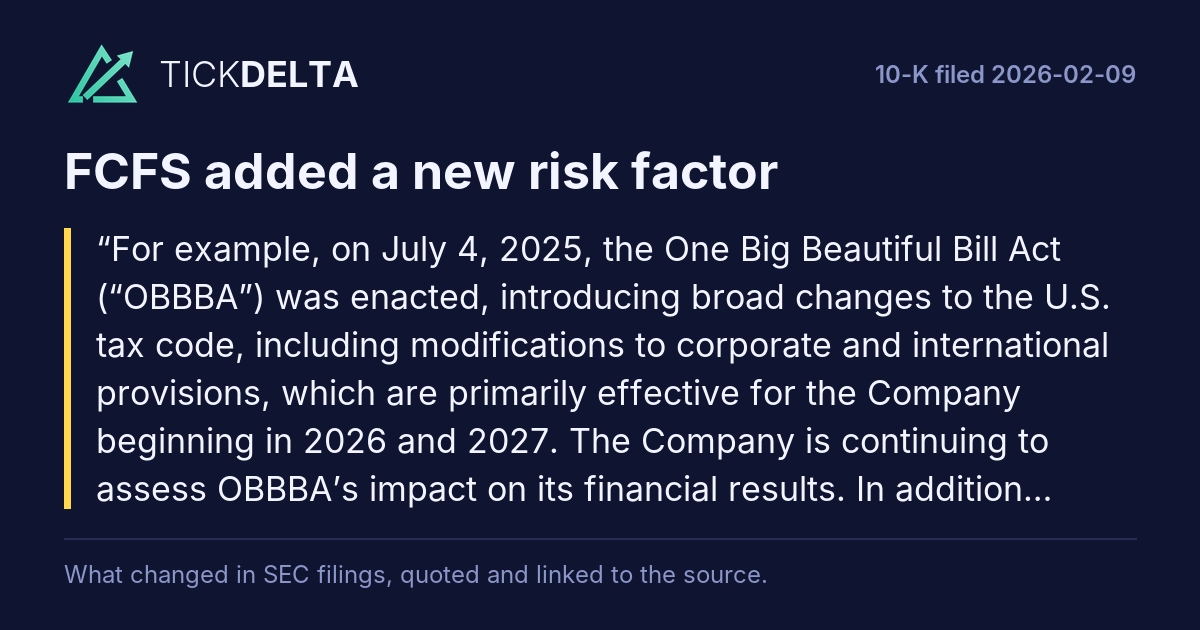
For example, on July 4, 2025, the One Big Beautiful Bill Act (“OBBBA”) was enacted, introducing broad changes to the U.S. tax code, including modifications to corporate and international provisions, which are primarily effective for the Company beginning in 2026 and 2027. The Company is continuing to assess OBBBA’s impact on its financial results. In addition, various foreign taxing jurisdictions enacted local legislation formally adopting the Global Anti-Base Erosion Model Rules (“Pillar
Two”), which generally provides for a minimum effective tax rate of 15%, as established by the Organization for Economic Co-operation and Development Pillar Two Framework. The effective dates were generally January 1, 2024, and January 1, 2025 for different aspects of the rules and vary by jurisdiction. More jurisdictions are expected to implement the model rules under local law in the future, with varying effective dates. Additionally, OBBBA includes modifications to the international tax framework. While the Company continues to evaluate the effect of these legislative changes as additional guidance becomes available, uncertainty remains regarding the timing and interpretation by tax authorities in affected jurisdictions.
Paragraphs in the 10-Q filed Oct 26, 2026 that were not in the one before
New in the latest 10-Q
7 paragraphs in the 10-Q filed Oct 26, 2026 with nothing like them in the 10-Q filed Jul 27, 2026 (at least half the words must differ; new numbers alone do not count). Quoted exactly, grouped by the item heading above them. This is text that changed, not a judgement of how serious it is.
10-Q
As of October 21, 2026, there were 42,887,671 shares of common stock outstanding.
Read in the 10-Q
Financial statements and notes
FIRSTCASH HOLDINGS, INC. CONSOLIDATED STATEMENTS OF CASH FLOWS (unaudited, in thousands) Nine Months Ended September 30, 2026 2025 Cash flow from operating activities: Net income $ 302,321 $ 226,203 Adjustments to reconcile net income to net cash flow provided by operating activities: Depreciation of leased merchandise 215,822 243,119 Provision for lease losses 71,204 88,025 Provision for loan losses 123,564 118,468 Share-based compensation expense 16,125 15,153 Depreciation and amortization expense 96,239 80,400 Amortization of debt issuance costs 3,504 2,974 Prepayment penalties on early termination of secured term loans 4,182 — Net amortization of premiums, discounts and unearned origination fees on finance receivables (51,422) (48,945) Deferred income taxes, net (1,811) 16,709 Changes in operating assets and liabilities, net of business combinations: Accounts receivable, net (6,831) (6,762) Inventories purchased directly from customers, wholesalers or manufacturers (45,803) (13,367) Leased merchandise (247,448) (302,432) Prepaid expenses and other assets (3,186) (12,253) Accounts payable, accrued liabilities and other liabilities 5,428 (27,086) Income taxes (9,495) (909) Net cash flow provided by operating activities 472,393 379,297 Cash flow from investing activities: Pawn loans made (1,995,764) (1,416,821) Pawn loans repaid 1,143,076 800,966 Recovery of pawn loan principal through sale of forfeited collateral 711,909 517,122 Investments in finance receivables (283,490) (338,295) Proceeds from finance receivables 264,339 263,139 Purchases of furniture, fixtures, equipment and improvements (55,954) (37,419) Purchases of store real property (69,728) (44,231) Acquisitions of pawn stores, net of cash acquired (21,074) (406,874) Net cash flow used in investing activities (306,686) (662,413) Cash flow from financing activities: Borrowings from credit facilities 433,924 689,372 Repayments of credit facilities (878,378) (315,070) Prepayment penalties on early termination of secured term loans (4,182) — Repayment and early termination of secured term loans (60,505) — Issuance of senior unsecured notes 750,000 — Debt issuance costs paid (12,270) — Purchases of treasury stock (251,150) (90,459) Payment of withholding taxes on net share settlements of restricted stock unit awards (11,240) (5,764) Dividends paid (55,082) (52,435) Net cash flow (used in) provided by financing activities (88,883) 225,644 Effect of exchange rates on cash 1,138 12,617 Change in cash and cash equivalents 77,962 (44,855) Cash and cash equivalents at beginning of the period 125,197 175,095 Cash and cash equivalents at end of the period $ 203,159 $ 130,240 The accompanying notes are an integral part of these consolidated financial statements.
Read in the 10-Q
On August 27, 2026, the Credit Facility was amended (the “2026 Amendment”) to, among other things, increase the total lender commitment, extend the term of the Credit Facility and amend certain financial covenants. Under the 2026 Amendment, the total lender commitment was increased from $ 700.0 million to $ 1,055.0 million and the term of the Credit Facility was extended to August 27, 2031. The 2026 Amendment permits borrowings denominated in British pounds sterling of up to a $ 500.0 million U.S. dollar equivalent. In addition, the 2026 Amendment increased the maximum permitted consolidated net leverage ratio to 3.5 times consolidated EBITDA, reduced the unused commitment fee and provided additional flexibility under certain of the negative covenants.
Read in the 10-Q
(1) Percentage of inventory aged greater than one year is 1.6% for U.S. pawn and 3.3% for total pawn excluding certain recently acquired U.S. stores which have historically carried significantly higher levels of aged jewelry inventory.
Read in the 10-Q
On August 14, 2025, the Company completed the H&T Acquisition. The results of operations of the U.K. pawn segment for the three months ended September 30, 2026 includes H&T’s results of operations for three full months while the comparable prior-year period includes H&T’s results of operations for the period August 14, 2025 to September 30, 2025 (“H&T PY Partial Period”), affecting comparability.
Read in the 10-Q
Show the other 2
On August 14, 2025, the Company completed the H&T Acquisition. The results of operations of the U.K. pawn segment for the nine months ended September 30, 2026 includes H&T’s results of operations for nine full months while the comparable prior-year period includes H&T’s results of operations for the H&T PY Partial Period, affecting comparability.
Read in the 10-Q
Other information
On August 17, 2026, Rick L. Wessel, Vice Chairman of the Board and Chief Executive Officer, adopted a written plan for the sale of up to 60,719 shares of the Company’s common stock that is intended to satisfy the affirmative defense conditions of Rule 10b5-1(c). The plan will expire on August 19, 2027, or on any earlier date on which all of the shares have been sold.
Read in the 10-Q
The 10-Q's risk factors against the 10-K
Item 1A of the 10-Q filed Oct 26, 2026 against Item 1A of the 10-K filed Feb 9, 2026.
A 10-Q repeats only the risks that changed, so a 10-K paragraph that is missing from it is not counted as removed.
Added is a paragraph with nothing like it in the 10-K, Reworded a sentence that is in both with several words changed,
Quiet changes a sentence in both where one to four words changed and one is a hedge or a modal
(cut words struck through, new words highlighted).
Text on the page, not a score; each links to the filing at sec.gov.
Phrases used for the first time
Two-word phrases in Risk Factors of the 10-K filed Feb 9, 2026 that are in none of the 1 earlier 10-Ks stored, back to Feb 3, 2025
Where each one is used
- artificial intelligence: •The Company’s future growth is dependent on its ability to keep pace with technological advances, including the adoption of generative artificial intelligence and other machine learning technologies, to remain competitive.
- machine learning: •The Company’s future growth is dependent on its ability to keep pace with technological advances, including the adoption of generative artificial intelligence and other machine learning technologies, to remain competitive.
- off-balance sheet: Determining the AFF business’ allowance for lease and loan losses and liability for off-balance sheet credit exposure requires many assumptions and complex analyses. If the estimates prove incorrect, the AFF business may incur net charge-offs in excess of its reserves or liabilities, or may be required to increase...
- sheet credit: Determining the AFF business’ allowance for lease and loan losses and liability for off-balance sheet credit exposure requires many assumptions and complex analyses. If the estimates prove incorrect, the AFF business may incur net charge-offs in excess of its reserves or liabilities, or may be required to increase...
- credit exposure: Determining the AFF business’ allowance for lease and loan losses and liability for off-balance sheet credit exposure requires many assumptions and complex analyses. If the estimates prove incorrect, the AFF business may incur net charge-offs in excess of its reserves or liabilities, or may be required to increase...
- technological developments: The Company’s industry is marked by rapid technological developments and innovations, such as the use of artificial intelligence and machine learning, to conform to evolving industry standards. The Company may be required to make significant investments in its information technology systems, including those related...
- realize anticipated: •The inability to successfully identify attractive acquisition targets, realize anticipated benefits from and integrate completed acquisitions could adversely affect results.
- technological advances: •The Company’s future growth is dependent on its ability to keep pace with technological advances, including the adoption of generative artificial intelligence and other machine learning technologies, to remain competitive.
Used at least twice, small words left out. Counted, not picked: a phrase can be new because the company renamed something.
What was taken out
10 paragraphs of last year's Risk Factors with nothing like them now. The longest are quoted.
Sources
Item 1A of each 10-K and 10-Q on EDGAR, quoted exactly. Each paragraph links to the filing at sec.gov.
Also
10-K change: what was reworded or cut, section by section.
Work with it
Excel workbook · CSV. Google Sheet that stays up to date: paste =IMPORTDATA("https://tickdelta.com/company/FCFS/export.csv") into a cell.