FEFirstEnergy
FE and its subsidiaries are principally involved in the transmission, distribution, and generation of electricity. 10-K, Item 1
- Employees
- 11,186
- Headquarters
- Akron, OH
- CEO
- Brian X. Tierney
- Next results
- around Feb 16, 2027
16 paragraphs in Risk Factors of the 10-K filed Feb 18, 2026 with nothing like them in the 10-K filed Feb 27, 2025. Quoted exactly. Paragraphs that were only edited are under 10-K change.
Compared with the Risk Factors in the latest 10-K of the other 30 Utilities companies: a paragraph with at least half its words the same at another company is called similar, and the companies are listed under it. A paragraph most of them have is marked boilerplate. No line means no other company has one like it. This counts text; it does not say how serious a risk is.
The retail rates for each of the Electric Companies are set by each of its respective regulatory agency for utilities in the state in which it operates - in Maryland by the MDPSC, in New Jersey by the NJBPU, in Ohio by the PUCO, in Pennsylvania by the
Read in the 10-K ↗
FERC, at the instruction of the U.S. Secretary of Energy, is also considering whether to develop regulations intended to speed interconnection of AI data centers and “hybrid” data center/electric generation facilities (collectively, “large loads”) to the transmission system. Final regulations, if any, from FERC are expected in the second quarter of 2026. To the extent the new regulations promulgated by FERC do not permit transmission utilities to fully recover costs associated with transmission network upgrades required to serve new large loads, our strategy of investing in transmission could be adversely affected.
External pressures beyond our control may increase customer rates and, when combined with state and federal regulatory action to mitigate bill impacts, may impair our ability to earn a fair and equitable return on our investments and execute our strategy.
PJM’s recent capacity auctions have been subject to a “price collar” that has resulted from all-time high generation capacity prices in recent auction outcomes. These all-time high capacity prices ultimately are passed through in retail rates and can result in material increases in retail customers’ monthly electric utility bills. On January 16, 2026, the PJM board along with various federal and state officials, expressed interest in extending the price collar through mid-2030.
In addition, the parties to the Statement of Principles suggested that PJM should conduct a “backstop” auction to procure additional generation capacity, with the costs to be allocated first to “new” data centers and second to existing PJM loads. If the PJM capacity auctions continue to clear at the auction cap, and if PJM conducts a “backstop” capacity auction that clears at a high price point, customer resistance to the resulting market driven increases on the generation portion of their bills could lead to increased pressure for state and federal utility regulators to limit the needed capital investment in transmission and distribution systems required for safe, reliable and resilient service to customers, which may impair our ability to earn a fair and equitable return on our investments and execute our strategy.
Our investments in transmission and distribution infrastructure modernization, reliability improvements, environmental compliance and storm hardening may increase customer bills over time and the resulting higher electric bills, when combined with the external pressures discussed above, may place pressure on residential customers’ affordability, particularly in portions of our service territory with lower median household income or high energy burdens and/or amongst those customers who have already seen significant retail bill increases. State and federal regulators may also adopt or modify policies intended to mitigate customer bill impacts – including disallowance or delayed recovery of certain capital investments or operating expenses, mandated bill assistance programs, changes to rate design, or restrictions on rate increases. Customer concerns regarding affordability may result in increased regulatory scrutiny, constraints on the size and timing of rate increases, expanded bill
mitigation requirements, or disallowances, any of which could adversely affect our ability to recover costs or earn our authorized return on equity. In addition, sustained increases in customer bills may lead to reduced electricity usage through conservation, energy efficiency, or distributed generation, which could limit future load growth and revenues.
Regulatory agencies may also require utilities to offset portions of rising costs related to grid modernization, resilience investments, environmental compliance, or rapidly evolving market conditions if they determine that such costs would unduly affect customer affordability. Any such actions could limit or delay our ability to recover costs or investments, earn a fair and equitable return, or maintain expected cash flows and could have an adverse effect on our businesses, financial condition, results of operations and cash flows.
Read in the 10-K ↗
Additionally, the operations of the Electric Companies are affected by the economic conditions in their respective service territories and those conditions could negatively impact the rate of delinquent customer accounts and our collections of accounts receivable, which could adversely impact our financial condition, results of operations and cash flows.
Read in the 10-K ↗
our business reputation and adversely affect our operating results through reduced revenues, increased capital and operating costs, litigation or the imposition of penalties/fines or other adverse regulatory outcomes.
Read in the 10-K ↗
MP owns and maintains coal-fired electric generation facilities located in West Virginia. Historically, coal-fired generation has greater exposure to the costs of complying with federal, state and local environmental statutes, rules and regulations relating to air emissions, including GHGs and CCR disposal, than other types of electric generation facilities. To the extent that changes in
Read in the 10-K ↗
imposed. We are unable to determine what impact, if any, future conservation activities will have on our financial condition or results of operations.
Read in the 10-K ↗
consolidated interest coverage ratio and the Electric Companies, the Transmission Companies, and FET were each in compliance with their debt-to-total-capitalization ratio covenants.
Read in the 10-K ↗
energy markets could lead to pressures for greater regulation of those markets or attempts to replace those market structures with other mechanisms for the sale of power, including the requirement of long-term contracts, which could have a material adverse effect on our results of operations and cash flows.
Similar paragraph at 1 of 30 other Utilities companies: CEGRead in the 10-K ↗
1 more
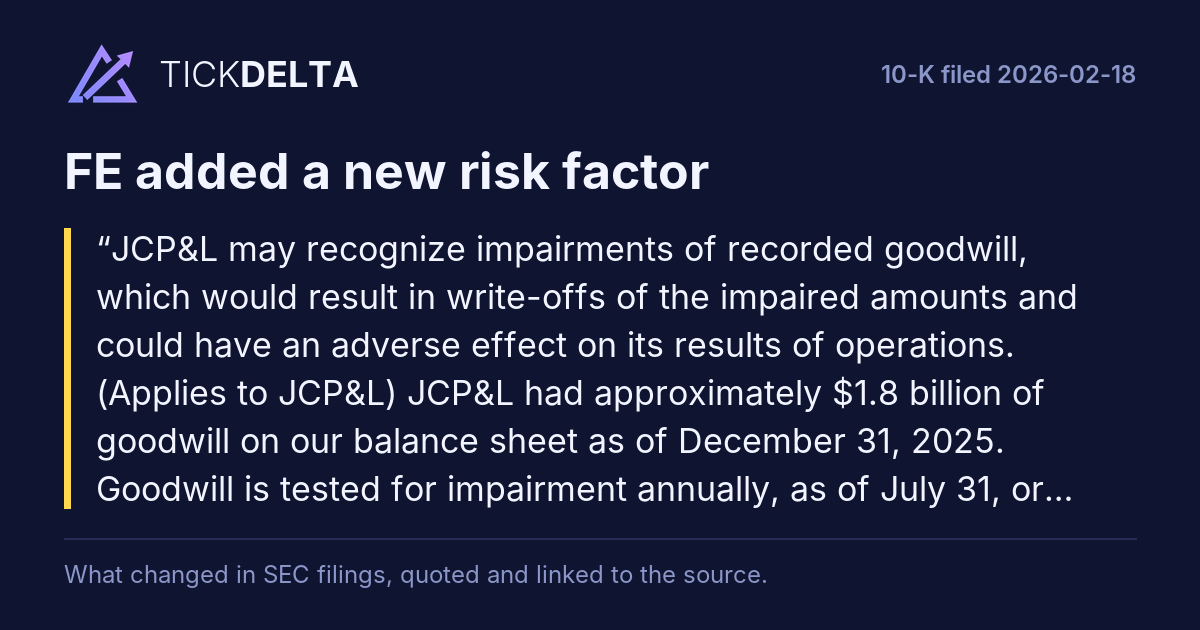
JCP&L may recognize impairments of recorded goodwill, which would result in write-offs of the impaired amounts and could have an adverse effect on its results of operations. (Applies to JCP&L)
Similar paragraph at 1 of 30 other Utilities companies: PNWJCP&L had approximately $1.8 billion of goodwill on our balance sheet as of December 31, 2025. Goodwill is tested for impairment annually, as of July 31, or whenever events or circumstances indicate impairment may have occurred. JCP&L is unable to predict the actual timing and amounts of any impairments in future years, which would depend on many factors, including interest rates, sector market performance, JCP&L’s capital structure, results of future rate proceedings, operating and capital expenditure requirements, the value of comparable acquisitions, environmental regulations and other factors. The recognition of impairments of goodwill, which may result in write-offs of such impaired amount, could have an adverse effect on JCP&L’s results of operations.
Read in the 10-K ↗
New in the latest 10-Q
71 paragraphs in the 10-Q filed Oct 28, 2026 with nothing like them in the 10-Q filed Jul 28, 2026 (at least half the words must differ; new numbers alone do not count). Quoted exactly, grouped by the item heading above them. This is text that changed, not a judgement of how serious it is.
Financial statements and notes
JCP&L had previously committed to a plan to sell its Morristown, New Jersey office building. During the third quarter of 2026, progress on the sale continued to the point that management determined it is probable the sale will close within one year, subject to customary closing conditions and applicable regulatory approvals. As a result, the carrying value of the office building has been classified as held-for-sale on the accompanying JCP&L Balance Sheets and is included within “Prepaid taxes and other” on FirstEnergy’s Consolidated Balance Sheets. Upon classification as held-for-sale, JCP&L recognized a $ 5 million pre-tax impairment charge, which is included within "Other operating expenses" on JCP&L’s and FirstEnergy’s Consolidated Statements of Income and Comprehensive Income for the three and nine months ended September 30, 2026. The impairment charge is included in FirstEnergy’s Integrated segment.
Read in the 10-Q ↗
The Registrants evaluate goodwill for impairment annually on July 31 and more frequently if indicators of impairment arise. For 2026, the Registrants performed a qualitative assessment of their reporting units' goodwill, assessing economic, industry and market considerations in addition to the reporting units' overall financial performance. Key factors used in the assessment included: growth rates, interest rates, expected capital investments, utility sector market performance, regulatory and legal developments, and other market considerations. It was determined that the fair values of these reporting units were, more likely than not, greater than their carrying values and a quantitative analysis was not necessary.
Read in the 10-Q ↗
FirstEnergy's reporting units are consistent with its reportable segments and consist of Distribution, Integrated and Stand-Alone Transmission. The following table presents goodwill by reporting unit as of September 30, 2026, and as of the measurement date, July 31, 2026:
Read in the 10-Q ↗
FE PA has a single reporting unit consistent with its single reportable segment. Goodwill as of both July 31, 2026, and September 30, 2026, was $ 962 million.
Read in the 10-Q ↗
JCP&L has a single reporting unit consistent with its single reportable segment. Goodwill as of both July 31, 2026, and September 30, 2026, was $ 1,811 million.
Read in the 10-Q ↗
(3) Includes affiliated lease revenues from ATSI, MAIT, and KATCo, as well as late payment charges.
Read in the 10-Q ↗
In the third quarter of 2026, FirstEnergy recognized a state tax benefit of approximately $ 69 million due to an uncertain tax position being effectively settled.
Read in the 10-Q ↗
JCP&L - Earnings and losses associated with corporate-owned life insurance policies were immaterial for the three and nine months ended September 30, 2026 and 2025. Other investment balances associated with corporate-owned life insurance policies were immaterial as of September 30, 2026 and December 31, 2025.
Read in the 10-Q ↗
circumstances, increase the conversion rate for a holder who elects to convert its notes of such series in connection with such corporate event or redemption as applicable.
Read in the 10-Q ↗
The EmPOWER Maryland program requires electric utilities to achieve specified energy efficiency and greenhouse gas reduction targets, which were modified by the Utility RELIEF Act to reduce certain targets for the 2027-2035 program cycles. PE's revised 2024-2026 EmPOWER plan, with a budget of approximately $314 million, was approved by the MDPSC in December 2024. PE filed its proposed 2027-2029 plan in September 2026. Beginning in 2026, PE is required to expense 100% of EmPOWER program costs as incurred, with previously deferred balances to be recovered through 2030. Legislation effective July 1, 2024 reduced the carrying costs recoverable on unamortized EmPOWER balances. PE challenged the legislation, and in August 2025 the Circuit Court for Washington County, Maryland ruled in PE's favor. The MDPSC and MDOPC appealed the decision, and oral argument before the Appellate Court of Maryland was held on September 4, 2026.
Read in the 10-Q ↗
On September 1, 2026, PE filed its proposed large load tariff which would create a separate class of large load customers thereby insulating residential customers from bearing costs associated with the interconnection of large load customers to the electric system.
Read in the 10-Q ↗
On September 4, 2026, PE filed with the MDPSC a distribution base rate case seeking to, among other things, increase PE’s Maryland annual base rate distribution revenues by approximately $53 million and approve a proposed three-year program focused on improving reliability. The case uses a historic test year of twelve months ending March 31, 2026, and requested an ROE of 10.6% and capital structure of approximately 54% equity and 46% debt. Evidentiary hearings are scheduled to begin January 11, 2027. A final order and new rates are expected to become effective in the second quarter of 2027.
Read in the 10-Q ↗
On July 15, 2026, the NJBPU issued an order directing a one-year transition period beginning on July 1, 2027, and ending on June 30, 2028, after which New Jersey EDCs would begin a full six-year cycle of energy efficiency programs. JCP&L’s EE&C Plan II ends on June 30, 2027. In accordance with the order, JCP&L filed its proposed transition plan with the NJBPU on September 30, 2026, which seeks to continue JCP&L’s existing cost recovery and lost revenue recovery mechanisms and contemplates a lower ROE for JCP&L’s energy efficiency programs by 150 basis points, at a proposed budget of approximately $178 million. The matter is pending before the NJBPU.
Read in the 10-Q ↗
On August 6, 2026, JCP&L filed with the NJBPU a base rate case utilizing a historical test period for the 12 months ending June 30, 2026. JCP&L proposed a net increase in base distribution revenues of approximately $253 million, with an ROE of 10.2% and a capital structure of approximately 47% debt and approximately 53% equity, with an effective date of May 6, 2027. JCP&L has also proposed to offset the increase in rates for residential customers until January 1, 2028, through a new, temporary tax-adjustment rider and amortization of an existing regulatory liability during this period. The filing also proposes a new storm recovery charge rider and requests additional funding for enhanced storm response and expanded vegetation management. The NJBPU has referred the matter to the New Jersey Office of Administrative Law and discovery has begun.
Read in the 10-Q ↗
Companies’ compliance tariffs, effective March 1, 2026. On March 20, 2026, the Ohio Companies and certain other parties filed with the PUCO second applications for rehearing of the February 18, 2026, entry on rehearing. On April 14, 2026, the PUCO issued an entry on rehearing denying all applications for rehearing. On May 14, 2026, Retail Energy Supply Association and IGS Energy Supply, LLC jointly filed with the PUCO a request for clarification and application for rehearing, to which the OCC and the Ohio Companies responded on May 26, 2026. On June 10, 2026, the PUCO issued its Fourth Entry on Rehearing, denying the application for rehearing. On August 10, 2026, the Ohio Companies filed a notice of appeal with the Supreme Court of Ohio, appealing the PUCO’s actions on rehearing, including the extension of the Ohio Companies’ deferred storm cost amortization period, and the issuance of additional directives on rehearing without following procedural rules. On October 19, 2026, the Ohio Companies filed their initial brief.
Read in the 10-Q ↗
On June 12, 2026, at the PUCO’s direction, the Ohio Companies filed an application requesting approval of a proposed data center tariff which will create a separate class for data centers and ensure proper allocation of costs associated with the interconnection of large load customers to the electric system. Comments and reply comments on the proposed data center tariff were filed by various parties in August 2026.
Read in the 10-Q ↗
To support the proposed Maidsville Energy Center project schedule, FirstEnergy has entered into a reservation agreement with Siemens Energy, Inc. for turbines scheduled for delivery in 2030. As described in the CPCN case, any contemplated data center agreements utilizing the Maidsville Energy Center's output, would be expected to address customer protections, pricing, risk transfer and long-term benefit sharing for existing West Virginia customers.
Read in the 10-Q ↗
that, if a transmission owner exits PJM, at and after such exit, the costs are to be charged to the transmission owner. On August 21, 2026, FirstEnergy filed protests at FERC arguing, among other things, that PJM had failed to demonstrate that the proposal to charge the costs to exiting transmission owners is “just and reasonable” as required by the Federal Power Act. On September 29, 2026, FERC issued an order suspending PJM’s proposed reliability backstop procurement tariff amendments until February 28, 2027, and instituting further proceedings. FERC further invited PJM to submit a second set of tariff amendments to address the issues that were identified in the September 29, 2026, order. On September 30, 2026, PJM announced the procurement would not begin as previously scheduled. FirstEnergy expects it will continue to participate in the PJM stakeholder processes and FERC proceedings.
Read in the 10-Q ↗
On August 13, 2026, PJM filed with FERC its interim resource adequacy service proposal, which would permit curtailment to data centers that did not bring their own supply of new generation resources. On September 3, 2026, FirstEnergy filed a limited protest of certain elements of PJM’s filing. On October 12, 2026, FERC issued an order accepting PJM’s proposed large load definition and PJM’s proposal to establish a registry to log and track such large loads. FERC rejected all of the remaining elements of PJM’s proposal without prejudice.
Read in the 10-Q ↗
On October 6, 2026, MP filed a complaint at FERC against PJM alleging that PJM’s Day-Ahead Market dispatch order during Winter Storm Fern in January and February 2026 was not consistent with the PJM Tariff and resulted in approximately $145 million in Winter Storm Fern-related net wholesale power costs being incurred by MP, which otherwise would be recovered from MP’s and PE’s West Virginia retail customers through the ENEC. On October 26, 2026, PJM filed its answer to MP’s complaint and a motion to dismiss. The matter is pending before FERC.
Read in the 10-Q ↗
disclose the potential additional credit rating contingent contractual collateral obligations of the Registrants as of September 30, 2026:
Read in the 10-Q ↗
(1) These amounts are included in "Other current liabilities" on the Registrants’ respective Balance Sheets.
Read in the 10-Q ↗
FirstEnergy is uniquely positioned to take advantage of data center growth, both in its service territory and across the region. As of October 27, 2026, FirstEnergy has contracted approximately 8 GWs of capacity and was in active negotiations concerning approximately 4 GWs of additional load. FirstEnergy expects this load growth to drive an increase in the 2027 to 2031 Energize365 investment plan, compared to the current 2026 to 2030 Energize365 investment plan, which is expected to further enhance FirstEnergy’s long-term earnings growth profile.
Read in the 10-Q ↗
On September 15, 2026, Fitch affirmed the ratings of FE and all subsidiaries. Fitch also affirmed the outlook of FE and all subsidiaries excluding OE, CEI, and TE whose outlooks were revised to stable.
Read in the 10-Q ↗
On September 4, 2026, PE filed with the MDPSC a distribution base rate case seeking to, among other things, increase PE’s Maryland annual base rate distribution revenues by approximately $53 million and approve a proposed three-year program focused on improving reliability. The case uses a historic test year of twelve months ending March 31, 2026, and contemplates a requested ROE of 10.6% with no proposed changes to PE’s current capital structure of approximately 54% equity and 46% debt. Evidentiary hearings are scheduled to begin January 11, 2027. A final order and new effective rates are expected in the second quarter of 2027.
Read in the 10-Q ↗
On May 12, 2026, the governor of Maryland signed the Utility RELIEF Act into law. Among other things, the legislation temporarily limits the use of forecasted costs in certain rate proceedings, modifies the standards by which the MDPSC may
Read in the 10-Q ↗
On August 6, 2026, JCP&L filed with the NJBPU a base rate case utilizing a historical test period for the 12 months ending June 30, 2026. JCP&L proposed a net increase in base distribution revenues of approximately $253 million, with an ROE of 10.2% and a capital structure of approximately 47% debt and approximately 53% equity, with an effective date of May 6, 2027. JCP&L has also proposed to offset the increase in rates for residential customers until January 1, 2028, through a new, temporary tax-adjustment rider and amortization of an existing regulatory liability during this period. The filing also proposes a new storm recovery charge rider and requests additional funding for enhanced storm response and expanded vegetation management. The NJBPU has referred the matter to the New Jersey Office of Administrative Law and discovery has begun.
Read in the 10-Q ↗
FirstEnergy expects to finalize the remaining major contracts shortly after receiving a satisfactory final WVPSC order. To support the proposed Maidsville Energy Center project schedule, FirstEnergy has entered into a reservation agreement with Siemens Energy, Inc. for turbines scheduled for delivery in 2030. As described in the CPCN case, any contemplated data center agreements utilizing the Maidsville Energy Center's output, would be expected to address customer protections, pricing, risk transfer and long-term benefit sharing for existing West Virginia customers. Separately from the Maidsville Energy Center, FirstEnergy has issued a request for proposals for an initial 3 GWs of additional combined-cycle turbines to support potential large-load customers in West Virginia and expects to provide an update in early 2027. FirstEnergy is also exploring bridge-power options and temporary behind-the-meter solutions as it develops the grid to support these customers with permanent transmission and generation service.
Read in the 10-Q ↗
• The recognition of a state tax benefit related to an uncertain tax position being effectively settled in 2026 and absence of a discrete tax charge recognized in 2025 related to the FET Equity Interest Sale.
Read in the 10-Q ↗
• The absence of a discrete tax benefit related to a remeasurement of excess deferred income taxes recognized in 2025.
Read in the 10-Q ↗
• The recognition of a state tax benefit related to an uncertain tax position being effectively settled in 2026 and absence of a discrete tax charge recognized in 2025 related to the FET Equity Interest Sale.
Read in the 10-Q ↗
• The absence of a discrete tax benefit related to a remeasurement of excess deferred income taxes recognized in 2025.
Read in the 10-Q ↗
• Higher vegetation management expenses of $9 million in Ohio, as approved and recovering in the base rate case.
Read in the 10-Q ↗
• $5 million pre-tax impairment charge related to JCP&L’s Morristown, New Jersey general office; and
Read in the 10-Q ↗
• Higher discrete tax benefits in 2026 compared to 2025, primarily due to recognition of a $69 million state tax benefit related to an uncertain tax position being effectively settled in 2026 and absence of a discrete tax charge recognized in 2025 related to the FET Equity Interest Sale; and
Read in the 10-Q ↗
• Higher vegetation management expenses of $9 million in Ohio, as approved and recovering in the base rate case; and
Read in the 10-Q ↗
• $5 million pre-tax impairment charge related to JCP&L’s Morristown, New Jersey general office; and
Read in the 10-Q ↗
• Higher discrete tax benefits in 2026 compared to 2025, primarily due to recognition of a $69 million state tax benefit related to an uncertain tax position being effectively settled in 2026 and absence of a discrete tax charge recognized in 2025 related to the FET Equity Interest Sale;
Read in the 10-Q ↗
supply chain disruptions that could, in turn, have an adverse effect on the Registrants’ results of operations, cash flow and financial condition.
Read in the 10-Q ↗
On September 15, 2026, Fitch affirmed the ratings of FE and all subsidiaries. Fitch also affirmed the outlook of FE and all subsidiaries excluding OE, CEI, and TE whose outlooks were revised to stable.
Read in the 10-Q ↗
The EmPOWER Maryland program requires electric utilities to achieve specified energy efficiency and greenhouse gas reduction targets, which were modified by the Utility RELIEF Act to reduce certain targets for the 2027-2035 program cycles. PE's revised 2024-2026 EmPOWER plan, with a budget of approximately $314 million, was approved by the MDPSC in December 2024. PE filed its proposed 2027-2029 plan in September 2026. Beginning in 2026, PE is required to expense 100% of EmPOWER program costs as incurred, with previously deferred balances to be recovered through 2030. Legislation effective July 1, 2024 reduced the carrying costs recoverable on unamortized EmPOWER balances. PE challenged the legislation, and in August 2025 the Circuit Court for Washington County, Maryland ruled in PE's favor. The MDPSC and MDOPC appealed the decision, and oral argument before the Appellate Court of Maryland was held on September 4, 2026.
Read in the 10-Q ↗
On September 1, 2026, PE filed its proposed large load tariff which would create a separate class of large load customers thereby insulating residential customers from bearing costs associated with the interconnection of large load customers to the electric system.
Read in the 10-Q ↗
On September 4, 2026, PE filed with the MDPSC a distribution base rate case seeking to, among other things, increase PE’s Maryland annual base rate distribution revenues by approximately $53 million and approve a proposed three-year program focused on improving reliability. The case uses a historic test year of twelve months ending March 31, 2026, and requested an ROE of 10.6% and capital structure of approximately 54% equity and 46% debt. Evidentiary hearings are scheduled to begin January 11, 2027. A final order and new rates are expected to become effective in the second quarter of 2027.
Read in the 10-Q ↗
On July 15, 2026, the NJBPU issued an order directing a one-year transition period beginning on July 1, 2027, and ending on June 30, 2028, after which New Jersey EDCs would begin a full six-year cycle of energy efficiency programs. JCP&L’s EE&C Plan II ends on June 30, 2027. In accordance with the order, JCP&L filed its proposed transition plan with the NJBPU on September 30, 2026, which seeks to continue JCP&L’s existing cost recovery and lost revenue recovery mechanisms and contemplates a lower ROE for JCP&L’s energy efficiency programs by 150 basis points, at a proposed budget of approximately $178 million. The matter is pending before the NJBPU.
Read in the 10-Q ↗
On August 6, 2026, JCP&L filed with the NJBPU a base rate case utilizing a historical test period for the 12 months ending June 30, 2026. JCP&L proposed a net increase in base distribution revenues of approximately $253 million, with an ROE of 10.2% and a capital structure of approximately 47% debt and approximately 53% equity, with an effective date of May 6, 2027. JCP&L has also proposed to offset the increase in rates for residential customers until January 1, 2028, through a new, temporary tax-adjustment rider and amortization of an existing regulatory liability during this period. The filing also proposes a new storm recovery charge rider and requests additional funding for enhanced storm response and expanded vegetation management. The NJBPU has referred the matter to the New Jersey Office of Administrative Law and discovery has begun.
Read in the 10-Q ↗
On June 12, 2026, at the PUCO’s direction, the Ohio Companies filed an application requesting approval of a proposed data center tariff which will create a separate class for data centers and ensure proper allocation of costs associated with the interconnection of large load customers to the electric system. Comments and reply comments on the proposed data center tariff were filed by various parties in August 2026.
Read in the 10-Q ↗
To support the proposed Maidsville Energy Center project schedule, FirstEnergy has entered into a reservation agreement with Siemens Energy, Inc. for turbines scheduled for delivery in 2030. As described in the CPCN case, any contemplated data center agreements utilizing the Maidsville Energy Center's output, would be expected to address customer protections, pricing, risk transfer and long-term benefit sharing for existing West Virginia customers.
Read in the 10-Q ↗
On August 13, 2026, PJM filed with FERC its interim resource adequacy service proposal, which would permit curtailment to data centers that did not bring their own supply of new generation resources. On September 3, 2026, FirstEnergy filed a limited protest of certain elements of PJM’s filing. On October 12, 2026, FERC issued an order accepting PJM’s proposed large load definition and PJM’s proposal to establish a registry to log and track such large loads. FERC rejected all of the remaining elements of PJM’s proposal without prejudice.
Read in the 10-Q ↗
On October 6, 2026, MP filed a complaint at FERC against PJM alleging that PJM’s Day-Ahead Market dispatch order during Winter Storm Fern in January and February 2026 was not consistent with the PJM Tariff and resulted in approximately $145 million in Winter Storm Fern-related net wholesale power costs being incurred by MP, which otherwise would be recovered from MP’s and PE’s West Virginia retail customers through the ENEC. On October 26, 2026, PJM filed its answer to MP’s complaint and a motion to dismiss. The matter is pending before FERC.
Read in the 10-Q ↗
FirstEnergy has pledged to achieve carbon neutrality by 2050 with respect to GHGs within FirstEnergy’s direct operational control (known as Scope 1 emissions). FirstEnergy’s ability to achieve its GHG reduction goal is subject to its ability to make operational changes and is conditioned upon numerous risks, many of which are outside of its control. With respect to
Read in the 10-Q ↗
On January 1, 2024, FirstEnergy consolidated the Pennsylvania Companies into FE PA, including then-OE subsidiary, Penn, making FE PA a new, single operating entity. In addition to merging each of the Pennsylvania Companies with and into FE PA, with FE PA surviving such mergers as the successor-in-interest to all assets and liabilities of the Pennsylvania Companies, (i) WP transferred certain of its Pennsylvania-based transmission assets to KATCo, and (ii) PN and ME contributed their respective Class B equity interests of MAIT to FE. FE PA operates under the rate districts of the former Pennsylvania Companies.
Read in the 10-Q ↗
• $5 million pre-tax impairment charge related to JCP&L’s Morristown, New Jersey general office; and
Read in the 10-Q ↗
Other information
The information set forth below is included for the purpose of providing disclosure under "Item 1.01 - Entry into a Material Definitive Agreement" and "Item 2.03 - Creation of a Direct Financial Obligation or an Obligation Under an Off-Balance Sheet Arrangement of a Registrant" of Form 8-K.
Read in the 10-Q ↗
October 18, 2029 to October 18, 2030 for the remaining Amended Credit Facilities; and (ii) allow for the option to extend the Credit Agreement by up to two additional one-year periods; and (iii) increase the letters of credit commitment amount from $100 million to $400 million for the MP and PE credit facility.
Read in the 10-Q ↗
• Amendment No. 5 to Credit Agreement, dated as of October 23, 2026, among FE, as borrower, the banks and other financial institutions party thereto, as lenders, and JPMorgan Chase Bank, N.A., as administrative agent;
Read in the 10-Q ↗
• Amendment No. 5 to Credit Agreement, dated as of October 23, 2026, among CEI, OE and TE, as borrowers, the banks and other financial institutions party thereto, as lenders, and JPMorgan Chase Bank, N.A., as administrative agent;
Read in the 10-Q ↗
• Amendment No. 5 to Credit Agreement, dated as of October 23, 2026, among MP and PE, as borrowers, the banks and other financial institutions party thereto, as lenders, and Mizuho Bank, Ltd., as administrative agent;
Read in the 10-Q ↗
• Amendment No. 3 to Credit Agreement, dated as of October 23, 2026, among KATCo, as borrower, the banks and other financial institutions party thereto, as lenders, and PNC Bank, National Association, as administrative agent;
Read in the 10-Q ↗
• Amendment No. 3 to Credit Agreement, dated as of October 23, 2026, among FET, as borrower, the banks and other financial institutions party thereto, as lenders, and JPMorgan Chase Bank, N.A., as administrative agent;
Read in the 10-Q ↗
• Amendment No. 5 to Credit Agreement, dated as of October 23, 2026, among ATSI, MAIT and TrAIL, as borrowers, the banks and other financial institutions party thereto, as lenders, and PNC Bank, National Association, as administrative agent;
Read in the 10-Q ↗
• Amendment No. 5 to Credit Agreement, dated as of October 23, 2026, among FE PA, as borrower, the banks and other financial institutions party thereto, as lenders, and Mizuho Bank, Ltd., as administrative agent; and
Read in the 10-Q ↗
• Amendment No. 5 to Credit Agreement, dated as of October 23, 2026, among JCP&L, as borrower, the banks and other financial institutions party thereto, as lenders, and Mizuho Bank, Ltd., as administrative agent.
Read in the 10-Q ↗
The foregoing description of the Amended Credit Facilities is qualified in its entirety by reference to each such amendment entered into by FE, the Ohio Companies, MP and PE, KATCo, FET, ATSI, MAIT and TrAIL, FE PA, and JCP&L, each of which is filed hereto as Exhibits 10.1, 10.2, 10.3, 10.4, 10.5 and 10.6 under FE, 10.1 under FE PA and 10.1 under JCP&L, and incorporated herein by reference.
Read in the 10-Q ↗
Item 6
(A) 10.1 Amendment No. 5 to Credit Agreement, dated as of October 23, 2026, among FE, as borrower, the banks and other financial institutions party thereto, as lenders, and JPMorgan Chase Bank, N.A., as administrative agent.
Read in the 10-Q ↗
(A) 10.2 Amendment No. 5 to Credit Agreement, dated as of October 23, 2026, among CEI, OE and TE, as borrowers, the banks and other financial institutions party thereto, as lenders, and JPMorgan Chase Bank, N.A., as administrative agent.
Read in the 10-Q ↗
(A) 10.3 Amendment No. 5 to Credit Agreement, dated as of October 23, 2026, among MP and PE, as borrowers, the banks and other financial institutions party thereto, as lenders, and Mizuho Bank, Ltd., as administrative agent.
Read in the 10-Q ↗
(A) 10.4 Amendment No. 3 to Credit Agreement, dated as of October 23, 2026, among KATCo, as borrower, the banks and other financial institutions party thereto, as lenders, and PNC Bank, National Association, as administrative agent.
Read in the 10-Q ↗
(A) 10.5 Amendment No. 3 to Credit Agreement, dated as of October 23, 2026, among FET, as borrower, the banks and other financial institutions party thereto, as lenders, and JPMorgan Chase Bank, N.A., as administrative agent.
Read in the 10-Q ↗
(A) 10.6 Amendment No. 5 to Credit Agreement, dated as of October 23, 2026, among ATSI, MAIT and TrAIL, as borrowers, the banks and other financial institutions party thereto, as lenders, and PNC Bank, National Association, as administrative agent.
Read in the 10-Q ↗
(A) 10.1 Amendment No. 5 to Credit Agreement, dated as of October 23, 2026, among FE PA, as borrower, the banks and other financial institutions party thereto, as lenders, and Mizuho Bank, Ltd., as administrative agent.
Read in the 10-Q ↗
(A) 10.1 Amendment No. 5 to Credit Agreement, dated as of October 23, 2026, among JCP&L, as borrower, the banks and other financial institutions party thereto, as lenders, and Mizuho Bank, Ltd., as administrative agent.
Read in the 10-Q ↗
The 10-Q's risk factors against the 10-K
Item 1A of the 10-Q filed Oct 28, 2026 against Item 1A of the 10-K filed Feb 18, 2026.
A 10-Q repeats only the risks that changed, so a 10-K paragraph that is missing from it is not counted as removed.
Added is a paragraph with nothing like it in the 10-K, Reworded a sentence that is in both with several words changed,
Quiet changes a sentence in both where one to four words changed and one is a hedge or a modal
(cut words struck through, new words highlighted and underlined).
Text on the page, not a score; each links to the filing at sec.gov.
What the 10-Q itself says about its risk factors:
Read in the 10-Q ↗
As of September 30, 2026, there has been no material change to the risk factors as disclosed in FirstEnergy’s and JCP&L’s Annual Report on Form 10-K for the year ended December 31, 2025. You should carefully consider FirstEnergy’s and JCP&L’s risk factors discussed in "Item 1A. Risk Factors" in FirstEnergy’s and JCP&L’s Annual Report on Form 10-K for the year ended December 31, 2025, filed with the SEC on February 18, 2026.
1 paragraph in the 10-Q's Item 1A, and none of them adds, rewords or quietly edits a paragraph of the 10-K's.
Work on FE in a spreadsheet:
Excel workbook (a sheet per section, ten years by column, charts, links to the filings) ·
CSV.
For a Google Sheet that stays up to date, paste =IMPORTDATA("https://tickdelta.com/company/FE/export.csv") into a cell.