4 paragraphs in Risk Factors of the 10-K filed Feb 25, 2026
with nothing like them in the 10-K filed Feb 25, 2025. Quoted exactly.
Paragraphs that were only edited are under 10-K change.
Compared with the Risk Factors in the latest 10-K of the other 30 Utilities companies:
a paragraph with at least half its words the same at another company is called similar, and the companies are listed under it.
A paragraph most of them have is marked boilerplate. No line means no other company has one like it.
This counts text; it does not say how serious a risk is.
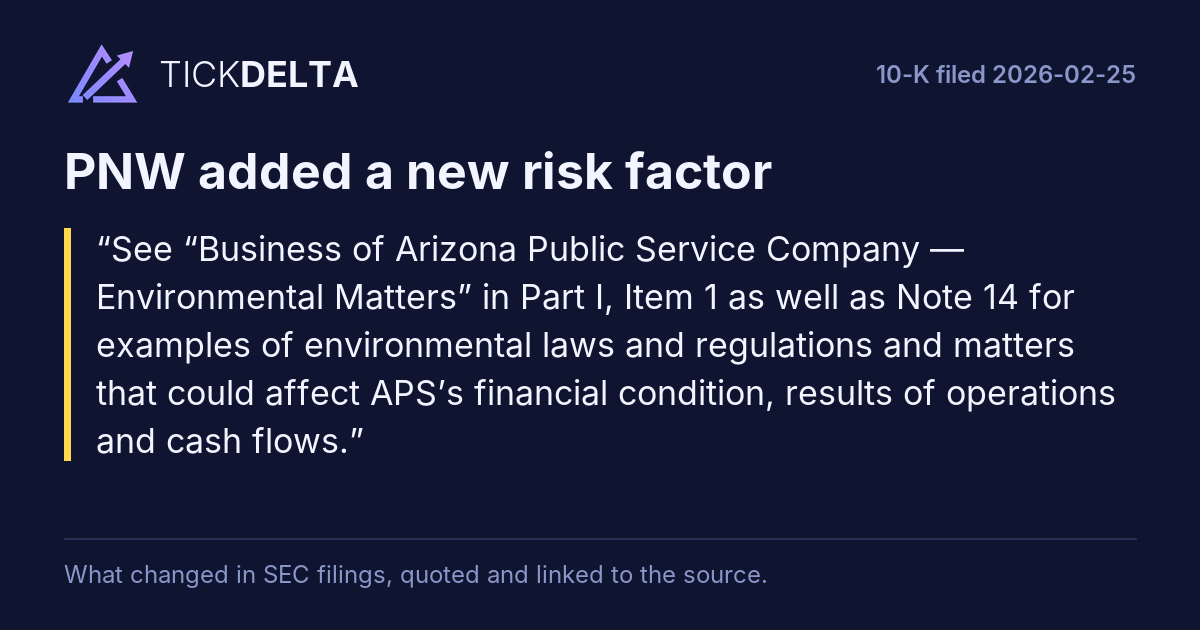
See “Business of Arizona Public Service Company — Environmental Matters” in Part I, Item 1 as well as Note 14 for examples of environmental laws and regulations and matters that could affect APS’s financial condition, results of operations and cash flows.
Read in the 10-K ↗
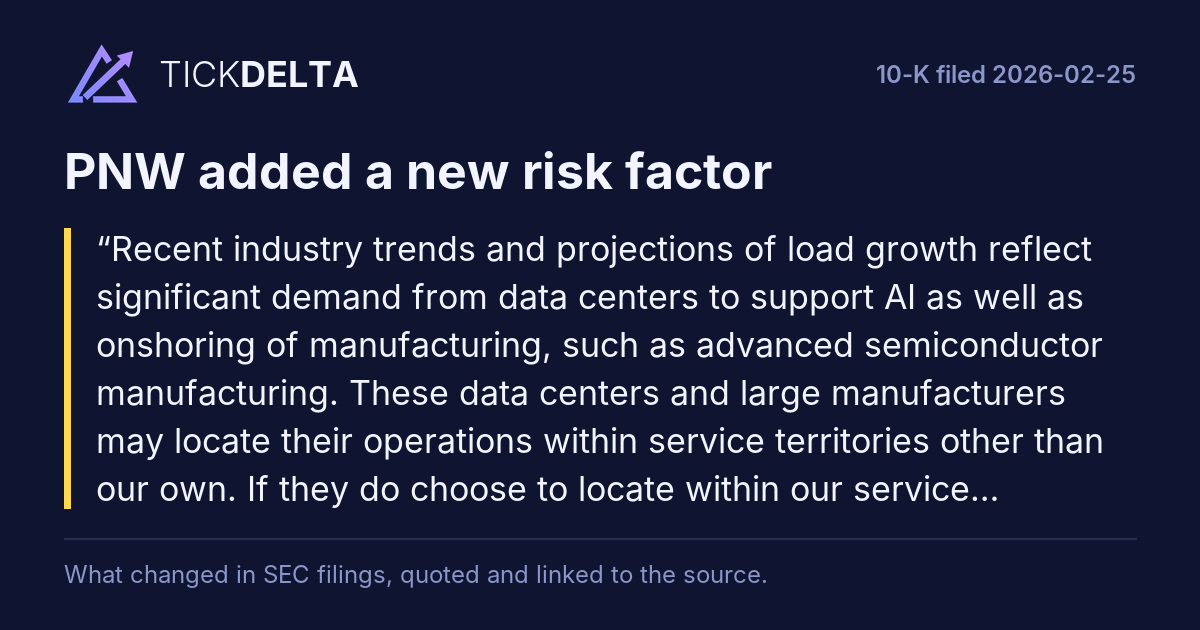
Recent industry trends and projections of load growth reflect significant demand from data centers to support AI as well as onshoring of manufacturing, such as advanced semiconductor manufacturing. These data centers and large manufacturers may locate their operations within service territories other than our own. If they do choose to locate within our service territory, we may not be able to provide sufficient electric service within the time period they require due to capital or other constraints. APS may need to accelerate development plans of the related generation and transmission facilities to serve these potential customers, which may necessitate alternative financing structures, such as the novel subscription model we are pursuing in an effort to ensure growth pays for growth and reduce cross-subsidization of customer classes, as well as ACC approval. APS may not be able to secure facilities or regulatory approval to support these customers in a timely manner. Additionally, the future demand from these customers may not be realized to the extent currently projected and significant uncertainties exist regarding the future energy demand associated with data centers and AI. The difficulty in forecasting these demands and the
additional risk of these arrangements could lead to stranded costs and other effects that could have material adverse impacts on APS’s financial condition, results of operations, and cash flows.
Similar paragraph at 2 of 30 other Utilities companies:
EVRG,
SRE
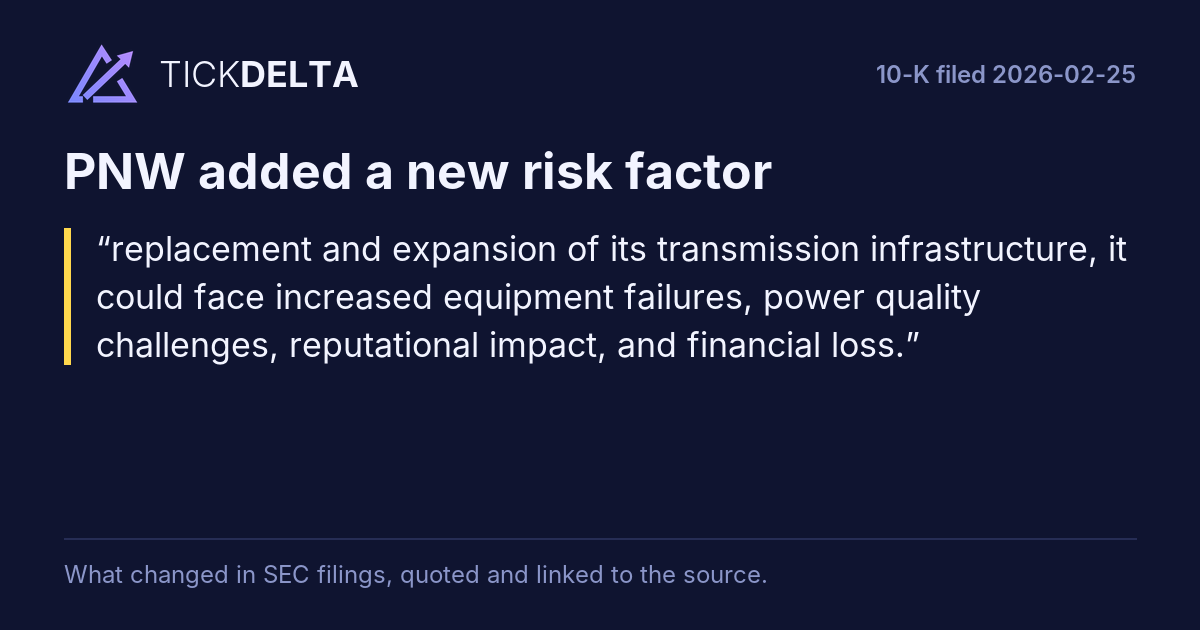
replacement and expansion of its transmission infrastructure, it could face increased equipment failures, power quality challenges, reputational impact, and financial loss.
Read in the 10-K ↗
New in the latest 10-Q
26 paragraphs in the 10-Q filed Nov 3, 2026 with nothing like
them in the 10-Q filed Aug 4, 2026 (at least half the words must differ; new numbers alone do not count).
Quoted exactly, grouped by the item heading above them. This is text that changed, not a judgement of how serious it is.
Financial statements and notes
(b)See Note 9 for information related to the Palo Verde sale leaseback purchases.
Read in the 10-Q ↗
In October 2026, APS executed a DPC to provide future retail electric services to TSMC Arizona Corporation (“TSMC Arizona”). See Note 7. APS expects to submit the DPC to the ACC for regulatory approval in 2026. APS cannot predict the outcome of this matter. The DPC had no impact on revenues recognized during the three or nine months ended September 30, 2026.
Read in the 10-Q ↗
Appeals denied those motions on October 29, 2026. APS now plans to file a petition for review with the Arizona Supreme Court. APS cannot predict the outcome of these proceedings, but does not expect the outcome will have a material impact on APS’ financial position, results of operations, or cash flows.
Read in the 10-Q ↗
On September 4, 2026, APS filed an application with the ACC requesting that APS issue a credit of approximately $ 33.6 million to customers through a one-time Renewable Energy Adjustment Charge. The
Read in the 10-Q ↗
credit is primarily based on revenue from the Green Power Partners Program sales. On October 7, 2026, the ACC approved this credit.
Read in the 10-Q ↗
On October 2, 2026, APS filed a Notice of Delayed Annual PSA Reset filing. This filing informed the ACC that APS will file its annual PSA update after the ACC’s decision in the 2025 Rate Case. APS understands that the ACC may issue a final decision in its pending 2025 Rate Case in December of 2026. If so, APS anticipates filing its Annual PSA Reset for the 2027 PSA Year in January of 2027, recognizing that this may result in delayed rate adjustments for the 2027 PSA Year. In the meantime, APS will maintain the currently authorized PSA rate.
Read in the 10-Q ↗
residential and commercial rates. An adjustment to APS’s retail rates to recover FERC-approved transmission charges went into effect automatically on June 1, 2025.
Read in the 10-Q ↗
On October 30, 2026, APS submitted its 2026 IRP to the ACC for acknowledgement. Stakeholder comments on the IRP are due January 28, 2027. APS cannot predict the outcome of this matter.
Read in the 10-Q ↗
On August 31, 2026, APS filed with the ACC a notice of its intention to convert Cholla Units 1 and 3 to natural gas and application to amend the certificate of environmental compatibility for Cholla Unit 3 to authorize conversion to natural gas. APS cannot predict the outcome of this matter.
Read in the 10-Q ↗
On October 16, 2026, APS signed a DPC with TSMC Arizona. APS expects to submit the DPC to the ACC for regulatory approval in 2026. APS cannot predict the outcome of this matter.
Read in the 10-Q ↗
Pursuant to the DPC, APS has agreed to provide service ramping to approximately 1.88 gigawatts to power TSMC Arizona’s semiconductor fabs/advanced packaging facilities for an initial term of 25 years. The DPC includes various contractual provisions to support the development of resources for APS to meet the load demand, including upfront payments for credit support and various forms of liquid and non-liquid collateral beginning on January 1, 2027. The exact amount and forms of collateral will vary throughout the term of the DPC depending on various factors, including the in-service dates of the resources developed to support TSMC Arizona.
Read in the 10-Q ↗
derivatives in the following tables represent the amounts reflected in income before the effect of PSA deferrals.
Read in the 10-Q ↗
The Palo Verde participants maintain insurance for property damage to, and decontamination of, property at Palo Verde in the aggregate amount of $ 2.8 billion. APS has also secured accidental outage
Read in the 10-Q ↗
whether general permitting mechanisms can be used as part of state or federal permitting efforts for CCR management.
Read in the 10-Q ↗
In the latest final regulations governing power plant carbon dioxide emissions, released April 25, 2024, EPA issued emission standards and guidelines for various subcategories of new and existing power plants. However, EPA has now taken final action to repeal the vast majority of those 2024 standards. On September 17, 2026, EPA concurrently published in the Federal Register both a final Partial Repeal Rule and a proposed Supplemental Full Repeal Rule. The final repeal action eliminates the CCS requirements in the 2024 standards for existing coal-fired power plants and new baseload natural gas-fired power plants (those operating over a 40% capacity factor), while also eliminating the gas co-firing requirements for existing coal-fired power plants and all requirements for existing gas- and oil-fired steam generating units. This action leaves in place the 2024 efficiency-based carbon performance standards for new natural gas power plants. The Supplemental Full Repeal Rule proposal, however, contemplates elimination of all 2024 carbon-emission standards, with comments due on November 2, 2026.
Read in the 10-Q ↗
As to the final Partial Repeal Rule, multiple health and climate organizations filed a petition for review of this action in the D.C. Circuit Court of Appeals on September 17, 2026. In addition, a petition for review was also filed by a coalition of 22 states and cities, including Arizona, on October 1, 2026, challenging the Partial Repeal Rule. Other petitions to EPA’s final Partial Rule Repeal are due by
Read in the 10-Q ↗
(b) Actual cash proceeds will be impacted by the timing of settlement, net of applicable fees.
Read in the 10-Q ↗
During the nine months ended September 30, 2026, the Company revised its cost estimates for existing asset retirement obligations for the following:
Read in the 10-Q ↗
• Cholla coal-fired power plant related to the closure of ponds and facilities, which resulted in an increase to the ARO of approximately $ 10 million, primarily due to increased cost estimates associated with the CCR Rule.
Read in the 10-Q ↗
The following table shows the change in our AROs for the nine months ended September 30, 2026 (dollars in thousands):
Read in the 10-Q ↗
Our vision is to create a sustainable energy future for Arizona. Our mission is to serve customers with safe, reliable, and affordable energy. As a part of that mission, in 2026, APS introduced its Pledge for Responsible Energy Growth, reaffirming its longstanding commitment to protect customers while serving the needs of new large energy users. The pledge is built on three core principles: safeguarding reliability by connecting large customers only when the grid can reliably support such customers; protecting customer rates by ensuring new large energy users pay the costs associated with serving their energy needs and growth; and preserving sufficient capacity to meet the needs of Arizona’s current and future homes, businesses, schools, hospitals, and communities.
Read in the 10-Q ↗
On October 16, 2026, APS signed a DPC with TSMC Arizona. APS expects to submit the DPC to the ACC for regulatory approval in 2026. APS cannot predict the outcome of this matter.
Read in the 10-Q ↗
Pursuant to the DPC, APS has agreed to provide service ramping to approximately 1.88 gigawatts to power TSMC Arizona’s semiconductor fabs/advanced packaging facilities for an initial term of 25 years. The DPC includes various contractual provisions to support the development of resources for APS to meet the load demand, including upfront payments for credit support and various forms of liquid and non-liquid collateral beginning on January 1, 2027. The exact amount and forms of collateral will vary throughout the term of the DPC depending on various factors, including the in-service dates of the resources developed to support TSMC Arizona.
Read in the 10-Q ↗
revenues. This resulted in a downward adjustment to unbilled revenues in that quarter, which contributes approximately 0.5% to 2026 year-to-date sales growth as compared to the same period last year.
Read in the 10-Q ↗
changes in our generation resource allocation, our hedging program for managing such costs and PSA deferrals and the related amortization.
Read in the 10-Q ↗
of amounts capitalized, and other changes in working capital; partially offset by higher payments for income taxes.
Read in the 10-Q ↗
The 10-Q's risk factors against the 10-K
Item 1A of the 10-Q filed Nov 3, 2026 against Item 1A of the 10-K filed Feb 25, 2026.
A 10-Q repeats only the risks that changed, so a 10-K paragraph that is missing from it is not counted as removed.
Added is a paragraph with nothing like it in the 10-K, Reworded a sentence that is in both with several words changed,
Quiet changes a sentence in both where one to four words changed and one is a hedge or a modal
(cut words struck through, new words highlighted and underlined).
Text on the page, not a score; each links to the filing at sec.gov.
Added10-Q 2026-11-03 vs 10-K 2026-02-25
In addition to the other information set forth in this report, you should carefully consider the factors discussed in Part I, Item 1A - Risk Factors in the 2025 Form 10-K, which could materially affect the business, financial condition, cash flows or future results of Pinnacle West and APS. The risks described in the 2025 Form 10-K are not the only risks facing Pinnacle West and APS. Additional risks and uncertainties not currently known to us or that we currently deem to be immaterial also may materially adversely affect the business, financial condition, cash flows and/or operating results of Pinnacle West and APS.
Read it in the 10-Q at sec.gov ↗