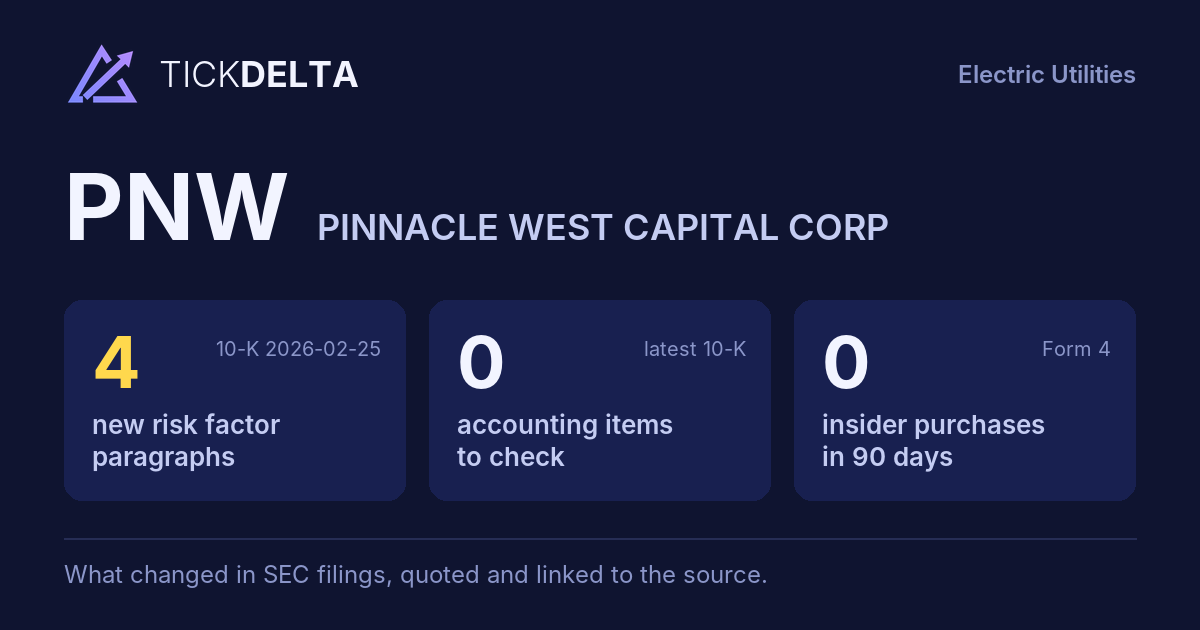
Sentences and paragraphs of PNW's Risk Factors and MD&A, 10-K 2026-02-25 against 10-K 2025-02-25.
Each links to the text at sec.gov.
Show the other 59
RemovedRisk Factors
2020, ACC Staff issued its second report regarding possible modifications to the ACC’s retail electric competition rules. During a July 15, 2020, ACC Staff meeting, the ACC Commissioners discussed the possible development of a retail competition pilot program, but no action was taken. The ACC continues to discuss matters related to retail electric competition, including the potential for additional buy-through programs or other pilot programs. In April 2022, the Arizona Legislature passed, and the Governor signed, a bill that repealed the electric deregulation law that had been in place in Arizona since 1998. On August 27, 2024, the ACC administratively closed this docket due to inactivity and obsolescence. Modification of the ACC’s retail electric competition rules or other efforts of deregulation could result in increased competition, which could have a significant adverse impact on APS’s business and results of operations.
Read it in 10-K 2025-02-25 at sec.gov ↗
RemovedRisk Factors
in distributed renewable energy programs would result in lower demand since customers would be meeting some of their own energy needs.
Read it in 10-K 2025-02-25 at sec.gov ↗
RemovedRisk Factors
Longer term, APS has been preparing for and can serve significant load growth from residential and business customers. On top of these existing growth trends, APS is also now receiving unprecedented incremental requests for service from extra-large commercial energy users (over 25 MW) with very high energy demands that persist virtually around-the-clock. These incremental requests for service by extra-large energy users far exceed available generation and transmission resource capacity in the Southwest region for the foreseeable future. APS is exploring available options for securing sufficient electric generation and transmission to meet these projections of future customer needs; however, there are difficulties in properly forecasting the demands of these extra-large customers due to factors such as the nascent nature of the industries (e.g., artificial intelligence) that these customers are supporting and the multiple variables that impact their usage ramp-up and ultimate level of demand. As data center and other extra-large customer opportunities evolve and develop, we may also enter into arrangements with customers and potential customers that require us to invest capital and assume credit risk related to such developments and the related generation and transmission investments before we receive any potential return. APS is implementing strategies to attempt to reduce this risk; however, the difficulty in forecasting these demands and the additional risk of these arrangements could lead to stranded costs and other effects that could have material adverse impacts on APS’s financial condition, results of operations, and cash flows.
Read it in 10-K 2025-02-25 at sec.gov ↗
RemovedRisk Factors
acceptance of new technologies could also enable the entry of new market participants, such as technology companies, into the interface between APS and its customers and could have other unpredictable effects on APS’s traditional business model.
Read it in 10-K 2025-02-25 at sec.gov ↗
RemovedRisk Factors
Pending or future federal or state legislative or regulatory activity or court proceedings could increase the costs of providing medical insurance for our employees and retirees. Any potential changes and resulting cost impacts cannot be determined with certainty at this time.
Read it in 10-K 2025-02-25 at sec.gov ↗
RewordedRisk Factors
The development and operation of any generation facility these facilities is also subject to many other risks, including those related to financing, siting, permitting, new and evolving technology, extreme weather events, workforce issues, cybersecurity attacks, supply chain constraints for key equipment and critical spare parts, overreliance on or the existence of a small number of suppliers, access to fuel, and the construction of sufficient transmission capacity to support these facilities among others.
Read it in 10-K 2026-02-25 at sec.gov ↗
RewordedRisk Factors
Deregulation or restructuring Modification of the ACC’s retail electric industry competition rules or other efforts of deregulation and other factors, such as customers installing behind the meter technologies or large customers developing large, utility scale generation projects to serve their energy needs, may result in increased competition, which could have a significant adverse impact on APS’s business and its results of operations.
Read it in 10-K 2026-02-25 at sec.gov ↗
RewordedRisk Factors
APS’s actual Actual sales growth, excluding weather-related variations, may differ from its our projections as a result of numerous factors, such as economic macroeconomic conditions, current and future economic, regulatory, business, and other conditions, such as the Arizona housing market, customer growth, the legal, regulatory, and business environment in Arizona, usage patterns and energy conservation, slower than expected ramp-up of and/or fewer than expected large data centers and large manufacturing facilities, slower than expected commercial and industrial expansions, impacts of energy efficiency programs and growth in DG, responses to retail price changes, changes in regulatory standards, and impacts of new and existing laws and regulations, including environmental laws and regulations.
Read it in 10-K 2026-02-25 at sec.gov ↗
RewordedRisk Factors
While these provisions may have the effect of encouraging persons seeking to acquire control of us to negotiate with our Board of Directors, they could enable the Board of Directors to hinder or frustrate a transaction that some, or a majority, of our shareholders might believe to be in their best interests and, in that case, may prevent or discourage attempts to remove and replace incumbent directors.
Read it in 10-K 2026-02-25 at sec.gov ↗
RewordedRisk Factors
Despite the fact that the majority of APS’s trading counterparties are rated as investment grade by the rating agencies, there is still a possibility that one or more of these companies could default, which could result in a material adverse impact on our earnings for a given period.
Read it in 10-K 2026-02-25 at sec.gov ↗
RewordedRisk Factors
The current regulatory standards, laws, Current laws and regulations as well as changes to those laws and regulations, including via judicial decisions and executive orders, create strategic challenges as to the in acquiring an appropriate generation portfolio and fuel diversification mix.
Read it in 10-K 2026-02-25 at sec.gov ↗
RewordedRisk Factors
Our ability to have the benefit of their cash flows, particularly in the case of any insolvency or financial distress affecting our subsidiaries, would arise only through our equity ownership interests in our subsidiaries and only after their creditors have been satisfied.
Read it in 10-K 2026-02-25 at sec.gov ↗
RewordedRisk Factors
The distributed renewable energy requirement is 30% of the applicable RES requirement for 2012 and subsequent years (APS requested was granted a waiver of this requirement in the 2024 and 2025 its 2026 RES Implementation Plans, which have not yet been approved by the ACC). Plan).
Read it in 10-K 2026-02-25 at sec.gov ↗
RewordedRisk Factors
Concerns over the physical security of these assets could include damage to certain of our facilities due to vandalism or other deliberate acts that could lead to outages or other adverse effects.
Read it in 10-K 2026-02-25 at sec.gov ↗
RewordedRisk Factors
The new regulations are currently being challenged in federal court. court and, in 2025, EPA proposed a rule to repeal these GHG emission standards.
Read it in 10-K 2026-02-25 at sec.gov ↗
RewordedRisk Factors
In addition, Colorado River water supplies for Arizona are subject to a Tier 1 shortage declaration, which declarations that substantially limits limit the quantity of water available for to the state.
Read it in 10-K 2026-02-25 at sec.gov ↗
RewordedRisk Factors
These types of events would as well as the impacts of integrating new IT systems could also require significant management attention and resources and could have a material adverse impact on our financial condition, results of operations, or cash flows.
Read it in 10-K 2026-02-25 at sec.gov ↗
Quiet changesRisk Factors
A Any failure to recover these potential increased costs through our rates could have a material adverse impact on our financial condition, results of operations, or cash flows.
Read it in 10-K 2026-02-25 at sec.gov ↗
AddedMD&A
Our vision is to create a sustainable energy future for Arizona. Our mission is to serve customers with safe, reliable, and affordable energy. We are committed to delivering operational excellence at the lowest cost possible while aspiring to lower carbon emissions over time.
Read it in 10-K 2026-02-25 at sec.gov ↗
AddedMD&A
As energy demand in Arizona continues to grow, we remain committed to delivering reliable service to our customers. We have a goal of achieving top quartile reliability as compared to peers. Key elements to delivering reliable service include resource and transmission planning to secure resource adequacy, planning and procuring resources to ensure sufficient reserve margins, distribution automation and resiliency investments, predictive and preventative maintenance programs, seasonal readiness programs, emergency preparedness, and securing a reliable supply chain. Securing a reliable grid requires ongoing infrastructure investments in addition to investments to support new customer growth.
Read it in 10-K 2026-02-25 at sec.gov ↗
AddedMD&A
Balanced Energy Mix. APS strives to procure a balanced energy mix, and we believe this provides the greatest reliability at the lowest cost possible while increasing resiliency. We achieve reliability, in part, through a blend of dispatchable resources, such as natural gas and battery storage, that can provide energy when intermittent resources, such as wind and solar, are unavailable. APS regularly
Read it in 10-K 2026-02-25 at sec.gov ↗
AddedMD&A
evaluates the best mix of resources based on a changing operating environment, including changes in generation technology, economics, and policy impacts.
Read it in 10-K 2026-02-25 at sec.gov ↗
AddedMD&A
Additional natural gas capacity is necessary to support reliable service and meet increasing energy needs. However, existing natural gas pipelines into Arizona are currently 100% committed. As a result, in July 2025, APS executed a gas transportation precedent agreement to secure a long-term supply of natural gas. The new pipeline is expected to be operational by late 2029 and will be owned and operated by a third-party. See Note 14 for more information. APS also plans to add up to 2,000 MW of flexible natural gas generation to its portfolio, designed to help meet the growing around-the-clock energy needs in Arizona. This generation is expected to serve existing customers and business-as-usual growth through our competitive ASRFP process as well as a new subscription model for large load customers, like data centers and large manufacturers. This subscription model is a commercial construct designed to ensure growth pays for growth while protecting affordability for other customers.
Read it in 10-K 2026-02-25 at sec.gov ↗
AddedMD&A
Palo Verde, one of the nation’s largest carbon-free energy resources, serves as a foundational part of APS’s resource portfolio. The plant is a critical asset to the Southwest, generating more than 32 million MWh – enough power for roughly 3.4 million households, or approximately 8.5 million people. Its continued operation is important to a carbon-neutral future for Arizona and the region, as a reliable, continuous, affordable resource and as a large contributor to the local economy. APS owns or leases 29.1% of Units 1, 2, and 3 Palo Verde. In June 2025, APS entered into agreements to purchase two of the three leased interests in Unit 2. The two subject leased interests represented approximately 7% or 94 MW of Unit 2. The transaction closed in September 2025, leaving one remaining lease for approximately 5.2% of Unit 2 that expires in 2033. See Note 12 for more information. APS’s rate case application filed in 2025 (the “2025 Rate Case”) includes pro forma adjustments to account for these acquisitions. APS continues to evaluate and pursue options for reliably serving growing customer energy needs and demand.
Read it in 10-K 2026-02-25 at sec.gov ↗
AddedMD&A
We are committed to keeping bills as low as possible for our customers while maintaining high levels of reliability. Inflation has dramatically impacted the cost of goods and services in recent years as shown by the Consumer Price Index for All Urban Consumers (“CPI-U”), which from 2018 through 2024 rose nationally 24.9% and 32.1% in Phoenix. Despite this, APS’s average residential rates remained well-below those inflation figures, rising 16.2% for the same period according to the U.S. Energy Information Administration. Inflation has moderated from earlier highs, with CPI-U rising 2.7% nationally and 2.2% in Phoenix over the 12 months ended December 2025. As a result of increased tariffs and supply chain constraints, APS amended several of its agreements from its ASRFP issued in 2023 to mitigate these cost impacts. However, APS remains cautious of potential price increases as a result of current and proposed tariffs, which could lead to higher costs and supply chain constraints, while also monitoring the outcome of the recent U.S. Supreme Court’s decision regarding the validity of certain tariffs.
Read it in 10-K 2026-02-25 at sec.gov ↗
AddedMD&A
APS’s IRP and competitive ASRFP processes serve important roles in providing reliable and affordable energy to APS’s customers. The IRP process helps identify the amount and type of resources required to reliably meet customer needs, while the ASRFP process seeks to meet those needs in a competitive manner based on cost, ability to meet system requirements, and commercial viability.
Read it in 10-K 2026-02-25 at sec.gov ↗
AddedMD&A
APS has seen increasing demand from large load customers in recent years. In the 2025 Rate Case, APS requested adjustments to rate designs and modification of cost allocation methodologies to ensure growth pays for growth. In line with the 2025 Rate Case, APS has developed a subscription model it believes will allow for these large load customers to fund the incremental infrastructure needed to serve them through long-term contracts where they cover capital costs and assume development risks, accelerating their path to service and ensuring those infrastructure costs are borne by those customers rather than residential or small business customers.
Read it in 10-K 2026-02-25 at sec.gov ↗
AddedMD&A
additional agreements. The scope of projects being negotiated out of the 2024 ASRFP reflects both the expanse of the 2023 ASRFP and the reality of adjusting to tariffs and changing federal policy.
Read it in 10-K 2026-02-25 at sec.gov ↗
AddedMD&A
APS has an aspirational goal to be carbon-neutral by 2050. This means that for any GHG emissions still produced by our generation resources as of 2050, we will aim to offset these emissions elsewhere. This goal reflects APS’s interest in new innovation and market transformations that address carbon emissions, while relying on the IRP and ASRFP processes to help determine the path forward.
Read it in 10-K 2026-02-25 at sec.gov ↗
AddedMD&A
Serving customers with excellence is foundational to APS’s business and remains our core focus as we adapt to evolving customer needs and emerging technology. Recognizing that every employee impacts our customer experience, we continue to provide information, tools, and resources enabling our teams to design, develop, and implement enhancements to improve our customer experience.
Read it in 10-K 2026-02-25 at sec.gov ↗
RemovedMD&A
Our strategy is to create a sustainable energy future for Arizona that delivers shareholder value and shared value by serving our customers with reliable, affordable, and clean energy.
Read it in 10-K 2025-02-25 at sec.gov ↗
RemovedMD&A
APS’s focus remains on its customers and the communities it serves. Accordingly, it is APS’s goal to achieve an industry-leading, best-in-class customer experience. This multi-year objective includes incrementally improving APS’s J.D. Power (“JDP”) residential and business customer satisfaction ratings from the fourth to the top of second quartile for its customers. For 2024, APS ranked at the top of the second quartile for large investor-owned utilities for both business and residential customers, with the residential results being APS’s highest rank and placement since 2016.
Read it in 10-K 2025-02-25 at sec.gov ↗
RemovedMD&A
In furtherance of a customer-centric culture, APS employees have delivered an enhanced customer experience in recent years through a number of past and ongoing initiatives, such as improving the ease-of-use of APS’s automated phone system, improving the speed of answering customer calls, advancing phone advisor soft skill development through updated training curriculum, and adding 1,100-plus in-person payment locations, as well as introducing new customer payment channels. Recently, APS redesigned its customer bills with the aim of increasing personalization and helping customers better understand their
Read it in 10-K 2025-02-25 at sec.gov ↗
RemovedMD&A
energy use and find ways to save. APS also implemented numerous enhancements to its website, including improving page-loading speeds, adding user-friendly dashboards, and making content more simple, relevant, and useful. APS enhanced other customer touchpoints, such as communications throughout outages and the online outage center in addition to continuing to communicate with customers in their preferred channels about topics that matter most to them, such as reliability, energy-efficiency, financial assistance, the environment, and programs that enable them to design their own personalized energy experience. Finally, APS continues to focus on employee learning, training, tools, and resources to ensure all employees understand their role in APS customers’ experiences.
Read it in 10-K 2025-02-25 at sec.gov ↗
RemovedMD&A
While our energy mix evolves, APS’s commitment to deliver reliable service to our customers remains. APS is managing through significant growth in the Phoenix metropolitan area while experiencing supply chain issues similar to those experienced in other industries.
Read it in 10-K 2025-02-25 at sec.gov ↗
RemovedMD&A
Planned investments will support operating and maintaining the grid, updating technology, accommodating customer growth, and enabling more renewable energy resources. To prioritize reliability and meet substantial growth in customer energy needs, APS has developed a future-focused, strategic transmission plan (the “Ten-Year Transmission Plan”). The Ten-Year Transmission Plan includes five critical transmission projects that comprise the APS strategic transmission portfolio, which represent a significant upgrade to our transmission system. These five projects, along with other projects included in the Ten-Year Transmission Plan, will support growing energy needs, strengthen reliability, and allow for the connection of new resources.
Read it in 10-K 2025-02-25 at sec.gov ↗
RemovedMD&A
Our advanced distribution management system allows operators to locate outages and control line devices remotely and helps them coordinate more closely with field crews to safely maintain an increasingly dynamic grid. The system will also integrate a new meter data management system that will increase grid visibility and give customers access to more of their energy usage data.
Read it in 10-K 2025-02-25 at sec.gov ↗
RemovedMD&A
For example, on August 14, 2024, APS filed a request with the ACC for a deferral order that would authorize APS to defer, for future recovery in rates, operations and maintenance expenses associated with wildfire management, including increased insurance costs. APS cannot predict the outcome of this matter. See Note 3 for more information.
Read it in 10-K 2025-02-25 at sec.gov ↗
RemovedMD&A
Maintaining reliability and affordability for customers during the clean energy transition is fundamental to APS’s strategy. Dispatchable natural gas generators provide energy during times when intermittent resources, such as solar and wind, are insufficient to meet customer demand. In addition to the previously added natural gas units at the modernized Ocotillo Power Plant in 2019 and efficiency improvements to gas units at the Redhawk, Sundance, and West Phoenix Power Plants in 2024, APS has contracted for two simple cycle combustion turbines (approximately 90 MW in total) at Sundance, which are expected to be in service in 2026, and eight simple cycle combustion turbines (approximately 397 MW in total) at Redhawk, which are expected to be in service in 2028. APS continues to evaluate and pursue options for reliably serving growing customer energy needs and demand.
Read it in 10-K 2025-02-25 at sec.gov ↗
RemovedMD&A
In October 2021, APS announced plans to evaluate regional market solutions as part of the Western Markets Exploratory Group (“WMEG”). As a member of WMEG, APS explored the potential for a staged approach to new market services, including day-ahead energy sales, transmission system expansion, and other power supply and grid solutions consistent with existing regulations and known and expected market design. APS utilizes the work done by WMEG to help identify market solutions that can help achieve carbon reduction goals while supporting reliable, affordable service for customers.
Read it in 10-K 2025-02-25 at sec.gov ↗
RemovedMD&A
APS went live with a new Energy Management System (“EMS”) in April 2024. APS expects the new EMS to provide a better foundation which will improve future integration of the renewable and energy storage assets into APS’s generation resource portfolio, allowing APS to maximize the flexibility of its resources and fully engage in the Western Energy Imbalance Market (“WEIM”). APS also believes it will better position APS to participate in market opportunities that develop over the next decade.
Read it in 10-K 2025-02-25 at sec.gov ↗
RemovedMD&A
APS’s key elements to delivering reliable power include resource and transmission planning, sufficient reserve margins, partnering with customers to manage peak demand, fire mitigation, and operational preparedness, among others. Seasonal readiness procedures at APS include inspections to ensure good material conditions and critical control system surveys. APS also plans for the unexpected by conducting emergency operations drills and coordinating with federal, state, and local agencies on fire and emergency management.
Read it in 10-K 2025-02-25 at sec.gov ↗
RewordedMD&A
Pinnacle West’s consolidated net cash provided by operating activities was $1,805 million in 2025 compared to $1,610 million in 2024 compared to $1,207 million in 2023, 2024, an increase of $403 $195 million in net cash provided, primarily due to $447 $238 million higher cash receipts from electric revenues, $236 $111 million in lower income taxes paid and $60 million lower payments for operations and maintenance costs; partially offset by $162 million higher payments for fuel and purchased power costs, $15 $29 million change in net collateral, partially offset by $125 million higher income taxes paid, $104 million higher payments for operations and maintenance costs, $49 million higher interest payments paid on debt and $17 $23 million of other changes in working capital.
Read it in 10-K 2026-02-25 at sec.gov ↗
RewordedMD&A
Pinnacle West’s consolidated net cash used for investing activities was $2,378 million in 2025 compared to $1,934 million in 2024 compared to $1,694 million in 2023, 2024, an increase of $240 $444 million primarily related to $272 $380 million of increased capital expenditures expenditures, net of contributions in aid of construction, and $21 $84 million of additional investing activity, proceeds from the BCE Sale received in 2024; partially offset by proceeds of $61 $20 million from less investing activity in the BCE Sale. current year.
Read it in 10-K 2026-02-25 at sec.gov ↗
RewordedMD&A
On June 30, 2023, In terms of recent solicitations, APS issued an ASRFP (the “2023 ASRFP”) on June 30, 2023, pursuant to which APS procured nearly 7,300 3,606 MW of new battery storage, 517 MW of natural gas, 2,649 MW of solar, and 500 MW of wind resources expected to be in service from 2026 to 2028.
Read it in 10-K 2026-02-25 at sec.gov ↗
RewordedMD&A
To address the rapid advancement ensure compliance with data security, reliability requirements, and our Code of artificial intelligence technology risks Ethical Conduct, governance and opportunities, APS has developed a cross functional governance structure with oversight are provided by leadership and experts from our information technology, cybersecurity, human resources, ethics, supply chain, legal, and nuclear generation teams.
Read it in 10-K 2026-02-25 at sec.gov ↗
RewordedMD&A
Other income and expenses, expense, net were $4 was $5 million higher for the year ended December 31, 2024, 2025 compared to the prior-year period, primarily due to investment gains in El Dorado, partially offset by the gain on the sale of BCE, partially offset by BCE recognized during the first quarter of 2024, lower PSA interest income and higher corporate giving expense.
Read it in 10-K 2026-02-25 at sec.gov ↗
RewordedMD&A
APS also implemented a PSPS public safety power shutoff (“PSPS”) program on certain feeders that began in the 2024 fire season, leveraging the additional real-time analysis provided by the new modelling software, and has educated and is continuing education outreach to customers and communities that may potentially be impacted by the PSPS program. modeling software.
Read it in 10-K 2026-02-25 at sec.gov ↗
RewordedMD&A
On October 31, 2019, 28, 2022, APS filed an application with the ACC (the “2019 “2022 Rate Case”) for an annual increase in retail base rates. rates, and on January 25, 2024, an Administrative Law Judge issued a ROO, as corrected on February 6, 2024 (the “2022 Rate Case ROO”).
Read it in 10-K 2026-02-25 at sec.gov ↗
RewordedMD&A
The results reflect an increase of approximately $107 $8 million, primarily as a result of the increased customer usage, customer growth and related pricing, higher transmission revenues, impacts of new customer rates, increased customer usage and growth, the effects of weather, higher LFCR revenue, and higher CRS revenue and LFCR revenue. AFUDC.
Read it in 10-K 2026-02-25 at sec.gov ↗
RewordedMD&A
APS also implemented a PSPS program on certain feeders that began in the 2024 fire season, leveraging the additional real-time analysis provided by the new modelling software, and has educated and is continuing will continue education outreach to customers and communities that may potentially be impacted by the PSPS program.
Read it in 10-K 2026-02-25 at sec.gov ↗
RewordedMD&A
Income taxes were $34 $4 million higher lower for the year ended December 31, 2024, 2025 compared with the prior-year period, primarily due to higher pre-tax income, tax benefits related to employee benefits and AFUDC Equity, offset by lower tax benefits from AFUDC equity, partially offset by credits and higher tax credits. pre-tax income.
Read it in 10-K 2026-02-25 at sec.gov ↗
RewordedMD&A
Interest charges, net of AFUDC, allowance for funds used during construction, were $60 $23 million higher for the year ended December 31, 2024, 2025 compared to the prior-year period, primarily due to higher debt balances and higher interest rates in the current period, higher lower allowance for borrowed funds and lower funds, partially offset by higher allowance for equity funds.
Read it in 10-K 2026-02-25 at sec.gov ↗
RewordedMD&A
Source of Fair Value 2025 2026 2027 2028 2029 2030 Total Fair Value Observable prices provided by other external sources $ (32) (6) $6 $ 2 $3 (2) $ $ $ (27) (2) Prices based on unobservable inputs (6) (9) (24) — — — (15) — (24) Total by maturity $ (38) (30) $6 $ (7) $3 (2) $ $ $ (42) (26)
Read it in 10-K 2026-02-25 at sec.gov ↗
Quiet changesMD&A
We believe that Pinnacle West and APS currently have ample borrowing capacity under their respective credit facilities and may readily access these facilities ensuring adequate liquidity for each company.
Read it in 10-K 2026-02-25 at sec.gov ↗
Quiet changesMD&A
Capital expenditures will are anticipated to be funded with internally generated cash and external financings, which may include issuances of long-term debt and Pinnacle West common stock.
Read it in 10-K 2026-02-25 at sec.gov ↗
Quiet changesMD&A
Income taxes are affected by the amount of pretax book income, income tax rates, certain deductions, certain credits and non-taxable items, such as AFUDC.
Read it in 10-K 2026-02-25 at sec.gov ↗
Quiet changesMD&A
Capital expenditures will are expected to be funded with internally generated cash and external financings, which may include issuances of long-term debt and Pinnacle West common stock.
Read it in 10-K 2026-02-25 at sec.gov ↗
Quiet changesMD&A
Purchase obligations may include commitments for capital expenditures and other obligations.
Read it in 10-K 2026-02-25 at sec.gov ↗