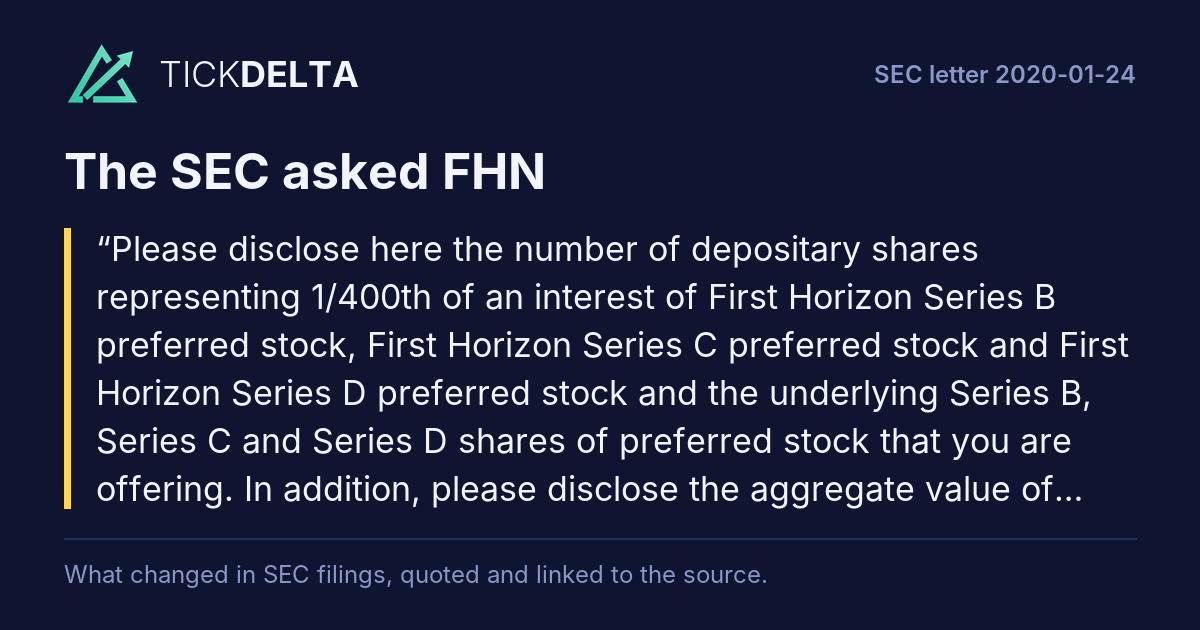
Set forth below is the information requested by the Staff with respect to the cash disposition of fractional interests in connection with the merger:
· As of January 31, 2020, based on information provided by IBKC’s transfer agent, there were approximately 2,669 record holders of IBKC common stock (excluding treasury shares).
Rest of the answer
We expect that a substantial majority, and likely all, of these record holders would receive cash in lieu of fractional shares because the exchange ratio is calculated out to three decimal points as part of a “market-to-market” exchange ratio.
· Pursuant to the terms of the merger agreement, the amount of cash to be paid in respect of fractional shares will be the average of the closing-sale prices of First Horizon common stock on the New York Stock Exchange (as reported by The Wall Street Journal) for the consecutive period of five trading days ending on the day preceding the closing date of the merger. Accordingly, it is currently not possible to estimate the amount of cash to dispose of fractional interests, as it will be dependent on the trading price of First Horizon common stock during the five trading days preceding the closing date. However, (i) assuming a price per fractional share of $16.31, the closing price for the shares of First Horizon common stock on November 1, 2019 (which was the last trading day before public announcement of the merger) and (ii) based upon the number of shares of outstanding IBKC common stock on January 31, 2020 of approximately 52,587,312 shares, and information provided by IBKC’s transfer agent regarding the record holders of IBKC common stock on January 31, 2020, we estimate that the aggregate amount of cash to be paid to record holders in lieu of fractional shares in the merger is approximately $22,022.03.
· No record holders of IBKC common stock would be effectively cashed out of their entire investment in IBKC common stock after giving effect to the receipt of cash in lieu of fractional shares because each record holder holds at least one share of IBKC common stock and, based on the exchange ratio of 4.584, would receive at least four shares of First Horizon common stock.
For the reasons set forth below, we respectfully submit that the merger is within the intended scope of Rule 13e-3(g)(2) and therefore exempt from the application of Rule 13e-3.
Pursuant to the merger, each share of IBKC common stock (other than shares of IBKC common stock owned by IBKC or First Horizon (in each case, other than shares of IBKC common stock
(i) held in trust accounts, managed accounts, mutual funds and the like, or otherwise held in a fiduciary or agency capacity, that are beneficially owned by third parties, or (ii) held, directly or indirectly, by IBKC or First Horizon in respect of debts previously contracted)), would be cancelled and exchanged for 4.584 shares of First Horizon common stock. As indicated by the figures above, the cash that is expected to be paid in lieu of fractional shares (assuming the $16.31 price per share and the number of IBKC common stock outstanding as of January 31, 2020) represents a de minimis amount (approximately 0.0006%) of the total consideration in the merger, which is valued at approximately $3.9 billion (based on the closing price of First Horizon common stock on November
1, 2019). The mechanic for giving effect to the payment of cash in lieu of fractional shares is designed to ensure that all holders of IBKC common stock would receive a cash amount equivalent to the value of the fractional First Horizon shares they would otherwise be due by operation of the merger. Except for the payment of a de minimis amount of cash in lieu of fractional shares, all the consideration will consist of First Horizon common stock, which is a class of equity security that both trades on a liquid market and satisfies the conditions in Rule 13e-3(g)(2)(i)-(iii) (i.e., the offered equity security has substantially the same rights as the equity security which is the subject of the Rule 13e-3 transaction, the offered equity security is registered pursuant to section 12 of the Securities Exchange Act of 1934, as amended (the “Exchange Act”), and the offered equity security is listed on a national securities exchange).
In the proposing release for Rule 13e-3 (Release
No. 34-14185, dated November 17, 1977), the Commission stated that “the practice of issuers…engaging in transactions which have the effect of eliminating or substantially reducing the equity interest of an issuer held by the public and resulting in the issuer or its successor becoming privately held is a matter of serious concern to the Commission.” In particular, the Commission noted that the going private transactions for which Rule 13e-3 was designed are transactions that have a coercive effect in that security holders confronted by a going private transaction are faced with the prospects of an illiquid market, termination of the protections under federal securities laws, and further efforts by the issuer or its affiliates to eliminate their equity interest. Further, as the Division has explained, the “basis of the subparagraph (g)(2) exception is that where ‘security holders are offered only an equity security which is either common stock or has essentially the same attributes as the security which is the subject of the Rule 13e-3 transaction… all holders of [the affected] class of security are on an equal footing and are permitted to maintain an equivalent or enhanced equity interest.” Question and Answer 9, Release No. 34-17719 (April
13, 1981) quoting Release No. 34-16075 (August 2, 1979). First Horizon respectfully submits that in the context of the merger, the payment of a de minimis amount of cash in lieu of fractional shares does not contravene the basis of the Rule 13e-3(g)(2) exception. Unlike the “going private” transactions generally captured by Rule 13e-3, by operation of the 4.584 exchange ratio, every single holder of IBKC common stock would “maintain an equivalent or enhanced equity interest” (as holders of First Horizon common stock) and would continue to enjoy the benefits of public ownership and the protections of the Exchange
Act. The cash in lieu of fractional shares in connection with the merger is not driven by any value decision or a decision to reduce the proportional ownership of the shareholders of IBKC, but rather is a customary mechanical procedure utilized in stock transactions to mitigate unnecessary administrative burdens on the corporate share register while permitting shareholders to maintain the equivalent or enhanced equity interest provided for pursuant to the exchange ratio.
In determining the intended scope of the Rule 13e-3(g)(2) exception, the Division has eschewed formalism and focused instead on whether a transaction is comprehended within the purposes of Rule 13e-3. For example, while the Rule 13e-3(g)(2) exception provides that security holders may be offered “only an equity security,” Question and Answer 11, Release No. 34-17719 (April 13, 1981) provides that the exception is available if security holders are offered the opportunity to elect either cash or stock consideration, if (1) the cash, when first offered, is substantially equivalent to the value of the security offered, and (2) both options are offered to security holders. Given that the Division has extended the Rule
13e-3(g)(2) exception to such cash/stock elections because they satisfy the exception’s purpose of ensuring that security holders are permitted to maintain an equivalent or enhanced equity interest, First Horizon respectfully submits that a merger where the only cash paid is for fractional shares should also fall within the intended scope of the Rule 13e-3(g)(2) exception. As part of its analysis, First Horizon has also considered that the Staff has not required the filing of a Schedule 13E-3 in a number of recent transactions where cash was paid in lieu of fractional shares notwithstanding that the Staff, in reviewing the related Registration
Statements on Form S-4, made similar comments regarding the exception in Rule 13e-3(g)(2) and requested analysis regarding the applicability of Rule 13e-3 to the transactions then at hand. See, e.g., Correspondence from Willscot Corp., Response 3 (filed
November 28, 2018); Correspondence from Colony Credit Real Estate, Inc., Response 4 (filed November 6, 2017); Correspondence from
Forest City Realty Trust, Inc., Response 1 (filed April 14, 2017).
First Horizon has also considered that the Staff has previously granted “no-action” relief for reliance on Rule 13e-3(g)(2) on facts involving the payment of cash in lieu of fractional shares to target security holders. In each of the following no-action letters, the incoming request referenced the payment of cash in lieu of fractional shares to target security holders. See, e.g., Canadian Pacific Limited (June 26, 1996); Standard Shares,
Incorporated (April 28, 1989); and Swanton Corporation (November 26, 1984). While the discussion relating to the availability of the exception did not focus on the presence of this cash payment, the Staff in each instance granted “no-action” relief from Rule 13e-3 on the basis of the Rule 13e-3(g)(2) exception. Moreover, as a policy matter, the payment of cash in lieu of fractional shares in the context of the merger does not involve the potential for abuse or overreaching associated with the “going private” transactions generally captured by Rule 13e-3.
* * *
First Horizon acknowledges that:
· First
Horizon is responsible for the adequacy and accuracy of the disclosure in its filings;
· Staff comments or changes to disclosure in response to Staff comments do not foreclose the
Commission from taking any action with respect to the filing; and
Horizon may not assert Staff comments as a defense in any proceeding initiated by the
Commissioner or any person under the federal securities laws of the United States.
If you have any further comments or questions relating to the foregoing, please do not hesitate to contact H. Rodgin Cohen of Sullivan & Cromwell LLP at (212) 558-3534 or [email protected].