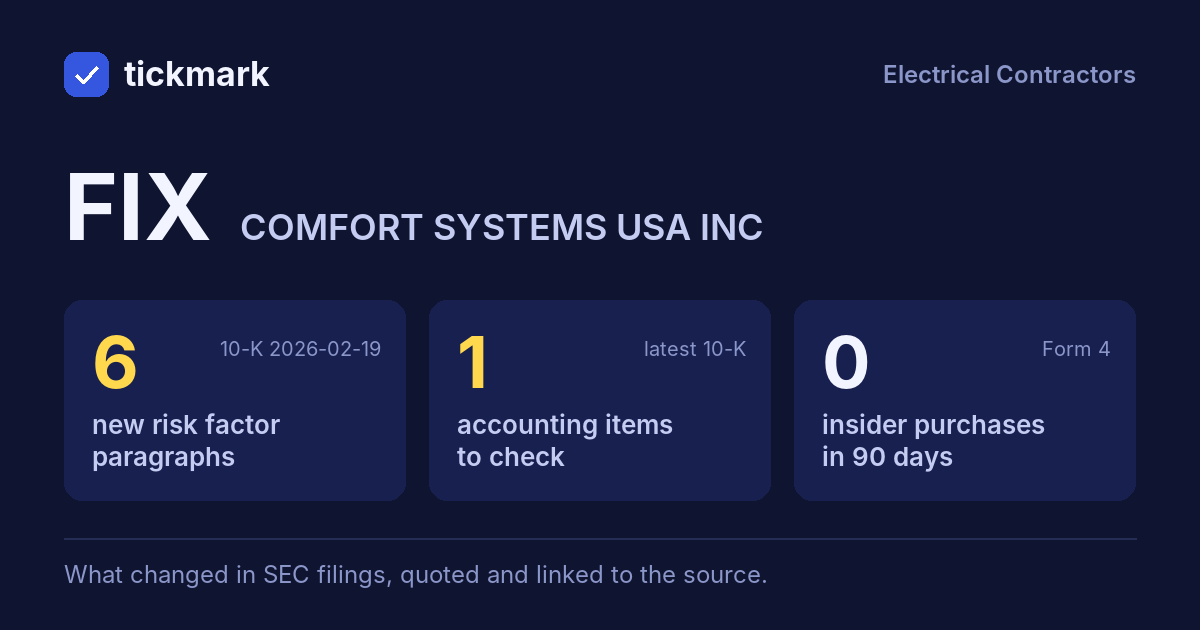
Sentences and paragraphs of FIX's Risk Factors and MD&A, 10-K 2026-02-19 against 10-K 2025-02-20.
Each links to the text at sec.gov.
AddedRisk Factors
In the past we have been required to increase, and it is possible we will in the future be required to increase, the number and percentage of total contract dollars for which we utilize an underlying surety bond. Historically, surety
Read it in 10-K 2026-02-19 at sec.gov ↗
AddedRisk Factors
We believe that our practice of placing significant decision-making power with local management is important to our successful growth and allows us to be responsive to opportunities and to our customers’ needs. However, this
Read it in 10-K 2026-02-19 at sec.gov ↗
AddedRisk Factors
We face numerous and evolving cybersecurity risks that threaten the confidentiality, integrity and availability of our IT Systems and Confidential Information, including from diverse threat actors, such as state-sponsored organizations, opportunistic hackers and hacktivists, as well as through diverse attack vectors, such as social engineering/phishing, malware (including ransomware), malfeasance by insiders, human or technological error (including the misuse of artificial intelligence tools by our employees), and as a result of malicious code embedded in open-source software, or misconfigurations, bugs or other vulnerabilities in commercial software that is integrated into our (or our suppliers’ or service providers’) IT Systems, products or services. Because we make extensive use of third-party suppliers and service providers, such as cloud services that support our internal and customer-facing operations, successful cyberattacks that disrupt or result in unauthorized access to third party IT Systems can materially impact our operations and financial results. Remote and hybrid working arrangements at the Company (and at many third-party providers) also increase cybersecurity risks due to the challenges associated with managing remote computing assets and security vulnerabilities that are present in many non-corporate and home networks. Additionally, any integration of artificial intelligence in our or any service providers’ operations, products or services is expected to pose new or unknown cybersecurity risks and challenges. Any circumvention or failure of our cybersecurity defenses or measures could compromise the confidentiality, integrity, and availability of our customers’ own IT Systems and/or Confidential Information as well.
Read it in 10-K 2026-02-19 at sec.gov ↗
AddedRisk Factors
against the threat of system disruptions and security breaches or to alleviate problems caused by these disruptions and breaches.
Read it in 10-K 2026-02-19 at sec.gov ↗
AddedRisk Factors
Changes in U.S. foreign relations, in particular foreign trade policies could lead to the imposition of additional trade barriers and tariffs.
Read it in 10-K 2026-02-19 at sec.gov ↗
AddedRisk Factors
We cannot predict the full extent of new, extended, or changed trade policies, including tariffs, that may be made by the current or a future presidential administration or Congress, including whether existing tariff policies will be maintained or modified or if changes in the U.S. trade policy could result in reactions from U.S. trading partners, such as adopting responsive trade policies making it more difficult or costly for us to purchase materials or supplies. These changes in U.S. trade policy or in laws and policies governing foreign trade or foreign relations generally, and any resulting negative sentiments towards the United States as a result of such changes, could have an adverse impact on our business, financial condition, results of operations, and cash flows.
Read it in 10-K 2026-02-19 at sec.gov ↗
AddedMD&A
we devote considerable attention to operating unit management quality, stability, and contingency planning, including related considerations of compensation and non-competition protection where applicable.
Read it in 10-K 2026-02-19 at sec.gov ↗
AddedMD&A
financing and professional costs in connection with the amendment to the Facility, which, combined with previously unamortized costs of $1.0 million, are being amortized on a straight-line basis as a non-cash charge to interest expense over the remaining term of the Facility. As of December 31, 2025, we had $100.0 million of outstanding borrowings on the revolving credit facility, $79.0 million in letters of credit outstanding and $921.0 million of credit available.
Read it in 10-K 2026-02-19 at sec.gov ↗
Show the other 1
AddedMD&A
The Facility contains financial covenants defining various financial measures and the levels of these measures with which we must comply. Covenant compliance is assessed as of each quarter end for the four fiscal quarters then ended. Credit Facility Adjusted EBITDA is defined under the Facility for financial covenant purposes as consolidated net income for the four fiscal quarters ending as of any given quarterly covenant compliance measurement date, plus the corresponding amounts for (a) interest expense; (b) provision for income taxes; (c) depreciation and amortization; (d) stock or equity compensation; and (e) other non-cash charges, in each case calculated on a pro forma basis for acquisitions or dispositions during such measurement period. The Facility’s principal financial covenants include:
Read it in 10-K 2026-02-19 at sec.gov ↗