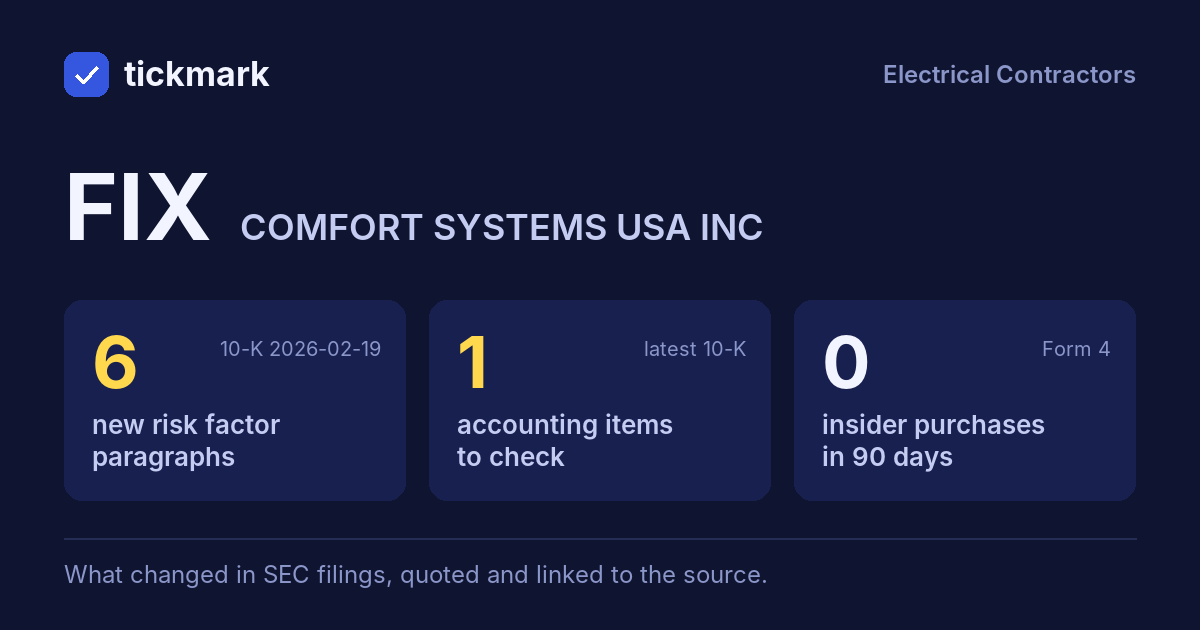
10-K 0001104659-26-017530 (2026-02-19) vs 10-K 0001558370-25-001222 (2025-02-20)
| Section | Compared text | Words now | Changed |
|---|
| Risk Factors | Item 1A | 9,176 |
19.7% |
| MD&A | Item 7 | 7,149 |
14.8% |
| Legal Proceedings | Item 3 | 279 |
15.6% |
| Accounting Policies | Item 8, Note 2 – Summary of Significant Accounting Policies and Estimates | 2,811 |
9.8% |
The redline: what was cut and what was added
In each section, the paragraph that changed most, marked against last year's 10-K:
cut words struck through, new words highlighted and underlined.
MD&A 189 words changed in this paragraph; it is 52% similar to last year's version.
We generated $849.1 million $1.19 billion of net cash flow from operating activities during 2024 2025 compared to $639.6 $849.1 million during 2023. 2024. The $209.5 $337.3 million increase in cash provided by operating activities was primarily driven by higher earnings before non-cash expenses such as amortization of intangible assets in the current year and a $366.4 an $877.9 million benefit from changes in billings in excess of costs and estimated earnings and deferred revenue driven by the timing of customer billings and payments. These increases were partially offset by a $778.9 million decrease in accounts payable and accrued other current liabilities driven by the size and timing of payments, including postponement of federal tax payments. On July 22, 2024, due to Hurricane Beryl, the Internal Revenue Service announced tax relief that extended the due dates for our federal tax payments until February 3, 2025. We thus made an $80.0 million federal tax payment in the first quarter of 2025 that otherwise would have been paid in the second half of 2024. These increases were partially offset by 2024, as a $317.0 million change in billings in excess result of costs and deferred revenue tax relief from the Internal Revenue Service due to more advance payments Hurricane Beryl. In 2023, we filed our 2022 federal tax return requesting a refund of our $107.1 million overpayment, which was received in April 2025 and positively impacted our second quarter cashflows. Along with the prior year. We have refund, we received large advance payments $11.3 million (or $8.9 million, net of tax) of interest income that reduced our provision for income taxes in the current and prior years that will reverse when project costs are incurred, except to the extent that additional advance payments are received. first quarter of 2025.
Source: Item 7, 10-K 0001104659-26-017530 vs Item 7, 10-K 0001558370-25-001222
Risk Factors 129 words changed in this paragraph; it is 47% similar to last year's version.
While we have security, internal control Moreover, cyberattacks are expected to accelerate on a global basis in frequency and technology measures magnitude as threat actors are becoming increasingly sophisticated in place using techniques and tools—including artificial intelligence to protect our systems engage in automated, targeted, and networks, these measures could fail as a result of a cyber-attack, other third-party action, employee error, malfeasance or other coordinated attacks—that circumvent security failure. In the ordinary course of business, we have been targeted by malicious cyber-attacks. controls, evade detection and remove forensic evidence. Because the techniques used to obtain unauthorized access or sabotage systems change frequently and generally are not identified until they are launched against a target, we may be unable to anticipate these techniques or to implement adequate preventative measures. As a result, we may be required to expend significant resources to protect against the threat of system disruptions and security breaches or to alleviate problems caused by these disruptions and breaches. Any of these events could damage our reputation and have a material adverse effect on our business, results of operations, financial condition and cash flows.
Source: Item 1A, 10-K 0001104659-26-017530 vs Item 1A, 10-K 0001558370-25-001222
Accounting Policies 71 words changed in this paragraph; it is 31% similar to last year's version.
We have As of December 31, 2025, we had a $6.8 $34.4 million investment in a construction-focused technology fund U.S. Treasury bills with a fair value that is not readily determinable and is maturities greater than ninety days but less than one year, which are recorded at cost. This investment amortized cost and is included in “Other Noncurrent Assets” “Prepaid Expenses and Other” in our Consolidated Balance Sheet and is reviewed quarterly for impairment. We did not recognize any impairments in the current year related to this investment. Sheet.
Source: Item 8, Note 2 – Summary of Significant Accounting Policies and Estimates, 10-K 0001104659-26-017530 vs Item 8, Note 2 – Summary of Significant Accounting Policies and Estimates, 10-K 0001558370-25-001222
Every change, by type
Sentences and paragraphs of FIX's Risk Factors and MD&A, 10-K 2026-02-19 against 10-K 2025-02-20.
Each links to the text at sec.gov.
Quiet changes are sentences kept from last year with one to four words changed, at least one of them a hedge, a modal or a qualifier
(may, could, will, not, significant, material…). A year or date rolling forward is not counted.
The full word list
adverse, adversely, all, although, anticipate, anticipates, any, approximately, believe, believes, can, cannot, certain, could, expect, expects, generally, however, if, intend, intends, largely, likely, many, material, materially, may, might, most, must, never, no, not, possible, primarily, probable, should, significant, significantly, some, substantial, substantially, unlikely, will, would
AddedRisk Factors
In the past we have been required to increase, and it is possible we will in the future be required to increase, the number and percentage of total contract dollars for which we utilize an underlying surety bond. Historically, surety
Read it in 10-K 2026-02-19 at sec.gov ↗
AddedRisk Factors
We believe that our practice of placing significant decision-making power with local management is important to our successful growth and allows us to be responsive to opportunities and to our customers’ needs. However, this
Read it in 10-K 2026-02-19 at sec.gov ↗
AddedRisk Factors
We face numerous and evolving cybersecurity risks that threaten the confidentiality, integrity and availability of our IT Systems and Confidential Information, including from diverse threat actors, such as state-sponsored organizations, opportunistic hackers and hacktivists, as well as through diverse attack vectors, such as social engineering/phishing, malware (including ransomware), malfeasance by insiders, human or technological error (including the misuse of artificial intelligence tools by our employees), and as a result of malicious code embedded in open-source software, or misconfigurations, bugs or other vulnerabilities in commercial software that is integrated into our (or our suppliers’ or service providers’) IT Systems, products or services. Because we make extensive use of third-party suppliers and service providers, such as cloud services that support our internal and customer-facing operations, successful cyberattacks that disrupt or result in unauthorized access to third party IT Systems can materially impact our operations and financial results. Remote and hybrid working arrangements at the Company (and at many third-party providers) also increase cybersecurity risks due to the challenges associated with managing remote computing assets and security vulnerabilities that are present in many non-corporate and home networks. Additionally, any integration of artificial intelligence in our or any service providers’ operations, products or services is expected to pose new or unknown cybersecurity risks and challenges. Any circumvention or failure of our cybersecurity defenses or measures could compromise the confidentiality, integrity, and availability of our customers’ own IT Systems and/or Confidential Information as well.
Read it in 10-K 2026-02-19 at sec.gov ↗
AddedRisk Factors
against the threat of system disruptions and security breaches or to alleviate problems caused by these disruptions and breaches.
Read it in 10-K 2026-02-19 at sec.gov ↗
AddedRisk Factors
Changes in U.S. foreign relations, in particular foreign trade policies could lead to the imposition of additional trade barriers and tariffs.
Read it in 10-K 2026-02-19 at sec.gov ↗
AddedRisk Factors
We cannot predict the full extent of new, extended, or changed trade policies, including tariffs, that may be made by the current or a future presidential administration or Congress, including whether existing tariff policies will be maintained or modified or if changes in the U.S. trade policy could result in reactions from U.S. trading partners, such as adopting responsive trade policies making it more difficult or costly for us to purchase materials or supplies. These changes in U.S. trade policy or in laws and policies governing foreign trade or foreign relations generally, and any resulting negative sentiments towards the United States as a result of such changes, could have an adverse impact on our business, financial condition, results of operations, and cash flows.
Read it in 10-K 2026-02-19 at sec.gov ↗
RemovedRisk Factors
We could be adversely impacted by the effects of inflation, supply chain disruptions, capital market volatility and an economic recession or downturn.
Read it in 10-K 2025-02-20 at sec.gov ↗
RemovedRisk Factors
In the past we have expanded, and it is possible we will continue to expand, the number and percentage of total contract dollars that require an underlying bond. Historically, surety market conditions have experienced times of difficulty as a result of significant losses incurred by many surety companies and the results of macroeconomic trends outside of our control, such as the current volatility in the capital markets and the possibility of an extended economic downturn or recession. Consequently, during times when less overall bonding capacity is available in the market, surety
Read it in 10-K 2025-02-20 at sec.gov ↗
RemovedRisk Factors
As cybersecurity threats continue to evolve, we may be required to expend significant additional resources to continue to modify or enhance our protective measures or to investigate and remediate any information security vulnerabilities. The inability to implement, maintain and upgrade adequate safeguards could have a material adverse effect on our business.
Read it in 10-K 2025-02-20 at sec.gov ↗
RemovedRisk Factors
The costs of employee health insurance have been increasing in recent years due to rising healthcare costs, legislative changes, and general economic conditions. Additionally, we may incur additional costs as a result of the Patient Protection and Affordable Care Act (the “Affordable Care Act”) that was signed into law in March 2010. Future legislation could also have an impact on our business, including potential healthcare reform efforts under the Trump administration, the nature and impact of which are uncertain. The status of the Affordable Care Act, any amendment, repeal or replacement thereof, is currently uncertain. For example, in December 2019, the United States Court of Appeals for the Fifth Circuit struck down a central provision of the Affordable Care Act, ruling that the requirement that people have health insurance was unconstitutional, sending the case back to a federal district judge in Texas to determine which of the law’s many parts could survive without the mandate. On March 2, 2020, the United States Supreme Court granted certiorari to review this case, and on June 17, 2021, the U.S. Supreme Court dismissed a challenge on procedural grounds that argued the Affordable Care Act is unconstitutional in its entirety because the “individual mandate” was repealed by Congress. The Affordable Care Act will remain in effect in its current form; however, we continue to evaluate the effect that the Affordable Care Act has on our business.
Read it in 10-K 2025-02-20 at sec.gov ↗
RemovedRisk Factors
Changes in United States trade policy, including the imposition of tariffs and the resulting consequences, may have a material adverse impact on our business and results of operations.
Read it in 10-K 2025-02-20 at sec.gov ↗
RemovedRisk Factors
As a result of policy changes or shifting proposals by the U.S. government, there may be greater restrictions and economic disincentives on international trade. For example, the U.S. government has adopted an evolving approach to trade policy, including renegotiating or terminating certain existing bilateral or multi-lateral trade agreements. It has also imposed tariffs on certain foreign goods and raised the possibility of imposing significant, additional tariff increases or expanding the tariffs to capture other types of goods. These tariffs and other changes in U.S. trade policy have in the past and could continue to trigger retaliatory actions by affected countries, and certain foreign governments have instituted or are considering imposing retaliatory measures on certain U.S. goods. If we are unable to pass the costs of such tariffs on to our customer base or otherwise mitigate such costs, or if demand for our services decreases due to the higher cost, our results of operations could be materially adversely affected. In response to Russia’s invasion of Ukraine in 2022, the United States and other countries imposed trade sanctions against Russia and Belarus, which impacted global operations and financial performance. We, our suppliers and our customers import certain raw materials, components and other products from foreign suppliers. As such, the adoption and expansion of trade restrictions such as those adopted in response to Russia’s invasion of Ukraine, the occurrence of a trade war, or other governmental action related to tariffs or trade agreements or policies has in the past and may continue to adversely impact demand for our services, our costs, our customers, our suppliers, and the United States economy, which in turn could have an adverse effect on our business, financial condition and results of operations.
Read it in 10-K 2025-02-20 at sec.gov ↗
RewordedRisk Factors
Further, ongoing political and economic instability has caused (and could continue to cause) supply chain disruptions and volatility in the global capital markets, supply chain disruptions, rising inflation which may increase our costs of capital and interest rates and the wars between Russia and Ukraine and unrest in the Middle East, could limit our ability to access the capital markets at a time when we would like, or need, to raise capital, which could have an impact on our ability to react to changing business conditions or new opportunities. capital.
Read it in 10-K 2026-02-19 at sec.gov ↗
RewordedRisk Factors
Further, to the extent some of our vendors, subcontractors, developers, or general contractors seek bankruptcy protection, we will likely incur additional attorneys’ fees and other professional consultant fees and expenses in connection with pursuing payment in such bankruptcy proceedings, and such increased expenses will likely force us to incur additional costs in attorneys’ fees, as well as other professional consultants, and will result in decreased revenue and profit.
Read it in 10-K 2026-02-19 at sec.gov ↗
RewordedRisk Factors
In addition, our systems, networks and infrastructure IT Systems could be damaged or interrupted by natural disasters, power loss, or telecommunications failures, intentional or inadvertent user misuse or error, failures of information technology solutions, computer viruses, malicious code, ransomware attacks and acts of terrorism. failures.
Read it in 10-K 2026-02-19 at sec.gov ↗
RewordedRisk Factors
If our assumptions and estimates related to these exposures prove to be inadequate or inaccurate, we it could experience have a reduction in material adverse effect on our profitability business, financial condition, results of operations, and liquidity and a weakening of our financial condition. cash flows.
Read it in 10-K 2026-02-19 at sec.gov ↗
RewordedRisk Factors
Additionally, because 5.4% 5.0% of our revenue for the year ended December 31, 2024 2025 was attributable to projects in the government sector, a reduction in federal, state, or local government spending in our industries and markets could result in decreased revenue have an adverse effect on our business, financial condition, results of operations and profit for us. cash flows.
Read it in 10-K 2026-02-19 at sec.gov ↗
RewordedRisk Factors
Further, we may undertake contractual commitments that exceed our labor, managerial or other resources, which could also adversely affect have a material adverse effect on our earnings business, financial condition, results of operations and our ability to increase revenue growth cash flows and cause material reputational or other harm.
Read it in 10-K 2026-02-19 at sec.gov ↗
RewordedRisk Factors
In addition, we We own and manage some of these IT Systems but also rely on third-party software and information technology technology, including but not limited to cloud computing services, for certain of our critical accounting, project management and financial information systems.
Read it in 10-K 2026-02-19 at sec.gov ↗
RewordedRisk Factors
Labor shortages, including the recent U.S. labor shortage, increased labor costs or the loss of key personnel may reduce could have a material adverse effect on our profitability business, financial condition, results of operations, and negatively impact our business. cash flows.
Read it in 10-K 2026-02-19 at sec.gov ↗
RewordedRisk Factors
Information technology system failures, including suppliers’ or vendors’ system failures, IT Systems failures could disrupt our operations by causing transaction errors, processing inefficiencies, the loss of customers, other business disruptions or the loss of employee or other third-party personal information. Confidential Information.
Read it in 10-K 2026-02-19 at sec.gov ↗
RewordedRisk Factors
Rising inflation and/or inflation, interest rates rate volatility and an economic recession or downturn may have an adverse effect on our business, financial condition and condition, results of operations. operations, and cash flows.
Read it in 10-K 2026-02-19 at sec.gov ↗
RewordedRisk Factors
Changes in tax laws laws, tax rates and regulations, and/or changes in addition to changes and conflicts in related interpretations and of tax laws, regulations or other tax guidance, could also materially impact our provision for income taxes, deferred tax assets and liabilities, and liabilities for uncertain tax positions.
Read it in 10-K 2026-02-19 at sec.gov ↗
RewordedRisk Factors
Moreover, our business may be adversely affected by severe weather in areas where we have significant operations. operations, which could have a material adverse effect on our financial condition, results of operations, and cash flows.
Read it in 10-K 2026-02-19 at sec.gov ↗
Quiet changesRisk Factors
If we are not able unable to maintain a sufficient level of bonding capacity in the future, it could preclude our ability to bid for certain contracts or successfully contract with some customers.
Read it in 10-K 2026-02-19 at sec.gov ↗
AddedMD&A
we devote considerable attention to operating unit management quality, stability, and contingency planning, including related considerations of compensation and non-competition protection where applicable.
Read it in 10-K 2026-02-19 at sec.gov ↗
AddedMD&A
financing and professional costs in connection with the amendment to the Facility, which, combined with previously unamortized costs of $1.0 million, are being amortized on a straight-line basis as a non-cash charge to interest expense over the remaining term of the Facility. As of December 31, 2025, we had $100.0 million of outstanding borrowings on the revolving credit facility, $79.0 million in letters of credit outstanding and $921.0 million of credit available.
Read it in 10-K 2026-02-19 at sec.gov ↗
AddedMD&A
The Facility contains financial covenants defining various financial measures and the levels of these measures with which we must comply. Covenant compliance is assessed as of each quarter end for the four fiscal quarters then ended. Credit Facility Adjusted EBITDA is defined under the Facility for financial covenant purposes as consolidated net income for the four fiscal quarters ending as of any given quarterly covenant compliance measurement date, plus the corresponding amounts for (a) interest expense; (b) provision for income taxes; (c) depreciation and amortization; (d) stock or equity compensation; and (e) other non-cash charges, in each case calculated on a pro forma basis for acquisitions or dispositions during such measurement period. The Facility’s principal financial covenants include:
Read it in 10-K 2026-02-19 at sec.gov ↗
RemovedMD&A
Year Ended December 31, 2024 2023 2022 Interest expense on notes to former owners $ 3,616 $ 1,365 $ 1,139 Interest expense on borrowings and unused commitment fees 1,434 7,507 10,955 Interest expense (income) on interest rate swaps — — (332) Interest expense on finance leases — — 4 Letter of credit fees 911 724 800 Amortization of debt financing costs 687 685 786 Total $ 6,648 $ 10,281 $ 13,352
Read it in 10-K 2025-02-20 at sec.gov ↗
RemovedMD&A
The Facility contains financial covenants defining various financial measures and the levels of these measures with which we must comply. Covenant compliance is assessed as of each quarter end.
Read it in 10-K 2025-02-20 at sec.gov ↗
RemovedMD&A
As of December 31, 2024, we have $80.0 million in letter of credit commitments, of which $56.1 million will expire in 2025 and $23.9 million will expire in 2026. The substantial majority of these letters of credit are posted with
Read it in 10-K 2025-02-20 at sec.gov ↗
RewordedMD&A
Same-store year-over-year backlog increased primarily due to increased project bookings and strong market conditions in the technology sector at our Texas electrical modular operation ($206.3 million) and at ($1.48 billion), one of our North Carolina operations ($1.26 billion), one of our Indiana operations ($901.1 million), one of our Texas operations ($183.2 million), in the healthcare sector ($850.2 million) and at our Mississippi Texas electrical operation ($76.6 million) and in the education sector at one of our Florida operations ($74.0 ($803.4 million).
Read it in 10-K 2026-02-19 at sec.gov ↗
RewordedMD&A
The effective rate for 2024 2025 was slightly higher lower than the 21% federal statutory rate primarily due to net state income taxes (3.9%) and nondeductible expenses (1.5%), partially offset by the a $30.5 million credit for increasing research activities (the “R&D (“R&D tax credit”) (4.1%). (2.4%) partially offset by $30.3 million of net state income taxes (2.3%).
Read it in 10-K 2026-02-19 at sec.gov ↗
RewordedMD&A
The $209.5 $337.3 million increase in cash provided by operating activities was primarily driven by higher earnings before non-cash expenses such as amortization of intangible assets in the current year and a $366.4 an $877.9 million benefit from increases changes in accounts payable billings in excess of costs and accrued liabilities estimated earnings and deferred revenue driven by the size and timing of payments, including postponement of federal tax customer billings and payments.
Read it in 10-K 2026-02-19 at sec.gov ↗
RewordedMD&A
Same-store year-over-year sequential backlog increased primarily due to increased project bookings and strong market conditions in the technology sector at our Texas electrical modular operation ($206.3 million) ($1.20 billion) and at one of our Texas operations ($183.2 million), in the healthcare sector at our Mississippi operation ($76.6 ($539.9 million) and in the education manufacturing sector at one of our Florida North Carolina operations ($74.0 ($372.2 million).
Read it in 10-K 2026-02-19 at sec.gov ↗
RewordedMD&A
We have an $850.0 million senior credit facility (the “Facility”) provided by a syndicate of banks, which The Facility is composed of a revolving credit line guaranteed by certain of our subsidiaries. subsidiaries, in the amount of $1.10 billion.
Read it in 10-K 2026-02-19 at sec.gov ↗
RewordedMD&A
Net Leverage Ratio—The Facility requires that the ratio of (a) our Consolidated Total Indebtedness (as defined in the Facility) minus unrestricted cash and cash equivalents up to $100,000,000, to (b) our Credit Facility Adjusted EBITDA not exceed 3.50 to 1.00 as of the end of each fiscal quarter. quarter; provided that, for the first four fiscal quarters ending after a material acquisition, such maximum Net Leverage Ratio steps up to 4.00 to 1.00.
Read it in 10-K 2026-02-19 at sec.gov ↗
RewordedMD&A
The effective rate for 2024 was slightly higher than the 21% federal statutory rate primarily due to $21.6 million of net state income taxes (3.9%) and nondeductible expenses (1.5%), (3.2%) partially offset by the a $23.2 million R&D tax credit for increasing research activities (the “R&D tax credit”) (4.1%). (3.5%).
Read it in 10-K 2026-02-19 at sec.gov ↗
RewordedMD&A
The same-store revenue increase primarily resulted from an increase in activity in the technology sector at two one of our Texas operations ($321.2 million), our North Carolina operations ($267.5 million), our Texas modular operation ($147.5 ($206.5 million), one of our Indiana operations ($137.2 million) and one of our Virginia operations ($129.4 ($109.7 million).
Read it in 10-K 2026-02-19 at sec.gov ↗
RewordedMD&A
The year-over-year backlog increase included the acquisitions of Summit ($297.9 Right Way ($106.2 million), Century ($91.6 million), Feyen Zylstra ($90.9 million) and J&S ($97.0 million) Meisner ($72.5 million), as well as a same-store increase of $441.6 million, $5.59 billion, or 8.6%. 93.2%.
Read it in 10-K 2026-02-19 at sec.gov ↗
RewordedMD&A
The Facility also provides for an accordion or increase option not to exceed the greater of (a) $250 $500 million and (b) 1.0x Credit Facility Adjusted EBITDA (as defined below), as well as a sublimit of up to $175.0 million issuable in the form of letters of credit. additional revolving commitments or incremental term loans.
Read it in 10-K 2026-02-19 at sec.gov ↗
RewordedMD&A
While Over the impacts from the supply chain shortages last several years, we have improved, we continue to experience increased also experienced increases in labor costs and delays in delivery of certain materials and equipment.
Read it in 10-K 2026-02-19 at sec.gov ↗
RewordedMD&A
The same-store increase in gross profit was primarily driven by both higher revenues in the current year as well as improved execution in our operations, including improvements in project execution increased volumes at our Texas electrical operation ($90.8 ($161.5 million), one of our North Carolina operations ($71.6 million) and one of our South Carolina Indiana operations ($19.9 ($76.0 million).
Read it in 10-K 2026-02-19 at sec.gov ↗