Form 10-K for the Year Ended December 31, 2014
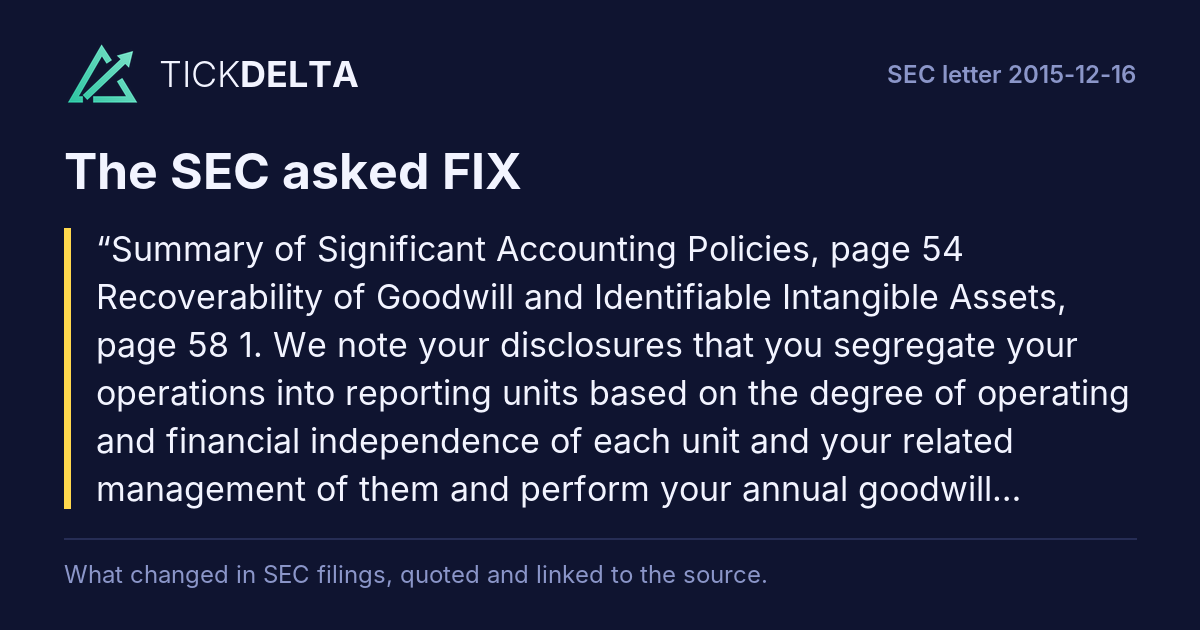
Summary of Significant Accounting Policies, page 54 Recoverability of Goodwill and Identifiable Intangible Assets, page 58 1. We note your disclosures that you segregate your operations into reporting units based on the degree of operating and financial independence of each unit and your related management of them and perform your annual goodwill impairment testing at the reporting unit level.Rest of the question
Please confirm to us, and clarify in future filings, that your reporting units are your operating segments or one level below your operating segments as required by ASC 350-20-20 and 350-35-36. If that is not accurate, please explain to us how you concluded the identification of your reporting units is appropriate. Segment Disclosure, page 61 2. We note your disclosures that your activities are within the mechanical services industry, which is the single industry segment you serve, each operating subsidiary represents an operating segment, and these segments have been aggregated, as the operating units meet all of the aggregation criteria. We also note you appear to have 37 operating units. Please demonstrate to us how you determined the aggregation of your operating segments is appropriate and complies with ASC 280-10-50-11. Also, please tell us how you determined no service line revenue disclosures are required by ASC 280-10-50-40.
As indicated in Item 1. Business, we have 37 operating units throughout the United States. The 37 operating units are the lowest level of discrete financial information in our organization. Each of those 37 operating units represent an operating segment for reporting under ASC 280 as well as our reporting units for purposes of our goodwill impairment testing under ASC 350. We will clarify this in our disclosure in future filings.
Segment Disclosure, page 61
2.Read in the reply ↗Rest of the answer
We note your disclosures that your activities are within the mechanical services industry, which is the single industry segment you serve, each operating subsidiary represents an operating segment, and these segments have been aggregated, as the operating units meet all of the aggregation criteria. We also note you appear to have 37 operating units. Please demonstrate to us how you determined the aggregation of your operating segments is appropriate and complies with ASC 280-10-50-11. Also, please tell us how you determined no service line revenue disclosures are required by ASC 280-10-50-40.
Response: We have determined that each of our 37 operating units as of December 31, 2014 are operating segments and can be aggregated into a single reporting segment based on the criteria in ASC-280-10-50-11 as shown below.
1) The nature of the products and services — All of our operating segments are providers of comprehensive HVAC installation, maintenance, repair and replacement services within the mechanical services industry in the United States. More specifically, we provide construction services which include the installation of HVAC equipment in existing and newly constructed buildings based on our customer’s specifications, typically under fixed price contracts. We may also provide maintenance and repair services to those customers after construction. The services offered are the same across all of our operating segments although the mix of services may vary during any given period. While certain HVAC equipment specifications may differ between projects, the nature of our services remains unchanged. Due to the similar nature of the work performed by each of our operating segments, we have situations where one operating segment will use another segment’s labor to help on a job when the first segment does not have enough people to complete all open projects.
2) The nature of the production process — All of our operating segments have the same production process, including how we source materials used on projects and how we execute on projects. We have construction trainers who focus on process that travel to all of our locations to ensure they are using the same best practices in a consistent manner. This also allows for the sharing of labor between operating segments as discussed above. The installation of new and replacement of existing systems involves the installation of materials meeting the specifications of our customer. Additionally, when performing repair and maintenance services, our technicians are trained to work on a wide base of installed equipment.
First report after the company's reply of 2016-01-12: 10-K filed 2016-02-23 ↗, against the 10-K filed 2015-02-26 ↗.
Tickdelta does not hold the text of both reports, so they are not compared here.
Also in this review: request for more time, 2015-12-28, closing letter, 2016-02-19