Paragraph 78 · 46% changed
Every version of it
Screener
/
SEC EDGAR
/CIK 0000910073
/10-K filed Feb 27, 2026, compared with Mar 4, 2025
/Numbers from the XBRL of the 10-Ks
NYSE
Financials · Savings Institutions, Not Federally Chartered
Flagstar Bank, National Association FLG
The 10-K against last year's
277 changes: 61 added, 99 removed, 115 reworded, 2 quiet changes
10-K Feb 27, 2026 vs Mar 4, 2025
Risk Factors
22.8%
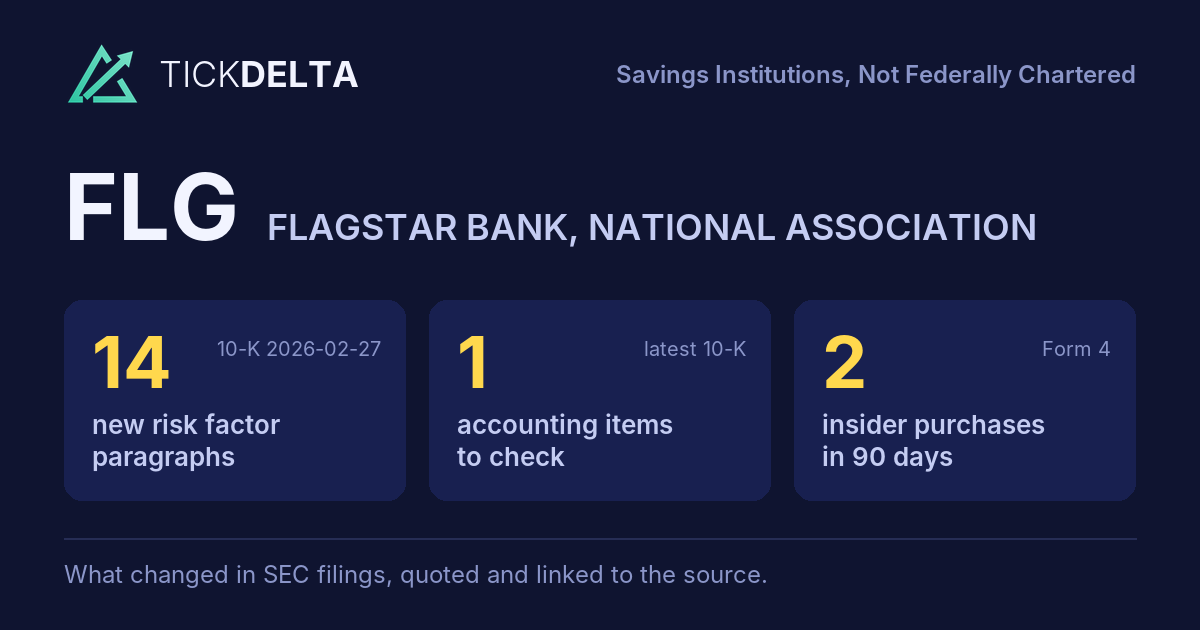
of the text changed · 12,585 words now · 14 new paragraphs, 15 gone
MD&A
54.4%
of the text changed · 8,197 words now · 47 new paragraphs, 84 gone
Legal Proceedings
73.9%
of the text changed · 3,036 words now
Accounting Policies
73.0%
of the text changed · 4,730 words now
10-K 0000910073-26-000025 (Feb 27, 2026) vs 10-K 0000910073-25-000038 (Mar 4, 2025)
Every paragraph, and how much of it changed
One bar per paragraph, in the order of the 10-K. Height and colour show the share of its words not in the closest paragraph a year earlier; the tallest bars are new paragraphs.
Risk Factors
106 paragraphs · 14 new · 51 reworded · 15 gone · 10-K Feb 27, 2026 against Mar 4, 2025
New paragraph
Reworded (5% of its words or more)
Same or nearly
Paragraph 99 · 38% changed
Every version of it
Paragraph 70 · 37% changed
Every version of it
Because our profitability stems from our ability to attract deposits and originate loans, our continued ability to compete for depositors and borrowers is critical to our success. Our success as a competitor depends on a number of factors, including our ability to develop, maintain, and build long-term relationships with our customers by providing them with convenience, in the form of multiple branch locations, extended hours of service, and access through alternative delivery channels; a broad and diverse selection of products and services; interest rates and service fees that compare favorably with those of our competitors; and skilled and knowledgeable personnel to assist our customers by addressing their financial needs. External factors that may impact our ability to compete include, among others, the entry of new lenders and depository institutions in our current markets.
Paragraph 7 · 33% changed
Every version of it
In addition to mitigating credit risk through our underwriting processes, we attempt to recognize such risk through the establishment of an allowance for credit losses. ACL. During 2024, 2025, the Company Bank continued to take decisive actions to build capital, reinforce our balance sheet, strengthen our risk management processes, and better align the Company Bank with relevant bank peers. We significantly built our reserve levels by recording a Our ACL of $1.1 billion provision for credit losses, bringing our allowance for credit losses to $1.2 billion at as of December 31, 2024, reflecting 2025 represents our actions to build reserves during the quarter to address weakness estimate of current expected losses in the office sector, potential repricing risk in the multi-family portfolio our loan and an increase in classified assets. lease portfolios, as well as our unfunded commitments.
Paragraph 14 · 33% changed
Every version of it
Paragraph 98 · 30% changed
Every version of it
In 2018, the Ninth Circuit Federal Court of Appeals held that California state law requiring mortgage servicers to pay interest on certain mortgage escrow accounts was not, as a matter of law, preempted by the National Bank Act ("NBA") (Lusnak v. Bank of America). This ruling goes against the position that regulators, national banks, and other federally chartered financial institutions have taken regarding the preemption of state-law mortgage escrow interest requirements. The opinion issued by the Ninth Circuit Federal Court of Appeals is legal precedent only in certain parts of the western United States. We are defending similar litigation in California and are currently appealing a federal district court judgment against us in that case to the Ninth Circuit. We are arguing that the Lusnak case was wrongly decided; we believe our situation can be distinguished from Lusnak as a matter of law and California’s interest on escrow law should be preempted as a matter of fact. If the Ninth Circuit’s holding is more broadly adopted by other Federal Circuits, including those covering states that currently have enacted, or in the future may enact, statutes requiring the payment of interest on escrow balances or if we would be required to retroactively credit interest on escrow funds, the Company’s earnings could be adversely affected.
Paragraph 59 · 27% changed
Every version of it
The FDIC, the Federal Reserve and the Office of the Comptroller of the Currency have promulgated joint OCC has issued guidance on sound risk management practices for financial institutions with concentrations in commercial real estate lending. Under this guidance, a financial institution that, like us, is actively involved in commercial real estate lending should perform a risk assessment to identify concentrations. A financial institution may have a “concentration” in commercial real estate lending if, among other factors factors, either (i) total reported loans for construction, land development and other land represent 100% or more of total capital, or (ii) total reported loans secured by multi-family and non-farm non-residential properties, loans for construction, land development and other land, and loans otherwise sensitive to the general commercial real estate market, including loans to commercial real estate related entities, represent 300% or more of total capital. The purpose of the guidance is to guide banks in developing risk management practices and capital levels commensurate with the level and nature of real estate concentrations. The guidance states While we believe that our management should employ heightened risk management practices including board has implemented policies and management oversight procedures with respect to our commercial real estate loan portfolio consistent with the joint guidance, if the OCC were to require us to implement additional policies and strategic planning, development procedures consistent with their interpretation of underwriting standards, risk assessment the joint guidance, or impose restrictions on the amount of commercial real estate loans we can hold in our portfolio, our financial condition and monitoring through market analysis and stress testing. operating results could be adversely affected.
Paragraph 86 · 23% changed
Every version of it
To a large degree, our success depends on our ability to attract and retain key personnel whose expertise, knowledge of our markets, and years of industry experience make them difficult to replace. Competition for skilled leaders in our industry can be intense, and we may not be able to hire or retain the people we would like to have working for us. The unexpected loss of services of one or more of our key personnel could have a material adverse impact on our business, given the specialized knowledge of such personnel and the difficulty of finding qualified replacements on a timely basis. Furthermore, our ability to attract and retain personnel with the skills and knowledge to support our business may require that we offer additional compensation and benefits that would reduce our earnings.
Paragraph 78 · 46% changed
Every version of it
10-K Mar 4, 2025Communication and information systems are essential to the conduct of our business, as we use such systems, and those maintained and provided to us by third-party service providers, to manage our customer relationships, our general ledger, our deposits, and our loans. In addition, our operations rely on the secure processing, storage, and transmission of confidential and other information in our computer systems and networks. Although we, and entities we have acquired, take and have taken protective measures and endeavor to modify them as circumstances warrant, the security of our computer systems, software, and networks, as well as the security of the computer systems, software, and networks of certain of our service providers, have been, and may in the future be, vulnerable to breaches, unauthorized access, misuse, computer viruses, or other malicious code and cyber-attacks that have had and could have an impact on information security. With the rise and permeation of online and mobile banking, the financial services industry in particular faces substantial cybersecurity risk due to the type of sensitive information provided by customers. We, and our third-party service providers, have been and may in the future be subject to cybersecurity incidents, including those that involve the unauthorized access to customer information affecting other financial institutions and industry groups. Our systems and those of our third-party service providers and customers are regularly the subject of attempted attacks that are increasingly sophisticated, and it is possible that we or they could experience a significant event in the future that could adversely affect our business or operations. In addition, breaches of security have in the past and may in the future occur through intentional or unintentional acts by those having authorized or unauthorized access to our confidential or other information, or that of our customers, clients, or counterparties. Certain previously identified cyber incidents have resulted, and future such events could result, in the breach of confidential and other information processed and stored in our computer systems and networks. These events could cause interruptions or malfunctions in our operations or the operations of our customers, clients, or counterparties. Further, we may not know that an attack occurred until well after the event. Even after discovering an attempt or breach occurred, we may not know the extent of the impact of the attack for some period of time. This could cause us significant reputational damage or result in our experiencing significant losses.
10-K Feb 27, 2026
confidential or other information, or that of our customers, clients, or counterparties. Certain previously identified cyber incidents have resulted, and future such events could result, in the breach of confidential and other information processed and stored in our computer systems and networks. These events could cause interruptions or malfunctions in our operations or the operations of our customers, clients, or counterparties. Further, we may not know that an attack occurred until well after the event. Even after discovering an attempt or breach occurred, we may not know the extent of the impact of the attack for some period of time. This could cause us significant reputational damage or result in our experiencing significant losses.
Paragraph 99 · 38% changed
Every version of it
10-K Mar 4, 2025In 2018, the Ninth Circuit Federal Court of Appeals held that California state law requiring mortgage servicers to pay interest on certain mortgage escrow accounts was not, as a matter of law, preempted by the National Bank Act (Lusnak v. Bank of America). This ruling goes against the position that regulators, national banks, and other federally chartered financial institutions have taken regarding the preemption of state-law mortgage escrow interest requirements. The opinion issued by the Ninth Circuit Federal Court of Appeals is legal precedent only in certain parts of the western United States. We are defending similar litigation in California and are currently appealing a federal district court judgment against us in that case to the Ninth Circuit. We are arguing that the Lusnak case was wrongly decided; we believe our situation can be distinguished from Lusnak as a matter of law and California’s interest on escrow law should be preempted as a matter of fact. If the Ninth Circuit’s holding is more broadly adopted by other Federal Circuits, including those covering states that currently have enacted, or in the future may enact, statutes requiring the payment of interest on escrow balances or if we would be required to retroactively credit interest on escrow funds, the Company’s earnings could be adversely affected.
10-K Feb 27, 2026
We are also defending similar litigation in California and are currently appealing a federal district court judgment against us in that case. If Flagstar’s appellate efforts are not successful, and the Ninth Circuit’s holding is more broadly adopted by other Federal Circuits, including those covering states that currently have enacted, or in the future may enact, statutes requiring the payment of interest on escrow balances or if we would be required to retroactively credit interest on escrow funds, our earnings could be adversely affected. For further information, see Note 20 - Commitments and Contingencies to our consolidated financial statements.
Paragraph 70 · 37% changed
Every version of it
10-K Mar 4, 2025
Because our profitability stems from our ability to attract deposits and originate loans, our continued ability to compete for depositors and borrowers is critical to our success. Our success as a competitor depends on a number of factors, including our ability to develop, maintain, and build long-term relationships with our customers by providing them with convenience, in the form of multiple branch locations, extended hours of service, and access through alternative delivery channels; a broad and diverse selection of products and services; interest rates and service fees that compare favorably with those of our competitors; and skilled and knowledgeable personnel to assist our customers by addressing their financial needs. External factors that may impact our ability to compete include, among others, the entry of new lenders and depository institutions in our current markets.
10-K Feb 27, 2026
Because our profitability stems from our ability to attract deposits and originate loans, our continued ability to compete for depositors and borrowers is critical to our success. Our success as a competitor depends on a number of factors, including our ability to develop, maintain, and build long-term relationships with our customers by providing them with convenience, in
Paragraph 7 · 33% changed
Every version of it
10-K Mar 4, 2025
In addition to mitigating credit risk through our underwriting processes, we attempt to recognize such risk through the establishment of an allowance for credit losses. During 2024, the Company continued to take decisive actions to build capital, reinforce our balance sheet, strengthen our risk management processes, and better align the Company with relevant bank peers. We significantly built our reserve levels by recording a $1.1 billion provision for credit losses, bringing our allowance for credit losses to $1.2 billion at December 31, 2024, reflecting our actions to build reserves during the quarter to address weakness in the office sector, potential repricing risk in the multi-family portfolio and an increase in classified assets.
10-K Feb 27, 2026
In addition to mitigating credit risk through our underwriting processes, we attempt to recognize such risk through the establishment of an ACL. During 2025, the Bank continued to take decisive actions to build capital, reinforce our balance sheet, strengthen our risk management processes, and better align the Bank with relevant bank peers. Our ACL of $1.1 billion as of December 31, 2025 represents our estimate of current expected losses in our loan and lease portfolios, as well as our unfunded commitments.
Paragraph 14 · 33% changed
Every version of it
10-K Mar 4, 2025On June 14, 2019, the New York State legislature passed the New York Housing Stability and Tenant Protection Act of 2019. This legislation represents the most extensive reform of New York State’s rent laws in several decades and generally limits a landlord’s ability to increase rents on rent regulated apartments and makes it more difficult to convert rent regulated apartments to market rate apartments. As a result, the value of the collateral located in New York State securing the Company’s multi-family loans or the future net operating income of such properties could potentially become impaired which, in turn, could have a material adverse effect on our financial condition and results of operations.
10-K Feb 27, 2026
Multi-family real estate loans generally involve a greater risk than residential real estate loans because of legislation and government regulations involving rent control and rent stabilization, which are outside the control of the borrower or the Bank, and could impair the value of the security for the loan or the future cash flow of such properties. For example, on June 14, 2019, the New York State legislature passed the New York Housing Stability and Tenant Protection Act of 2019. This legislation represents the most extensive reform of New York State’s rent laws in several decades and generally limits a landlord’s ability to increase rents on rent regulated apartments and makes it more difficult to convert rent regulated apartments to market rate apartments. At December 31, 2025, $15.8 billion or 55 percent of our total multi-family loan portfolio was secured by properties in New York State, $13.9 billion of which or 88 percent are subject to rent regulation laws to varying degrees, with $9.5 billion having 50 percent or more rent regulated units. In addition, state and local governments in New York may continue to enact or expand, and New York City has announced it is considering, (i) other rent control regulations and (ii) other government actions, which could further limit landlords’ abilities to raise rents or other adverse impacts, resulting in a negative impact on property values for our collateral for multi-family loans. As a result, the value of the collateral located in New York State securing the Bank’s multi-family loans or the future net operating income of such properties could potentially become impaired which, in turn, could have a material adverse effect on our financial condition and results of operations.
Paragraph 98 · 30% changed
Every version of it
10-K Mar 4, 2025
In 2018, the Ninth Circuit Federal Court of Appeals held that California state law requiring mortgage servicers to pay interest on certain mortgage escrow accounts was not, as a matter of law, preempted by the National Bank Act (Lusnak v. Bank of America). This ruling goes against the position that regulators, national banks, and other federally chartered financial institutions have taken regarding the preemption of state-law mortgage escrow interest requirements. The opinion issued by the Ninth Circuit Federal Court of Appeals is legal precedent only in certain parts of the western United States. We are defending similar litigation in California and are currently appealing a federal district court judgment against us in that case to the Ninth Circuit. We are arguing that the Lusnak case was wrongly decided; we believe our situation can be distinguished from Lusnak as a matter of law and California’s interest on escrow law should be preempted as a matter of fact. If the Ninth Circuit’s holding is more broadly adopted by other Federal Circuits, including those covering states that currently have enacted, or in the future may enact, statutes requiring the payment of interest on escrow balances or if we would be required to retroactively credit interest on escrow funds, the Company’s earnings could be adversely affected.
10-K Feb 27, 2026
In 2018, the Ninth Circuit Federal Court of Appeals held that California state law requiring mortgage servicers to pay interest on certain mortgage escrow accounts was not, as a matter of law, preempted by the National Bank Act ("NBA") (Lusnak v. Bank of America). This ruling goes against the position that regulators, national banks, and other federally chartered financial institutions have taken regarding the preemption of state-law mortgage escrow interest requirements. The opinion issued by the Ninth Circuit Federal Court of Appeals is legal precedent only in certain parts of the western United States.
Paragraph 59 · 27% changed
Every version of it
10-K Mar 4, 2025
The FDIC, the Federal Reserve and the Office of the Comptroller of the Currency have promulgated joint guidance on sound risk management practices for financial institutions with concentrations in commercial real estate lending. Under this guidance, a financial institution that, like us, is actively involved in commercial real estate lending should perform a risk assessment to identify concentrations. A financial institution may have a “concentration” in commercial real estate lending if, among other factors (i) total reported loans for construction, land development and other land represent 100% or more of total capital, or (ii) total reported loans secured by multi-family and non-farm non-residential properties, loans for construction, land development and other land, and loans otherwise sensitive to the general commercial real estate market, including loans to commercial real estate related entities, represent 300% or more of total capital. The purpose of the guidance is to guide banks in developing risk management practices and capital levels commensurate with the level and nature of real estate concentrations. The guidance states that management should employ heightened risk management practices including board and management oversight and strategic planning, development of underwriting standards, risk assessment and monitoring through market analysis and stress testing.
10-K Feb 27, 2026
The OCC has issued guidance on sound risk management practices for financial institutions with concentrations in commercial real estate lending. Under this guidance, a financial institution that, like us, is actively involved in commercial real estate lending should perform a risk assessment to identify concentrations. A financial institution may have a “concentration” in commercial real estate lending if, among other factors, either (i) total reported loans for construction, land development and other land represent 100% or more of total capital, or (ii) total reported loans secured by multi-family and non-farm non-residential properties, loans for construction, land development and other land, and loans otherwise sensitive to the general commercial real estate market, including loans to commercial real estate related entities, represent 300% or more of total capital. The purpose of the guidance is to guide banks in developing risk management practices and capital levels commensurate with the level and nature of real estate concentrations. While we believe that our management has implemented policies and procedures with respect to our commercial real estate loan portfolio consistent with the joint guidance, if the OCC were to require us to implement additional policies and procedures consistent with their interpretation of the joint guidance, or impose restrictions on the amount of commercial real estate loans we can hold in our portfolio, our financial condition and operating results could be adversely affected.
Paragraph 86 · 23% changed
Every version of it
10-K Mar 4, 2025
To a large degree, our success depends on our ability to attract and retain key personnel whose expertise, knowledge of our markets, and years of industry experience make them difficult to replace. Competition for skilled leaders in our industry can be intense, and we may not be able to hire or retain the people we would like to have working for us. The unexpected loss of
10-K Feb 27, 2026
To a large degree, our success depends on our ability to attract and retain key personnel whose expertise, knowledge of our markets, and years of industry experience make them difficult to replace. Competition for skilled leaders in our industry can be intense, and we may not be able to hire or retain the people we would like to have working for us. The unexpected loss of services of one or more of our key personnel could have a material adverse impact on our business, given the specialized knowledge of such personnel and the difficulty of finding qualified replacements on a timely basis. Furthermore, our ability to attract and retain personnel with the skills and knowledge to support our business may require that we offer additional compensation and benefits that would reduce our earnings.
MD&A
148 paragraphs · 47 new · 74 reworded · 84 gone · 10-K Feb 27, 2026 against Mar 4, 2025
New paragraph
Reworded (5% of its words or more)
Same or nearly
Paragraph 50 · 50% changed
Paragraph 29 · 48% changed
Paragraph 105 · 47% changed
The primary mortgage loan agencies maintain standards that define the criteria that must be met for an institution to qualify as an eligible custodial depository for the deposits related to loans owned by those entities, including have having an investment grade short-term issuer/deposit rating from Moody’s or S&P. We are currently not in compliance with that criteria. We have received a waiver of these criteria for all of our custodial deposits which could be revoked at any of the agencies' discretion. We have no other direct contractual relationships tied to further downgrades in our credit ratings but may suffer reputational risk that could have an adverse effect on our business should that occur.
Paragraph 35 · 46% changed
To mitigate our exposure to rent regulated rent-regulated properties, we are curtailing future originations of loans secured by rent-regulated properties. We are no longer utilizing mortgage brokers to refer loan origination opportunities to us. We are focusing originations and renewal retention on borrowers with whom we will have broader customer relationships beyond lending. Property values in this Additionally, we are strategically diversifying our loan sector have decreased substantially since origination due portfolio to unfavorable market conditions. The appraised value used in our loan-to-value ratio is determined using an income approach shift from multi-family loans to estimate the stabilized value of the collateral by applying a market driven capitalization rate to the stabilized cash flow of the property. other loan sectors.
Paragraph 97 · 46% changed
Paragraph 25 · 46% changed
Paragraph 148 · 46% changed
Paragraph 88 · 45% changed
Paragraph 50 · 50% changed
10-K Mar 4, 2025Statements of Condition in other liabilities and totaled $463 million at December 31, 2024, an increase of $17 million compared to $446 million at December 31, 2023.
10-K Feb 27, 2026
At December 31, 2025, Other loans decreased $178 million compared to December 31, 2024, primarily driven by payoffs at par.
Paragraph 29 · 48% changed
10-K Mar 4, 2025The following table sets forth option loans by year of repricing and non-option loans by year of contractual maturity for our multi-family and commercial real estate portfolios within loans held for investment at December 31, 2024. Loans that have adjustable rates are shown as being due in the period during which their interest rates are next subject to change. Risks associated with loan repricing are discussed in the Credit Risk section.
10-K Feb 27, 2026
Option loans offer the borrower the ability to reprice to a fixed rate after the initial fixed rate period. If not elected, the loan defaults to a variable rate. Option loans in the table are shown as being due in the period the interest rate is subject to change. Non-Option loans are beyond the option date and are reflected by maturity. Risks associated with loan repricing are discussed in the Credit Risk section.
Paragraph 105 · 47% changed
10-K Mar 4, 2025
The primary mortgage loan agencies maintain standards that define the criteria that must be met for an institution to qualify as an eligible custodial depository for the deposits related to loans owned by those entities, including have an investment grade short-term issuer/deposit rating from Moody’s or S&P. We are currently not in compliance with that criteria. We have received a waiver of these criteria for all of our custodial deposits which could be revoked at any of the agencies' discretion. We have no other direct contractual relationships tied to further downgrades in our credit ratings but may suffer reputational risk that could have an adverse effect on our business should that occur.
10-K Feb 27, 2026
The primary mortgage loan agencies maintain standards that define the criteria that must be met for an institution to qualify as an eligible custodial depository for the deposits related to loans owned by those entities, including having an
Paragraph 35 · 46% changed
10-K Mar 4, 2025
To mitigate our exposure to rent regulated properties, we are curtailing future originations of loans secured by rent-regulated properties. We are no longer utilizing mortgage brokers to refer loan origination opportunities to us. We are focusing originations and renewal retention on borrowers with whom we will have broader customer relationships beyond lending. Property values in this loan sector have decreased substantially since origination due to unfavorable market conditions. The appraised value used in our loan-to-value ratio is determined using an income approach to estimate the stabilized value of the collateral by applying a market driven capitalization rate to the stabilized cash flow of the property.
10-K Feb 27, 2026
To mitigate our exposure to rent-regulated properties, we are curtailing future originations of loans secured by rent-regulated properties. We are focusing originations and renewal retention on borrowers with whom we will have broader customer relationships beyond lending. Additionally, we are strategically diversifying our loan portfolio to shift from multi-family loans to other loan sectors.
Paragraph 97 · 46% changed
10-K Mar 4, 2025Properties and other assets that are acquired through foreclosure are classified as repossessed assets and are recorded at fair value at the date of acquisition, less the estimated cost of selling the property. Subsequent declines in the fair value of the assets are charged to earnings and are included in non-interest expense. It is our policy to require an appraisal, and an environmental assessment of properties classified as other real estate owned before foreclosure and to re-appraise the properties at least annually until they are sold. We dispose of such properties as quickly and prudently as possible, given current market conditions and the property’s condition.
10-K Feb 27, 2026
at least annually until they are sold. We dispose of such properties as quickly and prudently as possible, given current market conditions and the property’s condition.
Paragraph 25 · 46% changed
10-K Mar 4, 2025Included in our commercial and industrial portfolio at December 31, 2024, specialty finance loans and leases totaled $3.9 billion, or 5.7 percent of total loans held for investment, down $1.3 billion or 26 percent compared to December 31, 2023. The decrease in specialty finance loans was due to our decision to run off certain non-core loans totaling $2.4 billion partially offset by originations.
10-K Feb 27, 2026
Total loans and leases held for investment decreased $7.5 billion at December 31, 2025 compared to December 31, 2024, primarily as a result of the strategy of diversifying our loan portfolio by reducing our multi-family, CRE and non-core C&I loan exposure, partially offset by $5.8 billion in originations within our C&I portfolio.
Paragraph 148 · 46% changed
10-K Mar 4, 2025For further information on our critical accounting policies, please refer to Note 2 - Summary of Significant Accounting Policies.
10-K Feb 27, 2026
See Note 2 - Summary of Significant Accounting Policies and Note 7 - Allowance for Credit Losses on Loans and Leases to our consolidated financial statements for more information on the ACL.
Paragraph 88 · 45% changed
10-K Mar 4, 2025It is our practice to continually review the risk in our loan portfolio. The Company receives financial information from borrowers annually and in some cases more frequently. We most often receive updated borrower financial information in the second calendar quarter. Upon receipt of the borrower financial information, we perform an analysis to determine whether the cash flow from the underlying collateral is sufficient to meet the contractual loan payments, commonly referred to as the debt service coverage ratio. We consider the ability to cover debt service based upon the current contractual rate or, when a borrower’s initial fixed rate period expires in the near future, the lowest contractual rate reset option available under the loan terms using the current level for referenced indices. Loans that do not have a debt service coverage ratio of 1.0 or greater are evaluated for a potential downgrade to substandard or non-accrual risk rating. All substandard loans, including non-accrual loans, are appraised at the time of downgrade and are re-appraised annually. Based upon this appraisal the loan is evaluated to determine if an adjustment to the carrying amount is required. The largest substandard and non-accrual loans are reported and reviewed with the Risk Assessment Committee at least quarterly.
10-K Feb 27, 2026
For our C&I loan portfolio, we receive financial information from borrowers quarterly and in some cases less frequently. Quarterly borrower financial information is typically received within 45 to 60 days of quarter end. Upon receipt of the borrower financial information, we perform analyses to (i) determine whether borrower cash flow is sufficient to meet the contractual loan payments, commonly using a fixed-charge coverage ratio (FCCR) which is often a financial covenant of our borrowers (ii) test all borrower financial covenants, (iii) review and update collateral values, and (iv) update our internal borrower risk ratings. Loans that do not have a FCCR of 1.0 or greater are evaluated for a potential downgrade to substandard or non-accrual risk rating.
A paragraph is matched with the one last year that shares the most of its words; under half in common makes it new. The paragraphs shown are the 8 reworded the most in each section.
The paragraph that changed most in each section
The redline
Marked against last year's 10-K: cut words struck through, new words highlighted.
Accounting Policies205 words changed in this paragraph; it is 35% similar to last year's version.
Basic and diluted earnings per common share is are computed by dividing the net Net income available attributable to common shareholders stockholders by the weighted average number of weighted-average common shares outstanding during in the period. Diluted earnings per common share is computed by giving effect to all potentially dilutive securities that are outstanding. The potential dilutive effect of our warrants and convertible preferred stock is determined using the same if-converted method as basic earnings per common share, however, the computation reflects and the potential dilution that would occur if outstanding in-the-money stock options were exercised and converted into common stock. Diluted earnings per share is the amount dilutive effect of earnings available to each common share outstanding during the reporting periods adjusted to include the effects of potentially dilutive common shares. Potentially dilutive common shares include warrants, convertible preferred stock, our stock options and other stock-based awards. awards is determined using the treasury stock method. Potentially dilutive common shares are excluded from the computation of diluted earnings per share in the periods where the effect would be antidilutive. As the average common share price was above the $7.50 per share exercise price (on an as-converted common stock basis) of the warrants, the corresponding 105 million common shares underlying the shares of Series D NVCE Stock, par value $0.01 per share, underlying such warrants would have been included in the dilutive share count if the Company had positive earnings for the year. Additional information regarding the conversion of preferred shares and warrants is included in Note 19 - Mezzanine and Stockholders' Equity.
Source: Item 8, Note 2 – Summary of Significant Accounting Policies, 10-K 0000910073-26-000025 vs Item 8, Note 2 – Summary of Significant Accounting Policies, 10-K 0000910073-25-000038
Risk Factors171 words changed in this paragraph; it is 56% similar to last year's version.
Source: Item 1A, 10-K 0000910073-26-000025 vs Item 1A, 10-K 0000910073-25-000038
MD&A164 words changed in this paragraph; it is 34% similar to last year's version.
Source: Item 7, 10-K 0000910073-26-000025 vs Item 7, 10-K 0000910073-25-000038
Legal Proceedings68 words changed in this paragraph; it is 75% similar to last year's version.
Source: Item 3, via Note 20 – Commitments and Contingencies, 10-K 0000910073-26-000025 vs Item 3, via Note 20 – Commitments and Contingencies, 10-K 0000910073-25-000038
Sentences and paragraphs added, removed or reworded
Every change, by type
Sentences and paragraphs of FLG's Risk Factors and MD&A, 10-K Feb 27, 2026 against 10-K Mar 4, 2025. Each links to the text at sec.gov.
Quiet changes are sentences kept from last year with one to four words changed, at least one of them a hedge, a modal or a qualifier (may, could, will, not, significant, material…). A year or date rolling forward is not counted.
The full word list
adverse, adversely, all, although, anticipate, anticipates, any, approximately, believe, believes, can, cannot, certain, could, expect, expects, generally, however, if, intend, intends, largely, likely, many, material, materially, may, might, most, must, never, no, not, possible, primarily, probable, should, significant, significantly, some, substantial, substantially, unlikely, will, would
AddedRisk Factors
If we fail to maintain effective internal control over financial reporting, our ability to produce accurate and timely financial statements could be impaired and adversely affect our reputation, business, financial condition and stock price.
Read it in 10-K Feb 27, 2026 at sec.gov
AddedRisk Factors
We recognize the critical importance of maintaining effective internal controls over financial reporting to ensure accurate and timely financial reporting, prevent fraud, and maintain investor confidence. Our internal controls are subject to inherent limitations, including the possibility of human error, misconduct, inadequate processes, fraud, data breaches, and non-compliance with laws and regulations. We also acknowledge the challenges posed by changes in processes, procedures, technologies, employee turnover, and labor shortages. Although we have remediated the material weaknesses in internal control over financial reporting first disclosed in 2023, our prior experience underscores the risk that additional control deficiencies could arise in the future. If such deficiencies arise, their remediation could require significant management attention and resources otherwise spent on business operations. Further, maintaining the effectiveness of our internal control environment will continue to require comprehensive and ongoing monitoring, testing and enhancements as our business, systems and personnel evolve. There can be no assurance that we will not identify new material weaknesses or significant deficiencies in the future. If we identify a material weakness or a significant deficiency in internal control over financial reporting, we may be unable to remediate it timely. Any such failure could result in inaccurate financial statements, restatements, delays in filing required reports with our regulators, increased audit fees, regulatory scrutiny, or loss of confidence by investors or ratings agencies. These outcomes could materially and adversely affect our reputation, business, financial condition, and stock price. For more information, see Item 9A of this Annual Report on Form 10-K.
Read it in 10-K Feb 27, 2026 at sec.gov
AddedRisk Factors
We operate in a highly regulated industry, and compliance with, or changes to, the laws and regulations that govern our operations may adversely affect us.
Read it in 10-K Feb 27, 2026 at sec.gov
AddedRisk Factors
The banking industry is heavily regulated. Federal and state laws and regulations govern numerous matters affecting us, including changes in the ownership or control of banks, maintenance of adequate capital and sound financial condition, permissible types, amounts and terms of loans and investments, permissible non-banking activities, the level of reserves against deposits and restrictions on dividend payments. These and other restrictions limit the manner in which we conduct business and obtain financing. The laws, rules, regulations, and supervisory guidance and policies applicable to us are subject to regular modification and change. Such changes may, among other things, increase the cost of doing business, limit the types of financial services and products we offer, or affect the competitive balance between banks and other financial institutions. Any new regulations or legislation, change in existing regulations or oversight, whether a change in regulatory policy or a change in a regulator's interpretation of a law or regulation, could have a material impact on our operations, increase our costs of regulatory compliance and adversely affect our profitability. While we have developed policies and procedures designed to assist in compliance with these laws and regulations, no assurance is given that our compliance policies and procedures will be effective.
Read it in 10-K Feb 27, 2026 at sec.gov
AddedRisk Factors
changes in FDIC deposit insurance premium assessments. In addition, failure of the Bank to comply with such regulations could have a material adverse effect on our earnings and capital. See “Regulation and Supervision” in Part I, Item 1, “Business” earlier in this filing for a detailed description of the federal, state, and local regulations to which the Bank are subject.
Read it in 10-K Feb 27, 2026 at sec.gov
AddedRisk Factors
Political developments, including those arising from transitions in administration and shifts in congressional control, may create volatility and uncertainty, potentially resulting in significant changes in the size, scope, and effectiveness of government agencies and services.
Read it in 10-K Feb 27, 2026 at sec.gov
AddedRisk Factors
Political developments, such as those recently announced or enacted by the current administration, may result in sudden changes in laws, policies, and government operations. For example, throughout 2025, the administration has taken steps or indicated plans to (1) change leadership of, and potentially combine or eliminate, various regulatory agencies; (2) alter the purpose, funding, or enforcement powers of certain agencies; (3) significantly reduce the size of the federal government and workforce; and (4) modify, reinterpret, replace, or repeal various laws, regulations and regulatory guidance. These actions may create uncertainties and volatility in U.S. and global markets, potentially affecting the government's ability to provide services. They may also impact our ability to obtain guidance and support from the government in addressing existing or emerging risks. Many of these actions are being legally challenged or require further legislative action before implementation. The extent and timing of these changes are uncertain, as are their potential impacts, whether beneficial or adverse, on our business operations and financial performance.
Read it in 10-K Feb 27, 2026 at sec.gov
AddedRisk Factors
manner in which financial institutions must interact with clients when taking deposits, making loans, collecting and servicing loans and providing other services.
Read it in 10-K Feb 27, 2026 at sec.gov
Show the other 66
AddedRisk Factors
Although the Bank currently expects to file its Exchange Act reports with the SEC on a voluntary basis, the Bank may cease voluntarily filing at any time. If the Bank were to cease voluntarily filing with the SEC, its reports would no longer be available on the SEC's EDGAR system and may be more difficult for investors to locate.
Read it in 10-K Feb 27, 2026 at sec.gov
AddedRisk Factors
Historically, we have filed our annual, quarterly and current reports and other business and financial information required by the Exchange Act with the SEC. The SEC has made these filings publicly available through its Electronic Data Gathering, Analysis, and Retrieval (EDGAR) system. EDGAR allows investors to readily access the Bank's filings via the SEC's website. Following the Reorganization, we are only required to file those quarterly and annual reports with the OCC. In addition, we concurrently file such reports with the SEC on a voluntary basis. However, we can cease such voluntary reporting at any time, in which case we would only file our Exchange Act reports with the OCC. The OCC does not have a system comparable to EDGAR and there can be no assurance that the OCC will develop a comparable system in the near future. Therefore, to the extent that we do not file our quarterly and annual reports required by the Exchange Act with the SEC on a voluntary basis following the Reorganization, investors may find it more difficult to access these reports and thus may view us less favorably.
Read it in 10-K Feb 27, 2026 at sec.gov
AddedRisk Factors
Failure to effectively execute and operationalize our enterprise strategic plan in the face of evolving business, economic, and regulatory conditions could adversely impact our operations, financial results, and stock price.
Read it in 10-K Feb 27, 2026 at sec.gov
AddedRisk Factors
The Board of Directors has approved, and management continues to execute against, a multi‑year enterprise strategic plan that has remained largely consistent year over year, with targeted adjustments to reflect evolving business, economic, regulatory, and competitive conditions. While this continuity provides strategic clarity and alignment, the successful execution of the plan requires disciplined operationalization across the organization.
Read it in 10-K Feb 27, 2026 at sec.gov
RemovedRisk Factors
RemovedRisk Factors
RemovedRisk Factors
RemovedRisk Factors
RemovedRisk Factors
RemovedRisk Factors
RemovedRisk Factors
RemovedRisk Factors
RemovedRisk Factors
RemovedRisk Factors
RemovedRisk Factors
RemovedRisk Factors
RewordedRisk Factors
Our success as a competitor depends on a number of factors, including our ability to develop, maintain, and build long-term relationships with our customers by providing them with convenience, in the form of multiple branch locations, extended hours of service, and access through alternative delivery channels; a broad and diverse selection of products and services; interest rates and service fees that compare favorably with those of our competitors; and skilled and knowledgeable personnel to assist our customers by addressing their financial needs.
Read it in 10-K Feb 27, 2026 at sec.gov
RewordedRisk Factors
Changes in such regulation and supervision, or changes in regulation the interpretation or enforcement of applicable law by such authorities, whether in the form of policy, regulations, legislation, rules, orders, enforcement actions, ratings, or decisions, could have a material impact on the Company, our subsidiary bank and other affiliates, and our operations, Bank, including restrictions on the operation of a bank or a bank holding company the Bank, increased costs of regulatory compliance, and changes in FDIC deposit insurance premium assessments.
Read it in 10-K Feb 27, 2026 at sec.gov
RewordedRisk Factors
It is possible that the process of diversifying the Company’s our loan portfolio could result in substantial disruption of the Company's our business and operations, as the Company we may face the unexpected loss of key employees that it relies we rely on to assist with the transition or to work on the Company’s our continuing operations, the disruption of its our ongoing businesses, minimizing higher than anticipated costs, the adverse impacts to its relationships with its our customers and employees, or a failure to achieve on achieving the anticipated benefits and/or cost savings.
Read it in 10-K Feb 27, 2026 at sec.gov
RewordedRisk Factors
These types of third-party relationships are subject to increasingly demanding regulatory requirements and oversight by federal bank regulators (such as (the OCC, the Federal Reserve Board, the Office of the Comptroller of the Currency, FDIC and the Federal Deposit Insurance Corporation ("FDIC")) and the CFPB. CFPB).
Read it in 10-K Feb 27, 2026 at sec.gov
RewordedRisk Factors
These laws and regulations mandate certain disclosure requirements and regulate the manner in which financial institutions must interact with clients when taking deposits, making loans, collecting and servicing loans and providing other services.
Read it in 10-K Feb 27, 2026 at sec.gov
RewordedRisk Factors
The FDIC, the Federal Reserve and the Office of the Comptroller of the Currency have promulgated joint OCC has issued guidance on sound risk management practices for financial institutions with concentrations in commercial real estate lending.
Read it in 10-K Feb 27, 2026 at sec.gov
RewordedRisk Factors
Failure to comply with these sanctions could have serious legal negatively impact our business, financial condition, and results of operations as well as cause reputational consequences. harm.
Read it in 10-K Feb 27, 2026 at sec.gov
RewordedRisk Factors
Economic weakness in the New York City metropolitan region, where the majority of the properties collateralizing our multi-family, and commercial real estate, and acquisition, development, and construction estate loans, and the majority of the as well as certain businesses collateralizing our other commercial and industrial loans, are located could have an adverse impact on our financial condition and results of operations.
Read it in 10-K Feb 27, 2026 at sec.gov
RewordedRisk Factors
As of December 31, 2024, 2025, approximately 21.2 20 percent of our total deposits of $75.9 billion were not FDIC-insured. FDIC-insured or collateralized by securities or letters of credit.
Read it in 10-K Feb 27, 2026 at sec.gov
RewordedRisk Factors
At December 31, 2024, $34.1 2025, $29.0 billion or 49.9 47.7 percent of our total loans and leases, leases held for investment portfolio consisted of multi-family loans and $8.7 $9.3 billion or 12.7 15.3 percent consisted of commercial real estate CRE loans.
Read it in 10-K Feb 27, 2026 at sec.gov
RewordedRisk Factors
Deterioration in local economic conditions could drive the level of loan losses beyond the level we have provided for in our loan loss allowance; this, in turn, could necessitate an increase in our provisions for loan losses, which would reduce our earnings and capital.
Read it in 10-K Feb 27, 2026 at sec.gov
RewordedRisk Factors
Failure to keep pace with technological changes changes, including developments in digital assets such as stable coins and related payment technologies, could have a material adverse impact on our ability to compete for loans and deposits, and therefore on our financial condition and results of operations.
Read it in 10-K Feb 27, 2026 at sec.gov
Quiet changesRisk Factors
These factors could cause us to increase our provision for credit losses and could adversely affect our operating results and financial condition.
Read it in 10-K Feb 27, 2026 at sec.gov
AddedMD&A
As part of our commitment to delivering long-term shareholder value and sustained value creation, we are executing a strategic transformation plan designed to evolve into a fully diversified bank with a strong balance sheet, a robust capital position, and consistent earnings power.
Read it in 10-K Feb 27, 2026 at sec.gov
AddedMD&A
Our plan is anchored in enterprise strategic priorities that drive our approach to transformation and growth. These priorities focus on transforming Flagstar into a top-tier, relationship-driven regional bank, creating a customer-centric culture that prioritizes valuable relationships, and building an effective risk management mindset that supports safe and sound operations. From these priorities, we have established key strategies that guide execution: driving transformation and financial resilience, growing our core operations, executing a disciplined commercial banking and lending strategy, enhancing operational efficiency, developing talent and leadership, and aligning regulatory and risk management.
Read it in 10-K Feb 27, 2026 at sec.gov
AddedMD&A
Since initiating this plan in 2024, we have made measurable progress, including making key leadership additions, reducing non-core assets, improving our funding mix, enhancing our financial resilience, improving our liquidity and achieving profitability in the three months ended December 31, 2025. We believe that the continued successful execution of this plan will drive sustainable earnings and position us to deliver long-term value to shareholders.
Read it in 10-K Feb 27, 2026 at sec.gov
AddedMD&A
(1)Comprised of Loans and leases held for investment, net and Loans held for sale.
Read it in 10-K Feb 27, 2026 at sec.gov
AddedMD&A
(2)Comprised of Debt securities available-for-sale at amortized cost, Equity investments with readily determinable fair values, at fair value and FHLB stock and FRB-NY stock, at cost.
Read it in 10-K Feb 27, 2026 at sec.gov
AddedMD&A
The following table summarizes the change in NII attributable to changes in rate and volume:
Read it in 10-K Feb 27, 2026 at sec.gov
AddedMD&A
For the year ended December 31, 2025, NIM decreased by 6 basis points and NII decreased $431 million compared to the corresponding period in 2024. This was primarily as a result of lower average total loans and leases due to the strategic reduction in multi-family and CRE loans, the sale of our mortgage third party origination business and mortgage servicing business ("Mortgage Operations") during 2024 and the sale of our warehouse lending portfolio during 2024. The decrease was partially offset by lower average borrowed funds driven by the pay down of wholesale borrowings and lower interest-bearing deposits driven by the pay down of brokered deposits during 2024 and 2025.
Read it in 10-K Feb 27, 2026 at sec.gov
AddedMD&A
For the year ended December 31, 2025, the provision for credit losses decreased $908 million compared to the corresponding period for 2024. This decrease is primarily due to the normalization of credit trends, collateral values and borrower financials, which has resulted in a stabilized ACL and lower net charge-offs in our multi-family and CRE portfolios. Additionally, the improvement in our ACL balance since December 31, 2024, was as a result of the on-going volume declines from the strategic reduction in our multi-family, CRE and non-core C&I portfolios. This improvement was partially offset by declining trends in macro-economic conditions, although some improvement was seen during the three months ended December 31, 2025.
Read it in 10-K Feb 27, 2026 at sec.gov
AddedMD&A
For the year ended December 31, 2025, non-interest income decreased $59 million compared to the corresponding period for 2024. The decrease in non-interest income was primarily due to the non-recurrence of a $92 million gain on the sale of our Mortgage Operations in 2024, as well as lower net return on mortgage servicing rights, fee income, and net gain on loan sales and securitizations as a result of the sale of our Mortgage Operations in 2024. The decrease was partially offset by the non-recurrence of both a $121 million reduction in the Signature Transaction bargain purchase gain during the three months ended March 31, 2024, and $23 million of selling costs resulting from the sale of the mortgage warehouse business during the three months ended September 30, 2024. In addition, the $30 million gain on our investment in Figure Technology Solutions, Inc in 2025 also partially offset the decline in non-interest income.
Read it in 10-K Feb 27, 2026 at sec.gov
AddedMD&A
Total non-interest expenses for the year ended December 31, 2025 decreased $762 million compared to the corresponding period for 2024. The decrease is primarily due to lower compensation and benefits costs stemming from the actions taken to optimize costs during 2024, and a decrease in general and administrative expenses primarily due to the sale of our Mortgage Operations in 2024 as well as our continued focus on operating expense management. Additionally, we had lower FDIC insurance costs as a result of a lower asset base due to the sale of our Mortgage Operations and lower brokered deposits.
Read it in 10-K Feb 27, 2026 at sec.gov
AddedMD&A
The income tax benefit for the year ended December 31, 2025 decreased $239 million compared to the corresponding period for 2024, primarily as a result of the reduction in our pre-tax loss, partially offset by the tax impact of the adjustment to the bargain purchase gain recorded net of tax in 2024.
Read it in 10-K Feb 27, 2026 at sec.gov
AddedMD&A
The following table sets forth loans with adjustable rates ("Option Loans") by year of repricing and fixed rate loans ("Non-Option Loans") by year of contractual maturity:
Read it in 10-K Feb 27, 2026 at sec.gov
RemovedMD&A
RemovedMD&A
RemovedMD&A
RemovedMD&A
RemovedMD&A
RemovedMD&A
RemovedMD&A
RemovedMD&A
RemovedMD&A
RemovedMD&A
RemovedMD&A
RemovedMD&A
RewordedMD&A
RewordedMD&A
Year Ended December 31, (in millions) 2025 2024 2023 2022 $ Change % Change (2025 vs. 2024) (2025 vs. 2024) Fee income $ 89 $ 150 $ 172 $ 27 (61) (41)% Bank-owned life insurance 49 42 43 7 17% Net gain on mortgage/servicing sale 89 investment securities 31 — — 31 NM Net return on mortgage servicing rights — 73 103 6 (73) NM Net gain on loan sales and securitizations 32 48 89 5 Bank-owned life insurance 42 43 32 (16) (33)% Net gain on mortgage/servicing sale — 89 — (89) NM Net loan administration income 6 2 82 3 4 NM Bargain purchase gain — (121) 2,131 159 121 NM Other 134 117 67 15 17 15% Total non-interest income $ 341 $ 400 $ 2,687 $ 247 (59) (15)%
Read it in 10-K Feb 27, 2026 at sec.gov
RewordedMD&A
RewordedMD&A
Upon receipt of the borrower financial information, we perform an analysis analyses to (i) determine whether the borrower cash flow from the underlying collateral is sufficient to meet the contractual loan payments, commonly referred to as the debt service using a fixed-charge coverage ratio. ratio (FCCR) which is often a financial covenant of our borrowers (ii) test all borrower financial covenants, (iii) review and update collateral values, and (iv) update our internal borrower risk ratings.
Read it in 10-K Feb 27, 2026 at sec.gov
RewordedMD&A
Multi-family $ 588 $ 749 $ 121 $ 628 (161) (21)% Commercial real estate 65 28 37 estate(1) 155 70 85 NM One-to-four family first mortgage 78 25 40 (15) Acquisition, development, and construction 5 2 3 53 NM Commercial and industrial 126 110 37 73 16 15% Other loans 39 11 22 (11) 28 NM Total loans 30-89 days past due $ 986 $ 965 $ 250 $ 715 21 2%
Read it in 10-K Feb 27, 2026 at sec.gov
RewordedMD&A
We compete for deposits and customers through multiple channels, including our retail branch network, our private banking business and mobile and internet banking applications, Our ability to retain and attract deposits depends on numerous factors, including customer satisfaction, the rates of interest we pay, the types of products we offer, and the attractiveness of their terms. applications.
Read it in 10-K Feb 27, 2026 at sec.gov
RewordedMD&A
(1) Due within one year 3.51% 2.97% —% —% 3.40% —% Due from one to five years 3.02 2.61 3.93 4.48 — 3.16 4.79 Due from five to ten years 2.51 1.61 1.62 5.43 — 5.48 Due after ten years 4.44 — 4.42 — 5.95 5.45 Total debt securities available for sale 4.35 1.61 3.16 5.28 available-for-sale 4.37 2.62 4.92 5.45
Read it in 10-K Feb 27, 2026 at sec.gov
RewordedMD&A
RewordedMD&A
RewordedMD&A
RewordedMD&A
Based on the information and assumptions in effect at December 31, 2024, the following table reflects the estimated percentage change in future net interest income for the next twelve months, assuming 2025 the changes in interest rates noted: are noted below:
Read it in 10-K Feb 27, 2026 at sec.gov
RewordedMD&A
Although occupancy levels have historically tended to be stable due to below market rents, rent-regulated loans that are repricing are incurring debt service levels that, when combined with inflationary pressure on operating costs and limits on the ability to increase rental rates, approach or exceed some properties’ net operating income and may require the borrower to support the loan from sources unrelated to the collateral until elevated interest rates subside.
Read it in 10-K Feb 27, 2026 at sec.gov
Quiet changesMD&A
However, a sizable significant portion of our held for investment loans have fixed rates and generally reset to intermediate-term market rates when they reach repricing dates.
Read it in 10-K Feb 27, 2026 at sec.gov
Sources
The two latest 10-Ks on EDGAR, section by section. Each change links to the text at sec.gov.
Also
New risk factors: paragraphs with nothing like them last year, quoted in full.
Work with it
Excel workbook · CSV. Google Sheet that stays up to date: paste =IMPORTDATA("https://tickdelta.com/company/FLG/export.csv") into a cell.