Paragraphs with nothing like them in last year's 10-K
Quoted exactly
14 paragraphs in Risk Factors of the 10-K filed Feb 27, 2026
with nothing like them in the 10-K filed Mar 4, 2025. Quoted exactly.
Paragraphs that were only edited are under 10-K change.
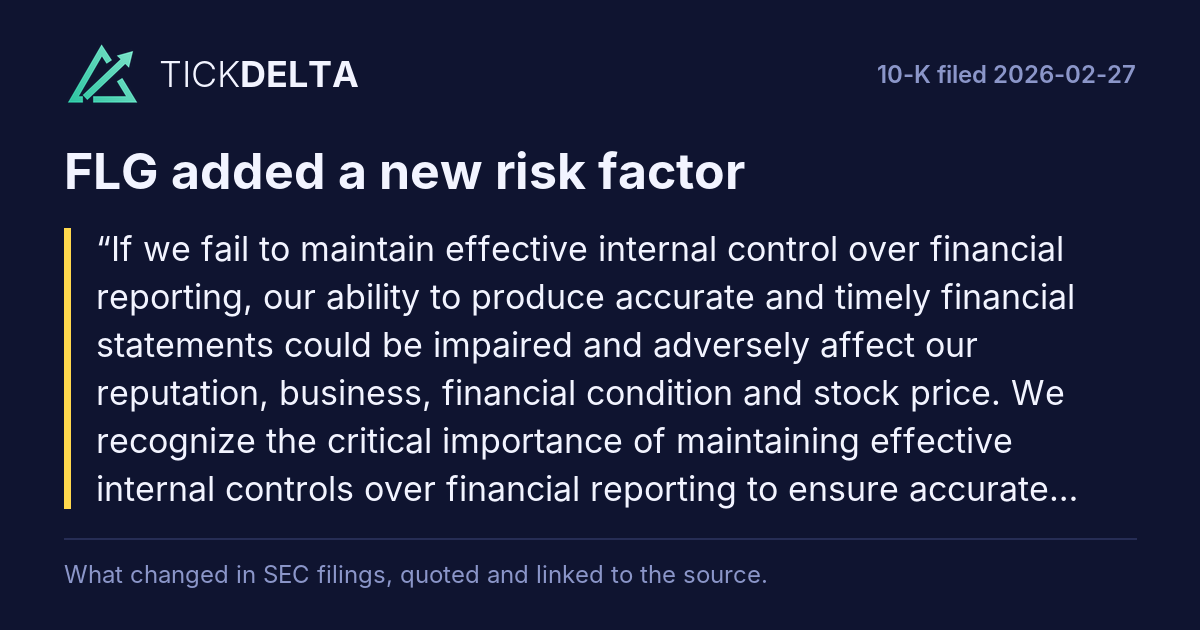
If we fail to maintain effective internal control over financial reporting, our ability to produce accurate and timely financial statements could be impaired and adversely affect our reputation, business, financial condition and stock price.
We recognize the critical importance of maintaining effective internal controls over financial reporting to ensure accurate and timely financial reporting, prevent fraud, and maintain investor confidence. Our internal controls are subject to inherent limitations, including the possibility of human error, misconduct, inadequate processes, fraud, data breaches, and non-compliance with laws and regulations. We also acknowledge the challenges posed by changes in processes, procedures, technologies, employee turnover, and labor shortages. Although we have remediated the material weaknesses in internal control over financial reporting first disclosed in 2023, our prior experience underscores the risk that additional control deficiencies could arise in the future. If such deficiencies arise, their remediation could require significant management attention and resources otherwise spent on business operations. Further, maintaining the effectiveness of our internal control environment will continue to require comprehensive and ongoing monitoring, testing and enhancements as our business, systems and personnel evolve. There can be no assurance that we will not identify new material weaknesses or significant deficiencies in the future. If we identify a material weakness or a significant deficiency in internal control over financial reporting, we may be unable to remediate it timely. Any such failure could result in inaccurate financial statements, restatements, delays in filing required reports with our regulators, increased audit fees, regulatory scrutiny, or loss of confidence by investors or ratings agencies. These outcomes could materially and adversely affect our reputation, business, financial condition, and stock price. For more information, see Item 9A of this Annual Report on Form 10-K.
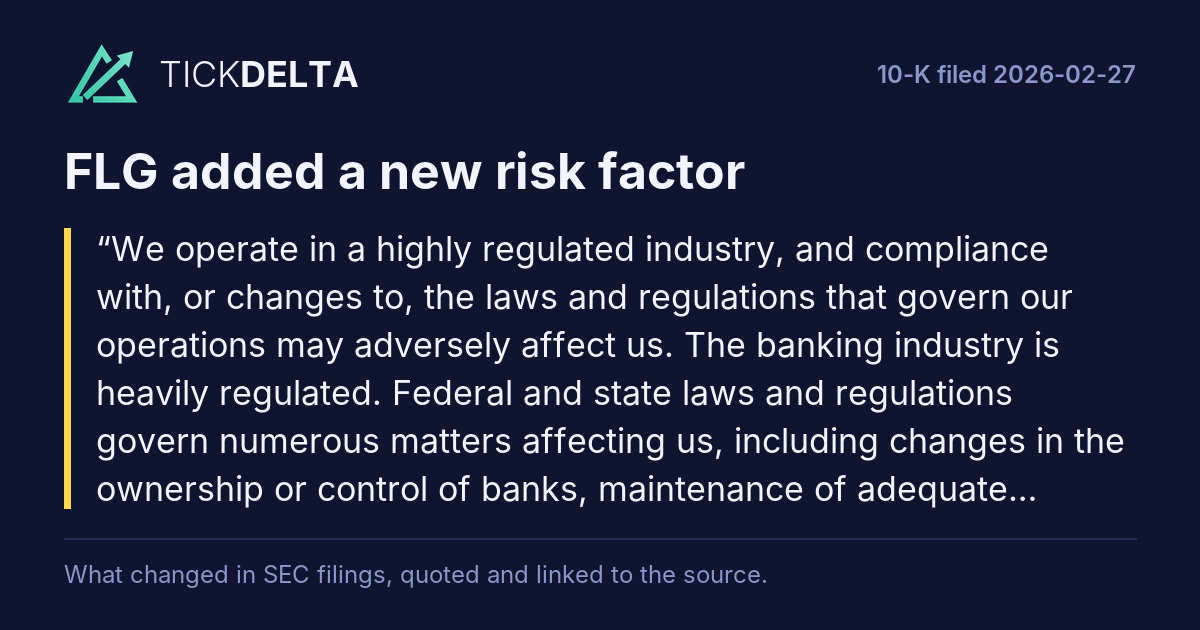
We operate in a highly regulated industry, and compliance with, or changes to, the laws and regulations that govern our operations may adversely affect us.
The banking industry is heavily regulated. Federal and state laws and regulations govern numerous matters affecting us, including changes in the ownership or control of banks, maintenance of adequate capital and sound financial condition, permissible types, amounts and terms of loans and investments, permissible non-banking activities, the level of reserves against deposits and restrictions on dividend payments. These and other restrictions limit the manner in which we conduct business and obtain financing. The laws, rules, regulations, and supervisory guidance and policies applicable to us are subject to regular modification and change. Such changes may, among other things, increase the cost of doing business, limit the types of financial services and products we offer, or affect the competitive balance between banks and other financial institutions. Any new regulations or legislation, change in existing regulations or oversight, whether a change in regulatory policy or a change in a regulator's interpretation of a law or regulation, could have a material impact on our operations, increase our costs of regulatory compliance and adversely affect our profitability. While we have developed policies and procedures designed to assist in compliance with these laws and regulations, no assurance is given that our compliance policies and procedures will be effective.
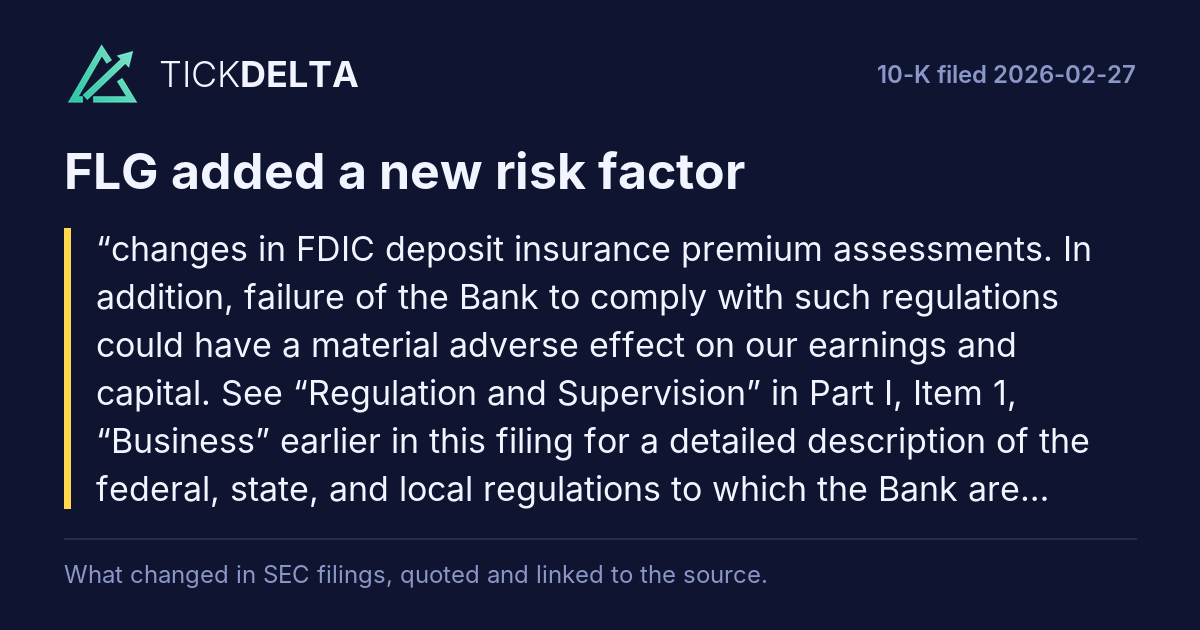
changes in FDIC deposit insurance premium assessments. In addition, failure of the Bank to comply with such regulations could have a material adverse effect on our earnings and capital. See “Regulation and Supervision” in Part I, Item 1, “Business” earlier in this filing for a detailed description of the federal, state, and local regulations to which the Bank are subject.
Political developments, including those arising from transitions in administration and shifts in congressional control, may create volatility and uncertainty, potentially resulting in significant changes in the size, scope, and effectiveness of government agencies and services.
Political developments, such as those recently announced or enacted by the current administration, may result in sudden changes in laws, policies, and government operations. For example, throughout 2025, the administration has taken steps or indicated plans to (1) change leadership of, and potentially combine or eliminate, various regulatory agencies; (2) alter the purpose, funding, or enforcement powers of certain agencies; (3) significantly reduce the size of the federal government and workforce; and (4) modify, reinterpret, replace, or repeal various laws, regulations and regulatory guidance. These actions may create uncertainties and volatility in U.S. and global markets, potentially affecting the government's ability to provide services. They may also impact our ability to obtain guidance and support from the government in addressing existing or emerging risks. Many of these actions are being legally challenged or require further legislative action before implementation. The extent and timing of these changes are uncertain, as are their potential impacts, whether beneficial or adverse, on our business operations and financial performance.
manner in which financial institutions must interact with clients when taking deposits, making loans, collecting and servicing loans and providing other services.
Although the Bank currently expects to file its Exchange Act reports with the SEC on a voluntary basis, the Bank may cease voluntarily filing at any time. If the Bank were to cease voluntarily filing with the SEC, its reports would no longer be available on the SEC's EDGAR system and may be more difficult for investors to locate.
Historically, we have filed our annual, quarterly and current reports and other business and financial information required by the Exchange Act with the SEC. The SEC has made these filings publicly available through its Electronic Data Gathering, Analysis, and Retrieval (EDGAR) system. EDGAR allows investors to readily access the Bank's filings via the SEC's website. Following the Reorganization, we are only required to file those quarterly and annual reports with the OCC. In addition, we concurrently file such reports with the SEC on a voluntary basis. However, we can cease such voluntary reporting at any time, in which case we would only file our Exchange Act reports with the OCC. The OCC does not have a system comparable to EDGAR and there can be no assurance that the OCC will develop a comparable system in the near future. Therefore, to the extent that we do not file our quarterly and annual reports required by the Exchange Act with the SEC on a voluntary basis following the Reorganization, investors may find it more difficult to access these reports and thus may view us less favorably.
Show the other 1
Failure to effectively execute and operationalize our enterprise strategic plan in the face of evolving business, economic, and regulatory conditions could adversely impact our operations, financial results, and stock price.
The Board of Directors has approved, and management continues to execute against, a multi‑year enterprise strategic plan that has remained largely consistent year over year, with targeted adjustments to reflect evolving business, economic, regulatory, and competitive conditions. While this continuity provides strategic clarity and alignment, the successful execution of the plan requires disciplined operationalization across the organization.
As the Bank progresses from building foundational capabilities to executing strategic initiatives at scale, we face increased execution risk. Effective execution requires disciplined prioritization; thoughtful deployment of financial, technical, and human capital resources; and responsiveness to changes in the operating environment. Execution efforts may also be influenced by broader external factors such as market conditions, competitive dynamics, regulatory expectations, and evolving customer preferences. If we do not execute on these strategic initiatives successfully, the Bank's financial condition and profitability may suffer as a result.
Our ability to achieve our strategic objectives depends on the soundness of the strategic plan and our ability to maintain alignment with our risk appetite as well as safe and sound banking practices. While management continuously monitors execution progress and adapts plans as appropriate, delays, increased costs, or the need to adjust execution approaches in response to changing conditions could adversely affect our business, financial condition, operational effectiveness, customer experience, and competitive position.
Paragraphs in the 10-Q filed Nov 6, 2026 that were not in the one before
New in the latest 10-Q
8 paragraphs in the 10-Q filed Nov 6, 2026 with nothing like
them in the 10-Q filed Aug 6, 2026 (at least half the words must differ; new numbers alone do not count).
Quoted exactly, grouped by the item heading above them. This is text that changed, not a judgement of how serious it is.
10-Q
September 30, 2026 compared to June 30, 2026 September 30, 2026 compared to September 30, 2025
Read in the 10-Qopen_in_new
(1) Includes $8.5 billion is secured by rent-regulated properties located in New York State, of which $3.0 billion is scheduled to reprice within the next twelve months.
Read in the 10-Qopen_in_new
(3) Includes $455 million of multi-family loans and $834 million of CRE loans with adjustable rates that do not have the option to reprice to a fixed rate.
Read in the 10-Qopen_in_new
Financial statements and notes
At September 30, 2026 and December 31, 2025, investment securities with a fair value of $ 16.2 billion and $ 15.4 billion, respectively, were pledged to secure borrowing capacity, public deposits, and for other purposes as required or permitted by law.
Read in the 10-Qopen_in_new
During the three months ended September 30, 2026, the examination of the Bank's 2019-2021 federal income tax returns was resolved, resulting in an income tax benefit of $ 22 million, including tax and interest.
Read in the 10-Qopen_in_new
Show the other 3
(1) Amounts exclude the impact of derivative financial instruments used to mitigate market risk exposure associated with mortgage loans held for sale.
Read in the 10-Qopen_in_new
During the three months ended September 30, 2026, the Bank repurchased 16,586,807 shares of common stock as part of the publicly announced Program, leaving $ 29 million available for purchases as of that date. The Program was completed in October 2026.
Read in the 10-Qopen_in_new
On August 26, 2026, the Supreme Court set all three cases (Kivett, Conti, Cantero) for consideration at the September 28 conference. On October 5, 2026, the Supreme Court issued an Order calling for the Views of the Solicitor General (CVSG) on the Kivett, Cantero, and Conti cert. petitions. Flagstar will continue to vigorously defend this action.
Read in the 10-Qopen_in_new
The 10-Q's risk factors against the 10-K
Item 1A of the 10-Q filed Nov 6, 2026 against Item 1A of the 10-K filed Feb 27, 2026.
A 10-Q repeats only the risks that changed, so a 10-K paragraph that is missing from it is not counted as removed.
Added is a paragraph with nothing like it in the 10-K, Reworded a sentence that is in both with several words changed,
Quiet changes a sentence in both where one to four words changed and one is a hedge or a modal
(cut words struck through, new words highlighted).
Text on the page, not a score; each links to the filing at sec.gov.
What the 10-Q itself says about its risk factors:Please see “Item 1A. Risk Factors” of our Annual Report on Form 10-K for the year ended December 31, 2025 for information regarding risk factors that could materially affect our business, financial condition, long-term strategic objectives, or guidance or expectations regarding our future results of operations. There have been no changes with regard to the risk factors disclosed in “Item 1A. Risk Factors” of our Annual Report on Form 10-K for the year ended December 31, 2025.
Read in the 10-Qopen_in_new
Added10-Q Nov 6, 2026 vs 10-K Feb 27, 2026
Participants in the Bank’s stock-based incentive plans may have shares of common stock withheld to fulfill the income tax obligations that arise in connection with the vesting of their stock awards. Shares that are withheld for this purpose are repurchased pursuant to the terms of the applicable stock-based incentive plan.
Read it in the 10-Q at sec.govopen_in_new
Added10-Q Nov 6, 2026 vs 10-K Feb 27, 2026
Shares Repurchased Pursuant to the Board of Directors’ Share Repurchase Authorization
Read it in the 10-Q at sec.govopen_in_new
Added10-Q Nov 6, 2026 vs 10-K Feb 27, 2026
In July 2026, the Board authorized a stock repurchase program to repurchase up to $250 million of the Bank's outstanding shares of common stock over the next 12-month period. The repurchase program may be suspended, modified, or discontinued at any time without prior notice. Share repurchases may be accomplished from time to time on the open market or otherwise, including through Rule 10b5-1 trading plans, which set certain restrictions on the method, timing, price, and volume of share repurchases, or through privately negotiated transactions. The repurchase program does not obligate the Bank to acquire any shares. In October 2026, we completed our share repurchases under the program and, as a result, had repurchased the full $250 million of the Bank's outstanding shares of common stock authorized under the program.
Read it in the 10-Q at sec.govopen_in_new
Added10-Q Nov 6, 2026 vs 10-K Feb 27, 2026
Shares that are repurchased pursuant to the Bank’s stock-based incentive plans are held in our Treasury account and may be used for various corporate purposes, including, but not limited to, merger transactions and the vesting of restricted stock awards.
Read it in the 10-Q at sec.govopen_in_new
Added10-Q Nov 6, 2026 vs 10-K Feb 27, 2026
The following table provides information relating to our repurchase of common stock for the three months ended September 30, 2026.
Read it in the 10-Q at sec.govopen_in_new
On March 11, 2024, we completed an approximately $1.05 billion equity investment in the Company in connection with which we sold and issued (a) 76,630,965 shares of our common stock, at a purchase price per share of $2.00, (b) 192,062 shares of a new series of our preferred stock, par value $0.01 per share, designated as Series B Noncumulative Convertible Preferred Stock, at a price per share of $2,000, each share of which is convertible into 1,000 shares of common stock, (c) 256,307 shares of a new series of our preferred stock, par value $0.01 per share, designated as Series C...
In the 10-K filed Mar 4, 2025open_in_new
We also acknowledge the challenges posed by changes in processes, procedures, technologies, employee turnover, and labor shortages. During 2024, we identified certain material weaknesses described in Item 9A of our Annual Report on Form 10-K/A for the year ended December 31, 2023, and we may discover additional future material weaknesses or significant deficiencies. Our efforts to remediate weaknesses or deficiencies in our internal controls could divert management attention and increase our expenses, in order to correct the weaknesses or deficiencies in our controls. A "material weakness"...
In the 10-K filed Mar 4, 2025open_in_new
Act and the Economic Growth, Regulatory Relief, and Consumer Protection Act. As a Category IV banking organization, we are subject to enhanced liquidity risk management requirements which include reporting, liquidity stress testing, a liquidity buffer and resolution planning, subject to the applicable transition periods. If we were to meet or exceed certain other thresholds, we would become subject to additional requirements. Failure to meet these requirements could expose us to compliance risks, higher penalties, increased expectations, and limitations on our activities. As a Category IV...
In the 10-K filed Mar 4, 2025open_in_new
The Parent Company (i.e., the company on an unconsolidated basis) is a separate and distinct legal entity from the Bank, and a substantial portion of the revenues the Parent Company receives consists of dividends from the Bank. These dividends are the primary funding source for the dividends we pay on our common stock and the interest and principal payments on our debt. Various federal and state laws and regulations limit the amount of dividends that a bank may pay to its parent company. In addition, our right to participate in a distribution of assets upon the liquidation or...
In the 10-K filed Mar 4, 2025open_in_new
Sources
Item 1A of each 10-K and 10-Q on EDGAR, quoted exactly. Each paragraph links to the filing at sec.gov.
Also
10-K change: what was reworded or cut, section by section.
Work with it
Excel workbook · CSV. Google Sheet that stays up to date: paste =IMPORTDATA("https://tickdelta.com/company/FLG/export.csv") into a cell.