Screener / SEC EDGAR /CIK 0001507079 /10-K filed Feb 19, 2026, compared with Feb 20, 2025 /Numbers from the XBRL of the 10-Ks
NYSE Consumer discretionary · Home Improvement Retail

Floor & Decor Holdings, Inc. FND

Compare with peers Embed
SEC comment letters, last 20 years

2 reviews of FND's filings by SEC staff

UPLOAD and CORRESP
Reviews 2 latest letter Dec 21, 2023
Questions asked 44 each answered in the company's own letter
No closing letter 1 reviews without a letter saying the staff completed it

When the SEC's staff reviews a filing, it writes to the company with numbered questions, and the company answers each one in a letter. SEC publishes the exchange once the review is over, at least 20 business days later. A question is not an accusation; most reviews end with the company adding detail to its next filing.

How the reviews went

Every review on EDGAR, from the first staff letter to the letter that closes it

  1. 1. Staff letters 4 UPLOAD
  2. 2. Questions in them 44 numbered comments
  3. 3. Company replies 4 CORRESP
  4. 4. Reviews closed 1 of 2 closing letter

Half the closed reviews took 33 days or less from the first letter to the closing letter.

Form 10-K

2023-12-21 to 2024-01-23 · 2 questions · 1 letter from the SEC, 1 from the company
Review closed 2024-01-23
RevenueResults discussion (MD&A)
Note 2. Revenue · Disaggregated Revenue, page 73
SEC asked (1)
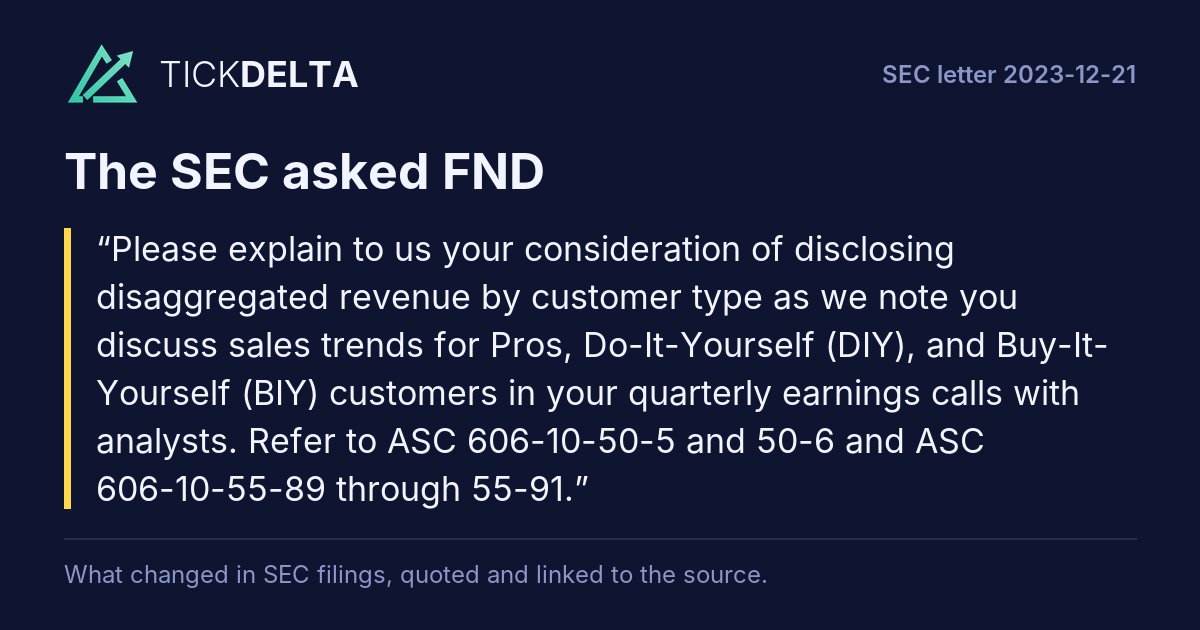
Please explain to us your consideration of disclosing disaggregated revenue by customer type as we note you discuss sales trends for Pros, Do-It-Yourself (DIY), and Buy-It- Yourself (BIY) customers in your quarterly earnings calls with analysts. Refer to ASC 606-10-50-5 and 50-6 and ASC 606-10-55-89 through 55-91.
FND answered
The Company acknowledges the Staff’s comment and respectfully advises the Staff that the Company has considered the guidance in Accounting Standards Codification (“ASC”)

606-10-50-5 and 50-6 and ASC 606-10-55-89 through 55-91, which require the Company to disaggregate revenue from contracts with customers into categories that “depict how the nature, amount, timing, and uncertainty of revenue and cash flows are affected by economic factors.” While ASC 606 provides examples of categories that may be used to achieve the disaggregation objective, an entity’s revenue disaggregation disclosure is
Rest of the answer

based on specific facts and circumstances and requires judgment.

2500 Windy Ridge Parkway, SE | Atlanta, GA 30339 | 404-471-1634 | flooranddecor.com

The Company primarily sells hard surface flooring and related accessories through retail stores located in the United States and through its website. The Company offers a broad assortment of in-stock hard-surface flooring, including tile, wood, laminate, vinyl, and natural stone along with decorative accessories and wall tile, installation materials, and adjacent categories. The Company’s stores appeal to a variety of customers, which we categorize into the following groups: (i) professional installers or commercial businesses (“Pro”); (ii) individuals who purchase and install our products without professional help (“Do It Yourself” or “DIY”); and (iii) individuals who buy our products for professional installation (“Buy it Yourself” or “BIY”).

In accordance with ASC 606-10-50-5 and 50-6, we considered the appropriate level of disaggregated revenue information to depict how the nature, amount, timing, and uncertainty of our revenue and cash flows are affected by economic factors, as well as sufficient information to enable users of financial statements to understand the relationship between the disclosure of disaggregated revenue and revenue information that is disclosed for our reportable retail segment. When considering whether it was appropriate to disaggregate revenue by customer, we considered the guidance set forth in ASC 606-10-55-89 through 55-91, including the examples of categories in ASC 606-10-55-91. In particular, we considered the following in accordance with 606-10-55-91(c):

· Market or type of customer – We recognize revenue when the customer obtains control of the inventory, which is typically at the point-of-sale. Payment is generally due immediately at the point-of-sale.

Sales transactions are the same for our Pro, DIY, and BIY customers. In addition, the end users of our products are primarily homeowners who are either making the purchase decision themselves or collaborating with the professionals performing the installation. Therefore, sales are sensitive to trends in the levels of end-user consumer spending and are driven by the same macroeconomic factors irrespective of which customer type executes the point-of-sale transaction. As a result of the foregoing considerations, we do not believe there is a significant level of disparity in the nature, amount, timing, and uncertainty of revenues and cash flows within our categories of customers.

In addition, per the implementation guidance in ASC

606-10-55-89 through 91, we also considered (a) disclosures presented outside of the financial statements such as earnings releases and investor presentations, (b) information regularly reviewed by the Chief Operating Decision Maker (“CODM”) for evaluating the financial performance of operating segments, and (c) other information that is similar to the types of information identified in (a) and

(b) and that is used by the Company or users of the Company’s financial statements to evaluate financial performance or make resource allocation decisions.

We have historically provided both an overall estimate of the percentage of sales to Pros and homeowners in our Form 10-K (Item 1. Business Our Competitive Strengths) and information regarding Pros and homeowners in our quarterly earnings calls with analysts to provide context about sales to our customers. We generally identify customers as Pros based on information that they provide to us when they transact in our stores or through our website. While we believe this provides meaningful directional information about Pro customer sales, due to our reliance on customers to self-identify as Pros, we do not believe that we have identified all Pros that transact with us. Accordingly, there is an element of estimation in determining the level of sales to our Pros. Further, we generally assume that individuals who are not identified as Pros are “homeowners” who may be either a DIY or BIY customer. Typically, every two to three years, we engage third-party research firms to survey a sample of homeowners to estimate the approximate mix of our DIY and BIY customers. Because of the element of estimation associated with identifying our DIY and BIY customers based on sample surveys, we do not bifurcate sales data between our DIY and BIY customers; rather, we consider all non-Pro sales as homeowner sales. Our CODM reviews summary revenue information related to Pro and homeowner sales, but such information is not used to make resource allocation decisions. We also considered whether any additional information related to customer type is used by the Company or users of the Company’s financial statements to evaluate financial performance or make resource allocation decisions but did not identify any such information.

Based on the guidance and considerations set forth above, including the guidance set forth in ASC 606-10-50-5 and 50-6 and ASC 606-10-55-89 to 55-91, we do not believe the Company is required to disaggregate revenue by customer type in the notes to our financial statements as we do not believe there is a significant level of disparity in the nature, amount, timing, and uncertainty of revenues and cash flows within our categories of customers. Notwithstanding the foregoing, the level of revenue disaggregation is subject to re-evaluation for appropriate disclosure in the future, as necessary, due to changes to the Company or our business, either organically or through future acquisitions, divestitures, or otherwise.

In addition, after considering the Staff’s comment and further evaluation and consideration of our disclosures in quarterly earnings calls with analysts, beginning with our Form 10-K for the fiscal year ended December 28, 2023, we will provide selected disclosure related to sales to Pro and homeowner customers in Management’s

Discussion & Analysis similar to the following example:

We estimate that our retail sales during [period] were approximately [ ]% from homeowners and [ ]% from Pros compared to approximately [ ]% from homeowners and [ ]% from Pros during [prior period].

Read in the reply
In its next report

First report after the company's reply of Jan 22, 2024: 10-K filed Feb 22, 2024 ↗, against the 10-K filed Feb 23, 2023 ↗.

Tickdelta does not hold the text of both reports, so they are not compared here.

Management's Discussion and Analysis of Financial Condition and Results of Operations · Gross Profit and Gross Profit Margin, page 23
SEC asked (2)
Please provide a separate discussion and analysis of cost of sales if changes in amounts are material. In your disclosure, consider discussing and quantifying components of costs of sales to the extent material to the change in cost of sales between periods. Refer to Item 303(c)(2) of Regulation S-K. This comment also applies to your annual reporting, if material.
FND answered
The Company acknowledges the Staff’s comment and respectfully advises the Staff that, consistent with industry practice for retailers, the Company believes that when discussing its business performance, considering the significant components of gross margin is more beneficial to the reader than a separate discussion of cost of sales and the components thereof. Any material changes in cost of sales would be included in the discussion of gross margin.
Rest of the answer

As such, we believe a separate discussion of cost of sales and the components thereof would be duplicative to the reader.

Further, the Company has considered Item 303(b)(2) and Item 303(c)(2) of Regulation S-K and believes that its existing disclosures comply with such requirements because its disclosures include discussion of the primary driver of changes to components of cost of sales and gross margin, which for the comparative periods presented in both its Q3 2023 Form 10-Q and FY2022 Form 10-K were supply chain costs. While the Company disclosed product costs as an additional factor affecting the gross margin rate for the comparative periods presented in the Q3 2023 Form 10-Q, the Company respectfully advises the Staff that only supply chain costs had a material impact on components of cost of sales and gross margin during such period. In future filings, the Company will clarify which factors affecting gross margin were material.

Pursuant to Item 303(b)(2) and Item 303(c)(2) of Regulation S-K, we will continue to consider the impacts of additional factors on our gross profit and gross margin, inclusive of cost of sales, and will disclose and quantify, to the extent quantification is possible, such additional factors in future filings if they are material.

* * *

If any additional supplemental information is required by the Staff or if you have any questions regarding the foregoing, please direct any such requests or questions to me at (678) 505-3866 or to Monica J. Shilling, P.C. of Kirkland & Ellis LLP at (310) 552-4355.

Read in the reply
In its next report

First report after the company's reply of Jan 22, 2024: 10-K filed Feb 22, 2024 ↗, against the 10-K filed Feb 23, 2023 ↗.

Tickdelta does not hold the text of both reports, so they are not compared here.

Also in this review: request for more time, Dec 26, 2023, closing letter, 2024-01-23
Form S-1

2017-03-08 to 2017-04-14 · 42 questions · 3 letters from the SEC, 3 from the company
No closing letter
Results discussion (MD&A)InventoryCritical estimatesDebtLiquidity and cashLegal and contingenciesNon-GAAP measuresRisk factorsLeasesRevenue
General
SEC asked (1)
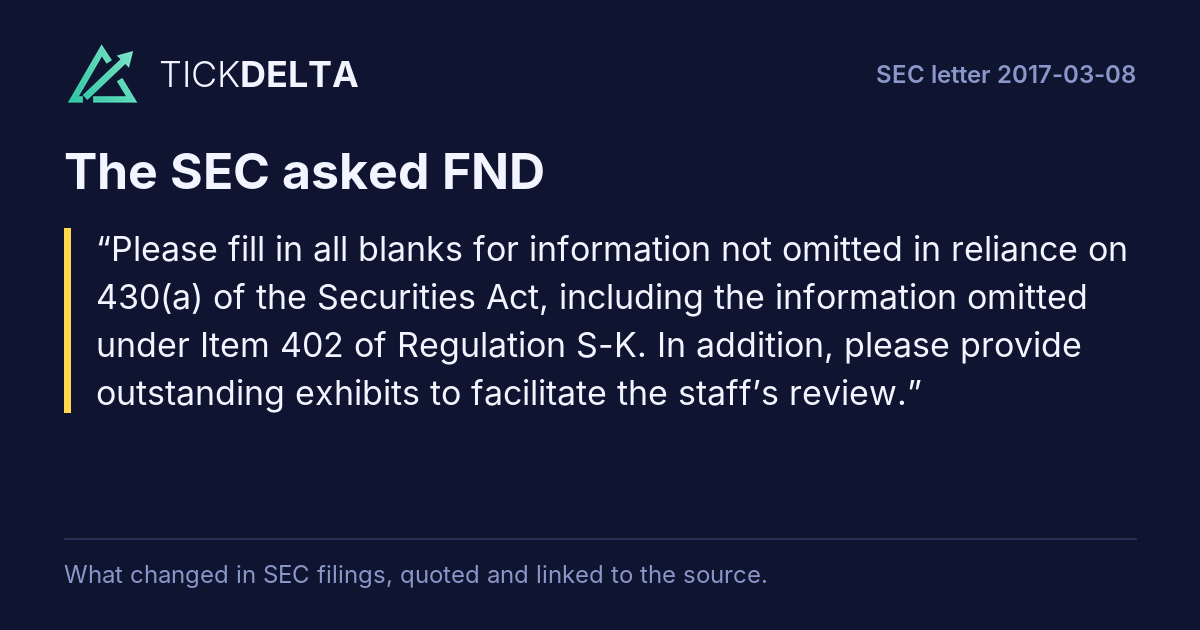
Please fill in all blanks for information not omitted in reliance on 430(a) of the Securities Act, including the information omitted under Item 402 of Regulation S-K. In addition, please provide outstanding exhibits to facilitate the staff’s review.
FND answered
The Company acknowledges the Staff’s comment and will provide in Amendment No. 1 and any subsequent amendments to the Registration Statement all information required by Form S-1 or Regulation S-K that may not be properly excluded under Rule 430A. The Company acknowledges that the Staff may have additional comments when items that are currently blank are completed or when exhibits are filed and will endeavor to complete or file such items in as timely a manner as possible to facilitate the Staff’s review.
Read in the reply
General
SEC asked (2)
Please consistently order numerical data presented in tabular and narrative format throughout your document. Please refer to SAB Topic 11:E for guidance.
FND answered
The Company has revised the disclosure as requested, including updating the tables in its financial statements set forth on the F-Pages of Amendment No. 1 so that data is presented in a consistent order.
Read in the reply
Prospectus Summary, page 1
SEC asked (3)
Please revise the second paragraph to disclose the stock split and the terms of the conversion of the Class B shares.
FND answered
The Company advises the Staff that the Company’s board of directors has not yet determined the ratio for, or approved, the stock split. The Company expects that its board of directors will approve the stock split prior to effectiveness of the Registration Statement. Upon approval of the stock split by the board of directors, the Company will revise its disclosure through a pre-effective amendment to the Registration Statement as soon as practicable. The Company has revised the disclosure as requested on pages 1, 8, 12, 137 and 142 of Amendment No.
Rest of the answer

1 to clarify the timing of the stock split and the terms of the conversion of the Class B shares.

Read in the reply
Prospectus Summary, page 1
SEC asked (4)
Please revise your disclosure of Adjusted EBITDA growth and Adjusted EBITDA to include a presentation of the most directly comparable US GAAP financial measures with equal or greater prominence throughout your Form S-1. Please refer to Item 10(e)(1)(i)(a) of Regulation S-K and Question 102.10 of the updated Non-GAAP Compliance and Disclosure Interpretations issued on May 17, 2016 for guidance.
FND answered
The Company has revised the disclosure as requested on pages 2 and 88 of Amendment No. 1 to disclose US GAAP financial measures with equal or greater prominence to the non-GAAP financial measures in accordance with Item 10(e)(1)(i)(A) and the Compliance and Disclosure Interpretations issued on May 17, 2016.
Read in the reply
Our Company, page 2
SEC asked (5)
Please update to reflect the growth statistics as of the latest fiscal year end, rather than September 2016.
FND answered
The Company has revised the disclosure as requested on pages 2, 62 and 88 of Amendment No. 1.
Read in the reply
Concurrent Transactions – Common Stock Changes, page 8
SEC asked (6)
Please revise your disclosures for the changes to your common stock to clarify when the changes will be made (i.e., prior to effectiveness of the Form S-1 or prior to the closing of the IPO and after the effectiveness of the Form S-1). Please address this comment throughout the Form S-1.
FND answered
The Company has revised the disclosure as requested on pages 1, 8, 12, 137, II-2 and II-3 of Amendment No. 1.
Read in the reply
Summary Consolidated Financial and Other Data, page 13
SEC asked (7)
Please provide pro forma financial information that complies with the guidance in Article 11-02 of Regulation S-X. In this regard, we note that (i) you refinanced your existing indebtedness that involved additional borrowings on September 30, 2016, entered into new debt agreements during fiscal year 2016 related to the reorganization and merger transactions, (ii) you repaid a portion of your outstanding debt from a
Rest of the question

portion of additional borrowings on September 30, 2016, (iii) you intend to make changes to your capital structure, and (iv) you intend to use the proceeds from the IPO transaction to repay a portion of your outstanding debt. The pro forma financial information that you have provided goes beyond a simple paragraph discussion. Your pro forma financial information should include footnotes that clearly explain and show how you arrive at each pro forma adjustment.

FND answered
The Company has added the requested disclosure on pages 15 through 17 and pages 57 through 61 of Amendment No. 1.
Read in the reply
Summary Consolidated Financial and Other Data, page 13
SEC asked (8)
We note that you exclude pre-opening expenses as part of your calculation of Adjusted EBITDA. Please explain to us why these are not normal, recurring, cash operating expenses necessary to operate your business. In this regard, we note pre-opening expenses for all periods presented, along with your discussion throughout the Form S-1 that your growth strategy is to expand the number of your stores from 71 to 400
Rest of the question

within the next 15 years. Please refer to Question 100.01 of the updated Non-GAAP Compliance and Disclosure Interpretations issued on May 17, 2016.

FND answered
The Company believes that pre-opening expenses are not normal, recurring, cash operating expenses necessary to operate its business because opening each new store requires a unique composition of expenses that can differ materially depending on the location, type of market and other factors outside the Company’s control. Additionally, pre-opening expenses for a particular store are generally incurred before the store has opened to its customers and begins to generate revenue.
Rest of the answer

Pre-opening expenses are incurred only when preparing to open new stores, and there can be no assurance as to the timing or number of stores that will be opened in a given period. Accordingly, it is possible that some periods will have no pre-opening expenses, and pre-opening expenses would no longer be incurred at all if only existing stores were operated going forward. As noted on pages 17, 60 and 65 of Amendment No. 1, the Company believes it is useful to exclude pre-opening expenses from the calculation of Adjusted EBITDA because the amounts incurred in any particular period to implement the Company’s growth strategy will vary based on the number and timing of new store openings, which are subject to factors outside the Company’s control such as the availability of suitable locations and market conditions.

The Company believes that showing “steady state” Adjusted EBITDA without the variability of pre-opening expenses amounts incurred in connection with new store openings on a period-over-period business better enables management and investors to evaluate the Company’s core operating performance. Presenting Adjusted EBITDA that excludes pre-opening expenses that only occur once in a store’s existence allows investors to better compare the Company’s Adjusted EBITDA margin to its peers.

The Company further advises the Staff that excluding pre-opening expenses as part of its calculation of Adjusted EBITDA is consistent with Adjusted EBITDA as calculated under the Company’s Credit Facilities to determine covenant compliance.

Read in the reply
Risk Factors, page 20 · Any disruption in our distribution capabilities…, page 22
SEC asked (9)
Please quantify the cost incurred to move your west coast distribution center.
FND answered
The Company has revised the disclosure as requested on page 23 of Amendment No. 1.
Read in the reply
If we violate or are alleged to have violated environmental…, page 29
SEC asked (10)
Please disclose the amount of significant expenses incurred to respond to allegations of violations of these laws.
FND answered
The Company has revised the risk factor on page 29 of Amendment No. 1 to delete the specific reference to expenses incurred to respond to allegations of violations of environmental, health and safety laws and regulations as this risk factor is intended to address forward-looking risks with respect to such laws. In addition, the Company has updated its disclosure in the previous risk factor on page 28 of Amendment No. 1 to provide additional detail with respect to the expenses incurred with respect to certain litigation surrounding the Company’s products.
Read in the reply
Our success depends substantially upon the continued retention of certain key personnel, page 33
SEC asked (11)
Please identify who in the company is considered “key personnel” and whether you have employment agreements with those individuals.
FND answered
The Company has revised the heading of the risk factor and the disclosure on page 33 of Amendment No. 1 to clarify that the Company considers its executive officers to be the Company’s key personnel. Such disclosure identifies the key personnel by the title of the executive officer. The Company does not deem any of its employees who are not executive officers as key personnel.
Read in the reply
Use of Proceeds, page 50
SEC asked (12)
Please revise this section to disclose the amount of proceeds you intend to use to pay the amounts outstanding under the Term Loan Facility.
FND answered
The Company has revised the disclosure as requested on pages 11 and 50 of Amendment No. 1.
Read in the reply
Use of Proceeds, page 50
SEC asked (13)
In addition, we note the disclosure of your intent to increase the number of your retail locations by more than 500% in coming years; please disclose what amount of proceeds, if any, you intend to designate to support this expansion. If you do not have current plans to use proceeds for this expansion, please revise your disclosure throughout the prospectus to clarify how you intend to achieve your expansion goals.
FND answered
The Company advises the Staff that it does not have any current plans to use the offering proceeds to fund its expansion efforts. The Company has revised the disclosure as requested on page 75 of Amendment No. 1 to clarify that the Company believes that cash expected to be generated from operations and the availability of borrowings under the Company’s ABL Facility will be sufficient to meet, among other things, anticipated capital expenditures for at least the next 12 months.
Read in the reply
Dividend Policy, page 51
SEC asked (14)
Please disclose the amount of dividends to your common stockholders and option holders you have made during each period presented. Please refer to Item 201(c) of Regulation S-K for guidance.
FND answered
The Company has revised the disclosure as requested on page 51 of Amendment No. 1.
Read in the reply
Management’s Discussion and Analysis of Financial Condition and Results of Operations, page · Results of Operations, page 67
SEC asked (15)
We note that you attribute the increases in comparable store sales to increases in comparable customer transactions and comparable average ticket growth. Please disclose the number of comparable customer transactions and the comparable average ticket amount for each period presented. Please refer to Section 501.12.b. of the Financial Reporting Codification for guidance.
FND answered
The Company advises the Staff that the methodology utilized in tracking comparable customer transactions and average ticket growth for internal use to manage the Company on a day-to-day basis is not in line with the Company’s revenue recognition policies. The Company notes to the Staff that it tracks customer transactions and average ticket amount at the time of a customer’s purchase. However, the Company’s sales are not recorded as revenue until the time the product is delivered to the customer.
Rest of the answer

Due to the size and weight of the Company’s products, some customers will pick up their product at a later date than the purchase date and, at times, on multiple occasions, which may cross reporting periods. Given the differences in how and when sales are recorded for the purposes of calculating comparable store sales versus the Company’s methodology to track comparable customer transactions and comparable average ticket amount, the Company does not believe that providing the number of comparable customer transactions and the comparable average ticket amount would provide meaningful information for investors. For example, if a customer were to make a significant purchase in a fiscal quarter and request delivery of the product on a date in the subsequent fiscal quarter, the Company’s comparable store sales between the two periods would reflect an increase with respect to such purchase; however, the number of customer transactions and average ticket amount would reflect a decrease between the two periods. The Company believes that reviewing comparable customer transactions and the average ticket amount with respect to each period would be less useful to an investor than evaluating the impact of these underlying drivers as part of the Company’s net sales as discussed in Management’s Discussion and Analysis on pages 68 and 70 of Amendment No. 1.

Given the uncertainties of the number of customer transactions and average ticket amount with respect to the Company’s comparable store sales, the Company believes that it is not appropriate to disclose such amounts for each period presented. However, the Company advises the Staff that it will continue to provide qualitative commentary on directional changes in customer transactions and average ticket amounts.

Read in the reply
Management’s Discussion and Analysis of Financial Condition and Results of Operations, page · Results of Operations, page 67
SEC asked (16)
Please expand your analysis of pre-opening expenses to disclose the number of new stores opened for each period and the number of stores in process of being opened as of the end of each period.
FND answered
The Company has revised the disclosure as requested on pages 61, 69 and 72 of Amendment No. 1.
Read in the reply
Management’s Discussion and Analysis of Financial Condition and Results of Operations, page · Results of Operations, page 67
SEC asked (17)
Please expand your disclosures for taxes for fiscal years 2015 and 2014 to provide a discussion and analysis of the favorable discrete items for fiscal year 2015.
FND answered
The Company has revised the disclosure as requested on pages 72 and 73 of Amendment No. 1.
Read in the reply
Liquidity and Capital Resources, page 78
SEC asked (18)
Please disclose the amount available under the Wells Facility Revolving Line of Credit without violating any covenants. Please refer to Item 303(a)(1) of Regulation S-K,
FND answered
The Company has revised the disclosure as requested on pages 74 and 75 of Amendment No. 1.
Read in the reply
Instruction 2 to Item 303(a) of Regulation S-K, and Section 501.13.c. of the Financial
SEC asked (19)
Please update your disclosures of planned total capital expenditures for fiscal year 2017. Please also clarify whether you will own or lease the new Georgia distribution center, along with the anticipated costs to move the two current distribution centers in Georgia and Florida.
FND answered
The Company has revised the disclosure as requested on pages 75 and 76 of Amendment No. 1.
Read in the reply
Instruction 2 to Item 303(a) of Regulation S-K, and Section 501.13.c. of the Financial
SEC asked (20)
We note that you attribute the increase in operating cash flows for the thirty-nine weeks ended September 29, 2016 to net income and improved working capital management. Please provide a discussion and analysis of working capital management.
Rest of the question

As part of your expanded disclosures, please include a discussion and analysis of the realizability of inventories considering inventories are your most significant current asset. Please refer to Item 303(a)(1) of Regulation S-K, Instructions 2 and 5 to Item 303(a) of Regulation S- K, and Section 501.13.b. of the Financial Reporting Codification for guidance.

FND answered
The Company has revised the disclosure as requested on page 75 of Amendment No. 1.
Read in the reply
Critical Accounting Policies and Estimates, page 83 · Inventory Valuation and Shrinkage, page 84
SEC asked (21)
Please provide a discussion of the assumptions used for the average cost method.
FND answered
The Company has revised the disclosure as requested on page 80 of Amendment No. 1 to clarify that the Company uses the weighted average cost method.
Read in the reply
Critical Accounting Policies and Estimates, page 83 · Inventory Valuation and Shrinkage, page 84
SEC asked (22)
Please disclose the carrying value of Chinese-manufactured laminate flooring matter inventory as of the most recent balance sheet date. Please also disclose the costs incurred related to lower of cost or market adjustments and/or obsolescence specifically for the Chinese-manufactured laminate flooring inventory matter for each period presented.
FND answered
The Company advises the Staff that as of the end of each of fiscal 2016 and fiscal 2015, the carrying value of inventory relating to the Chinese-manufactured laminate flooring matter was $0. Additionally, the Company no longer carries any inventory relating to the Chinese-manufactured laminate flooring matter.
Rest of the answer

Accordingly, the Company respectfully submits that it does not believe specific disclosures of the costs incurred related to lower of cost or market adjustments and/or obsolescence specifically for such inventory for each period presented would provide meaningful information to investors to better understand the Company’s operating results or financial statements.

Read in the reply
Critical Accounting Policies and Estimates, page 83 · Inventory Valuation and Shrinkage, page 84
SEC asked (23)
Please quantify the costs incurred for (a) inventory markdowns and obsolescence and (b) inventory shrinkage and damage for each period presented.
FND answered
The Company respectfully submits that the impact of inventory markdowns and obsolescence and of inventory shrinkage and damage is reflected in the Company’s gross profit and gross margin for each period presented.

The Company notes to the Staff that the costs incurred for inventory markdowns and obsolescence and inventory shrinkage and damage for each period presented have not changed materially from period to period.
Rest of the answer

The Company will continue to analyze the impact of inventory markdowns and obsolescence and of inventory shrinkage and damage and will provide specific disclosures if such amounts were to materially deviate from historical amounts.

Read in the reply
Stock-Based Compensation, page 87
SEC asked (24)
Please expand your disclosure to provide a discussion and analysis of the methodology used to estimate the fair value of the underlying common stock, a significant assumption included in the Black-Scholes option pricing model. Please also disclose the estimated fair value of your common stock for equity grants made during the most recent fiscal year and subsequent interim periods.
Rest of the question

For all equity awards granted during fiscal year 2016 and the subsequent interim period, please provide us with a list of the number of shares of common stock underlying the equity award by grant date and the corresponding estimated fair value of common stock. Please note that once you have disclosed the estimated IPO price range we may have comments regarding the estimated fair value of your common stock during this time period and will need sufficient time to evaluate.

FND answered
The Company has revised the disclosure as requested on pages 82 and 83 of Amendment No. 1.

Additionally, the following table sets forth the stock options issued by the Company during fiscal 2016 and any subsequent interim period and the value of the shares of the corresponding underlying common stock used to estimate the fair value of such stock options:
Read in the reply
Index to Consolidated Financial Statements, page F-1
SEC asked (25)
Please provide updated audited financial statements for fiscal year 2016 in accordance with Article 3-12 of Regulation S-X.
FND answered
The Company has added audited financial statements for fiscal year 2016 as requested.
Read in the reply
Index to Consolidated Financial Statements, page F-1
SEC asked (26)
We note that you intend to effect a stock split of all classes of your common stock. To the extent that you intend to do this prior to effectiveness of the Form S-1, please address the guidance in ASC 505-10-S99-4 (SAB Topic 4:C) to retroactively effect this change in your equity structure in the balance sheets and ASC 260-10-55-12 – 55-14 for the presentation of earnings/(loss) per share.
Rest of the question

Please note that if you revise your financial statements and your disclosures to give retroactive effect to the change in your equity structure, your auditors will need to revise their audit reports. If only a “to-be-issued” report can be presented due to a pending future event, your auditors should include a signed and dated preface to their “to-be-issued” report stating the reason for the “to-beissued” report and that they expect to be in a position to issue the report in the form presented prior to effectiveness. The signed, dated, and unrestricted auditors’ reports would need to be included in the filing prior to effectiveness. Refer to Article 2-02 of Regulation S-X for guidance.

FND answered
The Company advises the Staff that the Company’s board of directors has not yet determined the ratio for, or approved, the stock split. The Company expects that its board of directors will approve the stock split prior to effectiveness of the Registration Statement. Upon approval of the stock split by the board of directors, the Company will revise its financial statements and its disclosures throughout the Registration Statement filing to give retroactive effect to the stock split.
Rest of the answer

At that time, the Company’s auditors will include the appropriate reports in accordance with Article 2-02 of Regulation S-X.

Read in the reply
Consolidated Statements of Income, page F-4
SEC asked (27)
We note that you paid a cash dividend of $225 million on September 30, 2016. Considering the proximity of the dividend to your planned offering, please include pro forma per share data giving effect to the number of shares whose proceeds would be necessary to pay the dividend in excess of the current year’s earnings. Please include your calculation as a footnote. Please refer to SAB Topic 1:B.3. for guidance. 1.
Rest of the question

Summary of Significant Accounting Policies, page F-8

FND answered
The Company has added the requested disclosure as Note 10 to its Consolidated Financial Statements on pages F-32 and F-33 of Amendment No. 1.

1. Summary of Significant Accounting Policies, page F-8
Read in the reply
Receivables, page F-8
SEC asked (28)
Please disclose the amount of inventory identified to return to a vendor and included as a receivable for each period presented.
FND answered
The Company advises the Staff that the amount of inventory identified to return to a vendor and included as a receivable was immaterial for each of the years presented. The Company respectfully submits that it does not believe specific disclosures for each year presented is required. The Company will continue to analyze the impact of inventory identified to return to a vendor and included as a receivable and provide specific disclosures if the amounts become material.
Read in the reply
Long-Lived Assets, page F-11
SEC asked (29)
Please revise your disclosures to clarify that fair value is usually determined by the estimated discounted cash flow analysis of the asset rather than undiscounted cash flow analysis, if correct.
FND answered
The Company has revised the disclosure as requested on page 82 of Amendment No. 1.
Read in the reply
Stock-Based Compensation, page F-29
SEC asked (30)
We note your disclosure on page 7 that the dividend payments to option holders on September 30, 2016, were made in accordance with the terms of the 2011 Plan. However, your accounting policy does not include consideration of dividends in estimating the fair value of your stock-based compensation. Further, a dividend assumption is not included on page F-29.
Rest of the question

Please clarify whether the holder is required to repay dividend payments in the event the option does not vest. If the option holder is not required to repay the dividend payment, please expand your disclosures to clarify your accounting for the dividend payment in the event the option remains unvested and your estimate of the associated compensation cost. Please refer to ASC 718-10-55-45 for guidance. 9. Earnings Per Share, page F-31

FND answered
The Company advises the Staff that the Company engages a third-party valuation specialist to value the Company’s common stock on a semi-annual basis or more frequently, if necessary, and considers the anti-dilution provisions of the Company’s stock options during such valuation. The fair value of the Company’s common stock is used in determining the strike price of all stock options grants awarded by the Company.
Rest of the answer

As the Company does not intend to pay dividends in the near future, the Company does not utilize a dividend yield in the Black-Scholes option pricing model when estimating the fair value of its stock-based compensation.

Additionally, the Company notes to the Staff that the cash payments made to holders of options in accordance with the terms of the Company’s stock option plan in connection with the Company’s dividend are repayable to the Company if the underlying options do not vest. The Company has added disclosure on page 75 of Amendment No. 1 to clarify that a portion of such option payments were for unvested options and that option holders are required to repay any amounts related to options that do not vest prior to such option holder’s termination of employment. In the event an option holder defaults on such repayment, the Company will record the amount as additional stock based compensation expense in that reporting period. The Company has revised the disclosure in accordance with ASC 718-10-55-45.

9. Earnings Per Share, page F-31

Read in the reply
Stock-Based Compensation, page F-29
SEC asked (31)
Please tell us your consideration of the guidance in ASC 260-10-65-1 for your stockbased compensation when presenting earnings per share. 10. Subsequent Events, page F-31
FND answered
The Company has reviewed the guidance in ASC 260-10-65-1 (EITF 07-4, Application of the two class method under FASB No. 128 to a MLP) and does not believe that such guidance is applicable to the Company as neither the Company nor any of its subsidiaries are MLPs.

The Company additionally considered the guidance in ASU 260-10-45-59A to ASU 260-10-45-70 and determined that such guidance does not apply to the Company because (i) the Company does not have any securities, other than common stock that participate in dividends, and as a result do not have any participating securities and (ii) all
Rest of the answer

classes of the Company’s common stock participate equally in the earnings of the Company. Accordingly, the two-class method would not apply to the Company.

10. Subsequent Events, page F-31

Read in the reply
Stock-Based Compensation, page F-29
SEC asked (32)
Please disclose the date through which subsequent events were evaluated. Refer to ASC 855-10-50-1 for guidance. 6. Commitments and Contingencies, page F-45
FND answered
The Company acknowledges the Staff’s comment and as requested, Note 1 on page F-8 has been revised to disclose the date through which subsequent events have been evaluated. The disclosure in the Registration Statement was prepared in accordance with ASC 855-10-50-1 under the assumption that the Company was an SEC filer.

6. Commitments and Contingencies, page F-45
Read in the reply
Litigation, page F-46
SEC asked (33)
We note that the putative nationwide class action for the Chinese-manufactured laminate flooring products has been settled. However, we note that the settlement excluded seven members of the settlement class and personal injury claims.
Rest of the question

Please include a comprehensive discussion of the loss contingencies associated with the seven excluded members, the potential for personal injury cases, and the potential for additional lawsuits in accordance with ASC 450-20-50. Please also provide us with a discussion of your consideration as to whether any of these loss contingencies rise to the level of a probable loss and the need to recognize an accrual.

FND answered
The Company advises the Staff that the $14 million accrued with respect to the settlement includes amounts that are probable and estimable with respect to the excluded members of the settlement class.

The Company evaluates all loss contingencies in accordance with ASC 450-20-50. Based on its procedures, which include the evaluation of the matter as well as discussions with external counsel, if necessary, the Company does not believe there is a reasonable possibility or probability of a loss with respect to any of the matters described above to be accrued for in the Company’s financial
Rest of the answer

statements.

Read in the reply
Litigation, page F-46
SEC asked (34)
Please include a discussion of any government action that is probable and/or reasonably possible of materially impacting your consolidated financial statements related to the Chinese-manufactured laminate flooring products matter in accordance with ASC 45020-50.
FND answered
The Company advises the Staff that it has considered ASC 450-20-50 and does not believe any government action is probable and/or reasonably possible that will materially impact its consolidated financial statements related to the Chinese-manufactured laminate flooring products matter.
Read in the reply
Summary Consolidated Financial and Other Data, page 13
SEC asked (1)
We note your response to comment 6 in our letter dated March 8, 2017. Your presentation on pages 15 through 17 and 57 through 61 do not comply with the presentation requirements in Article 11-02 of Regulation S-X. As previously noted, the pro forma financial information that you have provided goes beyond a simple paragraph discussion.
Rest of the question

As such, your pro forma financial information should include a columnar presentation along with footnotes that clearly explain and show how you arrive at each pro forma adjustment.

FND answered
The Company has revised the disclosure as requested on pages 13 through 17 and 57 through 61 of the Amendment to include a columnar presentation and footnotes in accordance with the requirements of Article 11-02 of Regulation S-X.
Read in the reply
Summary Consolidated Financial and Other Data, page 13
SEC asked (2)
We note your response to comment 8 in our letter dated March 8, 2017. Please provide us with a more comprehensive discussion about your consideration of the guidance in Question 100.01 of the updated Non-GAAP Compliance and Disclosure Interpretations issued on May 17, 2016, given your statement in the Form S-1 that you intend to grow your store base by approximately 20% annually over the next several years and that
Rest of the question

you have incurred pre- opening expenses in all fiscal years and all fiscal quarters presented in the Form S-1. To the extent that you believe Adjusted EBITDA is part of a material covenant to your credit facilities and you intend to present the covenant calculation, including Adjusted EBITDA, please limit the presentation to your discussion and analysis of your credit facilities and provide the disclosures required by Question 102.09 of the updated Non-GAAP Compliance and Disclosure Interpretations issued on May 17, 2016. Finally, we note your reference to pre-opening expenses as non-recurring. Please remove this characterization from any presentation in accordance with the guidance in Item 10(e)(1)(ii)(b) of Regulation S-K and Question 102.03 of the updated Non-GAAP Compliance and Disclosure Interpretations issued on May 17, 2016.

FND answered
The Company has revised the disclosure as requested on pages 2, 15, 16, 46, 54, 55, 56, 65, 73, 74 and 88 of the Amendment to remove the Adjusted EBITDA addback related to pre-opening expenses.
Read in the reply
Management’s Discussion and Analysis of Financial Condition and Results of Operations, page · Results of Operations, page 67
SEC asked (3)
We note your response to comment 15 in our letter dated March 8, 2017. Please help us understand how you are able to state that the primary drivers for the change in comparable store sales for fiscal year 2016 is an increase in comparable customer transactions and a lesser extent comparable average ticket growth, if the data you have is not gathered on the same basis as you recognize revenue.
Rest of the question

Please note that if you remain unable to provide the number of comparable customer transactions and the comparable average ticket amount for each period presented, you are required to disclose the extent to which changes in net sales is attributed to volume changes and pricing changes in accordance with Item 303(a)(3)(iii) of Regulation S-K. Please also refer to Section 501.12.b. of the Financial Reporting Codification for guidance.

FND answered
The Company has revised the disclosure on pages 68 and 70 to clarify that the timing of measurement of customer transactions and average ticket may be slightly different than that of reported sales. In addition, the Company has revised the disclosure on pages 68 and 70 of the Amendment to provide the percentage of the period to period changes in comparable customer transactions and comparable average ticket.
Read in the reply
Critical Accounting Policies and Estimates, page 79 · Inventory Valuation and Shrinkage, page 84
SEC asked (4)
We note your response to comment 22 in our letter dated March 8, 2017. Please tell us the amount, if any, of the costs incurred related to lower of cost or market adjustments and/or obsolescence specifically for the Chinese-manufactured laminate flooring inventory matter for each period presented.
Rest of the question

To the extent that the costs were material, please disclose in your discussion and analysis of gross profit and gross profit margin in your results of operations section.

FND answered
The Company advises the Staff that the total lower of cost or market and total obsolescence adjustments for all products are immaterial for all periods presented, inclusive of any lower of cost or market and obsolescence adjustments for Chinese-manufactured laminate flooring.
Read in the reply
Critical Accounting Policies and Estimates, page 79 · Inventory Valuation and Shrinkage, page 84
SEC asked (5)
We note your response to comment 23 in our letter dated March 8, 2017. Please tell us the amount the costs incurred for (a) inventory markdowns and obsolescence and (b) inventory shrinkage and damage for each period presented. To the extent that the costs are material, please disclose in your discussion and analysis of gross profit and gross profit margin in your results of operations section.
FND answered
The Company advises the Staff that the costs incurred for inventory markdowns and obsolescence and for inventory shrinkage and damage are included in Cost of sales, which the Company discloses for each period presented on pages 14, 53, 60, 67 and F-4 of the Amendment. For each of fiscal 2016 and fiscal 2015, the percentage of cost of sales related to inventory markdowns and obsolescence and inventory shrinkage and damage was approximately 1.8% of such Cost of sales and for fiscal 2014, the percentage of Cost of sales related to inventory markdowns and obsolescence and inventory shrinkage and
Rest of the answer

damage was approximately 2.4% of such Cost of sales. The Company does not believe that it would be meaningful to investors to break out such amounts separately from other Cost of sales given that they are immaterial to the Company’s overall Cost of sales. This percentage has not meaningfully changed over the last three fiscal years. The Company notes to the Staff that it has provided specific disclosure on pages 68 and 71 of the Amendment with respect to the impact of certain changes in inventory shrinkage and damage to the period to period changes in gross margin and that it intends to provide specific disclosures in future filings if such amounts were to materially deviate from historical amounts.

Read in the reply
Index to Consolidated Financial Statements, page F-1
SEC asked (6)
Commitments and Contingencies, page F-24 Litigation, page F-25 6. We note the revised disclosures you provided in response to comment 33 in our letter dated March 8, 2017. Please expand the sentence regarding claims by the members excluded from the settlement class and personal injury claims to clarify that it is not reasonably possible to result in a material loss in excess of accrual in accordance with ASC
Rest of the question

450-20-50-3 through 50-5.

FND answered
The Company has revised the disclosure as requested on page F-26 of the Amendment to clarify that it is not reasonably possible to result in a material loss in excess of accrual.
Read in the reply
Unaudited Pro Forma Consolidated Financial Information, page 57
SEC asked (1)
Please expand footnotes 1 and 3 to the pro forma consolidated statement of income to provide sufficient information to allow an investor to recalculate the amounts impacting the adjustments to interest expense, which would include the amount of debt and interest rate. Please refer to Article 11-02(b)(6) of Regulation S-X. Further, please disclose the effect on income of a 1/8 percent variance in interest rates.
FND answered
The Company will revise the disclosure as requested in the Amendment.
Read in the reply
Unaudited Pro Forma Consolidated Financial Information, page 57
SEC asked (2)
Please expand footnote 2 to disclose the per share fair value of the options to be granted, the total amount of compensation expense to be recognized, and the vesting terms.
FND answered
Attached hereto as Annex A for review by the Staff are certain pages from the Registration Statement reflecting the Company’s proposed revisions to the disclosure in response to the comments from the Staff.

**********

The Company and the underwriters are currently preparing to circulate copies of the preliminary prospectus in connection with the offering as early as on or about Monday, April 17, 2017. The Company respectfully requests the Staff’s assistance in completing its review of the supplemental information contained herein as soon as possible.
Rest of the answer

Please advise us if we can provide any further information or assistance to facilitate your review. Please direct any further comments or questions regarding the Registration Statement, or this response letter, to me at (310) 284-4544.

Read in the reply

Letters without questions

Other letters

UPLOAD and CORRESP
8 other letters: notices that a filing will not be reviewed, requests to declare a registration effective, and the like

From the SEC's correspondence on EDGAR: staff letters (form UPLOAD) and company letters (form CORRESP), 18 letters filed since 2017-03-08. Questions and answers are matched by their numbers; topics come from words in each question. The reports are compared word for word (same form, before the first SEC letter against the first report after the company's reply). No AI.

Sources

The SEC's correspondence on EDGAR: staff letters (form UPLOAD) and company letters (form CORRESP), matched question by question. No AI.

Also

Filings: the letters in the filing list.

Work with it

Excel workbook · CSV. Google Sheet that stays up to date: paste =IMPORTDATA("https://tickdelta.com/company/FND/export.csv") into a cell.

Next in Owners and insiders:Insider trades
Esc

Type a ticker such as AAPL, a name, an investor such as Buffett, or a topic such as tariffs. ↑ ↓ to move, Enter to open.