Screener / SEC EDGAR /CIK 0000921825 /Numbers from the XBRL of the 10-Ks
NYSE Real estate · REIT

First Industrial Realty Trust Inc FR

Compare with peers Embed
SEC comment letters, last 20 years

6 reviews of FR's filings by SEC staff

UPLOAD and CORRESP
Reviews 6 latest letter Jul 20, 2017
Questions asked 30 each answered in the company's own letter
No closing letter 2 reviews without a letter saying the staff completed it

When the SEC's staff reviews a filing, it writes to the company with numbered questions, and the company answers each one in a letter. SEC publishes the exchange once the review is over, at least 20 business days later. A question is not an accusation; most reviews end with the company adding detail to its next filing.

How the reviews went

Every review on EDGAR, from the first staff letter to the letter that closes it

  1. 1. Staff letters 7 UPLOAD
  2. 2. Questions in them 30 numbered comments
  3. 3. Company replies 6 CORRESP
  4. 4. Reviews closed 4 of 6 closing letter

Half the closed reviews took 29 days or less from the first letter to the closing letter.

Form 10-K

2017-07-20 to 2017-07-26 · 1 question · 1 letter from the SEC, 1 from the company
Review closed 2017-07-26
Form 8-K Filed On April 26, 2017 · Exhibit 99.1
SEC asked
We note that your calculation of EBITDA contains adjustments for items other than interest, taxes, depreciation and amortization. Please revise future filings to ensure that measures calculated differently from EBITDA are not characterized as EBITDA. See Question 103.01 of the updated Compliance and Disclosure Interpretations issued on May 17, 2016.
FR answered
We will revise the line item that is labeled "EBITDA" in Exhibit 99.1 of Form 8-K filed on April 26, 2017 to "Adjusted EBITDA" in all of the Company’s future filings.
Read in the reply
In its next report

First report after the company's reply of Jul 25, 2017: 10-Q filed Jul 28, 2017 ↗, against the 10-Q filed Apr 28, 2017 ↗.

Tickdelta does not hold the text of both reports, so they are not compared here.

Also in this review: closing letter, 2017-07-26

Form 10-K for the year ended December 31, 2012

2013-05-29 to 2013-06-17 · 5 questions · 1 letter from the SEC, 1 from the company
Review closed 2013-06-17
LeasesAcquisitionsResults discussion (MD&A)
Item 2. Properties · In-Service Property Summary Totals, page 14
SEC asked (1)
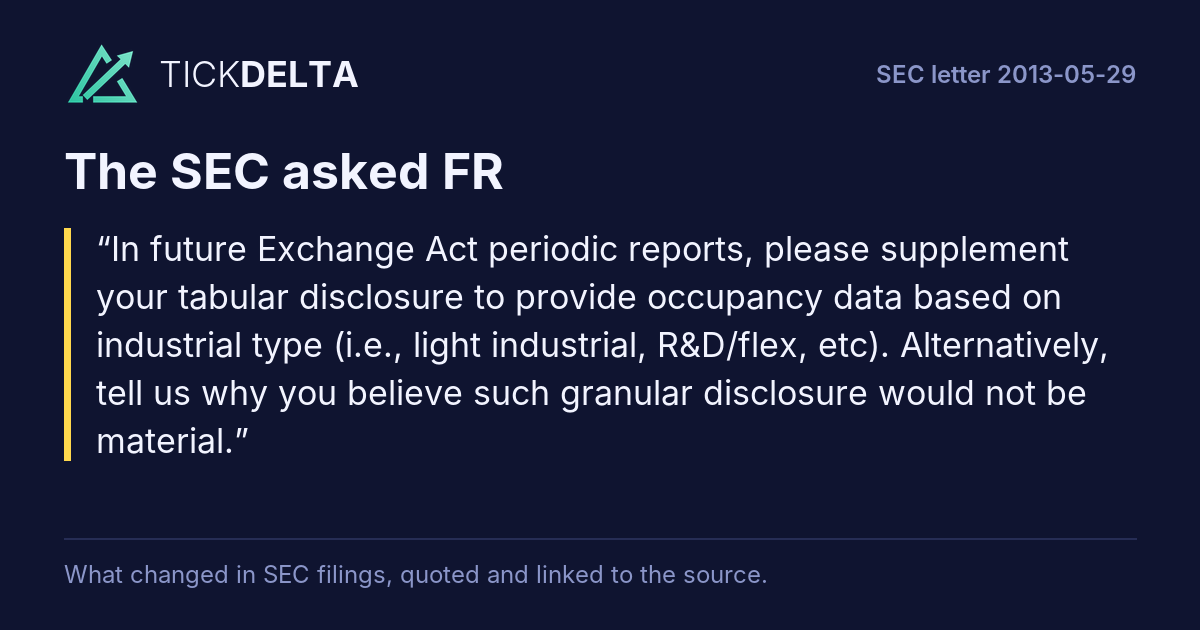
In future Exchange Act periodic reports, please supplement your tabular disclosure to provide occupancy data based on industrial type (i.e., light industrial, R&D/flex, etc). Alternatively, tell us why you believe such granular disclosure would not be material.
FR answered
Management hereby confirms that in future Form 10-K filings for each of the Registrants, we will supplement our tabular disclosure to provide occupancy data based on industrial type.
Read in the reply
In its next report

First report after the company's reply of Jun 11, 2013: 10-Q filed Aug 5, 2013 ↗, against the 10-Q filed May 7, 2013 ↗.

Tickdelta does not hold the text of both reports, so they are not compared here.

Property Acquisition/Development Activity, page 16
SEC asked (2)
We note your disclosure of the estimated completion cost and the amount that is unfunded. In future Exchange Act periodic reports, please also disclose the anticipated completion date. Where material developments are completed in the reported period, please discuss the leasing costs incurred.
FR answered
Management hereby confirms that in future Form 10-K filings for each of the Registrants, we will include the anticipated quarter in which we believe our developments in process will be completed and also, if material, will include disclosure of leasing costs for leased developments.
Read in the reply
In its next report

First report after the company's reply of Jun 11, 2013: 10-Q filed Aug 5, 2013 ↗, against the 10-Q filed May 7, 2013 ↗.

Tickdelta does not hold the text of both reports, so they are not compared here.

Tenant and Lease Information · Leasing Activity, page 17
SEC asked (3)
Please tell us if you are able to provide separate leasing activity disclosure for your new and renewal leases.
FR answered
Management hereby confirms that in future Form 10-K filings for each of the Registrants, we will provide the disclosure related to leasing activity separately, if applicable, for new and renewal leases.
Read in the reply
In its next report

First report after the company's reply of Jun 11, 2013: 10-Q filed Aug 5, 2013 ↗, against the 10-Q filed May 7, 2013 ↗.

Tickdelta does not hold the text of both reports, so they are not compared here.

Lease Expirations, page 17
SEC asked (4)
We note the response in your letter dated September 13, 2012 objecting to the presentation of current market rents. Where a material portion of your leases will expire in a subsequent period, please tell us if you would be able to provide qualitative disclosure of management’s view of whether rents on new and renewal leases would be positive, flat, or negative.
FR answered
Management hereby confirms that in future Form 10-K filings for each of the Registrants, we will include qualitative disclosure of management's view of whether rents on projected new and renewal leases for the next fiscal year would be positive, flat or negative compared to the rents on such expiring leases.
Read in the reply
In its next report

First report after the company's reply of Jun 11, 2013: 10-Q filed Aug 5, 2013 ↗, against the 10-Q filed May 7, 2013 ↗.

Tickdelta does not hold the text of both reports, so they are not compared here.

Operations · Supplemental Earnings Measure, page 35
SEC asked (5)
We note the response in your letter dated September 13, 2012. Please tell us if the disclosure in the Results of Operations section provides the components needed to arrive as NOI and SS NOI, as evaluated by management.
FR answered
As noted in our letter dated September 13, 2012, management did not, as of the filing of the Company's and the Operating Partnership's Form 10-K, believe net operating income (“NOI”) to be a key performance indicator insofar as it constitutes only a subcomponent of FFO. Further, to the extent that investors are interested in NOI, our Results of Operations section has traditionally provided the components needed to arrive at NOI as well as NOI related to our same store population.
Rest of the answer

Operating revenues and operating expenses by various categories, including the Company's same store population, are disclosed in the Results of Operations section and can be used to calculate both NOI and NOI related to same store population.

In early 2013, the Company's Compensation Committee adopted same store net operating income (“SS NOI”) as one of several criteria to be used in establishing an incentive bonus pool from which awards may be granted to the Company's executive management under the Company's executive officer bonus plan for the 2013 fiscal year. SS NOI, as adopted by the Compensation Committee, includes certain adjustments to the NOI amounts related to our same store population. The adjustments include straight-line rent, above/below market rent amortization, lease termination fees and lease inducement amortization. As a result of the Compensation Committee's adoption of SS NOI as a metric in executive compensation, management disclosed and included a reconciliation of SS NOI in the 1Q 2013 Form 10-Q for the Company filed on May 7, 2013. Such disclosure shall be included in future Exchange Act reports of the Company to the extent SS NOI continues to be utilized as a factor in determining incentive compensation for executive management or is otherwise determined to be a key performance indicator.

In connection with responding to the above comments, each of the Company and the Operating Partnership hereby acknowledges that it is responsible for the adequacy and accuracy of the disclosures in the filings; staff comments or changes to disclosure in response to staff comments do not foreclose the Commission from taking any action with respect to the filings; and the Company and Operating Partnership may not assert staff comments as a defense in any proceeding initiated by the Commission or any person under the federal securities laws of the United States.

Read in the reply
In its next report

First report after the company's reply of Jun 11, 2013: 10-Q filed Aug 5, 2013 ↗, against the 10-Q filed May 7, 2013 ↗.

Tickdelta does not hold the text of both reports, so they are not compared here.

Also in this review: closing letter, 2013-06-17

Form 10-K for the fiscal year ended December 31, 2011

2012-08-29 to 2012-09-27 · 5 questions · 1 letter from the SEC, 1 from the company
Review closed 2012-09-27
LeasesResults discussion (MD&A)Key metricsGoodwill and impairment
Form 10-K of First Industrial Realty Trust, Inc. for the fiscal year ended December 31, 2011 · Item 2. Properties, pages 15 to 20
SEC asked (1)
In future periodic filings, please expand your disclosure of your leasing activities for the most recent period, including a discussion of the volume of new or renewed leases, average rents or yields on new and renewed leases, the relationship between new rents and old rents on released space and, where applicable, average tenant improvement costs, leasing commissions and tenant concessions.
Rest of the question

To the extent you have material lease expirations in the next year, please include trend disclosure regarding the relationship of rents on expiring leases to market rents. Finally, please apply this comment to the Form 10-K of your operating partnership.

FR answered
Management hereby confirms that it will enhance its disclosure in future filings of the

Registrants with information related to our leasing activities for the most recent period by including a discussion of the volume of new or renewed leases, average rents or yields on new and renewed leases, the relationship between new rents and old rents on released space and, where applicable, average tenant improvement costs, leasing commissions and tenant concessions.
Rest of the answer

However, we respectfully object to the presentation of current market rents since the inclusion of such information would require us to include information on leasing activities provided by other property owners or tenants leasing space at other properties. We cannot be assured of the reliability or completeness of such information and, accordingly, do not believe it is appropriate to include such information in future filings. Additionally, as our properties occupy different competitive positions in each market, we believe the inherent differences among properties in each market make the presentation of market rents an unreliable measure for investors.

Read in the reply
In its next report

First report after the company's reply of Sep 13, 2012: 10-Q filed Nov 5, 2012 ↗, against the 10-Q filed Aug 3, 2012 ↗.

Tickdelta does not hold the text of both reports, so they are not compared here.

Operations · Results of Operations, page 28
SEC asked (2)
It appears that properties that are included in the “same store” pool in one year could be moved to the “redeveloped” pool in later years if they no longer have an occupancy of 90% (i.e. are no longer stabilized). Please confirm our understanding.
Rest of the question

In future periodic filings, when applicable, please briefly describe the amount of properties removed from the same store pool because they are designated as “redevelopments” and briefly describe the reasons for the change in designation. Additionally, apply this comment to the Form

FR answered
A decrease in occupancy on its own would not cause a property to be moved out of the same store classification. Properties that are classified as same store are moved out of the same store classification to the redevelopment classification only when capital expenditures for the redevelopment of the property are estimated to exceed 25% of the gross book basis plus accumulated depreciation and amortization of the property. The property is placed in service upon the earlier of reaching 90% occupancy or one year from the completion of the redevelopment.
Rest of the answer

The redevelopment property will be reclassified into the same store classification after it has been placed in service for at least two consecutive calendar years. For example, a redevelopment property that is placed in service on November 30, 2009 would be reclassified back into the same store pool for purposes of the 2011 Form 10-K given that the property would have been placed in service for two consecutive calendar years.

At December 31, 2011, there was one operating property in the redevelopment classification. This property was moved from same store to the redevelopment classification during 2011 due to the redevelopment work that was being completed.

In future Form 10-K and 10-Q filings, management will include disclosure for both Registrants setting forth the standard for moving properties out of the same store classification to the redevelopment classification and identify the number of properties transferred between these classifications.

Read in the reply
In its next report

First report after the company's reply of Sep 13, 2012: 10-Q filed Nov 5, 2012 ↗, against the 10-Q filed Aug 3, 2012 ↗.

Tickdelta does not hold the text of both reports, so they are not compared here.

Supplemental Earnings Measure, page 41
SEC asked (3)
Please tell us whether management considers net operating income a key performance indicator.
FR answered
Investors in, and analysts following, the real estate industry utilize net operating income (“NOI”), among other measures, as a supplemental performance measure. We believe net income available to our common stockholders and participating securities is the most appropriate measure of our financial performance and that funds from operations (“FFO”) is the best single supplemental measure available to capture our financial performance.
Rest of the answer

NOI, given its wide use by investors and analysts, is one of many appropriate supplemental performance measures, but is not a key performance indicator insofar as it constitutes only a subcomponent of FFO.

Further, we believe our current practice of disclosing revenues and property expenses

(and providing a narrative discussion of significant fluctuations of amounts disclosed) in our Annual Report on Form 10-K and in our subsequent Quarterly Reports on Form 10-Q in Management’s Discussion and Analysis of Financial Condition and

Results of Operations provides adequate disclosure of the components that comprise NOI. We believe that our detailed disclosure relating to the components of NOI provides investors and analysts with the relevant information to assess the impact of

NOI.

Therefore, although management believes that NOI is not a key performance indicator, each of the Registrants provides adequate disclosure of the components of NOI such that the impact of NOI may be assessed.

Read in the reply
In its next report

First report after the company's reply of Sep 13, 2012: 10-Q filed Nov 5, 2012 ↗, against the 10-Q filed Aug 3, 2012 ↗.

Tickdelta does not hold the text of both reports, so they are not compared here.

Financial Statements · Investment in Real Estate and Depreciation, page 65
SEC asked (4)
Please expand your discussion of development costs by discussing the types of indirect costs associated with development and construction in more detail. Additionally, please disclose the amount of soft costs such as interest and payroll expenditures capitalized for all periods presented with a narrative discussion of significant fluctuations.
Rest of the question

Reference is made to paragraphs 835-20-25-2 and 3 and 970-340-25-8 of the Financial Accounting Standards Codification. Finally, please apply this comment to the Form 10-K of your operating partnership.

FR answered
As noted in Footnote 3 under “Investment in Real Estate and Depreciation” in both Registrants’ 2011 Form 10-Ks, interest costs, real estate taxes, compensation costs of development personnel and other directly related costs during construction periods are capitalized. “Other directly related costs” include travel related expenses and office costs, if applicable.

In Footnote 8 of the Company’s 2011 Form 10-K and Footnote 9 of the Operating Partnership’s 2011 Form 10-K, we disclosed that each of the Registrants capitalized $437,000, $0 and $281,000 of interest costs for the years ending
Rest of the answer

December 31, 2011, 2010 and 2009, respectively. In 2009, the $281,000 of interest capitalized related to four developments that were substantially completed in 2009. In 2010, each of the Registrants capitalized $0 of interest costs as neither of the Registrants had any developments under construction during this time period. In 2011, the $437,000 of interest capitalized related to one development the Registrants started in 2011 (which was substantially completed in 2012).

In Footnote 13 of the

Company’s 2011 Form 10-K and Footnote 14 of the Operating Partnership’s 2011 Form 10-K, we disclosed that each of the Registrants capitalized $0, $0 and $45,000 of restricted stock amortization for the years ending December 31, 2011,

2010 and 2009, respectively. The difference in amounts capitalized between years is attributable to the same reasons discussed in the preceding paragraph; however, with respect to the year ended December 31, 2011, no compensation expense was capitalized as the amount was immaterial.

We believe we have complied with all disclosure requirements under generally accepted accounting principles. All other types of capitalized indirect costs not already disclosed by the Registrants were immaterial for all periods presented.

Read in the reply
In its next report

First report after the company's reply of Sep 13, 2012: 10-Q filed Nov 5, 2012 ↗, against the 10-Q filed Aug 3, 2012 ↗.

Tickdelta does not hold the text of both reports, so they are not compared here.

Investment in Real Estate · Impairment Charges, pages 72 to 73
SEC asked (5)
Please provide to us you calculation of the gain on reversal of impairment charge that resulted upon the determination that the assets no longer qualified for held for sale classification. In addition, please cite the authoritative literature relied upon to record this reversal.
Rest of the question

We urge all who are responsible for the accuracy and adequacy of the disclosure in the filing to be certain that the filing includes the information the Securities Exchange Act of 1934 and all applicable Exchange Act rules require. Since the company and its management are in possession of all facts relating to a company’s disclosure, they are responsible for the accuracy and adequacy of the disclosures they have made. In responding to our comments, please provide a written statement from the company acknowledging that:  the company is responsible for the adequacy and accuracy of the disclosure in the filing;  staff comments or changes to disclosure in response to staff comments do not foreclose the Commission from taking any action with respect to the filing; and  the company may not assert staff comments as a defense in any proceeding initiated by the Commission or any person under the federal securities laws of the United States.

FR answered
At December 31, 2010, the Company classified 192 industrial properties comprising approximately 15.8 million square feet and land parcels comprising approximately 695 acres as ‘held for sale’. In accordance with the accounting for ‘held for sale’ assets (ASC 360-10-35-43), the Company compared the carrying value of the asset to its estimated fair value less cost to sell and recognized an impairment loss to the extent the carrying value exceeded the fair value less cost to sell amount.
Rest of the answer

During the year ended December 31, 2010, the Company recognized an impairment charge of approximately $185 million related to certain of these assets.

During 2011, circumstances arose that were previously considered unlikely, and, as a result, the Company decided not to sell certain of the properties and land parcels classified as ‘held for sale’ at December 31, 2010 or the criteria for held for sale classification were no longer met. As a result, the Company reclassified such properties and land parcels back to ‘held and used’ throughout 2011. At the time of reclassification, the Company measured the assets at the lower of their

(i) carrying amount before the asset was classified as held for sale adjusted for any depreciation and amortization expense that would have been recognized had the property been continuously classified as ‘held and used’ or

(ii) fair value. Reference is made to paragraph 360-10-35-44 of the Financial Accounting Standards Codification.

When either of those two amounts (the carrying amount of the asset, adjusted for depreciation and amortization expense, or fair value) was greater than the carrying value of the asset while reported as ‘held for sale’, a reversal of impairment was recorded (to the extent an impairment charge had been recorded in a previous period while the property was classified as ‘held for sale’). In this regard, please note that estimated closing costs are no longer deducted from the fair value amount when assets are classified as held and used, therefore, to the extent the fair value of the asset continued to be less than the carrying value before held for sale classification (adjusted for depreciation and amortization), a reversal of impairment would be recorded. Similarly, if the fair value of an asset increased from a previous reporting period, yet fair value continued to be less than the carrying value before held for sale classification (adjusted for depreciation and amortization), a reversal of some or all of the impairment would be recorded.

At the time of reclassification, the Company recorded $2.1 million of a net impairment reversal related to certain of the reclassified assets. The impairment reversal includes $1.2 million of impairment reversal relating to land parcels comprising approximately 385 acres. The impairment reversal relating to these land parcels was primarily caused by reversing the deduction for closing costs since the land parcels had been previously recorded at fair value less costs to sell while classified as ‘held for sale’. The remaining impairment reversal of $0.9 million is a net amount which includes impairment reversal of $1.8 million related to 19 operating properties comprising 1.5 million square feet, offset by $1.0 million of an impairment charge related to four operating properties comprising 0.1 million square feet. The impairment reversal and the impairment charge relating to the 23 operating properties was primarily caused by fluctuations in fair value of the assets as well as the reversal of closing costs. The Company recorded an additional net impairment reversal of $6.7 million during the year ended December 31, 2011 relating to land parcels and operating properties classified as ‘held for use’ as of December 31, 2011. This additional reversal was recorded during quarters while the assets were classified as ‘held for sale’ (i.e. not during the period of reclassification from ‘held for sale’ to ‘held and used’ as described previously).

Please note that while the amounts recorded by the Operating Partnership differ from the Company’s reported amounts due to differences in ownership of the legal entities, the same methodology as described above was applied by the Operating Partnership.

In connection with responding to the above comments, each of the Company and the Operating Partnership hereby acknowledges that it is responsible for the adequacy and accuracy of the disclosures in the filings; staff comments or changes to disclosure in response to staff comments do not foreclose the Commission from taking any action with respect to the filings; and the Company and Operating Partnership may not assert staff comments as a defense in any proceeding initiated by the Commission or any person under the federal securities laws of the United States.

Read in the reply
In its next report

First report after the company's reply of Sep 13, 2012: 10-Q filed Nov 5, 2012 ↗, against the 10-Q filed Aug 3, 2012 ↗.

Tickdelta does not hold the text of both reports, so they are not compared here.

Also in this review: closing letter, 2012-09-27

Form 10-K for the year ended December 31, 2009

2010-07-14 to 2010-10-05 · 6 questions · 2 letters from the SEC, 2 from the company
Review closed 2010-10-05
Results discussion (MD&A)Liquidity and cashGoodwill and impairmentCritical estimatesLeasesRisk factorsDebtExecutive pay
Item 7 Management’s Discussion and Analysis of Financial Condition and Results of Operations · Critical Accounting Policies, page 30
SEC asked (1)
We note that you have recorded impairment charges on your real estate properties of $6.9 million and $9.2 million for the fiscal year ended December 31, 2009 and the first quarter ended March 31, 2010, respectively. Please disclose how the severe recession has impacted your impairment analysis and the related assumptions used in determining future cash flows from your properties.
Rest of the question

In your response, please address the notion that more than 50% of your gross leasable area is scheduled to come-off lease during the next three fiscal years in a period when the current economic environment makes it more challenging to lease to potential tenants and the trend in occupancy rates has been to the downside. Additionally, help us to understand why you recorded the impairment charge of $9.2 million during the first quarter of 2010 on the Grand Rapids Property and why impairment charges were not taken in an earlier period. Within your response, please provide to us any proposed disclosures to be included in future filings.

FR answered
As disclosed in the critical accounting policies within the MD&A and in footnote 4 to the Company’s consolidated financial statements included within the Form 10-K, the Company conducts a review of its real estate assets in accordance with ASC 360

Property, Plant, and Equipment, which indicates that real estate values should be analyzed whenever events or changes in circumstances indicate that the carrying value of a property may not be fully recoverable. The Company conducts this review on a quarterly basis.
Rest of the answer

For properties experiencing events or changes in circumstances that indicate the carrying value of a property may not be fully recoverable, we compare the estimated undiscounted cash flows against the carrying value. For properties held and used in which the estimated undiscounted cash flows are less than the carrying value, an impairment charge is recognized based on the difference between fair value and carrying value. For properties held for sale, the fair value of the property less costs to sell is compared to the property’s carrying value to determine if an impairment charge is required.

Assumptions included in the undiscounted cash flows include re-leasing and renewal probabilities of future lease expirations, vacancy factors, rental growth rates, capital expenditures, holding periods and ultimate residual value. For properties we analyze for impairment that have leases rolling in the next three years, the renewal and leasing rate assumptions are based on specific feedback from the regional offices responsible for leasing the properties. Since the severe recession, we have been using longer lease up times, lower rental rates and higher capitalization rates to value the property in our cash flow projections compared to those used prior to the recession.

The impairment charge taken on the Grand Rapids property was a result of a purchase option to be included in a renewing tenant’s lease the Company approved during the quarter ended March 31, 2010. Since the purchase option is exercisable within five years of the commencement of the lease, the holding period used for our undiscounted cash flows was less than what would normally be used for a property that is held and used. Using the shorter holding period, the total estimated undiscounted cash flows was less than our carrying value at March 31, 2010. As such, the Company calculated the fair market value of the property and recorded an impairment charge equal to the excess of the carrying value over fair market value, which was $9.2 million.

Read in the reply
In its next report

First report after the company's reply of Aug 16, 2010: 10-Q filed Nov 4, 2010 ↗, against the 10-Q filed May 4, 2010 ↗.

Tickdelta does not hold the text of both reports, so they are not compared here.

Liquidity and Capital Resources, page 40
SEC asked (2)
We note that your credit ratings have been downgraded since 2008. Please tell us why management did not consider this a material trend or uncertainty that should be discussed in the MD&A section. In addition, please tell us what consideration you gave to discussing the downgrade in your risk factors section.
FR answered
As noted by the Staff, our credit ratings have been downgraded since 2008. However, management does not consider the downgrades, themselves, to constitute a material trend or uncertainty to be discussed in the MD&A section. Rather, a credit rating represents a third party’s analysis of a company’s ability to repay existing or newly-issued indebtedness, and incorporates the rating agency’s evaluation of certain financial factors, including the status of a company’s liquidity and capital resources.
Rest of the answer

As such, although credit ratings are likely impacted by the material trends and uncertainties disclosed by the Company in its MD&A section, management does not believe that third party distillations and analyses of these trends and uncertainties, or any modifications to such analyses, themselves represent independent trends or uncertainties. The Company believes that it has provided adequate disclosure of material trends and uncertainties, including those that may underlie the rating agency determinations, in its Annual Report on Form 10-K and its

Quarterly Reports on Form 10-Q.

The Company acknowledges that its cost of borrowing may increase, and its access to the financial markets may be limited, by credit rating downgrades, and has provided disclosure to this effect in its MD&A, both in its discussion of liquidity and capital resources (page 41) and in the introductory portion (page 28). The Company also provides its current credit ratings (page 41). Further emphasis on the credit ratings could improperly deemphasize other factors that may affect the Company’s future costs of capital, which are also discussed in the MD&A, as well as capital resource alternatives available to, and utilized in the past 12 months by, the

Company such as mortgage financing and sales of equity securities.

The Company identifies its credit agency ratings as a factor that could have a material adverse effect on the Company’s operations and future prospects in its cautionary note regarding forward-looking statements (page 3). The Company also considered including a risk factor regarding its credit ratings, but management did not believe that such a risk factor was necessary in the absence of the sale of a rating-sensitive security.

However, in response to the Staff’s comment, and in light of recent downgrades by

Fitch Ratings and Standard & Poor’s of certain of the Company’s credit ratings, and recent risk factor disclosure provided by certain of the Company’s peers, management has determined that it is now appropriate to include a reference to credit ratings in its risk factors. As such, the Company included in Item 1A to its Quarterly Report on Form

10-Q for the quarter ended June 30, 2010 the following risk factor:

“Adverse changes in our credit ratings could negatively affect our liquidity and business operations.

The credit ratings of the Operating Partnership’s senior unsecured debt and the

Company’s preferred stock are based on the Company’s operating performance, liquidity and leverage ratios, overall financial position and other factors employed by the credit rating agencies in their rating analyses. Our credit ratings can affect the availability, terms and pricing of any indebtedness that we may incur going forward. There can be no assurance that we will be able to maintain any credit rating, and in the event any credit rating is downgraded, we could incur higher borrowing costs or be unable to access certain financial markets at all.”

Read in the reply
In its next report

First report after the company's reply of Aug 16, 2010: 10-Q filed Nov 4, 2010 ↗, against the 10-Q filed May 4, 2010 ↗.

Tickdelta does not hold the text of both reports, so they are not compared here.

Liquidity and Capital Resources, page 40
SEC asked (3)
We note that you are subject to “certain” financial covenants and that you are in compliance with such covenants. Please tell us if you are operating close to the limitations imposed by any covenants. If so, identify such covenants and tell us of any material actions taken to achieve compliance, including, but not limited to, sales of properties.
Rest of the question

Form 10-Q for the period ended March 31, 2010 Notes to Consolidated Financial Statements 3. Summary of Significant Accounting Policies

FR answered
Financial covenants, actions taken by us to achieve compliance and material options available to us to achieve future compliance are reflected in our discussion of current business risks and uncertainties in the MD&A (pages 28-30). In this section, we identify as financial covenants that we are monitoring fixed charge coverage ratios and total indebtedness, total unsecured indebtedness and total secured indebtedness limitations.
Rest of the answer

Identified actions taken or that may be taken in light of those covenants include:

• common stock dividend suspension;

preferred stock dividend suspension;

mortgage financing;

stock sales;

property sales; and debt pay downs.

We have updated and elaborated on this disclosure in the current business risks and uncertainties discussion in the MD&A in our Quarterly Reports on Form 10-Q for the quarters ended March 31, 2010 and June 30, 2010. There we note: “we expect to exceed the minimum amounts permitted under the unsecured leverage and fixed charge coverage covenants set forth in our Unsecured Line of Credit by only a thin margin.” We intend to continue to include comparable disclosure in future filings, to the extent appropriate.

Finally, in recognition of the thin margin by which the Company has been in compliance with its unsecured leverage and fixed charge coverage covenants, the

Company included in its Quarterly Report on Form 10-Q for the quarter ended June 30,

2010, the risk factor set forth below, supplementing the comparable risk factor included in the Annual Report on Form 10-K with additional (underscored) disclosure.

The Company intends to include this additional language in its risk factors in future filings, to the extent appropriate.

“Failure to comply with covenants in our debt agreements could adversely affect our financial condition

The terms of our agreements governing our Unsecured Line of Credit and other indebtedness require that we comply with a number of financial and other covenants, such as maintaining debt service coverage and leverage ratios and maintaining insurance coverage. Complying with such covenants may limit our operational flexibility. Moreover, our failure to comply with these covenants could cause a default under the applicable debt agreement even if we have satisfied our payment obligations. Consistent with our prior practice, we will, in the future, continue to interpret and certify our performance under these covenants in a good faith manner that we deem reasonable and appropriate. However, these financial covenants are complex and there can be no assurance that these provisions would not be interpreted by the lenders under our Unsecured Line of Credit or the trustee with respect to the senior debt securities in a manner that could impose and cause us to incur material costs. We anticipate that we will be able to operate in compliance with our financial covenants, including our unsecured leverage and fixed charge covenants, for the remainder of 2010. However, we expect to exceed the minimum amounts permitted under the unsecured leverage and fixed charge coverage covenants set forth in our Unsecured Line of Credit by only a thin margin. Our ability to meet our financial covenants may be adversely affected if economic and credit market conditions limit our ability to reduce our debt levels consistent with, or result in net operating income below, our current expectations.

Under our Unsecured Line of Credit, an event of default can also occur if the lenders, in their good faith judgment, determine that any material adverse change has occurred which could prevent timely repayment or materially impair our ability to perform our obligations under the loan agreement.

Upon the occurrence of an event of default, we would be subject to higher finance costs and fees, and the lenders under our Unsecured Line of Credit will not be required to lend any additional amounts to us. In addition, our outstanding senior debt securities as well as all outstanding borrowings under the Unsecured

Line of Credit, together with accrued and unpaid interest and fees, could be accelerated and declared to be immediately due and payable. Furthermore, our

Unsecured Line of Credit and senior debt securities contain certain cross-default provisions, which are triggered in the event that our other material indebtedness is in default. These cross-default provisions may require us to repay or restructure the Unsecured Line of Credit and the senior debt securities or other debt that is in default, which could adversely affect our financial condition, results of operations, cash flow and ability to pay dividends on, and the market price of, our stock. If repayment of any of our borrowings is accelerated, we cannot provide assurance that we will have sufficient assets to repay such indebtedness or that we would be able to borrow sufficient funds to refinance such indebtedness. Even if we are able to obtain new financing, it may not be on commercially reasonable terms, or terms that are acceptable to us.”

Form 10-Q for the period ended March 31, 2010

Notes to Consolidated Financial Statements

3. Summary of Significant Accounting Policies

Read in the reply
In its next report

First report after the company's reply of Aug 16, 2010: 10-Q filed Nov 4, 2010 ↗, against the 10-Q filed May 4, 2010 ↗.

Tickdelta does not hold the text of both reports, so they are not compared here.

Recent Accounting Pronouncements, page 9
SEC asked (4)
Please provide to us your analysis under ASC 810 that supports management’s conclusion that adoption of the new guidance did not impact your financial statements. Within your response please ensure that you address the effect the various fees you receive from the Joint Ventures have on the analysis.
FR answered
The Company performed an analysis of all of its arrangements that the Company i) holds an economic interest, voting right or similar rights in the entity, or obligations to that entity; ii) has issued a guarantee with respect to that entity;

iii) transferred assets to the entity; iv) manages the assets of the entity; and/or v) leases assets from the entity or provides it with financing to determine whether the arrangements would qualify as variable-interest entities (“VIEs”) and the appropriate accounting for such arrangements (i.e. consolidation, equity method of accounting).
Rest of the answer

The Company identified four joint venture entities which were VIEs.

Three of the four joint ventures, collectively referred to as the “Three Joint

Ventures,” have partnership and management agreements with the same joint venture partner and purposes that are nearly identical. The Three Joint Ventures were formed as limited liability companies with the sole purpose to invest in, own, develop, redevelop and hold for long term capital appreciation in industrial real estate. Since the main objective for each of the Three Joint Ventures is to buy and develop real estate assets, each would require significant contributions from its partners to sustain itself for the initial years of the venture. Accordingly, it was determined that the equity investment at risk was not sufficient to finance their respective activities without additional financial support. The fourth joint venture (the “Fourth Joint Venture”) was formed to invest in, own, operate and hold for long term capital appreciation interests in certain single tenant, net leased properties, with a majority of the business activities to be financed by third-party debt. At inception of this venture it was determined that the entity was not a VIE;

however, subsequently it was determined that the entity was a VIE because during 2009 certain third party mortgage lenders were granted the ability to make substantive decisions.

For the joint venture entities considered VIEs, the Company performed an assessment of which partner would be considered the primary beneficiary. This assessment is based upon which partner (a) had the power to direct matters that most significantly impact the activities of the VIEs, and (b) had the obligation to absorb losses or the right to receive benefits of the VIEs that could potentially be significant to the VIE based upon the terms of their respective partnership and management agreements.

Primary Beneficiary Review — the Three Joint Ventures

The Company reviewed the governing agreements for the Three Joint Ventures to determine the powers given to the respective parties to the agreements. The following documents were reviewed in detail for each joint venture:

o

Operating Agreement

Development Agreement

Management Agreement

Leasing Agreement

Credit Agreements

Based on the review it was determined that the following power/decision rights over activities which significantly impact the economic performance of the Three Joint

Ventures are equally shared by the Company and our partner:

Acquiring projects;

Selling, assigning or transferring projects;

Initiating member capital calls;

Approving operating budgets, development plans and leasing plans;

Approving material variances from approved budgets or plans, including changes in development scope and lease negotiations;

Executing new financing and modifications to existing financing;

Engaging alternate service providers, including project contractors associated with development plans;

Revising any existing asset or property development, management or leasing agreement or any service agreement;

Approving or rejecting proposed tax elections or settlements;

Withdrawing the Company from its role as manager;

Transferring of Member interest in the entity;

Final dissolution of the entity.

However, it was determined that our partner in the Three Joint Ventures has the power/decision right associated with securing all of the entity’s third party debt.

At our partner’s sole discretion, its portion of capital contributions serves as collateral for the financing. Failure by our partner to so collateralize would preclude the Three Joint Ventures from obtaining financing because even in a normalized market, the Three Joint Ventures would not be able to secure conventional financing without this collateral, making this a key power over which only our partner presides.

Primary Beneficiary Review — the Fourth Joint Venture

The Company carried out a similar review related to the Fourth Joint Venture. The following documents were reviewed in detail:

Amended and Restated Master Agreement

Amended and Restated Operating Agreement

Mortgage Agreements activities which significantly impact the economic performance of the Fourth Joint

Venture are equally shared by the Company and our partner:

Amending or revising the existing agreements;

Approving operating budgets for the majority of the buildings;

Approving leasing plans for the majority of the buildings;

Approving development plans;

Transferring of Member interest in the entity.

However, based on the review it was determined that the following key power/decision rights are held solely by our partner in the Fourth Joint Venture:

Majority of members of Board;

Approving material variances from approved budgets or plans on a majority of the properties;

Approving material changes in lease provisions; and

Approval of any agreement or investment which would cause the venture to earn interest income.

Additionally, based on our review of the Fourth Joint Venture’s mortgage agreements the following key power/decision rights are granted to the mortgage lenders for some of the properties:

Approving leases or amendments to existing leases;

Approval of operating budgets; and

Approval of expenditures not already included in an approved budget.

Based on the detailed analysis the Company performed, the Company concluded that it did not hold the power to direct the activities that most significantly impact economic performance for any of the Three Joint Ventures or the Fourth Joint

Venture. ASC 810 dictates that the primary beneficiary must have both of the characteristics (a) and (b) above. As the Company concluded that it did not meet characteristic (a) for either the Three Joint Ventures or the Fourth Joint Venture, the Company was and is not the primary beneficiary of any of its joint ventures.

Accordingly, the Company continued to account for the joint ventures under the equity method of accounting. Additionally, since the Company was able to conclude that it did not meet characteristic (a), it did not analyze the fees it earns related to the joint ventures, which would have been analyzed under characteristic

(b).
Read in the reply
In its next report

First report after the company's reply of Aug 16, 2010: 10-Q filed Nov 4, 2010 ↗, against the 10-Q filed May 4, 2010 ↗.

Tickdelta does not hold the text of both reports, so they are not compared here.

DEFINITIVE PROXY STATEMENT · Annual Incentive Bonuses, page 15
SEC asked (5)
We note that the named executive officers are awarded incentive compensation based on the achievement of FFO targets set by either existing employment agreements or company policy. Please tell us the different levels of FFO used to determine achievements meriting incentive compensation. Additionally, compare the actual FFO achieved with the target levels.
Rest of the question

As applicable, please provide similar disclosure in future filings so that investors can fully understand your incentive compensation arrangements.

FR answered
As indicated in the discussion of the annual incentive bonuses in the Company’s

Compensation Discussion and Analysis (the “CD&A”), achievement by the Company above a minimum FFO threshold for 2009 qualified each executive officer covered by the

2009 Executive Officer Bonus Plan to receive up to 125% of his stated target maximum cash and equity bonus opportunity, depending on the level of FFO achieved (the “FFO

Percentage”).
Rest of the answer

In response to the Staff’s comment, set forth below are the various potential FFO Percentages, and the level of FFO required to be achieved to qualify for each FFO Percentage.

FFO Percentage

0%

25%

50%

75%

100%

125%

FFO/share

$1.28

$1.37

$1.46

$1.55

$1.65

$1.74

The Company achieved FFO of $2.08 for the year ended December 31, 2009, thereby justifying an FFO Percentage of 125%. However, as disclosed in the Company’s CD&A, in order to conserve cash and to give consideration to the Company’s overall performance in 2009 and the current economic environment, the Company’s Chief

Executive Officer recommended to the Compensation Committee that it apply a revised

FFO Percentage in awarding bonuses. Based upon the Chief Executive Officer’s recommendation, the Compensation Committee exercised its discretion and established a bonus pool to be distributed among the members of Senior Management representing the aggregate cash and equity bonuses that would have been justified under the 2009

Executive Officer Bonus Plan had an FFO Percentage of 60.5% been applied.

The exercise of the Compensation Committee’s discretion decoupled the cash and equity bonuses actually received by the members of Senior Management from the level of FFO achieved by the Company. As a result, management did not believe that the levels of FFO required to be achieved in order to justify the various FFO

Percentages was material to investors and determined that disclosure of such target levels was neither required nor appropriate. Management intends to disclose in future filings, to the extent material, the levels of FFO (or comparable performance metrics) required to be achieved in order to justify specified bonus opportunities.

In connection with responding to the above comments, the Company hereby acknowledges that it is responsible for the adequacy and accuracy of the disclosures in the filings; staff comments or changes to disclosure in response to staff comments do not foreclose the Commission from taking any action with respect to the filings; and the Company may not assert staff comments as a defense in any proceeding initiated by the Commission or any person under the federal securities laws of the

United States. If you have any questions about any of the Company’s responses to your comments or require further explanation, please do not hesitate to telephone me at (312) 344-4380.

Read in the reply
In its next report

First report after the company's reply of Aug 16, 2010: 10-Q filed Nov 4, 2010 ↗, against the 10-Q filed May 4, 2010 ↗.

Tickdelta does not hold the text of both reports, so they are not compared here.

Item 7 Management’s Discussion and Analysis of Financial Condition and Results of Operations · Critical Accounting Policies, page 30
SEC asked
We note your enhanced discussion in the second paragraph of your response to prior comment 1 related to assumptions used in your impairment testing. Please confirm that you will enhance your discussion within the Management’s Discussion and Analysis of Financial Condition and Results of Operations of future filings to address significant changes in assumptions such as those which you had made in response to the
Rest of the question

severe recession.

FR answered
Management hereby confirms that it will enhance its discussion within the

Management’s Discussion and Analysis of Financial Condition and Results of

Operations in future filings to address significant changes in its assumptions.

In connection with responding to the above comment, the Company hereby acknowledges that it is responsible for the adequacy and accuracy of the disclosures in the filings; staff comments or changes to disclosure in response to staff comments do not foreclose the Commission from taking any action with respect to the filings; and the Company may not assert staff
Rest of the answer

comments as a defense in any proceeding initiated by the Commission or any person under the federal securities laws of the United States. If you have any questions about any of the Company’s responses to your comments or require further explanation, please do not hesitate to telephone me at (312)

344-4380.

Read in the reply
In its next report

First report after the company's reply of Sep 27, 2010: 10-Q filed Nov 4, 2010 ↗, against the 10-Q filed May 4, 2010 ↗.

Tickdelta does not hold the text of both reports, so they are not compared here.

Also in this review: closing letter, 2010-10-05

Form S-3

2009-03-24 to 2009-03-24 · 2 questions · 1 letter from the SEC, 0 from the company
No closing letter
SEC letter of Mar 24, 2009 ↗ no reply letter on EDGAR (the company may have answered in an amended filing)
General
SEC asked (1)
We refer to your annual report on Form 10-K filed on March 2, 2009 and note that the information required by Part III will be incorporated by reference to your proxy statement. Please note that we will not be in a position to declare your filings effective until such time as the complete disclosure required by Form 10-K has been filed.
FR answered

No reply letter found.

General
SEC asked (2)
As you know, we are reviewing your Form 10-K for the fiscal year ended December 31, 2008 and have issued a comment regarding that review. Please confirm that you will amend the registration statements on Form S-3 as appropriate to reflect your response to our comment on the Form 10-K.
Rest of the question

In addition, please note that we will not be in a position to declare your filings effective until we have resolved all comments on the Form 10-K. # # # # As appropriate, please amend your registration statement in response to these comments. You may wish to provide us with marked copies of the amendment to expedite our review. Please furnish a cover letter with your amendment that keys your responses to our comments and provides any requested information. Detailed cover letters greatly facilitate our review. Please understand that we may have additional comments after reviewing your amendment and responses to our comments. We urge all persons who are responsible for the accuracy and adequacy of the disclosure in the filing to be certain that the filing includes all information required under the Securities Act of 1933 and that they have provided all information investors require for an informed investment decision. Since the company and its management are in possession of all facts relating to a company’s disclosure, they are responsible for the accuracy and adequacy of the disclosures they have made. Notwithstanding our comment, in the event the company requests acceleration of the effective date of the pending registration statement, it should furnish a letter, at the time of such request, acknowledging that: ‚ should the Commission or the staff, acting pursuant to delegated authority, declare the filing effective, it does not foreclose the Commission from taking any action with respect to the filing; ‚ the action of the Commission or the staff, acting pursuant to delegated authority, in declaring the filing effective, does not relieve the company from its full responsibility for the adequacy and accuracy of the disclosure in the filing; and ‚ the company may not assert staff comments and the declaration of effectiveness as a defense in any proceeding initiated by the Commission or any person under the federal securities laws of the United States. In addition, please be advi sed that the Division of Enforcement has access to all information you provide to the staff of the Division of Corporation Finance in connection with our review of your filing or in response to our comments on your filing. We will consider a written request for acceleration of the effective date of the registration statement as confirmation of the fact that those requesting acceleration are aware of their respective responsibilities under the Securities Act of 1933 and the Securities Exchange Act of 1934 as they relate to the proposed public offering of the securities specified in the above registration statement. We will act on the request and, pursuant to delegated authority, grant acceleration of the effective date. We direct your attention to Rules 460 and 461 regarding requesting acceleration of a registration statement. Please allow adequate time after the filing of any amendment for further review before submitting a request for acceleration. Please provide this request at least two business days in advance of the requested effective date.

FR answered

No reply letter found.

Form 10-K

2008-09-10 to 2008-11-14 · 11 questions · 1 letter from the SEC, 1 from the company
No closing letter
Executive payLeasesDebt
Form 10-K for the fiscal year ended December 31, 2007 · Item 2. Properties, page 13
SEC asked (1)
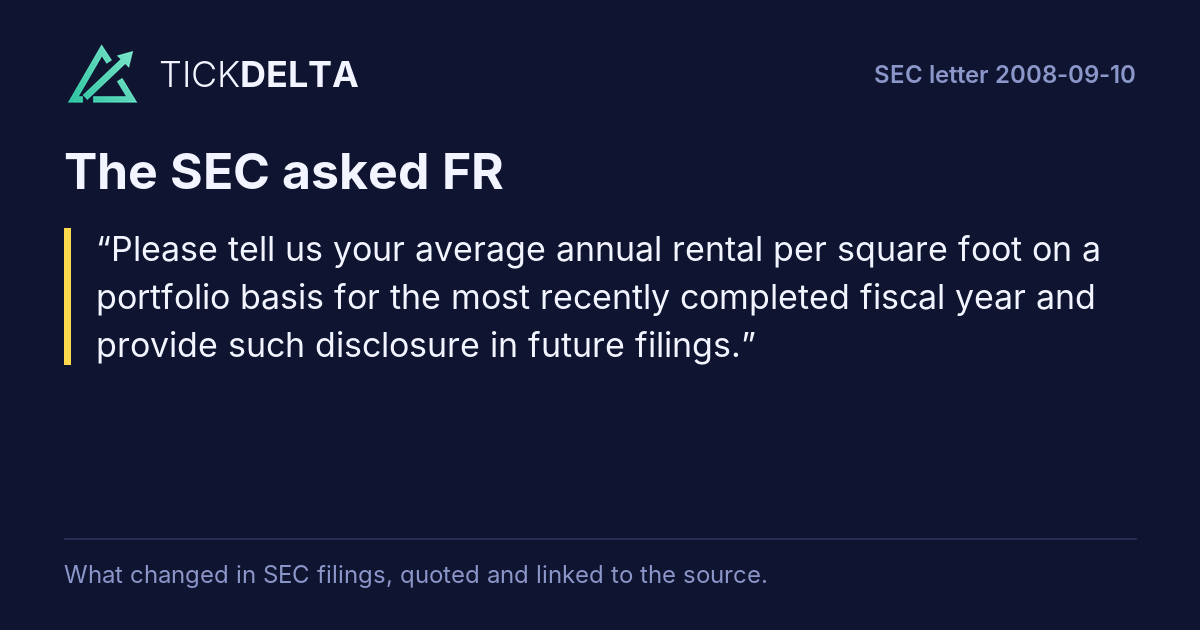
Please tell us your average annual rental per square foot on a portfolio basis for the most recently completed fiscal year and provide such disclosure in future filings.
FR answered
This was calculated by taking the monthly base rent (cash basis) per the terms of the leases, as of December 31, 2007, and multiplying times twelve. The Company will include this disclosure in future Form 10-K filings.
Read in the reply
In its next report

First report after the company's reply of Nov 14, 2008: 10-K filed Mar 2, 2009 ↗.

No earlier 10-K before the SEC's letter is in Tickdelta, so there is nothing to compare with.

Form 10-K for the fiscal year ended December 31, 2007 · Item 2. Properties, page 13
SEC asked (2)
We note that the average occupancies for several properties listed on page 17 are disclosed as “N/A.” Please tell us why you are not able to disclose an occupancy rate for those properties.
FR answered
The table included on page 17 discloses properties that the Company acquired during the year ended December 31, 2007. The average occupancy disclosure is a point in time disclosure and is the occupancy of the property or properties as of December 31, 2007 for our properties that are classified as in-service. As defined in Item 1, our in-service portfolio includes all properties other than developed, redeveloped and acquired properties that have not yet reached stabilized occupancy (defined as properties that are 90% leased).
Rest of the answer

As discussed in footnotes (a) and (b), the occupancy of any property that the Company has sold prior to December 31, 2007 or that is not classified as in-service, the occupancy is shown as N/A.

First Industrial Realty Trust. Inc.

Read in the reply
In its next report

First report after the company's reply of Nov 14, 2008: 10-K filed Mar 2, 2009 ↗.

No earlier 10-K before the SEC's letter is in Tickdelta, so there is nothing to compare with.

Notes to Consolidated Financial Statements
SEC asked (3)
Summary of Significant Accounting Policies Investment in Real Estate and Depreciation, page 61 3. We note that you classify properties as held for sale when management has approved the properties for sale. Please tell us whether you consider the other criteria that are to be met in the period where you classify as held for sale a longlived asset in accordance with paragraph 30 of SFAS 144.
Rest of the question

Further, please clarify your methodology in future filings.

FR answered
Management ensures that any property that is classified as held for sale meets all of the criteria (a through f) of paragraph 30 of SFAS No. 144. In future filings, the Company will modify its held for sale disclosure to clarify that all criteria has been met.
Read in the reply
Notes to Consolidated Financial Statements
SEC asked (4)
We note that you amortize below market leases over the remaining noncancelable terms of the respective leases. For below market leases, their value should be based on the remaining non-cancelable lease term plus any fixed rate renewal options, if applicable. The resulting value would be amortized over the remaining non-cancelable lease term plus any fixed rate renewal periods, if applicable.
Rest of the question

Please tell us how the utilization of this methodology as opposed to your estimation of the remaining expected lease terms would have affected your financial statements. Further, please clarify your methodology in future filings.

FR answered
Management agrees with the Staff’s comment that in some cases the fair value of below market leases should include the non-cancelable lease term and applicable renewal options and also that the amortization period for the liability should coincide with the period used in measuring the liability at the acquisition date. The Company’s calculates below market lease liabilities and the corresponding amortization periods related to below market leases on the remaining non-cancelable lease terms plus any fixed rate renewal periods only for leases that contain bargain renewal options.
Rest of the answer

The

Company looks to the definition of bargain renewal options within paragraph 5(e) of

Statement of Financial Accounting Standard No. 13, “a provision allowing the lessee, at his option, to renew the lease for a rental sufficiently lower than the fair rental of the property at the date the option becomes exercisable that exercise of the option appears... to be reasonably assured.”

The Company evaluates each real estate lease acquired to determine whether a renewal option is a bargain renewal option based on the facts and circumstances existing at the acquisition date. The Company concluded none of the leases included bargain renewal options. Accordingly, the liability for each below market lease acquired was calculated solely based on the non-cancelable lease term and is being amortized over that same period. The Company will update its disclosure in future Form 10-K filings to reflect the consideration the Company gives to option renewals.

Read in the reply
Notes to Consolidated Financial Statements
SEC asked (5)
Mortgage Loans Payable, Senior Unsecured Notes, Net and Unsecured Line of Credit, 5. Please tell us, and disclose in future filings, whether you were in compliance with the covenants related to your senior unsecured debt and your Unsecured Line of Credit as of the balance sheet date.
FR answered
As of December 31, 2007, the Company was in compliance with all of its covenants related to its senior unsecured debt and its Unsecured Line of Credit. In future

Form 10-Q and Form 10-K filings, the Company will disclose its compliance status.
Read in the reply
Executive Compensation Discussion and Analysis, page 11 · Base Salary, page 13
SEC asked (6)
We note the disclosure here that base salaries are determined by agreements and that increases are determined by the committee. Please tell us the material terms of the employment agreements for each named officer that dictates the components of executive compensation. For instance, tell us how the based salary was determined based on the terms of the agreements.
Rest of the question

Also, please tell us how the increases in base salaries were determined and the factors considered. Please provide such disclosure in your future filings.

FR answered
Each Named Executive Officer’s employment agreement identifies a specific minimum base salary, and provides that such Named Executive Officer’s base salary will be subject to discretionary increase on an annual basis as approved by the Compensation

Committee in accordance with the Company’s compensation policies, as they may be established from time to time. The terms of the agreements do not limit the discretion of the Committee to any factors.
Rest of the answer

The agreements do establish minimum amounts but these minimums were set several years ago at the time that the agreements were executed and therefore are not material to an understanding of the

Named Executive Officers’ current base salaries.

As indicated on page 13, the Compensation Committee may consider a number of factors in determining increases to the Named Executive Officers’ respective base salaries.

Further, base salary determinations were made by the Compensation Committee following recommendations provided by the Chief Executive Officer and the Chief

Financial Officer as indicated on page 12. However, the Compensation Committee determined only to make modest cost-of-living increases to each Named Executive

Officer’s base salary except in the case of the CEO. The Compensation Committee determined that the strong performance of the Company in 2006 and the Chief

Executive Officer’s leadership of the Company warranted an additional increase to the Chief Executive Officer’s base salary. This determination was subjective and not based upon specific criteria established prior to, in or following 2006. In future filings, the Company will provide disclosure identifying the factors considered by the Compensation Committee in determining whether further increases in base salary are appropriate.

Read in the reply
In its next report

First report after the company's reply of Nov 14, 2008: 10-K filed Mar 2, 2009 ↗.

No earlier 10-K before the SEC's letter is in Tickdelta, so there is nothing to compare with.

Executive Compensation Discussion and Analysis, page 11 · Base Salary, page 13
SEC asked (7)
We note the reference to the compensation consultants. Please identify the consultants and tell us their role in your compensation determinations. Provide similar disclosure in future filings.
FR answered
As indicated on page 13, the base salaries of the Named Executive Officers are a function of the minimum base salaries specified in their employment agreements and the increases to such base salaries approved by the Compensation Committee.

Although the Compensation Committee consulted with outside compensation consultants during the negotiation of the Named Executive Officers’ respective employment agreements in 2002 and 2005, the input received from such consultants is no longer considered by, and is therefore not material to the determinations of, the Company’s

Compensation Committee.
Rest of the answer

To eliminate confusion, the Company will remove from future filings the reference to the role of outside compensation consultants in setting the base salaries identified in each Named Executive Officer’s employment agreement.

As further indicated on page 13, in determining appropriate base salary increases, the Compensation Committee considers, among other things, peer information provided by compensation consultants. As disclosed on page 11, FPL Associates, an outside consultant, was retained in 2007 to review the appropriateness of the compensation of the Named Executive Officers and, as part of its review, surveyed a range of real estate companies that included not only the Company’s industrial peers, but similarly sized companies and companies with similar operating strategies from other sectors of the REIT industry. The Compensation Committee used this survey to gauge generally the appropriateness of the Company’s executive compensation programs. In future filings, the Company will include disclosure to clarify that the survey prepared by the Company’s outside compensation consultants is used, among other things, to gauge the appropriateness of the levels of base compensation paid to its

Named Executive Officers.

Read in the reply
In its next report

First report after the company's reply of Nov 14, 2008: 10-K filed Mar 2, 2009 ↗.

No earlier 10-K before the SEC's letter is in Tickdelta, so there is nothing to compare with.

Incentive Bonuses, page 13
SEC asked (8)
We note the disclosure of the maximum cash and equity bonuses in the table towards the bottom of page 13. The disclosure in the noted table does not reconcile with the disclosure on the previous page that the break down of total compensation was a 1/3 vs. 2/3 split between base salary and incentive compensation. Please tell us how the disclosure reconciles and provide similar disclosure in future filings.
FR answered
The disclosure on page 12 reflects both philosophy and fact. The Compensation

Committee’s philosophy is that a majority of executive compensation should be performance-based. Further, in recent years, base salary and benefits/perquisites has constituted approximately 1/3 of each Named Executive Officer’s compensation, while incentive compensation has comprised approximately 2/3 of each Named Executive

Officer’s compensation. The Summary Compensation Table indicates that this proportion was achieved in each of 2006 and 2007.
Rest of the answer

In future filings, the Company will clearly indicate that the proportion of base salary and benefits/perquisites to incentive compensation is a historical measurement, and that the proportion may vary in future years.

Although, as the Staff notes, the Named Executive Officers have the opportunity to achieve maximum cash and equity bonuses in amounts exceeding 2/3 of the Named

Executive Officer’s total compensation, maximum bonuses have not been earned historically. In the event that the maximum cash and equity bonuses are achieved by one or more of the Named Executive Officers in a given year, causing the base salary and benefits/perquisites paid to such Named Executive Officers to represent less that 1/3 of their total compensation, the result would nevertheless be consistent with the Compensation Committee’s compensation philosophy, outlined on page 12, that executive officers’ compensation should be largely tied to performance criteria designed to maximize the Company’s overall performance.

Read in the reply
In its next report

First report after the company's reply of Nov 14, 2008: 10-K filed Mar 2, 2009 ↗.

No earlier 10-K before the SEC's letter is in Tickdelta, so there is nothing to compare with.

Incentive Bonuses, page 13
SEC asked (9)
We note of the five performance categories, three appear to be objective categories. Please revise to disclose all the performance targets used to determine the amount of incentive bonuses to award. Also, discuss how actual results compared to those targets resulting in the bonuses awarded for fiscal year 2007.
Rest of the question

Please refer to Compliance and Disclosure Interpretations Question 118.04 located at http://www.sec.gov/divisions/corpfin/guidance/regs-kinterp.htm for further guidance. Similar disclosure should be provided in future filings.

FR answered
As indicated on page 14, when granting awards for 2007 under the Executive Officer

Bonus Plan, the Compensation Committee evaluated five broad performance categories, each of which contained one or more sub-categories, with the aggregate number of sub-categories totaling 32. Of the broad performance categories, “earnings growth” was assigned a weight of 50%, while each of the other categories was assigned a weight of 12.5%.
Rest of the answer

Because of the disproportionate weights assigned to the performance categories and the substantial number of subcategories, the Company does not believe that any sub-categories are individually material other than the funds from operations growth percentage target discussed on page 14. As such, the Company believes that discussion of any other individual target would be inappropriate, and is not necessary to an investor’s understanding of the Company’s compensation plan.

The Company believes that it is more meaningful, and material, to investors for the

Company’s disclosure to focus on the material performance categories rather than on the immaterial sub-categories.

As described in the Current Report on Form 8-K filed by the Company on May 20, 2008, the Compensation Committee has approved modifications of the criteria it will evaluate when granting incentive awards to the Named Executive Officers in 2008 and beyond. As a result of these modifications, when evaluating the Company’s performance in 2008 in connection with the Executive Officer Bonus Plan determinations, the Compensation Committee will consider fewer performance categories, all of which are objective. Materiality determinations for

2007 are likely to have little relevance to the Company’s materiality determinations for 2008. In future filings, the Company intends to disclose with particularity material performance targets and thresholds relating to each performance category for the relevant fiscal year and intends to clearly illustrate the manner in which actual performance dictates the percentage of the bonus potential associated with such performance category actually achieved.

Read in the reply
In its next report

First report after the company's reply of Nov 14, 2008: 10-K filed Mar 2, 2009 ↗.

No earlier 10-K before the SEC's letter is in Tickdelta, so there is nothing to compare with.

Incentive Bonuses, page 13
SEC asked (10)
We note the references to “high grade” and “average grade” in your discussion in this section. In connection with the preceding comment, please elaborate for us how the grades are determined and their significance in your overall consideration regarding incentive bonuses. Please provide similar disclosure in future filings.
FR answered
As discussed in the Company’s response to Comment 9, because of the disproportionate weights assigned to the performance categories, the Company does not believe that any of the performance sub-categories are individually material, other than the funds from operations growth percentage target that is discussed on page 14.
Rest of the answer

As such, the Company believes that discussion of the Compensation

Committee’s analysis of these sub-categories would be inappropriate, and that it is more meaningful, and material, to investors, for the Company’s disclosure to focus on the Compensation

Committee’s analysis of the broader performance categories.

Read in the reply
In its next report

First report after the company's reply of Nov 14, 2008: 10-K filed Mar 2, 2009 ↗.

No earlier 10-K before the SEC's letter is in Tickdelta, so there is nothing to compare with.

Incentive Bonuses, page 13
SEC asked (11)
We note the disclosure of the bonus ranges in the last paragraph on page 14. Please tell us the percentage awarded to each named officer and discuss how that percentage was determined based on the goals you set and the actual results achieved. Please provide similar disclosure in future filings.
Rest of the question

* * * * As appropriate, please respond to these comments within 10 business days or tell us when you will provide us with a response. Please submit a response letter on EDGAR that keys your response to our comments and provides any requested information. Detailed cover letters greatly facilitate our review. Please understand that we may have additional comments after reviewing your response to our comments.

FR answered
to your comment, the Company notes supplementally that the bonuses awarded by the Compensation Committee to the Named Executive Officers that participate in the Executive Officer Bonus Plan represented the following percentages of each such Named Executive Officer’s maximum cash bonus potential and maximum equity bonus potential, respectively:

% Maximum Cash

% Maximum Equity

Named Executive Officer

Bonus Potential

Michael W. Brennan

%

Michael J. Havala

Johannson L. Yap

David P.
Rest of the answer

Draft

After completing its evaluation of the various performance criteria described on page 14 in the Company’s proxy statement and thereby determining the estimated cash and non-cash payout for each Named Executive Officer, the Compensation Committee has the discretion to increase or decrease the amounts of such payouts, and to adjust the mix of cash versus non-cash compensation. In determining whether such adjustment would be appropriate for 2007, the Compensation Committee considered certain qualitative factors, as described on page 14, including the Chief Executive

Officer and Chief Financial Officer’s recommendations concerning compensation, as noted on page 12. As disclosed at the bottom of page 14 of the Company’s proxy statement, following the review of all relevant factors, the Compensation Committee rewarded Messrs. Havala and Yap for their exceptional individual performances in the prior fiscal year. The Company will provide in future filings greater specifity regarding any qualitative factors creating future differences in incentive compensation.

In connection with responding to the above comments, the Company hereby acknowledges that it is responsible for the adequacy and accuracy of the disclosures in the filings; staff comments or changes to disclosure in response to staff comments do not foreclose the Commission from taking any action with respect to the filings; and the Company may not assert staff comments as a defense in any proceeding initiated by the Commission or any person under the federal securities laws of the

United States. If you have any questions about any of the Company’s responses to your comments or require further explanation, please do not hesitate to telephone me at (312) 344-4380.

Read in the reply
In its next report

First report after the company's reply of Nov 14, 2008: 10-K filed Mar 2, 2009 ↗.

No earlier 10-K before the SEC's letter is in Tickdelta, so there is nothing to compare with.

Letters without questions

Other letters

UPLOAD and CORRESP
3 other letters: notices that a filing will not be reviewed, requests to declare a registration effective, and the like
  • Sep 15, 2009 · FR: asks the SEC to declare a registration effective · First Industrial Realty Trust, Inc. · Registration Statement on Form S-3 · Filed March...
  • Mar 12, 2009 · SEC: letter · First Industrial Realty Trust, Inc. and First Industrial, L.P. Form 10-K for fiscal...
  • Mar 12, 2009 · SEC: letter · First Industrial Realty Trust, Inc. and First Industrial, L.P. · Form 10-K for fiscal...

From the SEC's correspondence on EDGAR: staff letters (form UPLOAD) and company letters (form CORRESP), 20 letters filed since 2008-09-10. Questions and answers are matched by their numbers; topics come from words in each question. The reports are compared word for word (same form, before the first SEC letter against the first report after the company's reply). No AI.

Sources

The SEC's correspondence on EDGAR: staff letters (form UPLOAD) and company letters (form CORRESP), matched question by question. No AI.

Also

Filings: the letters in the filing list.

Work with it

Excel workbook · CSV. Google Sheet that stays up to date: paste =IMPORTDATA("https://tickdelta.com/company/FR/export.csv") into a cell.

Next in Owners and insiders:Insider trades
Esc

Type a ticker such as AAPL, a name, an investor such as Buffett, or a topic such as tariffs. ↑ ↓ to move, Enter to open.