Paragraph 143 · 49% changed
Every version of it
Screener
/
SEC EDGAR
/CIK 0001544522
/10-K filed Feb 26, 2026, compared with Feb 20, 2025
/Numbers from the XBRL of the 10-Ks
Nasdaq
Technology · Software
Freshworks Inc. FRSH
The 10-K against last year's
218 changes: 35 added, 60 removed, 120 reworded, 3 quiet changes
10-K Feb 26, 2026 vs Feb 20, 2025
Risk Factors
27.3%
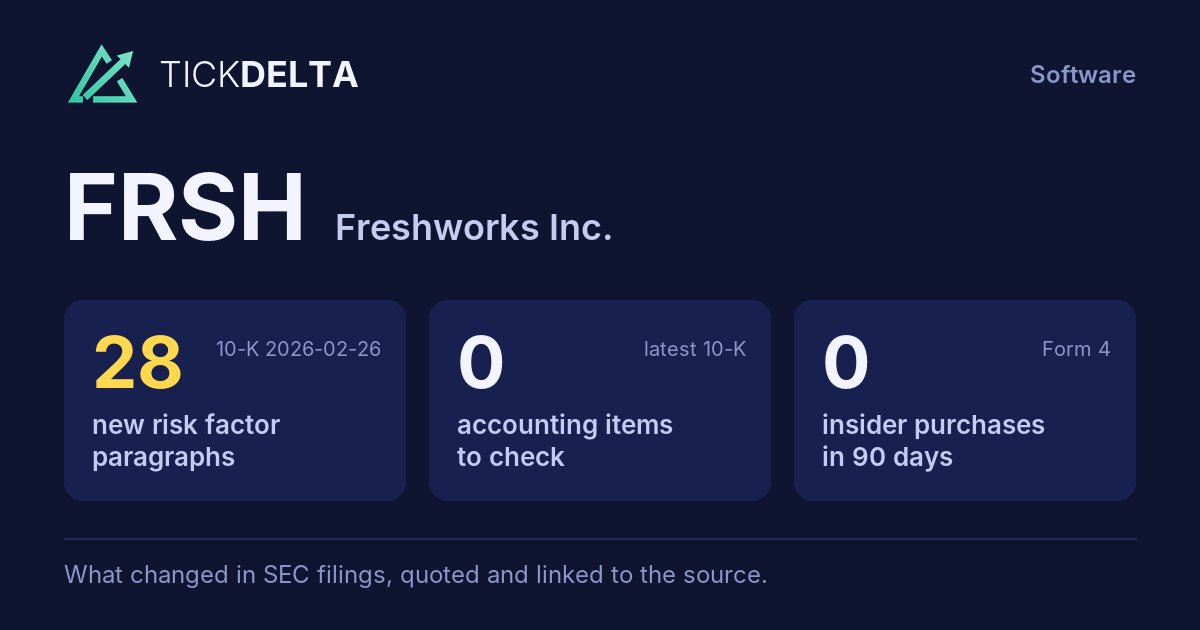
of the text changed · 24,123 words now · 28 new paragraphs, 55 gone
MD&A
17.0%
of the text changed · 8,562 words now · 7 new paragraphs, 5 gone
Legal Proceedings
5.2%
of the text changed · 588 words now
Accounting Policies
11.8%
of the text changed · 4,721 words now
10-K 0001544522-26-000036 (Feb 26, 2026) vs 10-K 0001544522-25-000010 (Feb 20, 2025)
Every paragraph, and how much of it changed
One bar per paragraph, in the order of the 10-K. Height and colour show the share of its words not in the closest paragraph a year earlier; the tallest bars are new paragraphs.
Risk Factors
302 paragraphs · 28 new · 70 reworded · 55 gone · 10-K Feb 26, 2026 against Feb 20, 2025
New paragraph
Reworded (5% of its words or more)
Same or nearly
Paragraph 180 · 48% changed
Every version of it
We are also frequently required to indemnify our channel partners and customers in the event of any against third-party infringement claims against our customers claims, and third parties who offer our products, and such indemnification these obligations may be excluded from contractual limitation of liability provisions that limit our exposure. These limitations. Such claims may require us to initiate or defend protracted and costly litigation on behalf of our customers and channel partners, regardless of the merits of these claims. If any of these claims succeed, we may be forced to pay damages on behalf of our customers and channel partners, may be required to modify one or more products to make it non-infringing, or may be required to obtain licenses for the products used. If we cannot obtain all necessary licenses on commercially reasonable terms, our customers may be forced to stop using one or more products, and our channel partners may be forced to stop selling one or more of our products.
Paragraph 135 · 46% changed
Every version of it
We derive, and expect to continue to derive, substantially all of our revenue from our Freshservice and Freshdesk products. As such, the continued growth in market demand for and market acceptance of these products is critical to our continued success. Demand for our products is affected by a number of factors, some of which are beyond our control, such as the rate of adoption of our products within an organization, the timing of development and release of new products by our competitors; the development and acceptance of new features, integrations, and capabilities for our products; price, product, and service changes by us or our competitors; technological changes and developments within the markets we serve; growth, contraction, and rapid evolution of our market; and general economic conditions and trends. If we are unable to continue to meet the demands of users and customers to keep up with trends in preferences for CX or EX products, or to achieve more widespread market acceptance of our products, our business, results of operations, and financial condition would be harmed. In addition, some current and potential customers, particularly larger organizations, may develop or acquire their own tools or continue to rely on traditional
Paragraph 102 · 46% changed
Every version of it
Paragraph 181 · 46% changed
Every version of it
Paragraph 57 · 46% changed
Every version of it
Larger customers are becoming a bigger part of our business. Sales to large customers involve risks that may not be present or that are present to a lesser extent with sales to smaller organizations, such as longer sales cycles, more complex customer requirements, substantial upfront sales costs, and less predictability in completing some of our sales. For example, large customers may require considerable time to evaluate and test our products prior to making a purchase decision. A number of factors influence the length and variability of our sales cycle, including the need to educate potential customers about the uses and benefits of our products, the considerable time spent by potential customers to evaluate and test our products prior to making a purchase decision, the discretionary nature of purchasing and budget cycles, and the competitive nature of evaluation and purchasing approval processes. As a result, the length of our sales cycle, from identification of the opportunity to deal closure, may vary significantly from customer to customer, with sales to large enterprises typically taking longer to complete. Our typical sales cycle for mid-market and enterprise customers is approximately 130 to 150 days, as compared to 30 days for SMB customers. Moreover, large customers are often more demanding than other customers and begin to deploy our products on a limited basis, but, nevertheless require implementation services and negotiate pricing discounts or other onerous terms, which increase our upfront investment in the sales effort with no guarantee that sales to these customers will justify our substantial upfront investment, which can affect our roadmaps and deliverables. If we fail to effectively manage these risks associated with sales cycles and sales to large customers, our business, financial condition, and results of operations may be adversely affected.
Paragraph 68 · 44% changed
Every version of it
Paragraph 35 · 43% changed
Every version of it
Paragraph 143 · 49% changed
Every version of it
10-K Feb 20, 2025We use AI, including generative AI, and ML technologies in our products and services. The development and use of AI/ML present various privacy and security risks that may impact our business. AI/ML are subject to Data Protection Laws, as well as increasing regulation and scrutiny. Several jurisdictions around the globe, including the EU and certain US states, have proposed or enacted laws governing AI/ML, for example, the EU's Artificial Intelligence Act. Additionally, certain Data Protection Laws extend rights to consumers (such as the right to delete certain personal information) and regulate automated decision making, which may be incompatible with our use of AI/ML. These obligations may make it harder for us to conduct our business using AI/ML, lead to regulatory fines or penalties, require us to change our business practices, retrain our AI/ML, or prevent or limit our use of AI/ML. For example, the Federal Trade Commission has required other companies to turn over (or disgorge) valuable insights or trainings generated through the use of AI/ML where they allege the company has violated privacy and consumer protection laws. If we cannot use AI/ML or that use is restricted, our business may be less efficient, or we may be at a competitive disadvantage.
10-K Feb 26, 2026
Our use of artificial intelligence, including generative and agentic AI and machine learning (ML) technologies, in products and services presents additional privacy and security risks. AI technologies are subject to increasing regulation (for example, in relation to data privacy and security as well as general consumer protection) in jurisdictions around the globe, including the EU's Artificial Intelligence Act and emerging US state laws. Privacy and data protection laws that regulate automated decision-making and extend consumer rights may be incompatible with our AI/ML use, potentially requiring us to disgorge profits, change business practices, retrain AI systems, and limit AI deployment. If we cannot use AI technologies or such use is
Paragraph 180 · 48% changed
Every version of it
10-K Feb 20, 2025
We are also frequently required to indemnify our channel partners and customers in the event of any third-party infringement claims against our customers and third parties who offer our products, and such indemnification obligations may be excluded from contractual limitation of liability provisions that limit our exposure. These claims may require us to initiate or defend protracted and costly litigation on behalf of our customers and channel partners, regardless of the merits of these claims. If any of these claims succeed, we may be forced to pay damages on behalf of our customers and channel partners, may be required to modify one or more products to make it non-infringing, or may be required to obtain licenses for the products used. If we cannot obtain all necessary licenses on commercially reasonable terms, our customers may be forced to stop using one or more products, and our channel partners may be forced to stop selling one or more of our products.
10-K Feb 26, 2026
We indemnify channel partners and customers against third-party infringement claims, and these obligations may be excluded from contractual liability limitations. Such claims may require us to initiate or defend costly litigation regardless of
Paragraph 135 · 46% changed
Every version of it
10-K Feb 20, 2025
We derive, and expect to continue to derive, substantially all of our revenue from our Freshservice and Freshdesk products. As such, the continued growth in market demand for and market acceptance of these products is critical to our continued success. Demand for our products is affected by a number of factors, some of which are beyond our control, such as the rate of adoption of our products within an organization, the timing of development and release of new products by our competitors; the development and acceptance of new features, integrations, and capabilities for our products; price, product, and service changes by us or our competitors; technological changes and developments within the markets we serve; growth, contraction, and rapid evolution of our market; and general economic conditions and trends. If we are unable to continue to meet the demands of users and customers to keep up with trends in preferences for CX or EX products, or to achieve more widespread market acceptance of our products, our business, results of operations, and financial condition would be harmed. In addition, some current and potential customers, particularly larger organizations, may develop or acquire their own tools or continue to rely on traditional
10-K Feb 26, 2026
We derive, and expect to continue to derive, substantially all of our revenue from our Freshservice and Freshdesk products. As such, the continued growth in market demand for and market acceptance of these products is critical to our continued success. Demand for our products is affected by a number of factors, some of which are beyond our control, such as the rate of
Paragraph 102 · 46% changed
Every version of it
10-K Feb 20, 2025Additionally, although we have implemented security measures designed to protect against security incidents, there can be no assurance that these measures will be effective. We take steps designed to detect, mitigate, and remediate vulnerabilities in our information systems (such as our hardware and/or software, including that of third parties upon which we rely). Additionally, certain data privacy and security obligations may require us to implement and maintain specific security measures or industry-standard or reasonable security measures to protect our information technology systems and sensitive information. We may not, however, detect and remediate all such vulnerabilities including on a timely basis. Further, we may experience delays in developing and deploying remedial measures designed to address any such identified vulnerabilities. Vulnerabilities could be exploited and result in a security incident.
10-K Feb 26, 2026
We take steps designed to detect, mitigate, and remediate vulnerabilities in our information systems (such as our hardware and/or software, including that of third parties with whom we work). However, we have not and may not in the future detect and remediate all such vulnerabilities, including on a timely basis. Additionally, we face security threats and vulnerabilities as a SaaS company arising from any vulnerabilities in our products and services and our customers’ use of our products and service
Paragraph 181 · 46% changed
Every version of it
10-K Feb 20, 2025We are also frequently required to indemnify our channel partners and customers in the event of any third-party infringement claims against our customers and third parties who offer our products, and such indemnification obligations may be excluded from contractual limitation of liability provisions that limit our exposure. These claims may require us to initiate or defend protracted and costly litigation on behalf of our customers and channel partners, regardless of the merits of these claims. If any of these claims succeed, we may be forced to pay damages on behalf of our customers and channel partners, may be required to modify one or more products to make it non-infringing, or may be required to obtain licenses for the products used. If we cannot obtain all necessary licenses on commercially reasonable terms, our customers may be forced to stop using one or more products, and our channel partners may be forced to stop selling one or more of our products.
10-K Feb 26, 2026
merit, pay damages on behalf of customers and partners, modify products to make them non-infringing, or obtain necessary licenses. If we cannot obtain required licenses on commercially reasonable terms, customers may be forced to stop using our products and channel partners may be forced to stop selling them, adversely affecting our business and results of operations.
Paragraph 57 · 46% changed
Every version of it
10-K Feb 20, 2025
Larger customers are becoming a bigger part of our business. Sales to large customers involve risks that may not be present or that are present to a lesser extent with sales to smaller organizations, such as longer sales cycles, more complex customer requirements, substantial upfront sales costs, and less predictability in completing some of our sales. For example, large customers may require considerable time to evaluate and test our products prior to making a purchase decision. A number of factors influence the length and variability of our sales cycle, including the need to educate potential customers about the uses and benefits of our products, the discretionary nature of purchasing and budget cycles, and the competitive nature of evaluation and purchasing approval processes. As a result, the length of our sales cycle, from identification of the opportunity to deal closure, may vary significantly from customer to customer, with sales to large enterprises typically taking longer to complete. Our typical sales cycle for mid-market and enterprise customers is approximately 130 to 150 days, as compared to 30 days for SMB customers. Moreover, large customers are often more demanding than other customers and begin to deploy our products on a limited basis, but, nevertheless require implementation services and negotiate pricing discounts or other onerous terms, which increase our upfront investment in the sales effort with no guarantee that sales to these customers will justify our substantial upfront investment, which can affect our roadmaps and deliverables. If we fail to effectively manage these risks associated with sales cycles and sales to large customers, our business, financial condition, and results of operations may be adversely affected.
10-K Feb 26, 2026
Larger customers are becoming a bigger part of our business. Sales to large customers involve longer sales cycles, more complex customer requirements, substantial upfront sales costs, and less predictability in completing some of our sales. A number of factors influence the length and variability of our sales cycle, including the need to educate potential customers about the uses and benefits of our products, the considerable time spent by potential customers to evaluate and test our products prior to making a purchase decision, the discretionary nature of purchasing and budget cycles, and the competitive nature of
Paragraph 68 · 44% changed
Every version of it
10-K Feb 20, 2025We believe that the brand identity that we have developed has significantly contributed to the success of our business with our existing customer base. We also believe that maintaining and enhancing the “Freshworks” brand is critical to expanding our customer base and establishing and maintaining relationships with partners. Successful promotion of our brand will depend largely on the effectiveness of our marketing efforts and on our ability to ensure that our products remain high-quality, reliable, and useful at competitive prices, as well as with respect to our free trial version. Maintaining and enhancing our brand may require us to make substantial investments, and these investments may not be successful. If we fail to promote and maintain the “Freshworks” brand, or if we incur excessive expenses in this effort, our business, results of operations, and financial condition would be adversely affected. We anticipate that, as our market becomes increasingly competitive, maintaining and enhancing our brand may become more difficult and expensive.
10-K Feb 26, 2026
“Freshworks” brand, or if we incur excessive expenses in this effort, our business, results of operations, and financial condition would be adversely affected. We anticipate that, as our market becomes increasingly competitive, maintaining and enhancing our brand may become more difficult and expensive.
Paragraph 35 · 43% changed
Every version of it
10-K Feb 20, 2025Furthermore, we operate in an industry that is characterized by rapid technological innovation, intense competition, changing customer needs, and frequent introductions of new products, technologies, and services. We may not be able to sustain the pace of improvements to our products successfully or implement systems, processes, and controls in an efficient or timely manner or in a manner that does not negatively affect our results of operations. Our failure to improve our systems, processes, and controls, or their failure to operate in the intended manner, may result in our inability to manage the growth of our business, forecast our revenue, expenses, and earnings accurately, or prevent losses.
10-K Feb 26, 2026
Additionally, we operate in an industry that is characterized by rapid technological innovation, intense competition, changing customer needs, and frequent introductions of new products, technologies, and services. If we cannot keep pace with these changes or fail to build the right systems and processes, we may struggle to manage our growth and accurately predict our financial performance.
MD&A
108 paragraphs · 7 new · 50 reworded · 5 gone · 10-K Feb 26, 2026 against Feb 20, 2025
New paragraph
Reworded (5% of its words or more)
Same or nearly
Paragraph 92 · 48% changed
Interest income increased decreased by $5.8 million $13.5 million, primarily due to higher interest rates and increased interest income earned on larger reduction in average balances maintained held in our marketable securities portfolios. portfolios as a result of our share repurchases.
Paragraph 4 · 47% changed
We provide people-first, people-first AI service software that organizations use to deliver exceptional employee and customer and experiences. Our employee experiences. We provide our solutions in two product families: Customer Experience (CX) and Employee Experience (EX). CX products include Freshdesk, Freshdesk Omni, Freshchat, Freshsales, and Freshmarketer. EX experience (EX) products include Freshservice, Freshservice for Business Teams Teams, Device42 and Device42. FireHydrant. Our latest generative customer experience (CX) products include our Freshdesk suite of products. Our AI solutions, offerings, which include Freddy AI Agent Agent, Freddy AI Copilot and Freddy AI Copilot, Insights, further enhance the employee and customer and employee experience. Freddy AI Agent offers always-on, autonomous, personalized resolutions to customer experience and employee queries. Freddy AI Copilot provides always-on contextual assistance for customer support, employee support, marketing and sales use cases are designed to boost productivity. Currently, over 72,000 companies choose Freshworks' uncomplicated solutions to increase efficiency and loyalty.
Paragraph 19 · 40% changed
Paragraph 79 · 39% changed
Paragraph 90 · 39% changed
General and administrative expense increased decreased by $12.9 $39.5 million, or 8%, 22%, for the year ended December 31, 2024 2025 compared to the year ended December 31, 2023. 2024. This increase decrease was primarily driven by lower stock-based compensation expense of $47.6 million primarily due to increases the cancellation of $7.1 equity awards following the resignation of our former Executive Chairman in December 2025. The decrease was partially offset by an increase of $6.8 million in personnel-related costs primarily due to higher variable incentive compensation adjustments, $5.8 million in stock-based and annual compensation expenses, $1.1 million in professional services fees, comprised primarily of legal, accounting, and consulting fees, partially offset by decreases of $1.7 million in tax reserves in accordance with ASC 450 and $1.6 million in directors and officers insurance. adjustments.
Paragraph 88 · 34% changed
Research and development expense increased decreased by $26.8 $1.4 million, or 19%, 1%, for the year ended December 31, 2024 2025 compared to the year ended December 31, 2023. 2024. This increase decrease was primarily driven by lower stock-based compensation expense of $6.7 million due to employee terminations and fully vested equity awards, as well as a $1.1 million decrease in personnel-related costs. These decreases were partially offset by increases of $17.8 $1.6 million in personnel-related third-party hosting costs due to compensation adjustments, $4.0 million in stock-based compensation expense, and $2.2 support our development activities, $1.3 million in software license fees, $1.0 million each in professional service fees and third-party hosting fees. allocated rent.
Paragraph 53 · 32% changed
•Acquisition expenses. We exclude acquisition expenses, which primarily consist of legal fees and due diligence costs, from our non-GAAP financial measures, measures because we do not believe these expenses have a direct correlation to the operating performance of our business.
Paragraph 93 · 29% changed
Other income (expense), net changed by $4.4 $5.8 million, primarily due to an unfavorable a $4.4 million favorable impact from changes in British pound and euro against the U.S. dollar. dollar, and a $1.8 million gain on sale of non-marketable equity investments.
Paragraph 92 · 48% changed
10-K Feb 20, 2025
Interest income increased by $5.8 million primarily due to higher interest rates and increased interest income earned on larger balances maintained in our marketable securities portfolios.
10-K Feb 26, 2026
Interest income decreased by $13.5 million, primarily due to reduction in average balances held in our marketable securities portfolios as a result of our share repurchases.
Paragraph 4 · 47% changed
10-K Feb 20, 2025
We provide people-first, AI service software that organizations use to deliver exceptional customer and employee experiences. We provide our solutions in two product families: Customer Experience (CX) and Employee Experience (EX). CX products include Freshdesk, Freshdesk Omni, Freshchat, Freshsales, and Freshmarketer. EX products include Freshservice, Freshservice for Business Teams and Device42. Our latest generative AI solutions, Freddy AI Agent and Freddy AI Copilot, further enhance the customer and employee experience. Freddy AI Agent offers always-on, autonomous, personalized resolutions to customer and employee queries. Freddy AI Copilot provides always-on contextual assistance for customer support, employee support, marketing and sales use cases to boost productivity. Currently, over 72,000 companies choose Freshworks' uncomplicated solutions to increase efficiency and loyalty.
10-K Feb 26, 2026
We provide people-first AI service software that organizations use to deliver exceptional employee and customer experiences. Our employee experience (EX) products include Freshservice, Freshservice for Business Teams, Device42 and FireHydrant. Our customer experience (CX) products include our Freshdesk suite of products. Our AI offerings, which include Freddy AI Agent, Freddy AI Copilot and Freddy AI Insights, further enhance the employee and customer and employee experience and are designed to boost productivity.
Paragraph 19 · 40% changed
10-K Feb 20, 2025We continue to increase the number of customers that have entered into larger subscriptions with us. We had approximately 3,053 customers each contributing $50,000 or more in ARR as of December 31, 2024, representing an increase of 22% compared to 2,497 customers as of December 31, 2023. As of December 31, 2024 and December 31, 2023, customers contributing more than $50,000 in ARR represented approximately 50% and 48% of total ARR, respectively. We believe that the number of customers contributing $50,000 or more in ARR indicates the strategic importance of our products for our customers and our ability to both initially land significant accounts or grow customers into significant accounts over time. No single customer accounted for more than 1% of ARR and our top 10 customers represented less than 5% of ARR as of December 31, 2024, and we have no significant concentration in a specific industry vertical.
10-K Feb 26, 2026
single customer accounted for more than 1% of ARR and our top 10 customers represented less than 5% of ARR as of December 31, 2025, and we have no significant concentration in a specific industry vertical.
Paragraph 79 · 39% changed
10-K Feb 20, 2025Provision for income taxes consists primarily of income taxes related to U.S. states and foreign jurisdictions in which we conduct business. We maintain a full valuation allowance on our U.S. federal and state net deferred tax assets as we have concluded that it is not more likely than not that the deferred tax assets will be realized. Provision for income taxes could also include changes in valuation allowance. Our effective tax rate is affected by tax rates in foreign jurisdictions and the relative amounts of income we earn in those jurisdictions, as well as non-deductible expenses, such as stock-based compensation, and changes in our valuation allowance.
10-K Feb 26, 2026
2025. Our effective tax rate is affected by tax rates in foreign jurisdictions and the relative amounts of income we earn in those jurisdictions as well as non-deductible expenses, such as stock-based compensation, and changes in our valuation allowance.
Paragraph 90 · 39% changed
10-K Feb 20, 2025
General and administrative expense increased by $12.9 million, or 8%, for the year ended December 31, 2024 compared to the year ended December 31, 2023. This increase was primarily due to increases of $7.1 million in personnel-related costs due to compensation adjustments, $5.8 million in stock-based compensation expenses, $1.1 million in professional services fees, comprised primarily of legal, accounting, and consulting fees, partially offset by decreases of $1.7 million in tax reserves in accordance with ASC 450 and $1.6 million in directors and officers insurance.
10-K Feb 26, 2026
General and administrative expense decreased by $39.5 million, or 22%, for the year ended December 31, 2025 compared to the year ended December 31, 2024. This decrease was primarily driven by lower stock-based compensation expense of $47.6 million primarily due to the cancellation of equity awards following the resignation of our former Executive Chairman in December 2025. The decrease was partially offset by an increase of $6.8 million in personnel-related costs primarily due to higher variable incentive compensation and annual compensation adjustments.
Paragraph 88 · 34% changed
10-K Feb 20, 2025
Research and development expense increased by $26.8 million, or 19%, for the year ended December 31, 2024 compared to the year ended December 31, 2023. This increase was primarily due to increases of $17.8 million in personnel-related costs due to compensation adjustments, $4.0 million in stock-based compensation expense, and $2.2 million in software license and third-party hosting fees.
10-K Feb 26, 2026
Research and development expense decreased by $1.4 million, or 1%, for the year ended December 31, 2025 compared to the year ended December 31, 2024. This decrease was primarily driven by lower stock-based compensation expense of $6.7 million due to employee terminations and fully vested equity awards, as well as a $1.1 million decrease in personnel-related costs. These decreases were partially offset by increases of $1.6 million in third-party hosting costs to support our development activities, $1.3 million in software license fees, $1.0 million each in professional service fees and allocated rent.
Paragraph 53 · 32% changed
10-K Feb 20, 2025
financial measures, because we do not believe these expenses have a direct correlation to the operating performance of our business.
10-K Feb 26, 2026
•Acquisition expenses. We exclude acquisition expenses, which primarily consist of legal fees and due diligence costs, from our non-GAAP financial measures because we do not believe these expenses have a direct correlation to the operating performance of our business.
Paragraph 93 · 29% changed
10-K Feb 20, 2025
Other income (expense), net changed by $4.4 million, primarily due to an unfavorable impact from changes in British pound against the U.S. dollar.
10-K Feb 26, 2026
Other income (expense), net changed by $5.8 million, primarily due to a $4.4 million favorable impact from changes in British pound and euro against the U.S. dollar, and a $1.8 million gain on sale of non-marketable equity investments.
A paragraph is matched with the one last year that shares the most of its words; under half in common makes it new. The paragraphs shown are the 8 reworded the most in each section.
The paragraph that changed most in each section
The redline
Marked against last year's 10-K: cut words struck through, new words highlighted.
Risk Factors215 words changed in this paragraph; it is 56% similar to last year's version.
Source: Item 1A, 10-K 0001544522-26-000036 vs Item 1A, 10-K 0001544522-25-000010
MD&A107 words changed in this paragraph; it is 43% similar to last year's version.
We provide people-first, people-first AI service software that organizations use to deliver exceptional employee and customer and experiences. Our employee experiences. We provide our solutions in two product families: Customer Experience (CX) and Employee Experience (EX). CX products include Freshdesk, Freshdesk Omni, Freshchat, Freshsales, and Freshmarketer. EX experience (EX) products include Freshservice, Freshservice for Business Teams Teams, Device42 and Device42. FireHydrant. Our latest generative customer experience (CX) products include our Freshdesk suite of products. Our AI solutions, offerings, which include Freddy AI Agent Agent, Freddy AI Copilot and Freddy AI Copilot, Insights, further enhance the employee and customer and employee experience. Freddy AI Agent offers always-on, autonomous, personalized resolutions to customer experience and employee queries. Freddy AI Copilot provides always-on contextual assistance for customer support, employee support, marketing and sales use cases are designed to boost productivity. Currently, over 72,000 companies choose Freshworks' uncomplicated solutions to increase efficiency and loyalty.
Source: Item 7, 10-K 0001544522-26-000036 vs Item 7, 10-K 0001544522-25-000010
Accounting Policies62 words changed in this paragraph; it is 71% similar to last year's version.
Income taxes are accounted for under the asset and liability method. Deferred tax assets and liabilities are recognized for the future tax consequences attributable to differences between the financial statement carrying amounts of existing assets and liabilities and their respective tax bases and operating loss and tax credit carryforwards. Deferred tax assets and liabilities are measured using enacted tax rates expected to apply to taxable income in the years in which those temporary differences are expected to be recovered or settled. The effect on deferred tax assets and liabilities of a change in tax rates is recognized in income in the period that includes the enactment date. A valuation allowance is recorded for deferred tax assets if it is more likely than not that some portion or all of the deferred tax assets will not be realized.
Source: Item 8, Note 2 – Summary of Significant Accounting Policies, 10-K 0001544522-26-000036 vs Item 8, Note 2 – Summary of Significant Accounting Policies, 10-K 0001544522-25-000010
Legal Proceedings56 words changed in this paragraph; it is 83% similar to last year's version.
On November 1, 2022, a purported Company stockholder filed a securities class action complaint in the U.S. District Court for the Northern District of California against us, certain of our current officers and directors, and underwriters of our initial public offering (IPO). On April 14, February 8, 2023, the court-appointed lead plaintiff and lead counsel. On April 14, 2023, lead plaintiff filed a consolidated an amended class action complaint. The amended complaint alleges that defendants violated Sections 11, 12(a)(2), and 15 of the Securities Act of 1933 by making material misstatements or omissions in offering documents filed in connection with the our IPO. The amended complaint seeks unspecified damages, interest, fees, costs, and rescission on behalf of purchasers and/or acquirers of common stock issued in the our IPO. On September 28, 2023, the court issued an order granting in part and denying in part defendants' motion to dismiss. We On January 16, 2025, we filed a motion for summary judgment, which the court granted and entered judgment in our and the other defendants defendants’ favor on April 10, 2025. Plaintiff has appealed the judgment, and we continue to vigorously defend against the remaining claims in this action.
Source: Item 3, via Note 9 – Commitments and Contingencies, 10-K 0001544522-26-000036 vs Item 3, via Note 9 – Commitments and Contingencies, 10-K 0001544522-25-000010
Sentences and paragraphs added, removed or reworded
Every change, by type
Sentences and paragraphs of FRSH's Risk Factors and MD&A, 10-K Feb 26, 2026 against 10-K Feb 20, 2025. Each links to the text at sec.gov.
Quiet changes are sentences kept from last year with one to four words changed, at least one of them a hedge, a modal or a qualifier (may, could, will, not, significant, material…). A year or date rolling forward is not counted.
The full word list
adverse, adversely, all, although, anticipate, anticipates, any, approximately, believe, believes, can, cannot, certain, could, expect, expects, generally, however, if, intend, intends, largely, likely, many, material, materially, may, might, most, must, never, no, not, possible, primarily, probable, should, significant, significantly, some, substantial, substantially, unlikely, will, would
AddedRisk Factors
•Failure or perceived failure to comply with existing or future laws, regulations, contracts, self-regulatory schemes, standards, and other obligations related to data privacy or security (including security incidents) could harm our business. Compliance or the actual or perceived failure to comply with such obligations could increase the costs of our products and services, limit their use or adoption, and otherwise negatively affect our operating results and business.
Read it in 10-K Feb 26, 2026 at sec.gov
AddedRisk Factors
The technology industry in particular has experienced heightened sensitivity to macroeconomic conditions, with enterprise technology spending often viewed as discretionary and subject to deferral during periods of economic uncertainty. Our customers have in the past and may continue to respond to macroeconomic pressures by reducing their technology budgets, delaying implementations, seeking shorter contract terms, or demanding more favorable pricing, all of which could have an adverse impact on our business operations, financial condition, and growth prospects.
Read it in 10-K Feb 26, 2026 at sec.gov
AddedRisk Factors
Generative and agentic AI is also the subject of a quickly evolving legal and regulatory environment, and new or enhanced governmental or regulatory scrutiny, litigation, ethical concerns, or other complications related to our use of generative or agentic AI could cause us to divert resources towards compliance and adversely affect our business, reputation, or financial
Read it in 10-K Feb 26, 2026 at sec.gov
AddedRisk Factors
results. For example, the U.S.’s regulatory framework related to AI technologies remains in development and has been the subject of federal level executive orders and legislation has been introduced and enacted at the state level. Additionally, obligations under the EU AI Act have gone into effect and will continue to be implemented in phases through 2030, and other jurisdictions have passed or are considering similarly focused legislation. Some of our operations are subject to the EU AI Act and depending on how the EU AI Act is implemented and interpreted, we may have to adapt our business practices, contractual arrangements and services to comply with such obligations. Our use of AI technology could result in additional compliance costs, regulatory investigations and actions, and lawsuits.
Read it in 10-K Feb 26, 2026 at sec.gov
AddedRisk Factors
Any of these risks could be difficult to eliminate or manage, and, if not addressed, could adversely affect our business, financial condition, results of operations, and growth prospects.
Read it in 10-K Feb 26, 2026 at sec.gov
AddedRisk Factors
numbers are based on what we believe to be reasonable estimates of our metrics for the applicable period of measurement, there are inherent challenges in measuring how our products are used across large populations globally.
Read it in 10-K Feb 26, 2026 at sec.gov
AddedRisk Factors
We (and the third parties with whom we work) process large amounts of sensitive information, including personal data, proprietary business information, trade secrets, and intellectual property, making us and our third-party service providers targets for evolving cyber threats. We (and the third parties with whom we work) face a variety of risks and threat actors, including ransomware attacks (which are becoming increasingly prevalent and severe), social engineering (including AI-enhanced deep fakes), online and offline fraud, malware, malicious code, denial-of-service attacks credential stuffing/harvesting attacks, personnel misconduct or error, software bugs, supply-chain attacks, nation-state actors, organized criminal groups, and attacks enhanced or facilitated by AI technologies. These risks and threat actors are increasingly sophisticated and difficult to detect. During geopolitical conflicts and depending on the relevant jurisdictions in which we (or third parties with whom we work or to whom we provide services) operate, we may face heightened risks of retaliatory cyber-attacks that could materially disrupt our operations and ability to deliver services. Hybrid work arrangements and business transactions (for example, acquisitions) further expand our cybersecurity risks. For example, acquired entities’ information technology systems may introduce additional vulnerabilities and other security issues that were not discovered during due diligence. Additionally, our data and information technology systems may be damaged or fail for reasons other than a cyberattack, such as hardware failures or natural disasters.
Read it in 10-K Feb 26, 2026 at sec.gov
AddedRisk Factors
(for example, customers’ failure to appropriately secure their account credentials or other manner in which they interact with our products and services). Our reliance on third-party service providers for cloud infrastructure, data centers, and other critical functions also introduces cybersecurity risks beyond our direct control, including supply-chain attacks and vulnerabilities in vendor systems. Additionally, use of third-party AI technologies by our personnel or in our products/services poses significant data security risks, as these tools may not protect the confidentiality of inputs, may use our data to train third-party models, or could inadvertently reveal sensitive information through AI-generated outputs. For example despite implementing guidelines for AI tool usage, we cannot guarantee compliance or track all relevant personnel interactions with these technologies, creating risks that may be particularly difficult to eliminate or manage.
Read it in 10-K Feb 26, 2026 at sec.gov
Show the other 55
AddedRisk Factors
It is difficult and costly to maintain measures designed to detect, investigate, mitigate, contain and remediate security incidents. While we have implemented security measures designed to protect against security incidents, there can be no assurance that these measures will be effective, and we have in the past and may in the future experience security incidents. For example, we have been the target of unsuccessful phishing / credential stuffing / other type of cyberattack attempts in the past, and expect such attempts will continue in the future.
Read it in 10-K Feb 26, 2026 at sec.gov
AddedRisk Factors
Any actual or perceived security incident impacting us (or the third parties with whom we work) could result in government investigations, enforcement actions, litigation, regulatory penalties, operational disruptions, reputational harm, customer loss, monetary fund diversions, diversions of management attention, financial costs for remediation, notification, and legal proceedings and other adverse consequences. Applicable obligations may require us or we may voluntarily choose to notify relevant stakeholders of security incidents. We may be required to fundamentally change our business practices in response to security incidents, and our insurance coverage and limitations of liability in our contracts may be inadequate to cover all potential damages, costs and other losses. The costs and resources required to prevent, detect, and respond to security threats continue to increase as we expand our business and process larger volumes of sensitive information, potentially diverting resources from growth initiatives and adversely affecting our competitive position.
Read it in 10-K Feb 26, 2026 at sec.gov
AddedRisk Factors
We rely on search engines, including traditional web search and emerging AI-powered platforms, to drive traffic to our websites, and changes in these platforms could adversely affect our business.
Read it in 10-K Feb 26, 2026 at sec.gov
AddedRisk Factors
Our success depends in part on our ability to attract users through unpaid search results on traditional web search engines such as Google. Search engines frequently update their algorithms, ranking methodologies, and user interfaces in ways that are outside our control. The search ecosystem is also evolving to include AI-generated responses and standalone AI search experiences, which increasingly provide answers without requiring users to click through to a website. These changes have contributed to a rise in “zero-click” searches, which could have an adverse impact on business, results of operations, and financial condition.
Read it in 10-K Feb 26, 2026 at sec.gov
RemovedRisk Factors
RemovedRisk Factors
RemovedRisk Factors
RemovedRisk Factors
RemovedRisk Factors
RemovedRisk Factors
RemovedRisk Factors
RemovedRisk Factors
RemovedRisk Factors
RemovedRisk Factors
RemovedRisk Factors
RemovedRisk Factors
RewordedRisk Factors
RewordedRisk Factors
RewordedRisk Factors
RewordedRisk Factors
To protect our trade secrets and other proprietary information, we require employees, consultants, and independent contractors to enter into confidentiality agreements. agreements and invention assignment agreements to control access to and use of our proprietary information and to ensure that any intellectual property developed by such employees, contractors, consultants, and other third parties are assigned to us.
Read it in 10-K Feb 26, 2026 at sec.gov
RewordedRisk Factors
We are also frequently required to indemnify our channel partners and customers in the event of any against third-party infringement claims against our customers claims, and third parties who offer our products, and such indemnification these obligations may be excluded from contractual limitation of liability provisions that limit our exposure. limitations.
Read it in 10-K Feb 26, 2026 at sec.gov
RewordedRisk Factors
If AWS increases pricing terms, pricing, terminates or seeks to terminate our contractual relationship, establishes more favorable relationships terms with our competitors, or changes or interprets its terms of service or policies in a manner that is unfavorable with respect to us, unfavorably, our business, results of operations, business and financial condition would be materially harmed.
Read it in 10-K Feb 26, 2026 at sec.gov
RewordedRisk Factors
Regulators in the United States are increasingly scrutinizing these such statements, and if these policies, materials or statements they are found to be deficient, lacking in transparency, deceptive, unfair, inaccurate, misleading, or misrepresentative of our practices, otherwise deficient we may be subject to investigation, regulatory investigations, enforcement actions by regulators, actions, or other adverse consequences.
Read it in 10-K Feb 26, 2026 at sec.gov
RewordedRisk Factors
We are subject to various complex and evolving export control, import, and trade and economic sanction sanctions laws and regulations that could impair our ability to compete internationally, result in international markets significant penalties, and subject us to liability for noncompliance. adversely affect our business and results of operations.
Read it in 10-K Feb 26, 2026 at sec.gov
RewordedRisk Factors
Our ability to utilize our net operating loss carryforwards and certain other tax attributes to offset taxable income or taxes may be limited. limited by ownership changes, evolving tax laws, and utilization restrictions, which could increase our future tax obligations and adversely affect our results of operations.
Read it in 10-K Feb 26, 2026 at sec.gov
RewordedRisk Factors
RewordedRisk Factors
While we employ practices designed to monitor our compliance with the licenses of third-party open source software and protect our valuable proprietary source code, we may inadvertently use third-party open source software in a manner that exposes us to claims of non-compliance with the applicable terms of such license, including claims for infringement of intellectual property rights or for breach of contract.
Read it in 10-K Feb 26, 2026 at sec.gov
RewordedRisk Factors
We expect that the requirements of these rules and regulations will continue to increase our legal, accounting, and financial compliance costs, make some activities more difficult, time consuming, and costly, and place significant strain on our personnel, systems, and resources.
Read it in 10-K Feb 26, 2026 at sec.gov
Quiet changesRisk Factors
AddedMD&A
In January 2026, the Company completed the acquisition of FireHydrant, Inc., a provider of AI-powered incident management software. The Company will account for the transaction as a business combination. Since the closing date of the acquisition occurred subsequent to the end of the reporting period, the allocation of purchase price to the underlying net assets has not yet been completed.
Read it in 10-K Feb 26, 2026 at sec.gov
AddedMD&A
We are subject to income taxes in the U.S. and in other foreign jurisdictions. We recognize current and deferred income taxes based on reported income before income taxes. Deferred income taxes reflect the effect of temporary differences and carryforwards recognized for financial reporting and income tax purposes. Deferred tax assets and liabilities are recognized based on the differences between the financial statement carrying amounts of assets and liabilities and their respective tax bases, utilizing tax rates that are expected to apply to taxable income in the years in which temporary differences are expected to be recovered or settled. We recognize valuation allowance to reduce deferred tax assets to the amount that we estimate, based on available evidence and management judgment, will more likely than not be realized. We record a valuation allowance in the period the determination is made that all or part of the net deferred tax assets will not be realized. We record interest and penalties related to unrecognized tax benefits in tax expense.
Read it in 10-K Feb 26, 2026 at sec.gov
AddedMD&A
•Gain on sale of non-marketable equity investments. We exclude gains on sale of non-marketable equity investments from certain of our non-GAAP financial measures because we believe they are unrelated to our ongoing operating performance and are not expected to recur in our continuing operating results.
Read it in 10-K Feb 26, 2026 at sec.gov
AddedMD&A
(1) During the year ended December 31, 2025, income tax adjustments primarily included approximately $151.7 million of tax benefit from a release of our valuation allowance on U.S. deferred tax assets and $39.1 million of income tax effect of non-GAAP adjustments, partially offset by $38.9 million of transition impact as a result of releasing our valuation allowance. During the year ended December 31, 2024, income tax adjustments included $14.3 million of income tax benefit associated with acquisitions.
Read it in 10-K Feb 26, 2026 at sec.gov
AddedMD&A
We are subject to income taxes in U.S. and in foreign jurisdictions. We monitor the realizability of our deferred tax assets and take into account all relevant factors at each reporting period. As of December 31, 2025, based on the relevant weight of positive and negative evidence, including the amount of our taxable income in the current year, which is objective and verifiable, we concluded that it is more likely than not that our U.S. federal and state deferred tax assets are realizable. As such, we released $151.7 million valuation allowance related to the U.S. deferred tax assets during the year ended December 31,
Read it in 10-K Feb 26, 2026 at sec.gov
AddedMD&A
The $46.2 million, or 6%, decrease in our operating expenses in the year ended December 31, 2025 compared to the year ended December 31, 2024 were primarily driven by the cancellation of equity awards following the resignation of our former Executive Chairman and lower headcount following the November 2024 restructuring, which decreased stock-based compensation expenses and personnel-related costs. The decrease is partially offset by the impact of annual compensation adjustments and higher variable incentive compensation which increased personnel-related costs.
Read it in 10-K Feb 26, 2026 at sec.gov
AddedMD&A
We are subject to income taxes in the U.S. and in foreign jurisdictions. We monitor the realizability of our deferred tax assets and take into account all relevant factors at each reporting period. As of December 31, 2025, based on the relevant weight of positive and negative evidence, including the amount of our taxable income in the current year, which is objective and verifiable, we concluded that it is more likely than not that our U.S. federal and state deferred tax assets are realizable. As such, we released $151.7 million valuation allowance related to the U.S. federal and state deferred tax assets during the year ended December 31, 2025.
Read it in 10-K Feb 26, 2026 at sec.gov
RemovedMD&A
RemovedMD&A
RemovedMD&A
RemovedMD&A
RemovedMD&A
RewordedMD&A
Net cash provided by investing activities of $38.8 $206.1 million for the year ended December 31, 2024 2025 consisted of $267.1 $243.9 million in proceeds from maturities and sales, net of purchases of marketable securities and $2.0 million in proceeds from sale of non-marketable securities; partially offset by $213.9 $18.4 million cash advances paid for the business combination, net $15.8 million related to the capitalization of cash acquired, $8.9 internal-use software, and $5.6 million in purchases, net of proceeds from sale, of property and equipment, and $5.5 million related to the capitalization of internal-use software. equipment.
Read it in 10-K Feb 26, 2026 at sec.gov
RewordedMD&A
We generated operating income of $13.2 million and incurred operating losses of $138.6 million, $170.2 million and $233.4 $170.2 million in the years ended December 31, 2024, 2023 2025, 2024 and 2022, 2023, respectively, and our recognized net income of $183.7 million and incurred net losses were of $95.4 million, $137.4 million and $232.1 $137.4 million in the years ended December 31, 2024, 2023 2025, 2024 and 2022, 2023, respectively.
Read it in 10-K Feb 26, 2026 at sec.gov
RewordedMD&A
Net cash used in financing activities of $67.3 $436.7 million for the year ended December 31, 2024 2025 consisted primarily of $60.3 $386.3 million cash paid to repurchase shares of our common stock and $56.7 million in payment of withholding taxes on net share settlement of equity awards, $13.7 million cash paid to repurchase shares of our common stock; awards; partially offset by $6.6 $6.2 million in net proceeds from issuance of common stock under our employee stock purchase plan, net. plan.
Read it in 10-K Feb 26, 2026 at sec.gov
RewordedMD&A
Research and development 19 23 23 27 Sales and marketing 47 54 60 69 General administrative 17 25 29 32 Restructuring charges — 2 — — Total operating expenses 83 104 112 128 Loss Income (loss) from operations 2 (20) (29) (47) Interest and other income, net 5 7 8 2 Loss Income (loss) before income taxes 7 (13) (21) (45) Provision for (benefit from) income taxes (16) 1 2 2 Net loss income (loss) 23 % (14) % (23) % (47)% (23)%
Read it in 10-K Feb 26, 2026 at sec.gov
RewordedMD&A
Net cash provided by operating activities of $160.6 $242.4 million for the year ended December 31, 2024 2025 reflects our net loss income of $95.4 $183.7 million, adjusted for non-cash items such as stock-based compensation of $216.7 $146.8 million, amortization of deferred contract acquisition costs of $28.6 $31.7 million, depreciation and amortization of $19.4 $25.9 million, non-cash lease expense of $8.8 $9.7 million, offset by $16.0 $6.6 million from discount amortization on marketable securities and $12.6 $1.8 million from changes in deferred income taxes. gain on sale of non-marketable equity investments.
Read it in 10-K Feb 26, 2026 at sec.gov
RewordedMD&A
The net cash inflows from changes in operating assets and liabilities were due to increases of operating liabilities of $54.8 $61.2 million in deferred revenue and $14.5 revenue, $19.1 million in accrued and other liabilities; liabilities and $9.6 million in accounts payable; partially offset by increases in operating assets of $34.5 $40.1 million in deferred contract acquisition costs, $17.1 $28.1 million in accounts receivable, $1.4 $11.9 million in prepaid expenses and other assets and decreases of operating liabilities of $4.3 $8.5 million in operating lease liabilities and $2.2 million in accounts payable. liabilities.
Read it in 10-K Feb 26, 2026 at sec.gov
RewordedMD&A
Interest income increased decreased by $5.8 million $13.5 million, primarily due to higher interest rates and increased interest income earned on larger reduction in average balances maintained held in our marketable securities portfolios. portfolios as a result of our share repurchases.
Read it in 10-K Feb 26, 2026 at sec.gov
RewordedMD&A
On constant currency basis, our net dollar retention rate was 105% 104% which was a decrease an increase from prior year primarily due to lower expansion within existing customers driven by macroeconomic pressures offset by the addition of Device42 and a slight an improvement in our overall churn rate.
Read it in 10-K Feb 26, 2026 at sec.gov
RewordedMD&A
Lease liabilities are measured based on the present value of the total lease payments not yet paid, discounted based on either the rate implicit in the lease or our incremental borrowing rate (the estimated rate we would be required to pay for a collateralized borrowing equal to the total lease payments over the term of the lease), whichever is more readily determinable.
Read it in 10-K Feb 26, 2026 at sec.gov
RewordedMD&A
Stock-based compensation expense 146,819 216,706 210,707 207,696 Employer payroll taxes on employee stock transactions 3,026 3,223 3,711 1,827 Amortization of acquired intangibles 13,854 8,160 303 1,591 Restructuring charges 405 9,664 — Acquisition expenses 684 — — Gain on sale of non-marketable equity investments (1,837) — — Income tax adjustments (1) (151,900) (12,017) 1,398 1,978 Non-GAAP net income (loss) $ 194,774 $ 130,368 $ 78,683 $ (19,040)
Read it in 10-K Feb 26, 2026 at sec.gov
RewordedMD&A
RewordedMD&A
We exclude the income tax effect of the above adjustments and adjustments, income tax effect associated with acquisitions and tax charges or benefits that are a result of a change in valuation allowance on deferred tax assets and its related impacts, from our non-GAAP financial measures.
Read it in 10-K Feb 26, 2026 at sec.gov
Quiet changesMD&A
We have been global from our earliest product sales and our global footprint continues to expand, with customers in approximately over 170 countries.
Read it in 10-K Feb 26, 2026 at sec.gov
Quiet changesMD&A
Our material cash requirements from known contractual obligations consists primarily consist of our obligations under operating leases for office space and contractual obligations for third-party cloud infrastructure.
Read it in 10-K Feb 26, 2026 at sec.gov
Sources
The two latest 10-Ks on EDGAR, section by section. Each change links to the text at sec.gov.
Also
New risk factors: paragraphs with nothing like them last year, quoted in full.
Work with it
Excel workbook · CSV. Google Sheet that stays up to date: paste =IMPORTDATA("https://tickdelta.com/company/FRSH/export.csv") into a cell.