Screener / SEC EDGAR /CIK 0001544522 /10-K filed Feb 26, 2026, compared with Feb 20, 2025 /Numbers from the XBRL of the 10-Ks
Nasdaq Technology · Software

Freshworks Inc. FRSH

Compare with peers Embed
New in the 10-K 28 paragraphs with nothing like them in the 10-K filed Feb 20, 2025 New in the 10-Q 13 paragraphs not in the 10-Q filed Aug 4, 2026 10-Q against the 10-K 2 risk factor paragraphs and sentences added or reworded

New risk paragraphs, branching off last year

Each branch is a paragraph in Risk Factors with nothing like it in the 10-K filed Feb 20, 2025. A box jumps to the paragraph as filed, below.

28 new

Paragraphs with nothing like them in last year's 10-K

Quoted exactly

28 paragraphs in Risk Factors of the 10-K filed Feb 26, 2026 with nothing like them in the 10-K filed Feb 20, 2025. Quoted exactly. Paragraphs that were only edited are under 10-K change.

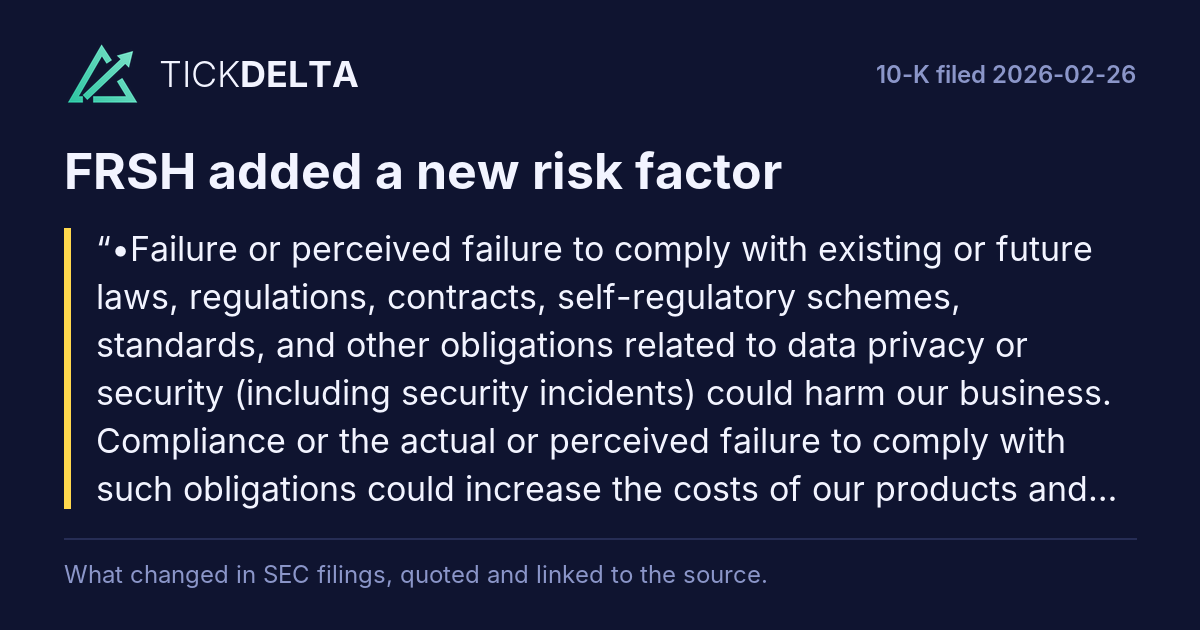
•Failure or perceived failure to comply with existing or future laws, regulations, contracts, self-regulatory schemes, standards, and other obligations related to data privacy or security (including security incidents) could harm our business. Compliance or the actual or perceived failure to comply with such obligations could increase the costs of our products and services, limit their use or adoption, and otherwise negatively affect our operating results and business.

Read in the 10-K

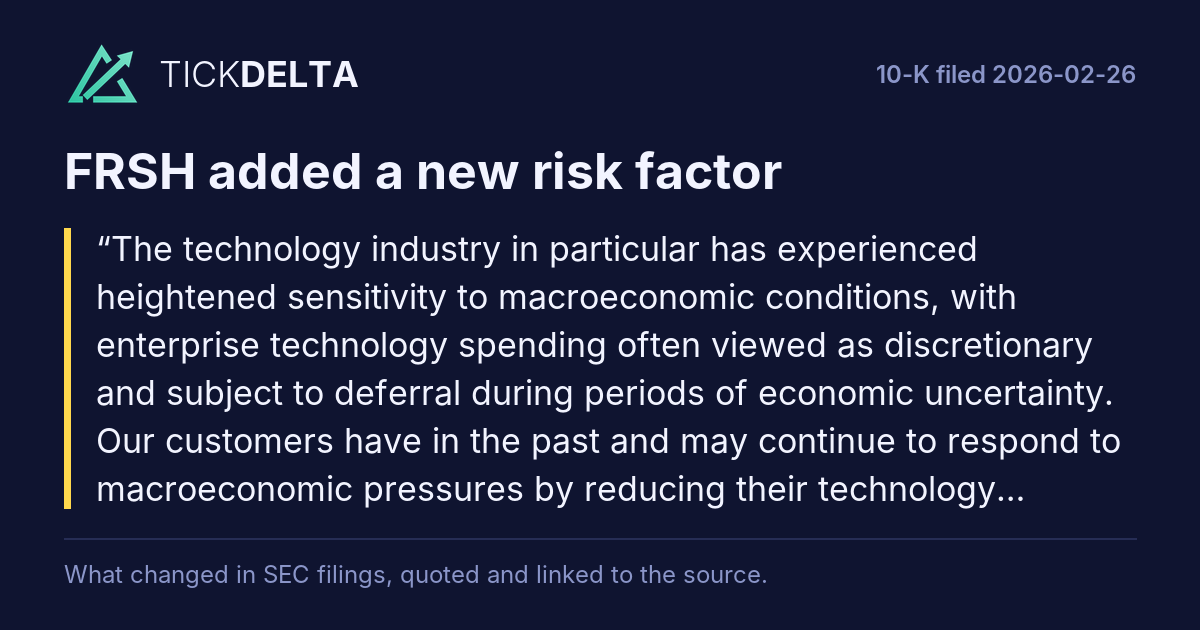
The technology industry in particular has experienced heightened sensitivity to macroeconomic conditions, with enterprise technology spending often viewed as discretionary and subject to deferral during periods of economic uncertainty. Our customers have in the past and may continue to respond to macroeconomic pressures by reducing their technology budgets, delaying implementations, seeking shorter contract terms, or demanding more favorable pricing, all of which could have an adverse impact on our business operations, financial condition, and growth prospects.

Read in the 10-K

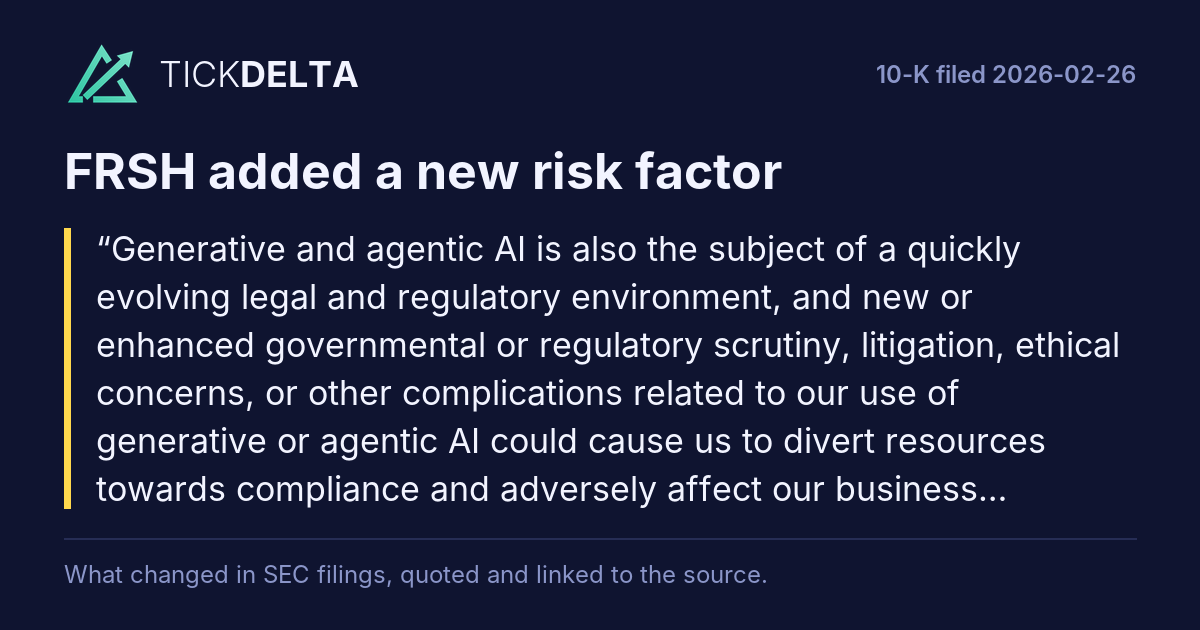
Generative and agentic AI is also the subject of a quickly evolving legal and regulatory environment, and new or enhanced governmental or regulatory scrutiny, litigation, ethical concerns, or other complications related to our use of generative or agentic AI could cause us to divert resources towards compliance and adversely affect our business, reputation, or financial

results. For example, the U.S.’s regulatory framework related to AI technologies remains in development and has been the subject of federal level executive orders and legislation has been introduced and enacted at the state level. Additionally, obligations under the EU AI Act have gone into effect and will continue to be implemented in phases through 2030, and other jurisdictions have passed or are considering similarly focused legislation. Some of our operations are subject to the EU AI Act and depending on how the EU AI Act is implemented and interpreted, we may have to adapt our business practices, contractual arrangements and services to comply with such obligations. Our use of AI technology could result in additional compliance costs, regulatory investigations and actions, and lawsuits.

Any of these risks could be difficult to eliminate or manage, and, if not addressed, could adversely affect our business, financial condition, results of operations, and growth prospects.

Read in the 10-K

numbers are based on what we believe to be reasonable estimates of our metrics for the applicable period of measurement, there are inherent challenges in measuring how our products are used across large populations globally.

Read in the 10-K

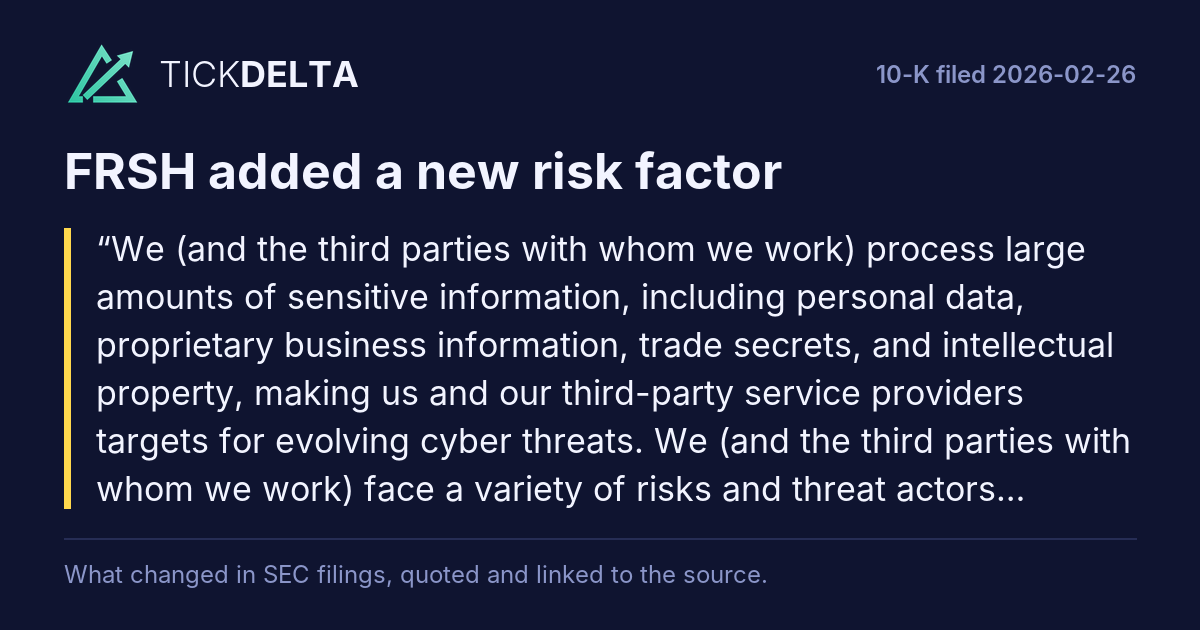
We (and the third parties with whom we work) process large amounts of sensitive information, including personal data, proprietary business information, trade secrets, and intellectual property, making us and our third-party service providers targets for evolving cyber threats. We (and the third parties with whom we work) face a variety of risks and threat actors, including ransomware attacks (which are becoming increasingly prevalent and severe), social engineering (including AI-enhanced deep fakes), online and offline fraud, malware, malicious code, denial-of-service attacks credential stuffing/harvesting attacks, personnel misconduct or error, software bugs, supply-chain attacks, nation-state actors, organized criminal groups, and attacks enhanced or facilitated by AI technologies. These risks and threat actors are increasingly sophisticated and difficult to detect. During geopolitical conflicts and depending on the relevant jurisdictions in which we (or third parties with whom we work or to whom we provide services) operate, we may face heightened risks of retaliatory cyber-attacks that could materially disrupt our operations and ability to deliver services. Hybrid work arrangements and business transactions (for example, acquisitions) further expand our cybersecurity risks. For example, acquired entities’ information technology systems may introduce additional vulnerabilities and other security issues that were not discovered during due diligence. Additionally, our data and information technology systems may be damaged or fail for reasons other than a cyberattack, such as hardware failures or natural disasters.

Read in the 10-K
Show the other 9

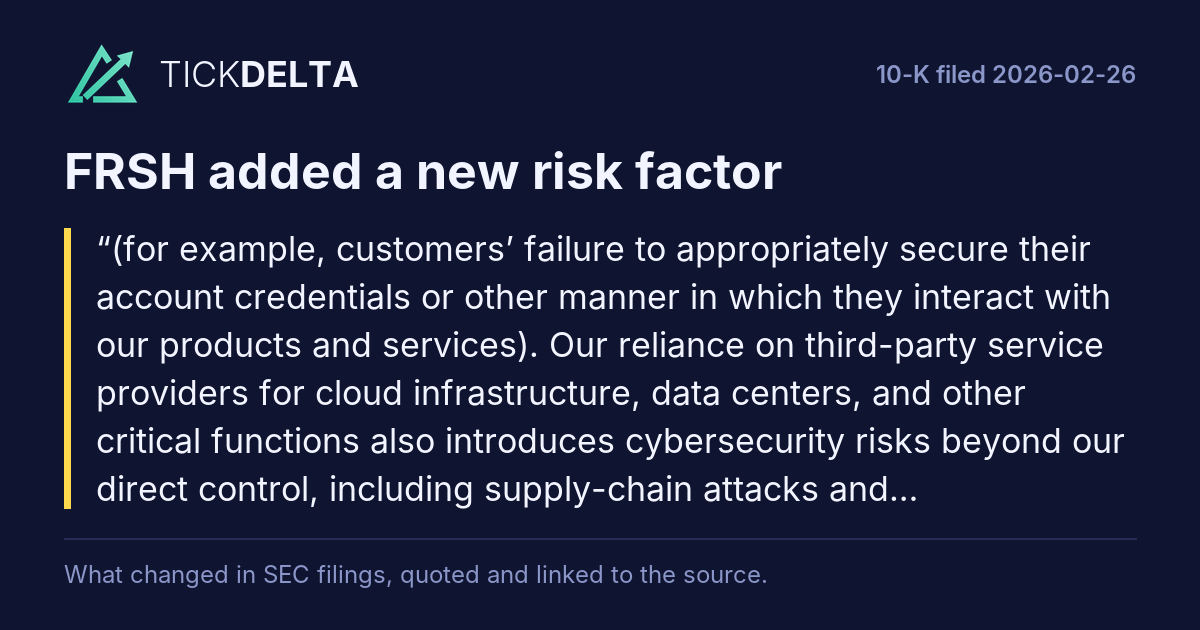
(for example, customers’ failure to appropriately secure their account credentials or other manner in which they interact with our products and services). Our reliance on third-party service providers for cloud infrastructure, data centers, and other critical functions also introduces cybersecurity risks beyond our direct control, including supply-chain attacks and vulnerabilities in vendor systems. Additionally, use of third-party AI technologies by our personnel or in our products/services poses significant data security risks, as these tools may not protect the confidentiality of inputs, may use our data to train third-party models, or could inadvertently reveal sensitive information through AI-generated outputs. For example despite implementing guidelines for AI tool usage, we cannot guarantee compliance or track all relevant personnel interactions with these technologies, creating risks that may be particularly difficult to eliminate or manage.

It is difficult and costly to maintain measures designed to detect, investigate, mitigate, contain and remediate security incidents. While we have implemented security measures designed to protect against security incidents, there can be no assurance that these measures will be effective, and we have in the past and may in the future experience security incidents. For example, we have been the target of unsuccessful phishing / credential stuffing / other type of cyberattack attempts in the past, and expect such attempts will continue in the future.

Any actual or perceived security incident impacting us (or the third parties with whom we work) could result in government investigations, enforcement actions, litigation, regulatory penalties, operational disruptions, reputational harm, customer loss, monetary fund diversions, diversions of management attention, financial costs for remediation, notification, and legal proceedings and other adverse consequences. Applicable obligations may require us or we may voluntarily choose to notify relevant stakeholders of security incidents. We may be required to fundamentally change our business practices in response to security incidents, and our insurance coverage and limitations of liability in our contracts may be inadequate to cover all potential damages, costs and other losses. The costs and resources required to prevent, detect, and respond to security threats continue to increase as we expand our business and process larger volumes of sensitive information, potentially diverting resources from growth initiatives and adversely affecting our competitive position.

Read in the 10-K

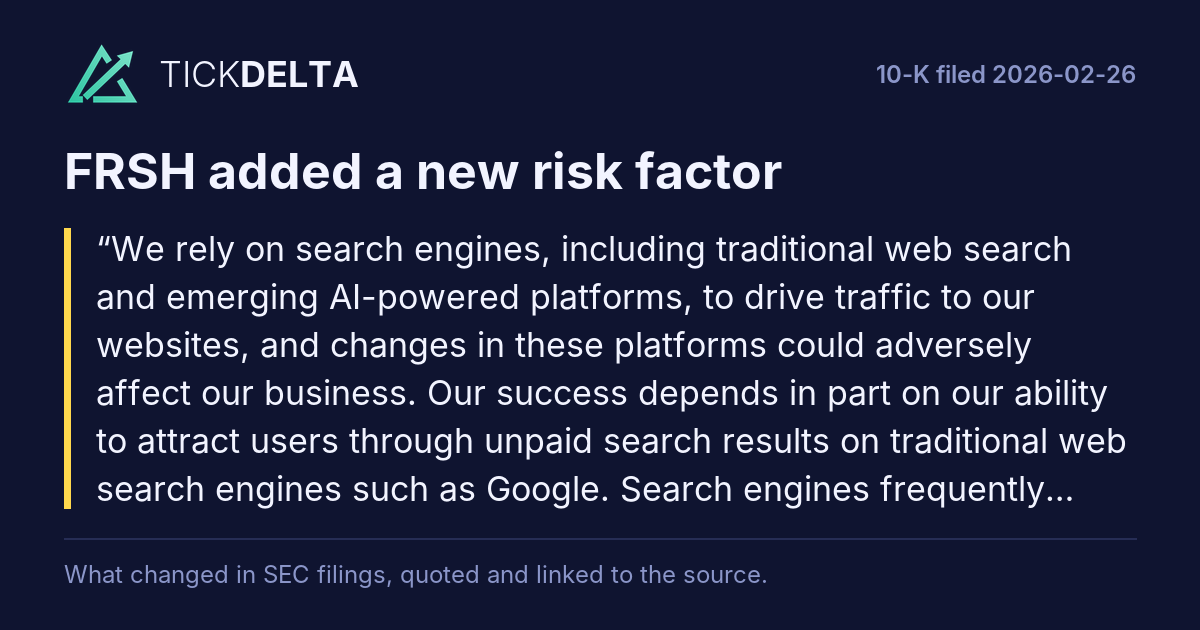
We rely on search engines, including traditional web search and emerging AI-powered platforms, to drive traffic to our websites, and changes in these platforms could adversely affect our business.

Our success depends in part on our ability to attract users through unpaid search results on traditional web search engines such as Google. Search engines frequently update their algorithms, ranking methodologies, and user interfaces in ways that are outside our control. The search ecosystem is also evolving to include AI-generated responses and standalone AI search experiences, which increasingly provide answers without requiring users to click through to a website. These changes have contributed to a rise in “zero-click” searches, which could have an adverse impact on business, results of operations, and financial condition.

Historically, traffic to our websites from search engines has been driven by our position in unpaid search results. Traffic from large language model (LLM)-based platforms currently represents a small portion of our total website traffic but has been growing in recent quarters. As these platforms become more widely adopted, they may become a more material component of our customer acquisition strategy.

At the same time, the rise of AI-powered search may reduce the effectiveness of traditional SEO strategies. Our rankings and visibility may be affected by changes to search engine algorithms, crawling or indexing practices, or interface designs that prioritize AI-generated content over traditional web links. These changes may reduce traffic to our sites, even if our content remains high-quality. Additionally, our content may be used by AI systems to generate responses or train models without driving attributable traffic or revenue.

Although we have made investments to improve our visibility in both traditional and AI-powered search environments, there can be no assurance that these efforts will fully offset the impact of ongoing changes in user behavior and search technology. If we are unable to maintain or improve our visibility, our ability to attract users through unpaid channels may decline, requiring increased investment in paid marketing to meet growth targets. This could increase customer acquisition costs and negatively affect our operating results.

Read in the 10-K

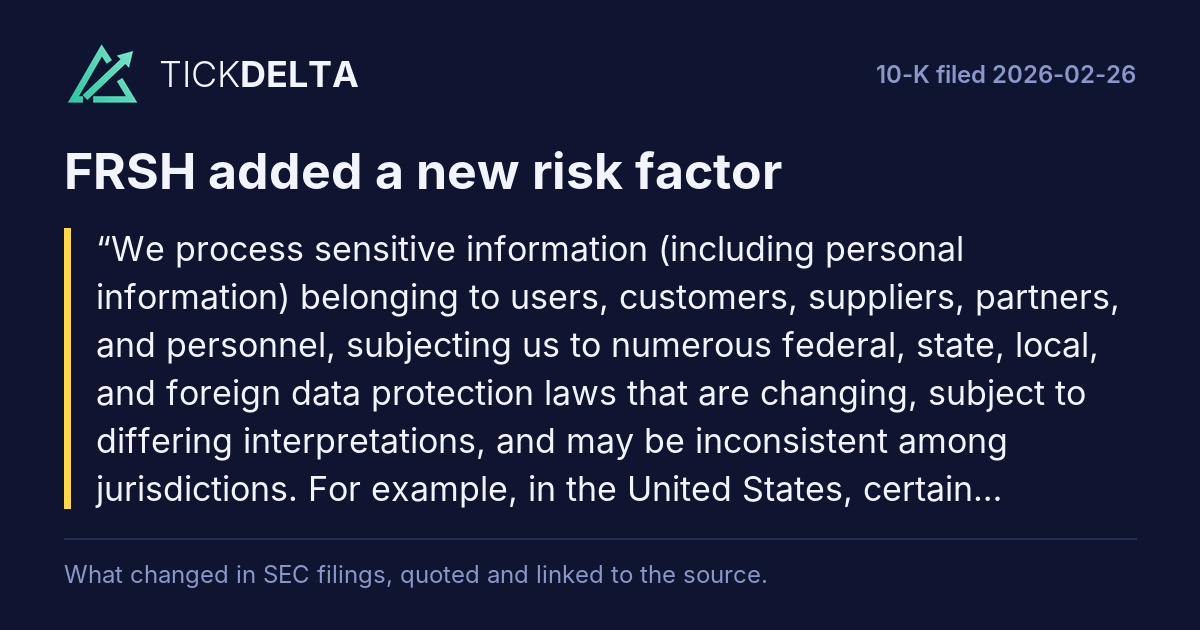
We process sensitive information (including personal information) belonging to users, customers, suppliers, partners, and personnel, subjecting us to numerous federal, state, local, and foreign data protection laws that are changing, subject to differing interpretations, and may be inconsistent among jurisdictions. For example, in the United States, certain comprehensive state consumer privacy laws impose obligations including specific privacy notice disclosures, consumer rights to access, correct, or delete personal information, and opt-out rights for targeted advertising and automated decision-making. These laws allow for statutory fines and, in some cases, private litigation with significant statutory damages. Internationally, regulations such as the EU GDPR, UK GDPR, and India's Digital Personal Data Protection Act impose strict processing requirements with consequences for noncompliance including potential processing bans, significant fines, and private litigation. Additional data privacy and security laws may be proposed or enacted in the jurisdictions in which we, our customers or other third parties with whom we work operate or offer products or services.

We may be unable to transfer personal information from the EU, UK, and other jurisdictions to the United States or other relevant jurisdictions due to data localization requirements or cross-border transfer limitations. While mechanisms such as the EU-U.S. Data Privacy Framework exist, these are subject to legal challenges and regulatory scrutiny. If we cannot lawfully transfer personal information or if compliance requirements become too onerous, we could face adverse consequences such as operational interruptions, the need to relocate business activities to other jurisdictions at significant expense, regulatory actions, substantial fines, and injunctions against data processing necessary to operate our business.

Read in the 10-K

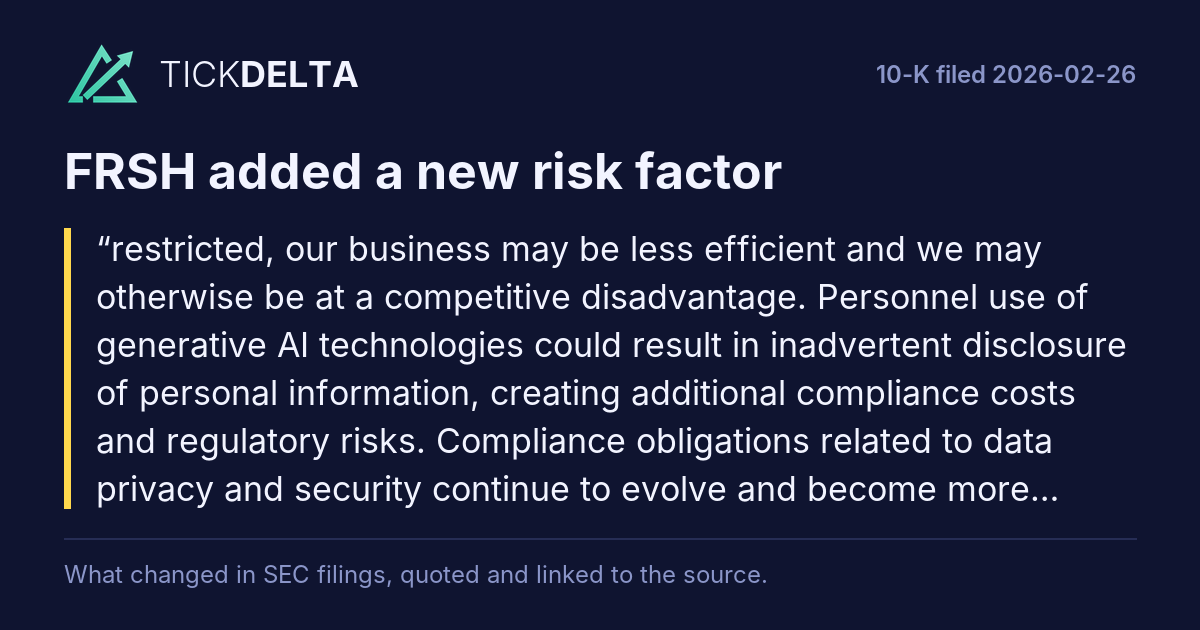
restricted, our business may be less efficient and we may otherwise be at a competitive disadvantage. Personnel use of generative AI technologies could result in inadvertent disclosure of personal information, creating additional compliance costs and regulatory risks.

Compliance obligations related to data privacy and security continue to evolve and become more stringent. These obligations are subject to differing applications and interpretations across jurisdictions. some of which may be inconsistent. Such obligations have required and will continue to require from us significant resource expenditures, and may limit our ability to develop new services, store and process customer data, or operate our business effectively. Any actual or perceived non-compliance with such obligations by us or by the third parties with whom we work (including our customers) could result in adverse consequences such as governmental enforcement actions, investigations, fines, penalties, audits, litigation including class actions and mass arbitration demands, additional reporting requirements, processing restrictions, orders to destroy data, and potential imprisonment of company officials. Data privacy and security-related claims are increasingly common, with some allowing statutory damages on a per-violation basis that could result in substantial financial exposure. For example, we have in the past and may in the future experience legal demands related to data privacy or security, such as in relation to our use of digital tracking technologies on our website. Any of these events could have a material adverse effect on our reputation, business, or financial condition, including but not limited to: loss of customers; interruptions or stoppages in our business operations; inability to process personal data or to operate in certain jurisdictions; limited ability to develop or commercialize our products; expenditure of time and resources to defend any claim or inquiry; adverse publicity; or substantial changes to our business model or operations.

Additionally, many of our products and services are general-purpose solutions that our customers can configure and deploy for their particular use cases. Depending on the manner in which our customers use our products and services, it could expose us to additional data privacy and security obligations (for example, those related to telemarketing, employment, and AI). Although we maintain measures designed to prohibit customers from using our products and services in unlawful or other harmful ways, customers may attempt (and have at times in the past attempted) to use our products and services in ways that violate our policies, terms or applicable laws, which could lead to adverse consequences for us such as those described above.

Read in the 10-K

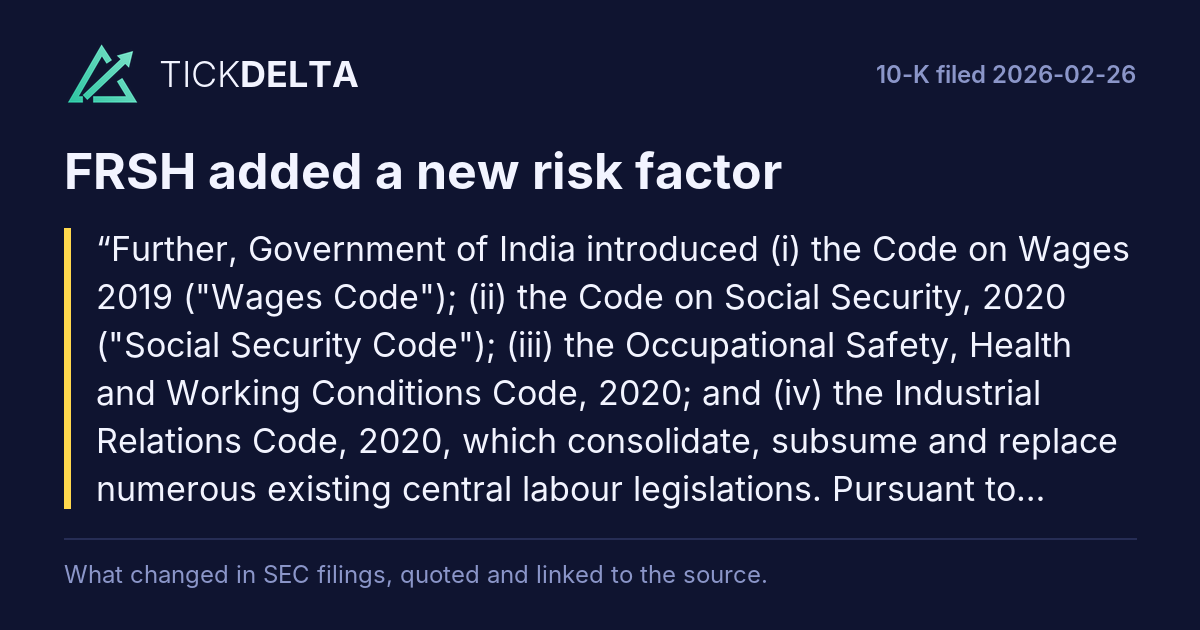
Further, Government of India introduced (i) the Code on Wages 2019 ("Wages Code"); (ii) the Code on Social Security, 2020 ("Social Security Code"); (iii) the Occupational Safety, Health and Working Conditions Code, 2020; and (iv) the Industrial Relations Code, 2020, which consolidate, subsume and replace numerous existing central labour legislations. Pursuant to notifications issued by Government of India dated November 21, 2025, the Occupational Safety, Health and Working Conditions Code, 2020 and Industrial Relations Code, 2020 have been made fully effective and certain provisions of the Wages Code and Social Security Code have been made effective, each as of November 21, 2025. The effect of these provisions on us including impact on overall employee expenses which in turn may affect our profitability cannot be predicted with certainty at this stage.

Read in the 10-K

We face risks from intellectual property infringement claims and other litigation that could result in significant costs, operational restrictions, and material adverse effects on our business and results of operations.

Read in the 10-K

Intellectual property litigation, regardless of merit, involves considerable costs and diverts management attention and resources, potentially harming our business and results of operations. We may be required to settle litigation on unfavorable terms, obtain licenses that may not be available on reasonable terms or at all, develop alternative non-infringing technology at significant expense, or discontinue certain practices or operations. Adverse judgments could require us to cease operations or pay substantial damages. Our insurance may not cover such claims, provide sufficient coverage, or remain available on acceptable terms, resulting in unanticipated costs and material adverse effects on our business.

Read in the 10-K

Changes in India's taxation system could adversely affect our business, financial condition, and results of operations due to the complex and evolving nature of central and state tax regimes.

Read in the 10-K

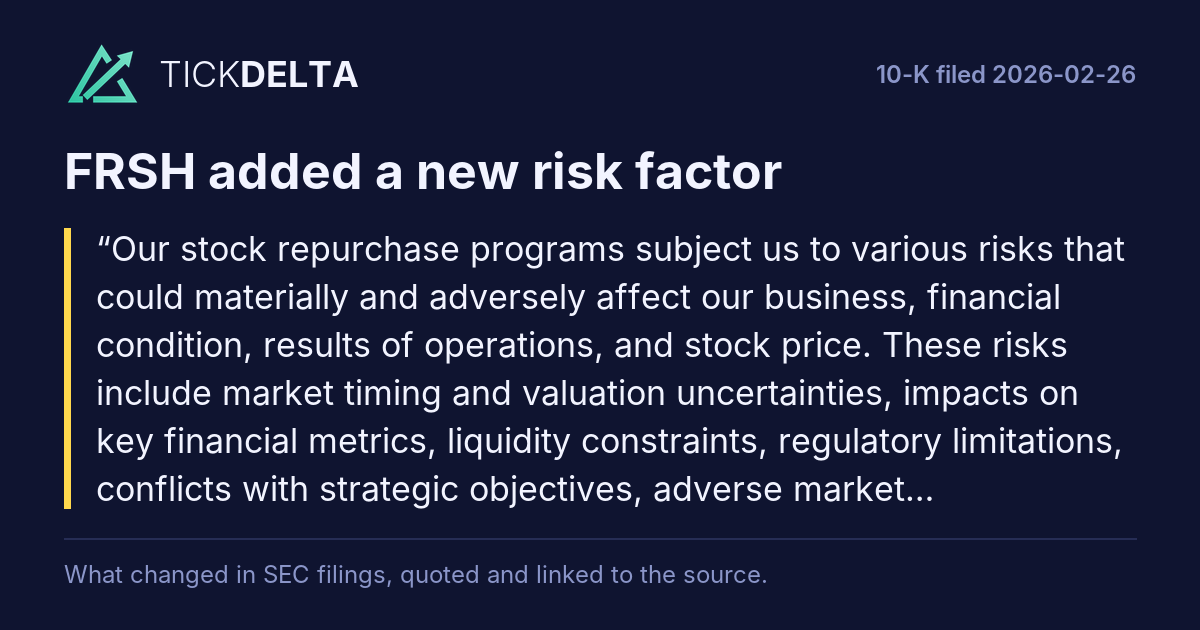
Our stock repurchase programs subject us to various risks that could materially and adversely affect our business, financial condition, results of operations, and stock price. These risks include market timing and valuation uncertainties, impacts on key financial metrics, liquidity constraints, regulatory limitations, conflicts with strategic objectives, adverse market perceptions, and execution challenges.

In November 2024, our board of directors approved a stock repurchase program for the repurchase of up to $400 million of the Company’s outstanding Class A common stock, which was completed in August 2025.

Our stock repurchase programs are subject to significant market timing and valuation risks that could result in suboptimal capital allocation and adverse impacts on shareholder value. We may repurchase shares at prices that subsequently prove to have been excessive relative to the intrinsic value of our stock, particularly during periods of market volatility or when our stock price is trading at elevated multiples. Market conditions, investor sentiment, and macroeconomic factors beyond our control can cause substantial fluctuations in our stock price, making it difficult to determine optimal timing and pricing for repurchases.

If we execute repurchases when our stock is overvalued, we may destroy shareholder value by paying more for shares than they are ultimately worth, reducing the economic benefit to continuing shareholders. Conversely, if we suspend or reduce repurchases during periods when our stock may be undervalued due to temporary market dislocations, we may miss opportunities to enhance shareholder returns. Our repurchase decisions are based on management's assessment of various factors, including stock price, market conditions, available cash, and alternative investment opportunities, but these assessments may prove incorrect. Additionally, the timing of our repurchases may create unintended signaling effects to the market about management's confidence in the company's prospects, potentially leading to increased volatility or adverse market reactions if our subsequent performance does not meet market expectations established by our repurchase activity.
Read in the 10-K

Paragraphs in the 10-Q filed Nov 3, 2026 that were not in the one before

New in the latest 10-Q

13 paragraphs in the 10-Q filed Nov 3, 2026 with nothing like them in the 10-Q filed Aug 4, 2026 (at least half the words must differ; new numbers alone do not count). Quoted exactly, grouped by the item heading above them. This is text that changed, not a judgement of how serious it is.

Financial statements and notes

The Company's accounting policy for foreign currency forward contracts designated as cash flow hedges is unchanged from that described in Note 2 to the audited financial statements included in the Company's Annual Report on Form 10-K for the year ended December 31, 2025. Beginning in August 2026, the Company also enters into foreign currency forward contracts to hedge certain foreign currency denominated monetary assets or liabilities, which are not designated as cash flow hedges. These foreign currency forward contracts have maturities of 12 months or less. Changes in the fair value of foreign exchange contracts are recognized in interest and other income, net on the condensed consolidated statements of operations and are intended to offset the foreign exchange gain or loss on the underlying net monetary assets or liabilities. Cash flows from the settlement of these forward contracts are classified as operating activities on the condensed consolidated statements of cash flows.

Read in the 10-Q

September 30, 2026 December 31, 2025 ─────────────────────────────────────────────────────────────────────────────────────────────────────────────────────────────────── Accrued compensation $ 23,653 $ 28,233 Acquisition-related liabilities 8,500 — Accrued third-party cloud infrastructure expenses 2,397 5,922 Accrued reseller commissions 10,434 11,512 Accrued advertising and marketing expenses 7,220 7,835 Advanced payments from customers 6,772 6,097 Accrued taxes 16,669 14,499 Operating lease liabilities, current 9,338 9,221 Contributions withheld for employee stock purchase plan 2,053 1,198 Income tax payable 8 3,571 Other accrued expenses 12,340 13,114 Total accrued liabilities $ 99,384 $ 101,202

Read in the 10-Q

Balance as of December 31, 2025 $146,676 Goodwill acquired (Note 5 — Business Combinations) 51,334 Balance as of September 30, 2026 $198,010

Read in the 10-Q

See Note 10 - Segments and Geographic Information for revenue by geographic location.

Read in the 10-Q

respectively. The 2026 performance targets can be earned from 0 % up to a maximum of 173.6 % of target shares for significant outperformance.

Read in the 10-Q
Show the other 8

In October 2026, the Company completed two acquisitions for preliminary aggregate consideration of approximately $ 102.5 million, paid primarily in cash. The Company will account for both transactions as business combinations. As the acquisitions were completed subsequent to the end of the reporting period, the initial accounting for the business combinations has not yet been completed.

Read in the 10-Q

In October 2026, the Company completed the acquisitions of Torii Labs Ltd. and its wholly owned subsidiary, Torii Software, Inc. (collectively, “Torii”), a provider of SaaS management and AI spend governance software, and Robusta Dev Ltd. (“Robusta”), a provider of AI-powered troubleshooting and automation software. The Company will account for these transactions as business combinations. Since the closing dates of the acquisitions occurred subsequent to the end of the reporting period, the allocation of purchase price to the underlying net assets for each acquisition has not yet been completed.

Read in the 10-Q

adverse conditions persist, they could have a material adverse impact on our results and our ability to accurately predict our future results and earnings.

Read in the 10-Q

• Gain on sale of non-marketable equity investments. We exclude gains on sale of non-marketable equity investments from certain of our non-GAAP financial measures because we believe they are unrelated to our ongoing operating performance and are not expected to recur in our continuing operating results.

Read in the 10-Q

Other expense, net remained relatively flat for the three months ended September 30, 2026 compared to the three months ended September 30, 2025.

Read in the 10-Q

in sales and marketing was partially offset by a $2.5 million decrease in stock-based compensation expense driven by an average lower headcount.

Read in the 10-Q

Market risk

Beginning in August 2026, we entered into short-dated foreign currency forward contracts to reduce the effect of exchange rate fluctuations on the remeasurement of rupee-denominated monetary assets and liabilities. These foreign currency forward contracts are not designated as hedging instruments, and changes in their fair value are recognized in earnings as they occur. Our policy limits these contracts to 90% of the identified exposure, measured as of each month end, and as a result these contracts do not eliminate our exposure to exchange rate movements. As of September 30, 2026, the total notional amount of outstanding contracts not designated as hedging instruments was $249.8 million.

Read in the 10-Q

Other information

(2) The shares that may be sold under the Rule 10b5-1 trading plan include up to 218,023 shares of our Class A Common Stock that are subject to restricted stock unit awards previously granted to Mr. Manning that may vest and be released to Mr. Manning on or prior to June 30, 2027 (subject to the satisfaction of the applicable service-based vesting conditions). The actual number of shares that will be released to Mr. Manning pursuant to the restricted stock unit awards and sold under the Rule 10b5-1 trading arrangement will be net of the number of shares withheld to satisfy tax withholding obligations arising from the vesting of such shares and is not yet determinable. The actual number of shares that will be subject to the Rule 10b5-1 trading plan is not yet determinable.

Read in the 10-Q

The 10-Q's risk factors against the 10-K

Item 1A of the 10-Q filed Nov 3, 2026 against Item 1A of the 10-K filed Feb 26, 2026. A 10-Q repeats only the risks that changed, so a 10-K paragraph that is missing from it is not counted as removed. Added is a paragraph with nothing like it in the 10-K, Reworded a sentence that is in both with several words changed, Quiet changes a sentence in both where one to four words changed and one is a hedge or a modal (cut words struck through, new words highlighted). Text on the page, not a score; each links to the filing at sec.gov.

Reworded10-Q Nov 3, 2026 vs 10-K Feb 26, 2026
You should carefully consider the risks and uncertainties described below, under the section “Risk Factors” in Part I, Item 1A of our Annual Report on Form 10-K for the fiscal year ended December 31, 2025 filed with the SEC on February 26, 2026 as well as the other information in this Annual Quarterly Report on Form 10-K, 10-Q, including our unaudited condensed consolidated financial statements and “Management’s Discussion and Analysis of Financial Condition and Results of Operations. Operations” before making an investment decision.

Read it in the 10-Q at sec.govThe 10-K sentence

Reworded10-Q Nov 3, 2026 vs 10-K Feb 26, 2026
Additional risks and uncertainties not presently known to us or that we currently believe are not material may also impair become important factors that affect our business, financial condition, results of operations, and growth prospects. business.

Read it in the 10-Q at sec.govThe 10-K sentence

Phrases used for the first time

Two-word phrases in Risk Factors of the 10-K filed Feb 26, 2026 that are in none of the 1 earlier 10-Ks stored, back to Feb 20, 2025

net income ×4tools saas ×3recently generated ×2market volatility ×2credential stuffing ×2relevant jurisdictions ×2guarantee compliance ×2maintain measures ×2investigations enforcement ×2disruptions reputational ×2customer acquisition ×2ai-powered search ×2security laws ×2consumer rights ×2additional data ×2wages code ×2
Where each one is used
  • net income: •Although we recently generated net income, we have a history of losses and we may not be able to sustain profitability.
  • tools saas: In addition, we rely on hardware and infrastructure purchased or leased from third parties and software, AI tools and SaaS products licensed from third parties to operate critical business functions, and we face risks as a result of our reliance on these third-party providers, including risks inherent in how third...
  • recently generated: •Although we recently generated net income, we have a history of losses and we may not be able to sustain profitability.
  • market volatility: Macroeconomic uncertainties, including inflationary pressures, rising interest rates, supply chain disruptions, labor market volatility, geopolitical tensions, and recession risks, have in the past adversely affected and may continue to adversely affect our business, future results of operations, and financial condition.
  • credential stuffing: We (and the third parties with whom we work) process large amounts of sensitive information, including personal data, proprietary business information, trade secrets, and intellectual property, making us and our third-party service providers targets for evolving cyber threats. We (and the third parties with whom we...
  • relevant jurisdictions: We (and the third parties with whom we work) process large amounts of sensitive information, including personal data, proprietary business information, trade secrets, and intellectual property, making us and our third-party service providers targets for evolving cyber threats. We (and the third parties with whom we...
  • guarantee compliance: (for example, customers’ failure to appropriately secure their account credentials or other manner in which they interact with our products and services). Our reliance on third-party service providers for cloud infrastructure, data centers, and other critical functions also introduces cybersecurity risks beyond our...
  • maintain measures: It is difficult and costly to maintain measures designed to detect, investigate, mitigate, contain and remediate security incidents. While we have implemented security measures designed to protect against security incidents, there can be no assurance that these measures will be effective, and we have in the past...

The 10-K at sec.gov

Used at least twice, small words left out. Counted, not picked: a phrase can be new because the company renamed something.

What was taken out

55 paragraphs of last year's Risk Factors with nothing like them now. The longest are quoted.

Across all companies
For example, under the GDPR, companies may face temporary or definitive bans on data processing and other corrective actions; significant fines; or private litigation related to processing of personal data brought by classes of data subjects or consumer protection organizations authorized at law to represent their interests. In addition, we may be unable to transfer personal information from the EU, UK, and other jurisdictions to the United States or other countries due to data localization requirements or limitations on cross-border data flows. The EU and other jurisdictions have enacted...
In the 10-K filed Feb 20, 2025
We may at times fail (or be perceived to have failed) in our efforts to comply with Data Protection Laws or any of our Data Protection Obligations. Moreover, despite our efforts, our personnel or third parties with whom we work may fail to comply with such obligations, which could negatively impact our business operations. If we or the third parties with whom we work fail, or are perceived to have failed, to address or comply with applicable Data Protection Laws or any of our Data Protection Obligations, we could face significant consequences, including governmental enforcement actions...
In the 10-K filed Feb 20, 2025
products and services may expose us to copyright infringement or other intellectual property misappropriation claims related to AI training or output. As a result, we may face claims from third parties claiming infringement of their intellectual property rights, or mandatory compliance with open source software or other license terms, with respect to software, or other materials or content we believed to be available for use, and not subject to license terms or other third party proprietary rights. As we face increasing competition and our public profile increases, the possibility of...
In the 10-K filed Feb 20, 2025
Despite our efforts to maintain the security, privacy, integrity, confidentiality, availability, and authenticity of our Processing, information, and IT networks and systems, we or our third-party vendors have not in the past and may not in the future be able to anticipate or implement effective preventive and remedial measures against all data security and privacy threats. No security solution, strategy, or measures can address all possible security threats or block all methods of penetrating a network or otherwise perpetrating a security incident. For example, we and our third-party...
In the 10-K filed Feb 20, 2025

Sources

Item 1A of each 10-K and 10-Q on EDGAR, quoted exactly. Each paragraph links to the filing at sec.gov.

Also

10-K change: what was reworded or cut, section by section.

Work with it

Excel workbook · CSV. Google Sheet that stays up to date: paste =IMPORTDATA("https://tickdelta.com/company/FRSH/export.csv") into a cell.

Next:10-K change
Esc

Type a ticker such as AAPL, a name, an investor such as Buffett, or a topic such as tariffs. ↑ ↓ to move, Enter to open.