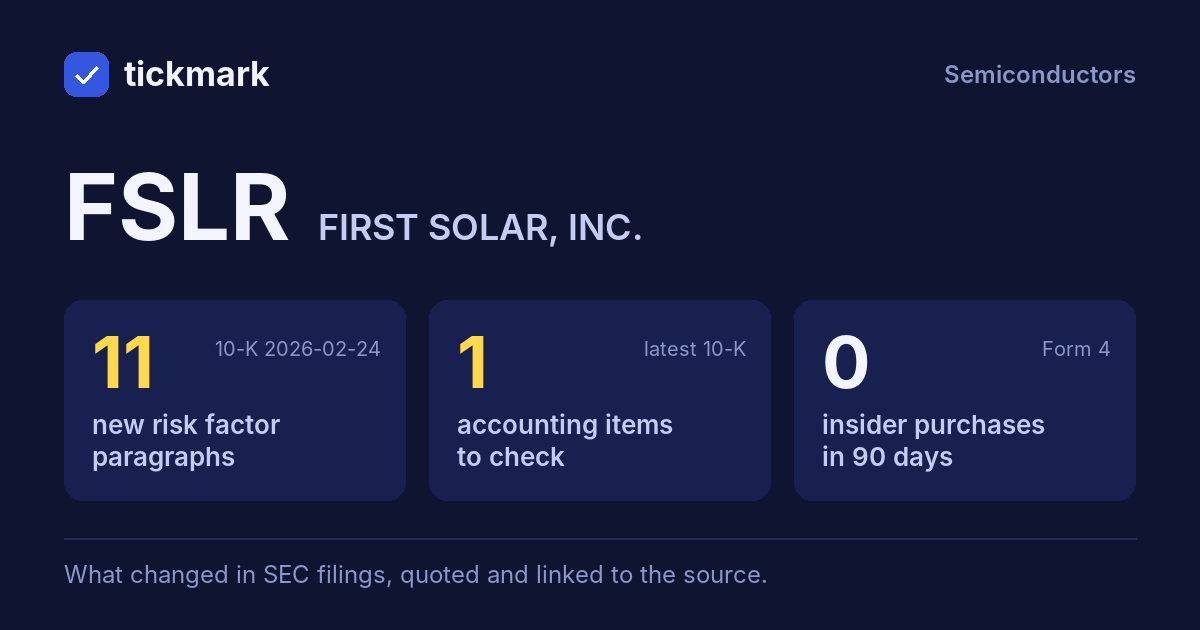
Marked against last year's 10-K:
cut words struck through, new words highlighted and underlined.
MD&A 288 words changed in this paragraph; it is 32% similar to last year's version.
•India. The ALMM was introduced in 2021 as •United States. In April 2024, the American Alliance for Solar Manufacturing Trade Committee, which includes First Solar, filed a non-tariff barrier set of AD/CVD petitions with the USDOC and the USITC to incentivize domestic manufacturing of PV modules by approving the list of models impose duties on certain unfairly traded solar products from Cambodia, Malaysia, Thailand, and manufacturers who can participate in certain solar development projects. The ALMM is approved Vietnam. Following final affirmative determinations by the MNRE, USDOC and any modifications USITC that identified final subsidy rates of 534.67% to 3,403.96% for Cambodia, 14.64% to 168.8% for Malaysia, 263.74% to 799.55% for Thailand, and 68.15% to 542.64% for Vietnam, AD/CVD orders, including the ALMM assessment of countervailing duties and its application may affect future investments in suspension of liquidation of such products, were issued on June 9, 2025. On July 17, 2025, the Alliance for American Solar Manufacturing and Trade filed another set of AD/CVD petitions with the USDOC and the USITC to impose duties on unfairly traded crystalline silicon solar module manufacturing in India. For example, in December 2024, products from India, Indonesia, and Laos. In addition to a range of alleged illegal subsidies, the ALMM was amended petitioners identified dumping margins of 213.96% for India, 89.65% for Indonesia, and 245.79 to require nearly all solar development projects to use PV modules that contain domestically manufactured solar cells, which is expected to be effective 249.09% for such projects completed on or after June 2026. Laos. For more information about the ALMM, this development, see Item 1A. “Risk Factors – The modification, reduction, elimination, or expiration of government subsidies, economic incentives, eligibility limitations, tax incentives, renewable energy targets, and other support for on-grid solar electricity applications, or the impact of other public policies, such as tariffs or other trade remedies imposed on solar cells and modules or related raw materials or equipment, have, and in the future could, negatively impact demand and/or price levels for our solar modules and limit our growth or lead to a reduction in our net sales or increase our costs, thereby adversely impacting our operating results.”
Source: Item 7, 10-K 0001274494-26-000021 vs Item 7, 10-K 0001274494-25-000010
Legal Proceedings 247 words changed in this paragraph; it is 33% similar to last year's version.
We have During the year ended December 31, 2024, we identified manufacturing issues affecting certain Series 7 modules manufactured in 2023 and 2024 that may cause the modules to experience premature power loss once installed in the field. The ultimate loss Subsequently, we will incur for identified the causes of these manufacturing issues will depend and compiled and evaluated data on the extent of the premature power loss that is experienced in relation to the obligations under our limited product warranties, as well as any potential additional commitments we expected impact such issues may make to remediate the affected modules. Based have on currently available information and certain assumptions and estimates, we believe a reasonable estimate of the aggregate losses related to these manufacturing issues will range from approximately $ 56 million to $ 100 million. At this time, no individual amount within that range is a better estimate than any other amount. Accordingly, as of December 31, 2024, we increased our product warranty liability by the low end of the range, which we recorded as a reduction to revenue. The estimated range set forth above was based on our evaluation of the currently available information, performance, including select collecting samples of module performance data from several locations, locations. During the year ended December 31, 2025, we settled certain of our obligations related to these issues and continued to engage in settlement discussions with various additional customers. Based on such settlement experience, the estimated number of affected modules, and projections of probable costs to remediate the issues. As additional information becomes available to us, our issues, we believe a reasonable estimate of the aggregate potential future losses related will range from approximately $ 35 million to these manufacturing issues may change, and any change in estimate may also result in a change to our product warranty liability. $ 75 million.
Source: Item 3, via Note 14 – Commitments and Contingencies, 10-K 0001274494-26-000021 vs Item 3, via Note 14 – Commitments and Contingencies, 10-K 0001274494-25-000010
Risk Factors 224 words changed in this paragraph; it is 40% similar to last year's version.
•United States — Antidumping and Countervailing Duties on Certain Traded Solar Products. In April 2024, the American Alliance for Solar Manufacturing Trade Committee, which includes First Solar, filed a set of AD/CVD petitions with the USDOC and the USITC U.S. International Trade Commission (“USITC”) to impose duties on certain unfairly traded solar products from Cambodia, Malaysia, Thailand, and Vietnam. The investigations could potentially lead On April 21, 2025, the USDOC announced final determinations in the AD/CVD investigations. Final AD/CVD rates ranged from de minimis to over 3,400%, depending on the imposition particular foreign producer. On June 9, 2025, the USITC notified USDOC of its final affirmative determinations in the AD/CVD investigations. AD/CVD orders, including the assessment of AD/CVDs and suspension of liquidation of such products, were issued on June 9, 2025. On July 17, 2025, the Alliance for American Solar Manufacturing and Trade filed another set of AD/CVD orders petitions with the USDOC and the USITC to impose duties on such unfairly traded crystalline silicon solar products. products from India, Indonesia, and Laos. In June 2024, August 2025, the USITC issued affirmative preliminary determinations. In October 2024, the USDOC announced preliminary affirmative determinations in the CVD investigations, finding that silicon solar cells and panels from Cambodia, Malaysia, Thailand, and Vietnam are unfairly subsidized at rates ranging from de minimis to nearly 300%, depending on the particular foreign producer. The USDOC has imposed provisional CVDs accordingly. In November 2024, the USDOC announced preliminary affirmative determinations in the AD investigations, providing for certain preliminary dumping rates applicable to solar cells from Cambodia, Malaysia, Thailand, and Vietnam ranging from de minimis to approximately 270%, depending on the particular foreign producer. The USDOC is expected to announce final issue its preliminary countervailing duty determinations in June 2025. February 2026 and preliminary antidumping duty determinations in April 2026.
Source: Item 1A, 10-K 0001274494-26-000021 vs Item 1A, 10-K 0001274494-25-000010
Accounting Policies 124 words changed in this paragraph; it is 45% similar to last year's version.
Government Grants. We account for government assistance that is not subject to the scope of ASC 740 using a grant accounting model, by analogy to International Accounting Standards 20, Accounting for Government Grants and Disclosure of Government Assistance, and recognize such grants when we have reasonable assurance that we will comply with the grant’s conditions and that the grant will be received. Government grants whose primary condition is the purchase, construction, or acquisition of a long-lived asset are considered asset-based grants and are recognized as a reduction to such asset’s cost basis, which reduces future depreciation. Other government grants not related to long-lived assets are considered income-based grants and are recognized as a reduction to the related cost of activities that generated the benefit. We recognize grants expected to be received directly from a government entity at their stated value. When we expect to transfer grants to a third party, we recognize the grants at, or adjust their carrying value to, the amount expected to be received from the transaction. Proceeds received from asset-based
Source: 10-K text, Note 2 – Summary of Significant Accounting Policies, 10-K 0001274494-26-000021 vs 10-K text, Note 2 – Summary of Significant Accounting Policies, 10-K 0001274494-25-000010