Screener / SEC EDGAR /CIK 0001398659 /10-K filed Feb 26, 2026, compared with Mar 3, 2025 /Numbers from the XBRL of the 10-Ks
NYSE Industrials · Management Consulting Services

Genpact LTD G

Compare with peers Embed
SEC comment letters, last 20 years

5 reviews of G's filings by SEC staff

UPLOAD and CORRESP
Reviews 5 latest letter May 7, 2020
Questions asked 8 each answered in the company's own letter
No closing letter 0 reviews without a letter saying the staff completed it

When the SEC's staff reviews a filing, it writes to the company with numbered questions, and the company answers each one in a letter. SEC publishes the exchange once the review is over, at least 20 business days later. A question is not an accusation; most reviews end with the company adding detail to its next filing.

How the reviews went

Every review on EDGAR, from the first staff letter to the letter that closes it

  1. 1. Staff letters 7 UPLOAD
  2. 2. Questions in them 8 numbered comments
  3. 3. Company replies 8 CORRESP
  4. 4. Reviews closed 5 of 5 closing letter

Half the closed reviews took 15 days or less from the first letter to the closing letter.

Form 10-K for the Fiscal Year Ended December 31, 2019

2020-05-07 to 2020-05-21 · 1 question · 1 letter from the SEC, 1 from the company
Review closed 2020-05-21
Liquidity and cashAcquisitionsRisk factorsDebt
SEC asked
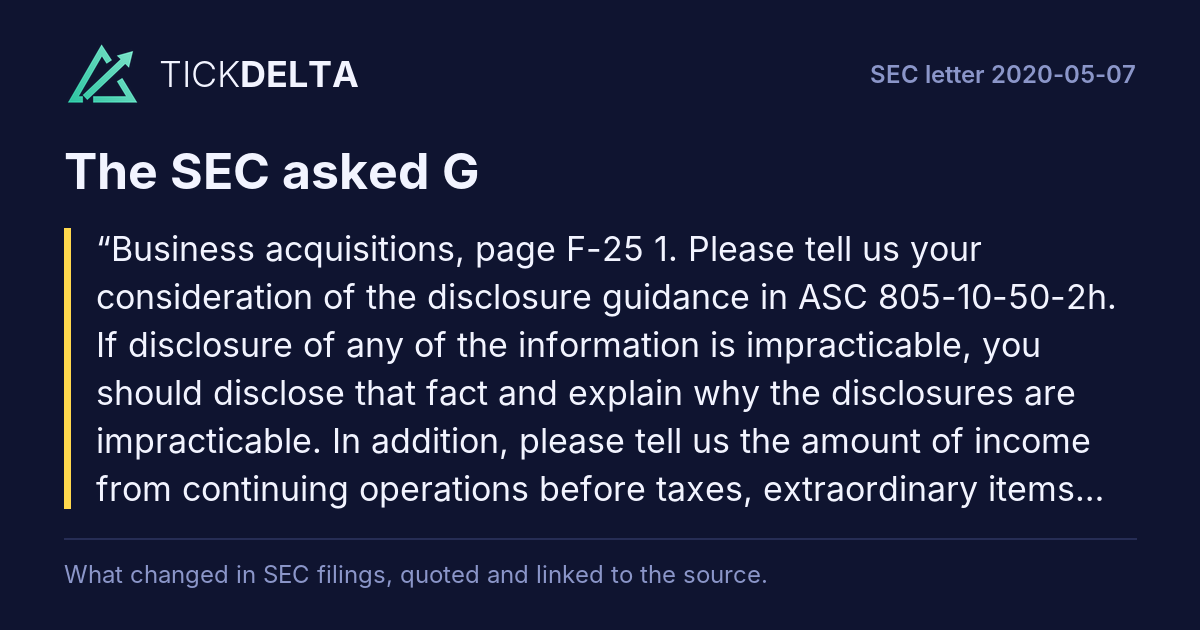
Business acquisitions, page F-25 1. Please tell us your consideration of the disclosure guidance in ASC 805-10-50-2h. If disclosure of any of the information is impracticable, you should disclose that fact and explain why the disclosures are impracticable.
Rest of the question

In addition, please tell us the amount of income from continuing operations before taxes, extraordinary items and cumulative effect of a change in accounting principle of Rightpoint Consulting LLC for the year ended December 31, 2018 used to measure the significance of the acquired business under Rule 3-05 of Regulation S-X. 14. Long-term debt, page F-40 2. We note your disclosure in Risk Factors that your ability to pay dividends is subject to restrictive covenants contained in credit facility agreements. Please tell us your consideration of describing the most significant restrictions on the payment of dividends, indicating their pertinent provisions and the amount of retained earnings or net income restricted or free of restrictions. Please refer to Rule 4-08(e)(1) of Regulation S-X. 17. Employee benefit plans, page F-43 3. We note that retirement benefits recognized in the consolidated balance sheets as disclosed in notes 13 and 16 are greater than the amounts disclosed in the table of the funded status of defined benefit plans on page F-44 and deferred compensation plan disclosed on page F-49. Please tell us the nature and amounts of other items included in retirement benefits in notes 13 and 16.

G answered
We acknowledge the Staff’s comment and advise as follows regarding the Company’s consideration of the disclosure guidance in ASC 805-10-50-2h.

The disclosure guidance under ASC 805-10-50-2h requires a public entity to disclose pro forma revenue and earnings of the combined entity as though the business combination(s) that occurred during the current year had occurred as of the beginning of the comparable prior annual reporting period if comparative financial information is provided.
Rest of the answer

This disclosure is required only where acquired businesses during the fiscal year are, in the aggregate, considered material under ASC 805-10-50-3. Our materiality evaluation indicated the 2019 acquired businesses, taken together, were not material as a percentage of total Company assets, net assets or income from continuing operations.

Additionally, we evaluated the significance of Rightpoint Consulting, LLC under the tests set forth in Rule 3-05 of Regulation S-X and concluded that Rightpoint Consulting, LLC did not meet any of the tests required for conclusion that Rightpoint was a significant business. We note for the Staff that the amount of income (loss) from continuing operations before taxes, extraordinary items and cumulative effect of a change in accounting principle of Rightpoint Consulting, LLC for the year ended December 31, 2018 that was used to measure the significance of the Rightpoint business under Rule 3-05 of Regulation S-X was $(3,412,441). Finally, there was no significant impact on our disclosures due to differences in the accounting policies of the Company and Rightpoint Consulting, LLC, and, accordingly, any such differences were disregarded for purposes of our analysis.

14. Long-term debt, page F-40

2)

We note your disclosure in Risk Factors that your ability to pay dividends is subject to restrictive covenants contained in credit facility agreements. Please tell us your consideration of describing the most significant restrictions on the payment of dividends, indicating their pertinent provisions and the amount of retained earnings or net income restricted or free of restrictions. Please refer to Rule 4-08(e)(1) of Regulation S-X.

Response:

We acknowledge the Staff’s comment and advise as follows regarding the Company’s considerations in describing the most significant restrictions on the payment of dividends.

Our amended credit agreement restricts certain payments, including dividend payments, only if:

•

The Company is in default in connection with the performance or observance of any term of the credit agreement; or

The Company is not, or after making any such payment would not be, in compliance with certain financial covenants, specifically the maintenance of a net debt to EBITDA leverage ratio of below 3x and an interest coverage ratio of more than 3x.

In response to the Staff’s comment, we have added the disclosure set forth below on page 25, Note 12, in our Quarterly Report on Form 10-Q for the quarter ended March 31, 2020, filed on May 11, 2020, and we will continue to include such disclosure in future filings with the SEC.

“The amended credit agreement restricts certain payments, including dividend payments, if there is an event of default under the credit agreement or if the Company is not, or after making the payment would not be, in compliance with certain financial covenants contained in the amended credit agreement. These covenants require the Company to maintain a net debt to EBITDA leverage ratio of below 3x and an interest coverage ratio of more than 3x. For the quarter ended March 31, 2020, the Company was in compliance with the terms of the credit agreement, including all of the financial covenants therein. The Company’s retained earnings are not subject to any restrictions on availability to make dividend payments to shareholders, subject to compliance with the financial covenants described above that are contained in the amended credit agreement.”

17. Employee benefit plans, page F-43

3)

We note that retirement benefits recognized in the consolidated balance sheets as disclosed in notes 13 and 16 are greater than the amounts disclosed in the table of the funded status of defined benefit plans on page F-44 and deferred compensation plan disclosed on page F-49. Please tell us the nature and amounts of other items included in retirement benefits in notes 13 and 16.

Response:

We acknowledge the Staff’s comment and advise as follows regarding the Company’s disclosures in notes 13 and 16.

The amount disclosed in notes 13 and 16 includes the Company’s liabilities for all retirement benefits, while the table of defined benefit plans on page F-44 is restricted to liabilities relating to defined benefit plans. In addition to defined benefit plans, the retirement benefits disclosed in Notes 13 and 16 also include the Company’s liability for compensated absences, as defined in Note 2(p) to the financial statements included in our Annual Report on Form 10-K for the year ended December 31, 2019. To clarify our disclosure, we have made additional disclosure of the amount of the Company’s liability for compensated absences in Notes 13 and 14 on page 27 of our Quarterly Report on Form 10-Q for the quarter ended March 31, 2020, filed on May 11, 2020.

Finally, although the deferred compensation plan disclosed on page F-49 is an employee benefit plan, it is not a retirement benefit and has therefore been excluded from retirement benefits disclosed in Notes 13 and 16. We have included disclosure regarding the deferred compensation plan on page F-50 of the Company’s Form 10-K for the year ended December 31, 2019, and amounts relating to the deferred compensation plan are included in the “Others” line item, in note 16 (Other liabilities).

Read in the reply

Also in this review: closing letter, 2020-05-21
Form 10-K for the fiscal year ended December 31, 2016

2017-04-19 to 2017-06-22 · 2 questions · 2 letters from the SEC, 3 from the company
Review closed 2017-06-13
Income taxesRisk factors
Item 1A. Risk Factors · Tax matters may have an adverse effect on our operations, effective tax rate and financial condition, page 17
SEC asked
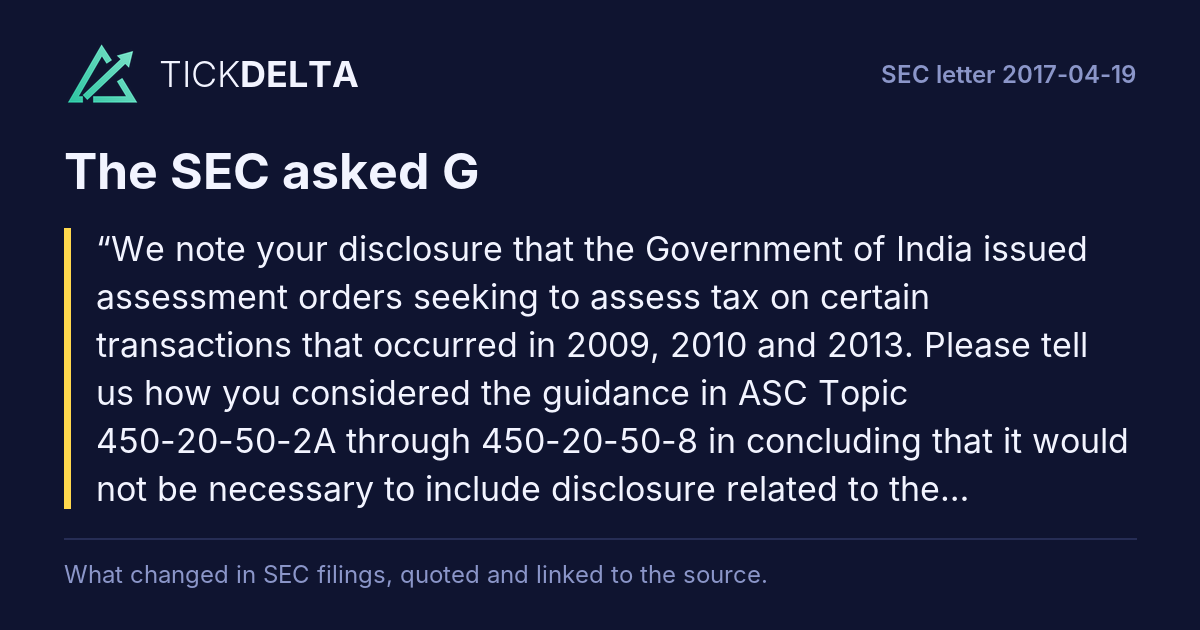
We note your disclosure that the Government of India issued assessment orders seeking to assess tax on certain transactions that occurred in 2009, 2010 and 2013. Please tell us how you considered the guidance in ASC Topic 450-20-50-2A through 450-20-50-8 in concluding that it would not be necessary to include disclosure related to the assessment orders in your financial statements.
G answered
We acknowledge the Staff’s comment and considered the guidance in ASC Topic 450-20-50-2A through 450-20-50-8.

In the Annual Report, the Company has made the following disclosure in Item 1A—Risk Factors on page 17:

“[T]he Government of India issued assessment orders to us in 2014, 2015 and 2016 seeking to assess tax on certain transactions that occurred in 2009, 2010 and 2013. We do not believe that the transactions should be subject to tax in India under applicable law, including due to the relief provided under the Mauritius-India treaty, and have accordingly filed appeals.
Rest of the answer

Our appeal in respect of tax year 2010 has been resolved in our favor. We have received demands for potential tax claims resulting from assessments related to tax years 2009 and 2013 in an aggregate amount of $158 million, including interest. To date, we have paid a total of $20 million toward these demands to the Indian tax authority under protest, and may be required to pay the remainder of the demands pending resolution of the matter. There is no assurance that we will prevail in this matter or similar transactions, including where we have relied on the Mauritius-India treaty, and a final determination of tax in the amounts claimed could have a material adverse effect on our operations, effective tax rate and financial condition.”

The transactions referred to in this risk factor relate to certain transactions executed during the years 2009, 2010 and 2013 between the Company’s Indian and Mauritius subsidiaries. The transactions involved the repurchase of its own shares by one of the Company’s Indian subsidiaries and related restructuring. The Indian tax authorities have issued orders seeking to assess additional tax on these transactions.

These assessments were under the Indian Income Tax Act. The Company believes that any disclosure of the potential tax liability resulting from the assessments is properly governed by ASC Topic 740—Income Taxes and not ASC Topic 450-20. As provided in ASC Topic 450-20-15, uncertainty in income taxes is specifically excluded from the scope of ASC Topic 450-20. The Company evaluated the assessments under ASC Topic 740 and concluded that, based on the technical merits of the cases, it is more likely than not that the Company is not liable for any additional taxes as a result of the above-referenced transactions. Accordingly, the Company made no disclosure relating to the assessments in its financial statements.

Read in the reply
In its next report

First report after the company's reply of May 1, 2017: 10-Q filed May 10, 2017 ↗, against the 10-Q filed Nov 8, 2016 ↗.

Tickdelta does not hold the text of both reports, so they are not compared here.

Item 1A. Risk Factors · Tax Matters may have an adverse effect on our operations, effective tax rate and financial condition, page 17
SEC asked
We have considered your response to our prior comment. Please clarify for us how you have applied the guidance in ASC Topic 740-10-50-15 with respect to the assessment orders issued by the Government of India.
G answered
We acknowledge the Staff’s comment, and advise as follows regarding the Company’s application of ASC 740-10-50-15 to the subject transactions.

As we indicated in our May 1, 2017 response letter, we evaluated the Indian tax assessments under ASC Topic 740 and concluded that no disclosure relating to the assessments was required in our financial statements.

In applying the guidance of 740-10-50-15, the Company evaluated whether it is more likely than not that the Company’s tax positions are sustainable, based on technical merits, despite the Indian tax authorities’ assessment orders.
Rest of the answer

Consideration was given to a number of factors, including the applicable statutes, precedents, administrative practice, and available appellate procedures. With respect to several technical aspects, the advice of expert tax counsel was sought to support management’s analysis. Based on that detailed analysis, management concluded that it was more likely than not that the tax benefits were sustainable. The Company further proceeded with the measurement of the tax benefits and concluded the full tax benefits were likely to be realizable and therefore the Company recognized the full tax benefit. Consequently, management determined that there were no unrecognized tax benefits to be disclosed.

Read in the reply
In its next report

First report after the company's reply of Jun 16, 2017: 10-Q filed Aug 9, 2017 ↗, against the 10-Q filed Nov 8, 2016 ↗.

Tickdelta does not hold the text of both reports, so they are not compared here.

Also in this review: company letter, Jun 22, 2017, closing letter, 2017-06-13

Form 10-K for the fiscal year ended December 31, 2015

2016-05-17 to 2016-06-01 · 2 questions · 1 letter from the SEC, 1 from the company
Review closed 2016-06-01
Non-GAAP measuresRevenueResults discussion (MD&A)
Operations, page 38 · Net Revenues, page 49
SEC asked (1)
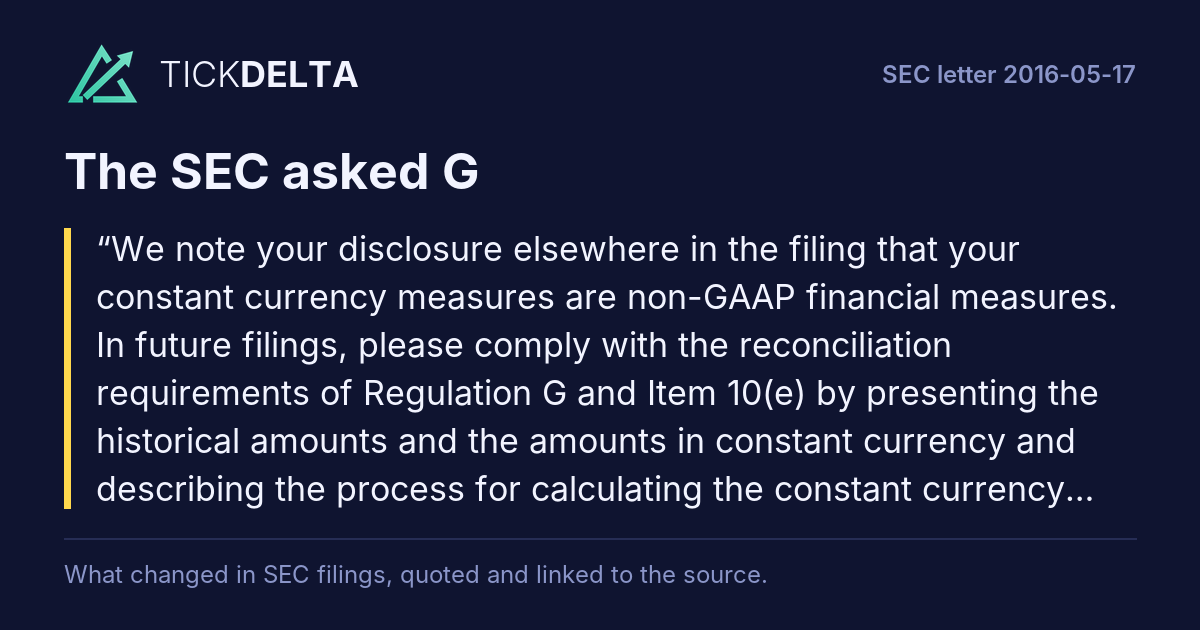
We note your disclosure elsewhere in the filing that your constant currency measures are non-GAAP financial measures. In future filings, please comply with the reconciliation requirements of Regulation G and Item 10(e) by presenting the historical amounts and the amounts in constant currency and describing the process for calculating the constant currency amounts and the basis of presentation.
Rest of the question

This reconciliation should also be included in any Item 2.02 Form 8-K filings to the extent constant currency measures are presented.

G answered

No numbered answer found in the reply. Read the reply ↗

In its next report

First report after the company's reply of May 27, 2016: 10-Q filed Aug 8, 2016 ↗, against the 10-Q filed May 9, 2016 ↗.

Tickdelta does not hold the text of both reports, so they are not compared here.

Form 8-K dated February 4, 2016 · Item 2.02 – Results of Operations and Financial Condition
SEC asked (2)
We note you provided forecasts and forecast ranges for certain non-GAAP financial measures. In future Item 2.02 Form 8-K’s, please provide the reconciliations required by Item 10(e)(1)(i) of Regulation S-K.
G answered
We acknowledge the Staff's comment and advise the Staff that in future Item 2.02 Form 8-K filings that contain forecasts and forecast ranges for non-GAAP financial measures, we will provide the reconciliations required by Item 10(e)(l)(i) of Regulation S-K.

The Company acknowledges that:

·

The Company is responsible for the adequacy and accuracy of the disclosure in the filing;

Staff comments or changes to disclosure in response to Staff comments do not foreclose the Commission from taking any action with respect to the filing; and

The Company may not assert Staff comments as a defense
Rest of the answer

in any proceeding initiated by the Commission or any person under the federal securities laws of the United States.

Read in the reply
In its next report

First report after the company's reply of May 27, 2016: 10-Q filed Aug 8, 2016 ↗, against the 10-Q filed May 9, 2016 ↗.

Tickdelta does not hold the text of both reports, so they are not compared here.

Also in this review: closing letter, 2016-06-01

Form 10-K for the year ended December 31, 2014

2015-04-14 to 2015-05-27 · 2 questions · 2 letters from the SEC, 2 from the company
Review closed 2015-05-27
Non-GAAP measures
Operations, page 39 · Bookings, page 47
SEC asked
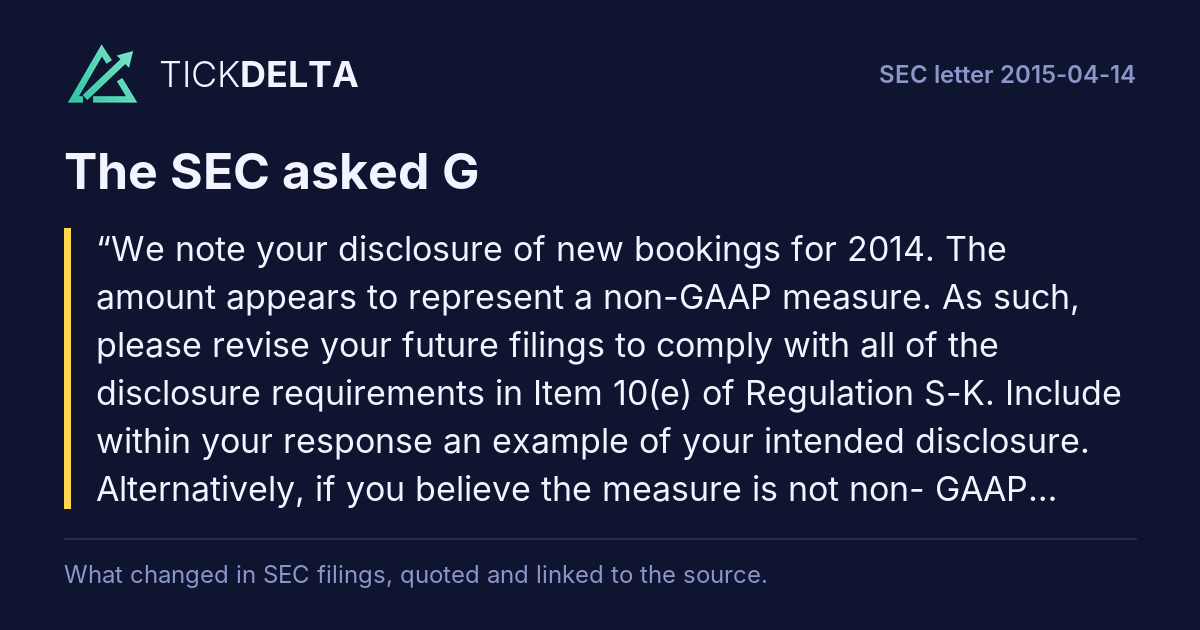
We note your disclosure of new bookings for 2014. The amount appears to represent a non-GAAP measure. As such, please revise your future filings to comply with all of the disclosure requirements in Item 10(e) of Regulation S-K. Include within your response an example of your intended disclosure. Alternatively, if you believe the measure is not non- GAAP, please explain to us in detail the basis for your position.
G answered
The Company provided disclosure regarding new bookings in Management’s Discussion and Analysis of Financial Condition and Results of Operations in the Company’s Annual Report. The Company defines new bookings as the contract value of new client contracts, including certain renewals, extensions and changes to existing contracts to the extent that such changes include increases to scope of work to be performed, but specifically excludes regular renewals of contracts with no change in scope.
Rest of the answer

In effect, new bookings is a subset of the orders received by the Company in a given time period.

The Company respectfully advises the Staff that it believes new bookings is not a non-GAAP financial measure within the meaning of Item 10(e)(2) of Regulation S-K and that new bookings is an “operating or other statistical measure” that is expressly excluded from the definition of a non-GAAP financial measure under Item 10(e)(4)(i) of Regulation S-K.

Item 10(e)(2) of Regulation S-K defines a non-GAAP financial measure as a numerical measure of a registrant’s historical or future financial performance, financial position or cash flows that:

(i) excludes amounts, or is subject to adjustments that have the effect of excluding amounts, that are included in the most directly comparable measure calculated and presented in accordance with GAAP in the statement of income, balance sheet or statement of cash flows (or equivalent statements) of the issuer, or

(ii) includes amounts, or is subject to adjustments that have the effect of including amounts, that are excluded from the most directly comparable measure so calculated and presented.

Item 10(e)(4)(i) of Regulation S-K expressly excludes operating and other statistical measures from the definition of “non-GAAP financial measures.”

The Company does not calculate new bookings by excluding or including any amounts that are included or excluded, respectively, from a measure calculated in accordance with GAAP and new bookings is not subject to adjustments that have the effect of excluding or including any amounts presented in accordance with GAAP. As used by the Company, new bookings is an operating measure that is not derived from the Company’s revenues or any other amounts presented in accordance with GAAP in the Company’s statement of income, balance sheet or statement of cash flows or other equivalent statements. New bookings, as defined by the Company, are a subset of orders. We believe that orders are an operating performance measure that fall outside the scope of the definition of non-GAAP financial measures.

New bookings does not directly correspond to the Company’s historical or future revenues. The Company’s revenues recognized each year will vary from the new bookings value since new bookings is a snapshot measurement of a portion of total client contract value at a moment in time which involves estimates and judgments around various factors, including contract interpretation, scope of services to be provided, tenor (contract terms range from one month to seven years), the start date of performance under a contract, the time period taken to achieve full volume under a contract, foreign currency exchange rates and price movements for cost of living adjustments in future years. Given the multitude of variables involved, the Company is unable to ascertain in a meaningful way what portion of revenues recognized in a given year corresponds to a new bookings number for that year.

The Company believes that new bookings is an important and useful metric as an indicator of revenue growth potential. New bookings is also used by management to measure the Company’s sales force productivity. Please also note that the Company understands that bookings is used by other companies as an operating measure and generally is not treated as a non-GAAP financial measure subject to reconciliation.

Accordingly, for the reasons stated above, the Company does not believe it is required to make the disclosures required of non-GAAP financial measures as new bookings does not qualify as a non-GAAP financial measure under Item 10(e)(2) of Regulation S-K and is expressly excluded from such definition under Item 10(e)(4)(i) of Regulation S-K.

The Company acknowledges that:

·

The Company is responsible for the adequacy and accuracy of the disclosure in the filing;

Staff comments or changes to disclosure in response to staff comments do not foreclose the Commission from taking any action with respect to the filing; and

The Company may not assert staff comments as a defense in any proceeding initiated by the Commission or any person under the federal securities laws of the United States.

Read in the reply
In its next report

First report after the company's reply of Apr 24, 2015: 10-Q filed May 8, 2015 ↗, against the 10-Q filed Nov 7, 2014 ↗.

Tickdelta does not hold the text of both reports, so they are not compared here.

Operations, page 39 · Bookings, page 47
SEC asked
We note your response to our prior comment one. In future filings, please specifically identify new bookings as an operating or other statistical measure. Additionally, to the extent material, please disclose the reasons for the change in new bookings for the periods presented.
G answered
The Company confirms that in future filings it will specifically identify new bookings as an operating or other statistical measure and, to the extent material, disclose the reasons for the change in new bookings for the periods presented.

The Company acknowledges that:

·

The Company is responsible for the adequacy and accuracy of the disclosure in the filing;

Staff comments or changes to disclosure in response to staff comments do not foreclose the Commission from taking any action with respect to the filing; and

The Company may not assert staff comments as a defense in any proceeding
Rest of the answer

initiated by the Commission or any person under the federal securities laws of the United States.

Read in the reply

Also in this review: closing letter, 2015-05-27

Form 10-K

2013-06-10 to 2013-06-25 · 1 question · 1 letter from the SEC, 1 from the company
Review closed 2013-06-25
Financial Statements · Consolidated Statements of Income, page F-6
SEC asked
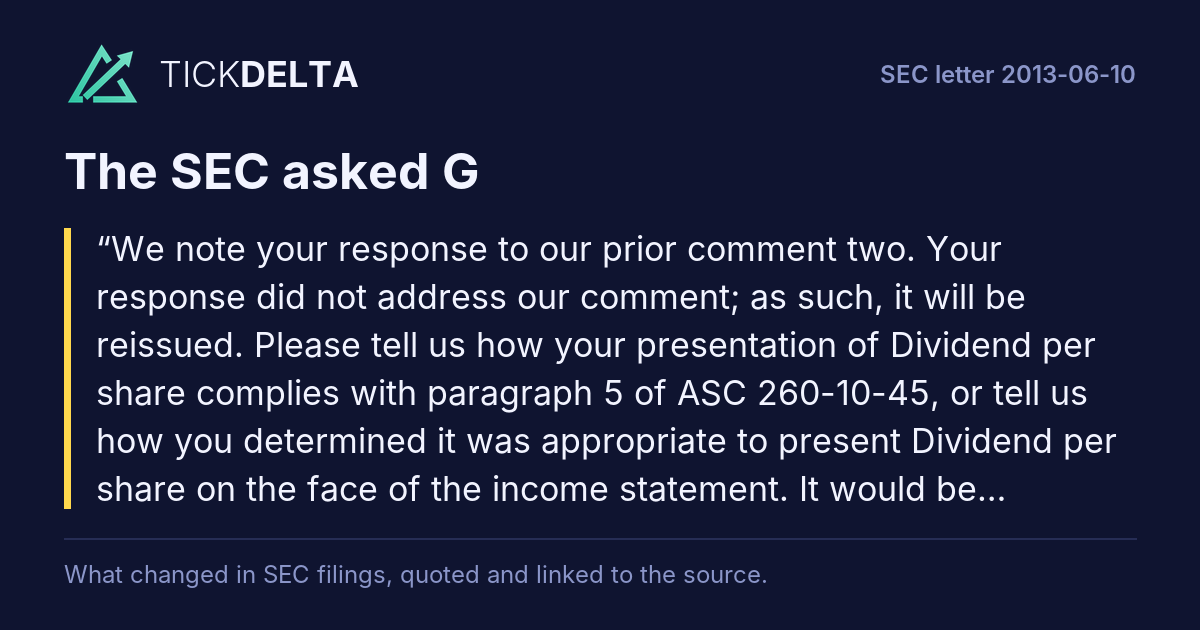
We note your response to our prior comment two. Your response did not address our comment; as such, it will be reissued. Please tell us how your presentation of Dividend per share complies with paragraph 5 of ASC 260-10-45, or tell us how you determined it was appropriate to present Dividend per share on the face of the income statement.
Rest of the question

It would be appropriate to present dividend per share within the financial statement footnotes only.

G answered
The Company has considered the guidance in paragraph 5 of ASC 260-10-45. With respect to the special dividend of $2.24 per share we paid on September 24, 2012, the primary reason the Company disclosed the dividend per share information on the face of the income statement in our Annual Report in addition to the footnotes was to make the disclosure more accessible to the reader.

In future filings, disclosure relating to dividends will be included in the footnotes only and not on the face of the income statement.
Read in the reply
In its next report

First report after the company's reply of Jun 13, 2013: 10-Q filed Aug 9, 2013 ↗.

No earlier 10-Q before the SEC's letter is in Tickdelta, so there is nothing to compare with.

Also in this review: closing letter, 2013-06-25

Letters without questions

Other letters

UPLOAD and CORRESP
2 other letters: notices that a filing will not be reviewed, requests to declare a registration effective, and the like
  • Jun 21, 2018 · G: letter to the SEC · Genpact Luxembourg S.à r.l. · Genpact Limited · Registration Statement on Form S-4 ·...
  • Jun 14, 2018 · SEC: will not review the filing · Genpact Limited · Registration Statement on Form S-4 · Filed June 4, 2018 · File No. 333-225425

From the SEC's correspondence on EDGAR: staff letters (form UPLOAD) and company letters (form CORRESP), 22 letters filed since 2013-06-10. Questions and answers are matched by their numbers; topics come from words in each question. The reports are compared word for word (same form, before the first SEC letter against the first report after the company's reply). No AI.

Sources

The SEC's correspondence on EDGAR: staff letters (form UPLOAD) and company letters (form CORRESP), matched question by question. No AI.

Also

Filings: the letters in the filing list.

Work with it

Excel workbook · CSV. Google Sheet that stays up to date: paste =IMPORTDATA("https://tickdelta.com/company/G/export.csv") into a cell.

Next in Owners and insiders:Insider trades
Esc

Type a ticker such as AAPL, a name, an investor such as Buffett, or a topic such as tariffs. ↑ ↓ to move, Enter to open.