Paragraph 99 · 50% changed
Every version of it
Screener
/
SEC EDGAR
/CIK 0000039911
/10-K filed Mar 17, 2026, compared with Mar 18, 2025
/Numbers from the XBRL of the 10-Ks
NYSE
Consumer discretionary · Apparel Retail
GAP Inc GAP
The 10-K against last year's
128 changes: 18 added, 28 removed, 81 reworded, 1 quiet changes
10-K Mar 17, 2026 vs Mar 18, 2025
Risk Factors
22.6%
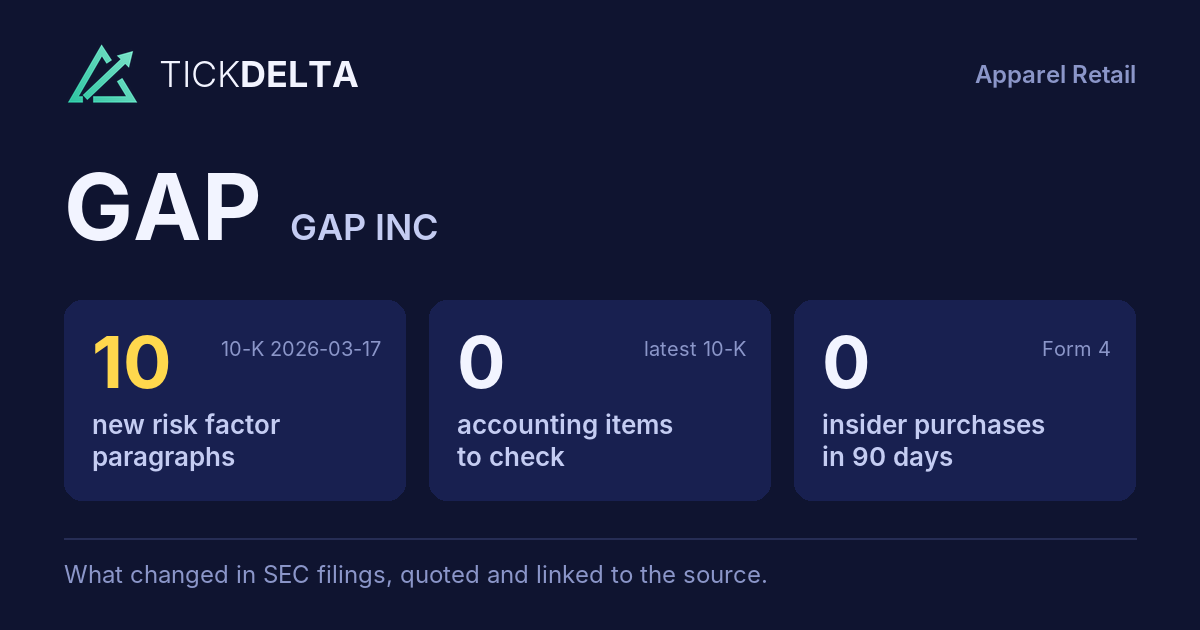
of the text changed · 8,330 words now · 10 new paragraphs, 17 gone
MD&A
15.1%
of the text changed · 4,617 words now · 8 new paragraphs, 11 gone
Legal Proceedings
2.1%
of the text changed · 423 words now
Accounting Policies
8.4%
of the text changed · 3,756 words now
10-K 0001628280-26-018573 (Mar 17, 2026) vs 10-K 0000039911-25-000029 (Mar 18, 2025)
Every paragraph, and how much of it changed
One bar per paragraph, in the order of the 10-K. Height and colour show the share of its words not in the closest paragraph a year earlier; the tallest bars are new paragraphs.
Risk Factors
106 paragraphs · 10 new · 75 reworded · 17 gone · 10-K Mar 17, 2026 against Mar 18, 2025
New paragraph
Reworded (5% of its words or more)
Same or nearly
Paragraph 24 · 48% changed
Every version of it
Paragraph 57 · 46% changed
Every version of it
Paragraph 85 · 46% changed
Every version of it
•limit our flexibility in planning for, for or reacting to, to general adverse economic conditions or changes in our business and the industry in which we operate; or industry;
Paragraph 49 · 43% changed
Every version of it
We have entered into franchise agreements to operate stores and websites in many countries around the world. Under these agreements, third parties operate, or will operate, stores and websites that sell apparel and related products under our brand names. We have also entered into licensing agreements with third parties to sell products using our brand names. The effect of these arrangements on our business and results of operations is uncertain and will depend upon various factors, including the demand for our products in international markets, the demand for new product categories and our ability to successfully identify appropriate third parties to act as franchisees, licensees, distributors, or in a similar capacity. In addition, certain aspects of these arrangements are not directly within our control, such as franchisee and licensee financial stability and the ability of these third parties to meet their projections regarding store locations, store openings, and sales.
Paragraph 89 · 43% changed
Every version of it
We generated net cash from operating activities of $1.3 billion in fiscal 2025 and ended fiscal 2025 with $3.0 billion of cash, cash equivalents, and short-term investments on our balance sheet. Our ability to make required payments on our indebtedness depends upon our future operating performance and cash flow generation, which are subject to general economic, financial, business, competitive, legislative, regulatory, and other factors that are beyond our control. We cannot assure you that our business will generate sufficient cash flows from operations or that future borrowings will be available to us in an amount sufficient to enable us to fund our debt service obligations and other liquidity needs. If we cannot make scheduled payments on our indebtedness, we will be in default and, as a result, our lenders could declare all outstanding principal and interest to be due and payable, could terminate their commitments to loan money to us, and could foreclose against any assets securing our indebtedness under the ABL Facility, and we could be forced into bankruptcy or liquidation. Facility.
Paragraph 106 · 43% changed
Every version of it
Paragraph 96 · 41% changed
Every version of it
Paragraph 99 · 50% changed
Every version of it
10-K Mar 18, 2025Failure to comply with applicable laws and regulations, and changes in the regulatory or administrative landscape, could adversely affect our business, financial condition, and results of operations.
10-K Mar 17, 2026
We must comply with applicable laws and regulations and manage changes in the regulatory and administrative landscape.
Paragraph 24 · 48% changed
Every version of it
10-K Mar 18, 2025Our success is largely dependent upon our ability to gauge and anticipate the tastes of our customers and to provide merchandise that satisfies customer demand in a timely manner. However, lead times for many of our design and purchasing decisions may make it more difficult for us to respond rapidly to new or changing apparel trends or consumer acceptance of our products. In addition, transportation shortages, factory closures, labor shortages, port congestion, and other supply chain disruptions have in the past and may in the future lead to prolonged delays in receiving inventory. The global apparel retail business fluctuates according to changes in consumer preferences, dictated in part by apparel trends and season. To the extent we misjudge the market for our merchandise or the products suitable for local markets, or fail to execute trends and deliver products to the market as timely as our competitors, our sales will be adversely affected, and the markdowns required to move the resulting excess inventory will adversely affect our gross margins and results of operations.
10-K Mar 17, 2026
according to changes in consumer preferences, dictated in part by apparel trends and season. To the extent we misjudge the market for our merchandise or the products suitable for local markets, or fail to execute trends and deliver products to the market as timely as our competitors, our sales will be adversely affected and we will need to mark down excess inventory. Any of these risks could adversely affect our business, financial condition, and results of operations.
Paragraph 57 · 46% changed
Every version of it
10-K Mar 18, 2025Our investments in customer, digital, omni-channel, and other strategic initiatives may not deliver the results we anticipate.
10-K Mar 17, 2026
If the implementation of our customer, digital, omni-channel, and other strategic initiatives is not successful, or we do not realize the return on our investments in these initiatives that we anticipate, our business, financial condition, and results of operations could be adversely affected.
Paragraph 85 · 46% changed
Every version of it
10-K Mar 18, 2025
•limit our flexibility in planning for, or reacting to, changes in our business and the industry in which we operate;
10-K Mar 17, 2026
•limit our flexibility in planning for or reacting to general adverse economic conditions or changes in our business or industry;
Paragraph 49 · 43% changed
Every version of it
10-K Mar 18, 2025
We have entered into franchise agreements to operate stores and websites in many countries around the world. Under these agreements, third parties operate, or will operate, stores and websites that sell apparel and related products under our brand names. We have also entered into licensing agreements to sell products using our brand names. The effect of these arrangements on our business and results of operations is uncertain and will depend upon various factors, including the demand for our products in international markets, the demand for new product categories and our ability to successfully identify appropriate third parties to act as franchisees, licensees, distributors, or in a similar capacity. In addition, certain aspects of these arrangements are not directly within our control, such as franchisee and licensee financial stability and the ability of these third parties to meet their projections regarding store locations, store openings, and sales.
10-K Mar 17, 2026
We have entered into franchise agreements to operate stores and websites in many countries around the world. Under these agreements, third parties operate, or will operate, stores and websites that sell apparel and related products under our brand names. We have also entered into licensing agreements with third parties to sell products using our brand names.
Paragraph 89 · 43% changed
Every version of it
10-K Mar 18, 2025
If we cannot make scheduled payments on our indebtedness, we will be in default and, as a result, our lenders could declare all outstanding principal and interest to be due and payable, could terminate their commitments to loan money to us, and could foreclose against any assets securing our indebtedness under the ABL Facility, and we could be forced into bankruptcy or liquidation.
10-K Mar 17, 2026
We generated net cash from operating activities of $1.3 billion in fiscal 2025 and ended fiscal 2025 with $3.0 billion of cash, cash equivalents, and short-term investments on our balance sheet. Our ability to make required payments on our indebtedness depends upon our future operating performance and cash flow generation, which are subject to general economic, financial, business, competitive, legislative, regulatory, and other factors that are beyond our control. We cannot assure you that our business will generate sufficient cash flows from operations or that future borrowings will be available to us in an amount sufficient to enable us to fund our debt service obligations and other liquidity needs. If we cannot make scheduled payments on our indebtedness, we will be in default and, as a result, our lenders could declare all outstanding principal and interest to be due and payable, could terminate their commitments to loan money to us, and could foreclose against any assets securing our indebtedness under the ABL Facility.
Paragraph 106 · 43% changed
Every version of it
10-K Mar 18, 2025Failure to comply with applicable laws and regulations, and changes in the regulatory or administrative landscape, could adversely affect our business, financial condition, and results of operations.
10-K Mar 17, 2026
impact income in the quarter of such development, settlement, or resolution. An unfavorable outcome could adversely affect our business, financial condition, and results of operations.
Paragraph 96 · 41% changed
Every version of it
10-K Mar 18, 2025Global economic conditions have and could continue to adversely affect our business, financial condition, and results of operations.
10-K Mar 17, 2026
adverse impacts. Any of these risks could adversely affect our business, financial condition, results of operations, and reputation.
MD&A
90 paragraphs · 8 new · 34 reworded · 11 gone · 10-K Mar 17, 2026 against Mar 18, 2025
New paragraph
Reworded (5% of its words or more)
Same or nearly
Paragraph 34 · 50% changed
Paragraph 55 · 46% changed
•a decrease of $471 $80 million related to merchandise inventory driven by a slight increase in inventory at the end of fiscal 2024 accounts payable, primarily due to the timing of receipts payments for merchandise inventory compared with a significant reduction in inventory in fiscal 2023 as a result of an elevated opening balance of inventory in that fiscal year. 2024;
Paragraph 57 · 44% changed
Paragraph 40 · 40% changed
Interest income increased $26 million primarily includes interest earned on our cash, cash equivalents, and short-term investments, as well as tax-related interest income. Interest income decreased slightly during fiscal 2024 2025 compared with fiscal 2023 2024, primarily due to higher cash balances, lower interest rates, partially offset by a decrease in tax-related interest income. higher cash balances.
Paragraph 60 · 38% changed
Paragraph 17 · 37% changed
Macroeconomic factors, including uncertainty surrounding inflationary pressures, global geopolitical instability, inflationary pressures, foreign currency fluctuations, and changes related to government fiscal, monetary, and tax policies including changes in interest rates, tax rates, duties, tariffs, tax laws, and other restrictions, restrictions as a result of government fiscal, monetary, trade, and tax policies, continue to create a complex and challenging retail macro environment. The macroeconomic environment has had In fiscal 2025, the United States enacted significant changes to its trade policy and may continue imposed substantial tariffs on imported goods from most countries. In February 2026, the U.S. Supreme Court invalidated tariffs imposed under the IEEPA, and subsequently, new tariffs were imposed on a temporary basis pursuant to have an impact on consumer behavior. We anticipate alternative statutory authority. With continued uncertainty related to the macroeconomic environment expected during fiscal 2025, and 2026, we will continue to monitor the impact of macroeconomic conditions, including conditions on consumer behavior and the impact of these factors on consumer demand. For additional information on the risks and uncertainties to our business caused by macroeconomic factors, see the section sections entitled “Risk Factors—Risks Related to Macroeconomic Conditions—Global Conditions—Our business is impacted by global economic conditions and the related impact on consumer spending” and "Risk Factors—Risks Related to Macroeconomic Conditions—Trade matters, including the imposition of tariffs by the United States, have had, and could continue to adversely affect have, an adverse effect on our business, financial condition, and results of operations” business" in Item 1A, Risk Factors, of this Form 10-K.
Paragraph 42 · 36% changed
The change in the effective tax rate for fiscal 2024 2025 compared with fiscal 2023 2024 was primarily due to changes in valuation allowances in the prior year, tax benefits recognized in the prior year from a U.S. transfer pricing settlement related to our sourcing activities, and changes in the amount and mix of jurisdictional earnings, partially offset by a as well as less favorable impact from stock-based impacts of share-based compensation.
Paragraph 59 · 36% changed
Paragraph 34 · 50% changed
10-K Mar 18, 2025•Occupancy expenses decreased 0.4 percentage points as a percentage of net sales in fiscal 2024 compared with fiscal 2023, primarily driven by an increase in net sales without a corresponding increase in occupancy expenses.
10-K Mar 17, 2026
•Cost of goods sold increased 0.8 percentage points as a percentage of net sales in fiscal 2025 compared with fiscal 2024, primarily driven by an estimated impact of approximately 1.2 percentage points from tariff costs net of related mitigation efforts, partially offset by less promotional activity at all brands except Athleta Global.
Paragraph 55 · 46% changed
10-K Mar 18, 2025
•a decrease of $471 million related to merchandise inventory driven by a slight increase in inventory at the end of fiscal 2024 primarily due to the timing of receipts compared with a significant reduction in inventory in fiscal 2023 as a result of an elevated opening balance of inventory in that fiscal year.
10-K Mar 17, 2026
•a decrease of $80 million related to accounts payable, primarily due to timing of payments for merchandise inventory compared with fiscal 2024;
Paragraph 57 · 44% changed
10-K Mar 18, 2025Interest income increased $26 million during fiscal 2024 compared with fiscal 2023 primarily due to higher cash balances, partially offset by a decrease in tax-related interest income.
10-K Mar 17, 2026
•a decrease of $41 million related to merchandise inventory, primarily due to higher tariff rates during fiscal 2025, partially offset by timing of receipts.
Paragraph 40 · 40% changed
10-K Mar 18, 2025
Interest income increased $26 million during fiscal 2024 compared with fiscal 2023 primarily due to higher cash balances, partially offset by a decrease in tax-related interest income.
10-K Mar 17, 2026
Interest income primarily includes interest earned on our cash, cash equivalents, and short-term investments, as well as tax-related interest income. Interest income decreased slightly during fiscal 2025 compared with fiscal 2024, primarily due to lower interest rates, partially offset by higher cash balances.
Paragraph 60 · 38% changed
10-K Mar 18, 2025•$69 million less in net proceeds from the sale of property during fiscal 2024 compared with fiscal 2023.
10-K Mar 17, 2026
•$23 million more purchases of property and equipment during fiscal 2025 compared with fiscal 2024.
Paragraph 17 · 37% changed
10-K Mar 18, 2025
Macroeconomic factors, including uncertainty surrounding inflationary pressures, global geopolitical instability, and changes related to government fiscal, monetary, and tax policies including changes in interest rates, tax rates, duties, tariffs, and other restrictions, continue to create a complex and challenging retail environment. The macroeconomic environment has had and may continue to have an impact on consumer behavior. We anticipate continued uncertainty related to the macroeconomic environment during fiscal 2025, and we will continue to monitor macroeconomic conditions, including consumer behavior and the impact of these factors on consumer demand. For additional information on the risks and uncertainties to our business caused by macroeconomic factors, see the section entitled “Risk Factors—Risks Related to Macroeconomic Conditions—Global economic conditions have and could continue to adversely affect our business, financial condition, and results of operations” in Item 1A, Risk Factors, of this Form 10-K.
10-K Mar 17, 2026
Macroeconomic factors, including uncertainty surrounding global geopolitical instability, inflationary pressures, foreign currency fluctuations, and changes in interest rates, duties, tariffs, tax laws, and other restrictions as a result of government fiscal, monetary, trade, and tax policies, continue to create a complex and challenging macro environment. In fiscal 2025, the United States enacted significant changes to its trade policy and imposed substantial tariffs on imported goods from most countries. In February 2026, the U.S. Supreme Court invalidated tariffs imposed under the IEEPA, and subsequently, new tariffs were imposed on a temporary basis pursuant to alternative statutory authority. With continued uncertainty expected during fiscal 2026, we will continue to monitor the impact of macroeconomic conditions on consumer behavior and demand. For additional information on the risks and uncertainties to our business caused by macroeconomic factors, see the sections entitled “Risk Factors—Risks Related to Macroeconomic Conditions—Our business is impacted by global economic conditions and the related impact on consumer spending” and "Risk Factors—Risks Related to Macroeconomic Conditions—Trade matters, including the imposition of tariffs by the United States, have had, and could continue to have, an adverse effect on our business" in Item 1A, Risk Factors, of this Form 10-K.
Paragraph 42 · 36% changed
10-K Mar 18, 2025
The change in the effective tax rate for fiscal 2024 compared with fiscal 2023 was primarily due to changes in valuation allowances in the prior year, tax benefits recognized in the prior year from a U.S. transfer pricing settlement related to our sourcing activities, and changes in the amount and mix of jurisdictional earnings, partially offset by a favorable impact from stock-based compensation.
10-K Mar 17, 2026
The change in the effective tax rate for fiscal 2025 compared with fiscal 2024 was primarily due to changes in the amount and mix of jurisdictional earnings, as well as less favorable impacts of share-based compensation.
Paragraph 59 · 36% changed
10-K Mar 18, 2025•$247 million of net purchases of short-term investments during fiscal 2024; and
10-K Mar 17, 2026
•$117 million fewer net purchases of short-term investments in fiscal 2025 compared with fiscal 2024; partially offset by
A paragraph is matched with the one last year that shares the most of its words; under half in common makes it new. The paragraphs shown are the 8 reworded the most in each section.
The paragraph that changed most in each section
The redline
Marked against last year's 10-K: cut words struck through, new words highlighted.
MD&A228 words changed in this paragraph; it is 37% similar to last year's version.
February 1, 2025 Fiscal 2025 January 31, 2026 Number of Net Number of Stores Number of Square Footage Opened/(Closed) Store Locations Store Locations (in millions) Old Navy North America 1,249 (7) 1,242 19.6 Gap North America 453 6 459 4.9 Gap Asia 122 1 123 1.1 Banana Republic North America 380 (22) 358 2.9 Banana Republic Asia 42 (2) 40 0.1 Athleta North America 260 (8) 252 1.0 Company-operated stores total 2,506 (32) 2,474 29.6 February 3, 2024 Fiscal 2024 February 1, 2025 Number of Net Number of Number of Stores Number of Square Footage Opened/(Closed) Store Locations Stores Opened Stores Closed Store Locations (in millions) Old Navy North America 1,243 20 14 6 1,249 19.8 Gap North America 472 5 24 (19) 453 4.8 Gap Asia 134 1 13 (12) 122 1.1 Banana Republic North America 400 4 24 (20) 380 3.2 Banana Republic Asia 43 6 7 (1) 42 0.1 Athleta North America 270 2 12 (10) 260 1.1 Company-operated stores total 2,562 38 94 (56) 2,506 30.1 Franchise 998 139 74 1,063 N/A Total 3,560 177 168 3,569 30.1 Increase (decrease) over prior year 0.3 % (1.6)% January 28, 2023 Fiscal 2023 February 3, 2024 Number of Number of Number of Number of Square Footage Store Locations Stores Opened Stores Closed Store Locations (in millions) Old Navy North America 1,238 25 20 1,243 19.8 Gap North America 493 1 22 472 5.0 Gap Asia (1) 232 2 11 134 1.2 Banana Republic North America 419 2 21 400 3.3 Banana Republic Asia 46 4 7 43 0.2 Athleta North America 257 25 12 270 1.1 Company-operated stores total 2,685 59 93 2,562 30.6 Franchise (1) 667 293 96 998 N/A Total 3,352 352 189 3,560 30.6 Increase (decrease) over prior year 6.2 % (3.8)%
Source: Item 7, 10-K 0001628280-26-018573 vs Item 7, 10-K 0000039911-25-000029
Accounting Policies169 words changed in this paragraph; it is 32% similar to last year's version.
In September 2022, November 2025, the Financial FASB issued ASU No. 2025-09, Hedge Accounting Standards Board ("FASB") issued accounting standards update ("ASU") No. 2022-04, Disclosure of Supplier Finance Program Obligations. Improvements. The ASU is intended to enhance more closely align hedge accounting with the transparency economics of the use of supplier finance programs by requiring additional disclosures about the program’s nature and potential magnitude, including a rollforward of the obligations and activity during the period. risk management activities. The ASU is effective retrospectively for fiscal years and interim periods within those years beginning after December 15, 2022, except for the amendment on rollforward information, which is effective prospectively for fiscal years beginning after December 15, 2023. 2026, with early adoption permitted. The ASU does not affect the recognition, measurement, or financial statement presentation of supplier finance program obligations. We adopted the required guidance of this ASU on January 29, 2023 on a retrospective basis, except for the amendment on rollforward information which we adopted should be applied on a prospective basis for basis. We are currently assessing the fiscal year ended February 1, 2025. See Note 17 of Notes to impact that this ASU will have on the Company's Consolidated Financial Statements for information regarding our supply chain finance program. and related disclosures.
Source: Item 8, Note 1 – Organization and Summary of Significant Accounting Policies, 10-K 0001628280-26-018573 vs Item 8, Note 1 – Organization and Summary of Significant Accounting Policies, 10-K 0000039911-25-000029
Risk Factors112 words changed in this paragraph; it is 48% similar to last year's version.
We generated net cash from operating activities of $1.3 billion in fiscal 2025 and ended fiscal 2025 with $3.0 billion of cash, cash equivalents, and short-term investments on our balance sheet. Our ability to make required payments on our indebtedness depends upon our future operating performance and cash flow generation, which are subject to general economic, financial, business, competitive, legislative, regulatory, and other factors that are beyond our control. We cannot assure you that our business will generate sufficient cash flows from operations or that future borrowings will be available to us in an amount sufficient to enable us to fund our debt service obligations and other liquidity needs. If we cannot make scheduled payments on our indebtedness, we will be in default and, as a result, our lenders could declare all outstanding principal and interest to be due and payable, could terminate their commitments to loan money to us, and could foreclose against any assets securing our indebtedness under the ABL Facility.
Source: Item 1A, 10-K 0001628280-26-018573 vs Item 1A, 10-K 0000039911-25-000029
Legal Proceedings10 words changed in this paragraph; it is 98% similar to last year's version.
As a multinational company, we are subject to various Actions arising in the ordinary course of our business. Many of these Actions raise complex factual, tax, and legal issues and are subject to uncertainties. As of February 1, 2025, January 31, 2026, Actions filed against us included commercial, intellectual property, customer, employment, securities, and data privacy claims, including class action lawsuits. The plaintiffs in some Actions seek unspecified damages or injunctive relief, or both. In addition, we have filed a petition in the U.S. Tax Court to defend research credits taken in prior years. See Note 4 of Notes to Consolidated Financial Statements for further details. Actions are in various procedural stages and some are covered in part by insurance. As of January 31, 2026 and February 1, 2025 and February 3, 2024, 2025, we recorded a liability for an estimated loss if the outcome of an Action is expected to result in a loss that is considered probable and reasonably estimable. The liability recorded as of January 31, 2026 and February 1, 2025 and February 3, 2024 was not material for any individual Action or in total. Subsequent to February 1, 2025 January 31, 2026 and through the filing date of March 18, 2025, 17, 2026, no information has become available that indicates a change is required that would be material to our the Consolidated Financial Statements taken as a whole.
Source: Item 3, via Note 14 – Commitments and Contingencies, 10-K 0001628280-26-018573 vs Item 3, via Note 14 – Commitments and Contingencies, 10-K 0000039911-25-000029
Sentences and paragraphs added, removed or reworded
Every change, by type
Sentences and paragraphs of GAP's Risk Factors and MD&A, 10-K Mar 17, 2026 against 10-K Mar 18, 2025. Each links to the text at sec.gov.
Quiet changes are sentences kept from last year with one to four words changed, at least one of them a hedge, a modal or a qualifier (may, could, will, not, significant, material…). A year or date rolling forward is not counted.
The full word list
adverse, adversely, all, although, anticipate, anticipates, any, approximately, believe, believes, can, cannot, certain, could, expect, expects, generally, however, if, intend, intends, largely, likely, many, material, materially, may, might, most, must, never, no, not, possible, primarily, probable, should, significant, significantly, some, substantial, substantially, unlikely, will, would
AddedRisk Factors
Our business is impacted by global economic conditions and the related impact on consumer spending.
Read it in 10-K Mar 17, 2026 at sec.gov
AddedRisk Factors
Trade matters, including the imposition of tariffs by the United States, have had, and could continue to have, an adverse effect on our business.
Read it in 10-K Mar 17, 2026 at sec.gov
AddedRisk Factors
For example, during fiscal 2025, the United States enacted significant changes to its trade policy and imposed substantial tariffs on imported goods from most countries, which increased cost of goods sold during fiscal 2025. In February 2026, the U.S. Supreme Court invalidated tariffs imposed under the International Emergency Economic Powers Act ("IEEPA"). Subsequently, new tariffs were imposed on a temporary basis pursuant to alternative statutory authority.
Read it in 10-K Mar 17, 2026 at sec.gov
AddedRisk Factors
There is currently significant uncertainty about the future relationship between the United States and many other countries with respect to tariffs and trade policies, as well as the ability to recover any tariff refunds that may be owed. The situation regarding U.S. tariffs and trade policies has been fluid and continues to change. The risk of future changes may be particularly acute should trade tensions between the United States and other countries worsen, which could result in, among other things, increased tariffs and other trade restrictions, increased product costs, disruptions in the availability of goods, or a breakdown of international supply chains.
Read it in 10-K Mar 17, 2026 at sec.gov
AddedRisk Factors
We continue to evaluate the impact of current and potential tariffs on our supply chain, costs, sales, and profitability, as well as our strategies to mitigate negative impacts. We can provide no assurance that any strategies we implement to mitigate the impact of such tariffs or other trade actions will be successful in whole or
Read it in 10-K Mar 17, 2026 at sec.gov
AddedRisk Factors
in part. To the extent that our supply chain, costs, sales, or profitability are negatively impacted by these tariffs or other trade actions, or if there is an escalation of tariffs or other trade restrictions, our business, financial condition, and results of operations could be adversely affected.
Read it in 10-K Mar 17, 2026 at sec.gov
AddedRisk Factors
Our efforts to integrate AI into our business operations may not be successful and could result in liability.
Read it in 10-K Mar 17, 2026 at sec.gov
AddedRisk Factors
We continue to integrate AI and similar technologies across our business, which presents risks, challenges, and ethical issues that could impact our operations and result in liability. AI algorithms or training methodologies may have flaws, and AI technologies may be prone to cybersecurity incidents or service interruptions. Data sets used by AI may be overbroad, insufficient, or contain biased information, and AI may generate offensive, illegal, inaccurate, or otherwise harmful content. Use of AI by our employees could increase the risk of exposure of confidential or competitively sensitive information. Privacy concerns and risks related to intellectual property rights of inputs into our AI programs and in our AI work product are also present.
Read it in 10-K Mar 17, 2026 at sec.gov
Show the other 58
AddedRisk Factors
If our use of AI technologies produces deficient, inaccurate, controversial, or misleading work product, or has other unintended consequences, we could be subject to legal liability, regulatory action, and competitive or reputational harm. Further, we may be unable to quickly and successfully adapt to rapid change resulting from advancements in AI and similar technologies, or our competitors may have more success implementing and utilizing these technologies than we do. Any of these risks could have an adverse effect on our business, financial condition, results of operations, and reputation.
Read it in 10-K Mar 17, 2026 at sec.gov
AddedRisk Factors
We maintain a complex technology platform consisting of both legacy and modern systems. We also increasingly rely on third-party service providers for public cloud infrastructure that powers our e-commerce platform and other
Read it in 10-K Mar 17, 2026 at sec.gov
RemovedRisk Factors
RemovedRisk Factors
RemovedRisk Factors
RemovedRisk Factors
RemovedRisk Factors
RemovedRisk Factors
RemovedRisk Factors
RemovedRisk Factors
RemovedRisk Factors
RemovedRisk Factors
RemovedRisk Factors
RemovedRisk Factors
RewordedRisk Factors
RewordedRisk Factors
Some of the factors that may influence consumer spending patterns include higher unemployment levels; pandemics and other health crises; extreme weather conditions and natural disasters; higher consumer debt levels; inflationary pressures; recession or fear of recession; global geopolitical instability (including in Europe ongoing conflicts between Russia and Ukraine as well as the Middle East); United States, Israel, and Iran); reductions in net worth based on market declines and uncertainty; home foreclosures and reductions in home values; fluctuating interest and foreign currency exchange rates and credit availability; government austerity measures; changes and uncertainties related to government fiscal, monetary, trade, and tax policies including changes in interest rates, tax rates, duties, tariffs, tax laws, and other restrictions; fluctuating fuel and other energy costs; fluctuating commodity prices; pandemics and other health crises; and reduced consumer confidence and general uncertainty regarding the overall future economic environment.
Read it in 10-K Mar 17, 2026 at sec.gov
RewordedRisk Factors
RewordedRisk Factors
RewordedRisk Factors
RewordedRisk Factors
If our vendors, or any raw material suppliers on which our vendors rely, suffer prolonged manufacturing or transportation disruptions due to pandemics and public health crises, extreme weather conditions and natural disasters, geopolitical instability, or other unforeseen events, disruptions, our ability to source product could be adversely impacted impacted, which would adversely affect our sales business, financial condition, and results of operations.
Read it in 10-K Mar 17, 2026 at sec.gov
RewordedRisk Factors
RewordedRisk Factors
To the extent we misjudge the market for our merchandise or the products suitable for local markets, or fail to execute trends and deliver products to the market as timely as our competitors, our sales will be adversely affected, affected and the markdowns required we will need to move the resulting mark down excess inventory will adversely affect our gross margins and results of operations. inventory.
Read it in 10-K Mar 17, 2026 at sec.gov
RewordedRisk Factors
The secure operation of our networks and systems, and those of our business partners, suppliers, and third-party service providers, including those on which this type of information is stored, processed, and maintained is critical to our business operations.
Read it in 10-K Mar 17, 2026 at sec.gov
RewordedRisk Factors
The income and cash flow that we receive from Barclays depends upon a number of factors, including the level of sales on private label and co-branded accounts; accounts, the level of balances carried on the accounts; accounts, payment rates on the accounts; accounts, finance charge rates and other fees on the accounts; accounts, the level of credit losses for the accounts; accounts, Barclays’ ability to extend credit to our customers, and the cost of customer rewards programs.
Read it in 10-K Mar 17, 2026 at sec.gov
RewordedRisk Factors
We currently have corporate credit ratings of BB BB+ with a stable outlook from Standard & Poor's ("S&P") and Ba2 with a positive outlook from Standard & Poor's and Ba2 with a stable outlook from Moody’s.
Read it in 10-K Mar 17, 2026 at sec.gov
RewordedRisk Factors
Quiet changesRisk Factors
Such events have the potential to disrupt our operations and those of our franchisees, vendors, and other business partners, cause store and factory closures, and impact our customers, employees, and workers in our supply chain, all of which may could adversely affect our business, financial condition, and results of operations.
Read it in 10-K Mar 17, 2026 at sec.gov
AddedMD&A
Over the last two years, we have focused on fixing the fundamentals, enabling us to perform while we transform. As we move into the next phase of our transformation, we are focused on building momentum through the following strategic priorities:
Read it in 10-K Mar 17, 2026 at sec.gov
AddedMD&A
•building our brands to increase relevance, while we elevate our product and customer experience to drive sustainable growth;
Read it in 10-K Mar 17, 2026 at sec.gov
AddedMD&A
•optimizing our platform to drive scale by advancing capabilities that amplify and enable our brands;
Read it in 10-K Mar 17, 2026 at sec.gov
AddedMD&A
•strengthening our culture by developing talent and fostering a high-performance environment; and
Read it in 10-K Mar 17, 2026 at sec.gov
AddedMD&A
Our execution of these strategic priorities will position us to continue growing our core apparel business, while pursuing new strategic initiatives. We are expanding our beauty and accessories assortment, increasing customer engagement through our revamped loyalty program, and advancing technology capabilities throughout our organization.
Read it in 10-K Mar 17, 2026 at sec.gov
AddedMD&A
As of January 31, 2026 and February 1, 2025, the Company's franchise partners operated approximately 1,000 franchise stores.
Read it in 10-K Mar 17, 2026 at sec.gov
AddedMD&A
Uncertainty surrounding changes in U.S. trade policy and tariff rates is contributing to overall macroeconomic volatility. The Company continues to evaluate the impact of U.S. trade policy and tariff rates, which increased cost of goods sold in fiscal 2025. Ongoing changes to tariff rates may impact our gross margins in future quarters and may also impact comparability across periods.
Read it in 10-K Mar 17, 2026 at sec.gov
AddedMD&A
•a decrease of $65 million related to accrued expenses and other current liabilities, primarily due to higher payments for fiscal 2024 performance-based compensation made during fiscal 2025; and
Read it in 10-K Mar 17, 2026 at sec.gov
RemovedMD&A
RemovedMD&A
RemovedMD&A
RemovedMD&A
RemovedMD&A
RemovedMD&A
RemovedMD&A
RemovedMD&A
RemovedMD&A
RemovedMD&A
RemovedMD&A
RewordedMD&A
For additional information on the risks and uncertainties to our business caused by macroeconomic factors, see the section sections entitled “Risk Factors—Risks Related to Macroeconomic Conditions—Global Conditions—Our business is impacted by global economic conditions and the related impact on consumer spending” and "Risk Factors—Risks Related to Macroeconomic Conditions—Trade matters, including the imposition of tariffs by the United States, have had, and could continue to adversely affect have, an adverse effect on our business, financial condition, and results of operations” business" in Item 1A, Risk Factors, of this Form 10-K.
Read it in 10-K Mar 17, 2026 at sec.gov
RewordedMD&A
The change in the effective tax rate for fiscal 2024 2025 compared with fiscal 2023 2024 was primarily due to changes in valuation allowances in the prior year, tax benefits recognized in the prior year from a U.S. transfer pricing settlement related to our sourcing activities, and changes in the amount and mix of jurisdictional earnings, partially offset by a as well as less favorable impact from stock-based impacts of share-based compensation.
Read it in 10-K Mar 17, 2026 at sec.gov
RewordedMD&A
Macroeconomic factors, including uncertainty surrounding inflationary pressures, global geopolitical instability, inflationary pressures, foreign currency fluctuations, and changes related to government fiscal, monetary, and tax policies including changes in interest rates, tax rates, duties, tariffs, tax laws, and other restrictions, restrictions as a result of government fiscal, monetary, trade, and tax policies, continue to create a complex and challenging retail macro environment.
Read it in 10-K Mar 17, 2026 at sec.gov
RewordedMD&A
The seasonality of our operations, in addition to the impact of global economic conditions such as uncertainty surrounding inflationary pressures, global geopolitical instability, and changes related to government fiscal, monetary, and tax policies including changes in interest rates, tax rates, duties, tariffs, and other restrictions, macroeconomic factors, may lead to significant fluctuations in certain asset and liability accounts as well as cash inflows and outflows between fiscal year-end and subsequent interim periods.
Read it in 10-K Mar 17, 2026 at sec.gov
RewordedMD&A
Operating expenses increased $38 million, but decreased $100 million, or 1.1 0.4 percentage points as a percentage of net sales during fiscal 2024 2025 compared with fiscal 2023, 2024, primarily due to the following: an increase in net sales as well as an increase in strategic investments.
Read it in 10-K Mar 17, 2026 at sec.gov
RewordedMD&A
RewordedMD&A
Interest income increased $26 million decreased slightly during fiscal 2024 2025 compared with fiscal 2023 2024, primarily due to higher cash balances, lower interest rates, partially offset by a decrease in tax-related interest income. higher cash balances.
Read it in 10-K Mar 17, 2026 at sec.gov
RewordedMD&A
The increase was primarily due related to improved Comp Sales driven by Old Navy Global and Gap Global, our two largest brands, partially offset by Athleta Global.
Read it in 10-K Mar 17, 2026 at sec.gov
RewordedMD&A
($ in millions) January 31, February 1, February 3, 2026 2025 2024 Cash and cash equivalents $ 2,616 $ 2,335 $ 1,873 Short-term investments 386 253 — Debt 3.625 percent Senior Notes due 2029 750 750 3.875 percent Senior Notes due 2031 750 750 Working capital 2,477 1,947 1,299 Current ratio 1.75:1 1.60:1 1.42:1
Read it in 10-K Mar 17, 2026 at sec.gov
RewordedMD&A
Fiscal Year 2025 2024 2023 Old Navy Global 3% (1)% 3% Gap Global 6% 4% 1% Banana Republic Global 3% 1% (7)% Athleta Global (9)% —% (12)% The Gap, Inc. 3% (2)% 3%
Read it in 10-K Mar 17, 2026 at sec.gov
RewordedMD&A
We paid an annual dividend of $0.66 per share in fiscal 2025 and $0.60 per share in fiscal 2024 and fiscal 2023. 2024.
Read it in 10-K Mar 17, 2026 at sec.gov
RewordedMD&A
Cost of goods sold and occupancy expenses decreased 2.5 increased 0.5 percentage points as a percentage of net sales in fiscal 2024 2025 compared with fiscal 2023. 2024.
Read it in 10-K Mar 17, 2026 at sec.gov
Sources
The two latest 10-Ks on EDGAR, section by section. Each change links to the text at sec.gov.
Also
New risk factors: paragraphs with nothing like them last year, quoted in full.
Work with it
Excel workbook · CSV. Google Sheet that stays up to date: paste =IMPORTDATA("https://tickdelta.com/company/GAP/export.csv") into a cell.