GAP Inc GAP
New risk paragraphs, branching off last year
Each branch is a paragraph in Risk Factors with nothing like it in the 10-K filed Mar 18, 2025. A box jumps to the paragraph as filed, below.
Paragraphs with nothing like them in last year's 10-K
10 paragraphs in Risk Factors of the 10-K filed Mar 17, 2026 with nothing like them in the 10-K filed Mar 18, 2025. Quoted exactly. Paragraphs that were only edited are under 10-K change.
Our business is impacted by global economic conditions and the related impact on consumer spending.
Trade matters, including the imposition of tariffs by the United States, have had, and could continue to have, an adverse effect on our business.
For example, during fiscal 2025, the United States enacted significant changes to its trade policy and imposed substantial tariffs on imported goods from most countries, which increased cost of goods sold during fiscal 2025. In February 2026, the U.S. Supreme Court invalidated tariffs imposed under the International Emergency Economic Powers Act ("IEEPA"). Subsequently, new tariffs were imposed on a temporary basis pursuant to alternative statutory authority.
There is currently significant uncertainty about the future relationship between the United States and many other countries with respect to tariffs and trade policies, as well as the ability to recover any tariff refunds that may be owed. The situation regarding U.S. tariffs and trade policies has been fluid and continues to change. The risk of future changes may be particularly acute should trade tensions between the United States and other countries worsen, which could result in, among other things, increased tariffs and other trade restrictions, increased product costs, disruptions in the availability of goods, or a breakdown of international supply chains.
We continue to evaluate the impact of current and potential tariffs on our supply chain, costs, sales, and profitability, as well as our strategies to mitigate negative impacts. We can provide no assurance that any strategies we implement to mitigate the impact of such tariffs or other trade actions will be successful in whole or
in part. To the extent that our supply chain, costs, sales, or profitability are negatively impacted by these tariffs or other trade actions, or if there is an escalation of tariffs or other trade restrictions, our business, financial condition, and results of operations could be adversely affected.
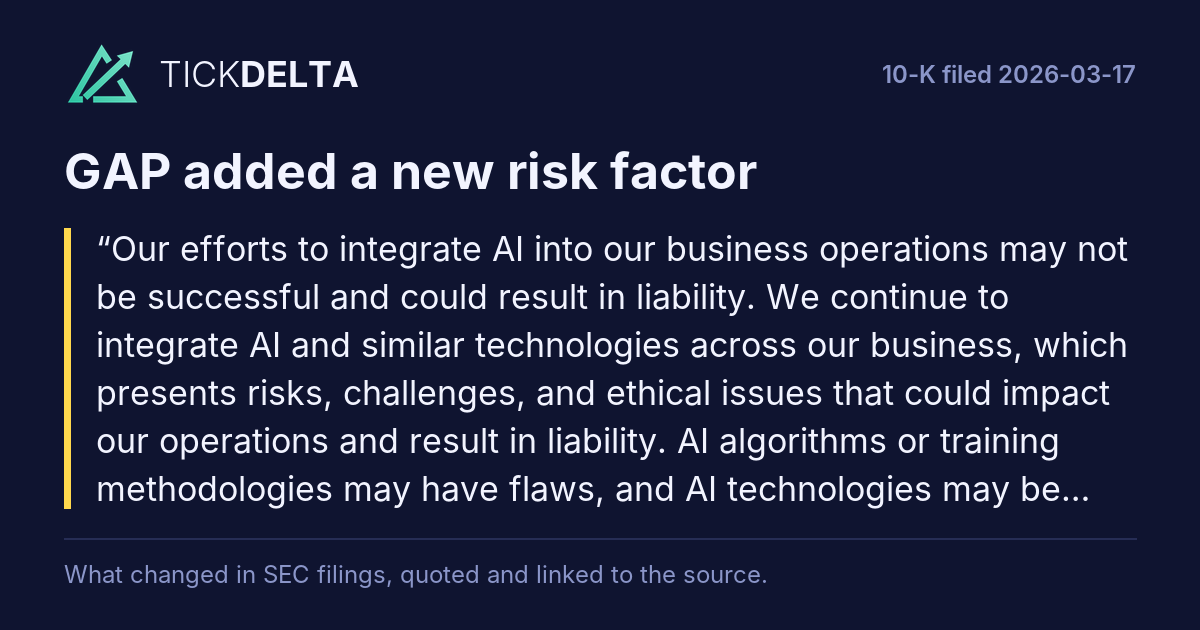
Our efforts to integrate AI into our business operations may not be successful and could result in liability.
We continue to integrate AI and similar technologies across our business, which presents risks, challenges, and ethical issues that could impact our operations and result in liability. AI algorithms or training methodologies may have flaws, and AI technologies may be prone to cybersecurity incidents or service interruptions. Data sets used by AI may be overbroad, insufficient, or contain biased information, and AI may generate offensive, illegal, inaccurate, or otherwise harmful content. Use of AI by our employees could increase the risk of exposure of confidential or competitively sensitive information. Privacy concerns and risks related to intellectual property rights of inputs into our AI programs and in our AI work product are also present.
If our use of AI technologies produces deficient, inaccurate, controversial, or misleading work product, or has other unintended consequences, we could be subject to legal liability, regulatory action, and competitive or reputational harm. Further, we may be unable to quickly and successfully adapt to rapid change resulting from advancements in AI and similar technologies, or our competitors may have more success implementing and utilizing these technologies than we do. Any of these risks could have an adverse effect on our business, financial condition, results of operations, and reputation.
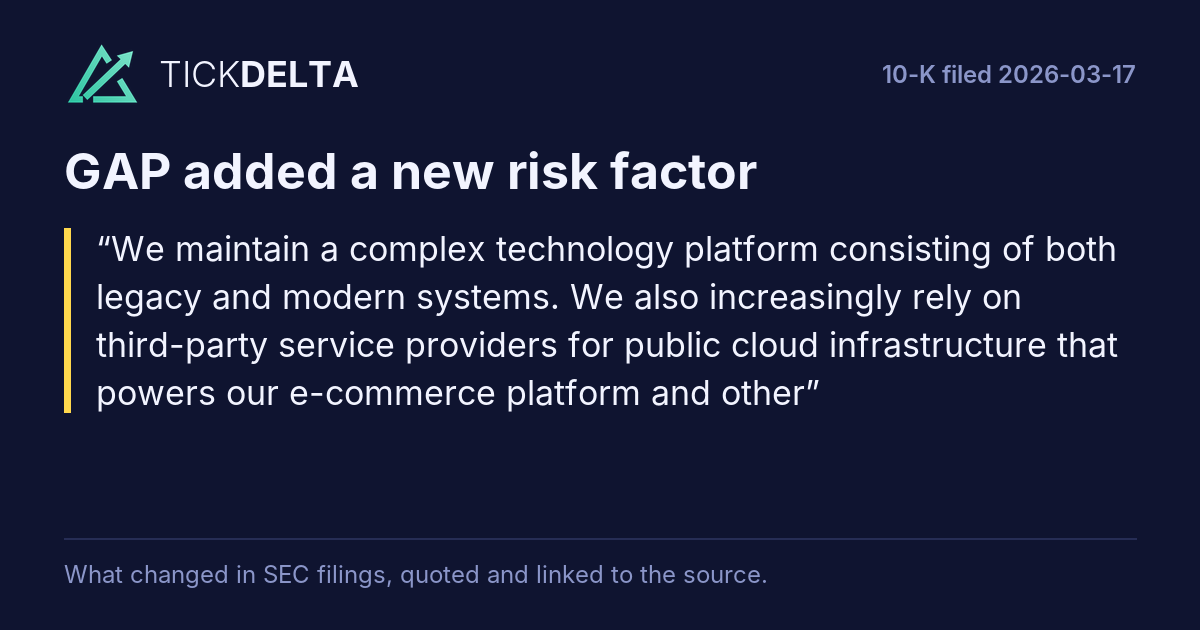
We maintain a complex technology platform consisting of both legacy and modern systems. We also increasingly rely on third-party service providers for public cloud infrastructure that powers our e-commerce platform and other
Paragraphs in the 10-Q filed Aug 28, 2026 that were not in the one before
New in the latest 10-Q
8 paragraphs in the 10-Q filed Aug 28, 2026 with nothing like them in the 10-Q filed May 29, 2026 (at least half the words must differ; new numbers alone do not count). Quoted exactly, grouped by the item heading above them. This is text that changed, not a judgement of how serious it is.
Financial statements and notes
In April 2026, the U.S. Customs and Border Protection launched a platform for importers of record to submit claims for IEEPA tariff refunds that were previously collected. During the second quarter of fiscal 2026, we submitted eligible IEEPA tariff refund claims of approximately $ 512 million and recognized a corresponding reduction to cost of goods sold and occupancy expenses on the Condensed Consolidated Statements of Operations for the 13 and 26 weeks ended August 1, 2026. This was partially offset by our commitment of appreciation for certain vendors of approximately $ 95 million, which was recorded within current liabilities on the Condensed Consolidated Balance Sheets. As of August 1, 2026, we received tariff refunds of approximately $ 95 million with the remaining $ 417 million recorded within other current assets on the Condensed Consolidated Balance Sheets. Additionally, we received approximately $ 5 million of related interest on the refund amounts.
Read in the 10-Q
13 Weeks Ended 26 Weeks Ended (shares in millions) August 1, August 2, August 1, August 2,
Read in the 10-Q
(1)For the 13 and 26 weeks ended August 1, 2026, cost of goods sold includes approximately $417 million of net IEEPA tariff recoveries, consisting of approximately $512 million of tariff refunds, partially offset by a commitment of appreciation of approximately $95 million for certain vendors.
Read in the 10-Q
In April 2026, the U.S. Customs and Border Protection launched a platform for importers of record to submit claims for IEEPA tariff refunds that were previously collected. During the second quarter of fiscal 2026, we submitted claims for previously paid eligible tariffs and have received tariff refunds of approximately $95 million with the remaining $417 million recorded within other current assets on the Condensed Consolidated Balance Sheets. In addition, we received approximately $5 million of related interest. We are monitoring developments related to the refund process and assessing the timing and extent of additional recoveries.
Read in the 10-Q
Given the continued uncertainty surrounding global trade policy and broader macroeconomic conditions, we will continue to evaluate potential impacts on our business.
Read in the 10-Q
Show the other 3
• a decrease of $445 million related to other current assets and other long-term assets primarily due to a tariff refund receivable included in other current assets on the Condensed Consolidated Balance Sheets.
Read in the 10-Q
Other information
We are providing the following disclosure in lieu of filing a Current Report on Form 8-K relating to Item 5.02 (Departure of Directors or Certain Officers; Election of Directors; Appointment of Certain Officers; Compensatory Arrangements of Certain Officers):
Read in the 10-Q
On August 26, 2026, the Compensation and Management Development Committee of the Board approved a modification to the relocation benefits granted to the Company's President and Chief Executive Officer ("CEO"), Richard Dickson, under his initial offer letter to extend eligibility of the home sale assistance benefit through fiscal 2027, due to the impact of the 2025 Palisades Fire affecting the sale of the CEO's former residence.
Read in the 10-Q
The 10-Q's risk factors against the 10-K
Item 1A of the 10-Q filed Aug 28, 2026 against Item 1A of the 10-K filed Mar 17, 2026.
A 10-Q repeats only the risks that changed, so a 10-K paragraph that is missing from it is not counted as removed.
Added is a paragraph with nothing like it in the 10-K, Reworded a sentence that is in both with several words changed,
Quiet changes a sentence in both where one to four words changed and one is a hedge or a modal
(cut words struck through, new words highlighted).
Text on the page, not a score; each links to the filing at sec.gov.
What the 10-Q itself says about its risk factors:There have been no material changes in our risk factors from those disclosed in Part I, Item 1A of our Annual Report on Form 10-K for the fiscal year ended January 31, 2026.
Read in the 10-Q
1 paragraph in the 10-Q's Item 1A, and none of them adds, rewords or quietly edits a paragraph of the 10-K's.
Phrases used for the first time
Two-word phrases in Risk Factors of the 10-K filed Mar 17, 2026 that are in none of the 1 earlier 10-Ks stored, back to Mar 18, 2025
Where each one is used
- sustainability-related initiatives: Increasingly regulators, customers, investors, employees, and other stakeholders are focusing on sustainability matters and related disclosures. These developments have resulted in, and are likely to continue to result in, increased general and administrative expenses and increased management time and attention...
- ongoing conflicts: Our business is affected by global economic conditions and the related impact on consumer spending worldwide. Global economic conditions have impacted, and could continue to impact, our business. Some of the factors that may influence consumer spending patterns include higher unemployment levels; extreme weather...
- states israel: Our business is affected by global economic conditions and the related impact on consumer spending worldwide. Global economic conditions have impacted, and could continue to impact, our business. Some of the factors that may influence consumer spending patterns include higher unemployment levels; extreme weather...
- trade policies: There is currently significant uncertainty about the future relationship between the United States and many other countries with respect to tariffs and trade policies, as well as the ability to recover any tariff refunds that may be owed. The situation regarding U.S. tariffs and trade policies has been fluid and...
- trade restrictions: There is currently significant uncertainty about the future relationship between the United States and many other countries with respect to tariffs and trade policies, as well as the ability to recover any tariff refunds that may be owed. The situation regarding U.S. tariffs and trade policies has been fluid and...
- chain costs: We continue to evaluate the impact of current and potential tariffs on our supply chain, costs, sales, and profitability, as well as our strategies to mitigate negative impacts. We can provide no assurance that any strategies we implement to mitigate the impact of such tariffs or other trade actions will be...
- costs sales: We continue to evaluate the impact of current and potential tariffs on our supply chain, costs, sales, and profitability, as well as our strategies to mitigate negative impacts. We can provide no assurance that any strategies we implement to mitigate the impact of such tariffs or other trade actions will be...
- trade actions: We continue to evaluate the impact of current and potential tariffs on our supply chain, costs, sales, and profitability, as well as our strategies to mitigate negative impacts. We can provide no assurance that any strategies we implement to mitigate the impact of such tariffs or other trade actions will be...
Used at least twice, small words left out. Counted, not picked: a phrase can be new because the company renamed something.
What was taken out
17 paragraphs of last year's Risk Factors with nothing like them now. The longest are quoted.
Sources
Item 1A of each 10-K and 10-Q on EDGAR, quoted exactly. Each paragraph links to the filing at sec.gov.
Also
10-K change: what was reworded or cut, section by section.
Work with it
Excel workbook · CSV. Google Sheet that stays up to date: paste =IMPORTDATA("https://tickdelta.com/company/GAP/export.csv") into a cell.