Paragraph 59 · 46% changed
Every version of it
Screener
/
SEC EDGAR
/CIK 0000040211
/10-K filed Feb 19, 2026, compared with Feb 19, 2025
/Numbers from the XBRL of the 10-Ks
NYSE
Industrials · Travel Services
Gatx Corp GATX
The 10-K against last year's
156 changes: 23 added, 8 removed, 124 reworded, 1 quiet changes
10-K Feb 19, 2026 vs Feb 19, 2025
Risk Factors
18.9%
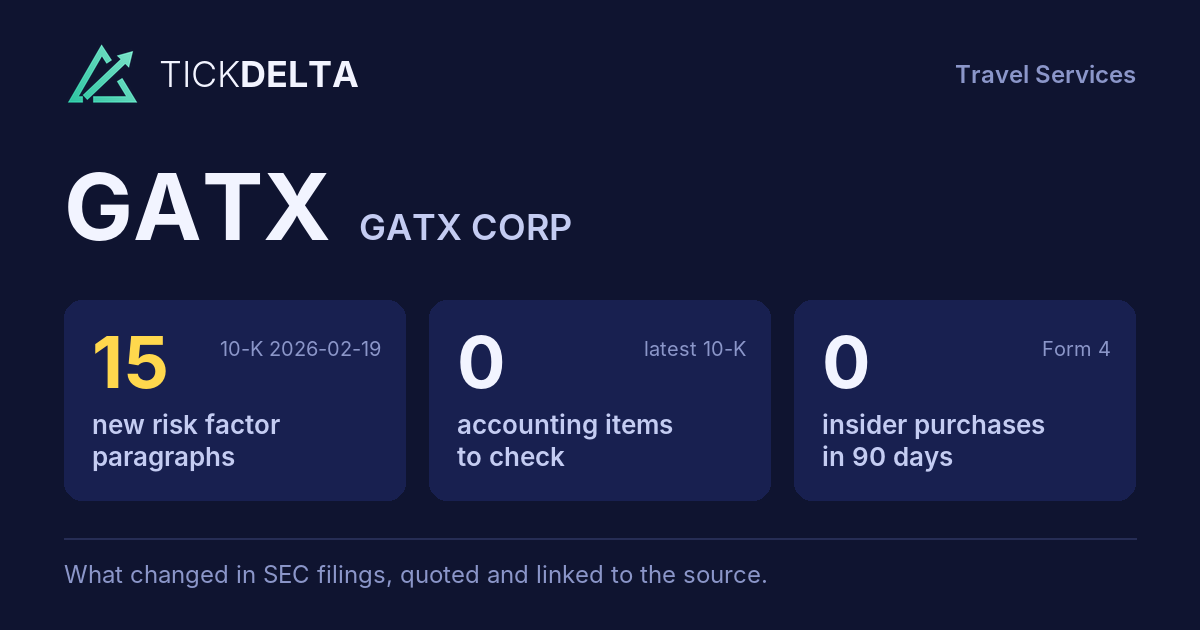
of the text changed · 6,877 words now · 15 new paragraphs, 1 gone
MD&A
17.1%
of the text changed · 9,422 words now · 8 new paragraphs, 7 gone
Legal Proceedings
27.2%
of the text changed · 1,688 words now
Accounting Policies
7.3%
of the text changed · 3,690 words now
10-K 0000040211-26-000018 (Feb 19, 2026) vs 10-K 0000040211-25-000024 (Feb 19, 2025)
Every paragraph, and how much of it changed
One bar per paragraph, in the order of the 10-K. Height and colour show the share of its words not in the closest paragraph a year earlier; the tallest bars are new paragraphs.
Risk Factors
105 paragraphs · 15 new · 34 reworded · 1 gone · 10-K Feb 19, 2026 against Feb 19, 2025
New paragraph
Reworded (5% of its words or more)
Same or nearly
Paragraph 21 · 35% changed
Every version of it
Paragraph 68 · 33% changed
Every version of it
We may be affected by climate matters physical effects of or market or regulatory societal responses to climate matters. change.
Paragraph 57 · 28% changed
Every version of it
Paragraph 9 · 26% changed
Every version of it
Adverse changes in commodity prices or reduced demand for commodities could reduce customer demand for various types of assets in our fleet. A significant decrease in the price of a commodity may cause producers of that commodity to reduce their production levels. A significant increase in the price of a commodity could cause our customers to switch to less expensive alternatives. In either case, these changes in customer behavior can reduce demand for the portions of our fleet that are used to transport the commodity. In addition, demand for transportation assets used to transport certain commodities, including ethanol and other renewable fuels, commodities may be affected positively or negatively by new or revised laws or regulations, or by new or revised government policies, subsidies and or mandates, which may be enacted, changed, or eliminated from time to time, while demand for transportation assets used to transport fossil fuels or that directly or indirectly require consumption of fossil fuels for operation may be affected by government policies and mandates with respect to climate matters and carbon emissions. affecting such commodities.
Paragraph 5 · 22% changed
Every version of it
•Changes in railroad operations, efficiency, safety, pricing and service offerings, including those related to “precision scheduled railroading” or railroading”, labor strikes or shortages; shortages, or mergers of one or more Class I railroads;
Paragraph 7 · 19% changed
Every version of it
•Changes in conditions affecting the aviation industry, including geographic exposure, global conflict geopolitical tensions or conflict, and customer concentrations; and
Paragraph 10 · 18% changed
Every version of it
The availability and relative cost of alternative modes of transportation and changes in customer transportation preferences also could reduce demand for our assets. For example, technological innovations in the trucking industry and patterns in of U.S. economic growth that favor truck over rail could result in a modal shift away from rail and reduce customer demand for our rail assets. Demand
Paragraph 59 · 46% changed
Every version of it
10-K Feb 19, 2025We rely on our IT Infrastructure (defined below) in all aspects of our business operations. We own and manage certain aspects of our IT infrastructure, but we also rely on third parties for a range of IT systems and related products and services, including but not limited to, cloud computing services (such third-party systems and our IT infrastructure, collectively, our “IT Infrastructure”). We and certain of our third-party providers collect, maintain and process data about customers, employees, business partners and others, including personally identifiable information, as well as confidential and proprietary information belonging to our business, including trade secrets (such data and information, collectively, “Confidential Information”). We face numerous and evolving cybersecurity risks that threaten the confidentiality, integrity and availability of our IT Infrastructure and Confidential Information. These risks have continued to increase in recent years in their frequency and levels of sophistication and intensity by sophisticated and organized groups and individuals with a wide range of motives and expertise. The implementation of remote and hybrid work options for our employees and employees of our third-party IT suppliers has led to a substantial increase in remote access to our networks and systems. All IT systems are vulnerable to cybersecurity threats and other unlawful attempts to disrupt or gain access to these systems, and these vulnerabilities may be increased by remote computing assets and additional security vulnerabilities that are present in many public, non-corporate and home networks. We and our third-party providers are regularly subject to attempted cyber intrusions, hacks and ransomware attacks, and we expect these incidents to accelerate and become increasingly sophisticated in using techniques and tools, including artificial intelligence, that circumvent security controls, evade detection and remove forensic evidence. While we have invested significant expense and effort in the protection of our Confidential Information and IT Infrastructure, the steps we have taken to mitigate these risks may not be effective to prevent breaches of our IT Infrastructure. Breaches of our IT Infrastructure could lead to disruptions in our business, potentially including the theft, destruction, loss, misappropriation, or release of Confidential Information stored on our IT Infrastructure and subject us to potential lawsuits, including class actions, other material legal liabilities, reputational damage, lost customers or significant costs associated with incident response, system restoration or remediation, applicable filings and notifications, and future compliance. These disruptions could adversely affect our operations, financial position, and results of operations. There can be no assurance that our cybersecurity risk management program and processes, including our policies, controls, or procedures, will be fully implemented, complied with, or effective in protecting our systems and information. While we maintain insurance to mitigate our exposure to these risks, our insurance policies, which carry retention and coverage limits, may not be adequate to reimburse us for losses caused by security breaches or other cybersecurity events, and we cannot guarantee that applicable insurance will be available to us in the future on economically reasonable terms or at all.
10-K Feb 19, 2026
Cybersecurity threats have increased in recent years in their frequency, complexity, and sophistication. We and our third-party providers are regularly subject to attempted cyber intrusions, some of which have been successful, and we expect these incidents to continue to evolve. Moreover, the use of emerging technologies, including AI, by us or our third-party providers may pose new or unforeseen cybersecurity risks. While we have invested significant expense and effort in the protection of our information and systems, the steps we have taken may not be effective in preventing all breaches of our IT Infrastructure. A successful cyberattack or other security incident could result in business interruptions, financial losses, theft, destruction, unavailability, or unauthorized disclosure of Confidential Information, reputational harm, loss of customers, significant remediation costs, or exposure to litigation, regulatory investigations, or penalties. Such events could adversely affect our operations, financial position, and results of operations. There can be no assurance that our cybersecurity risk management program and processes will be fully effective in protecting our systems and information. While we maintain insurance to mitigate our exposure to these risks, our insurance policies, which carry retention and coverage limits, may not be adequate to reimburse us for all losses caused by a cybersecurity event, and we cannot guarantee that applicable insurance will be available to us in the future on economically reasonable terms or at all.
Paragraph 21 · 35% changed
Every version of it
10-K Feb 19, 2025We also perform a variety of government or industry-mandated maintenance programs on our fleet of transportation assets. These compliance programs are cyclical in nature, and as a result, we can face significant increases in the number of maintenance events in any given year. A significant increase in maintenance events or severe constraints in the repair networks may negatively impact our operations and substantially increase maintenance and other related costs as a result of increased volume or the need to utilize higher cost third party maintenance providers. In addition, while we rely on third party maintenance providers to assist with these compliance procedures for our transportation assets, high demand faced by these providers from other asset owners may constrain our access to the providers or may substantially increase our costs.
10-K Feb 19, 2026
cost third party maintenance providers. In addition, while we may rely on third party maintenance providers to assist with certain compliance procedures for our transportation assets, high demand faced by these providers from other asset owners may constrain our access to the providers or may substantially increase our costs.
Paragraph 68 · 33% changed
Every version of it
10-K Feb 19, 2025
We may be affected by climate matters or market or regulatory responses to climate matters.
10-K Feb 19, 2026
We may be affected by physical effects of or societal responses to climate change.
Paragraph 57 · 28% changed
Every version of it
10-K Feb 19, 2025We rely on technology in all aspects of our business operations. If we are unable to adequately maintain and secure our information technology (“IT”) infrastructure from cybersecurity threats and related disruptions, our business could be negatively impacted.
10-K Feb 19, 2026
If we are unable to adequately protect our information technology systems against cybersecurity threats and related disruptions, our business could be negatively impacted.
Paragraph 9 · 26% changed
Every version of it
10-K Feb 19, 2025
Adverse changes in commodity prices or reduced demand for commodities could reduce customer demand for various types of assets in our fleet. A significant decrease in the price of a commodity may cause producers of that commodity to reduce their production levels. A significant increase in the price of a commodity could cause our customers to switch to less expensive alternatives. In either case, these changes in customer behavior can reduce demand for the portions of our fleet that are used to transport the commodity. In addition, demand for transportation assets used to transport certain commodities, including ethanol and other renewable fuels, may be affected by government subsidies and mandates, which may be enacted, changed, or eliminated from time to time, while demand for transportation assets used to transport fossil fuels or that directly or indirectly require consumption of fossil fuels for operation may be affected by government policies and mandates with respect to climate matters and carbon emissions.
10-K Feb 19, 2026
Adverse changes in commodity prices or reduced demand for commodities could reduce customer demand for various types of assets in our fleet. A significant decrease in the price of a commodity may cause producers of that commodity to reduce their production levels. A significant increase in the price of a commodity could cause our customers to switch to less expensive alternatives. In either case, these changes in customer behavior can reduce demand for the portions of our fleet that are used to transport the commodity. In addition, demand for transportation assets used to transport certain commodities may be affected positively or negatively by new or revised laws or regulations, or by new or revised government policies, subsidies or mandates, affecting such commodities.
Paragraph 5 · 22% changed
Every version of it
10-K Feb 19, 2025
•Changes in railroad operations, efficiency, safety, pricing and service offerings, including those related to “precision scheduled railroading” or labor strikes or shortages;
10-K Feb 19, 2026
•Changes in railroad operations, efficiency, safety, pricing and service offerings, including those related to “precision scheduled railroading”, labor strikes or shortages, or mergers of one or more Class I railroads;
Paragraph 7 · 19% changed
Every version of it
10-K Feb 19, 2025
•Changes in conditions affecting the aviation industry, including geographic exposure, global conflict and customer concentrations; and
10-K Feb 19, 2026
•Changes in conditions affecting the aviation industry, including geographic exposure, geopolitical tensions or conflict, and customer concentrations; and
Paragraph 10 · 18% changed
Every version of it
10-K Feb 19, 2025
The availability and relative cost of alternative modes of transportation and changes in customer transportation preferences also could reduce demand for our assets. For example, technological innovations in the trucking industry and patterns in U.S. economic
10-K Feb 19, 2026
The availability and relative cost of alternative modes of transportation and changes in customer transportation preferences also could reduce demand for our assets. For example, technological innovations in the trucking industry and patterns of U.S. economic growth that favor truck over rail could result in a modal shift away from rail and reduce customer demand for our rail assets. Demand
MD&A
174 paragraphs · 8 new · 73 reworded · 7 gone · 10-K Feb 19, 2026 against Feb 19, 2025
New paragraph
Reworded (5% of its words or more)
Same or nearly
Paragraph 21 · 48% changed
Paragraph 42 · 44% changed
In 2024, 2025, segment profit of $351.8 million decreased 1.2% compared to $356.0 million increased 15.8% compared to $307.3 million in 2023. 2024. The increase decrease was primarily due to driven by higher lease revenue, higher net gain on asset dispositions, maintenance and higher repair revenue, interest expenses, partially offset by higher interest expense lease revenue and higher maintenance expense. The amount and timing of disposition gains is dependent on a number of factors and may vary materially from year to year. repair revenue.
Paragraph 85 · 40% changed
Investment volume was $147.1 million in 2025, compared to $260.8 million in 2024, compared to $267.3 million in 2023. In both 2024 and 2023, 2024. GEL acquired seven aircraft spare engines in 2025 that were placed on long-term leases directly with a customer and ten aircraft spare engines. engines in 2024 that were employed in the engine capacity agreement with Rolls-Royce.
Paragraph 19 · 39% changed
•We anticipate Engine Leasing's segment profit in 2025 2026 to be higher than 2024. We expect an increase in segment profit from GEL as a result of additional aircraft spare engines acquired during 2024. In addition, RRPF 2025. RRPF's results are expected to be higher as a result of continued improvement growth in global air travel. Additionally, long lead times for delivery of new engines and repair services are driving strong demand for existing assets. GEL results are expected to benefit from these same factors.
Paragraph 63 · 38% changed
In 2024, 2025, segment profit of $356.0 $125.9 million increased 15.8% 5.1% compared to $307.3 $119.8 million in 2023. 2024. The increase was primarily due to higher lease revenue, higher net gain on asset dispositions, revenue and higher repair revenue, changes in foreign exchange rates, partially offset by higher interest expense and higher maintenance expense. The amount and timing of disposition gains is dependent on a number of factors and may vary materially from year to year.
Paragraph 49 · 37% changed
Paragraph 17 · 37% changed
•We expect Rail North America's segment profit in 2025 2026 to increase slightly from 2024. Lease 2025. Generally, lease rates for railcars scheduled to renew in 2025 2026 will likely be higher than expiring rates for most car types as the lease rate environment for existing railcars is expected to remain favorable. The stable. Our fleet is highly diversified across car types, customers, and commodities, and broadly we see stable demand for railcars in 2026. For certain of our most economically sensitive car types, we are anticipating a more challenging commercial environment. Across the entire fleet, we expect that increasing lease rates, along with new railcar additions to and the fleet, should impact of the Wells Fargo rail acquisition, will generate higher lease revenue in 2025. 2026. We anticipate that remarketing income to be slightly lower than 2024, but we continue to see a income, driven by strong secondary market. We expect market conditions and increased asset sales activity given our larger North American fleet, will be higher in 2026. Ownership costs, comprised of interest and depreciation, and maintenance expense will be higher in 2026, primarily due to the impact of slightly higher regulatory compliance work, partially offset by a benefit from efficiencies in our owned maintenance network to result in modestly higher maintenance expense in 2025 compared to the prior year. Finally, we anticipate interest expense and depreciation to be higher in 2025 compared to 2024. Wells Fargo rail acquisition.
Paragraph 82 · 35% changed
In 2024, marine operating expense decreased $6.5 million, due to sale of the Specialized Gas Vessels in 2023. Depreciation 2025, depreciation expense increased $9.5 $1.9 million, due to aircraft spare engines acquired in 2023 2024 and 2024. 2025, partially offset by the impact of an increase in the useful lives of certain engines.
Paragraph 21 · 48% changed
10-K Feb 19, 2025The railcar leasing environment was favorable as demand for existing railcars remained steady. Rail North America continued to extend lease renewal terms at attractive rates while maintaining high fleet utilization and a strong renewal success rate. Utilization of our non-boxcar fleet was 99.1% at the end of the year.
10-K Feb 19, 2026
Demand for most railcars was stable during the year, despite ongoing macroeconomic uncertainty, and the renewal success rate remained strong. Utilization of our non-boxcar fleet was 99.0% at the end of the year.
Paragraph 42 · 44% changed
10-K Feb 19, 2025
In 2024, segment profit of $356.0 million increased 15.8% compared to $307.3 million in 2023. The increase was primarily due to higher lease revenue, higher net gain on asset dispositions, and higher repair revenue, partially offset by higher interest expense and higher maintenance expense. The amount and timing of disposition gains is dependent on a number of factors and may vary materially from year to year.
10-K Feb 19, 2026
In 2025, segment profit of $351.8 million decreased 1.2% compared to $356.0 million in 2024. The decrease was driven by higher maintenance and interest expenses, partially offset by higher lease revenue and higher repair revenue.
Paragraph 85 · 40% changed
10-K Feb 19, 2025
Investment volume was $260.8 million in 2024, compared to $267.3 million in 2023. In both 2024 and 2023, GEL acquired ten aircraft spare engines.
10-K Feb 19, 2026
Investment volume was $147.1 million in 2025, compared to $260.8 million in 2024. GEL acquired seven aircraft spare engines in 2025 that were placed on long-term leases directly with a customer and ten aircraft spare engines in 2024 that were employed in the engine capacity agreement with Rolls-Royce.
Paragraph 19 · 39% changed
10-K Feb 19, 2025
•We anticipate Engine Leasing's segment profit in 2025 to be higher than 2024. We expect an increase in segment profit from GEL as a result of additional aircraft spare engines acquired during 2024. In addition, RRPF results are expected to be higher as a result of continued improvement in global air travel.
10-K Feb 19, 2026
•We anticipate Engine Leasing's segment profit in 2026 to be higher than 2025. RRPF's results are expected to be higher as a result of continued growth in global air travel. Additionally, long lead times for delivery of new engines and repair services are driving strong demand for existing assets. GEL results are expected to benefit from these same factors.
Paragraph 63 · 38% changed
10-K Feb 19, 2025
In 2024, segment profit of $356.0 million increased 15.8% compared to $307.3 million in 2023. The increase was primarily due to higher lease revenue, higher net gain on asset dispositions, and higher repair revenue, partially offset by higher interest expense and higher maintenance expense. The amount and timing of disposition gains is dependent on a number of factors and may vary materially from year to year.
10-K Feb 19, 2026
In 2025, segment profit of $125.9 million increased 5.1% compared to $119.8 million in 2024. The increase was primarily due to higher lease revenue and changes in foreign exchange rates, partially offset by higher interest expense.
Paragraph 49 · 37% changed
10-K Feb 19, 2025Rail International, composed primarily of GATX Rail Europe ("GRE"), produced solid operating results in 2024 and continued to grow its fleet, exceeding 30,000 railcars during the current year. GRE experienced renewal lease rate increases for a majority of railcar types in 2024. Utilization was 96.1% at the end of the year.
10-K Feb 19, 2026
Despite pressure on utilization, GRE experienced renewal lease rate increases for a majority of railcar types in 2025. Utilization was 94.7% at the end of the year.
Paragraph 17 · 37% changed
10-K Feb 19, 2025
•We expect Rail North America's segment profit in 2025 to increase slightly from 2024. Lease rates for railcars scheduled to renew in 2025 will likely be higher than expiring rates for most car types as the lease rate environment for existing railcars is expected to remain favorable. The increasing lease rates, along with new additions to the fleet, should generate higher lease revenue in 2025. We anticipate remarketing income to be slightly lower than 2024, but we continue to see a strong secondary market. We expect the impact of slightly higher regulatory compliance work, partially offset by a benefit from efficiencies in our owned maintenance network to result in modestly higher maintenance expense in 2025 compared to the prior year. Finally, we anticipate interest expense and depreciation to be higher in 2025 compared to 2024.
10-K Feb 19, 2026
•We expect Rail North America's segment profit in 2026 to increase from 2025. Generally, lease rates for railcars scheduled to renew in 2026 will likely be higher than expiring rates for most car types as the lease rate environment for existing railcars is expected to remain stable. Our fleet is highly diversified across car types, customers, and commodities, and broadly we see stable demand for railcars in 2026. For certain of our most economically sensitive car types, we are anticipating a more challenging commercial environment. Across the entire fleet, we expect that increasing lease rates, along with new railcar additions and the impact of the Wells Fargo rail acquisition, will generate higher lease revenue in 2026. We anticipate that remarketing income, driven by strong secondary market conditions and increased asset sales activity given our larger North American fleet, will be higher in 2026. Ownership costs, comprised of interest and depreciation, and maintenance expense will be higher in 2026, primarily due to the impact of the Wells Fargo rail acquisition.
Paragraph 82 · 35% changed
10-K Feb 19, 2025
In 2024, marine operating expense decreased $6.5 million, due to sale of the Specialized Gas Vessels in 2023. Depreciation expense increased $9.5 million, due to aircraft spare engines acquired in 2023 and 2024.
10-K Feb 19, 2026
In 2025, depreciation expense increased $1.9 million, due to aircraft spare engines acquired in 2024 and 2025, partially offset by the impact of an increase in the useful lives of certain engines.
A paragraph is matched with the one last year that shares the most of its words; under half in common makes it new. The paragraphs shown are the 8 reworded the most in each section.
The paragraph that changed most in each section
The redline
Marked against last year's 10-K: cut words struck through, new words highlighted.
Risk Factors410 words changed in this paragraph; it is 43% similar to last year's version.
Source: Item 1A, 10-K 0000040211-26-000018 vs Item 1A, 10-K 0000040211-25-000024
MD&A162 words changed in this paragraph; it is 47% similar to last year's version.
•We expect Rail North America's segment profit in 2025 2026 to increase slightly from 2024. Lease 2025. Generally, lease rates for railcars scheduled to renew in 2025 2026 will likely be higher than expiring rates for most car types as the lease rate environment for existing railcars is expected to remain favorable. The stable. Our fleet is highly diversified across car types, customers, and commodities, and broadly we see stable demand for railcars in 2026. For certain of our most economically sensitive car types, we are anticipating a more challenging commercial environment. Across the entire fleet, we expect that increasing lease rates, along with new railcar additions to and the fleet, should impact of the Wells Fargo rail acquisition, will generate higher lease revenue in 2025. 2026. We anticipate that remarketing income to be slightly lower than 2024, but we continue to see a income, driven by strong secondary market. We expect market conditions and increased asset sales activity given our larger North American fleet, will be higher in 2026. Ownership costs, comprised of interest and depreciation, and maintenance expense will be higher in 2026, primarily due to the impact of slightly higher regulatory compliance work, partially offset by a benefit from efficiencies in our owned maintenance network to result in modestly higher maintenance expense in 2025 compared to the prior year. Finally, we anticipate interest expense and depreciation to be higher in 2025 compared to 2024. Wells Fargo rail acquisition.
Source: Item 7, 10-K 0000040211-26-000018 vs Item 7, 10-K 0000040211-25-000024
Legal Proceedings99 words changed in this paragraph; it is 69% similar to last year's version.
The recorded accruals represent our best estimate of all costs for remediation and restoration of affected sites, without reduction for anticipated recoveries from third parties, and include both asserted and unasserted claims. However, we are unable to provide a reasonable estimate of the maximum potential loss associated with these sites because cleanup costs cannot be predicted with certainty. Various factors beyond our control can impact the amount of loss GATX will ultimately incur with respect to these sites, including the extent of corrective actions that may be required; evolving environmental laws and regulations; advances in environmental technology, technology; the extent of other parties' participation in cleanup efforts; developments in periodic environmental analyses related to sites determined to be contaminated; and developments in environmental surveys and studies of potentially contaminated sites. As a result, future charges associated with these sites could have a significant effect on results of operations in a particular quarter or year if the costs materially exceed the accrued amount as individual site studies and remediation and restoration efforts proceed. However, management believes it is unlikely that the ultimate cost to GATX for any of these sites, either individually or in the aggregate, will have a material adverse effect on our consolidated financial position or liquidity.
Source: Item 3, via Note 24 – Legal Proceedings and Other Contingencies, 10-K 0000040211-26-000018 vs Item 3, via Note 23 – Legal Proceedings and Other Contingencies, 10-K 0000040211-25-000024
Accounting Policies43 words changed in this paragraph; it is 81% similar to last year's version.
We use derivatives, such as interest rate swap agreements, treasury rate locks, options, cross currency swaps, and currency forwards, to hedge our exposure to interest rate and foreign currency exchange rate risk on existing and anticipated transactions. In 2025, we entered into deal-contingent interest rate swap contracts to hedge the interest rate risk related to the anticipated issuance of long-term debt used to finance the acquisition of Wells Fargo's rail assets. These deal-contingent derivatives are classified as cash flow hedges. We formally designate derivatives that meet specific accounting criteria as qualifying hedges at inception. These criteria require us to have the expectation that the derivative will be highly effective at offsetting changes in the fair value or expected cash flows of the hedged exposure, both at the inception of the hedging relationship and on an ongoing basis.
Source: Item 8, Note 3 – Significant Accounting Policies, 10-K 0000040211-26-000018 vs Item 8, Note 3 – Significant Accounting Policies, 10-K 0000040211-25-000024
Sentences and paragraphs added, removed or reworded
Every change, by type
Sentences and paragraphs of GATX's Risk Factors and MD&A, 10-K Feb 19, 2026 against 10-K Feb 19, 2025. Each links to the text at sec.gov.
Quiet changes are sentences kept from last year with one to four words changed, at least one of them a hedge, a modal or a qualifier (may, could, will, not, significant, material…). A year or date rolling forward is not counted.
The full word list
adverse, adversely, all, although, anticipate, anticipates, any, approximately, believe, believes, can, cannot, certain, could, expect, expects, generally, however, if, intend, intends, largely, likely, many, material, materially, may, might, most, must, never, no, not, possible, primarily, probable, should, significant, significantly, some, substantial, substantially, unlikely, will, would
AddedRisk Factors
Threatened or implemented changes in tariffs and other global trade policies could adversely affect our business.
Read it in 10-K Feb 19, 2026 at sec.gov
AddedRisk Factors
There is currently significant uncertainty about the future relationship between the U.S. and various other countries with respect to tariffs, trade policies, and treaties. The current U.S. presidential administration has announced a range of tariffs on imports from many countries, but the situation remains fluid, and the long-term application of such tariffs, and their effect on our business, is difficult to predict. We are continuing to monitor the evolving environment, and we are working with our suppliers and customers to mitigate potential impacts on our business. While many of our current asset purchases, including newly manufactured railcars, are exempt under the United States-Mexico-Canada Agreement (“USMCA”), that status may change in the future, and many components and materials on which we rely may not be exempt. Any new, modified, or threatened tariffs, as well as continued uncertainty regarding global trade policies, could increase our costs, negatively affect demand from our customers, or lead to general economic decline, any of which could adversely affect our business, financial condition or results of operations. Furthermore, our competitors may be less exposed to tariff impacts or in a better position to mitigate increased costs, which could adversely affect our competitiveness.
Read it in 10-K Feb 19, 2026 at sec.gov
AddedRisk Factors
Failure to effectively integrate the Wells Fargo rail business, or to realize the other anticipated benefits of the GABX joint venture, could adversely affect our business, financial condition, and results of operations.
Read it in 10-K Feb 19, 2026 at sec.gov
AddedRisk Factors
On January 1, 2026, we closed on the acquisition of Wells Fargo’s rail operating lease portfolio. The acquisition was completed through a newly formed joint venture with Brookfield. While we expect GABX to contribute materially to our results of operations, the joint venture is subject to numerous risks and uncertainties, many of which are beyond our control.
Read it in 10-K Feb 19, 2026 at sec.gov
AddedRisk Factors
The success of the GABX joint venture will depend, in part, on our ability to successfully integrate the acquired business without materially disrupting our current operations. Realizing the expected benefits requires timely execution of core integration activities, including transferring contracts, migrating data and systems, onboarding new employees, operational handovers, coordinated customer and vendor communications, and properly accounting for the new assets and services. Delays or errors could cause service disruptions, customer or vendor losses, higher costs, and diminished benefits. Integration efforts may also divert management’s attention from our ongoing operations, and unanticipated integration costs may be significant and exceed current estimates. Any such integration challenges could adversely affect our business, financial condition and results of operations.
Read it in 10-K Feb 19, 2026 at sec.gov
AddedRisk Factors
We may not realize the anticipated benefits from the GABX joint venture for other reasons, including an inability to manage a larger fleet profitably, challenges in leveraging the enhanced customer base, or failure to capitalize on potential cost efficiencies and synergies. The success of the GABX joint venture depends on effective governance and alignment with our joint venture partner Brookfield, and it is also subject to the same execution risks that affect our core railcar business. Failure to effectively execute GABX’s strategy, including with respect to leasing rates, utilization, asset sales, maintenance and safety standards, capital deployment, and remarketing opportunities, could result in operational and financial performance below expectations. Further, if a failure to operate successfully causes GABX to be unable to make required debt payments, we may be required to make the payments thereunder as guarantor to GABX's credit agreement obligations, which could reduce our liquidity and increase our leverage. If we are
Read it in 10-K Feb 19, 2026 at sec.gov
AddedRisk Factors
unable to realize the anticipated benefits of the GABX joint venture, our business, financial condition and results of operations could be adversely affected.
Read it in 10-K Feb 19, 2026 at sec.gov
AddedRisk Factors
Minority ownership of the GABX joint venture and failure to acquire increased or full ownership of it may adversely affect our financial results.
Read it in 10-K Feb 19, 2026 at sec.gov
Show the other 45
AddedRisk Factors
We currently own 30% of the GABX joint venture and serve as the exclusive manager of its rail portfolio and day‑to‑day operations. GABX’s governance documents limit our ability to act unilaterally on certain matters and may constrain certain strategic flexibility. As with all joint ventures, differences in views between us and Brookfield may delay decisions or prevent agreement on certain issues, and potential or actual conflicts of interest could result in lost or delayed opportunities.
Read it in 10-K Feb 19, 2026 at sec.gov
AddedRisk Factors
We hold a series of annual call options that, if exercised in full over time, may result in GATX acquiring 100% ownership of GABX; however, there can be no assurance that we will exercise these options on the anticipated schedule or at all, that required regulatory approvals will be obtained when needed, or that we will have access to financing on acceptable terms to fund any of these option exercises. If we do not exercise a call option within the applicable window, our economic participation in certain distributable cash flows under the joint venture agreements can be adversely adjusted for a limited period, which could materially reduce our cash flows. Any of these factors could adversely affect our ability to achieve full ownership or realize the anticipated benefits of the GABX joint venture, which could adversely affect our business, financial condition and results of operations.
Read it in 10-K Feb 19, 2026 at sec.gov
AddedRisk Factors
Our business relies heavily on information technology ("IT"). Our IT infrastructure includes systems we own and manage, as well as those provided by third parties, including cloud-based services (collectively, our “IT Infrastructure”). We and certain of our third-party providers collect, process, and store data relating to customers, employees, business partners and others, including personal information and confidential business information (collectively, “Confidential Information”). We face numerous and evolving cybersecurity risks that threaten the confidentiality, integrity and availability of our IT Infrastructure and Confidential Information.
Read it in 10-K Feb 19, 2026 at sec.gov
AddedRisk Factors
In addition, we are subject to an evolving and increasingly complex set of federal, state, and foreign laws and regulations governing data privacy, data protection, cybersecurity, and AI. We could incur substantial costs related to ongoing compliance with these requirements, and any failure to comply with applicable laws and regulations could lead to significant fines, penalties, litigation, or reputational damage.
Read it in 10-K Feb 19, 2026 at sec.gov
RemovedRisk Factors
RewordedRisk Factors
For example, restrictions on GHG emissions could significantly increase costs for our customers whose production processes require significant amounts of energy, which could reduce demand for the lease of our assets, while rail and other transportation assets in our fleet that are used to carry fossil fuels, such as coal and petroleum, or that directly or indirectly require fossil fuel consumption for operation of the assets could see reduced demand or be rendered obsolete depending on the extent to which government regulations mandate a reduction in fossil fuel consumption or customer preferences change. assets.
Read it in 10-K Feb 19, 2026 at sec.gov
RewordedRisk Factors
RewordedRisk Factors
We and our third-party providers are regularly subject to attempted cyber intrusions, hacks and ransomware attacks, some of which have been successful, and we expect these incidents to accelerate and become increasingly sophisticated in using techniques and tools, including artificial intelligence, that circumvent security controls, evade detection and remove forensic evidence. continue to evolve.
Read it in 10-K Feb 19, 2026 at sec.gov
RewordedRisk Factors
These transactions may likewise present financial, managerial, and operational challenges, including diversion of management attention from existing businesses, attention, difficulty with integrating or separating personnel and financial and other systems, increased expenses and costs, assumption of liabilities and indemnities, and increased compliance risks, and potential disputes with the buyers or sellers or third parties. risks.
Read it in 10-K Feb 19, 2026 at sec.gov
RewordedRisk Factors
Such a crisis could also result in operational and labor disruptions, employee attrition disruptions and difficulty securing future labor needs, as well as impacts the broader employment market and supply chains, our suppliers, and our customers. needs.
Read it in 10-K Feb 19, 2026 at sec.gov
RewordedRisk Factors
We are subject to the risks associated with natural disasters and the physical effects of climate matters, change, which may increase in frequency and severity over time and may have a material adverse effect on our assets, operations and business. time.
Read it in 10-K Feb 19, 2026 at sec.gov
RewordedRisk Factors
Severe weather, climate matters, and rising temperatures, droughts, or natural disasters, such as fires, hurricanes, wind, tornadoes, flooding, hurricanes, fires and floods, or earthquakes, could cause significant business interruptions and result in increased costs and liabilities and or decreased revenues.
Read it in 10-K Feb 19, 2026 at sec.gov
RewordedRisk Factors
Any of these factors, individually or in operation with one or more of the other factors, another, or other unforeseen impacts of climate matters, could reduce the demand for and value of our assets, and change, could have an adverse effect on our financial position, results of operations, and cash flows.
Read it in 10-K Feb 19, 2026 at sec.gov
RewordedRisk Factors
RewordedRisk Factors
While we have invested significant expense and effort in the protection of our Confidential Information information and IT Infrastructure, systems, the steps we have taken to mitigate these risks may not be effective to prevent in preventing all breaches of our IT Infrastructure.
Read it in 10-K Feb 19, 2026 at sec.gov
RewordedRisk Factors
Such laws, rules, and regulations could be changed in ways that would require us to modify our business models and objectives, impose requirements for additional maintenance or substantial modification or refurbishment of our assets, or otherwise affect our returns on investments by restricting or prohibiting existing activities and products, subjecting them to escalating costs or prohibiting them outright. increasing costs.
Read it in 10-K Feb 19, 2026 at sec.gov
RewordedRisk Factors
Quiet changesRisk Factors
In addition, while we may rely on third party maintenance providers to assist with these certain compliance procedures for our transportation assets, high demand faced by these providers from other asset owners may constrain our access to the providers or may substantially increase our costs.
Read it in 10-K Feb 19, 2026 at sec.gov
AddedMD&A
On May 29, 2025, GATX entered into a definitive agreement to acquire railcars from Wells Fargo Bank, N.A. ("Wells Fargo") through a newly formed joint venture ("GABX" or the "GABX joint venture") with Brookfield Infrastructure Partners L.P. and its institutional partners (collectively, “Brookfield”). The transaction formally closed on January 1, 2026 and consisted of approximately 101,000 railcars for approximately $4.2 billion. Initially, GATX's ownership share of GABX is 30%, with Brookfield's share at 70%. GATX will have the option to acquire up to 100% of GABX's equity over time. GATX also agreed to directly purchase approximately 200 locomotives from Wells Fargo for approximately $30.4 million, and Brookfield agreed to directly acquire Wells Fargo’s rail finance lease portfolio. GATX will serve as manager of the railcars in GABX as well as the finance lease portfolio directly owned by Brookfield. In anticipation of the closing of the transaction, on December 31, 2025, GATX contributed equity of $385.3 million to GABX, Brookfield contributed equity of $899.0 million to GABX, and GABX executed a $2.96 billion term loan to fund the acquisition. GATX has guaranteed GABX's debt financing obligations. During 2025, GABX entered into deal contingent interest rate swaps in order to hedge the exposure on its anticipated debt financing. As of December 31, 2025, GABX is consolidated and is reported in the Rail North America segment, and its operations will be reflected within that segment for reporting periods after the closing of the transaction. See "Note 26. Subsequent Events" in Part II, Item 8 of this Form 10-K for further information.
Read it in 10-K Feb 19, 2026 at sec.gov
AddedMD&A
In the fourth quarter of 2025, GATX Rail Europe acquired 5,882 railcars from DB Cargo AG. The acquisition was an opportunity to grow and diversify the GRE fleet by adding a mix of favorable model types.
Read it in 10-K Feb 19, 2026 at sec.gov
AddedMD&A
Within Rail International, GATX Rail Europe ("GRE") experienced a challenging railcar leasing market as GRE faced macroeconomic headwinds, including weak GDP results. This uncertainty caused some customers to take a cautionary approach to rail fleet planning, thereby tempering demand across certain car types.
Read it in 10-K Feb 19, 2026 at sec.gov
AddedMD&A
In 2025, GATX recorded $6.5 million of expenses associated with the acquisition of Wells Fargo's rail assets. These expenses were recorded in SG&A.
Read it in 10-K Feb 19, 2026 at sec.gov
AddedMD&A
In addition, a customer sold its interest in a nuclear power plant facility for which GATX previously managed the lease, and GATX received $7.4 million of residual sharing proceeds as part of a previously agreed upon residual sharing arrangement. This income was recorded in Other income (expense), including eliminations.
Read it in 10-K Feb 19, 2026 at sec.gov
AddedMD&A
Portfolio proceeds increased $44.4 million in 2025 compared to 2024, driven by more railcars and locomotives sold at Rail North America.
Read it in 10-K Feb 19, 2026 at sec.gov
AddedMD&A
(1) Issuances include $2,959.0 million at GABX used to finance the acquisition of Wells Fargo's rail assets. The cash proceeds from this issuance are included in the restricted cash balance at December 31, 2025, as noted above.
Read it in 10-K Feb 19, 2026 at sec.gov
AddedMD&A
(8) Insurance recoveries related to aircraft spare engines at RRPF for which it had previously recorded impairment losses.
Read it in 10-K Feb 19, 2026 at sec.gov
RemovedMD&A
RemovedMD&A
RemovedMD&A
RemovedMD&A
RemovedMD&A
RemovedMD&A
RemovedMD&A
RewordedMD&A
Results for 2024 2025 included a net positive impact of $13.5 million ($0.37 per diluted share) from tax adjustments and other items, compared to a net negative impact of $3.9 million ($0.11 per diluted share) from tax adjustments and other items, compared to items in 2024 and a net positive impact of $1.6 million ($0.05 per diluted share) from tax adjustments and other items in 2023 and a net negative impact of $61.8 million ($1.72 per diluted share) from tax adjustments and other items in 2022 (see "Non-GAAP Financial Measures" at the end of this item Item for further details).
Read it in 10-K Feb 19, 2026 at sec.gov
RewordedMD&A
RewordedMD&A
We acquired 2,302 newly built railcars and purchased 1,035 railcars in the secondary market in 2025 compared to 3,812 newly built railcars, purchased 2,279 railcars in the secondary market, and purchased 156 locomotives in the secondary market in 2024, compared to 3,835 newly built railcars, 1,934 railcars in the secondary market, and no locomotives in 2023. 2024.
Read it in 10-K Feb 19, 2026 at sec.gov
RewordedMD&A
The variance was driven by the absence of environmental reserves recorded and expenses related to litigation claims settlements, settlements recorded in the prior year and residual sharing proceeds received in the current year, as noted above, partially offset by the absence of pension settlement charges recorded in 2023. above.
Read it in 10-K Feb 19, 2026 at sec.gov
RewordedMD&A
RewordedMD&A
Net income attributable to GATX was $333.3 million, or $9.12 per diluted share, for 2025 compared to $284.2 million, or $7.78 per diluted share, for 2024 compared to 2024, and $259.2 million, or $7.12 per diluted share, for 2023, and $155.9 million, or $4.35 per diluted share, for 2022. 2023.
Read it in 10-K Feb 19, 2026 at sec.gov
RewordedMD&A
The increase decrease in portfolio investments and capital additions of $9.4 $357.7 million in the year ended December 31, 2024 2025 was primarily due to more fewer railcars and locomotives acquired at Rail North America, partially offset by fewer railcars aircraft spare engines acquired at GRE and Rail India, Engine Leasing, and fewer tank containers acquired at Trifleet. Trifleet, partially offset by more railcars acquired at GRE.
Read it in 10-K Feb 19, 2026 at sec.gov
RewordedMD&A
RewordedMD&A
The operating environment for our engine leasing businesses at RRPF and GEL is strong, as global air travel continues to recover to pre-pandemic levels trends are positive, and beyond. long lead times for delivery of new engines and repair services are driving solid demand for existing assets.
Read it in 10-K Feb 19, 2026 at sec.gov
RewordedMD&A
In 2024, 2025, maintenance expense increased $30.3 $43.6 million, driven by higher costs of repairs, more regulatory compliance repair events, and including more repairs performed by the railroads. railroads, and a mix of repairs that resulted in higher costs per repair.
Read it in 10-K Feb 19, 2026 at sec.gov
RewordedMD&A
In 2024, 2025, net gain (loss) on asset dispositions was unfavorable decreased by $1.6 $0.6 million, driven by the absence of gains recorded in 2023 for the sale of natural gas holdings, partially offset by net gains in 2024 and net losses in 2023 associated with the Specialized Gas Vessels.
Read it in 10-K Feb 19, 2026 at sec.gov
RewordedMD&A
Sources
The two latest 10-Ks on EDGAR, section by section. Each change links to the text at sec.gov.
Also
New risk factors: paragraphs with nothing like them last year, quoted in full.
Work with it
Excel workbook · CSV. Google Sheet that stays up to date: paste =IMPORTDATA("https://tickdelta.com/company/GATX/export.csv") into a cell.