Gatx Corp GATX
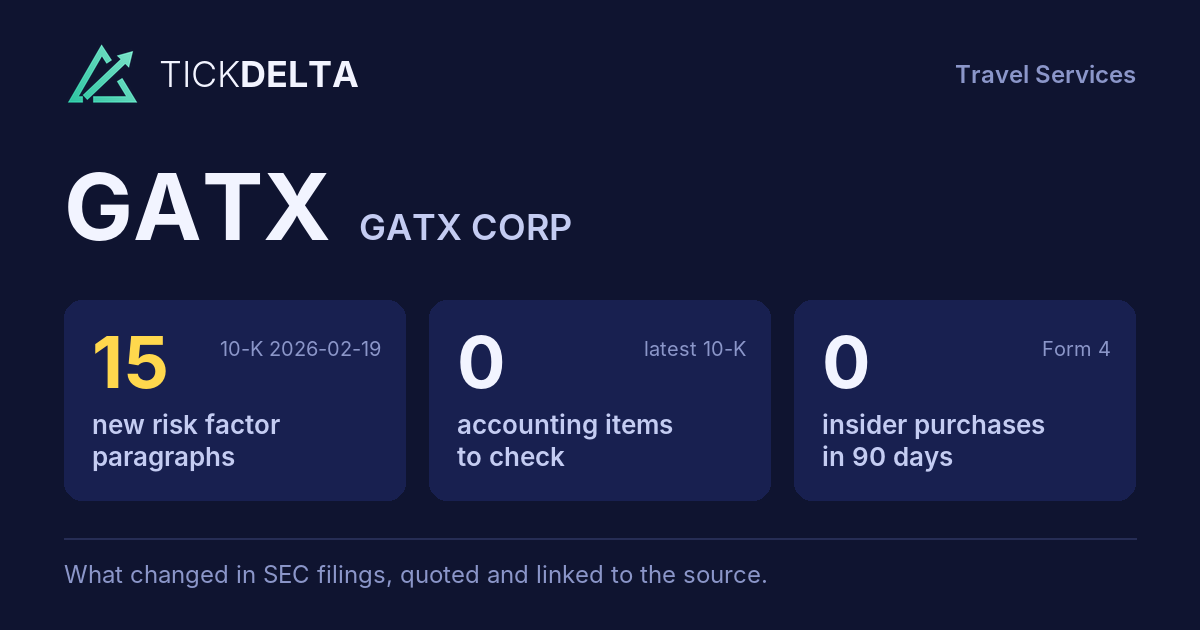
New risk paragraphs, branching off last year
Each branch is a paragraph in Risk Factors with nothing like it in the 10-K filed Feb 19, 2025. A box jumps to the paragraph as filed, below.
Paragraphs with nothing like them in last year's 10-K
15 paragraphs in Risk Factors of the 10-K filed Feb 19, 2026 with nothing like them in the 10-K filed Feb 19, 2025. Quoted exactly. Paragraphs that were only edited are under 10-K change.
Threatened or implemented changes in tariffs and other global trade policies could adversely affect our business.
There is currently significant uncertainty about the future relationship between the U.S. and various other countries with respect to tariffs, trade policies, and treaties. The current U.S. presidential administration has announced a range of tariffs on imports from many countries, but the situation remains fluid, and the long-term application of such tariffs, and their effect on our business, is difficult to predict. We are continuing to monitor the evolving environment, and we are working with our suppliers and customers to mitigate potential impacts on our business. While many of our current asset purchases, including newly manufactured railcars, are exempt under the United States-Mexico-Canada Agreement (“USMCA”), that status may change in the future, and many components and materials on which we rely may not be exempt. Any new, modified, or threatened tariffs, as well as continued uncertainty regarding global trade policies, could increase our costs, negatively affect demand from our customers, or lead to general economic decline, any of which could adversely affect our business, financial condition or results of operations. Furthermore, our competitors may be less exposed to tariff impacts or in a better position to mitigate increased costs, which could adversely affect our competitiveness.
Failure to effectively integrate the Wells Fargo rail business, or to realize the other anticipated benefits of the GABX joint venture, could adversely affect our business, financial condition, and results of operations.
On January 1, 2026, we closed on the acquisition of Wells Fargo’s rail operating lease portfolio. The acquisition was completed through a newly formed joint venture with Brookfield. While we expect GABX to contribute materially to our results of operations, the joint venture is subject to numerous risks and uncertainties, many of which are beyond our control.
The success of the GABX joint venture will depend, in part, on our ability to successfully integrate the acquired business without materially disrupting our current operations. Realizing the expected benefits requires timely execution of core integration activities, including transferring contracts, migrating data and systems, onboarding new employees, operational handovers, coordinated customer and vendor communications, and properly accounting for the new assets and services. Delays or errors could cause service disruptions, customer or vendor losses, higher costs, and diminished benefits. Integration efforts may also divert management’s attention from our ongoing operations, and unanticipated integration costs may be significant and exceed current estimates. Any such integration challenges could adversely affect our business, financial condition and results of operations.
We may not realize the anticipated benefits from the GABX joint venture for other reasons, including an inability to manage a larger fleet profitably, challenges in leveraging the enhanced customer base, or failure to capitalize on potential cost efficiencies and synergies. The success of the GABX joint venture depends on effective governance and alignment with our joint venture partner Brookfield, and it is also subject to the same execution risks that affect our core railcar business. Failure to effectively execute GABX’s strategy, including with respect to leasing rates, utilization, asset sales, maintenance and safety standards, capital deployment, and remarketing opportunities, could result in operational and financial performance below expectations. Further, if a failure to operate successfully causes GABX to be unable to make required debt payments, we may be required to make the payments thereunder as guarantor to GABX's credit agreement obligations, which could reduce our liquidity and increase our leverage. If we are
unable to realize the anticipated benefits of the GABX joint venture, our business, financial condition and results of operations could be adversely affected.
Minority ownership of the GABX joint venture and failure to acquire increased or full ownership of it may adversely affect our financial results.
We currently own 30% of the GABX joint venture and serve as the exclusive manager of its rail portfolio and day‑to‑day operations. GABX’s governance documents limit our ability to act unilaterally on certain matters and may constrain certain strategic flexibility. As with all joint ventures, differences in views between us and Brookfield may delay decisions or prevent agreement on certain issues, and potential or actual conflicts of interest could result in lost or delayed opportunities.
We hold a series of annual call options that, if exercised in full over time, may result in GATX acquiring 100% ownership of GABX; however, there can be no assurance that we will exercise these options on the anticipated schedule or at all, that required regulatory approvals will be obtained when needed, or that we will have access to financing on acceptable terms to fund any of these option exercises. If we do not exercise a call option within the applicable window, our economic participation in certain distributable cash flows under the joint venture agreements can be adversely adjusted for a limited period, which could materially reduce our cash flows. Any of these factors could adversely affect our ability to achieve full ownership or realize the anticipated benefits of the GABX joint venture, which could adversely affect our business, financial condition and results of operations.
Our business relies heavily on information technology ("IT"). Our IT infrastructure includes systems we own and manage, as well as those provided by third parties, including cloud-based services (collectively, our “IT Infrastructure”). We and certain of our third-party providers collect, process, and store data relating to customers, employees, business partners and others, including personal information and confidential business information (collectively, “Confidential Information”). We face numerous and evolving cybersecurity risks that threaten the confidentiality, integrity and availability of our IT Infrastructure and Confidential Information.
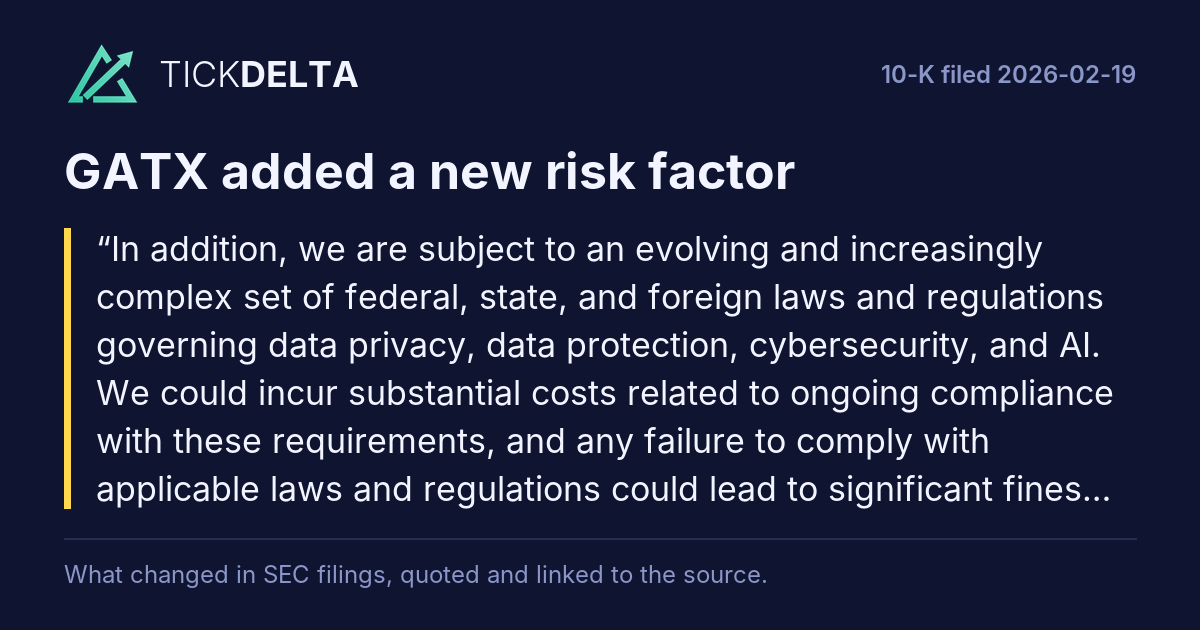
In addition, we are subject to an evolving and increasingly complex set of federal, state, and foreign laws and regulations governing data privacy, data protection, cybersecurity, and AI. We could incur substantial costs related to ongoing compliance with these requirements, and any failure to comply with applicable laws and regulations could lead to significant fines, penalties, litigation, or reputational damage.
We may increasingly use AI in our business going forward, and challenges with its implementation or use could result in operational issues, reputational or financial harm, or legal liability. Conversely, innovations driven by AI may positively impact industries that utilize transportation assets going forward, and if we do not successfully implement them, we may fail to increase operational efficiency, lose competitive advantage, or face diminished customer demand. These factors could materially impact our business, financial condition, or results of operations.
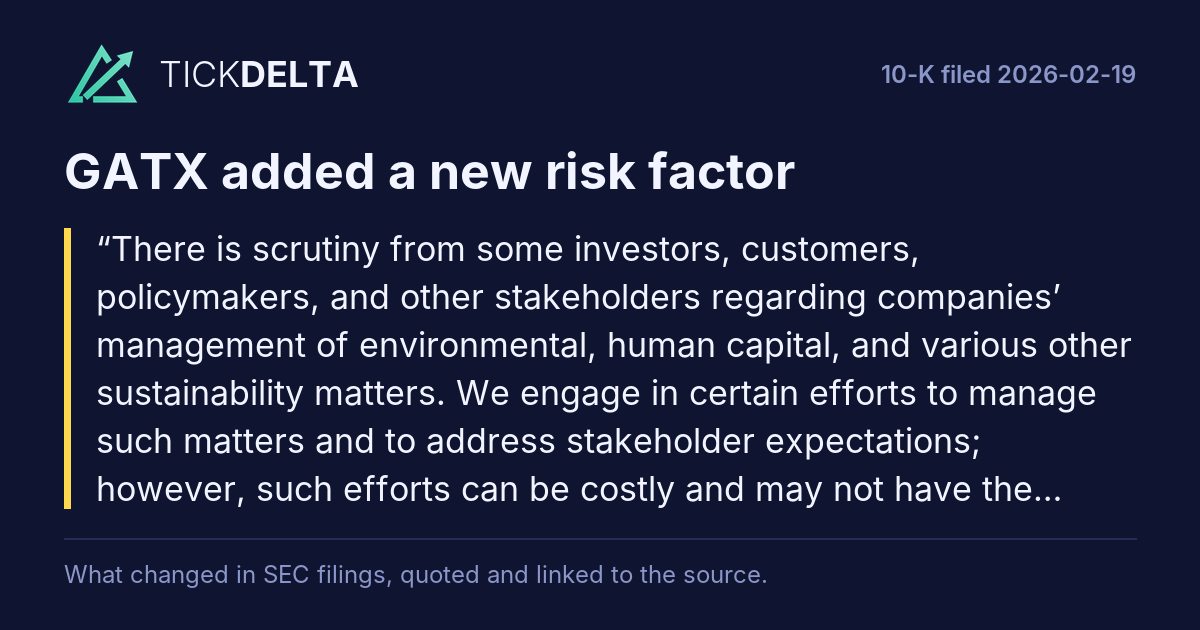
There is scrutiny from some investors, customers, policymakers, and other stakeholders regarding companies’ management of environmental, human capital, and various other sustainability matters. We engage in certain efforts to manage such matters and to address stakeholder expectations; however, such efforts can be costly and may not have the desired effect. As with other companies, our approach to such matters also evolves, and we cannot guarantee that our approach will align with the expectations or preferences of any particular stakeholder.
Additionally, stakeholder expectations vary and, at times, can conflict. For example, while some policymakers (such as California and the European Union) have adopted requirements for various disclosures or actions on environmental and social matters, policymakers in other jurisdictions have sought to constrain companies’ consideration of such matters in some circumstances. Some proponents and opponents of such matters are increasingly resorting to activism, including litigation, to advance their perspectives. Addressing stakeholder expectations entails costs and any failure to successfully navigate such expectations, as well as evolving legal requirements, may result in reputational harm, challenges with recruitment and retention of customers or employees, regulatory concerns, investor dissatisfaction, or other adverse impacts to our business.
Paragraphs in the 10-Q filed Oct 30, 2026 that were not in the one before
New in the latest 10-Q
8 paragraphs in the 10-Q filed Oct 30, 2026 with nothing like them in the 10-Q filed Jul 31, 2026 (at least half the words must differ; new numbers alone do not count). Quoted exactly, grouped by the item heading above them. This is text that changed, not a judgement of how serious it is.
Financial statements and notes
(1) Non-cash financing lease transactions are a result of the reclassification from operating lease liability to finance lease liability upon notice of the intent to exercise an early buy-out option.
Read in the 10-Q
(2) Represents the return of capital to the non-controlling interest based on its share of the reduction in the Wells Fargo rail assets acquisition purchase price.
Read in the 10-Q
As of September 30, 2026, GATX's ownership of GABX was 33.6 % and Brookfield's ownership was 66.4 %.
Read in the 10-Q
(2) Represents the return of capital to the non-controlling interest based on its share of the reduction in the Wells Fargo rail assets acquisition purchase price.
Read in the 10-Q
In the third quarter of 2025, GATX recorded $3.8 million of expense associated with the acquisition of Wells Fargo's rail assets. These expenses were recorded in SG&A.
Read in the 10-Q
Show the other 3
In addition, in the third quarter of 2025, a customer sold its interest in a nuclear power plant facility for which GATX previously managed the lease, and GATX received $7.4 million of residual sharing proceeds as part of a previously agreed upon residual sharing arrangement. This income was recorded in other income, including eliminations.
Read in the 10-Q
Other information
Departure of directors or certain officers; election of directors; appointment of certain officers; compensatory arrangements of certain officers
Read in the 10-Q
On October 28, 2026, Kim Nero, the Executive Vice President and Chief Human Resources Officer of GATX Corporation (the "Company"), left the Company. The Company expects to enter into a separation agreement with Ms. Nero that provides for a general release of claims against the Company and pursuant to which Ms. Nero will receive the severance benefits set forth under the Company's U.S. Executive Severance Plan. A copy of the Severance Plan was filed as Exhibit 10.2 to the Company's Annual Report on Form 10-K for the fiscal year ended December 31, 2022.
Read in the 10-Q
The 10-Q's risk factors against the 10-K
Item 1A of the 10-Q filed Oct 30, 2026 against Item 1A of the 10-K filed Feb 19, 2026.
A 10-Q repeats only the risks that changed, so a 10-K paragraph that is missing from it is not counted as removed.
Added is a paragraph with nothing like it in the 10-K, Reworded a sentence that is in both with several words changed,
Quiet changes a sentence in both where one to four words changed and one is a hedge or a modal
(cut words struck through, new words highlighted).
Text on the page, not a score; each links to the filing at sec.gov.
What the 10-Q itself says about its risk factors:There have been no material changes in our risk factors since December 31, 2025. For a discussion of our risk factors, refer to "Item 1A. Risk Factors" of our Annual Report on Form 10-K for the year ended December 31, 2025.
Read in the 10-Q
1 paragraph in the 10-Q's Item 1A, and none of them adds, rewords or quietly edits a paragraph of the 10-K's.
Phrases used for the first time
Two-word phrases in Risk Factors of the 10-K filed Feb 19, 2026 that are in none of the 1 earlier 10-Ks stored, back to Feb 19, 2025
Where each one is used
- gabx joint: Failure to effectively integrate the Wells Fargo rail business, or to realize the other anticipated benefits of the GABX joint venture, could adversely affect our business, financial condition, and results of operations.
- climate change: We may be affected by physical effects of or societal responses to climate change.
- anticipated benefits: Failure to effectively integrate the Wells Fargo rail business, or to realize the other anticipated benefits of the GABX joint venture, could adversely affect our business, financial condition, and results of operations.
- stakeholder expectations: There is scrutiny from some investors, customers, policymakers, and other stakeholders regarding companies’ management of environmental, human capital, and various other sustainability matters. We engage in certain efforts to manage such matters and to address stakeholder expectations; however, such efforts can be...
- global trade: Threatened or implemented changes in tariffs and other global trade policies could adversely affect our business.
- tariffs trade: There is currently significant uncertainty about the future relationship between the U.S. and various other countries with respect to tariffs, trade policies, and treaties. The current U.S. presidential administration has announced a range of tariffs on imports from many countries, but the situation remains fluid,...
- wells fargo: Failure to effectively integrate the Wells Fargo rail business, or to realize the other anticipated benefits of the GABX joint venture, could adversely affect our business, financial condition, and results of operations.
- full ownership: Minority ownership of the GABX joint venture and failure to acquire increased or full ownership of it may adversely affect our financial results.
Used at least twice, small words left out. Counted, not picked: a phrase can be new because the company renamed something.
What was taken out
1 paragraph of last year's Risk Factors with nothing like them now. The longest are quoted.
Sources
Item 1A of each 10-K and 10-Q on EDGAR, quoted exactly. Each paragraph links to the filing at sec.gov.
Also
10-K change: what was reworded or cut, section by section.
Work with it
Excel workbook · CSV. Google Sheet that stays up to date: paste =IMPORTDATA("https://tickdelta.com/company/GATX/export.csv") into a cell.