Screener / SEC EDGAR /CIK 0000923796 /10-K filed Feb 25, 2026, compared with Feb 28, 2025 /Numbers from the XBRL of the 10-Ks
NYSE Industrials · Homebuilders

GEO Group Inc GEO

Compare with peers Embed
SEC comment letters, last 20 years

4 reviews of GEO's filings by SEC staff

UPLOAD and CORRESP
Reviews 4 latest letter May 9, 2017
Questions asked 23 each answered in the company's own letter
No closing letter 1 reviews without a letter saying the staff completed it

When the SEC's staff reviews a filing, it writes to the company with numbered questions, and the company answers each one in a letter. SEC publishes the exchange once the review is over, at least 20 business days later. A question is not an accusation; most reviews end with the company adding detail to its next filing.

How the reviews went

Every review on EDGAR, from the first staff letter to the letter that closes it

  1. 1. Staff letters 7 UPLOAD
  2. 2. Questions in them 23 numbered comments
  3. 3. Company replies 7 CORRESP
  4. 4. Reviews closed 3 of 4 closing letter

Half the closed reviews took 17 days or less from the first letter to the closing letter.

Form 10-K for the fiscal year ended December 31, 2016

2017-05-09 to 2017-05-26 · 3 questions · 1 letter from the SEC, 1 from the company
Review closed 2017-05-26
Non-GAAP measures
Operations · Funds from Operations, page 81
SEC asked (1)
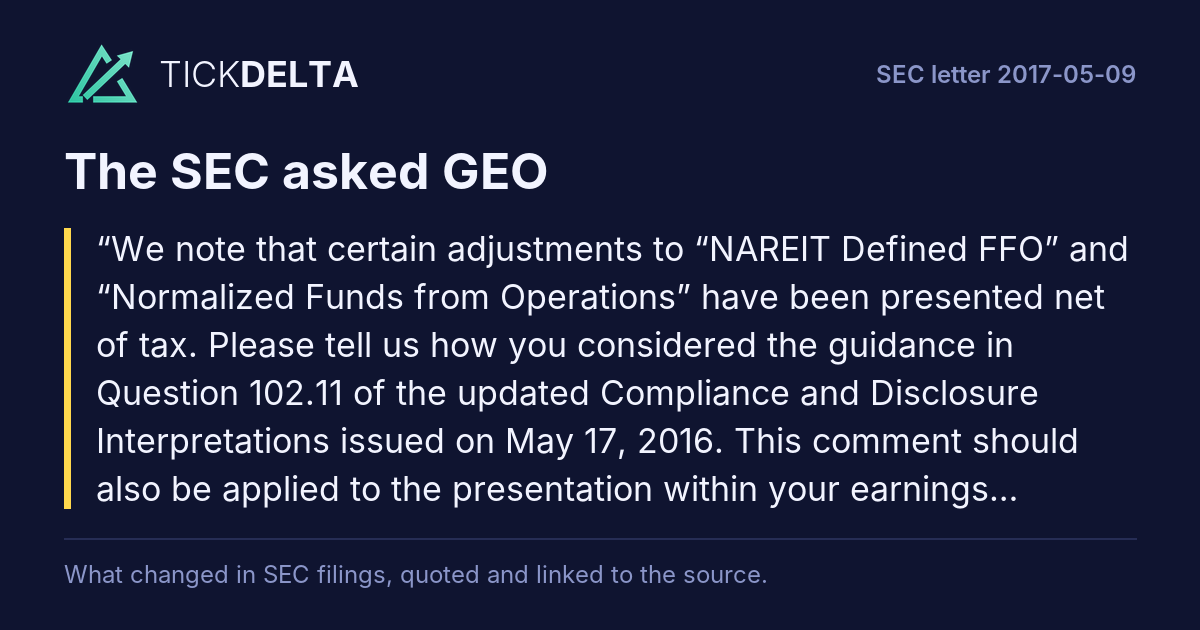
We note that certain adjustments to “NAREIT Defined FFO” and “Normalized Funds from Operations” have been presented net of tax. Please tell us how you considered the guidance in Question 102.11 of the updated Compliance and Disclosure Interpretations issued on May 17, 2016.
Rest of the question

This comment should also be applied to the presentation within your earnings release filed on Form 8-K and within the supplemental information posted on your website.

GEO answered
We acknowledge the Staff’s comment and we will revise the presentation and definition of FFO and Normalized FFO in future earnings releases, supplemental materials and periodic filings to be consistent with the proposed presentation attached hereto as Exhibit I.
Read in the reply
In its next report

First report after the company's reply of May 18, 2017: 10-Q filed Aug 7, 2017 ↗, against the 10-Q filed May 4, 2017 ↗.

Tickdelta does not hold the text of both reports, so they are not compared here.

Form 8-K filed February 28, 2017 · Exhibit 99.1
SEC asked (2)
We note your calculation of EBITDA contains adjustments for items other than interest, taxes, depreciation and amortization. Please revise in future filings to ensure that measures calculated differently from EBITDA are not characterized as EBITDA. See Question 103.01 of the updated Compliance and Disclosure Interpretations issued on May 17, 2016.
Rest of the question

This comment should also be applied to your presentation within the supplemental information posted on your website.

GEO answered
We acknowledge the Staff’s comment and we will revise the presentation and definition of EBITDA in future earnings releases and supplemental materials to be consistent with the proposed presentation attached hereto as Exhibit II.
Read in the reply
In its next report

First report after the company's reply of May 18, 2017: 10-Q filed Aug 7, 2017 ↗, against the 10-Q filed May 4, 2017 ↗.

Tickdelta does not hold the text of both reports, so they are not compared here.

Form 8-K filed February 28, 2017 · Exhibit 99.1
SEC asked (3)
In future filings, please revise to present a separate EBITDA reconciliation to comply with Item 10(e)(1)(i)(B) of Regulation S-K which requires a reconciliation of non-GAAP financial measures disclosed or released with the most directly comparable GAAP measure (i.e. net income). Further, your reconciliation should begin with the GAAP measure, so the non-GAAP measures do not receive undue prominence.
Rest of the question

See Question 102.10 of the updated Compliance and Disclosure Interpretations issued on May 17, 2016. This comment should also be applied to your presentation within the supplemental information posted on your website.

GEO answered
We acknowledge the

Staff’s comment and we will revise the presentation of the EBITDA reconciliation in future earnings releases and supplemental materials to be consistent with the proposed presentation attached hereto as Exhibit II.
Read in the reply
In its next report

First report after the company's reply of May 18, 2017: 10-Q filed Aug 7, 2017 ↗, against the 10-Q filed May 4, 2017 ↗.

Tickdelta does not hold the text of both reports, so they are not compared here.

Also in this review: closing letter, 2017-05-26

Form 10-K for the Year Ended December 31, 2014

2015-05-18 to 2015-06-04 · 1 question · 1 letter from the SEC, 1 from the company
Review closed 2015-06-04
Acquisitions
Form 10-Q for the quarterly period ended March 31, 2015
SEC asked
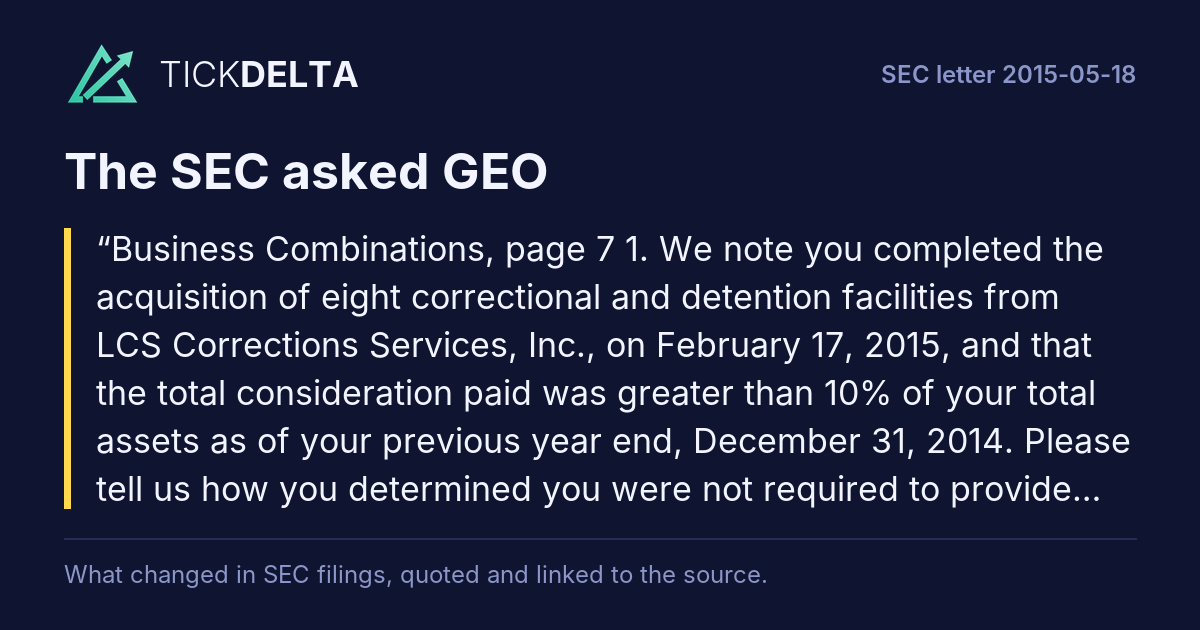
Business Combinations, page 7 1. We note you completed the acquisition of eight correctional and detention facilities from LCS Corrections Services, Inc., on February 17, 2015, and that the total consideration paid was greater than 10% of your total assets as of your previous year end, December 31, 2014.
Rest of the question

Please tell us how you determined you were not required to provide audited Rule 3-14 financial statements and related pro forma information by amendment to your Form 8-K by May 3, 2015. In responding to our comments, please provide a written statement from the company acknowledging that:  the company is responsible for the adequacy and accuracy of the disclosure in the filing;  staff comments or changes to disclosure in response to staff comments do not foreclose the Commission from taking any action with respect to the filing; and  the company may not assert staff comments as a defense in any proceeding initiated by the Commission or any person under the federal securities laws of the United States.
GEO answered
As the staff indicated, and as the Company has disclosed in its Form 8-K and in its Form 10-Q for the quarterly period ended March 31,

2015, the Company completed the acquisition of eight correctional and detention facilities from LCS Corrections Services, Inc. and its affiliates (collectively, “LCS”), on February 17, 2015 for total consideration of approximately

$307.4 million.

Prior to the acquisition of these facilities, the Company did consider the disclosure requirements required by Items 2.01 and 9.01 of Form 8-K as well as Rule 3-14 of Regulation S-X.
Rest of the answer

The Company reviewed the guidance set forth in the SEC’s Division of Corporation Finance Financial Reporting Manual, specifically in

Section 2305.2 – Nature of Real Estate Operations, which states that Rule 3-14 of Regulation S-X applies to the acquisition or probable acquisition of real estate operations. The guidance provides that “the term

‘real estate operations’ refers to properties that generate revenues solely through leasing. Examples include office, apartment and industrial buildings as well as shopping centers and malls. ‘Real estate operations’ excludes the acquisition of properties that generate revenues from operations other than leasing real property, such as nursing homes, hotels, motels, golf courses, auto dealerships, and equipment rental operations, which are more susceptible to variations in costs and revenues over shorter periods due to market and managerial factors.”

Collectively the correctional and detention facilities that the Company acquired from LCS do not generate revenues solely through leasing real property but instead generate revenue through general operations under facility management contracts with approved government appropriations based on a net rate per day per inmate. This per diem rate generally covers services provided such as security, food, medical and rehabilitation programs. Therefore, since these revenues are substantially generated from general operations and not from leasing activities, the Company concluded that Rule 3-14 of Regulation S-X was not applicable to this acquisition. As such, the Company determined that it was not required to provide audited Rule 3-14 financial statements and related pro forma information related to this acquisition in its Form 8-K.

We believe the response provided above fully addresses the Staff’s comment.

Read in the reply

Also in this review: closing letter, 2015-06-04

Form 10-K

2014-05-30 to 2014-08-25 · 4 questions · 2 letters from the SEC, 2 from the company
Review closed 2014-08-25
RevenueIncome taxesResults discussion (MD&A)Key metrics
Item 7. Management’s Discussion and Analysis of Financial Condition and Results of · Operations, page 53
SEC asked (1)
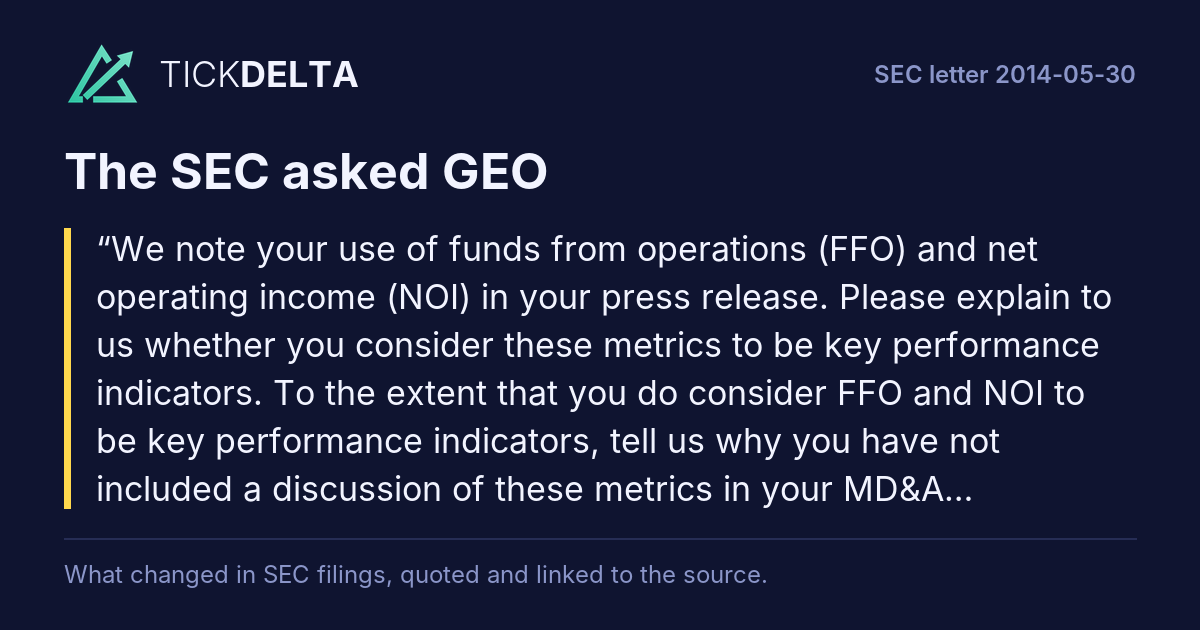
We note your use of funds from operations (FFO) and net operating income (NOI) in your press release. Please explain to us whether you consider these metrics to be key performance indicators. To the extent that you do consider FFO and NOI to be key performance indicators, tell us why you have not included a discussion of these metrics in your MD&A.
Rest of the question

Financial Statements Notes to Consolidated Financial Statements, page 95 1. Summary of Business Organization, Operations and Significant Accounting Policies, page 95

GEO answered
The Company has provided FFO, normalized funds from operations (Normalized FFO) and adjusted funds from operations (AFFO) in our press releases as supplemental Non-GAAP measures which we believe are important supplemental measures of our operating performance and believe they are frequently used by certain securities analysts, investors and other interested parties as part of their evaluation of our Company and other REITs.

Page

The Company has historically excluded these Non-GAAP measures from its Form 10-Q and Form

10-K filings, however, we understand that the Staff has in recent comment
Rest of the answer

letters requested that certain REIT registrants disclose FFO in future periodic filings. In addition, the Company’s view of FFO, Normalized FFO and AFFO as performance measures has increased and we are currently relying more on FFO, Normalized FFO and AFFO to measure performance, reflect the impact to operations from trends in occupancy rates, per diem rates, operating costs and interest costs, and measure our ability to pay quarterly dividend payments. Accordingly, in future periodic filings, the Company will provide FFO as defined by the National Association of Real Estate Investment Trusts (“NAREIT”) and a reconciliation to the Company’s

GAAP net income for each period presented. In addition, the Company will disclose, in future periodic filings, Normalized FFO and AFFO, along with their definitions and reconciliation to FFO.

With respect to net operating income (“NOI”), the Company does not consider this to be a key performance indicator. NOI is one operational metric out of many used by the industry to assess company performance and, accordingly, the Company provides this measure to securities analysts and investors. However, unlike FFO there is no standard industry definition regarding the method of calculation. As a result, NOI is not consistently defined or calculated by peer companies or investors. Further, this metric does not take into account all aspects of the Company’s performance because NOI does not include the impact of certain revenues and expenses such as equity in earnings of affiliates, interest income, interest expense, income taxes, general and administrative expenses and can be significantly influenced by the level of capital expenditures. We therefore believe it is not meaningful disclosure to include in the Company’s MD&A section of its Form 10-Q and Form 10-K filings.

Read in the reply
In its next report

First report after the company's reply of Jun 26, 2014: 10-Q filed Aug 8, 2014 ↗, against the 10-Q filed May 6, 2014 ↗.

Tickdelta does not hold the text of both reports, so they are not compared here.

Revenue Recognition, page 105
SEC asked (2)
Please tell us how you complied with paragraph 2e-h of ASC 605-25-50 or tell us how you determined it was not necessary to disclose this information. 17. Income Taxes, page 143
GEO answered
As the Staff has noted, we have disclosed our general accounting policy related to multiple-element arrangements in our Form 10-K for the year ended December 31, 2013.

Historically, any significant activity involving multiple-element arrangements has related to our project development services where we also provide standard management services. However, we have not had any contracts to provide project development services in addition to standard management services during the last three years.
Rest of the answer

If we obtain contracts for such multiple-element arrangements in the future, we will provide additional disclosures under ASC 605-25-50 in accordance with the particular terms of each individual contract. Additionally, sales of monitoring equipment and other services involving multiple-element arrangements at our wholly-owned subsidiary, BI, has not been significant for any of the reporting periods covered by the Form 10-K. For the year ended December 31, 2013, BI had two sales involving multiple-element arrangements for a total of approximately $100,000. For the year ended

December 31, 2012, BI had three sales involving multiple-element arrangements for a total of approximately $200,000 and had no sales involving multiple-element arrangements in 2011. As our revenues earned involving multiple-element arrangements have clearly been immaterial, we believe that it has not been necessary to disclose in the Form 10-K the information included in paragraphs 2e-h of ASC 605-25-50. We will remove our general policy disclosure relating to multiple-element arrangements in future periodic filings and we will add additional disclosures under paragraphs 2e-h of ASC 605-25-50 when, and if, such arrangements become significant.

17. Income Taxes, page 143

Read in the reply
In its next report

First report after the company's reply of Jun 26, 2014: 10-Q filed Aug 8, 2014 ↗, against the 10-Q filed May 6, 2014 ↗.

Tickdelta does not hold the text of both reports, so they are not compared here.

Revenue Recognition, page 105
SEC asked (3)
We note you recorded an adjustment for the Impact of your REIT election during 2013. We further note that you made your REIT election during 2012. Please tell us the nature of the 2013 adjustment and tell us how you determined that this adjustment relates to 2013.
GEO answered
First, the Company respectfully advises the Staff that the actual REIT election was not made in 2012. The Company began to organize its operations in order to be eligible to elect REIT status and made the decision to convert to REIT status in 2012, but the Company did not begin operating as a REIT until the year ended December 31, 2013.

In response to the Staff’s request that GEO provide the background on the nature of its 2013 REIT election related adjustment as well as elaborate on how it determined that this adjustment relates to 2013, GEO would like to begin by directing the Staff to
Rest of the answer

Note 17 of the notes to the financials in the Form 10-K beginning on page 143.

GEO’s footnote disclosure on page 144 includes the following relevant disclosure:

“In 2013 and 2012, the Company had a tax benefit related to the REIT conversion of $14.9 million and $79.0 million respectively, which was primarily related to the revaluation of certain deferred tax assets and liabilities upon conversion to the effective tax rate of the REIT at a zero tax rate.”

The 2013 adjustment referenced in the above footnote disclosure consists of the following components that are further discussed below.

Worthless stock deduction

$

6.9 million

Impact of acceleration of tax depreciation on certain assets

6.5 million

Tax return to tax accrual items

1.5 million

Total temporary differences (revalued at zero tax rate)

14.9 million

GEO believes it is important to note that the $14.9 million adjustment for the impact of the REIT election consisting of the components listed above would not ordinarily have an effective income tax rate impact since they consist of a change from what was recorded, estimated or accrued to reflect tax basis differences. However, since these underlying assets and liabilities belong to legal entities that form part of the REIT which is essentially not subject to tax, the related gross deferred tax items needed to be revalued at a zero tax rate – and thus impacted the effective tax rate. The zero income tax rate is a result of the REIT receiving a deduction for dividends paid, which as a practical matter is generally larger than taxable income and therefore leaves no income subject to tax.

The impact of the REIT election amounts reported in 2013 related to items that were not reasonably knowable or readily accessible as of the date the December 31, 2012 balance sheet was prepared. Therefore, this $14.9 million adjustment reflects changes in estimates from the date the December 31, 2012 balance sheet was prepared and the adjustment was recorded at the time when information necessary to determine the impact was available and accessible in accordance with ASC 250-10-45-17. Each item described below was grouped under the caption “Impact of REIT election” because, if not for the REIT election, these items would only give rise to a timing difference and not a permanent difference, and therefore would not impact the Company’s effective tax rate disclosed in the rate reconciliation of the tax footnote.

Worthless stock deduction:

Legal entities that form part of the REIT are deemed liquidated into the REIT parent at the end of the day preceding the effective date of the

REIT election, which was January 1, 2013. General U.S. tax rules apply in the case of a liquidation as a result of a REIT conversion. In most situations, these rules provide for a tax-free liquidation with a carry-over tax basis of assets and liabilities that formed part of the liquidated subsidiary. These rules are inapplicable if the liquidating corporation is over-indebted (or insolvent). Such a situation occurs when the debts of the company are in excess of its fair market value and as a result there are no assets available in return for capital stock. The Company has many legal entities which were deemed liquidated into the REIT parent as a result of the REIT election. As such, this required a subsidiary by subsidiary analysis to determine if the liquidation was tax free or not.

In order to completely document a taxable liquidation which results in a worthless stock deduction, there were a number of complex evaluations that needed to be undertaken. These evaluations include, but are not limited to, the following:

Debt

An evaluation of whether GEO could fully support the debts of its subsidiaries or to what extent it could support the debts of its subsidiaries needed to be performed. This evaluation needed to be comprehensive in order to sustain Internal Revenue

Service (“IRS”) scrutiny. If the total debt of each subsidiary being analyzed was less than its fair market value, then the subsidiary was not deemed insolvent. The analysis of debt included intercompany advances.

Fair Market Value

Another evaluation focused on the fair market value of each entity. The evaluation of fair market value of each entity needed to be substantiated and fully supported in order to sustain IRS scrutiny. If the fair market value of the subsidiary was in excess of its debt then the subsidiary would not be insolvent.

Outside Tax Basis in Subsidiary Stock

Another evaluation required GEO to calculate and support the outside tax basis in its subsidiary stock in order to sustain IRS scrutiny and compute the amount of any applicable stock loss.

Subsidiary debt, fair market value and outside tax basis are not information items that are generally maintained up to date unless a company is in the process of divesting subsidiaries or has intentions of divesting subsidiaries. GEO had not completed divestitures or liquidations since 2005 when it undertook two dispositions and GEO did not intend to undertake divestitures or liquidations until it was required to do so in order to be eligible for REIT status. As a result, this information was not readily available.

For subsidiaries that participate in the filing of a U.S. federal consolidated tax return, the outside basis is essentially adjusted each year for income items, expense items and other tax attributes. In the case of subsidiaries that formed part of a consolidated group that was previously acquired by the Company, the analysis included tax years that preceded our acquisition. As such, these values were not readily available at the time of the filing of GEO’s Form 10-K for the year ended December 31, 2012.

GEO hired a national accounting firm to assist with the gathering of financial and tax information to determine debt, fair market value and outside basis in over a dozen subsidiaries. Three of these subsidiaries were found to be insolvent.

The identified aggregate worthless stock deduction was a change to GEO’s 2012 tax provision estimate. The change in accounting estimate was made in the second quarter of 2013 and reported in GEO’s Form 10-Q for the second quarter ended June 30, 2013. As of the date the

December 31, 2012 balance sheet was prepared, the financial and tax information necessary in order to determine the actual tax impact of the worthless stock deduction was not reasonably known nor readily accessible with a reasonable level of accuracy. As of this date, GEO was not in a position to confirm the solvency of these entities. Under ASC 740-10-25-14 and ASC 740-10-35-2, GEO’s management made its best judgment given the facts, circumstances, and information available at the reporting date and decided to record the financial statement impact of these liquidations when a reasonable estimate could be made with accurate and reliable data. The transactions in question and the required tax analyses were complex in nature and infrequent in occurrence. Therefore, GEO believes it was appropriate to reflect it as a change in accounting estimate made in 2013. ASC 250-10-45-17 states that “A change in accounting estimate shall be accounted for in the period of change if the change affects that period only or in the period of change and future periods if the change affects both. A change in accounting estimate shall not be accounted for by restating or retrospectively adjusting amounts reported in financial statements of prior periods or by reporting pro forma amounts for prior periods.” Therefore, the change in accounting estimate was accounted for in 2013 since that was the period of change.

Since GEO is a participant in the IRS Compliance Assurance Process or CAP program for 2012, the worthless stock deduction has been audited by the IRS and the IRS agreed with the Company’s treatment. The IRS review of the worthless stock deduction was finalized during the fourth quarter of 2013 with the issuance of a Notice of Proposed Adjustment in December of 2013.

Impact of acceleration of tax depreciation on certain assets:

With the filing of the 2012 tax return on September 14, 2013, GEO requested a catch up tax depreciation deduction from the IRS principally with respect to certain security related assets specific to our business that had been classified with a more conservative tax life when originally placed in service.

At the end of 2012, the Company was undergoing an audit by the IRS. The IRS was challenging the tax recovery periods of certain security related assets placed in service during 2010 and 2011. As of the date the December 31, 2012 balance sheet was prepared, the Company and the IRS were not in agreement as to the challenged tax recovery periods used for these fixed assets. In the second quarter of 2013 after the filing of the annual report on Form 10-K for the year ended December 31, 2012, the Company settled its differences with the IRS as to the allowable tax lives of these fixed assets. The settled tax recovery periods were also applied in preparing a method change for similar assets. In 2013, the Company filed for an Automatic Change in Accounting Method with the IRS to retroactively change the tax recovery periods of these fixed assets, which resulted in an acceleration of tax depreciation on GEO’s 2012 income tax return and which was different from the tax depreciation used for the 2012 income tax provision.

In addition, deductions for repairs and maintenance for previously capitalized asset costs were made under newly issued Treasury regulations.

These new regulations prompted the Company to change its method regarding the deductibility of certain repair costs which were previously capitalized. In 2013, the Company filed for an Automatic Change in Accounting Method with the IRS to retroactively deduct certain repair costs, the impact of which was included in the 2012 income tax return but different from what was recorded in the 2012 tax provision.

ASC 250-10-20, “Changes in Accounting estimates result from new information.” In this case, new information was obtained upon the settlement of the issues with the IRS relating to the tax recovery periods of certain fixed assets specific to the Company’s corrections and detention business as well as newly issued Treasury regulations. Therefore, the change in judgment was related to new information and thus a change in accounting estimate. Based on ASC 250-10-45-17 as described above, the change in accounting estimate was accounted for in 2013 since that was the period of change.

The automatic accounting method changes were audited by the IRS as part of the 2012 CAP audit and were accepted with no change during the fourth quarter of 2013.

This adjustment reflects differences between items that were estimated as of the date the December 31, 2012 balance sheet was prepared and the actual amounts of these items reflected on the Company’s tax return. The tax return to tax accrual items reported under the caption “Impact of REIT election” in the rate reconciliation only included temporary differences which would ordinarily not give rise to an effective tax rate impact if it was not for the REIT conversion. No permanent tax return to tax accrual items are included under this caption.

Due to the fact that ASC 250-10-45-17 applies, the change in accounting estimate was accounted for in 2013 since that was the period of change.

GEO believes it is important to note that the $14.9 million adjustment reported under the caption “Impact of REIT election” consisting of the worthless stock deduction, impact of acceleration of tax depreciation on certain assets and tax return to tax accrual items as discussed above would not ordinarily have an effective income tax rate impact since they consist of a change from what was recorded, estimated or accrued to reflect tax basis differences. However, since the underlying assets and liabilities belong to legal entities that form part of the REIT which is essentially not subject to tax, the related gross deferred tax items needed to also be revalued at a zero tax rate – and thus impacted the effective tax rate. The zero income tax rate is a result of the REIT receiving a deduction for dividends paid, which as a practical matter is generally larger than taxable income and therefore leaves no income subject to tax.

The impact of the REIT election amounts reported in 2013 related to items that were not reasonably knowable or readily accessible as of the date the December 31, 2012 balance sheet was prepared. Therefore, this $14.9 million adjustment reflects changes in estimates from the date the December 31, 2012 balance sheet was prepared and the adjustment was recorded at the time in which information necessary to determine the impact was available and accessible in accordance with ASC

250-10-45-17. Each item described above was grouped under the caption “Impact of REIT election” because, if not for the REIT election, these items would only give rise to a timing difference and not a permanent difference, and therefore would not impact the Company’s effective tax rate disclosed in the rate reconciliation of the tax footnote.

We believe the responses provided above fully address the Staff’s comments. If you have any questions, please call the undersigned at 305-982-5519.

In connection with responding to the Staff’s comments, GEO has acknowledged in Exhibit A to this letter the following:

•

GEO is responsible for the adequacy and accuracy of the disclosure in the filing;

Staff comments or changes to disclosure in response to Staff comments do not foreclose the Commission from taking any action with respect to the filing; and

GEO may not assert Staff comments as a defense in any proceeding initiated by the Commission or any person under the federal securities laws of the United States.
Read in the reply
In its next report

First report after the company's reply of Jun 26, 2014: 10-Q filed Aug 8, 2014 ↗, against the 10-Q filed May 6, 2014 ↗.

Tickdelta does not hold the text of both reports, so they are not compared here.

Financial Statements · Notes to Consolidated Financial Statements, page 95
SEC asked
Income Taxes, page 143 1. We have considered your response to our prior comment three. With respect to your worthless stock deduction, please clarify for us what new information was received in 2013 that was not available as of December 31, 2012.
Rest of the question

To the extent the company was waiting on the completion of its internal analysis, explain to us why the results were not accounted for as a correction of an error in accordance with ASC Topic 250-10-45-25. In addition, please tell us if the deduction resulted in a decrease to the company’s income tax liability for prior years, and whether the company has received a refund as of the date of your response.

GEO answered
To provide context to the Company’s process related to determining the Company’s estimate of the worthless stock deduction, we wanted to describe to you in more detail the steps taken by the Company as it relates to the December 31, 2012 worthless stock deduction.

A worthless stock deduction involves a two-step analysis. First, the subsidiary must be tested for insolvency which requires a comparison of the fair market value of the subsidiary’s business to its debt.
Rest of the answer

Also, in the case of intercompany advances, there must be a determination of whether or not the intercompany advances are considered to be a liability or equity for tax purposes. If the subsidiary is determined to be solvent, then there can be no worthless stock deduction. Secondly, only once insolvency is established, is it relevant to determine the tax basis to calculate the amount of the worthless stock loss.

In order to arrive at an estimate of the worthless stock deduction there are several key informational data points that are absolutely essential to determine whether or not there is a potential deduction and whether or not it is possible to estimate such a deduction. These key informational data points are as follows:

•

Debt Legitimacy Study

Fair Market Value Valuation

Tax Basis Study

In addition, calculating the tax basis for a subsidiary that participates in the filing of a consolidated group requires the tracking of income, expense and other information since the subsidiary’s inception.

On December 6, 2012, the Company announced that it was converting to a REIT effective January 1, 2013. The Company undertook a significant number of contractual, legal and organizational restructuring activities in December 2012 to ensure that it was able to operate in compliance as a REIT effective January 1, 2013. Included among these significant actions were two transactions that gave rise to the Company’s overall worthless stock deduction. These two transactions were the sale of the Company’s Residential Treatment Services (“RTS”) division and the deemed liquidation of certain subsidiaries which became Qualified REIT Subsidiaries. If not for the REIT conversion, there would have been no reason to consider whether or not a worthless stock deduction existed and neither of these two transactions would have occurred.

For the sale of RTS, management was able to determine that a worthless stock deduction existed and estimate the deduction because all of the information related to the key data points discussed above was available at December 31, 2012. Since RTS was sold to a third party under a purchase contract at December 31, 2012, it resulted in an arm’s length negotiated sale price which established the fair market value of the subsidiary and its assets. In addition, the determination of the insolvency of RTS was simplified because its intercompany debt was supported by an intercompany note which was important because it significantly reduced the likelihood that the Internal Revenue Service (“IRS”) would consider the intercompany debt to be equity which could have resulted in RTS not being insolvent. Since the Company had all of the key informational data points available at December 31, 2012, management was able to determine that RTS was insolvent and management therefore was able to reasonably estimate the amount of the worthless stock deduction. The Company recorded a tax benefit of $7.8 million which was included in discontinued operations in the Company’s Annual Report on Form 10-K for the year ended December 31, 2012.

In contrast to the RTS transaction, the key informational data points needed to determine if a worthless stock deduction would be available for the subsidiaries deemed liquidated as a result of the REIT conversion were not available to the Company as of December 31, 2012. For instance, no fair market valuations of the liquidating subsidiaries existed and there were no third party sales to substantiate the fair values. Also, the indebtedness of the liquidating subsidiaries consisted primarily of intercompany advances with a history that predated our acquisition of these subsidiaries (in some cases by almost 20 years). Most importantly, the information was not available to allow the Company to determine the solvency of the subsidiaries. As discussed above, the Company did not make the decision to convert to a REIT until December 6, 2012.

With respect to the Company’s estimate of the worthless stock deduction for the liquidated subsidiaries, the following new information was received by the Company after December 31, 2012.

In December 2012, the Company engaged a national third party tax consulting firm to perform a debt legitimacy study of the debt for the liquidating subsidiaries. In April 2013, the Company received the debt legitimacy study from the tax consulting firm. The debt legitimacy study provided new information which the Company did not have prior to the filing of the December 31, 2012 financial statements.

In January 2013, the Company engaged the national third party tax consulting firm to perform a solvency scoping analysis on over a dozen subsidiaries. Based on the scoping analysis, the Company engaged the third party tax consulting firm in February 2013 to perform a valuation study on four subsidiaries. On July 2, 2013, the Company received the final valuation reports. The final valuation reports allowed management to conclude that three of the four subsidiaries for which a study was prepared were in fact insolvent. The valuation reports provided new information which the Company did not have prior to the filing of the December 31, 2012 financial statements and together with the debt legitimacy study allowed management to conclude which subsidiaries were in fact insolvent and therefore gave rise to a worthless stock deduction as a consequence of the REIT conversion.

In February 2013, the Company engaged the national third party tax consulting firm to perform a tax basis study for the liquidating subsidiaries. In

June 2013, the final tax basis study was received from the third party tax consulting firm. As noted above, the tax basis study was required to calculate the amount of the worthless stock deduction and incorporated the information received from the debt legitimacy study and the fair market valuation. The tax basis study was new information which the Company did not have prior to the filing of the December 31, 2012 financial statements.

The new information listed above which was substantially received from the national third party consulting firms in June and July of 2013 was not available to the Company prior to the filing of its December 31, 2012 financial statements. The new information received was not a part of the Company’s books and records and other information was not readily accessible from the

Company’s 2012 books and records. Because this new information was needed by the Company to estimate the worthless stock deduction related to the liquidating subsidiaries and because this information was not available prior to the filing of its

December 31, 2012 financial statements, the Company considered the amount recorded in 2013 related to the worthless stock deductions a change in estimate under ASC 250-10-45-17 and not the correction of an error under ASC 250-10-45 paragraphs 22 to

24. ASC 250 defines changes in accounting estimate as changes resulting from new information while ASC 250 defines an error as an error in recognition, measurement, presentation or disclosure in financial statements resulting from mathematical mistakes, mistakes in the application of GAAP, or oversight or misuse of facts that existed at the time the financial statements were prepared. In this situation, management did not experience mathematical mistakes, mistakes in the application of

GAAP or oversight or misuse of facts but rather the required key informational data points necessary to perform and estimate the calculation were not available. Management estimated that there was no worthless stock deduction relating to the liquidating subsidiaries as of the filing of the Annual Report on Form 10-K for the year ended December 31, 2012 since the information available would not support one. Once new information was received, management revised its estimate and recorded a worthless stock deduction for these subsidiaries in 2013. For the RTS subsidiary, information was available for the Company to support and reasonably estimate a worthless stock deduction as of December 31, 2012 and therefore the

Company recorded the related tax benefit in its Annual Report on Form 10-K for the year ended December 31, 2012.

Finally, the comment letter asked if the deduction resulted in a decrease to the Company’s income tax liability for prior years, and whether the Company has received a refund as of the date of our response. The deduction did result in a decrease to the

Company’s income tax liability for the 2012 tax year. Further, as stated in our correspondence dated June 26, 2014, the IRS audited the worthless stock deduction and agreed with the Company’s treatment. The Company has received a refund for the 2012 tax year as of the date of this response.

We believe the responses provided above fully address the Staff’s comments. If you have any questions, please call the undersigned at 305-982-5519.

In connection with responding to the Staff’s comments, GEO has acknowledged in Exhibit A to this letter the following:

GEO is responsible for the adequacy and accuracy of the disclosure in the filing;

Staff comments or changes to disclosure in response to Staff comments do not foreclose the Commission from taking any action with respect to the filing; and

GEO may not assert Staff comments as a defense in any proceeding initiated by the Commission or any person under the federal securities laws of the United States.
Read in the reply

Also in this review: closing letter, 2014-08-25

Form S-4

2013-06-26 to 2014-01-02 · 15 questions · 3 letters from the SEC, 3 from the company
No closing letter
Risk factorsNon-GAAP measuresResults discussion (MD&A)
SEC letter of Jun 26, 2013 ↗ no reply letter on EDGAR (the company may have answered in an amended filing)
General
SEC asked (1)
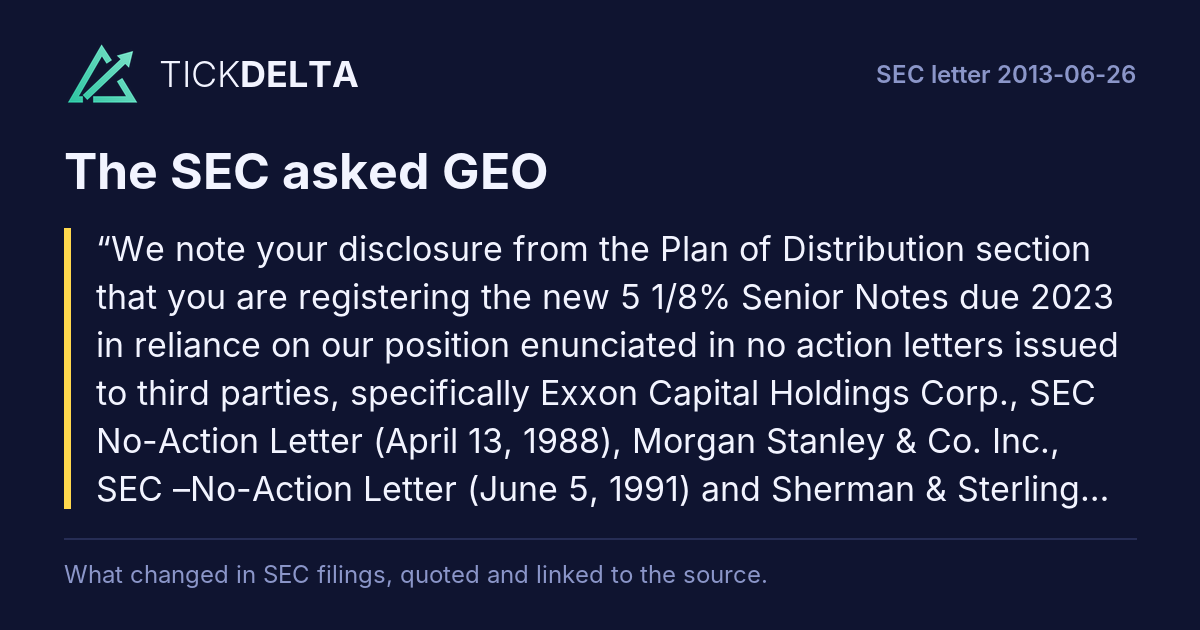
We note your disclosure from the Plan of Distribution section that you are registering the new 5 1/8% Senior Notes due 2023 in reliance on our position enunciated in no action letters issued to third parties, specifically Exxon Capital Holdings Corp., SEC No-Action Letter (April 13, 1988), Morgan Stanley & Co. Inc., SEC –No-Action Letter (June 5, 1991) and Sherman & Sterling, SEC No-Action Letter (July 2, 1993).
Rest of the question

Accordingly, with the next amendment, please provide us with a supplemental letter stating that you are registering the exchange offer in reliance on our position contained in these letters and include the representations contained in the Morgan Stanley and Sherman & Sterling noaction letters.

GEO answered

No reply letter found.

General
SEC asked (2)
Please provide us with support for all quantitative and qualitative business and industry data presented in the registration statement, including, but not limited to, statements about your competitive position in the industry, research data prepared by the National Association of State Budget Officers, the Bureau of Justice Statistics, the Bureau of Prisons and the Pew Center on the States.
Rest of the question

Please note that the requested information should be filed as EDGAR correspondence or, alternatively, should be sent in paper form accompanied by a cover letter indicating that the material is being provided pursuant to Securities Act Rule 418 and that such material should be returned to the registrant upon completion of the staff review process. Please also highlight the specific portions that you are relying upon so that we can reference them easily. In addition, please confirm to us that any third party data included in the registration statement was not prepared for or commissioned by the registrant or its affiliates.

GEO answered

No reply letter found.

Cover Page of Prospectus
SEC asked (3)
Please move the statements in the third paragraph under the table of contents related to broker-dealer use of the prospectus to the cover page.
GEO answered

No reply letter found.

Cover Page of Prospectus
SEC asked (4)
It appears that the offer could be open for less than 20 full business days if the offer expires at 5:00 p.m. rather than midnight on the twentieth business day following commencement. See Question and Answer Eight in Exchange Act Release No. 16623 (March 5, 1980). Please confirm that the offer will be open at least through midnight on the twentieth business day. See Rule 14d-1(g)(3) of the Exchange Act.
Rest of the question

In addition, please confirm that the expiration date will be included in the final prospectus disseminated to security holders and filed pursuant to the applicable provisions of Rule 424.

GEO answered

No reply letter found.

Table of Contents
SEC asked (5)
Please revise your disclosure in the last paragraph hereunder to clarify that the prospectus will be updated to the extent required by law.
GEO answered

No reply letter found.

Competitive Strengths, page 2
SEC asked (6)
To balance your discussion of competitive strengths, please disclose summary risk factors, including the risks related to government appropriations discussed on page 29.
GEO answered

No reply letter found.

Conditions to the Exchange Offer, page 8
SEC asked (7)
Please revise your disclosure in the summary to briefly highlight all of such conditions. For instance, revise to briefly describe the representations required by the noteholders in connection with the exchange.
GEO answered

No reply letter found.

Conditions to the Exchange Offer, page 8
SEC asked (8)
Please also revise to describe your unfettered right to amend the offer and describe the extension of the offer period in connection with any material changes, consistent with your disclosure on page 40.
GEO answered

No reply letter found.

Summary Historical Financial and Other Data, page 11
SEC asked (9)
Please revise your disclosure to more thoroughly describe the adjustments made to EBITDA or FFO to arrive at Adjusted EBITDA, Normalized FFO and Adjusted FFO. Your revised disclosure should include a detailed discussion of why management believes the adjustments are necessary to provide investors with a better understanding of the company’s performance.
GEO answered

No reply letter found.

Risk Factors · Operating juvenile correctional facilities…, page 30
SEC asked (10)
Please supplement your disclosure in this section to discuss more specifically the “increased operational risks and difficulties” related to the operation of juvenile correctional facilities. Exhibit 5.1 – Opinion of Akerman Senterfitt as to the validity of the securities being offered and as to matters of Florida and Delaware law
GEO answered

No reply letter found.

Risk Factors · Operating juvenile correctional facilities…, page 30
SEC asked (11)
Please refer to subpart (g) of the second full paragraph on page 2 of the opinion. We note that counsel has assumed that the execution, delivery and performance by each of the parties to the Opinion Documents does not violate any law, rule or regulation applicable to such party.
Rest of the question

The noted assumption appears inappropriate because it assumes legal matters that appear material to counsel’s opinions regarding the validity and binding obligation of the Indenture (found in opinion 8) as well as the due authorization of the Exchange Notes (per opinion 9). Please provide a revised opinion that omits or limits the scope of this assumption.

GEO answered

No reply letter found.

Note 1 – Summary of Business Organization, Operations and Significant Accounting Policies · Property and Equipment, page 82
SEC asked (12)
We note that a part of your business deals with the construction of correctional and detention facilities. Please expand your existing disclosure regarding property and equipment to further discuss your capital expenditures policy.
Rest of the question

Your disclosure should address the following:  The types of indirect expenses that are potentially capitalized during the development stage in addition to interest, such as taxes, salaries and other general and administrative expenses.  To the extent material, quantify and disclose personnel costs capitalized during construction for all periods presented and discuss fluctuations in capitalized personnel costs for all periods presented within your MD&A.  The periods of capitalization including a discussion of when the capitalization period begins and ends.

GEO answered

No reply letter found.

Item 15 – Exhibits and Financial Statement Schedules
SEC asked (13)
We note that all other schedules besides Schedule II have been omitted because they are either inapplicable or not required. Given your business operations and recent REIT conversion, please clarify how you have complied with the requirements of Rule 5-04 of Regulation S-X for Schedule III.
GEO answered

No reply letter found.

Summary Historical Financial and Other Data, page 11
SEC asked
We have considered your response to comment 9 and reviewed your revised disclosures. We are unclear how your revised disclosure addresses our comment as it relates to Adjusted EBITDA. With regard to Normalized FFO and Adjusted FFO, you state that your adjustments do not reflect a necessary component of your operational performance and are not indicative of your core operating performance.
Rest of the question

Please further revise your disclosures to describe each adjustment to Adjusted EBITDA, Normalized FFO, and Adjusted FFO and how the nature of each adjustment does not represent a necessary component of your operational performance and are not indicative of your core operating performance.

GEO answered
Pursuant to Rule 461 under the Securities Act of 1933, as amended (the “Securities Act”), The GEO Group, Inc. (the

“Company”) requests that the effectiveness of the Registration Statement referenced above be accelerated anytime prior to 5:30 p.m. on September 12, 2013.

As requested, the Company acknowledges that:

• should the Commission or the staff, acting pursuant to delegated authority, declare the filing effective, it does not foreclose the Commission from taking any action with respect to the filing;

the action of the Commission or the staff, acting pursuant to delegated authority,
Rest of the answer

in declaring the filing effective, does not relieve the Company from its full responsibility for the adequacy and accuracy of the disclosure in the filing; and the Company may not assert staff comments and the declaration of effectiveness as a defense in any proceeding initiated by the Commission or any person under the federal securities laws of the United States.

Read in the reply
General
SEC asked
We note your disclosure that you are registering 5 7⁄8% Senior Notes due in 2022 in reliance on our position enunciated in no action letters issued to third parties, specifically Exxon Capital Holdings Corp., SEC No-Action Letter (April 13, 1988), Morgan Stanley & Co. Inc., SEC No-Action Letter (June 5, 1991) and Sherman & Sterling, SEC No- Action Letter (July 2, 1993).
Rest of the question

Accordingly, with the next amendment, please provide us with a supplemental letter stating that you are registering the exchange offer in reliance on our position contained in these letters and include the representations contained in the Morgan Stanley and Sherman & Sterling no-action letters.

GEO answered
Contemporaneously with the submission of this response letter and the filing of Amendment No. 1, GEO is filing a supplemental letter stating that GEO is registering the exchange offer in reliance on the Commission’s position enunciated in the above mentioned no-action letters. The supplemental letter includes the representations contained in the Morgan Stanley and

Shearman & Sterling no-action letters.

Mr.
Rest of the answer

Duc Dang, Special Counsel

In connection with responding to the Staff’s comments, GEO has acknowledged in Exhibit A to this letter the following:

• should the Commission or the Staff, acting pursuant to delegated authority, declare the filing effective, it does not foreclose the Commission from taking any action with respect to the filing;

the action of the Commission or the Staff, acting pursuant to delegated authority, in declaring the filing effective, does not relieve GEO from its full responsibility for the adequacy and accuracy of the disclosure in the filing; and

GEO may not assert Staff comments and the declaration of effectiveness as a defense in any proceeding initiated by the Commission or any person under the federal securities laws of the United States.

We believe the response provided above fully addresses the Staff’s comment. If you have any questions, please call the undersigned at

305-982-5519.

Read in the reply

Also in this review: company letter, Jan 2, 2014

Letters without questions

Other letters

UPLOAD and CORRESP
4 other letters: notices that a filing will not be reviewed, requests to declare a registration effective, and the like

From the SEC's correspondence on EDGAR: staff letters (form UPLOAD) and company letters (form CORRESP), 21 letters filed since 2013-06-27. Questions and answers are matched by their numbers; topics come from words in each question. The reports are compared word for word (same form, before the first SEC letter against the first report after the company's reply). No AI.

Sources

The SEC's correspondence on EDGAR: staff letters (form UPLOAD) and company letters (form CORRESP), matched question by question. No AI.

Also

Filings: the letters in the filing list.

Work with it

Excel workbook · CSV. Google Sheet that stays up to date: paste =IMPORTDATA("https://tickdelta.com/company/GEO/export.csv") into a cell.

Next in Owners and insiders:Insider trades
Esc

Type a ticker such as AAPL, a name, an investor such as Buffett, or a topic such as tariffs. ↑ ↓ to move, Enter to open.