Form 10-K for the Fiscal Year Ended December 31, 2013
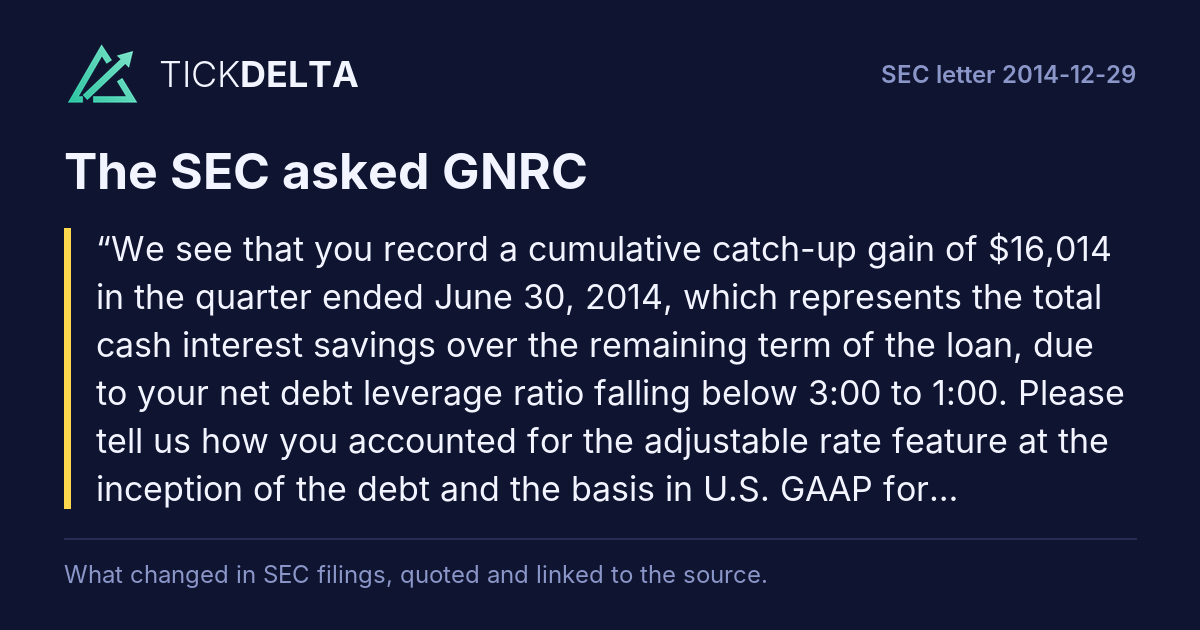
We see that you record a cumulative catch-up gain of $16,014 in the quarter ended June 30, 2014, which represents the total cash interest savings over the remaining term of the loan, due to your net debt leverage ratio falling below 3:00 to 1:00. Please tell us how you accounted for the adjustable rate feature at the inception of the debt and the basis in U.S. GAAP for recognizing the catch-up gain during 2014.Rest of the question
Please reference the relevant accounting literature in your response.
As required by Accounting Standards Codification 835-30, Imputation of Interest, the Company is using the interest method to measure interest expense over the life of the debt. The Company followed the guidance in the Financial Accounting Standards Board (the “Board”) Concept Statement 7 to address the impact of changes in cash flows subsequent to the inception of the debt under the interest method.Read in the reply ↗Rest of the answer
Paragraph 97 of Concept Statement 7 states that there are three options to account for subsequent changes in cash flows: the prospective approach, the catch-up approach or the retrospective approach. Consistent with the Board’s stated preference in Paragraph 98 of Concept Statement 7, the Company has made the policy election to use the catch-up approach.
Under the catch-up approach, to calculate the effective interest rate used in the interest method for measuring interest expense, the Company estimated cash flows over the life of the debt at inception. Considering the Company’s expectations and various priorities of future excess cash at the time of refinancing, the Company believed that the net debt leverage ratio at inception was the most applicable ratio to use when estimating future cash flows. In the second quarter of 2014, the Company’s net debt leverage ratio fell below 3.00 to 1.00, causing a decrease in contractual interest rate. Therefore, the Company recorded the cumulative catch-up gain of $16,014 in that period, which represents the present value of the total cash interest savings discounted at the original effective interest rate.
* * * * *
Generac hereby acknowledges that:
●
Generac is responsible for the adequacy and accuracy of the disclosures it has made in its filings, including the 2013 Form 10-K and the Third Quarter 2014 Form 10-Q;
Staff comments or changes to disclosure in response to Staff comments do not foreclose the Commission from taking any action with respect to Generac’s filings; and
Generac may not assert Staff comments as a defense in any proceeding initiated by the Commission or any person under the federal securities laws of the United States.
If you need any further information, please contact York A. Ragen, Chief Financial Officer by phone at 262-544-4811 ext. 2788 or by email at York.Ragen@generac.com, or Bill Mongan, Vice President - Finance by phone at 262-544-4811 ext.2097 or by email at Bill.Mongan@generac.com.
First report after the company's reply of 2015-01-09: 10-K filed 2015-02-27 ↗, against the 10-K filed 2014-03-03 ↗.
Tickdelta does not hold the text of both reports, so they are not compared here.
Also in this review: closing letter, 2015-01-13