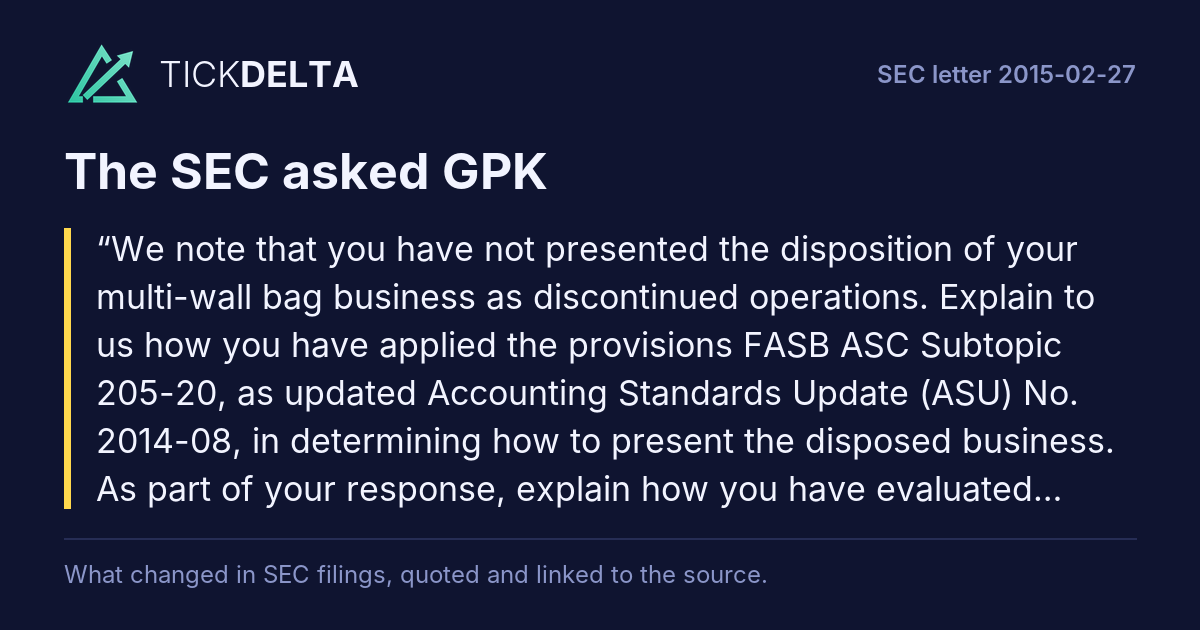
In connection with the sale of our multi-wall bag business, the Company reevaluated its reportable segments effective July 1, 2014. The Company concluded it had the following operating and reportable segments preand post- July 1, 2014 under the guidance in ASC 280, Segment Reporting.
Rest of the answer
facility that was not sold, which was reported in paperboard packaging for all periods when recast.
As of July 1, 2014:
Reportable Segment
Each of these operating segments engages in business activities from which it earns revenues and incurs expenses and each operating segments’ operating results are regularly reviewed by the Company’s Chief Operating Decision Maker (“CODM”). As outlined in Exhibit A, each of the operating segments produces paperboard packaging solutions for its customers as follows:
Consumer Products – converts paperboard into finished cartons in the Americas and provides paperboard packaging solutions to food, and other consumer product companies.
Beverage – converts paperboard into finished cartons in the Americas and Australia and provides paperboard packaging solutions to beverage and other consumer product companies.
Europe – converts paperboard into finished cartons in Europe and provides paperboard packaging solutions to food, beverage and other consumer product companies.
Pacific Rim – provides paperboard to converters who convert the paperboard into finished cartons and provides paperboard packaging solutions to beverage, food and other consumer product companies.
Mills – produces paperboard for use in each of the other operating segments and sells paperboard to external folding carton converters.
The Company refers to the facilities within the Consumer Products, Beverage, Europe and Pacific Rim operating segments as converting plants and those within the Mills operating segment as mills.
David Scheible, the Company’s Chairman, President and Chief Executive Officer (CEO) and Mike Doss, the Company’s Chief Operating Officer (COO) together represent the Company’s CODM. They review and assess the performance of each of these operating segments and make the ultimate decisions as to the allocation of the Company’s resources. Each of the operating segments is led by a senior executive officer that reports to either the CEO or the COO. The CODM obtains
Page 7 of 7 CONFIDENTIAL TREATMENT REQUESTED BY and reviews monthly reporting from each of the operating segment executives that includes month and year-to-date results with comparisons to prior year and plan as well as the outlook for the remainder of the year.
Aggregation of Operating Segments
A key part of the Company’s strategy is to maximize the internal consumption of the mill’s paperboard. During 2014 approximately 85% of the paperboard produced by the mills was internally consumed by the converting plans. Further, with the recent European acquisitions and the recently completed 2015 acquisitions of converting assets, the Company expects to consume even more of the mill’s production internally.
The Company’s integrated system of mills and converting plants begins with the fiber balance, managed by the Supply Chain organization, which matches internal demand to mill production. This allows the Company to align customer requirements with planned mill production schedules. Shared research and development, procurement and other corporate functions also support this integrated system. The Company’s volume and carton pricing decisions are made based on the impact to the total Company, not the specific operating segment. For example, when negotiating carton pricing with customers, the CODM considers the economic impact to the consolidated entity rather than the impact to the specific operating segment (e.g. a lower margin to the converting operations could still produce an acceptable margin on a consolidated basis). This is further supported by the Company’s incentive compensation plans because operating segment executives are compensated based on consolidated Company operating results, not operating segment results. In addition, the Company would not separately divest the mills nor does the Company believe a market participant would purchase only the mills, as the current integrated footprint provides a competitive advantage that would not be realizable with two stand-alone businesses.
The key input costs for the mills are pine pulpwood, recycled fibers, energy, plastic resins and various chemicals used in the coating of paperboard. The key input costs for the converting plants are internal and externally purchased paperboard, freight, labor and benefits. The mills are exposed to volatility in operating results as market prices change for fiber and energy. The converting plants are insulated from fiber and energy costs for internally purchased board as internal transfer prices are generally set annually. The converting plants are exposed to changes in market prices for externally purchased board. Customer contracts generally contain price recovery mechanisms for board costs. These recovery mechanisms generally reset pricing six to nine months following inflation based on external market indices. Accordingly, when input costs for board increase, the mill margin will contract,
Page 8 of 8 CONFIDENTIAL TREATMENT REQUESTED BY however, converting contracts allow the Company to recover a portion of this lower margin through future price increases. Customer contracts also allow for pricing to reset during deflationary periods.
The Company has aggregated operating segments into a single reportable segment as permitted by the aggregation guidance of ASC 280 as the Company has determined that aggregation is consistent with the objective and basic principles of ASC 280, as the operating segments have similar economic characteristics (see additional comments below) and are similar in all of the following qualitative areas: (1) the nature of the products and services, (2) the nature of the production processes, (3) the type or class of customer for their products and services, (4) the methods used to distribute their products or provide their services and (5) the nature of the regulatory environment.
The attached Exhibit A documents the analysis of similar economic and other qualitative characteristics.
Similar Economic Characteristics
As illustrated in Exhibit A, the Company prepared a quantitative analysis comparing the economic characteristics of the five operating segments. The primary performance measure used to assess similarity of economic characteristics is operating income margin as adjusted for depreciation and amortization which is equivalent to operating EBITDA margin. These are the primary operating measures used by the CODM to assess performance and allocate resources. The mills sell the paperboard to the converting plants at a transfer price determined during the annual budget process. During the current year, the transfer price may or may not be indicative of the current market price. All the intercompany sales and profit are eliminated in consolidation.
Because the transfer price of paperboard sold by the Mill operating segment to the other operating segments may not reflect a current market price, to assess economic similarity as required by ASC 280, the operating EBITDA margin for each operating segment was adjusted to more closely reflect the economics of a third-party transaction. Accordingly, the operating segment EBITDA margins from the monthly reporting packages reviewed by the CODM are adjusted to reflect an external market price. Operating EBITDA was also adjusted to exclude non-recurring items as those items would not be reflective of ongoing operating performance and include items that would be reflective of ongoing operating performance. For example, in the Beverage operating segment a one-time rebate was excluded and in the Europe operating segment, the full year impact of the Benson acquisition was included. Management believes these adjustments are appropriate for the purpose of evaluating economic characteristics similarity.
The following table summarizes these results for the year ended December 31, 2014.
Page 9 of 9 CONFIDENTIAL TREATMENT REQUESTED BY
Operating Segment
Adjusted EBITDA Margin
Average
- 10 % Average
+10% Average
[*]
The Pacific Rim operating segment was excluded from the above due to immateriality (approximately 1 percent of sales and EBITDA).
While ASC 280 does not prescribe a specific threshold for economic similarity, a difference of 10% may indicate that operating segments are not economically similar. Since 10% is not a bright line, the Company also considered additional factors, such as the impact of inflation and price recovery mechanisms, the nature of multi-year contracts, and input purchasing power, to further support the aggregation to one reportable segment.
As noted in the above table, the Adjusted EBITDA margin for both the [*] and [*] operating segments are outside the 10% variation. The [*] Adjusted EBITDA margin declined from [*] in 2013 primarily due to declines in market demand for certain products which resulted in lower volume and negotiated pricing decreases to maintain or obtain volume. The Company expects these margins to improve as the result of a recent acquisition in early 2015 and other initiatives. The [*] operating segment Adjusted EBITDA margin increased from [*] in 2013 to [*] in 2015 primarily due to acquisitions. Since 2012, the Company has made 3 acquisitions in [*]. As these acquisitions become further integrated and the [*] business matures, the Company expects the Adjusted EBITDA margins to continue to improve as a result of optimizing manufacturing and supply chain activities and providing access to shared research and development and new products.
The Mill operating segment has similar economic and qualitative characteristics and, the Company believes that the Mill operating segment should not be a separate reportable segment due to the integrated nature with the converting plants. The Company also considered what investors and users of the financial statements have requested and what has been consistently provided related to the assessment of the Company’s performance and do not believe separate operating segment financial information related to the mill operations are meaningful to users of the
Page 10 of 10 CONFIDENTIAL TREATMENT REQUESTED BY financial statements. The Company also recognizes this is consistent with the manner in which other integrated paperboard producers view their operations.
Conclusion
Based on this quantitative and qualitative analysis summarized herein, the integrated nature of the mill and converting plant system, the CODM’s review, communications to the investor community, and the absence of significantly different economic characteristics, the Company concluded that the most meaningful disclosure would be to aggregate the 5 operating segments into one reportable segment, paperboard packaging.
Closing Comments
The undersigned hereby acknowledges, on behalf of the Company, that the Company is responsible for the adequacy and accuracy of the disclosure in its filing;
Staff comments or changes to disclosure in response to Staff comments do not foreclose the Commission from taking any action with respect to the filing; and the Company may not assert Staff Comments as a defense in any proceeding initiated by the Commission or any person under the federal securities laws of the United States.