Form 10-K
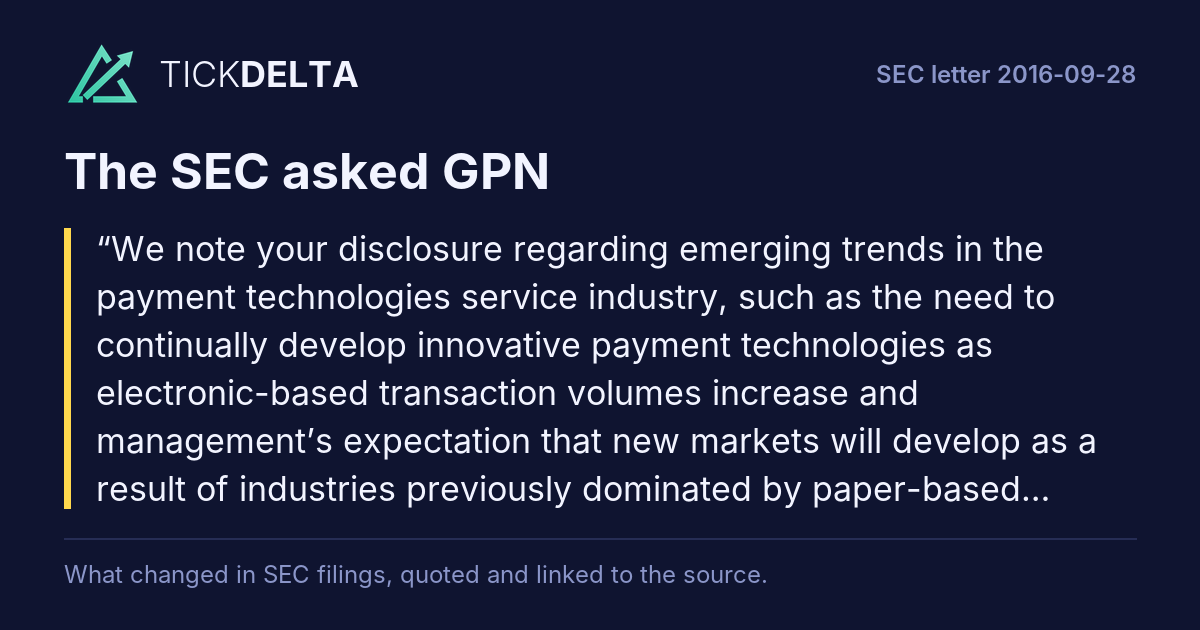
We note your disclosure regarding emerging trends in the payment technologies service industry, such as the need to continually develop innovative payment technologies as electronic-based transaction volumes increase and management’s expectation that new markets will develop as a result of industries previously dominated by paper-based transactions migrating to electronic-based settlement solutions.Rest of the question
In future filings, please include a detailed discussion and analysis in your MD&A section of any known material trends, demands, commitments, events or uncertainties that have had or are reasonably likely to have a material impact on liquidity, capital resources, or results of operations. Please show us what this disclosure will look like. Please refer to Item 303(a) of Regulation S-K and SEC Release No. 34-48960 for guidance.
We acknowledge the Staff’s comment and will, in future filings, enhance our disclosure to describe known trends, demands, commitments, events or uncertainties that have had or are reasonably expected to have a material effect on liquidity, capital resources or results of operations in Management’s Discussion and Analysis of Financial Condition and Results of Operations (“MD&A”).Read in the reply ↗Rest of the answer
Specifically, we will enhance our disclosure by providing discussion within MD&A that addresses certain broader matters, such as industry and market trends, anticipated changes in demand and uncertainties, as well as the potential effect we believe those items may have on our liquidity, capital resources or results of operations, if material. The specific disclosure in future filings will vary based on the specific circumstances at the time. To address the specific matters identified above, our disclosure would be similar to the following:
•
The payments industry continues to grow worldwide and as a result, certain large merchant acquirers, including us, have expanded operations globally by pursuing acquisitions and creating alliances and joint ventures. We expect to continue to expand to new markets internationally or increase our scale and improve our competitiveness in existing markets by pursuing further acquisitions and joint ventures in the future.
We believe that electronic payment transactions will continue to grow and that an increasing percentage of these will be facilitated through emerging technologies. As a result, we expect an increasing portion of our future capital investment will be allocated to support the development of new and emerging technologies; however, we do not expect our aggregate capital spending to increase materially as a result of this.
We also believe new markets will continue to develop in areas that have been previously dominated by paper-based transactions. We expect industries such as education, government and healthcare, as well as payment types such as recurring payments and business-to-business payments, to continue to see transactions migrate to electronic-based solutions. We anticipate that the continued development of new services and the emergence of new vertical markets will be a factor in the growth of our business and our revenue grow in the future.
Please tell us why you refer to adjusted operation margin, net income and diluted EPS as “cash” operating margin, cash net income and cash diluted EPS, as it appears each of these measures includes adjustments to eliminate expenses that required or will require cash settlement. Please also tell us how your provision of cash diluted EPS is consistent with Accounting Series Release No. 142 and Question 102.05 of the Staff’s Compliance and Disclosure Interpretations regarding Non-GAAP measures updated May 17, 2016. In this regard, we note the way this measure is named, labeled may suggest to users that it is a liquidity measure.
Response: We respectfully note that we used “cash operating margin,” “cash net income” and “cash diluted EPS” in our Form 8-K filed July 28, 2016 as performance measures. The use of the term “cash” was not to imply these are liquidity measures, but rather it was a term selected simply to distinguish these measures from our GAAP results. We attempted to make this clear through our disclosure regarding “Non-GAAP Financial Measures” in our earnings release and in the schedules to that release, specifically in Schedule 10, where we stated “Global Payments supplements revenues, operating income and earnings per share information determined in accordance with U.S. GAAP by providing operating income, net income and related earnings per share on a cash earnings basis and Adjusted Net Revenue to assist with evaluating our performance.”
In our experience, and we believe the experience of other companies in the payments industry, investors and analysts recognize these measures are used exclusively as financial performance measures. These measures are used by investors and analysts that provide research on our common stock as the primary financial performance measures for our business, and we do not believe that investors or analysts view these as either cash flow or liquidity measures. Management uses these measures, together with other metrics, to set goals and measure performance of the business and to determine incentive compensation. In addition, we believe that these financial performance measures provide useful supplemental information about operating results, enhance the overall understanding of past financial performance and future prospects, increase comparability of our performance from period-to-period and relative to that of our peers, and allow for greater transparency with respect to key metrics used by management in its financial and operational decision making. Finally, we believe that these non-GAAP financial measures could not be viewed as measures of liquidity since they include significant non-cash expenses, such as depreciation, and they include adjustments to eliminate expenses that required or will require cash settlement.
Nonetheless, in response to the Staff’s Compliance and Disclosure Interpretations regarding Non-GAAP measures updated May 17, 2016, we already had plans to change our references to these non-GAAP financial measures from “cash operating margin,” “cash net income” and “cash diluted EPS” to “adjusted operating margin,” “adjusted net income” and “adjusted EPS,” respectively, to avoid any potential confusion as it relates to them being misconstrued as liquidity measures. To maintain the consistency of our financial reporting for the fiscal year ended May 31, 2016, we elected to implement this new naming convention after the start of our new fiscal year with our earnings release for the first quarterly period ended August 31, 2016 and our Current Report on Form 8-K dated October 5, 2016 reflects these revised terms.
First report after the company's reply of 2016-10-12: 10-Q filed 2017-01-09 ↗.
No earlier 10-Q before the SEC's letter is in Tickdelta, so there is nothing to compare with.
Please tell us why you refer to adjusted operating margin, net income and diluted EPS as “cash” operating margin, cash net income and cash diluted EPS, as it appears each of these measures includes adjustments to eliminate expenses that required or will require cash settlement. Please also tell us how your provision of cash diluted EPS is consistent with Accounting Series Release No.Rest of the question
142 and Question 102.05 of the Staff’s Compliance and Disclosure Interpretations regarding Non-GAAP measures updated May 17, 2016. In this regard, we note the way this measure is named/labeled may suggest to users that it is a liquidity measure.
Our revised disclosure on page 42, under “Role of Executive Officers”, is set forth below, beginning after the first sentence. We respectfully request that the elements of this revised disclosure be included in our 2017 Definitive Proxy Statement on Schedule 14A, which will be filed in the first quarter of 2017 given our change in fiscal year, rather than in an amended 2016 Definitive Proxy Statement on Schedule 14A.
The FWC report examined market data from our peer group and analyzed compensation for comparable positions for our named executive officers.Read in the reply ↗Rest of the answer
The Compensation Committee considered the Chief Executive Officer’s recommendations, in conjunction with the counsel of FWC and the market data, in determining the compensation elements for these named executive officers. In considering the FWC report, the Compensation Committee primarily considered and reviewed the median level of compensation within the peer group. In setting actual compensation levels for our NEOs, however, the Compensation Committee did not target any element of compensation at a particular percentile or percentile range of the peer group data. Rather, the Compensation Committee uses this information as one input in its decision-making process. The Compensation Committee determined all aspects of Mr. Sloan’s compensation as Chief Executive Officer in consultation with FWC and consideration of the FWC report. Mr. Sloan did not participate in the Compensation Committee’s determination of his compensation.
First report after the company's reply of 2016-10-12: 10-Q filed 2017-01-09 ↗.
No earlier 10-Q before the SEC's letter is in Tickdelta, so there is nothing to compare with.
We note that you used the peer group data provided by FWC “for fiscal 2016 benchmarking purposes,” and that you set compensation for the named executive officers’ based on “comparable positions” in the market or a “review of the market data.” As it appears that you use one or more benchmarks to set your compensation, please revise your disclosure to identify these benchmarks and their components.Rest of the question
Please refer to Item 402(b) of Regulation S-K.
Our revised disclosure on page 44, following the Base Salary table, is set forth below. We respectfully request that the elements of this revised disclosure be included in our 2017 Definitive Proxy Statement on Schedule 14A, which will be filed in the first quarter of 2017 given our change in fiscal year, rather than in an amended 2016 Definitive Proxy Statement on Schedule 14A.
The Compensation Committee determined to increase the salaries of Messrs.Read in the reply ↗Rest of the answer
Sacchi, Green and Sloan by considering, among other inputs, the market data on comparable positions from our peer group set forth in the FWC report, including but not limited to the median level of compensation for comparable positions. The Compensation Committee also considered its general assessment of the performance of Mr. Sloan, and Mr. Sloan’s assessment of Messrs. Sacchi and Green.
First report after the company's reply of 2016-10-12: 10-Q filed 2017-01-09 ↗.
No earlier 10-Q before the SEC's letter is in Tickdelta, so there is nothing to compare with.
Please revise your disclosure to explain how it was determined to increase the salaries of Messrs. Sacchi, Green and Sloan by 25%, 25% and 11%, respectively.
Our revised disclosure on page 44, following the Target Bonus Opportunity Table, is set forth below. We respectfully request that the elements of this revised disclosure be included in our 2017 Definitive Proxy Statement on Schedule 14A, which will be filed in the first quarter of 2017 given our change in fiscal year, rather than in an amended 2016 Definitive Proxy Statement on Schedule 14A.
In determining the target bonus opportunities for each named executive officer, the Compensation Committee considered the market data for bonus target opportunity and total compensation opportunity forRead in the reply ↗Rest of the answer
comparable positions within our peer group, as reflected in the FWC report, the Committee’s general assessment of the Company’s Chief Executive Officer, and the Chief Executive Officer’s assessment and recommendations with respect to the other named executive officers.
First report after the company's reply of 2016-10-12: 10-Q filed 2017-01-09 ↗.
No earlier 10-Q before the SEC's letter is in Tickdelta, so there is nothing to compare with.
Please revise your disclosure to explain how the target bonus opportunity, expressed as a percentage of base salary, was determined for each named executive officer.
Our revised disclosure on page 46, to be added at the end of first paragraph under Long Term Incentive Plan, is set forth below. We respectfully request that the elements of this revised disclosure be included in our 2017 Definitive Proxy Statement on Schedule 14A, which will be filed in the first quarter of 2017 given our change in fiscal year, rather than in an amended 2016 Definitive Proxy Statement on Schedule 14A.
In determining the LTI awards for each named executive officer, the Compensation Committee considered the market data for LTI awards and total compensation opportunity forRead in the reply ↗Rest of the answer
comparable positions within our peer group, as reflected in the FWC report, the Committee’s general assessment of the Company’s Chief Executive Officer, and the Chief Executive Officer’s assessment and recommendations with respect to the other named executive officers.
Should you or any member of your team have any further questions or need any additional information, please contact me at (770) 829-8256 or David Sheffield, Chief Accounting Officer, at (770) 829-8030.
First report after the company's reply of 2016-10-12: 10-Q filed 2017-01-09 ↗.
No earlier 10-Q before the SEC's letter is in Tickdelta, so there is nothing to compare with.
We note that all grants of LTI awards to your named executive officers “are based on target values consistent with the executives’ skills, responsibilities, experience and performance in relation to comparable positions in the marketplace” and that you made target allocations of Performance Units, Stock Options and Time-Based Restricted Stock to your NEOs.Rest of the question
Please provide further disclosure of how you determined the amount of Performance Units, Stock Options, and Time-Based Restricted Stock granted to your NEOs in fiscal 2016. Please refer to Item 402(b) of Regulation S-K.
No numbered answer found in the reply. Read the reply ↗
First report after the company's reply of 2016-10-12: 10-Q filed 2017-01-09 ↗.
No earlier 10-Q before the SEC's letter is in Tickdelta, so there is nothing to compare with.
We note your responses to comments 4, 5 and 6, and that the increases in salaries, setting of target bonus opportunities and determination of LTI grants were based in part on “assessments” of the named executive officers.Rest of the question
Please revise your future disclosures to enhance your discussion of the assessments made with respect to each named executive officer and the manner in which such assessments corresponded to the compensation decisions regarding each named executive officer. Please show us what your revised disclosure will look like.
As noted in our letter dated October 12, 2016, our Compensation Committee considered a variety of factors, including assessments of each named executive officer, in determining their salaries, target bonus opportunities and LTI grants. While our Compensation Committee assesses the performance of each named executive officer individually, it follows the same process with respect to each such officer. The Compensation Committee then sets the target compensation levels based on those assessments and the other factors set forth in our prior letter.Read in the reply ↗Rest of the answer
Set
10 Glenlake Parkway | North Tower | Atlanta, Georgia 30328 | www.globalpaymentsinc.com
Mr. Thompson forth below is our proposed additional disclosure relating to the assessments, which would apply to each named executive officer. We would propose to add the disclosure below to each of the disclosures set forth in our October 12, 2016 letter:
•
The Compensation Committee does not use a specific formula for evaluating the individual performance of each named executive officer. The Compensation Committee makes each assessment taking into consideration the quality and effectiveness of each named executive officer’s leadership and their respective contribution to the Company’s financial and operational success, as well as the totality of the executive’s performance.
Notes to Unaudited Consolidated Financial Statements
Note 5, Other Assets, page 13
With reference to the specific accounting guidance on which you relied, please tell us the basis in GAAP for your accounting for Visa’s acquisition of your membership interests in Visa Europe. In doing so, please tell us:
how the original membership interest in Visa Europe was accounted for and whether the investment had a net book value of zero, and if so, why;
all the factors considered in determining the Series B and C preferred shares received in the exchange have a value of zero; and whether you have determined it’s probable that a loss has been incurred with respect to potential litigation involving Visa Europe and the amount accrued for such loss.
Response:
We obtained our original membership interests in Visa Europe via three wholly-owned European subsidiaries, each of which acquired a single equity share for €10. Obtaining the membership interests enabled us to process and fund transactions through the Visa Europe network without a third-party sponsor financial institution. Our ownership interest in Visa Europe was minor (less than 1%), and we had no ability to control or influence decision making at Visa Europe. We accounted for our interest in Visa Europe under the cost method of accounting under ASC 325-20 because our interest was viewed as an “equity security” as defined in ASC 320-10-20 that lacked a “readily determinable fair value” as defined in ASC 320-10-20. The total carrying amount was equal to the cost of the combined membership interests of €30.
Visa Inc.’s acquisition of Visa Europe resulted in the sale of our entire membership interests in Visa Europe, having qualified as a sale per the requirements of ASC 860-10-40, paragraphs 4 and 5. We recorded the consideration received at fair value in accordance with ASC 325-20-30 paragraphs 2 and 3, recognizing the gain in earnings and establishing a new cost basis for the investment. We determined the estimated fair value of the Series B and C convertible preferred shares (the “Preferred Shares”) received as consideration in accordance with ASC 820-10-35-2. We considered multiple factors in that estimation process. The initial step in estimating the fair value of the Preferred Shares was calculating the value of the Visa Inc. common shares into which the Preferred Shares would convert if converted at the full conversion rate per the arrangement. The Preferred Shares include an embedded guarantee related to the risk of potential adjustments to the common stock conversion rate of the Preferred Shares based on the expected outcome of potential litigation involving Visa Europe in the United Kingdom and elsewhere in Europe. This embedded guarantee was not required to be bifurcated under ASC 815 and was a factor in estimating the fair value of the Preferred Shares. We also considered the restrictions on the transferability of the Preferred Shares in the estimate of fair value as well as the significant uncertainty associated with each of the factors above.
The effect of the potential indemnified losses has been reflected in the estimated fair value of the Preferred Shares. No additional loss amounts from the potential litigation were viewed as probable and, therefore, we have recorded no additional liability for such potential losses in accordance with ASC 450.
*****
Should you or any member of your team have any further questions or need any additional information, please contact me at (770) 829-8256 or David Sheffield, Senior Vice President and Chief Accounting Officer, at (770) 829-8030.
With reference to the specific accounting guidance on which you relied, please tell us the basis in GAAP for your accounting for Visa’s acquisition of your membership interests in Visa Europe. In doing so, please tell us: how the original membership interest in Visa Europe was accounted for and whether the investment had a net book value of zero, and if so, why; all the factors considered in determining theRest of the question
Series B and C preferred shares received in the exchange have a value of zero; and whether you have determined it’s probable that a loss has been incurred with respect to potential litigation involving Visa Europe and the amount accrued for such loss.
No numbered answer found in the reply. Read the reply ↗
First report after the company's reply of 2016-11-16: 10-Q filed 2017-01-09 ↗.
No earlier 10-Q before the SEC's letter is in Tickdelta, so there is nothing to compare with.
Also in this review: closing letter, 2016-12-02