Paragraph 233 · 50% changed
Every version of it
Screener
/
SEC EDGAR
/CIK 0001528396
/10-K filed Sep 11, 2026, compared with Sep 11, 2025
/Numbers from the XBRL of the 10-Ks
NYSE
Technology · Software
Guidewire Software, Inc. GWRE
The 10-K against last year's
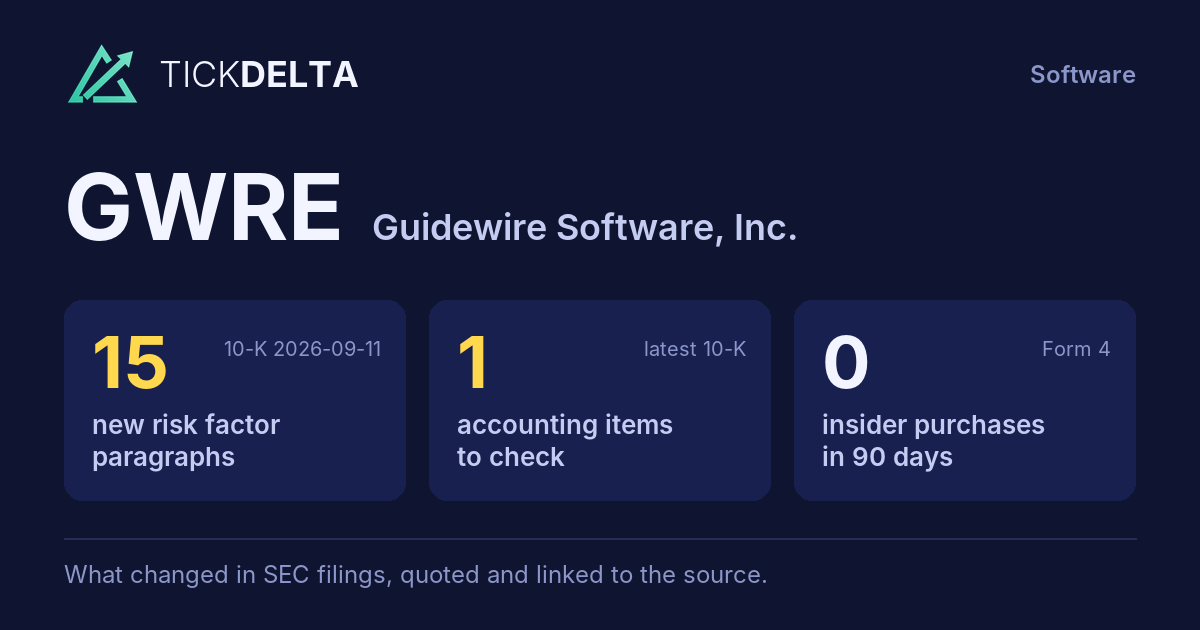
173 changes: 22 added, 29 removed, 120 reworded, 2 quiet changes
10-K Sep 11, 2026 vs Sep 11, 2025
Risk Factors
14.5%
of the text changed · 23,272 words now · 15 new paragraphs, 21 gone
MD&A
19.0%
of the text changed · 8,947 words now · 7 new paragraphs, 8 gone
Legal Proceedings
1.3%
of the text changed · 562 words now
Accounting Policies
8.5%
of the text changed · 6,128 words now
10-K 0001528396-26-000046 (Sep 11, 2026) vs 10-K 0001528396-25-000221 (Sep 11, 2025)
Every paragraph, and how much of it changed
One bar per paragraph, in the order of the 10-K. Height and colour show the share of its words not in the closest paragraph a year earlier; the tallest bars are new paragraphs.
Risk Factors
246 paragraphs · 15 new · 81 reworded · 21 gone · 10-K Sep 11, 2026 against Sep 11, 2025
New paragraph
Reworded (5% of its words or more)
Same or nearly
Paragraph 186 · 49% changed
Every version of it
The market price of our common stock could be has been, and may continue to be, volatile and subject to wide fluctuations fluctuations. The volatility may occur in response to, among other things, to the risk factors described in this report, the timing and amount of any share repurchases by us, report and other factors beyond our control, such as fluctuations in the valuation of companies perceived by investors to be comparable to us and research analyst coverage about our business. including:
Paragraph 141 · 48% changed
Every version of it
Paragraph 136 · 48% changed
Every version of it
Our products and business involve the collection, storage and processing of customer data and, in some cases, information that relates to individuals and/or constitutes personal data (including from our employees, business partners and others, and, in some cases, from our customers), and our products may provide business critical software and analytics necessary for our customers’ operations. As such, we may be an attractive target for data security attacks that threaten the confidentiality, integrity, and availability of our information technology systems and confidential information. Security incidents or breaches could result in public disclosure of confidential information or personal information, loss or modification of data affecting our customers’ operations, fraud or theft, ransom demands, or other misuse of confidential information or personal information, which in turn could result in our cloud services being perceived as not being secure, a reduction in customers using our products, as well as litigation, breach of contract claims, indemnity obligations, additional reporting requirements and/or oversight, restrictions on processing data, and other liabilities for our Company, liabilities, all of which could lead to loss of revenue, a diminished ability to retain existing or attract new customers due to reputational harm, fines, costs, or other penalties or sanctions. While we have taken, and are continually updating and enhancing, steps to protect the confidential information, customer data and personal data that we steward, including confidential information we may obtain through our customer support services or customer usage of our cloud-based services, our security measures or the security measures of companies we rely on could be breached. We rely on third-party technology and systems for a variety of information technology systems and related products and services, including, without limitation, cloud computing services, encryption and authentication technology, employee email, content delivery to customers, back-office support, and other functions. Our ability to control or prevent breaches of any of these systems may be beyond our control. Any failure by a third party to prevent or mitigate data security incidents, breaches or improper access to, or use, acquisition, disclosure, alteration or destruction of customer data could have adverse consequences for us. Because techniques used to obtain unauthorized access or infiltrate, sabotage, disable or degrade systems change frequently and generally are not identified until they are launched against a target, we may be unable to anticipate these techniques or to implement adequate preventative measures despite our efforts in implementing and deploying security measures. The use of constantly evolving technologies by diverse threat actors, including state-sponsored organizations, opportunistic hackers and hacktivists, such as the increased use of AI technologies, are sophisticated and complex and may increase the velocity of such threats, frequency of incident cases, and otherwise magnifying the risks associated with these types of attacks. These attack vectors may include social engineering/phishing, malware (including ransomware), malfeasance by insiders, human or technological error, and as a result of malicious code embedded in open source software or the exploitation of bugs, misconfigurations or exploited vulnerabilities in software or hardware that is integrated into our (or our suppliers’ or service providers’) information technology systems, products or services. Although we have developed systems and processes designed to protect our and our customers’ data, prevent loss or unauthorized modification of data, ensure only authorized use of services, and prevent other cybersecurity incidents or breaches, including systems and processes designed to reduce the impact of a security incident or breach to a third-party vendor, such measures cannot provide absolute security, and our systems may be vulnerable to malware or physical or electronic break-ins that our security measures may not be able to detect, investigate, remediate or recover from, or to avoid a material adverse impact to our information technology systems, confidential information, supply chain or business. Moreover, we have acquired and continue to acquire companies whose systems may contain cybersecurity vulnerabilities and/or unsophisticated security measures, which may expose us to significant cybersecurity, operational, and financial risks. Because our products are integrated with our customers’ systems and processes, any circumvention or failure of our cybersecurity defenses or measures could compromise the confidentiality, integrity, and availability of our customers’ own information technology systems and/or confidential information as well.
Paragraph 58 · 47% changed
Every version of it
The models underlying our AI technologies may experience decay (also known as “model drift”) in which their performance and accuracy decrease over time without further human intervention to correct such decay. AI technologies may also create content content, software code, system configurations, or analytical insights that appears appear facially correct but is are factually inaccurate inaccurate, biased, or flawed. Additionally, certain AI tools may execute unexpected or erroneous automated actions across our products, services, and solutions. Our customers, employees, or others may rely on or use such factually incorrect or flawed content or automated actions to their detriment, which detriment and we may expose us to brand or reputational harm, competitive harm, and/or legal liability. In all events, the development, marketing and use of offer AI technologies presents emerging ethical and social issues, and if we enable or offer solutions that draw scrutiny or controversy due to their perceived or actual impact on customers or on society as a whole, we may experience societal impact. Any of these issues could expose us to brand or reputational harm, customer attrition, competitive harm, additional costs, and/or legal liability. If our AI technologies development, deployment deployment, oversight, or governance is ineffective or inadequate, it may result in incidents that impair the public acceptance of AI solutions or cause harm to individuals, customers or society, or result in our offerings not working as intended or producing unexpected outcomes. The use of AI by our workforce presents additional cybersecurity, confidentiality, and intellectual property rights risks. Because the legal landscape regarding intellectual property rights in AI technologies remains unsettled, our use of such technologies may lead to allegations of infringement or misappropriation. Employee or contractor engagement with authorized or unapproved AI tools could inadvertently expose our proprietary source code, trade secrets, or confidential customer data to public model training sets or third parties. Incorporating generative AI code-assist tools into our software development lifecycle or customer deployments may introduce additional bugs and vulnerabilities and could also expose us to third-party IP infringement claims if outputs are deemed “substantially similar” to copyrighted third-party code, impair our ability to obtain and enforce copyright or intellectual property protection on AI-generated software outputs, risk losing proprietary protection due to open-source commingling, or result in third-party tool providers retaining rights in generated code.
Paragraph 137 · 45% changed
Every version of it
Paragraph 229 · 44% changed
Every version of it
Paragraph 138 · 44% changed
Every version of it
Paragraph 233 · 50% changed
Every version of it
10-K Sep 11, 2025Global events have adversely affected, and may continue to adversely affect, our business, results of operations, and financial condition.
10-K Sep 11, 2026
Further, to the extent global events adversely affect our business, results of operations, or financial condition, it may also have the effect of heightening many of the other risks described in this “Risk Factors” section.
Paragraph 186 · 49% changed
Every version of it
10-K Sep 11, 2025
The market price of our common stock could be subject to wide fluctuations in response to, among other things, the risk factors described in this report, the timing and amount of any share repurchases by us, and other factors beyond our control, such as fluctuations in the valuation of companies perceived by investors to be comparable to us and research analyst coverage about our business.
10-K Sep 11, 2026
The market price of our common stock has been, and may continue to be, volatile and subject to wide fluctuations. The volatility may occur in response to the risk factors described in this report and other factors beyond our control, including:
Paragraph 141 · 48% changed
Every version of it
10-K Sep 11, 2025In addition, data security incidents or breaches could expose us to liability under various laws and regulations across jurisdictions, increase the risk of litigation and governmental or regulatory investigation, and increase our costs for compliance. For example, we may need to notify governmental authorities and/or affected individuals with respect to certain cybersecurity incidents or breaches in light of a growing number of laws, including those in the European Economic Area (“EEA”), U.K., and the United States. Complying with such numerous and complex regulations in the event of a cybersecurity incident or breach would be expensive and difficult, and failure to comply with these regulations could subject us to regulatory scrutiny and additional liability. We may also be contractually required to notify customers or other counterparties of a cybersecurity incident or breach.
10-K Sep 11, 2026
comply with these regulations could subject us to regulatory scrutiny and additional liability. We may also be contractually required to notify customers or other counterparties of a cybersecurity incident or breach.
Paragraph 136 · 48% changed
Every version of it
10-K Sep 11, 2025
Our products and business involve the collection, storage and processing of customer data and, in some cases, information that relates to individuals and/or constitutes personal data (including from our employees, business partners and others, and, in some cases, from our customers), and our products may provide business critical software and analytics necessary for our customers’ operations. As such, we may be an attractive target for data security attacks that threaten the confidentiality, integrity, and availability of our information technology systems and confidential information. Security incidents or breaches could result in public disclosure of confidential information or personal information, loss or modification of data affecting our customers’ operations, fraud or theft, ransom demands, or other misuse of confidential information or personal information, which in turn could result in our cloud services being perceived as not being secure, a reduction in customers using our products, as well as litigation, breach of contract claims, indemnity obligations, additional reporting requirements and/or oversight, restrictions on processing data, and other liabilities for our Company, all of which could lead to loss of revenue, a diminished ability to retain or attract new customers due to reputational harm, fines, costs, or other penalties or sanctions. While we have taken, and are continually updating and enhancing, steps to protect the confidential information, customer data and personal data that we steward, including confidential information we may obtain through our customer support services or customer usage of our cloud-based services, our security measures or the security measures of companies we rely on could be breached. We rely on third-party technology and systems for a variety of information technology systems and related products and services, including, without limitation, cloud computing services, encryption and authentication technology, employee email, content delivery to customers, back-office support, and other functions. Our ability to control or prevent breaches of any of these systems may be beyond our control. Any failure by a third party to prevent or mitigate data security incidents, breaches or improper access to, or use, acquisition, disclosure, alteration or destruction of customer data could have adverse consequences for us. Because techniques used to obtain unauthorized access or infiltrate, sabotage, disable or degrade systems change frequently and generally are not identified until they are launched against a target, we may be unable to anticipate these techniques or to implement adequate preventative measures despite our efforts in implementing and deploying security measures. The use of constantly evolving technologies by diverse threat actors, including state-sponsored organizations, opportunistic hackers and hacktivists, such as the increased use of AI technologies, are sophisticated and complex and may increase the velocity of such threats, frequency of incident cases, and otherwise magnifying the risks associated with these types of attacks. These attack vectors may include social engineering/phishing, malware (including ransomware), malfeasance by insiders, human or technological error, and as a result of malicious code embedded in open source software or the exploitation of bugs, misconfigurations or exploited vulnerabilities in software or hardware that is integrated into our (or our suppliers’ or service providers’) information technology systems, products or services. Although we have developed systems and processes designed to protect our and our customers’ data, prevent loss or unauthorized modification of data, ensure only authorized use of services, and prevent other cybersecurity incidents or breaches, including systems and processes designed to reduce the impact of a security incident or breach to a third-party vendor, such measures cannot provide absolute security, and our systems may be vulnerable to malware or physical or electronic break-ins that our security measures may not be able to detect, investigate, remediate or recover from, or to avoid a material adverse impact to our information technology systems, confidential information, supply chain or business. Moreover, we have acquired and continue to acquire companies whose systems may contain cybersecurity vulnerabilities and/or unsophisticated security measures, which may expose us to significant cybersecurity, operational, and financial risks. Because our products are integrated with our customers’ systems and processes, any circumvention or failure of our cybersecurity defenses or measures could compromise the confidentiality, integrity, and availability of our customers’ own information technology systems and/or confidential information as well.
10-K Sep 11, 2026
Our products and business involve the collection, storage and processing of customer data and, in some cases, information that relates to individuals and/or constitutes personal data (including from our employees, business partners and others, and, in some cases, from our customers), and our products may provide business critical software and analytics necessary for our customers’ operations. As such, we may be an attractive target for data security attacks that threaten the confidentiality, integrity, and availability of our information technology systems and confidential information. Security incidents or breaches could result in public disclosure of confidential information or personal information, loss or modification of data affecting our customers’ operations, fraud or theft, ransom demands, or other misuse of confidential information or personal information, which in turn could result in our cloud services being perceived as not being secure, a reduction in customers using our products, as well as litigation, breach of contract claims, indemnity obligations, additional reporting requirements and/or oversight, restrictions on processing data, and other liabilities, all of which could lead to loss of revenue, a diminished ability to retain existing or attract new customers due to reputational harm, fines,
Paragraph 58 · 47% changed
Every version of it
10-K Sep 11, 2025
AI technologies may create content that appears facially correct but is factually inaccurate or flawed. Our customers, employees, or others may rely on or use such factually incorrect or flawed content to their detriment, which may expose us to brand or reputational harm, competitive harm, and/or legal liability. In all events, the development, marketing and use of AI technologies presents emerging ethical and social issues, and if we enable or offer solutions that draw scrutiny or controversy due to their perceived or actual impact on customers or on society as a whole, we may experience brand or reputational harm, competitive harm, additional costs, and/or legal liability. If our AI technologies development, deployment or governance is ineffective or inadequate, it may result in incidents that impair the public acceptance of AI solutions or cause harm to individuals, customers or society, or result in our offerings not working as intended or producing unexpected outcomes.
10-K Sep 11, 2026
The models underlying our AI technologies may experience decay (also known as “model drift”) in which their performance and accuracy decrease over time without further human intervention to correct such decay. AI technologies may also create content, software code, system configurations, or analytical insights that appear facially correct but are factually inaccurate, biased, or flawed. Additionally, certain AI tools may execute unexpected or erroneous automated actions across our products, services, and solutions. Our customers, employees, or others may rely on or use such factually incorrect or flawed content or automated actions to their detriment and we may offer AI solutions that draw scrutiny or controversy due to their perceived or actual societal impact. Any of these issues could expose us to brand or reputational harm, customer attrition, competitive harm, additional costs, and/or legal liability. If our AI technologies development, deployment, oversight, or governance is ineffective or inadequate, it may result in incidents that impair the public acceptance of AI solutions or cause harm to individuals, customers or society, or result in our offerings not working as intended or producing unexpected outcomes. The use of AI by our workforce presents additional cybersecurity, confidentiality, and intellectual property rights risks. Because the legal landscape regarding intellectual property rights in AI technologies remains unsettled, our use of such technologies may lead to allegations of infringement or misappropriation. Employee or contractor engagement with authorized or unapproved AI tools could inadvertently expose our proprietary source code, trade secrets, or confidential customer data to public model training sets or third parties. Incorporating generative AI code-assist tools into our software development lifecycle or customer deployments may introduce additional bugs and vulnerabilities and could also expose us to third-party IP infringement claims if outputs are deemed “substantially similar” to copyrighted third-party code, impair our ability to obtain and enforce copyright or intellectual property protection on AI-generated software outputs, risk losing proprietary protection due to open-source commingling, or result in third-party tool providers retaining rights in generated code.
Paragraph 137 · 45% changed
Every version of it
10-K Sep 11, 2025Our products and business involve the collection, storage and processing of customer data and, in some cases, information that relates to individuals and/or constitutes personal data (including from our employees, business partners and others, and, in some cases, from our customers), and our products may provide business critical software and analytics necessary for our customers’ operations. As such, we may be an attractive target for data security attacks that threaten the confidentiality, integrity, and availability of our information technology systems and confidential information. Security incidents or breaches could result in public disclosure of confidential information or personal information, loss or modification of data affecting our customers’ operations, fraud or theft, ransom demands, or other misuse of confidential information or personal information, which in turn could result in our cloud services being perceived as not being secure, a reduction in customers using our products, as well as litigation, breach of contract claims, indemnity obligations, additional reporting requirements and/or oversight, restrictions on processing data, and other liabilities for our Company, all of which could lead to loss of revenue, a diminished ability to retain or attract new customers due to reputational harm, fines, costs, or other penalties or sanctions. While we have taken, and are continually updating and enhancing, steps to protect the confidential information, customer data and personal data that we steward, including confidential information we may obtain through our customer support services or customer usage of our cloud-based services, our security measures or the security measures of companies we rely on could be breached. We rely on third-party technology and systems for a variety of information technology systems and related products and services, including, without limitation, cloud computing services, encryption and authentication technology, employee email, content delivery to customers, back-office support, and other functions. Our ability to control or prevent breaches of any of these systems may be beyond our control. Any failure by a third party to prevent or mitigate data security incidents, breaches or improper access to, or use, acquisition, disclosure, alteration or destruction of customer data could have adverse consequences for us. Because techniques used to obtain unauthorized access or infiltrate, sabotage, disable or degrade systems change frequently and generally are not identified until they are launched against a target, we may be unable to anticipate these techniques or to implement adequate preventative measures despite our efforts in implementing and deploying security measures. The use of constantly evolving technologies by diverse threat actors, including state-sponsored organizations, opportunistic hackers and hacktivists, such as the increased use of AI technologies, are sophisticated and complex and may increase the velocity of such threats, frequency of incident cases, and otherwise magnifying the risks associated with these types of attacks. These attack vectors may include social engineering/phishing, malware (including ransomware), malfeasance by insiders, human or technological error, and as a result of malicious code embedded in open source software or the exploitation of bugs, misconfigurations or exploited vulnerabilities in software or hardware that is integrated into our (or our suppliers’ or service providers’) information technology systems, products or services. Although we have developed systems and processes designed to protect our and our customers’ data, prevent loss or unauthorized modification of data, ensure only authorized use of services, and prevent other cybersecurity incidents or breaches, including systems and processes designed to reduce the impact of a security incident or breach to a third-party vendor, such measures cannot provide absolute security, and our systems may be vulnerable to malware or physical or electronic break-ins that our security measures may not be able to detect, investigate, remediate or recover from, or to avoid a material adverse impact to our information technology systems, confidential information, supply chain or business. Moreover, we have acquired and continue to acquire companies whose systems may contain cybersecurity vulnerabilities and/or unsophisticated security measures, which may expose us to significant cybersecurity, operational, and financial risks. Because our products are integrated with our customers’ systems and processes, any circumvention or failure of our cybersecurity defenses or measures could compromise the confidentiality, integrity, and availability of our customers’ own information technology systems and/or confidential information as well.
10-K Sep 11, 2026
costs, or other penalties or sanctions. While we have taken, and are continually updating and enhancing, steps to protect the confidential information, customer data and personal data that we steward, including confidential information we may obtain through our customer support services or customer usage of our cloud-based services, our security measures or the security measures of companies we rely on could be breached. We rely on third-party technology and systems for a variety of information technology systems and related products and services, including, without limitation, cloud computing services, encryption and authentication technology, employee collaboration tools, content delivery to customers, back-office support, and other functions. Our ability to control or prevent breaches of any of these systems may be beyond our control. Any failure by a third party to prevent or mitigate data security incidents, breaches or improper access to, or use, acquisition, disclosure, alteration or destruction of customer data could have adverse consequences for us. Because techniques used to obtain unauthorized access or infiltrate, sabotage, disable or degrade systems change frequently and generally are not identified until they are launched against a target, we may be unable to anticipate these techniques or to implement adequate preventative measures despite our efforts in implementing and deploying security measures.
Paragraph 229 · 44% changed
Every version of it
10-K Sep 11, 2025In addition, we expect there will likely continue to be increasing levels of regulation, as policymakers in jurisdictions such as Europe, California, and Australia are adopting or considering adopting various requirements regarding sustainability disclosures or actions. Such regulations are not uniform, which may increase the cost and complexity of compliance, as well as associated risks. Moreover, both advocates and opponents of sustainability matters are increasingly resorting to a range of activism forms, including litigation, to advance their perspectives. Addressing stakeholder expectations and regulatory requirements may be costly and any failure to successfully navigate such expectations, as well as evolving interpretations of any existing or new governmental laws or requirements, may result in reputational harm, loss of customers or contracts, regulatory or investor engagement, or other adverse impacts to our business. Our customers and other stakeholders are also subject to many of these expectations and regulatory considerations, which may augment or result in additional risks that also could adversely impact our business, results of operations, or financial condition.
10-K Sep 11, 2026
requirements, may result in reputational harm, loss of customers or contracts, regulatory or investor engagement, or other adverse impacts to our business. Our customers and other stakeholders are also subject to many of these expectations and regulatory considerations, which may augment or result in additional risks that also could adversely impact our business, results of operations, or financial condition.
Paragraph 138 · 44% changed
Every version of it
10-K Sep 11, 2025Our products and business involve the collection, storage and processing of customer data and, in some cases, information that relates to individuals and/or constitutes personal data (including from our employees, business partners and others, and, in some cases, from our customers), and our products may provide business critical software and analytics necessary for our customers’ operations. As such, we may be an attractive target for data security attacks that threaten the confidentiality, integrity, and availability of our information technology systems and confidential information. Security incidents or breaches could result in public disclosure of confidential information or personal information, loss or modification of data affecting our customers’ operations, fraud or theft, ransom demands, or other misuse of confidential information or personal information, which in turn could result in our cloud services being perceived as not being secure, a reduction in customers using our products, as well as litigation, breach of contract claims, indemnity obligations, additional reporting requirements and/or oversight, restrictions on processing data, and other liabilities for our Company, all of which could lead to loss of revenue, a diminished ability to retain or attract new customers due to reputational harm, fines, costs, or other penalties or sanctions. While we have taken, and are continually updating and enhancing, steps to protect the confidential information, customer data and personal data that we steward, including confidential information we may obtain through our customer support services or customer usage of our cloud-based services, our security measures or the security measures of companies we rely on could be breached. We rely on third-party technology and systems for a variety of information technology systems and related products and services, including, without limitation, cloud computing services, encryption and authentication technology, employee email, content delivery to customers, back-office support, and other functions. Our ability to control or prevent breaches of any of these systems may be beyond our control. Any failure by a third party to prevent or mitigate data security incidents, breaches or improper access to, or use, acquisition, disclosure, alteration or destruction of customer data could have adverse consequences for us. Because techniques used to obtain unauthorized access or infiltrate, sabotage, disable or degrade systems change frequently and generally are not identified until they are launched against a target, we may be unable to anticipate these techniques or to implement adequate preventative measures despite our efforts in implementing and deploying security measures. The use of constantly evolving technologies by diverse threat actors, including state-sponsored organizations, opportunistic hackers and hacktivists, such as the increased use of AI technologies, are sophisticated and complex and may increase the velocity of such threats, frequency of incident cases, and otherwise magnifying the risks associated with these types of attacks. These attack vectors may include social engineering/phishing, malware (including ransomware), malfeasance by insiders, human or technological error, and as a result of malicious code embedded in open source software or the exploitation of bugs, misconfigurations or exploited vulnerabilities in software or hardware that is integrated into our (or our suppliers’ or service providers’) information technology systems, products or services. Although we have developed systems and processes designed to protect our and our customers’ data, prevent loss or unauthorized modification of data, ensure only authorized use of services, and prevent other cybersecurity incidents or breaches, including systems and processes designed to reduce the impact of a security incident or breach to a third-party vendor, such measures cannot provide absolute security, and our systems may be vulnerable to malware or physical or electronic break-ins that our security measures may not be able to detect, investigate, remediate or recover from, or to avoid a material adverse impact to our information technology systems, confidential information, supply chain or business. Moreover, we have acquired and continue to acquire companies whose systems may contain cybersecurity vulnerabilities and/or unsophisticated security measures, which may expose us to significant cybersecurity, operational, and financial risks. Because our products are integrated with our customers’ systems and processes, any circumvention or failure of our cybersecurity defenses or measures could compromise the confidentiality, integrity, and availability of our customers’ own information technology systems and/or confidential information as well.
10-K Sep 11, 2026
Furthermore, as AI technologies continue to advance rapidly, threat actors are leveraging these evolving capabilities to create novel and sophisticated attack methods that are increasingly automated, targeted, coordinated, and more difficult to defend against. The broad availability of these AI technologies can enable less-skilled threat actors to initiate attacks and significantly increase the velocity, frequency, scale, and impact of security incidents across our software supply chain and cloud environment. The risk that offensive AI capabilities may evolve faster than defensive security measures, including any AI-powered defensive tools we deploy, creates an asymmetric threat environment that exists across the broader technology landscape. Whether accelerated by AI or utilizing traditional methods, these attack vectors may include social engineering/phishing, malware (including ransomware), malfeasance by insiders, human or technological error, the introduction of malicious code embedded in open source software, or the exploitation of bugs, misconfigurations or vulnerabilities in software or hardware that is integrated into our (or our suppliers’ or service providers’) information technology systems, products or services. Although we have developed systems and processes designed to protect our and our customers’ data, prevent loss or unauthorized modification of data, ensure only authorized use of services, and prevent other cybersecurity incidents or breaches, including systems and processes designed to reduce the impact of a security incident or breach to a third-party vendor, such measures cannot provide absolute security, and our systems may be vulnerable to malware or physical or electronic break-ins that our security measures may not be able to detect, investigate, remediate or recover from, or to avoid a material adverse impact to our information technology systems, confidential information, supply chain or business. Moreover, we have acquired and continue to acquire companies whose systems may contain cybersecurity vulnerabilities and/or unsophisticated security measures, which may expose us to significant cybersecurity, operational, and financial risks. Because our products are integrated with our customers’ systems and processes, any circumvention or failure of our cybersecurity defenses or measures could compromise the confidentiality, integrity, and availability of our customers’ own information technology systems and/or confidential information as well. Furthermore, members of our workforce who work remotely may utilize remote networks and hardware that are less robust or reliable than our corporate infrastructure, which could expose us to increased cybersecurity vulnerabilities, compromised internet infrastructure, and business disruptions.
MD&A
113 paragraphs · 7 new · 64 reworded · 8 gone · 10-K Sep 11, 2026 against Sep 11, 2025
New paragraph
Reworded (5% of its words or more)
Same or nearly
Paragraph 84 · 48% changed
Other income (expense), net in was an expense of $21.0 million for fiscal year 2026 compared to an expense of $35.1 million for fiscal year 2025. Other income (expense), net for fiscal year 2026 was primarily driven by a foreign currency loss of $22.5 million due to fluctuations in foreign currency exchange rates, compared to a foreign currency gain of $16.7 million for fiscal year 2025. Fiscal year 2025 consists also included $53.6 million of expense related to the retirement of a debt retirement loss associated with the portion of our 2025 Convertible Senior Notes of $53.6 million and a $2.1 million decrease in the fair value of our strategic investments, partially offset by a $16.7 million gain primarily from foreign currency fluctuations and a $3.7 million gain on the sale of one of our strategic investments. During the second quarter of fiscal year 2025, one of our strategic investments was acquired. As a result, we received $5.7 million in consideration for our equity interest in the investee, composed of $3.4 million in cash and $2.3 million of an ownership interest in the acquirer, and recognized a $3.7 million gain in excess of cost. Notes.
Paragraph 18 · 46% changed
Paragraph 74 · 45% changed
We expect our sales and marketing expenses to continue to increase in absolute dollars due as we support new product initiatives, ongoing subscription and cloud growth, and the impact of inflation, but to inflation grow more slowly than revenue over time. As a result, we expect sales and investments to support ongoing growth, but decrease marketing expense as a percentage of revenue to decline as overall hiring slows after our recent period of investment to build out our we realize efficiencies and leverage prior investments in customer success team and add analytics and cloud sales capabilities. success.
Paragraph 63 · 44% changed
Our gross margin increased to 64% in fiscal year 2026, as compared to 63% in fiscal year 2025, as compared to 59% in fiscal year 2024. 2025. Gross margin was increased primarily impacted by due to the increase growth in subscription and support revenue at a higher margin due which continues to outpace increases in cloud operations efficiencies infrastructure and higher services margin after the completion of certain implementation projects that required significant investment by us and higher utilization rates. personnel costs.
Paragraph 62 · 42% changed
Our gross profit increased by $168.7 $195.3 million compared to the prior year. Gross profit was primarily impacted by an the increase in subscription and support gross profit due to the increase in subscription revenue from cloud migrations and cloud operations efficiencies. License new and renewed subscription orders at a rate higher than subscription and support costs. This increase was partially offset by a decrease in license gross profit slightly increased primarily as a result of customer renewals and lower costs associated with development of online training curriculum. Services gross margin increased due to increased lower license revenue from new implementation and migration projects, higher utilization rates and the completion of certain implementation projects that required significant investment by us. as customers migrate to subscription services.
Paragraph 51 · 40% changed
Term license revenue increased decreased by $3.0 $17.4 million compared to the prior year year, primarily due to higher renewals and expansion orders within our existing customer base, partially offset by the impact of agreements that migrate customers that migrated from a term license to a subscription service. service, partially offset by an increase in renewals. Ongoing revenue related to migration agreements is recorded as subscription revenue. The impact on term license revenue from contracts with an initial term of greater than two years or a renewal term of greater than one year was $0.5 million during fiscal year 2025, as compared to $2.7 million in the prior year.
Paragraph 72 · 39% changed
Paragraph 76 · 38% changed
Paragraph 84 · 48% changed
10-K Sep 11, 2025
Other income (expense), net in fiscal year 2025 consists of a debt retirement loss associated with the 2025 Convertible Senior Notes of $53.6 million and a $2.1 million decrease in the fair value of our strategic investments, partially offset by a $16.7 million gain primarily from foreign currency fluctuations and a $3.7 million gain on the sale of one of our strategic investments. During the second quarter of fiscal year 2025, one of our strategic investments was acquired. As a result, we received $5.7 million in consideration for our equity interest in the investee, composed of $3.4 million in cash and $2.3 million of an ownership interest in the acquirer, and recognized a $3.7 million gain in excess of cost.
10-K Sep 11, 2026
Other income (expense), net was an expense of $21.0 million for fiscal year 2026 compared to an expense of $35.1 million for fiscal year 2025. Other income (expense), net for fiscal year 2026 was primarily driven by a foreign currency loss of $22.5 million due to fluctuations in foreign currency exchange rates, compared to a foreign currency gain of $16.7 million for fiscal year 2025. Fiscal year 2025 also included $53.6 million of expense related to the retirement of a portion of our 2025 Convertible Senior Notes.
Paragraph 18 · 46% changed
10-K Sep 11, 2025Our services revenue is also subject to seasonal fluctuations, though to a lesser degree than our license revenue and subscription revenue. Our services revenue is impacted by the number of billable days in a given fiscal quarter. Our second fiscal quarter, which is the quarter ending January 31, usually has fewer billable days due to the impact of calendar year end holidays in Europe and the United States. Our fourth fiscal quarter usually has fewer billable days due to the impact of vacations taken by our services professionals. Because we pay our services professionals the same amount throughout the year, our gross margins on our services revenue are usually lower in these quarters. This seasonal pattern, however, may be absent in any given year.
10-K Sep 11, 2026
professionals the same amount throughout the year, our gross margins on our services revenue are usually lower in these quarters. This seasonal pattern, however, may be absent in any given year.
Paragraph 74 · 45% changed
10-K Sep 11, 2025
We expect our sales and marketing expenses to continue to increase in absolute dollars due to inflation and investments to support ongoing growth, but decrease as a percentage of revenue as overall hiring slows after our recent period of investment to build out our customer success team and add analytics and cloud sales capabilities.
10-K Sep 11, 2026
We expect our sales and marketing expenses to increase in absolute dollars as we support new product initiatives, ongoing subscription and cloud growth, and the impact of inflation, but to grow more slowly than revenue over time. As a result, we expect sales and marketing expense as a percentage of revenue to decline as we realize efficiencies and leverage prior investments in customer success.
Paragraph 63 · 44% changed
10-K Sep 11, 2025
Our gross margin increased to 63% in fiscal year 2025, as compared to 59% in fiscal year 2024. Gross margin was primarily impacted by the increase in subscription and support revenue at a higher margin due to cloud operations efficiencies and higher services margin after the completion of certain implementation projects that required significant investment by us and higher utilization rates.
10-K Sep 11, 2026
Our gross margin increased to 64% in fiscal year 2026, as compared to 63% in fiscal year 2025. Gross margin increased primarily due to the growth in subscription and support revenue which continues to outpace increases in cloud infrastructure and personnel costs.
Paragraph 62 · 42% changed
10-K Sep 11, 2025
Our gross profit increased by $168.7 million compared to the prior year. Gross profit was impacted by an increase in subscription and support gross profit due to the increase in subscription revenue and cloud operations efficiencies. License gross profit slightly increased primarily as a result of customer renewals and lower costs associated with development of online training curriculum. Services gross margin increased due to increased revenue from new implementation and migration projects, higher utilization rates and the completion of certain implementation projects that required significant investment by us.
10-K Sep 11, 2026
Our gross profit increased by $195.3 million compared to the prior year. Gross profit was primarily impacted by the increase in subscription and support gross profit due to the increase in subscription revenue from cloud migrations and new and renewed subscription orders at a rate higher than subscription and support costs. This increase was partially offset by a decrease in license gross profit due to lower license revenue as customers migrate to subscription services.
Paragraph 51 · 40% changed
10-K Sep 11, 2025
Term license revenue increased by $3.0 million compared to the prior year primarily due to higher renewals and expansion orders within our existing customer base, partially offset by the impact of customers that migrated from a term license to a subscription service. Ongoing revenue related to migration agreements is recorded as subscription revenue. The impact on term license revenue from contracts with an initial term of greater than two years or a renewal term of greater than one year was $0.5 million during fiscal year 2025, as compared to $2.7 million in the prior year.
10-K Sep 11, 2026
Term license revenue decreased by $17.4 million compared to the prior year, primarily due to agreements that migrate customers from a term license to a subscription service, partially offset by an increase in renewals. Ongoing revenue related to migration agreements is recorded as subscription revenue.
Paragraph 72 · 39% changed
10-K Sep 11, 2025The $31.3 million increase in sales and marketing expenses was primarily due to increases in personnel costs, including higher contract acquisition costs and stock-based compensation, of $24.1 million, travel costs of $3.2 million, web hosting expenses of $2.6
10-K Sep 11, 2026
Sales and marketing expenses increased by $28.6 million compared to the prior year, primarily due to increases in personnel costs of $18.9 million associated with higher headcount, which includes the impact of contract acquisition costs, travel costs of $4.9 million, and marketing and advertising expenses of $4.9 million due to customer events and increased lead generation activity, partially offset by decreases in web hosting expenses of $1.6 million and amortization of intangible assets of $0.7 million.
Paragraph 76 · 38% changed
10-K Sep 11, 2025The $17.0 million increase in our general and administrative expenses was primarily due to increases in professional services expenses of $6.2 million, net of capitalized implementation costs, due to ongoing projects to upgrade our technology infrastructure, personnel costs of $5.6 million, travel costs of $3.4 million, bad debt expense of $1.0 million, software subscription costs of $0.5 million, and web hosting costs of $0.3 million.
10-K Sep 11, 2026
General and administrative expenses increased by $14.0 million compared to the prior year, primarily due to increases in personnel costs of $11.2 million driven by higher headcount and stock-based compensation, bad debt expense of $1.5 million, web hosting costs of $1.1 million, and facilities costs of $1.0 million, partially offset by a decrease in software subscription costs of $1.8 million.
A paragraph is matched with the one last year that shares the most of its words; under half in common makes it new. The paragraphs shown are the 8 reworded the most in each section.
The paragraph that changed most in each section
The redline
Marked against last year's 10-K: cut words struck through, new words highlighted.
Risk Factors498 words changed in this paragraph; it is 43% similar to last year's version.
Our products and business involve the collection, storage and processing of customer data and, in some cases, information that relates to individuals and/or constitutes personal data (including from our employees, business partners and others, and, in some cases, from our customers), and our products may provide business critical software and analytics necessary for our customers’ operations. As such, we may be an attractive target for data security attacks that threaten the confidentiality, integrity, and availability of our information technology systems and confidential information. Security incidents or breaches could result in public disclosure of confidential information or personal information, loss or modification of data affecting our customers’ operations, fraud or theft, ransom demands, or other misuse of confidential information or personal information, which in turn could result in our cloud services being perceived as not being secure, a reduction in customers using our products, as well as litigation, breach of contract claims, indemnity obligations, additional reporting requirements and/or oversight, restrictions on processing data, and other liabilities for our Company, liabilities, all of which could lead to loss of revenue, a diminished ability to retain existing or attract new customers due to reputational harm, fines, costs, or other penalties or sanctions. While we have taken, and are continually updating and enhancing, steps to protect the confidential information, customer data and personal data that we steward, including confidential information we may obtain through our customer support services or customer usage of our cloud-based services, our security measures or the security measures of companies we rely on could be breached. We rely on third-party technology and systems for a variety of information technology systems and related products and services, including, without limitation, cloud computing services, encryption and authentication technology, employee email, content delivery to customers, back-office support, and other functions. Our ability to control or prevent breaches of any of these systems may be beyond our control. Any failure by a third party to prevent or mitigate data security incidents, breaches or improper access to, or use, acquisition, disclosure, alteration or destruction of customer data could have adverse consequences for us. Because techniques used to obtain unauthorized access or infiltrate, sabotage, disable or degrade systems change frequently and generally are not identified until they are launched against a target, we may be unable to anticipate these techniques or to implement adequate preventative measures despite our efforts in implementing and deploying security measures. The use of constantly evolving technologies by diverse threat actors, including state-sponsored organizations, opportunistic hackers and hacktivists, such as the increased use of AI technologies, are sophisticated and complex and may increase the velocity of such threats, frequency of incident cases, and otherwise magnifying the risks associated with these types of attacks. These attack vectors may include social engineering/phishing, malware (including ransomware), malfeasance by insiders, human or technological error, and as a result of malicious code embedded in open source software or the exploitation of bugs, misconfigurations or exploited vulnerabilities in software or hardware that is integrated into our (or our suppliers’ or service providers’) information technology systems, products or services. Although we have developed systems and processes designed to protect our and our customers’ data, prevent loss or unauthorized modification of data, ensure only authorized use of services, and prevent other cybersecurity incidents or breaches, including systems and processes designed to reduce the impact of a security incident or breach to a third-party vendor, such measures cannot provide absolute security, and our systems may be vulnerable to malware or physical or electronic break-ins that our security measures may not be able to detect, investigate, remediate or recover from, or to avoid a material adverse impact to our information technology systems, confidential information, supply chain or business. Moreover, we have acquired and continue to acquire companies whose systems may contain cybersecurity vulnerabilities and/or unsophisticated security measures, which may expose us to significant cybersecurity, operational, and financial risks. Because our products are integrated with our customers’ systems and processes, any circumvention or failure of our cybersecurity defenses or measures could compromise the confidentiality, integrity, and availability of our customers’ own information technology systems and/or confidential information as well.
Source: Item 1A, 10-K 0001528396-26-000046 vs Item 1A, 10-K 0001528396-25-000221
MD&A148 words changed in this paragraph; it is 44% similar to last year's version.
Net cash provided by used in financing activities increased by $81.2 $661.3 million in fiscal year 2025 2026 as compared to fiscal year 2024. 2025. The increase in cash provided by used in financing activities was primarily because due to $606.3 million in cash paid for shares repurchased under the authorized and approved share repurchase programs and $3.2 million from lower proceeds from stock option exercises, offset by $26.6 million of $671.8 proceeds received from the issuance of common stock under the employee stock purchase plan. Additionally, in fiscal year 2025, $613.1 million in net cash received, net of paid issuance costs, was received from the issuance of the 2029 Convertible Senior Notes and an increase purchase of $2.9 related capped calls, $532.6 million cash received from was used for the issuance of common stock upon exercise of stock options, partially offset by $353.5 million used to retire $220.9 million aggregate principal amount retirement and maturity of the 2025 Convertible Senior Notes, $179.1 million used to settle the outstanding principal of the 2025 Convertible Senior Notes at maturity, $58.8 million used to purchase capped calls related to the 2029 Convertible Senior Notes, and $2.1 million was used to establish our revolving credit facility. facility which did not recur in the current year.
Source: Item 7, 10-K 0001528396-26-000046 vs Item 7, 10-K 0001528396-25-000221
Accounting Policies117 words changed in this paragraph; it is 35% similar to last year's version.
In November 2024, September 2025, the FASB issued ASU No. 2024-04, Debt—Debt with Conversion 2025-06, Intangibles—Goodwill and Other Options Other—Internal-Use Software (Subtopic 470-20): Induced Conversions 350-40): Targeted Improvements to the Accounting for Internal-Use Software which removes all references to prescriptive and sequential software development stages to increase the operability of Convertible Debt Instruments, which clarifies applying the requirements for determining whether certain settlements of convertible debt instruments should be accounted for as guidance to software costs incurred in an induced conversion. iterative development environment. The new standard was early adopted by will be effective and the Company will adopt it beginning August 1, 2024 and 2028. Upon adoption, the guidance can be applied retrospectively for all periods presented. using a prospective, retrospective, or modified transition approach. The new Company is currently assessing the impact of adopting this standard did not have an impact on prior periods presented on the consolidated financial statements.
Source: Item 8, Note 1 – The Company and Summary of Significant Accounting Policies and Estimates, 10-K 0001528396-26-000046 vs Item 8, Note 1 – The Company and Summary of Significant Accounting Policies and Estimates, 10-K 0001528396-25-000221
Legal Proceedings8 words changed in this paragraph; it is 96% similar to last year's version.
(1) Purchase commitments represent royalty obligations and commitments to purchase goods and services, entered into in the ordinary course of business, for which a penalty could be imposed if the agreement was cancelled for any reason other than an event of default as described by the agreement. During fiscal year 2023, the Company entered into an agreement with a cloud infrastructure services provider for a total obligation of $600 million over a five-year period. Purchase commitments do not include lease obligations (refer to Note 8). 8 “Leases” for future operating lease payments).
Source: Item 3, via Note 9 – Commitments and Contingencies, 10-K 0001528396-26-000046 vs Item 3, via Note 9 – Commitments and Contingencies, 10-K 0001528396-25-000221
Sentences and paragraphs added, removed or reworded
Every change, by type
Sentences and paragraphs of GWRE's Risk Factors and MD&A, 10-K Sep 11, 2026 against 10-K Sep 11, 2025. Each links to the text at sec.gov.
Quiet changes are sentences kept from last year with one to four words changed, at least one of them a hedge, a modal or a qualifier (may, could, will, not, significant, material…). A year or date rolling forward is not counted.
The full word list
adverse, adversely, all, although, anticipate, anticipates, any, approximately, believe, believes, can, cannot, certain, could, expect, expects, generally, however, if, intend, intends, largely, likely, many, material, materially, may, might, most, must, never, no, not, possible, primarily, probable, should, significant, significantly, some, substantial, substantially, unlikely, will, would
AddedRisk Factors
•the impact of economic downturns, recessions, or market volatility caused by inflation, deflation, financial instability, public health crises, geopolitical conflicts, and trade uncertainties, which may negatively affect our partners and vendors, or cause a delay, failure to execute, collection issues, or cancellation of significant customer agreements and professional service arrangements;
Read it in 10-K Sep 11, 2026 at sec.gov
AddedRisk Factors
•renewals or modifications of customer contracts or term licenses with duration greater than one year;
Read it in 10-K Sep 11, 2026 at sec.gov
AddedRisk Factors
•our ability to negotiate and maintain favorable terms with customers and prospects that possess substantial negotiating leverage, as well as our ability to avoid penalties or renegotiations triggered by failures to meet contractual obligations such as service levels, implementation times, and product delivery;
Read it in 10-K Sep 11, 2026 at sec.gov
AddedRisk Factors
Furthermore, our ability to offer and utilize AI capabilities depends on the continued availability, performance, and cost of third-party infrastructure, hardware, and foundational AI models. Developing, testing, and deploying AI systems may increase our operating expenses due to the intensive computing power involved. Service disruptions, unfavorable pricing changes, model deprecation, unannounced changes to model performance or behavior, or a failure by third-party model providers to secure proper licenses or training data consents could constrain our product roadmap and increase operating expenses.
Read it in 10-K Sep 11, 2026 at sec.gov
AddedRisk Factors
As our use of AI technologies evolves, we may in the future license certain data from third parties or open-source databases to develop and train our models. If we choose to leverage such data, we would depend on third party assurances that the data was obtained lawfully, and we cannot be certain that licensors of open-source datasets have sufficient rights to make them available. If we utilize such data in the future and are deemed to not have sufficient rights to it, we may be subject to litigation by the owners of the content or other materials that comprise such data, similar to the litigation that is currently pending in U.S. and other courts against developers of AI technologies. Additionally, as our product offerings evolve, we are developing extensible platform capabilities that will allow our customers and partners to integrate or plug-in third-party foundational AI models into core applications. To the extent we facilitate these integrations, we cannot guarantee that such users will not purposely or accidentally use AI technologies for improper purposes, including disseminating illegal, inaccurate, defamatory, or harmful content, intellectual property infringement or misappropriation, furthering bias or discrimination, cybersecurity attacks, data privacy violations, or to develop competing technologies, or that the measures we implement to prevent such improper use will be effective. Such improper use by any our customers utilizing these third-party models through our platform could adversely affect our business, reputation, and financial condition or subject us to legal liability.
Read it in 10-K Sep 11, 2026 at sec.gov
AddedRisk Factors
Moreover, the regulatory framework for AI technologies is rapidly evolving as many federal, state and foreign government bodies and agencies have enacted or are currently considering laws and regulations governing AI. Additionally, existing laws and regulations may be interpreted or enforced in ways that would affect our use of AI technologies. For example, evolving legal and regulatory frameworks targeted at AI technologies, such as the EU Artificial Intelligence Act, the EU Product Liability Directive as revised, and emerging U.S. federal and state standards, may require us to modify our data handling, model governance and compliance practices. Compliance with these diverse and evolving regulations may be costly or disruptive to our operations, increase our expenses, and restrict our ability to deploy specific AI features in certain markets, which may hinder our customers’ ability to adopt our AI-enabled products. Furthermore, any actual or perceived failure to successfully navigate these complex requirements could subject us to regulatory investigations, administrative fines, or operational restrictions that could harm our business.
Read it in 10-K Sep 11, 2026 at sec.gov
AddedRisk Factors
address customer requirements, our customers’ ability to successfully migrate to and implement our subscription services, tax and accounting implications, and our costs.
Read it in 10-K Sep 11, 2026 at sec.gov
AddedRisk Factors
acquired or alliance products, or reduced pricing due to bundled sales, may cause fluctuations in our quarterly financial results, may adversely affect our operating margins, and may reduce the benefits of such acquisitions or alliances.
Read it in 10-K Sep 11, 2026 at sec.gov
Show the other 57
AddedRisk Factors
Additionally, we have licensed, and may license in the future, intellectual property rights from third parties, and the licenses we receive to such intellectual property rights may not provide exclusive or unrestricted rights in all fields of use and in all territories in which we may wish to develop or commercialize our products in the future and may restrict our rights to offer certain products in certain markets or impose other obligations on us in exchange for our rights to the licensed intellectual property. If we violate the terms of any of our license agreements, such as by failing to make specified payments or failing to comply with quality control standards, a licensor may have the right to terminate our license. Even if we comply with all the terms of a license agreement, we cannot guarantee that we will be able to renew an agreement when it expires even if we desire to do so. The failure to maintain or renew our material license agreements could result in a loss of revenue and negatively impact our results of operations.
Read it in 10-K Sep 11, 2026 at sec.gov
AddedRisk Factors
We rely on various software applications to accurately maintain our books and records and prepare our financial statements, and are in the process of updating our quote-to-cash process, including our customer quoting, contracting, revenue, and billing. While we have invested significant resources, including additional personnel and third-party consultants, to implement these applications, we may experience difficulties during or following the transition. Any errors in our new applications could adversely affect our operations, including our ability to accurately report our financial results in a timely manner, maintain appropriate internal controls and processes, file our quarterly or annual reports with the SEC, and invoice and collect from our customers, each of which may harm our operations and reduce investor confidence. Data integrity problems or other issues may be discovered even after the transition is complete which, if not corrected, could impact our business, reputation, or results of operations. If we encounter unforeseen difficulties with our implementation, our business, operations, and results of operations could be adversely affected.
Read it in 10-K Sep 11, 2026 at sec.gov
AddedRisk Factors
Our stock price has been and may continue to be volatile, and it may rise or fall regardless of our operating performance.
Read it in 10-K Sep 11, 2026 at sec.gov
AddedRisk Factors
•fluctuations in the valuation of companies perceived by investors to be comparable to us;
Read it in 10-K Sep 11, 2026 at sec.gov
RemovedRisk Factors
RemovedRisk Factors
RemovedRisk Factors
RemovedRisk Factors
RemovedRisk Factors
RemovedRisk Factors
RemovedRisk Factors
RemovedRisk Factors
RemovedRisk Factors
RemovedRisk Factors
RemovedRisk Factors
RemovedRisk Factors
RewordedRisk Factors
RewordedRisk Factors
RewordedRisk Factors
Our customers, employees, or others may rely on or use such factually incorrect or flawed content or automated actions to their detriment, which detriment and we may expose us offer AI solutions that draw scrutiny or controversy due to brand their perceived or reputational harm, competitive harm, and/or legal liability. actual societal impact.
Read it in 10-K Sep 11, 2026 at sec.gov
RewordedRisk Factors
The costs of compliance with with, and other burdens imposed by by, evolving privacy-related privacy and data-protection laws, regulations, and standards may limit the use and adoption of our products and reduce overall demand. demand, and, depending on how these evolving rules are interpreted, may require updates or adjustments to our contract terms.
Read it in 10-K Sep 11, 2026 at sec.gov
RewordedRisk Factors
In addition, our amended and restated bylaws provide that any person or entity purchasing or otherwise acquiring any interest in shares of our capital stock is deemed to have notice of and consented to the Delaware Forum Provision and the Federal Forum Provision; provided, however, that stockholders cannot and will not be deemed to have waived our compliance with the U.S. federal securities laws and the rules and regulations thereunder.
Read it in 10-K Sep 11, 2026 at sec.gov
RewordedRisk Factors
In September 2022, January 2026, our board of directors authorized and approved a share repurchase program of up to $400.0 $500.0 million of our outstanding shares of common stock. stock, following the completion of our previous $400.0 million share repurchase program authorized in September 2022.
Read it in 10-K Sep 11, 2026 at sec.gov
RewordedRisk Factors
RewordedRisk Factors
Because of the technical nature of our products and the dynamic market in which we compete, any failure to attract, integrate, and retain qualified direct sales, professional services, cloud operations, personnel, effectively manage a hybrid workforce, and product development personnel, as well as maintain our contract workers, corporate culture could harm our ability to generate sales, deliver consulting services, manage our customers’ cloud environments, or successfully develop new products and enhancements of existing products.
Read it in 10-K Sep 11, 2026 at sec.gov
RewordedRisk Factors
Whether our product development efforts or business model will prove successful and accomplish our business objectives is subject to numerous uncertainties and risks, including, but not limited to, customer demand, our ability to further develop, manage, and scale infrastructure, our ability to include functionality and usability in such offerings that address customer requirements, our customers’ ability to successfully migrate to and implement our subscription services, tax and accounting implications, and our costs.
Read it in 10-K Sep 11, 2026 at sec.gov
RewordedRisk Factors
Furthermore, given the potential limitations of scanning tools and the complex nature of complex systems, software and services like ours, as well as the scanning tools we deploy across our networks and products, even if we regularly identify and track security vulnerabilities, we may be unable to comprehensively apply patches, confirm that measures are in place to mitigate all such vulnerabilities, or ensure that patches are applied before vulnerabilities are exploited by a threat actor.
Read it in 10-K Sep 11, 2026 at sec.gov
RewordedRisk Factors
Addressing stakeholder expectations and regulatory requirements may be costly and any failure to successfully navigate such expectations, as well as evolving interpretations of any existing or new governmental laws or requirements, may result in reputational harm, loss of customers or contracts, regulatory or investor engagement, or other adverse impacts to our business.
Read it in 10-K Sep 11, 2026 at sec.gov
RewordedRisk Factors
Quiet changesRisk Factors
This revenue allocation generally only impacts the initial term of the contract.
Read it in 10-K Sep 11, 2026 at sec.gov
AddedMD&A
We expect the cost of subscription and support revenue to increase in absolute dollars due to a greater number of customers utilizing our cloud services, continued adoption of cloud-based and AI-related product features, growth in cloud customer transaction volume, and the impact of inflation and other macroeconomic events.
Read it in 10-K Sep 11, 2026 at sec.gov
AddedMD&A
Interest income decreased by $8.1 million compared to the prior year, primarily due to lower interest rates and lower available funds to invest due to purchases under our stock repurchase program.
Read it in 10-K Sep 11, 2026 at sec.gov
AddedMD&A
(1) During the fiscal year ended July 31, 2026, we began excluding unrealized foreign currency exchange rate (gains) losses as a non-GAAP adjustment to other income (expense), net. Accordingly, we have recast previously reported amounts in our non-GAAP schedules.
Read it in 10-K Sep 11, 2026 at sec.gov
AddedMD&A
In January 2026, our board of directors authorized and approved a share repurchase program of up to $500.0 million of our outstanding common stock. Share repurchases under this program may be made from time to time, in the open market, in privately negotiated transactions and otherwise, at the discretion of our management and in accordance with applicable federal securities laws, including Rule 10b-18 of the Exchange Act, and other applicable legal requirements. Such repurchases may also be made in compliance with Rule 10b5-1 trading plans entered into by the Company.
Read it in 10-K Sep 11, 2026 at sec.gov
AddedMD&A
During the fiscal year ended July 31, 2026, we repurchased 4,085,350 shares of common stock at an average price of $148.41.
Read it in 10-K Sep 11, 2026 at sec.gov
AddedMD&A
During the fiscal year ended July 31, 2025, we did not repurchase any shares of common stock.
Read it in 10-K Sep 11, 2026 at sec.gov
AddedMD&A
As of July 31, 2026, we had $31.9 million available to repurchase shares under the new share repurchase program. In accordance with the Inflation Reduction Act of 2022, we anticipate being subject to excise taxes of approximately $3.1 million related to fiscal year 2026 share repurchases and our share repurchases in the future may be subject to additional excise taxes.
Read it in 10-K Sep 11, 2026 at sec.gov
RemovedMD&A
RemovedMD&A
RemovedMD&A
RemovedMD&A
RemovedMD&A
RemovedMD&A
RemovedMD&A
RemovedMD&A
RewordedMD&A
RewordedMD&A
Stock-based compensation 2.13 1.89 1.78 Amortization of intangibles 0.08 0.06 0.07 Acquisition consideration holdback 0.01 — (0.01) Amortization of debt issuance costs 0.05 0.04 0.02 Changes in fair value of strategic investment investments (0.01) 0.02 0.02 Gain (Gains) losses on sale of strategic investment investments (0.01) (0.04) (0.02) Retirement of debt(1) debt — 0.63 — Unrealized foreign exchange rate (gains) losses(1) 0.26 (0.19) Tax impact of non-GAAP adjustments (0.76) (0.41) Interest expense on convertible debt — 0.05 Non-GAAP dilutive shares excluded from GAAP net income (loss) per share calculation — (0.08) (0.72) (0.71) Non-GAAP net income (loss) per share – diluted $ 2.65 3.43 $ 1.35 2.51 Shares used in computing Non-GAAP net income (loss) per share amounts:
Read it in 10-K Sep 11, 2026 at sec.gov
RewordedMD&A
Stock-based compensation 40,332 25,368 Amortization of intangibles 858 520 1,488 855 Acquisition consideration holdback 31 25 341 30 Amortization of debt issuance costs 591 165 871 594 Changes in fair value of strategic investment 365 208 Gain investments (90) 359 (Gains) losses on sale of strategic investment (463) (196) investments (125) (520) Retirement of debt(1) 6,756 debt — 7,585 Unrealized foreign exchange rate (gains) losses(1) 7,113 (3,488) Tax impact of non-GAAP adjustments 31,336 18,681 11,610 30,119 Non-GAAP tax provision (benefit) $ 44,479 86,375 $ 12,598 40,493 Net income (loss) per share reconciliation:
Read it in 10-K Sep 11, 2026 at sec.gov
RewordedMD&A
The increase decrease in cash used in investing activities was primarily due to higher lower net purchases of available-for-sale securities transactions of $154.5 $140.5 million, $26.9 offset by a $12.9 million increase in the acquisition of strategic investments, an increase of $11.1 million in cash paid as purchase consideration for the acquisition of Quantee, acquisitions, higher capital expenditures and capitalized software development costs of $1.9 $10.6 million, and a decrease of $0.9 $4.9 million in proceeds from the sale of strategic investments, and an increase of $0.4 million of acquisition of new strategic investments.
Read it in 10-K Sep 11, 2026 at sec.gov
RewordedMD&A
Interest expense includes both stated interest and the amortization of debt issuance costs associated with the outstanding amount due on the aggregate principal amount of our 1.25% Convertible Senior Notes due 2025 (“2025 Convertible Senior Notes”) and the aggregate principal amount of our 1.25% Convertible Senior Notes convertible senior notes due 2029 (the “2029 Convertible Senior Notes”) and, for the comparative fiscal year 2025, our 1.25% convertible senior notes due 2025 (the “2025 Convertible Senior Notes,” together with the 2025 2029 Convertible Senior Notes, the “Convertible Senior Notes”).
Read it in 10-K Sep 11, 2026 at sec.gov
RewordedMD&A
We expect our research and development expenses to increase in absolute dollars due to inflation and investments to enhance and develop our products and services, but decrease as services and, to a percentage of revenue after our recent period of significant investment in cloud platform capabilities as overall hiring slows, and we focus on hiring in lower cost regions. lesser extent, inflation.
Read it in 10-K Sep 11, 2026 at sec.gov
RewordedMD&A
Stock-based compensation 181,799 161,556 146,460 Amortization of intangibles 6,701 5,444 5,468 Acquisition consideration holdback 1,510 177 143 Amortization of debt issuance costs 3,939 3,758 1,732 Changes in fair value of strategic investment investments (489) 2,130 1,957 Gain (Gains) losses on sale of strategic investment investments (632) (3,671) (1,803) Retirement of debt(1) debt — 53,565 — Unrealized foreign exchange rate (gains) losses(1) 22,462 (16,743) Tax impact of non-GAAP adjustments (64,888) (33,333) (61,541) (60,902) Non-GAAP net income (loss) $ 227,875 293,031 $ 114,521 215,118 Tax provision (benefit) reconciliation:
Read it in 10-K Sep 11, 2026 at sec.gov
RewordedMD&A
RewordedMD&A
We face a number of risks in the execution of our strategy, including, but not limited to, risks related to fluctuations in our results due to factors largely outside of our control, reliance on sales to a relatively small number of large customers and the related substantial negotiating leverage of these customers, lengthy and variable sales and implementation cycles, competing effectively in the global market, growing our business and managing our expanding operations, development development, adoption, deployment, workforce use and use maintenance of AI in an evolving regulatory environment, making long-term pricing commitments based on cost estimates that may change, expanding market adoption of our cloud-based offerings, maintaining customer satisfaction and renewals, and cost-effectively and securely managing the infrastructure of our cloud-based customers. customers, and the impact of these and other factors, including the impact of AI on the insurance and software industries, on our stock price and its volatility.
Read it in 10-K Sep 11, 2026 at sec.gov
RewordedMD&A
RewordedMD&A
Term license revenue increased decreased by $3.0 $17.4 million compared to the prior year year, primarily due to higher renewals and expansion orders within our existing customer base, partially offset by the impact of agreements that migrate customers that migrated from a term license to a subscription service. service, partially offset by an increase in renewals.
Read it in 10-K Sep 11, 2026 at sec.gov
RewordedMD&A
Federal income tax rate of 21% primarily mainly due to the debt retirement expense which is non-deductible tax deductions for tax purposes and other permanent differences related to stock-based compensation including excess tax benefits, compensation, research and development credits, foreign earnings taxed in the U.S., the foreign derived intangible income FDII deduction, and certain non-deductible expenses, including, but not limited to, including executive compensation limitation.
Read it in 10-K Sep 11, 2026 at sec.gov
Quiet changesMD&A
Our term licenses are generally sold under an initial term of two years with optional annual renewals after the initial term.
Read it in 10-K Sep 11, 2026 at sec.gov
Sources
The two latest 10-Ks on EDGAR, section by section. Each change links to the text at sec.gov.
Also
New risk factors: paragraphs with nothing like them last year, quoted in full.
Work with it
Excel workbook · CSV. Google Sheet that stays up to date: paste =IMPORTDATA("https://tickdelta.com/company/GWRE/export.csv") into a cell.