Added10-Q Jun 5, 2026 vs 10-K Sep 11, 2025
into, a failure to enter into, or cancellation of significant customer agreements or the fulfillment of professional service arrangements;
Each branch is a paragraph in Risk Factors with nothing like it in the 10-K filed Sep 11, 2025. A box jumps to the paragraph as filed, below.
15 paragraphs in Risk Factors of the 10-K filed Sep 11, 2026 with nothing like them in the 10-K filed Sep 11, 2025. Quoted exactly. Paragraphs that were only edited are under 10-K change.
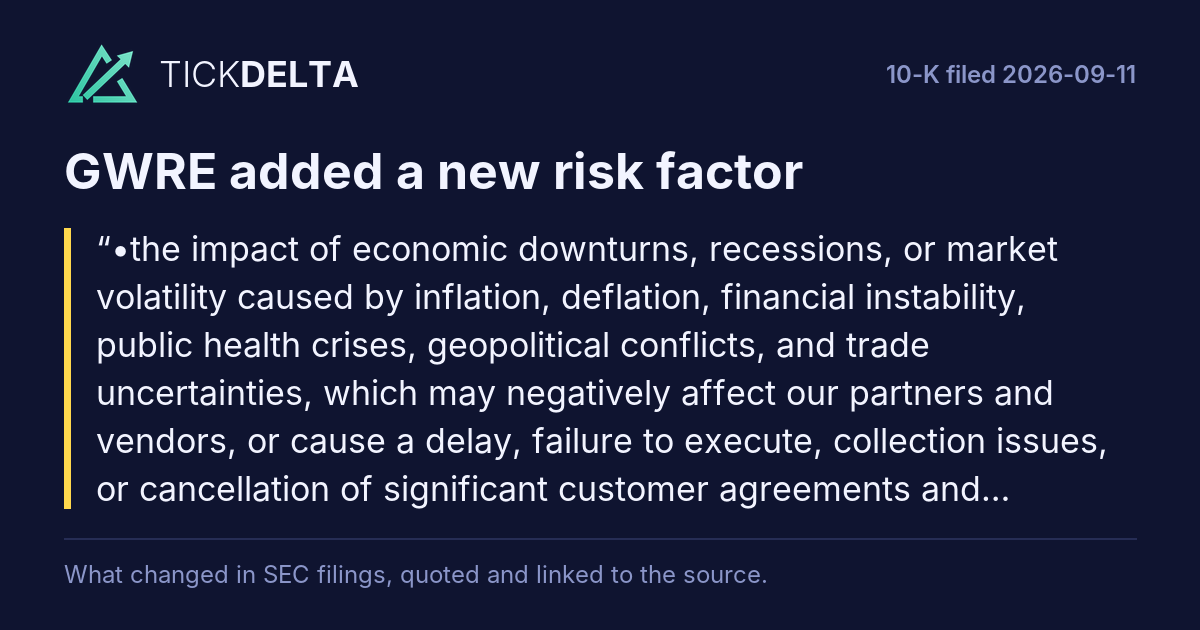
•the impact of economic downturns, recessions, or market volatility caused by inflation, deflation, financial instability, public health crises, geopolitical conflicts, and trade uncertainties, which may negatively affect our partners and vendors, or cause a delay, failure to execute, collection issues, or cancellation of significant customer agreements and professional service arrangements;
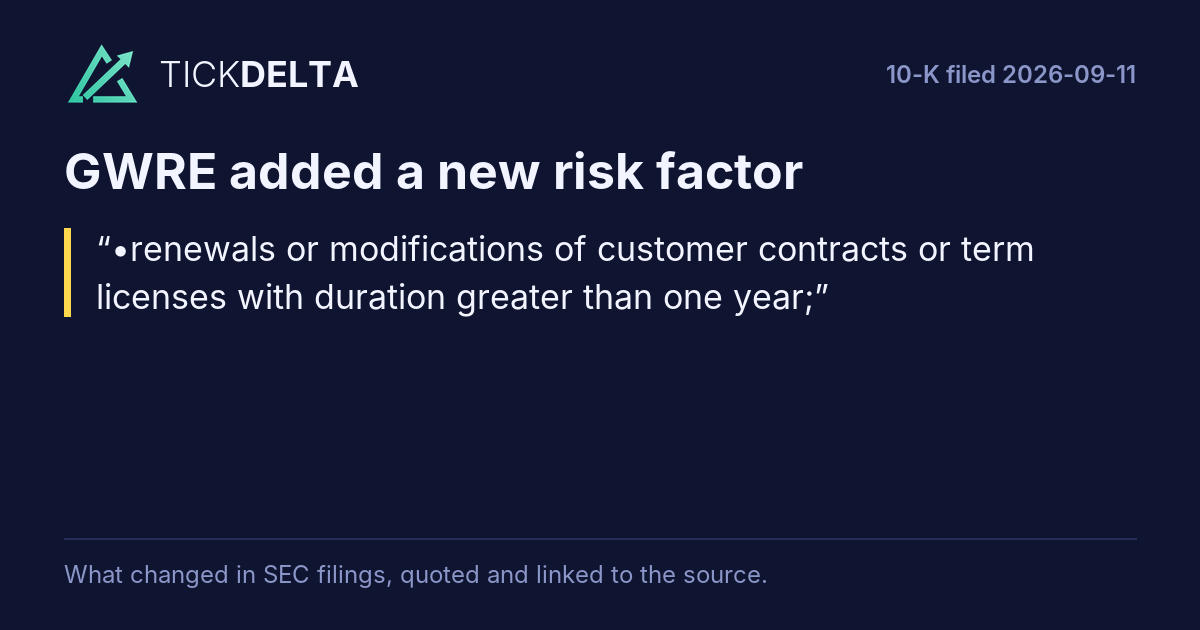
•renewals or modifications of customer contracts or term licenses with duration greater than one year;
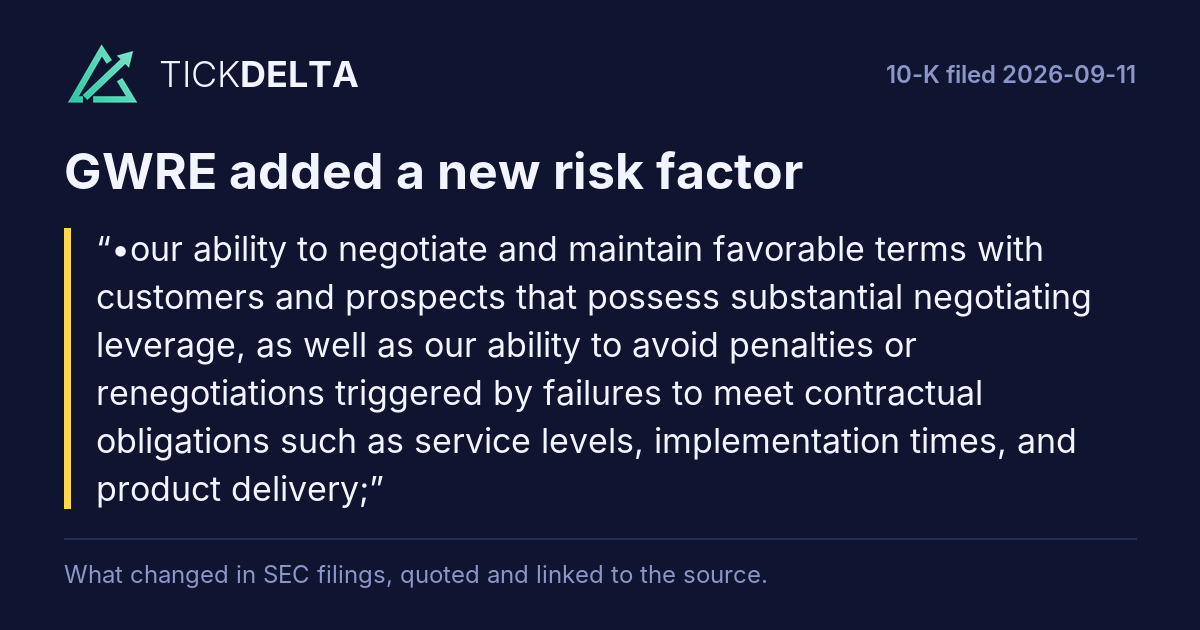
•our ability to negotiate and maintain favorable terms with customers and prospects that possess substantial negotiating leverage, as well as our ability to avoid penalties or renegotiations triggered by failures to meet contractual obligations such as service levels, implementation times, and product delivery;
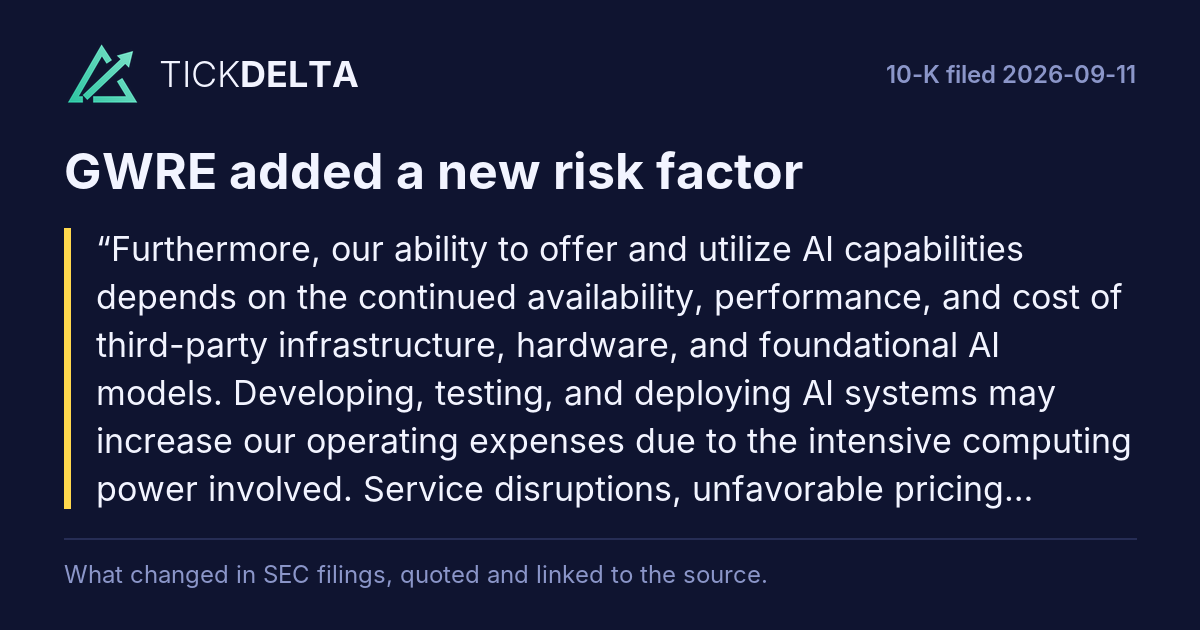
Furthermore, our ability to offer and utilize AI capabilities depends on the continued availability, performance, and cost of third-party infrastructure, hardware, and foundational AI models. Developing, testing, and deploying AI systems may increase our operating expenses due to the intensive computing power involved. Service disruptions, unfavorable pricing changes, model deprecation, unannounced changes to model performance or behavior, or a failure by third-party model providers to secure proper licenses or training data consents could constrain our product roadmap and increase operating expenses.
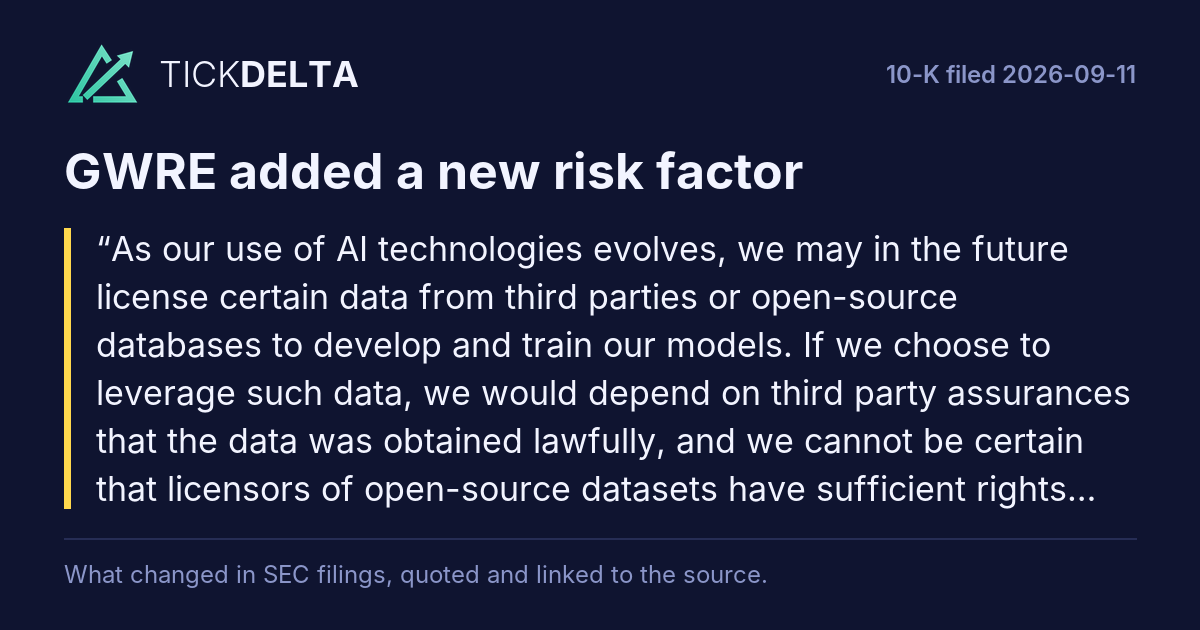
As our use of AI technologies evolves, we may in the future license certain data from third parties or open-source databases to develop and train our models. If we choose to leverage such data, we would depend on third party assurances that the data was obtained lawfully, and we cannot be certain that licensors of open-source datasets have sufficient rights to make them available. If we utilize such data in the future and are deemed to not have sufficient rights to it, we may be subject to litigation by the owners of the content or other materials that comprise such data, similar to the litigation that is currently pending in U.S. and other courts against developers of AI technologies. Additionally, as our product offerings evolve, we are developing extensible platform capabilities that will allow our customers and partners to integrate or plug-in third-party foundational AI models into core applications. To the extent we facilitate these integrations, we cannot guarantee that such users will not purposely or accidentally use AI technologies for improper purposes, including disseminating illegal, inaccurate, defamatory, or harmful content, intellectual property infringement or misappropriation, furthering bias or discrimination, cybersecurity attacks, data privacy violations, or to develop competing technologies, or that the measures we implement to prevent such improper use will be effective. Such improper use by any our customers utilizing these third-party models through our platform could adversely affect our business, reputation, and financial condition or subject us to legal liability.
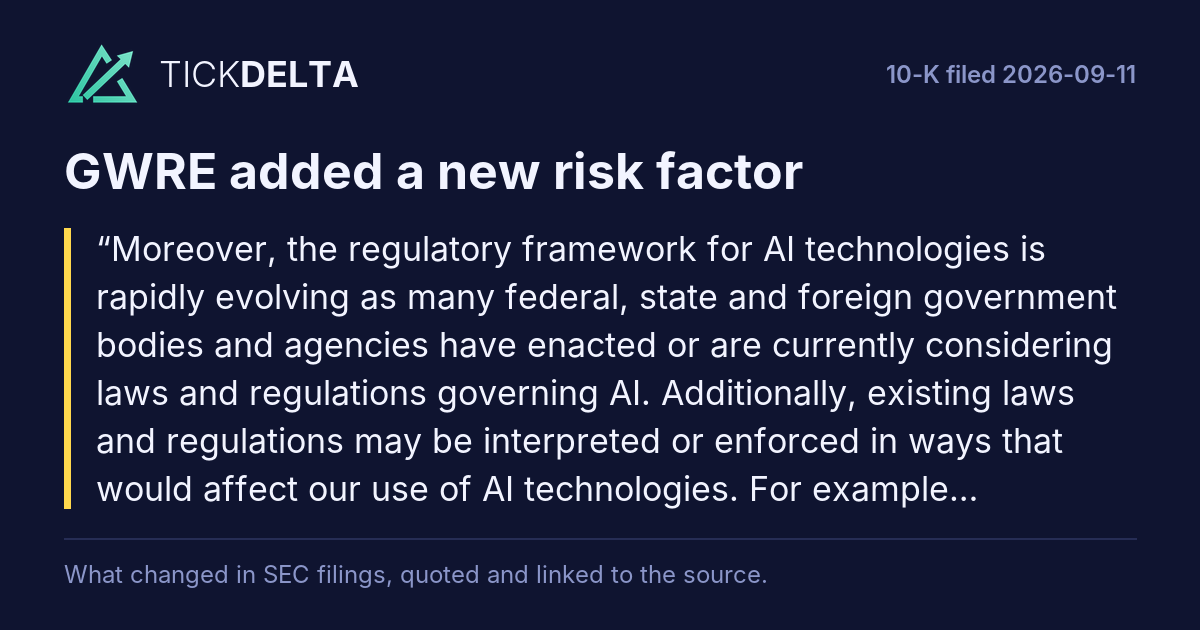
Moreover, the regulatory framework for AI technologies is rapidly evolving as many federal, state and foreign government bodies and agencies have enacted or are currently considering laws and regulations governing AI. Additionally, existing laws and regulations may be interpreted or enforced in ways that would affect our use of AI technologies. For example, evolving legal and regulatory frameworks targeted at AI technologies, such as the EU Artificial Intelligence Act, the EU Product Liability Directive as revised, and emerging U.S. federal and state standards, may require us to modify our data handling, model governance and compliance practices. Compliance with these diverse and evolving regulations may be costly or disruptive to our operations, increase our expenses, and restrict our ability to deploy specific AI features in certain markets, which may hinder our customers’ ability to adopt our AI-enabled products. Furthermore, any actual or perceived failure to successfully navigate these complex requirements could subject us to regulatory investigations, administrative fines, or operational restrictions that could harm our business.
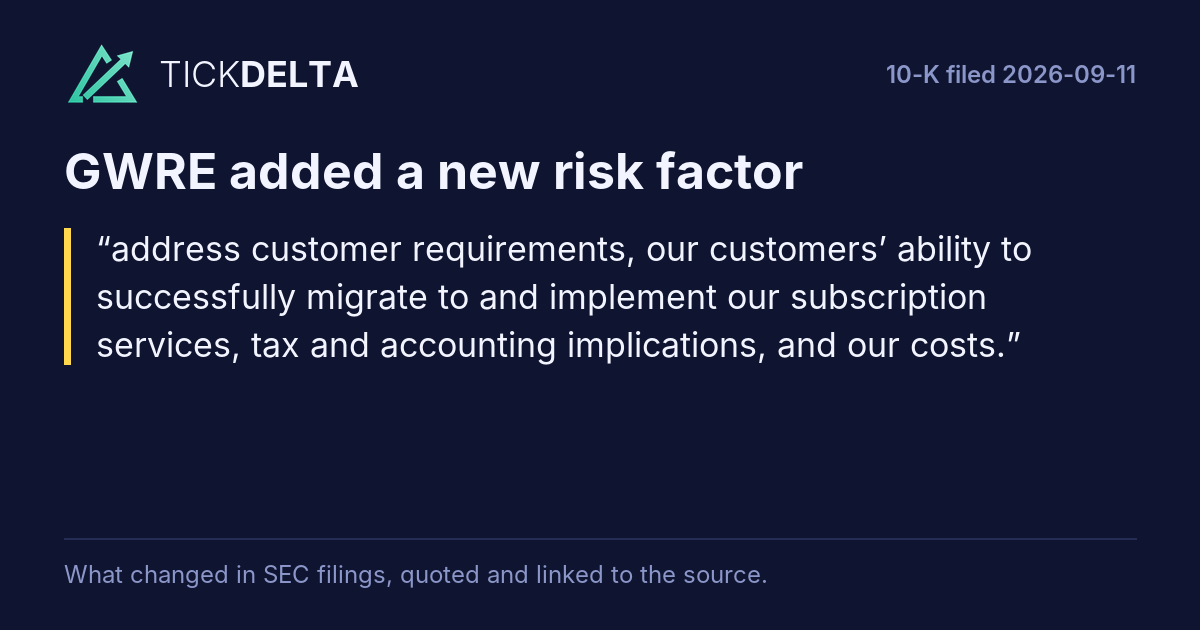
address customer requirements, our customers’ ability to successfully migrate to and implement our subscription services, tax and accounting implications, and our costs.
acquired or alliance products, or reduced pricing due to bundled sales, may cause fluctuations in our quarterly financial results, may adversely affect our operating margins, and may reduce the benefits of such acquisitions or alliances.
Additionally, we have licensed, and may license in the future, intellectual property rights from third parties, and the licenses we receive to such intellectual property rights may not provide exclusive or unrestricted rights in all fields of use and in all territories in which we may wish to develop or commercialize our products in the future and may restrict our rights to offer certain products in certain markets or impose other obligations on us in exchange for our rights to the licensed intellectual property. If we violate the terms of any of our license agreements, such as by failing to make specified payments or failing to comply with quality control standards, a licensor may have the right to terminate our license. Even if we comply with all the terms of a license agreement, we cannot guarantee that we will be able to renew an agreement when it expires even if we desire to do so. The failure to maintain or renew our material license agreements could result in a loss of revenue and negatively impact our results of operations.
We rely on various software applications to accurately maintain our books and records and prepare our financial statements, and are in the process of updating our quote-to-cash process, including our customer quoting, contracting, revenue, and billing. While we have invested significant resources, including additional personnel and third-party consultants, to implement these applications, we may experience difficulties during or following the transition. Any errors in our new applications could adversely affect our operations, including our ability to accurately report our financial results in a timely manner, maintain appropriate internal controls and processes, file our quarterly or annual reports with the SEC, and invoice and collect from our customers, each of which may harm our operations and reduce investor confidence. Data integrity problems or other issues may be discovered even after the transition is complete which, if not corrected, could impact our business, reputation, or results of operations. If we encounter unforeseen difficulties with our implementation, our business, operations, and results of operations could be adversely affected.
Our stock price has been and may continue to be volatile, and it may rise or fall regardless of our operating performance.
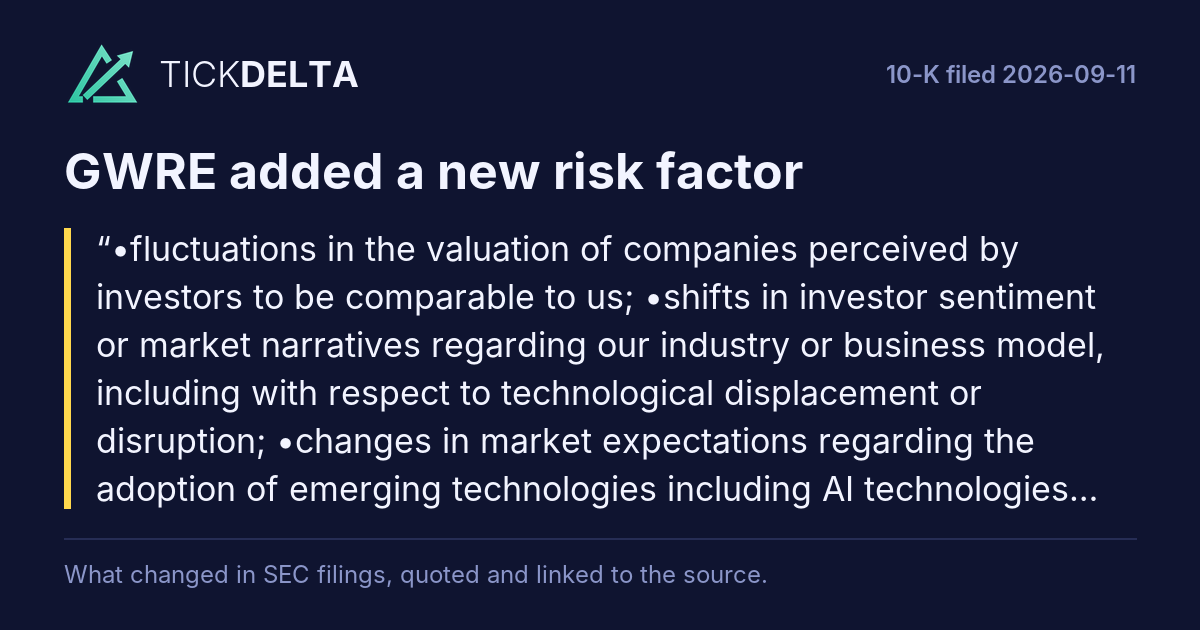
•fluctuations in the valuation of companies perceived by investors to be comparable to us;
•shifts in investor sentiment or market narratives regarding our industry or business model, including with respect to technological displacement or disruption;
•changes in market expectations regarding the adoption of emerging technologies including AI technologies; and
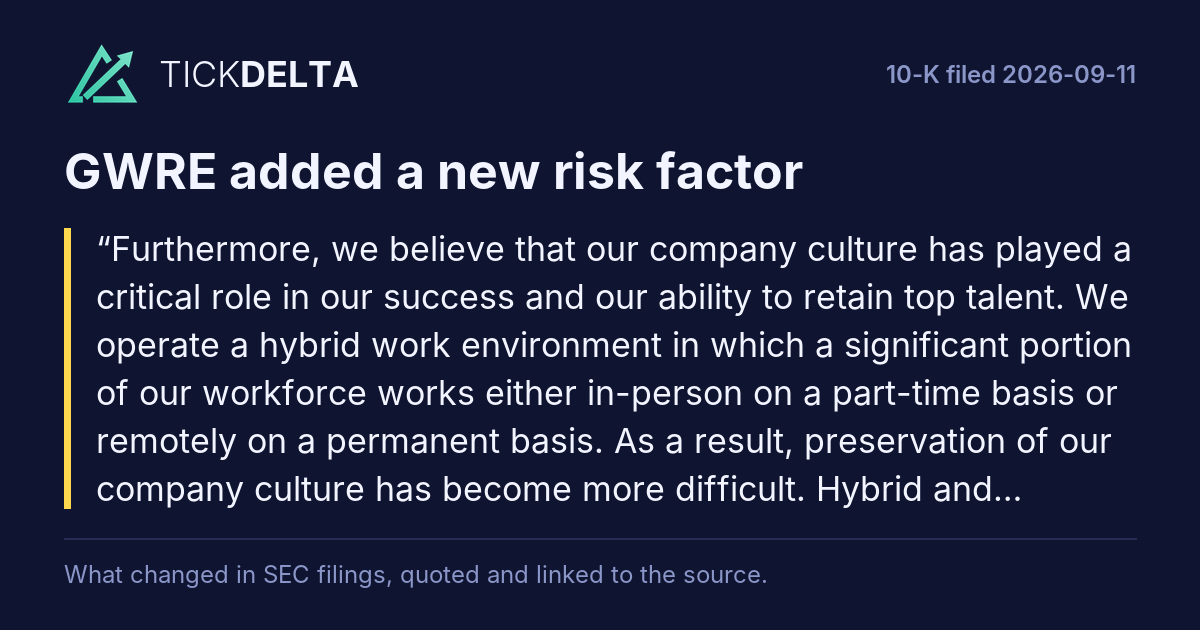
Furthermore, we believe that our company culture has played a critical role in our success and our ability to retain top talent. We operate a hybrid work environment in which a significant portion of our workforce works either in-person on a part-time basis or remotely on a permanent basis. As a result, preservation of our company culture has become more difficult. Hybrid and remote working arrangements may adversely affect our ability to recruit and retain personnel who prefer a fully remote or fully in-person work environment. Additionally, this operating model could decrease our workforce’s ability to collaborate, train new hires and communicate effectively, decrease innovation and productivity, and negatively affect morale and retention rates. Any failure to maintain our company culture could harm our competitive position.
New in the latest 10-Q
14 paragraphs in the 10-Q filed Jun 5, 2026 with nothing like them in the 10-Q filed Mar 6, 2026 (at least half the words must differ; new numbers alone do not count). Quoted exactly, grouped by the item heading above them. This is text that changed, not a judgement of how serious it is.
Adjustments to reconcile net income (loss) to net cash provided by (used in) operating activities:
Read in the 10-Q
Amortization of premium (accretion of discount) on available-for-sale securities, net (5,377) (8,613)
Read in the 10-Q
Proceeds from issuance of convertible senior notes, net of issuance costs — 671,840
Read in the 10-Q
Proceeds from issuance of common stock under employee stock purchase plan 13,364 —
Read in the 10-Q
significant inputs that were not observable in the market and thus represent a Level 3 measurement. The Company amortizes the acquired intangibles over their estimated useful lives.
Read in the 10-Q
The Inflation Reduction Act of 2022 imposed an excise tax of 1% on share repurchases in excess of new issuances in the fiscal year. During the three and nine months ended April 30, 2026, the Company recorded total excise tax of $ 1.5 million, which has been included within retained earnings (accumulated deficit), as part of the cost basis of the common stock repurchased, and other current liabilities in the condensed consolidated balance sheets as of April 30, 2026.
Read in the 10-Q
Cost of Revenue: Three Months Ended April 30, 2026 2025 Change Amount Amount ($) (%) (in thousands, except percentages) Cost of revenue: Subscription and support $ 67,882 $ 57,411 $ 10,472 18% License 374 892 (518) (58)% Services 67,639 52,507 15,132 29% Total cost of revenue $ 135,896 $ 110,810 $ 25,086 23% Includes stock-based compensation of: Cost of subscription and support revenue $ 3,391 $ 3,598 $ (207) Cost of license revenue — 32 (32) Cost of services revenue 6,108 5,055 1,053 Total $ 9,498 $ 8,685 $ 813
Read in the 10-Q
(1) During the three months ended April 30, 2026, we began excluding unrealized foreign currency exchange rate (gains) losses as a non-GAAP adjustment to other income (expense), net. Accordingly, we have recast previously reported amounts in our non-GAAP schedules.
Read in the 10-Q
As of April 30, 2026, we had $240.5 million available to repurchase shares under the new share repurchase program. If we execute fully on the share repurchase program in the fiscal year, we may be subject to excise taxes on the share repurchase in accordance with the Inflation Reduction Act of 2022.
Read in the 10-Q
Jeff Cooper, Chief Financial Officer Termination (1) February 5, 2026 Up to 35,894 (1)
Read in the 10-Q
Jeff Cooper, Chief Financial Officer Adoption (2) March 20, 2026 Up to 16,760 (3)
Read in the 10-Q
Winston King, Chief Administrative Officer, General Counsel, and Secretary Amendment (4) April 9, 2026 Up to 25,691 (3)
Read in the 10-Q
(1) Mr. Cooper terminated his Rule 10b5-1 trading arrangement, which was originally adopted on October 14, 2025. The aggregate number of shares reported in this table represents the total shares originally authorized for potential sale under the arrangement prior to its termination.
Read in the 10-Q
(3) This number represents an estimate of the maximum number of shares of common stock that may be sold pursuant to the trading plan, based on an assumed 40% tax withholding rate and the maximum payout of PSUs that have not yet achieved or vested. The actual number of shares sold will depend on the satisfaction of the conditions specified in the plan and the final tax withholding requirements at the time of sale.
Read in the 10-Q
Item 1A of the 10-Q filed Jun 5, 2026 against Item 1A of the 10-K filed Sep 11, 2025.
A 10-Q repeats only the risks that changed, so a 10-K paragraph that is missing from it is not counted as removed.
Added is a paragraph with nothing like it in the 10-K, Reworded a sentence that is in both with several words changed,
Quiet changes a sentence in both where one to four words changed and one is a hedge or a modal
(cut words struck through, new words highlighted).
Text on the page, not a score; each links to the filing at sec.gov.
The first 18 of 28 are shown (at most 12 of each type).
Two-word phrases in Risk Factors of the 10-K filed Sep 11, 2026 that are in none of the 1 earlier 10-Ks stored, back to Sep 11, 2025
Used at least twice, small words left out. Counted, not picked: a phrase can be new because the company renamed something.
21 paragraphs of last year's Risk Factors with nothing like them now. The longest are quoted.
Item 1A of each 10-K and 10-Q on EDGAR, quoted exactly. Each paragraph links to the filing at sec.gov.
10-K change: what was reworded or cut, section by section.
Excel workbook · CSV. Google Sheet that stays up to date: paste =IMPORTDATA("https://tickdelta.com/company/GWRE/export.csv") into a cell.