Reworded10-Q 2026-10-22 vs 10-K 2026-02-17
HONHoneywell Technologies
- Headquarters
- Charlotte, NC
- CEO
- Vimal Kapur
- Next results
- around Dec 21, 2026
7 paragraphs in Risk Factors of the 10-K filed Feb 17, 2026 with nothing like them in the 10-K filed Feb 14, 2025. Quoted exactly. Paragraphs that were only edited are under 10-K change.
Compared with the Risk Factors in the latest 10-K of the other 81 Industrials companies: a paragraph with at least half its words the same at another company is called similar, and the companies are listed under it. A paragraph most of them have is marked boilerplate. No line means no other company has one like it. This counts text; it does not say how serious a risk is.
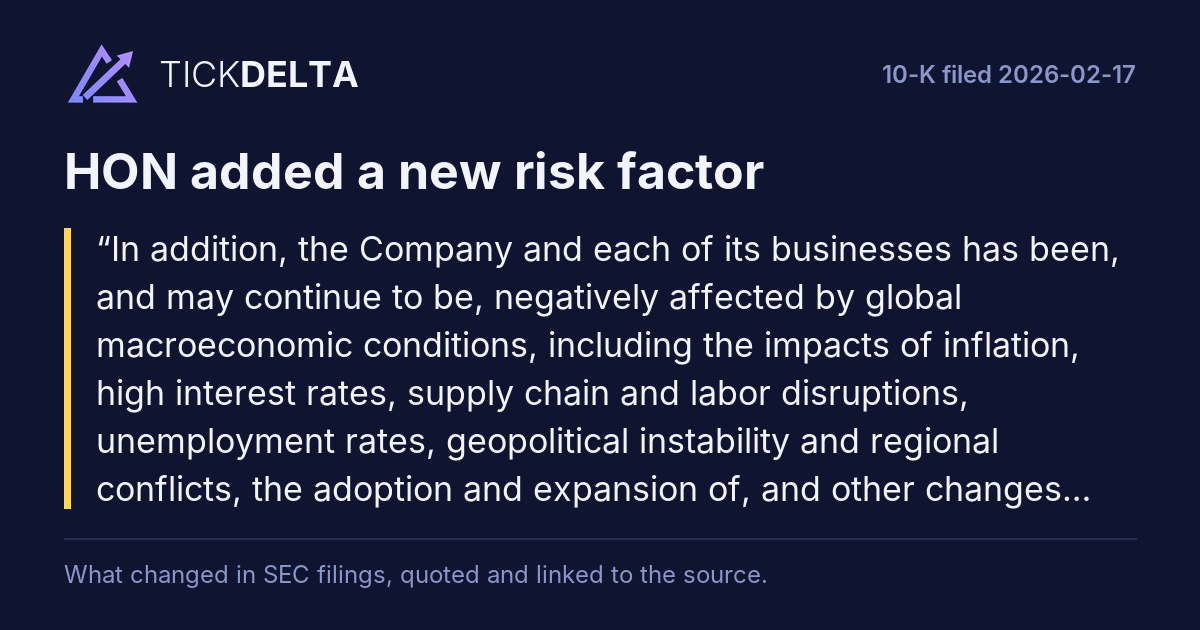
In addition, the Company and each of its businesses has been, and may continue to be, negatively affected by global macroeconomic conditions, including the impacts of inflation, high interest rates, supply chain and labor disruptions, unemployment rates, geopolitical instability and regional conflicts, the adoption and expansion of, and other changes to, trade restrictions and tariffs, quotas, embargoes, and other related actions, and the occurrence or threat of a trade war or other governmental action related to tariffs or trade agreements or policies. Such factors could adversely impact, demand for our products, our costs, our customers, our suppliers, and the world and U.S. economies. The impact of such factors could have a material adverse effect on our business, operating results, cash flows, and financial condition.
Similar paragraph at 1 of 81 other Industrials companies: GNRCRead in the 10-K ↗
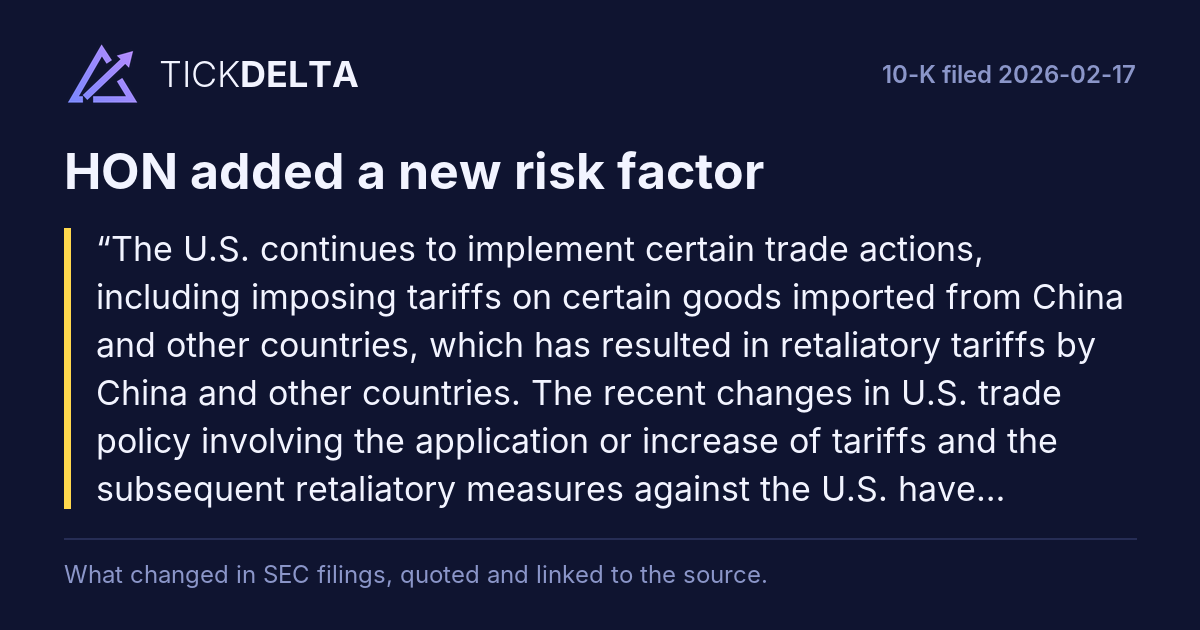
The U.S. continues to implement certain trade actions, including imposing tariffs on certain goods imported from China and other countries, which has resulted in retaliatory tariffs by China and other countries. The recent changes in U.S. trade policy involving the application or increase of tariffs and the subsequent retaliatory measures against the U.S. have created a dynamic environment that may have a material adverse impact on our business. While we have deployed strategies to mitigate the impact of these dynamic trade policies, there is no assurance that we will be able to mitigate the full impact of all such tariffs, retaliatory tariffs or other trade policies that have or may develop in this rapidly changing environment. Increasing trade tensions and changes in trade policies have the potential to adversely impact our costs, the demand for our products, our supply chain and the global economy, and could result in fines and penalties or reputational harm if we are found not to be in compliance, which may have an adverse impact on our business, including operating and financial results and conditions.
Similar paragraph at 1 of 81 other Industrials companies: EMRRead in the 10-K ↗
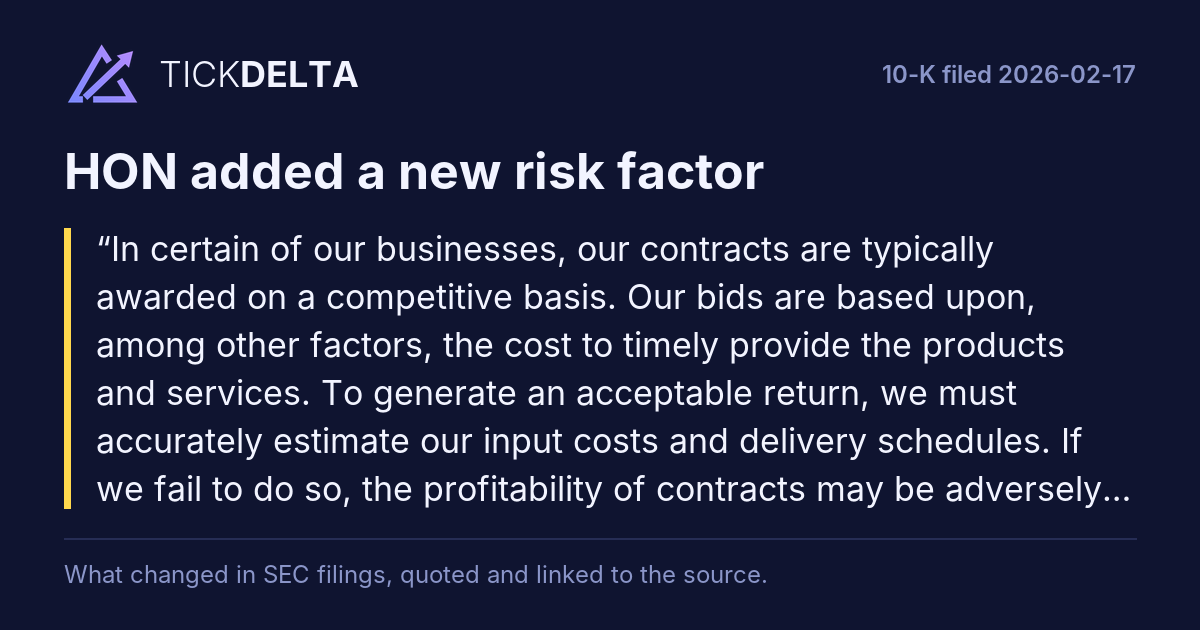
In certain of our businesses, our contracts are typically awarded on a competitive basis. Our bids are based upon, among other factors, the cost to timely provide the products and services. To generate an acceptable return, we must accurately estimate our input costs and delivery schedules. If we fail to do so, the profitability of contracts may be adversely affected – including because some of our contracts provide for liquidated damages if we do not perform on time – which could have a material adverse effect on our competitive position, results of operations, cash flows or financial condition.
Read in the 10-K ↗
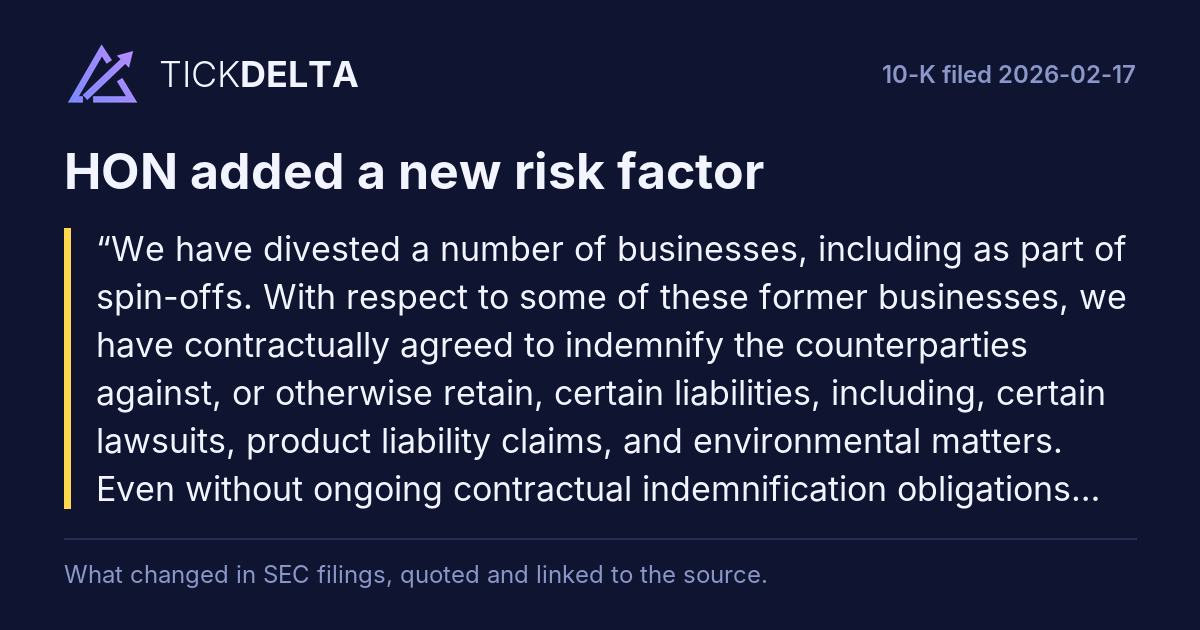
We have divested a number of businesses, including as part of spin-offs. With respect to some of these former businesses, we have contractually agreed to indemnify the counterparties against, or otherwise retain, certain liabilities, including, certain lawsuits, product liability claims, and environmental matters. Even without ongoing contractual indemnification obligations, we could be exposed to liabilities arising out of such divestitures. In addition, the counterparties to those divestitures or spun-off businesses may have agreed to indemnify us or assume certain liabilities relating to those divestitures. However, there can be no assurance that the indemnity or assumption of liability by the counterparties will be sufficient to protect us against the full amount of these liabilities, or that a counterparty will be able to fully satisfy its obligations. Third parties also could seek to hold us responsible for any of the liabilities that a counterparty agreed to assume. Even if we ultimately succeed in recovering any amounts for which we were initially held liable, we may be temporarily required to bear these losses ourselves.
Similar paragraph at 1 of 81 other Industrials companies: FDXFRead in the 10-K ↗
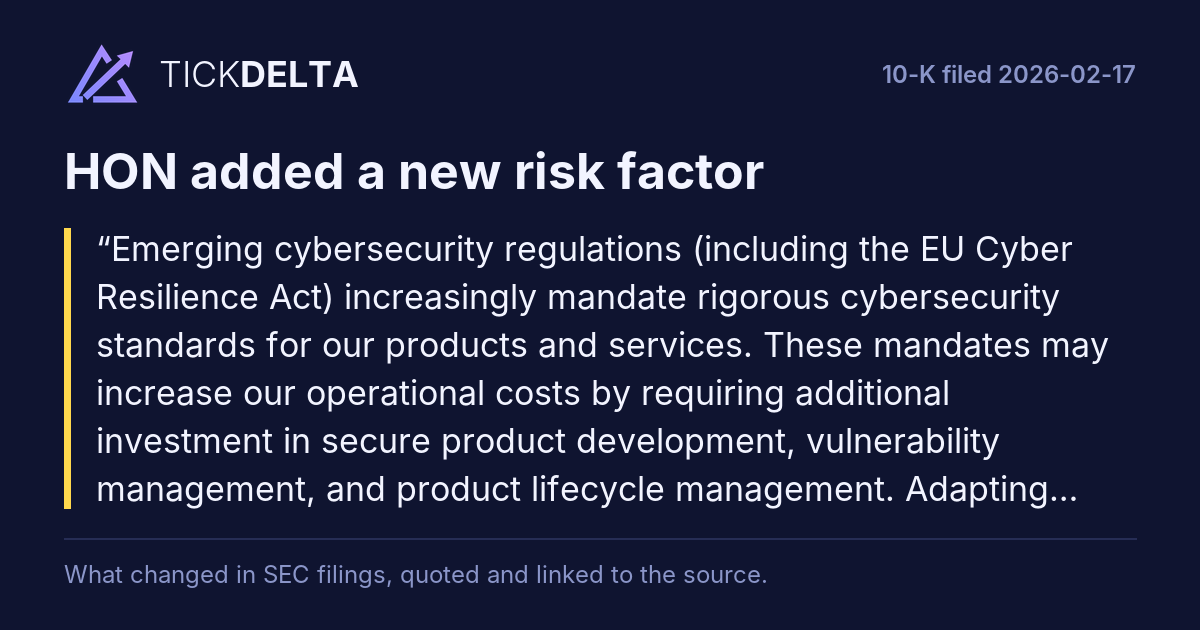
Emerging cybersecurity regulations (including the EU Cyber Resilience Act) increasingly mandate rigorous cybersecurity standards for our products and services. These mandates may increase our operational costs by requiring additional investment in secure product development, vulnerability management, and product lifecycle management. Adapting our diverse portfolio to meet these requirements may require costly product redesigns, delay market entry for new solutions, or necessitate strategic retirement of legacy offerings. Failure to meet these standards could result in significant financial penalties, restricted market access, and reputational harm that could adversely affect our competitive position and financial results.
Moreover, beyond the regulations generally applicable to data collection and use, technologies such as artificial intelligence and machine learning may introduce novel compliance, security, and operational risks due to the rapidly evolving legal and regulatory environment, both in the United States and internationally, surrounding the development, sale and use of these technologies. Governments globally—including through frameworks such as the EU AI Act, the Colorado Artificial Intelligence Act, and the California AI Transparency Act—are adopting rules that impose heightened transparency, risk‑management, monitoring, and human‑oversight obligations. As these frameworks develop, we may be required to modify our practices, contracts, or products. Their ultimate impact is uncertain, and additional jurisdictions may adopt similar requirements. Failure to comply could result in regulatory scrutiny, fines, or reputational harm.
Read in the 10-K ↗
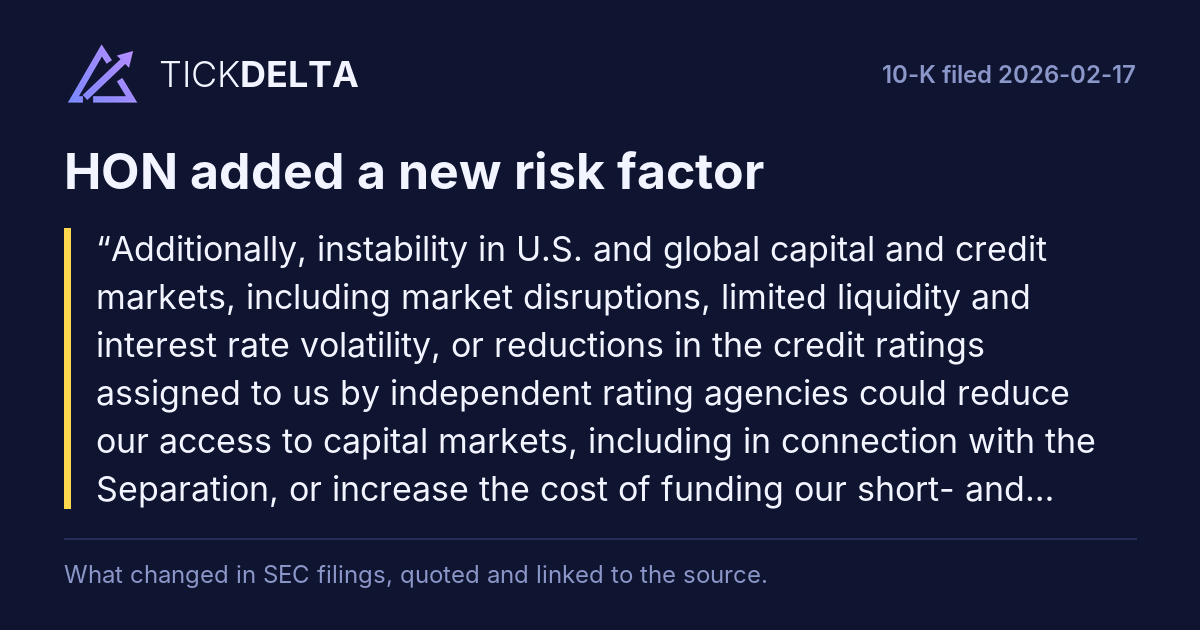
Additionally, instability in U.S. and global capital and credit markets, including market disruptions, limited liquidity and interest rate volatility, or reductions in the credit ratings assigned to us by independent rating agencies could reduce our access to capital markets, including in connection with the Separation, or increase the cost of funding our short- and long-term credit requirements. In particular, if we are unable to access capital and credit markets on terms that are acceptable to us, or at all, we may not be able to make certain investments or fully execute our business plans and strategies. If we were to raise funding through the issuance of equity securities, our shareowners would experience dilution of their existing ownership interest. If we were to raise significant additional funds by issuing debt, rating agencies could downgrade our credit ratings or put them on negative watch.
Read in the 10-K ↗
New in the latest 10-Q
51 paragraphs in the 10-Q filed Oct 22, 2026 with nothing like them in the 10-Q filed Jul 23, 2026 (at least half the words must differ; new numbers alone do not count). Quoted exactly, grouped by the item heading above them. This is text that changed, not a judgement of how serious it is.
10-Q
There were 317,358,518 shares of Common Stock outstanding at September 30, 2026.
Read in the 10-Q ↗
Our iconic heritage traces its origins to the late nineteenth century with the development of early temperature control technologies and the formation of the original Honeywell Heating Specialty Company in 1906. Honeywell Technologies introduced the first electronic control system in 1974, marking the beginning of modern distributed control systems, which enabled large complex plants to be controlled by a network of distributed controllers. At around the same time, in the 1970s, the debut of Honeywell Technologies’ Alpha 1000 and Delta systems brought a novel convergence of building management solutions that integrated fire, security, and energy systems into a unified platform. Through organic innovations as well as numerous strategic acquisitions, Honeywell Technologies has taken a software-first approach to increasing customer productivity and operational efficiency with forward-looking technology. Our rich history of innovation and technology leadership has cemented our long-standing reputation for driving significant productivity and enabling better outcomes for customers, ultimately making Honeywell Technologies instrumental to the future of critical industries.
Read in the 10-Q ↗
Through our three operating segments, we provide mission-critical solutions in industries where reliability is paramount and sustainable competitive advantages can be established. Honeywell Technologies focuses on critical control points that often represent only a single-digit percentage of a project’s spend but deliver outsized value to our customers, creating aftermarket opportunities that enable us to add substantial value over the life of their assets. Our decades of deep domain expertise combined
Read in the 10-Q ↗
with our cutting-edge technologies enable us to offer value-based solutions that span a complementary set of business models, including products, projects, services, and software.
Read in the 10-Q ↗
Our strategy is firmly rooted in the application of core competencies and our mature Accelerator operating system to meet industry demands for high return on investment (ROI) outcomes that build on integrated, enterprise-level solutions for customers. Honeywell Technologies has a substantial installed base of differentiated and critical equipment across Building Automation, Process Automation and Technology, and Industrial Automation.
Read in the 10-Q ↗
We collaborate closely with top-tier partners that strengthen our go-to-market strategies by expanding our reach within existing verticals and enabling us to serve new customer segments in industries undergoing meaningful transformation, such as data centers, liquefied natural gas (LNG), semiconductors, and life sciences. These relationships provide us with valuable insights and broad end-customer access, which in turn solidifies our reputation as a leader across our sectors.
Read in the 10-Q ↗
The key enablers of our business model are our proprietary Honeywell Technologies Accelerator operating system and our Honeywell Technologies Forge intelligence layer. Accelerator is our comprehensive management and operational framework that leverages decades of development to drive growth and competitive advantages through increased efficiency, manufacturing productivity, value-based pricing, customer problem solving, and innovation. This system is designed to enhance enterprise collaboration and accelerate decision-making, while optimizing our workforce. Our Accelerator operating system has matured over decades, using Lean, Six Sigma, and digital tools to provide real-time visibility into supply chain, production, and operational performance.
Read in the 10-Q ↗
Our Honeywell Technologies Forge intelligence layer is a hardware-agnostic and open-architecture platform, which allows us to combine deep domain expertise and vast quantities of data in order to provide critical insights and outcomes for customers. This platform helps improve client processes, enhance productivity, support sustainability initiatives, and empower workers across all our business segments. By integrating Honeywell Technologies Forge into our portfolio and combining it with our leading-edge artificial intelligence (AI) capabilities, we enable customers to unlock greater value from their assets and operations and deliver enterprise-level outcomes.
Read in the 10-Q ↗
To accelerate growth, we monetize our installed base with software, services and aftermarket offerings to generate incremental revenue streams that achieve consistent and reliable growth and recurring revenue streams. While there has been a significant push to digitize the industrial space, we believe significant opportunities remain for Honeywell Technologies to transform how organizations leverage technologies to automate complex operations, improve performance, and proactively respond to challenges faced by our customers.
Read in the 10-Q ↗
Drive innovation through focus on research and development (R&D) and new product introductions
Read in the 10-Q ↗
Our R&D investments are pivotal in driving strong organic growth from new product introductions that not only sustain our core business but also generate incremental revenue streams. Our commitment to drive a continuous cycle of product innovation leads to value-added product refreshments built on deep, trusted relationships. Our high level of customer focus provides us with prospects for co-innovation that benefit not only our existing customer base but also new customers by solving their most pressing challenges.
Read in the 10-Q ↗
We focus our R&D investments on establishing a refreshed pipeline of solutions that create significant incremental outcomes to extend asset life, improve operational efficiency, and enhance customer decision-making across our segments. Across our portfolio, we continue to improve our strategic focus by developing new solutions that aim to transform customer operations through product upgrades, data analytics, and AI-based offerings. Our holistic, disciplined approach focuses on every element from accelerating ideation through to the commercialization phase. Over the last several years, we transformed our innovation process, working to ensure increased growth and ROI across our portfolio through strategic portfolio planning and building a culture of customer centricity.
Read in the 10-Q ↗
As we consider opportunities to invest in technology, we target investments that we can use across our entire portfolio, further strengthening our single platform cross-selling model. Across our businesses, we developed and commercialized multiple vendor-agnostic innovations that increase customer productivity and operational efficiency, ensuring that we deliver quality solutions faster and at a reduced cost. As we continue to execute our own digital transformation, we are committed to embedding innovation into every aspect of our operations. Our mission is as much about setting new industry standards and anticipating future needs as it is about delivering today’s solutions.
Read in the 10-Q ↗
We complement our organic growth strategy with a disciplined mergers and acquisitions (M&A) strategy, regularly identifying and evaluating a robust pipeline of acquisition opportunities across all businesses as part of our efforts to broaden our portfolio, access differentiated technologies and innovations and expand our exposure to high-growth verticals and regions. Our recent acquisitions focused on high-growth verticals and strategically expanded our existing portfolio, enabling us to create end-to-end, integrated offerings in attractive segments. Specifically, we believe that the acquisitions of Carrier Access Solutions, Air Products' LNG business, Compressor Controls Corporation (CCC), Sundyne, and Johnson Matthey’s Catalyst Technologies business will notably increase annualized revenue across our Building Automation and Process Automation and Technology portfolios. We apply a rigorous evaluation process designed to align each opportunity with our strategic objectives, financial criteria, and operational requirements, with the goal of ultimately supporting value creation.
Read in the 10-Q ↗
Our business model is designed to sustain growth that is less dependent on business cycles. We refer to this as “decoupled” growth: revenue that is not tied to the capital equipment lifecycle, unlike most traditional aftermarket sales. Decoupled growth creates new industry segments, such as connected buildings, and new offerings, such as cybersecurity, which expand the total addressable market and provide platforms for integrated solutions that combine multiple offerings in our broad portfolio.
Read in the 10-Q ↗
In addition to growing in our core end-markets, we are concentrating on additional expansion in four “high-growth vertical” areas: data centers, semiconductors, life sciences, and LNG, where we bring our portfolio together around customer outcomes that matter most. In each vertical, we aim to build scale through vertical-specific offerings, a tailored commercial approach, and targeted acquisitions and partnerships. By way of example, in data centers, we help operators maximize uptime and energy efficiency by integrating building management, power and cooling controls, fire safety, and security. In our semiconductor vertical we help fabrication facilities protect yield and operate safely through environmental controls, gas detection, and process automation. And in LNG, we help producers improve throughput, reliability, and safety across liquefaction and export operations through process control, safety systems, and operations software.
Read in the 10-Q ↗
For example, for pharmaceutical and biotechnology manufacturers, one of our core focuses is on improving manufacturing quality: small deviations in temperature, humidity, pressure, or contamination control can compromise a batch and create regulatory exposure. We address this by integrating our process automation software and controls, building management systems, and fire and security solutions into a seamless solution for our customers. Building controls hold the precise environmental conditions production requires; process automation provides real-time visibility into production data across the manufacturing lifecycle; and fire and security systems protect people, facilities, and product while supporting compliance with stringent regulations. Together, these capabilities help customers improve product quality, simplify regulatory compliance, and lower operating costs. Because our capabilities apply across verticals, lessons from one domain carry into others, which we believe deepens our relationships with existing customers.
Read in the 10-Q ↗
As a pure-play automation company, we have global scale with over half of our total annual sales from outside of the United States, and approximately one-third of total annual sales from high-growth regions. As reshoring investments remain strong, we believe this global mix positions us well to meet the local needs of customers for longevity of human life, energy demand / security, and increased energy consumption. Our global scale and reach are bolstered by the strength of our trusted brand and the depth of our channel partnerships. Our local-for-local strategy applies across all our regions and our global engineering services model, which enables us to both maintain customer focus and deliver on precise requirements and specifications that differ from country to country with speed and agility.
Read in the 10-Q ↗
Honeywell Technologies is a global, pure-play automation business that brings together proprietary operating disciplines, deep domain expertise, and AI-enabled Forge solutions to boost customer productivity, drive growth across our installed base and high-growth markets and help address the world's most mission-critical challenges. Underpinned by our Accelerator operating system,
Read in the 10-Q ↗
our growth strategies work together to translate our installed base and domain expertise into actionable paths to develop and grow consistent, recurring revenue in new and existing segments.
Read in the 10-Q ↗
Within Building Automation, our Honeywell Technologies Forge solutions enable channel partners and end-users to digitally manage buildings, through asset onboarding, self-service capabilities, and applications. Digitalization, coupled with cloud transformation, creates the capability to connect assets, visualize data that provides actionable insights through intuitive dashboards, manage systems remotely, and leverage AI to facilitate installation, commissioning, and life-time service.
Read in the 10-Q ↗
Operating our Process Automation and Technology business as a single segment enables us to unlock significant customer efficiency benefits, since we believe we are singularly positioned to deliver end-to-end solutions combining our molecule expertise with our controls and software. For example, through the acquisition of Air Products' LNG business in 2024, we now provide
Read in the 10-Q ↗
customers with a full-service set of solutions consisting of natural gas pre-treatment, liquefaction, and enterprise-level digital automation technologies unified under the Honeywell Technologies Forge and Experion platforms.
Read in the 10-Q ↗
Our extensive installed base of sensing and measurement offerings, combined with vertical domain expertise and deep integration with Honeywell Technologies' Forge platform, delivers distinctive, value-accretive outcomes that address evolving customer needs. The combination of data, cloud and smarter edge solutions allows Industrial Automation to deliver enterprise level outcomes rather than just point solutions at each asset or site.
Read in the 10-Q ↗
2 Other transactions with shareowners includes an increase in Retained earnings related to the pro rata distribution of all of the issued and outstanding shares of common stock of Honeywell Aerospace. In connection with the Aerospace Spin-Off, the Company derecognized assets of $21.9 billion and liabilities of $24.9 billion, including the Aerospace Senior Notes as discussed in Note 9 Debt and Credit Agreements. Additionally, the Company reclassified $74 million of Noncontrolling interest at...
Read in the 10-Q ↗
As of December 31, 2025, the Company concluded the assets and liabilities of each of the Productivity Solutions and Services (PSS) and Warehouse and Workflow Solutions (WWS) businesses, which were a part of the Productivity goodwill reporting unit within the Industrial Automation reportable business segment, met the held for sale criteria, and the Company presented the associated assets and liabilities of each business as held for sale beginning December 31, 2025. On July 27, 2026, the Company completed the sale of its WWS business in exchange for total consideration of $ 157 million, net of cash transferred. On August 3, 2026, the Company completed the sale of its PSS business for total consideration of $ 1,370 million, net of cash transferred.
Read in the 10-Q ↗
During the third quarter, the Company recognized a pre-tax gain on the sale of the businesses of $ 339 million, primarily attributed to a gain on the sale of the PSS business, which was recorded in Other (income) expense in the Consolidated Statement of Operations. During the nine months ended September 30, 2026, the Company recognized a $ 311 million increase to the valuation allowance to write down the WWS disposal group to fair value, less costs to sell.
Read in the 10-Q ↗
On October 30, 2025, the Company completed the spin-off of its Advanced Materials business into an independent, publicly traded company named Solstice. The Company structured the transaction as a tax-free separation for U.S. federal income tax purposes, providing shareowners of record with one share of Solstice stock for every four shares of Honeywell common stock.
Read in the 10-Q ↗
The following table summarizes the key components of net income (loss) from discontinued operations:
Read in the 10-Q ↗
smarter edge solutions allows Industrial Automation to deliver enterprise level outcomes rather than just point solutions at each asset/site.
Read in the 10-Q ↗
September 30, 2026 December 31, 2025 Gross Accumulated Net Gross Accumulated Net
Read in the 10-Q ↗
In March 2026, the Company repaid its $ 1.0 billion 4.37 % term loan due 2027. In August 2026, the Company made a partial prepayment of $ 1.5 billion on the $ 2.75 billion of borrowings outstanding under the 2025 term loan due 2027. As of September 30, 2026, there were $ 1.25 billion of borrowings outstanding under this term loan.
Read in the 10-Q ↗
In conjunction with the Honeywell Aerospace Spin-Off, the Company entered into the Separation and Distribution Agreement with Honeywell Aerospace and underwent a separation, pursuant to which certain businesses and entities with associated environmental liabilities were transferred to Honeywell Aerospace. Honeywell Aerospace assumed responsibility for those environmental liabilities and agreed to indemnify the Company for any losses, costs, or liabilities incurred by the Company in connection with such environmental liabilities. In addition, the Company received acknowledgements from environmental agencies which established that Honeywell Aerospace would be obligated to remediate these environmental liabilities, and the Company may be looked to, for remediation if Honeywell Aerospace does not satisfy its remediation obligations. Accordingly, in connection with the Aerospace Spin-Off transaction, the Company derecognized $ 828 million of environmental liabilities through equity as part of the transferred businesses and recognized its residual obligation as a stand-ready obligation in accordance with ASC 460, Guarantees.
Read in the 10-Q ↗
The Company is unable to estimate the maximum potential amount of any payments in the event Honeywell Aerospace does not satisfy its environmental liabilities obligations because the scope, timing, and ultimate cost of future remediation activities depend on site-specific conditions, regulatory requirements, and other factors that cannot currently be estimated. The Company would not be responsible for any assumed obligations unless (i) Honeywell Aerospace was financially or legally incapable of satisfying its remediation or indemnification obligations and (ii) all available defenses of the Company to liability were finally (and without further right of appeal) determined by a court of competent jurisdiction to be invalid. The Company evaluates this scenario as a loss contingency at each reporting date. At September 30, 2026, the Company concluded that no additional accrual for liability was required under ASC 450-20 because a loss was remote.
Read in the 10-Q ↗
The Company continues to be responsible for environmental liabilities related to properties and operations retained by the Company following the Aerospace Spin-Off, as set forth in the Separation and Distribution Agreement.
Read in the 10-Q ↗
In conjunction with the Resideo Technologies, Inc. (Resideo) spin-off, the Company entered into an indemnification and reimbursement agreement with a Resideo subsidiary, pursuant to which Resideo’s subsidiary had an ongoing obligation to make cash payments to Honeywell Technologies in amounts equal to 90 % of Honeywell Technologies’ annual net spending for environmental matters at certain sites as defined in the agreement. As the Company incurred costs for environmental matters deemed probable and reasonably estimable related to the sites covered by the indemnification and reimbursement agreement, a corresponding receivable from Resideo for 90 % of such costs was also recorded. The amount payable to Honeywell Technologies in any given year was subject to a cap of $ 140 million, and the payment obligation was to continue until the earlier of December 31, 2043, or December 31 of the third consecutive year during which the annual payment obligation was less than $ 25 million. Reimbursements associated with this agreement were collected from Resideo quarterly and were $ 105 million in the nine months ended September 30, 2025.
Read in the 10-Q ↗
In the third quarter of 2025, the Company and Resideo entered into a termination agreement for the accelerated monetization of the indemnification and reimbursement agreement. Upon closing of the transactions contemplated pursuant to the termination agreement, the Company received a one-time cash payment of $ 1,590 million in lieu of all future payments to which the Company was entitled pursuant to the indemnification and reimbursement agreement. Additionally, Resideo paid the quarterly payment of $ 35 million for the quarter ending September 30, 2025 due under the indemnification and reimbursement agreement. The Company applied the one-time cash payment and quarterly reimbursement payment against the outstanding receivable balance due from Resideo, inclusive of expenses incurred in the third quarter of 2025. The Company recognized a gain of $ 802 million in Other (income) expense for the cash proceeds received in excess of the receivables due from Resideo as of the third quarter of 2025.
Read in the 10-Q ↗
As a result of the termination agreement, Resideo no longer has any obligation to make cash payments to Honeywell Technologies in respect of Honeywell Technologies’ net spending for environmental matters.
Read in the 10-Q ↗
In connection with the Aerospace Spin-Off, Honeywell Technologies transferred $ 6.4 billion of pension benefit obligations and $ 9.0 billion of plan assets for certain pension plans to Honeywell Aerospace.
Read in the 10-Q ↗
Additionally, in conjunction with the Aerospace Spin-Off, the Company transferred assets of $26 million from the former Aerospace Technologies reportable business segment to the Industrial Automation reportable business segment. Prior period amounts have been recast.
Read in the 10-Q ↗
• Partially offset by gain on sale of the WWS and PSS businesses of approximately $0.3 billion.
Read in the 10-Q ↗
• Nonrecurring gain recognized on Resideo termination agreement in the nine months ended September 30, 2025 of approximately $0.8 billion, and
Read in the 10-Q ↗
• Partially offset by gain on sale of the WWS and PSS businesses of approximately $0.4 billion.
Read in the 10-Q ↗
• Partially offset by changes in estimate on prior tax positions of 740 basis points.
Read in the 10-Q ↗
• Nonrecurring gain recognized on Resideo termination agreement in the three months ended September 30, 2025 ($2.51 after tax),
Read in the 10-Q ↗
• Partially offset by gain recognized on sale of WWS and PSS businesses ($0.70 after tax),
Read in the 10-Q ↗
• Higher tax benefits driven by U.S. federal, and state matters ($0.58 after tax), and
Read in the 10-Q ↗
• Partially offset by nonrecurring gain recognized on Resideo termination agreement in the nine months ended September 30, 2025 ($2.49 after tax).
Read in the 10-Q ↗
Nine months ended September 30, 2026 compared with nine months ended September 30, 2025
Read in the 10-Q ↗
Net cash provided by operating activities decreased by $4,461 million, driven by the change in classification of Honeywell Aerospace cash used by operations of $189 million in 2026 and provided by operations of $2,594 million in 2025 to discontinued operations, and the receipt of the Resideo indemnification and reimbursement agreement termination payment of $1,590 million in 2025.
Read in the 10-Q ↗
Item 6
10.2* Offer Letter dated August 17, 2026 from Honeywell International Inc. to Billal Hammoud (filed herewith)
Read in the 10-Q ↗
The 10-Q's risk factors against the 10-K
Item 1A of the 10-Q filed Oct 22, 2026 against Item 1A of the 10-K filed Feb 17, 2026.
A 10-Q repeats only the risks that changed, so a 10-K paragraph that is missing from it is not counted as removed.
Added is a paragraph with nothing like it in the 10-K, Reworded a sentence that is in both with several words changed,
Quiet changes a sentence in both where one to four words changed and one is a hedge or a modal
(cut words struck through, new words highlighted and underlined).
Text on the page, not a score; each links to the filing at sec.gov.
What the 10-Q itself says about its risk factors:
Read in the 10-Q ↗
In our Quarterly Report on Form 10-Q for the second quarter of 2026, we updated our risk factors included in our Annual Report on Form 10-K for the year ended December 31, 2025 to reflect risks for Honeywell Technologies following completion of the Aerospace Spin-Off on June 29, 2026. Other than as noted below, there have been no material changes to our Risk Factors presented in our Quarterly Report on Form 10-Q for the second quarter of 2026 under the section titled Risk Factors.
Reworded10-Q 2026-10-22 vs 10-K 2026-02-17
Reworded10-Q 2026-10-22 vs 10-K 2026-02-17
In addition, in some cases the counterparties to those our divestitures or spun-off businesses may have agreed to indemnify us or assume certain liabilities relating to those divestitures.
Work on HON in a spreadsheet:
Excel workbook (a sheet per section, ten years by column, charts, links to the filings) ·
CSV.
For a Google Sheet that stays up to date, paste =IMPORTDATA("https://tickdelta.com/company/HON/export.csv") into a cell.