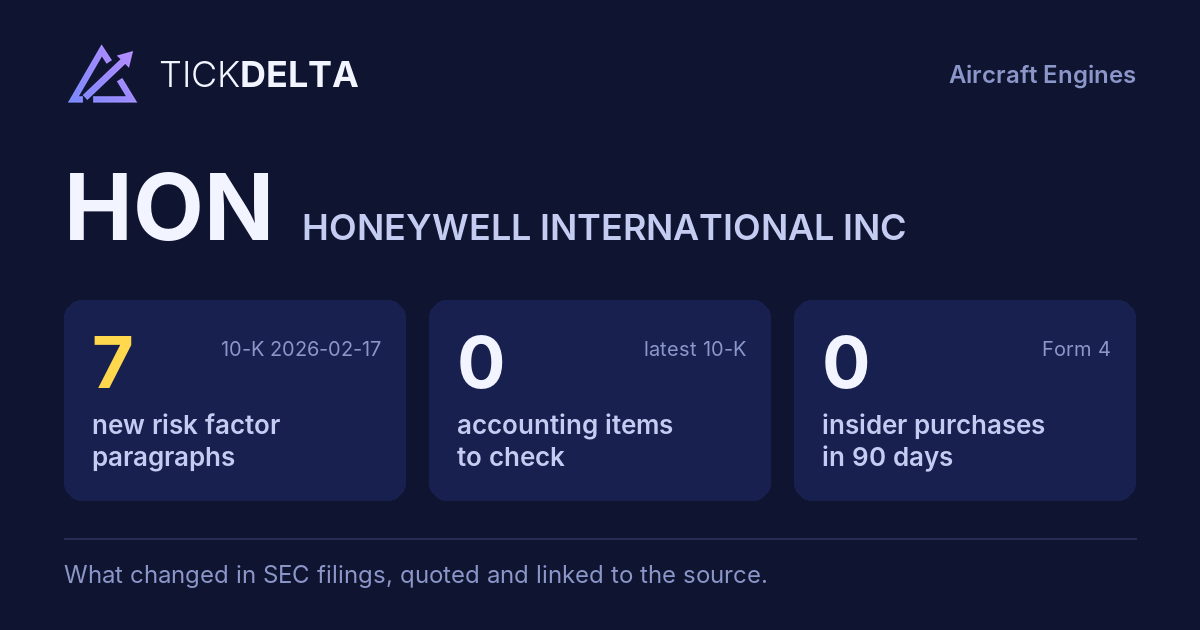
10-K 0000773840-26-000013 (2026-02-17) vs 10-K 0000773840-25-000010 (2025-02-14)
| Section | Compared text | Words now | Changed |
|---|
| Risk Factors | Item 1A | 8,431 |
11.4% |
| MD&A | Item 7 | 3,442 |
46.1% |
| Legal Proceedings | Item 3 | 132 |
not compared |
| Accounting Policies | Item 8, Note 1 – SUMMARY OF SIGNIFICANT ACCOUNTING POLICIES | 3,846 |
11.3% |
The redline: what was cut and what was added
In each section, the paragraph that changed most, marked against last year's 10-K:
cut words struck through, new words highlighted and underlined.
Risk Factors 192 words changed in this paragraph; it is 31% similar to last year's version.
The U.S. continues to implement certain trade actions, including imposing tariffs on certain goods imported from China and other countries, which has resulted in retaliatory tariffs by China and other countries. More significant The recent changes in U.S. trade policy involving the application or increase of tariffs have been proposed by and the new administration in the U.S., although it is not possible to predict the extent or focus of any such tariffs at this time. Additional tariffs, export controls, and sanctions laws imposed by subsequent retaliatory measures against the U.S. have created a dynamic environment that may have a material adverse impact on a broader range our business. While we have deployed strategies to mitigate the impact of imports, or further these dynamic trade policies, there is no assurance that we will be able to mitigate the full impact of all such tariffs, retaliatory trade measures taken by China tariffs or other countries trade policies that have or may develop in response, this rapidly changing environment. Increasing trade tensions and changes in trade policies have the potential to adversely impact our costs, the demand for our products, our supply chain and the global economy, and could increase the cost of result in fines and penalties or reputational harm if we are found not to be in compliance, which may have an adverse impact on our products. business, including operating and financial results and conditions.
Source: Item 1A, 10-K 0000773840-26-000013 vs Item 1A, 10-K 0000773840-25-000010
Accounting Policies 125 words changed in this paragraph; it is 39% similar to last year's version.
In December 2023, September 2025, the FASB issued ASU 2023-09, Income Taxes (Topic 740): 2025-06, Intangibles—Goodwill and Other—Internal-Use Software (Subtopic 350-40): Targeted Improvements to Income Taxes Disclosures, the Accounting for Internal-Use Software, which requires greater disaggregation of income tax disclosures. modernizes the accounting for internal-use software costs by removing all references to prescriptive and sequential software development stages. The new standard requires additional information entities to be disclosed consider whether significant development uncertainty has been resolved before starting to capitalize software costs and aligns disclosure requirements with respect to the income tax rate reconciliation Accounting Standard Codification (ASC) 360, Property, Plant, and income taxes paid disaggregated by jurisdiction. This Equipment. The ASU should be applied prospectively is effective for fiscal years annual and interim reporting periods beginning after December 15, 2024, 2027, and can be applied prospectively, retrospectively, or using a modified transition method, with retrospective application early adoption permitted. The Company is currently evaluating the impacts of this guidance on the Company’s Company's Consolidated Financial Statements.
Source: Item 8, Note 1 – SUMMARY OF SIGNIFICANT ACCOUNTING POLICIES, 10-K 0000773840-26-000013 vs Item 8, Note 1 – SUMMARY OF SIGNIFICANT ACCOUNTING POLICIES, 10-K 0000773840-25-000010
MD&A 105 words changed in this paragraph; it is 43% similar to last year's version.
We continue to monitor the impacts of ongoing macroeconomic conditions and geopolitical events. An escalation of geopolitical tensions or the implementation of developments that continue to be characterized by elevated trade tensions, economic policy uncertainty, and evolving inflationary pressures. While continued global trade restrictions could impede disinflation growth proved more resilient than widely anticipated, new tariffs imposed in 2025 and negatively impact growth prospects. 2026 to date, along with ongoing rollbacks and negotiations, are driving volatility in global markets. Global conflicts, tariffs, labor disruptions, and new regulations continue to create generate volatility in global markets and contribute to supply chain shortages vulnerabilities and pricing volatility. fluctuations. We continue to actively collaborate remain proactive in our collaboration with our suppliers to minimize shortages and reduce mitigate supply chain and price volatility. Global growth in the economy is projected to remain stable with further easing of inflation.
Source: Item 7, 10-K 0000773840-26-000013 vs Item 7, 10-K 0000773840-25-000010
Every change, by type
Sentences and paragraphs of HON's Risk Factors and MD&A, 10-K 2026-02-17 against 10-K 2025-02-14.
Each links to the text at sec.gov.
Quiet changes are sentences kept from last year with one to four words changed, at least one of them a hedge, a modal or a qualifier
(may, could, will, not, significant, material…). A year or date rolling forward is not counted.
The full word list
adverse, adversely, all, although, anticipate, anticipates, any, approximately, believe, believes, can, cannot, certain, could, expect, expects, generally, however, if, intend, intends, largely, likely, many, material, materially, may, might, most, must, never, no, not, possible, primarily, probable, should, significant, significantly, some, substantial, substantially, unlikely, will, would
AddedRisk Factors
In addition, the Company and each of its businesses has been, and may continue to be, negatively affected by global macroeconomic conditions, including the impacts of inflation, high interest rates, supply chain and labor disruptions, unemployment rates, geopolitical instability and regional conflicts, the adoption and expansion of, and other changes to, trade restrictions and tariffs, quotas, embargoes, and other related actions, and the occurrence or threat of a trade war or other governmental action related to tariffs or trade agreements or policies. Such factors could adversely impact, demand for our products, our costs, our customers, our suppliers, and the world and U.S. economies. The impact of such factors could have a material adverse effect on our business, operating results, cash flows, and financial condition.
Read it in 10-K 2026-02-17 at sec.gov ↗
AddedRisk Factors
The U.S. continues to implement certain trade actions, including imposing tariffs on certain goods imported from China and other countries, which has resulted in retaliatory tariffs by China and other countries. The recent changes in U.S. trade policy involving the application or increase of tariffs and the subsequent retaliatory measures against the U.S. have created a dynamic environment that may have a material adverse impact on our business. While we have deployed strategies to mitigate the impact of these dynamic trade policies, there is no assurance that we will be able to mitigate the full impact of all such tariffs, retaliatory tariffs or other trade policies that have or may develop in this rapidly changing environment. Increasing trade tensions and changes in trade policies have the potential to adversely impact our costs, the demand for our products, our supply chain and the global economy, and could result in fines and penalties or reputational harm if we are found not to be in compliance, which may have an adverse impact on our business, including operating and financial results and conditions.
Read it in 10-K 2026-02-17 at sec.gov ↗
AddedRisk Factors
In certain of our businesses, our contracts are typically awarded on a competitive basis. Our bids are based upon, among other factors, the cost to timely provide the products and services. To generate an acceptable return, we must accurately estimate our input costs and delivery schedules. If we fail to do so, the profitability of contracts may be adversely affected – including because some of our contracts provide for liquidated damages if we do not perform on time – which could have a material adverse effect on our competitive position, results of operations, cash flows or financial condition.
Read it in 10-K 2026-02-17 at sec.gov ↗
AddedRisk Factors
We have divested a number of businesses, including as part of spin-offs. With respect to some of these former businesses, we have contractually agreed to indemnify the counterparties against, or otherwise retain, certain liabilities, including, certain lawsuits, product liability claims, and environmental matters. Even without ongoing contractual indemnification obligations, we could be exposed to liabilities arising out of such divestitures. In addition, the counterparties to those divestitures or spun-off businesses may have agreed to indemnify us or assume certain liabilities relating to those divestitures. However, there can be no assurance that the indemnity or assumption of liability by the counterparties will be sufficient to protect us against the full amount of these liabilities, or that a counterparty will be able to fully satisfy its obligations. Third parties also could seek to hold us responsible for any of the liabilities that a counterparty agreed to assume. Even if we ultimately succeed in recovering any amounts for which we were initially held liable, we may be temporarily required to bear these losses ourselves.
Read it in 10-K 2026-02-17 at sec.gov ↗
AddedRisk Factors
Emerging cybersecurity regulations (including the EU Cyber Resilience Act) increasingly mandate rigorous cybersecurity standards for our products and services. These mandates may increase our operational costs by requiring additional investment in secure product development, vulnerability management, and product lifecycle management. Adapting our diverse portfolio to meet these requirements may require costly product redesigns, delay market entry for new solutions, or necessitate strategic retirement of legacy offerings. Failure to meet these standards could result in significant financial penalties, restricted market access, and reputational harm that could adversely affect our competitive position and financial results.
Read it in 10-K 2026-02-17 at sec.gov ↗
AddedRisk Factors
Moreover, beyond the regulations generally applicable to data collection and use, technologies such as artificial intelligence and machine learning may introduce novel compliance, security, and operational risks due to the rapidly evolving legal and regulatory environment, both in the United States and internationally, surrounding the development, sale and use of these technologies. Governments globally—including through frameworks such as the EU AI Act, the Colorado Artificial Intelligence Act, and the California AI Transparency Act—are adopting rules that impose heightened transparency, risk‑management, monitoring, and human‑oversight obligations. As these frameworks develop, we may be required to modify our practices, contracts, or products. Their ultimate impact is uncertain, and additional jurisdictions may adopt similar requirements. Failure to comply could result in regulatory scrutiny, fines, or reputational harm.
Read it in 10-K 2026-02-17 at sec.gov ↗
AddedRisk Factors
Additionally, instability in U.S. and global capital and credit markets, including market disruptions, limited liquidity and interest rate volatility, or reductions in the credit ratings assigned to us by independent rating agencies could reduce our access to capital markets, including in connection with the Separation, or increase the cost of funding our short- and long-term credit requirements. In particular, if we are unable to access capital and credit markets on terms that are acceptable to us, or at all, we may not be able to make certain investments or fully execute our business plans and strategies. If we were to raise funding through the issuance of equity securities, our shareowners would experience dilution of their existing ownership interest. If we were to raise significant additional funds by issuing debt, rating agencies could downgrade our credit ratings or put them on negative watch.
Read it in 10-K 2026-02-17 at sec.gov ↗
RemovedRisk Factors
The U.S. continues to implement certain trade actions, including imposing tariffs on certain goods imported from China and other countries, which has resulted in retaliatory tariffs by China and other countries. More significant tariffs have been proposed by the new administration in the U.S., although it is not possible to predict the extent or focus of any such tariffs at this time. Additional tariffs, export controls, and sanctions laws imposed by the U.S. on a broader range of imports, or further retaliatory trade measures taken by China or other countries in response, could increase the cost of our products.
Read it in 10-K 2025-02-14 at sec.gov ↗
RewordedRisk Factors
The Company has previously announced its intent to (i) spin off its Advanced Materials business, which is part of its Energy and Sustainability Solutions reportable business segment (the “AM Spin-off”), and (ii) separate its Aerospace Technologies segment from Automation, Honeywell, which will comprise its Industrial Automation, the Building Automation, and the remainder of the Energy and Sustainability Solutions segments (the “Automation and Aerospace Separation”), “Separation”), into standalone, publicly traded companies, in transactions a transaction that are is intended to be tax-free for the Company’s shareowners for U.S. federal income tax purposes (together, the “Separations”). purposes.
Read it in 10-K 2026-02-17 at sec.gov ↗
RewordedRisk Factors
Energy and Sustainability Solutions' results of operations can be impacted by environmental and health standards, regulations, and judicial determinations, including potential per/polyfluoroalkyl substances (PFAS) legislation and regulations that, if adopted, could impact the sale of certain products in our Advanced Materials business unit, without fully assessing level of risk or environmental impact. determinations.
Read it in 10-K 2026-02-17 at sec.gov ↗
RewordedRisk Factors
There continues to be a lack of consistent climate and other ESG legislation, which creates economic and regulatory uncertainty; however, there has been an increasing amount of legislative and regulatory activity, particularly in the European Union, the United Kingdom, and U.S., although we are unable to predict at this time how the trajectory of legislative and regulatory activity in the U.S. will be impacted by the new administration.
Read it in 10-K 2026-02-17 at sec.gov ↗
RewordedRisk Factors
In an effort to reduce the impact of current and future supply chain disruptions, we have implemented short-term and long-term strategies to reduce the impact of such disruptions, including supply chain simplification, continued alignment to local supply sources, digital solutions for identifying and managing shortages, pricing actions, actions and dual source strategies, longer-term planning for constrained materials, material supply tracking tools, direct engagement with key suppliers to meet customer demand, new supplier development, and development of new or redesigned products that satisfy our product quality controls and engineering qualifications and/or any applicable regulatory requirements.
Read it in 10-K 2026-02-17 at sec.gov ↗
RewordedRisk Factors
The failure to satisfy all of the required conditions for either the Separation, as well as additional factors such as conditions in the equity and debt markets and other external conditions, including, but not limited to, a government shutdown or shareowner actions or challenges relating to either the Separation or to other aspects of the Company’s business or strategy, many of which are outside of the Company’s control, could delay the completion of one or both of the Separations Separation relative to their respective its anticipated timelines timeline or prevent one or both it from occurring.
Read it in 10-K 2026-02-17 at sec.gov ↗
RewordedRisk Factors
The All aspects of the EU’s Pillar Two Directive were fully effective dates are on January 1, 2024, and January 1, 2025, for different aspects of the directive. 2025.
Read it in 10-K 2026-02-17 at sec.gov ↗
RewordedRisk Factors
(which we are unable to predict at this time), To the extent the current conflict between Russia and Ukraine persists, it may also negatively impact other risk factors disclosed in this Form 10-K and further impact our financial results.
Read it in 10-K 2026-02-17 at sec.gov ↗
RewordedRisk Factors
Emerging technology, such as generative and agentic artificial intelligence, is complex and rapidly evolving, and while we aim to develop and use artificial intelligence responsibly, we may ultimately be unsuccessful in identifying or resolving all issues, problems, and the technologies that we develop, develop or use may ultimately be flawed flawed, which could harm our reputation and expose us to risks related to such potential infringement of others' intellectual property, biases, inaccuracies or errors in outputs from these outputs. technologies.
Read it in 10-K 2026-02-17 at sec.gov ↗
RewordedRisk Factors
The Company is subject to risks related to its plans plan to separate Automation and Aerospace Technologies and to spin off its Advanced Materials business Honeywell from Honeywell Aerospace, into standalone, publicly traded companies.
Read it in 10-K 2026-02-17 at sec.gov ↗
RewordedRisk Factors
Concentrations of credit, counterparty, and market risk risk, and limitations in our ability to access the capital markets may adversely affect our results of operations and financial condition.
Read it in 10-K 2026-02-17 at sec.gov ↗
RewordedRisk Factors
Each of the Separations The Separation will be subject to the satisfaction of a number of customary conditions, including, among others, finalization of applicable financial statements, the filing and effectiveness of applicable filings (including a Form 10 registration statements) statement) with the SEC, assurance that the transactions transaction will be tax-free to Honeywell’s shareowners, receipt of applicable regulatory and other customary approvals, and final approval by Honeywell’s Board of Directors.
Read it in 10-K 2026-02-17 at sec.gov ↗
RewordedRisk Factors
We are currently, and may in the future become, subject to lawsuits, fines, investigations, and disputes (some of which involve substantial amounts claimed) arising out of the conduct of our business, or those of previously-owned entities, including matters relating to commercial transactions, government contracts, product liability (including asbestos), liability, the integration of emerging technologies (such as, but not limited to, artificial intelligence and machine learning), prior acquisitions and divestitures, employment, employee benefits plans, intellectual property, antitrust, anti-corruption, accounting, import and export, and environmental, health, and safety matters.
Read it in 10-K 2026-02-17 at sec.gov ↗
AddedMD&A
We continue to monitor macroeconomic and geopolitical developments that continue to be characterized by elevated trade tensions, economic policy uncertainty, and evolving inflationary pressures. While continued global growth proved more resilient than widely anticipated, new tariffs imposed in 2025 and 2026 to date, along with ongoing rollbacks and negotiations, are driving volatility in global markets. Global conflicts, tariffs, labor disruptions, and new regulations continue to generate volatility in global markets and contribute to supply chain vulnerabilities and pricing fluctuations. We remain proactive in our collaboration with suppliers to minimize shortages and mitigate supply chain and price volatility.
Read it in 10-K 2026-02-17 at sec.gov ↗
AddedMD&A
We continually assess the relative strength of each business in our portfolio as to strategic fit, market position, profit, and cash flow contribution in order to identify target investment and acquisition opportunities in order to upgrade our combined portfolio. We also identify businesses that do not fit into our long-term strategic plan based on their market position, relative profitability, or growth potential. During the second quarter of 2025, we completed the divestiture of our PPE business, as well as closed on the acquisition of Sundyne. We also announced our agreement to acquire Johnson Matthey's Catalyst Technologies business segment.
Read it in 10-K 2026-02-17 at sec.gov ↗
AddedMD&A
On July 8, 2025, we announced we are evaluating strategic alternatives for our Productivity Solutions and Services and Warehouse and Workflow Solutions businesses within the Industrial Automation reportable segment to further simplify Honeywell's portfolio and accelerate shareowner value creation ahead of the planned separation of Honeywell from Honeywell Aerospace. As of December 31, 2025, the assets and liabilities of these businesses are classified as held for sale.
Read it in 10-K 2026-02-17 at sec.gov ↗
AddedMD&A
On July 30, 2025, we entered into a termination agreement for the accelerated monetization of the indemnification and reimbursement agreement we had with Resideo Technologies, Inc. (Resideo), pursuant to which Resideo’s subsidiary had an ongoing obligation to make cash payments to Honeywell in amounts equal to 90% of Honeywell’s annual net spending for environmental matters at certain sites as defined in the agreement. Upon closing of the transactions contemplated pursuant to the termination agreement, we received a one-time cash payment of $1.6 billion in lieu of all future payments to which the Company was entitled pursuant to the indemnification and reimbursement agreement.
Read it in 10-K 2026-02-17 at sec.gov ↗
AddedMD&A
On September 29, 2025, we permanently divested our legacy Bendix asbestos liabilities and certain non-Bendix asbestos liabilities. We recorded a pre-tax loss of $148 million in 2025 related to the divested asbestos liabilities. Under the terms of the divestiture agreement, we contributed $1.4 billion in cash and derecognized $1.5 billion in asbestos liabilities and $0.1 billion of related insurance assets to a third party entity.
Read it in 10-K 2026-02-17 at sec.gov ↗
AddedMD&A
On October 30, 2025, the Company completed the spin-off of its Advanced Materials business into an independent, publicly traded company named Solstice Advanced Materials, Inc. (Solstice). Honeywell shareowners of record as of the close of business on October 17, 2025 received one share of Solstice common stock for every four shares of Honeywell common stock. Results of operations, financial position, and cash flows for the Advanced Materials business are reported as discontinued operations for all periods presented and the notes to the financial statements have been adjusted on a retrospective basis. Discussions throughout this MD&A are based on continuing operations unless otherwise noted.
Read it in 10-K 2026-02-17 at sec.gov ↗
AddedMD&A
In October 2025, we announced a planned realignment, expected to be effective in the first quarter of 2026, of our business units comprising our Industrial Automation and Energy and Sustainability Solutions reportable business segments. This realignment will form a new reportable business segment, Process Automation and Technology, and result in a new composition of our Industrial Automation reportable business segment. Process Automation and Technology will be comprised of UOP, which is currently in Energy and Sustainability Solutions, and the core portion of the Process Solutions business, which is currently in Industrial Automation. The new composition of Industrial Automation will continue to include the smart energy, thermal solutions, and process measurement and control businesses, currently included in the Process Solutions business, as well as the Sensing and Safety Technologies, Warehouse and Workflow Solutions, and Productivity Solutions and Services businesses. Following the realignment, our reportable business segments will be Aerospace Technologies, Building Automation, Process Automation and Technology, and Industrial Automation. In addition to the realignment, also beginning in 2026, the Company will report its disaggregation of revenue within its Building Automation, Process Automation and Technology, and Industrial Automation segments based on the business models of Products, Projects, Solutions, and Aftermarket. The realignment will not impact our historical consolidated financial position, results of operations, or cash flows. We expect to report our financial performance based on this realignment effective with the first quarter of 2026.
Read it in 10-K 2026-02-17 at sec.gov ↗
AddedMD&A
1 Includes litigation matters considered to be unusual and not indicative of the Company's ongoing performance.
Read it in 10-K 2026-02-17 at sec.gov ↗
AddedMD&A
•Partially offset by unfavorable impact of foreign currency translation, driven by the strengthening of the U.S. dollar against the Turkish lira, Chinese renminbi, and Canadian dollar, offset by the weakening of the U.S. dollar against the British pound.
Read it in 10-K 2026-02-17 at sec.gov ↗
AddedMD&A
•Gain recognized on Resideo termination agreement of approximately $0.8 billion,
Read it in 10-K 2026-02-17 at sec.gov ↗
AddedMD&A
•Partially offset by higher divestiture-related costs of approximately $0.4 billion.
Read it in 10-K 2026-02-17 at sec.gov ↗
AddedMD&A
•Nontaxable return of basis on the Resideo termination agreement, representing a 310 basis-point decrease,
Read it in 10-K 2026-02-17 at sec.gov ↗
RemovedMD&A
A detailed discussion of the prior year 2023 to 2022 year-over-year changes is not included herein and can be found in the Management's Discussion and Analysis of Financial Condition and Results of Operations section in Exhibit 99.1 to the Current Report on Form 8-K filed April 25, 2024, which updated our Form 10-K for the year ended December 31, 2023, by recasting historical segment information to reflect the realignment of certain of the Company's business units effective the first quarter of 2024 and impacted the composition of the Company's reportable segments.
Read it in 10-K 2025-02-14 at sec.gov ↗
RemovedMD&A
We continue to monitor the impacts of ongoing macroeconomic conditions and geopolitical events. An escalation of geopolitical tensions or the implementation of global trade restrictions could impede disinflation and negatively impact growth prospects. Global conflicts, tariffs, labor disruptions, and regulations continue to create volatility in global markets and contribute to supply chain shortages and pricing volatility. We continue to actively collaborate with our suppliers to minimize shortages and reduce supply and price volatility. Global growth in the economy is projected to remain stable with further easing of inflation.
Read it in 10-K 2025-02-14 at sec.gov ↗
RemovedMD&A
During the first quarter of 2024, the Company realigned certain of its business units, which impacted the composition of its reportable segments. The Company recast historical periods to reflect this change in segment presentation. See Note 22 Segment Financial Data of Notes to Consolidated Financial Statements for further discussion.
Read it in 10-K 2025-02-14 at sec.gov ↗
RemovedMD&A
On February 6, 2025, the Company announced its intention to separate its Automation and Aerospace Technologies businesses into independent, U.S. publicly traded companies.
Read it in 10-K 2025-02-14 at sec.gov ↗
RemovedMD&A
On November 22, 2024, we announced an agreement to sell our PPE business for $1.3 billion, with the assets and liabilities of the business classified as held for sale until the closing date of the sale. The transaction is expected to be completed in the first half of 2025.
Read it in 10-K 2025-02-14 at sec.gov ↗
RemovedMD&A
On October 8, 2024, the Company announced its intention to spin off its Advanced Materials business into an independent, U.S. publicly traded company.
Read it in 10-K 2025-02-14 at sec.gov ↗
RewordedMD&A
The increase change in Net sales was attributable to the following:2024 following:2025 Versus 2024 2024 Versus 2023 2023 Versus 2022 Volume 3 % 1 % —% Price 4 % 2 % 4 % Foreign currency translation —% (1)% Acquisitions 4% 3% Divestitures (2 %) — % Other1 (1 %) Acquisitions, divestitures, and other, net 2 — % —% Total % change in Net sales 8 % 5 % 3 %
Read it in 10-K 2026-02-17 at sec.gov ↗
RewordedMD&A
Factors Contributing to Year-Over-Year Change 2025 vs. 2024 2024 vs. 2023 2023 vs. 2022 Net Segment Net Segment Sales Profit Sales Profit Organic 2% —% 2% 4% Foreign currency translation (1)% —% (1)% —% Acquisitions, divestitures, and other, net 7% 10% —% —% Total % Reported percent change 13% 16% 8% 10% 1% 4% Less:
Read it in 10-K 2026-02-17 at sec.gov ↗
RewordedMD&A
Sales increased $509 $827 million due to higher organic sales of $245 $287 million in Products and higher organic sales of $217 million in Building Solutions Solutions, both driven by higher demand for building projects and services, partially offset by lower organic sales of $124 million in Products driven by lower demand.
Read it in 10-K 2026-02-17 at sec.gov ↗
RewordedMD&A
Our mitigation strategies include supply chain simplification, continued alignment to local supply sources, digital solutions for identifying and managing shortages, pricing actions and hedging dual source strategies, longer term planning for constrained materials, new supplier development, material supply tracking tools, and direct engagement with key suppliers to meet customer demand. suppliers, and new supplier development.
Read it in 10-K 2026-02-17 at sec.gov ↗
RewordedMD&A
Our continued Strong relationships with strategic primary and secondary suppliers allow us to collaborate to reliably source key components and raw materials, which include considering altering existing products, developing develop new products, and committing commit our own resources to assist certain suppliers. suppliers, and at times, alter designs of existing products.
Read it in 10-K 2026-02-17 at sec.gov ↗
RewordedMD&A
Research and development expenses slightly increased but were flat as a percentage of Net sales. net sales primarily due to increased investment in new product development in our Aerospace Technologies business.
Read it in 10-K 2026-02-17 at sec.gov ↗
RewordedMD&A
On February 6, 2025, the Company we announced its our intention to pursue a separation of its Automation and Aerospace Technologies businesses Honeywell from Honeywell Aerospace, into independent, U.S. publicly traded companies, which is targeted intended to be completed in the second half third quarter of 2026.
Read it in 10-K 2026-02-17 at sec.gov ↗
RewordedMD&A
The separation will be subject to the satisfaction of a number of customary conditions, including, among others, finalization of the financial statements of the Automation and Aerospace Technologies businesses, the filing and effectiveness of applicable filings (including a Form 10 registration statement) statement that includes required financial statements) with the SEC, assurance that the separation of the businesses will be tax-free to Honeywell’s shareowners, receipt of applicable regulatory approvals approvals, and final approval by Honeywell’s Board of Directors.
Read it in 10-K 2026-02-17 at sec.gov ↗
RewordedMD&A
An impairment charge was recorded on Impairment of assets held for sale related increased due to the classification of our personal protective equipment business as held for sale during the twelve months year ended December 31, 2024.
Read it in 10-K 2026-02-17 at sec.gov ↗
RewordedMD&A
Gross margin increased by approximately $1.0 $0.5 billion and gross margin as a percentage increased 80 of Net sales decreased 160 basis points to 38.1% 36.9% compared to 37.3% 38.5% for the same period of 2023. 2024.
Read it in 10-K 2026-02-17 at sec.gov ↗
RewordedMD&A
The Additionally, the acquisition of Access Solutions contributed $424 $302 million to 2024 sales. of inorganic sales growth during 2025.
Read it in 10-K 2026-02-17 at sec.gov ↗
RewordedMD&A
Sales Aerospace Technologies' sales and segment profit for the twelve months ended December 31, 2024, 2024 decreased by approximately $370 million due to the Bombardier Agreement.
Read it in 10-K 2026-02-17 at sec.gov ↗