tickmark
Sign in

Tickdelta is free for now. Sign up and get Pro free

← Screener

HYPDHyperion DeFi

Crypto · Financial Services · Nasdaq

We were organized as a corporation under the laws of the State of Florida on March 12, 2014 under the name “PGP Holdings V, Inc.” 10-K, Item 1

Headquarters
Dallas, TX
CEO
Hyunsu Jung
Next results
around Mar 25, 2027
Compare with peers → Embed

When the SEC's staff reviews a filing, it writes to the company with numbered questions, and the company answers each one in a letter. SEC publishes the exchange once the review is over, at least 20 business days later. Below: what the staff asked HYPD, and the company's answer to each question, quoted from the letters. A question is not an accusation; most reviews end with the company adding detail to its next filing.

Form S-3

2025-07-31 to 2025-12-05 · 6 questions · 2 letters from the SEC, 2 from the company
No closing letter
Crypto assetsLiquidity and cashRisk factors
SEC asked
Given the nature of your resale offering, including the size of the transaction relative to the number of outstanding shares held by non-affiliates, the nature of your relationship with Hyperion DeFi Holdings, LLC, and the amount of time Hyperion DeFi Holdings, LLC has held its securities, it appears that the transaction may be an indirect primary offering on behalf of the registrant.
Rest of the question

Please provide us with a detailed legal analysis of your basis for determining that it is appropriate to characterize the transaction as a secondary offering under Securities Act Rule 415(a)(1)(i). For guidance, refer to Securities Act Rules Compliance & Disclosure Interpretation 612.09.

HYPD answered
The Company acknowledges the staff’s comment and respectfully submits that the transaction is a secondary offering under Rule 415(a)(1)(i) promulgated under the Securities Act of 1933, as amended (the “Securities Act”).

Background

The Company entered into a securities purchase agreement on June 17, 2025 (the “Purchase Agreement”) for the June 2025 PIPE with institutional accredited investors identified therein (the “Purchasers”), including HLIP Holdings, LLC (“HLIP”), formerly Hyperion DeFi Holdings, LLC.
Rest of the answer

Pursuant to the Purchase Agreement, the Purchasers purchased an aggregate of 5,128,205 shares of the Company’s Series A Non-Voting Preferred Stock, par value $0.0001 per share (the “Series A Preferred Stock”) and warrants (the “Purchaser Warrants”) to purchase 200% of the number of shares of the Company’s common stock, par value $0.0001 per share (the “Common Stock”) issuable upon full conversion of the Preferred Shares, for an aggregate purchase price of approximately $50 million. The Company also issued warrants to purchase 1,846,153 shares of Common Stock at an exercise price of $3.25 per share (the “Placement Agent Warrants”) and 307,962 shares of Series A Preferred Stock (together with the shares of Series A Preferred Stock issued to the Purchasers, the “Preferred Shares”) to Chardan (the “Placement

Agent”) as compensation for its services as placement agent in connection with the June 2025 PIPE pursuant to the Engagement

Letter, dated June 17, 2025, by and between the Company and Chardan (the “Engagement Letter”).

Pursuant to the Certificate of Designation of Preferences, Rights and Limitations filed with the Secretary of State of the State of Delaware on June 20, 2025 (the

“Certificate of Designation”), holders of Series A Preferred Stock are entitled to receive dividends on their shares equal to an annual rate of 6%, payable quarterly in arrears in cash or, at the Company’s option, shares of Common Stock (the “In-Kind

Dividends”).

Also on June 17, 2025, the

Company also entered into the Fourth Amendment (the “Fourth Amendment”) to the Supplement to that certain Loan and

Security Agreement, dated November 22, 2022 (the “Loan and Security Agreement”) with Avenue Capital Management II,

L.P., as administrative agent and collateral agent, Avenue Venture Opportunities Fund, L.P., as a lender (“Avenue 1”) and Avenue Venture Opportunities Fund II, L.P., as a lender (“Avenue 2” and, together with Avenue 1, the “Lenders” and the Lenders, together with the Purchasers and the Placement Agent, the “Selling Shareholders”). In connection with the Fourth Amendment, the Company issued to the Lenders warrants (the “Lender Warrants” and together with the Purchaser

Warrants and Placement Agent Warrants, the “Warrants”) to purchase an aggregate of 350,000 shares of Common Stock at an exercise price of $4.00 per share.

On July 18, 2025 the Company filed the Registration Statement for up to 50,770,667 shares of Common Stock (the “Shares”), which includes:

i.

Up to 15,384,615 shares of Common Stock issuable upon conversion of the Preferred Shares issued to the Purchasers pursuant to the Purchase Agreement;

ii.

up to 30,769,230 shares of Common Stock issuable upon the exercise of the Purchaser Warrants;

iii.

up to 923,076 shares of Common Stock issuable upon the conversion of the Preferred Shares issued to the Placement Agent pursuant to the Engagement Letter;

iv.

up to 1,846,153 shares of Common Stock issuable upon the exercise of the Placement Agent Warrants;

v.

up to 1,497,593 shares of Common Stock issuable as In-Kind Dividends; and vi.

up to 350,000 shares of Common Stock issuable upon the exercise of the Lender Warrants.

Analysis

In an effort to assist registrants in determining whether an offering by selling shareholders may be characterized as a secondary offering that is eligible to be made on a shelf basis under Rule 415(a)(1)(i), the staff issued Interpretation 612.09 in its Securities Act Rules Compliance and Disclosure Interpretations

(“C&DI 612.09”). C&DI 612.09 provides that “[t]he question of whether an offering styled a secondary one is really on behalf of the issuer is a difficult factual one, not merely a question of who receives the proceeds” and that consideration be given to the following factors:

how long the selling shareholders have held the shares;

the circumstances under which the selling shareholders have received the shares;

the relationship of the selling shareholders to the issuer;

the number of shares being sold;

whether the selling shareholders are in the business of underwriting securities; and whether under all the circumstances it appears that the seller is acting as a conduit for the issuer.

Each of the relevant factors listed in C&DI 612.09 is discussed below. Based on an analysis of the specific factors listed in C&DI 612.09 and all the circumstances applicable to the Company, the Company respectfully submits that the transactions described herein are appropriately characterized as transactions that are eligible to be made under Rule 415(a)(1)(i).

A. How Long the Shares Have been Held

The Preferred Shares and Warrants were, and the Shares, if and when issued, will be, issued in transactions in reliance on the exemption from registration provided by Section

4(a)(2) of the Securities Act and/or Rule 506 promulgated thereunder, or under any applicable state securities laws. Under the Purchase

Agreement and the Lender Warrants, the Purchasers and Lenders, respectively, represented to the Company that they were accredited investors within the meaning of Regulation D promulgated under the Securities Act and that they were acquiring the securities for investment only and not with a view toward, or for resale in connection with, the public sale or distribution thereof. The Placement Agent is an accredited investor within the meaning of Regulation D promulgated under the Securities Act. The Preferred Shares and Warrants, and the Shares issuable pursuant to the terms of the Preferred Shares and the Warrants, were offered without any general solicitation by the Company or its representatives.

Generally, the longer shares are held, the less likely it is that the selling shareholders are acting as a mere conduit for the Company. However, the Company notes that there is no mandatory holding period for a private investment in public equities (a “PIPE”) transaction, such as the June 2025 PIPE, or for the other private transactions discussed herein, to be characterized as a private placement. As noted by the staff in Interpretation 139.11 in the Securities Act Sections Compliance and Disclosure Interpretations (“C&DI 139.11”), a valid secondary offering could in theory occur immediately following the closing of a private placement. C&DI 139.11 provides as follows:

“In a PIPE transaction, a company will be permitted to register the resale of securities prior to their issuance if the company has completed a Section 4(2)-exempt sale of the securities […] to the investor, and the investor is at market risk at the time of filing of the resale registration statement.

The investor must be irrevocably bound to purchase a set number of securities for a set purchase price that is not based on market price or a fluctuating ratio, either at the time of effectiveness of the resale registration statement or at any subsequent date. […]

There can be no conditions to closing that are within an investor’s control or that an investor can cause not to be satisfied. For example, closing conditions in capital formation transactions relating to the market price of the company’s securities or the investor’s satisfactory completion of its due diligence on the company are unacceptable conditions. The closing of the private placement of the unissued securities must occur within a short time after the effectiveness of the resale registration statement.”

As the interpretation states, a company may even register a secondary offering before shares are issued in a PIPE transaction. The Company is not aware of any staff guidance on Rule 415 addressing the appropriate length of time shares must be held in order to determine whether a purported secondary offering is really a primary offering. In addition, the Company is not aware that the staff has taken the position that the period of time elapsing between a closing and the effectiveness of a registration statement has raised concerns about whether the offering is a valid secondary offering, and the Company believes such a position would be inconsistent with C&DI 139.11, which allows inclusion of the securities sold after a registration statement is filed.

Furthermore, because the consideration has already been paid and the Preferred Shares and the Warrants have already been delivered to the Selling Shareholders, each such party bears the investment risk of holding the securities issued to it in connection with the private transactions discussed herein. The Purchasers,

Placement Agent and Lenders participated in these transactions with the knowledge that they might not be able to exit their positions at a profit, and they provided evidence that they purchased their securities with the intent to invest, rather than to effect a distribution as an underwriter would have.

Although the Selling Shareholders have only been subject to the full investment risk associated with ownership of the Company’s equity securities for less than two months, the Company believes this timing conforms to the custom and practices in many PIPE transactions. In many PIPE and other private placement transactions, a registration statement is required to be filed shortly post-closing and declared effective shortly after filing.

As noted above, the Company is not aware that the staff has taken a position that the period of time elapsing between a closing and the effectiveness of a registration statement has raised concerns about whether the offering is a valid secondary offering, and the Company believes such a position would be inconsistent with C&DI 139.11 set forth above, which allows inclusion of the securities sold after a registration statement is filed. If inclusion for resale of the securities sold after a registration statement is filed is permitted in a secondary offering, then, a fortiori, inclusion of the securities sold before a registration statement is filed, regardless of the holding period, may be permitted. The Company believes that the discussion above supports the conclusion that the offering pursuant to the Registration Statement is a valid secondary offering.

B. The Circumstances Under

Which the Selling Shareholders Received Their Shares

The Shares being registered for resale were or will be issued to the Selling Shareholders upon the exercise of the Warrants, conversion of the Preferred Shares or distribution of the In-Kind Dividends, as applicable, which were issued and sold to the Selling Shareholders in arm’s-length private placement transactions pursuant to the Purchase Agreement, Engagement Letter or the Fourth Amendment, as applicable. The terms of the transactions were vigorously negotiated, including between legal counsels for the Company and the Purchasers, Placement Agent and Lenders, and the transactions complied in all respects with Section 4(a)(2) of the Securities Act. As set forth in the Registration Statement, other than receipt of the exercise price of the Warrants upon any exercise thereof, the Company will not receive any proceeds from the resale of the Shares by the Selling Shareholders. Although the question of who receives proceeds is not the only factor on which the analysis of the character of an offering should be based, the fact that the Company will not receive any financial benefits from the sales of the securities being registered further supports the conclusion that the proposed offering is not a primary offering on behalf of the Company.

Furthermore, the Purchasers and the Lenders specifically represented to the Company in the applicable transaction documentation that they were acquiring the securities for their own account and not with a view toward, or for resale in connection with, the public sale or distribution thereof, and each Purchaser specifically represented that it had no agreement or understanding, directly or indirectly, with any individual, a limited liability company, a partnership, a joint venture, a corporation, a trust, an unincorporated organization, any other entity and any governmental entity or any department or agency thereof to distribute any of the securities in violation of applicable securities laws.

In addition, as far as the

Company is aware, the Selling Shareholders have not engaged, and will not engage, in any directed selling efforts, marketing or other solicitation of purchasers or otherwise pre-arrange for the sale of the Shares being registered. The Selling Shareholders are expected to sell the Shares in ordinary trading in the public markets and, accordingly, are subject to the general risks of trading securities in public markets, including the risk that any of the Selling Shareholders sell shares below their cost basis.

Furthermore, the Company is not aware of any evidence that a distribution would occur if the Registration Statement is declared effective. Under the Commission’s rules, a “distribution” requires special selling efforts. Rule 100(b) of Regulation M defines a “distribution” as “an offering of securities, whether or not subject to registration under the Securities Act, that is distinguished from ordinary trading transactions by the magnitude of the offering and the presence of special selling efforts and selling methods.” There is nothing to suggest that any special selling efforts or selling methods by or on behalf of the Selling Shareholders have or would take place if the Registration Statement is declared effective. The Company also is not aware of any facts to suggest that the Selling Shareholders have taken any actions to condition or prime the market for the potential resale of the Common Stock.

The Company believes that the discussion above supports the conclusion that the offering pursuant to the Registration Statement is a valid secondary offering.

C. Selling Shareholders’

Relationship with the Company

Other than Chardan acting as Placement Agent for the Company in connection with the June 2025 PIPE and Chardan's participation in ongoing financing efforts, such as the at-the-market offering facility referenced in the response to Comment 1, Avenue 1 and Avenue 2 acting as the Lenders to the Company in connection with the Loan and Security Agreement, and HLIP, as discussed in further detail below, the Selling Shareholders do not have any relationship with the Company other than as passive investors in the Company. Other than as discussed below with respect to HLIP, none of the Selling Shareholders or their respective affiliates have held any position or office, have had any material relationship with the Company within the past three years, or were provided with any control over the Company’s business pursuant to the Purchase

Agreement, Engagement Letter or Fourth Amendment.

HLIP designated Mr. Hyunsu

Jung to his positions as director and Chief Investment Officer of the Company and the Company then appointed him to these positions pursuant to the terms of the Purchase Agreement. The Purchase Agreement provides that to the extent that at any time during the 36 months following the closing date (assuming HLIP continues to hold at least 50% of the shares of Common Stock underlying the Preferred Shares and the Purchaser

Warrants originally issued pursuant to the Purchase Agreement), Mr. Jung no longer serves as a director or the Company’s Chief Investment

Officer, HLIP shall have the right to nominate a replacement to fill either or both of those roles and the Company shall use its commercially reasonable efforts to have the replacement(s) appointed as soon as reasonably practicable. In addition, the Purchase Agreement provides that HLIP shall have the ability to nominate a director to serve as the Chair of the Board of Directors of the Company. The Purchase Agreement was negotiated at arm’s length, and prior to the June 2025 PIPE, the Company had no relationship with HLIP. Additionally, HLIP is subject to a 4.99% beneficial ownership limitation pursuant to the Certificate of Designation and the Purchaser Warrants (which limitation may be increased as described below under “–D. Amount of Shares Being Registered”, although the Company has received no indication that HLIP anticipates electing such an increase), and a majority of the Company’s directors remain independent. Moreover, the staff has previously noted in Interpretation 212.15 in the Securities Act Rules Compliance and Disclosure Interpretations that “affiliates of issuers are not necessarily treated as being the alter egos of the issuers. Under appropriate circumstances, affiliates may make offerings that are deemed to be genuine secondaries.” For the reasons set forth above, the Company submits that HLIP’s relationship to the Company as an investor that assumes market risk with respect to the Shares it acquires in connection with the June 2025 PIPE is appropriate for resale under Rule 415(a)(1)(i).

Moreover, the registration rights granted to the Purchasers under the Registration Rights Agreement entered into by the Company and the Purchasers on June 17, 2025

(the “Registration Rights Agreement”), and the registration rights granted to the Placement Agent and the Lenders, are customary and are not indicative of any desire of the Selling Shareholders to sell or distribute the Common Stock on behalf of the

Company, or at all. The Selling Shareholders negotiated for such customary registration rights for a variety of business reasons, and the registration rights were not granted by the Company for the purpose of conducting an indirect primary offering. Absent the contractual obligations contained in the Purchase Agreement, Registration Rights Agreement, Placement Agent Warrant or Lender Warrant, as applicable, the Company would not be filing the Registration Statement.

This factor weighs favorably in the Company’s determination that the offering for resale of the Shares by the Selling Shareholders under the Registration Statement is a secondary offering and not a primary offering.

D. Amount of Shares Being

Registered

As of September 19, 2025, the Company had 6,959,159 shares of Common Stock outstanding. A total of 50,770,667 shares of Common Stock are issuable upon exercise of the Warrants, conversion of the Preferred Shares and distribution of the In-Kind Dividends are being registered for resale by the Selling

Shareholders pursuant to the Registration Statement, of which 59,796 shares were outstanding as of August 15, 2025. While the number of shares being registered is a factor considered by the staff in determining whether an offering should be deemed to be a primary or secondary offering, the Company submits that undue weight should not be placed on this single factor. The staff’s own interpretations support this position. Pursuant to C&DI 612.09, the number of shares being offered is only one of several factors to be considered in evaluating whether, under all the circumstances, a purported secondary offering is instead an indirect primary offering. In addition, Interpretation

612.12 in the Securities Act Rules Compliance and Disclosure Interpretations describes a scenario in which a controlling holder of more than 70% of the outstanding shares of a registrant is able to effect a valid secondary offering. The interpretation states, in relevant part:

“A controlling person of an issuer owns a 73% block. That person will sell the block in a registered “at-the-market” equity offering. Rule 415(a)(4) applies only to offerings by or on behalf of the registrant. A secondary offering by a control person that is not deemed to be by or on behalf of the registrant is not restricted by Rule 415(a)(4).”

In addition, Interpretation

216.14 in the Securities Act Forms Compliance and Disclosure Interpretations, regarding the use of Form S-3 to effect a secondary offering, provides: “Secondary sales by affiliates may be made under General Instruction I.B.3. to Form S-3 [relating to secondary offerings], even in cases where the affiliate owns more than 50% of the issuer’s securities, unless the facts and circumstances indicate that the affiliate is acting as an underwriter or by or on behalf of the issuer” (emphasis added). The Company believes that these interpretive provisions make clear that a single holder of in excess of 50% of the public float of an issuer’s common stock can effect a valid secondary offering of its shares unless other facts, beyond the mere level of ownership, indicate that the selling shareholder is acting as a conduit of the issuer. The Company notes that in this offering, each of the Selling Shareholders is well below that threshold, and pursuant to applicable beneficial ownership limitations, no Selling Shareholder can beneficially own more than 9.99% of the Company’s Common Stock without an adjustment to such limitations.

In addition, the number of

Shares being registered is the maximum number of Shares issued or issuable by the Company to the Selling Shareholders pursuant to the

Warrants and the Preferred Shares held by the Selling Shareholders. It is possible that the Selling Shareholders might not exercise the

Warrants in full or convert any of their Preferred Shares. Furthermore, the Warrants and the Certificate of Designation contain beneficial ownership blocker provisions that set beneficial ownership thresholds for each of the Selling Shareholders by not allowing these parties to convert their Preferred Shares or exercise their Warrants into shares of Common Stock if such exercise will result in such Selling

Shareholder holding shares of Common Stock of the Company above a certain ownership percentage of the outstanding shares of Common Stock of the Company. The Series A Preferred Stock is subject to a 4.99% threshold, the Lender Warrants contain a 9.99% threshold, and the Purchaser

Warrants and the Placement Agent Warrants contain a 4.99% threshold for beneficial ownership. In each case, the beneficial ownership limitation may be increased at the Selling Shareholder’s election upon 60 days’ notice to the Company (effective on the 61st day after such notice is delivered to Company) subject to the terms of the Certificate of Designation or Warrants, as applicable, provided that such percentage may in no event exceed 19.99%. The Company has received no indication that any Selling Shareholder anticipates electing such an increase in its beneficial ownership limitation. Consequently, the Selling Shareholders may not convert their Preferred Shares or exercise their existing Warrants and hold more than the applicable ownership thresholds (currently 4.99% or 9.99%), and in no event may any conversion or exercise result in a Selling Shareholder holding more than 19.99% of the outstanding shares of Common Stock of the

Company.

We also submit that emphasis solely on the number of shares being registered in relation to the shares outstanding or the public float can severely limit a smaller public company’s financing alternatives, which are generally few. The staff has acknowledged this by accepting as valid many secondary offerings where a significant number of shares are being registered but the facts do not otherwise demonstrate that the selling shareholders are acting as a conduit for the issuer to effect a primary offering.

E. Whether the Selling Shareholders are Involved in the Underwriting Business

The

Company advised us that it understands that, although Chardan is a broker-dealer, it did not act as an underwriter in connection with the applicable private transaction described herein. None of the other Selling Shareholders are in the business of underwriting securities or are registered broker-dealers.

F. Whether the Selling Shareholders

Act as a Conduit of the Company

Based on the foregoing analysis and the totality of the facts and circumstances, the Company believes that the facts support the conclusion that the Selling Shareholders are not acting on the Company’s behalf and are motivated by their own self-interests, and therefore are not acting as conduits of the Company.

For all of the reasons set forth above, the Company respectfully submits to the staff that the proposed resale of the Shares by the Selling Shareholders, as contemplated by the Registration Statement, should appropriately be classified as a valid secondary offering and not a primary offering, and, accordingly, the Company can rely on Rule 415(A)(1)(i) of the Securities Act for the offering of the Shares.

We thank the staff for their review and comments on the Registration Statement. We acknowledge that it is the responsibility of the Company and its management to provide adequate and accurate disclosures in its filings.

We are committed to cooperating with the staff and providing any additional information or clarification as needed. We respectfully request that the staff inform us of any further comments or questions, or if the staff is satisfied with our responses and has no further comments.

Read in the reply ↗
Prospectus Summary · HYPE Treasury, page 5
SEC asked (1)
Please revise to describe the lifecycle of a HYPE token transaction.
HYPD answered
The Company respectfully acknowledges the Staff’s comment and advises the Staff that it has revised the disclosure on page 6 in the Amended Registration Statement in response to the Staff’s comment. Read in the reply ↗
Prospectus Summary · HYPE Treasury, page 5
SEC asked (2)
Please disclose the material terms of your custody arrangements with Anchorage including whether your HYPE tokens will be held in hot or cold storage. Clarify whether your custodian has insurance covering the crypto assets it holds, describe the type and amount of insurance coverage, and state whether this coverage is specific to you or is shared among Anchorage's customers.
HYPD answered
the Staff’s comment and advises the Staff that it has revised the disclosure on page 6 in the Amended Registration Statement in response to the Staff’s comment. Read in the reply ↗
Prospectus Summary · HYPE Treasury, page 5
SEC asked (3)
Regarding your staking program, please address the following: • Disclose the percentage of validator commissions you pay to each of Kinetiq and Pier Two pursuant to the Joint Validator Operators Agreement as discussed in your 10-Q for the period ended September 30, 2025.
Rest of the question

• Disclose the policies and procedures you have for your staking plans, including, for example, what percentage of your HYPE tokens you intend to stake. • Discuss any liquidity risks (if material) with your staking plans, including the liquidity risks related to the HYPE token unbonding period.

HYPD answered
The Company respectfully acknowledges the Staff’s comment and advises the Staff that it has revised the disclosure on page 6 in the Amended

Registration Statement in response to the Staff’s comment. Read in the reply ↗
Prospectus Summary · HYPE Treasury, page 5
SEC asked (4)
We note disclosure in your Form 10-Q for the period ended September 30, 2025 that you provided Felix with the HYPE required to launch a perpetual futures market and will earn a share of the fees earned from trading activity. Please disclose whether this perpetual futures market will exist in the United States or will be subject to CFTC regulation.
HYPD answered
the Staff’s comment and advises the Staff that it has revised the disclosure on page 6 in the Amended Registration Statement in response to the Staff’s comment. Read in the reply ↗
Risk Factors, page 9
SEC asked (5)
Please include a separate risk factor addressing the 238 million HYPE tokens being unlocked over the next two years and the resulting negative impact this could have on the price of HYPE tokens.
HYPD answered
the Staff’s comment and advises the Staff that it has revised the disclosure on page 11 in the Amended Registration Statement in response to the Staff’s comment.

We thank the Staff for their review and comments on the Registration Statement. We acknowledge that it is the responsibility of the Company and its management to provide adequate and accurate disclosures in its filings.

We are committed to cooperating with the Staff and providing any additional information or clarification as needed.
Rest of the answer

We respectfully request that the Staff inform us of any further comments or questions, or if the Staff is satisfied with our responses and has no further comments.
Read in the reply ↗

Form 10-K for the fiscal year ended December 31, 2020

2021-12-22 to 2022-02-22 · 3 questions · 1 letter from the SEC, 1 from the company
Review closed 2022-02-22
RevenueResults discussion (MD&A)
Financial Overview · Revenue and Cost of Revenue, page 72
SEC asked (1)
Please explain how you applied the provisions of ASC 606 to both the Artic Vision and Bausch License Agreements. In this regard, specify the performance obligations of each party, the amount of the transaction price and how it was determined, and the method in which revenue is being recognized for each performance obligation.
Rest of the question

Ensure that all disclosures required by ASC 606 related to these agreements are provided in future filings. Please also separately quantify the potential aggregate milestone payments by development, regulatory and sales milestones and tell us your consideration of disclosing this information in future filings.

HYPD answered
In response to the

Staff’s comment, the Company will revisit ASC 606’s disclosure requirements and, if necessary, will expand its disclosure related to both the Arctic Vision and Bausch License Agreements in future filings to enable readers to better understand the nature, amount, timing, and uncertainty of revenue and cash flows from contracts with customers.

Responses to the Staff’s specific comments with respect to each license agreement are set forth below.

Arctic Vision License Agreement

The Company concluded that the Arctic

Vision License Agreement represents a collaborative
Rest of the answer

agreement pursuant to ASC 808 that involves a joint operating activity for the following reasons:

· Both parties are active participants in the activity.

o Arctic Vision has a contractual right to use the intellectual property; and o The Company is directing and carrying out the activities of the joint operating activity.

· Both parties are exposed to significant risks and rewards.

o The Company can earn up to $37.75 million of milestone payments, plus royalties earned on Arctic Vision product sales.

o Arctic Vision will generate future sales from a successfully commercialized product.

Furthermore, the Company concluded that providing a license of intellectual property within specified territories is part of the Company’s ordinary activities and that the licensing revenues, milestone revenues and royalty revenues are pursuant to a vendor-customer relationship; and therefore concluded that such revenues are within the scope of ASC 606, and will be recognized as revenues.

The following summarizes the Company’s

ASC 606 analysis with respect to the various revenue streams:

Non-Refundable Upfront Payment of $4.0 Million License

Fee

The Company recognizes revenue on a gross basis because it acts as a principal in its arrangement with Arctic Vision as it is the entity that promised to provide goods or services to its customers, controls the specified good or service before it is transferred to the customer, is primarily responsible for acceptability of the specified good or service, and has discretion in establishing the prices for the specified goods or service.

The Company has two bundled performance obligations related to the non-refundable up-front payment from Arctic Vision, which includes a license and delivery of the related trial data and information for each of the two licensed products. The performance obligations (license and trial data access) related to each product are bundled together because they are not distinct within the context of the contract and do not provide the customer with value on a stand-alone basis. Arctic Vision will utilize the license and trial data in order to file with and obtain approval from various Asian regulators. Ultimately, Arctic Vision intends to develop and commercialize the two licensed products in Greater China (mainland China,

Hong Kong, Macau and Taiwan) and South Korea.

· The transaction price of the promised goods or services are fixed and do not give rise to variable consideration.

· Since there are two bundled performance obligations, the $4.0 million transaction price is allocated to the single performance obligation for each licensed product. Management determined that the license and trial data for each product provide roughly equivalent value to Arctic Vision. Accordingly, the Company allocated

50% or $2.0 million of the transaction price to each licensed product.

· The Company will recognize revenue for each licensed product at a point in time upon completion of its single performance obligation, when the customer is able to benefit from the license, which includes delivery of the related trial data.

Milestone Payments of Up to $39.75

Million

Under the terms of the License Agreement

(as subsequently amended on September 14, 2021 for the asterisked items listed below) the specified performance obligations (which include filings of Marketing Authorization Applications or “MAAs”) are as follows:

Milestone Event

Gross Payment

[***]

Total

$ 39,750,000

CONFIDENTIAL

TREATMENT REQUESTED

BY Eyenovia, Inc.

Milestone revenue represents variable consideration, which is only recognized as revenue when the related performance obligation is satisfied. In future filings the Company intends to disclose the aggregate potential milestone revenues related to (a) the filing of MAAs; and (b) the receipt of regulatory approvals.

Royalty Payments

Arctic Vision will purchase its supply of MicroPine and MicroLine from the Company or, for such products not supplied by the Company, will pay the Company a percentage royalty on net sales of such products in the range of between one percent and nine percent, subject to certain adjustments. The Company will pay a percentage of such payments, royalties, or net proceeds of such supply to Senju pursuant to the Exclusive License Agreement with Senju, as amended by the License Amendment dated April 8, 2020, a Letter Agreement dated August 10, 2020 and the License Amendment 2, effective

September 14, 2021.

ASC 606 provides specific guidance for licenses of intellectual property with consideration that varies entirely based on the customer’s subsequent sales or usage of the intellectual property. For these licenses, the consideration is not included in the transaction price until it is no longer variable. Accordingly, the Company recognizes such revenue as sales are generated.

Bausch License Agreement

The Company concluded that the Bausch

License Agreement represents a collaborative agreement pursuant to ASC 808 that involves a joint operating activity for the following o The Company owns the underlying intellectual property; and o Bausch is directing and carrying out the activities of the joint operating activity.

o The Company can earn up to $35 million of milestone payments, plus royalties earned on Bausch gross profit.

o Bausch will generate future sales from a successfully commercialized product.

providing a license of intellectual property within specified territories is part of the Company’s ordinary activities and that the licensing revenues, milestone revenues and royalty revenues are pursuant to a vendor-customer relationship; and therefore concluded

The following summarizes the Company’s ASC 606 analysis with respect to the various revenue streams:

Non-Refundable Upfront Payment of $10.0 Million License

· The Company recognizes revenue on a gross basis because it acts as a principal in its arrangements with Bausch as it is the entity that promised to provide goods or services to its customers, controls the specified good or service before it is transferred to the customer, is primarily responsible for acceptability of the specified good or service, and has discretion in establishing the prices for the specified goods or service.

· Related to its license agreement with Bausch, the Company’s performance obligations are to provide the licensed technology, deliver the related trial data and transfer the clinical trial supervisory oversight to Bausch.

· The promises are bundled together since they are not distinct within the context of the contract and do not provide the customer with value on a stand-alone basis.

· The $10.0 million transaction price of the promised goods or services is fixed and does not give rise to variable consideration.

· Since there is one bundled performance obligation, the entire $10.0 million upfront cash license fee is solely attributed to the single performance obligation.

· The Company will recognize revenue at a point in time upon the completion of its single performance obligation, when the customer is able to benefit from the license, which includes

(i) delivering the trial data; and (ii) transferring supervisory control of the clinical trial.

Milestone Payments of Up to $35.0

Under the terms of the License Agreement, the specified performance obligations are as follows:

Milestone Payment

$ 35,000,000

CONFIDENTIAL TREATMENT

REQUESTED

Milestone revenues represent variable consideration, which is only recognized as revenue when the related performance obligation is satisfied. In future filings, the Company intends to continue to disclose the aggregate potential milestone revenues, without further breakdown.

Bausch will pay the Company royalties on a tiered basis ranging up to fifteen percent, based on gross profits from the sales of the Bausch

Licensed Product in the United States and Canada, subject to certain adjustments in the event of generic entry, negative gross profits or patent expiration, for a period of the later to occur of the tenth anniversary of the first commercial sale of a Bausch Licensed Product in such country in the Licensed Territory or the expiration of the last valid patent claim for a Bausch Licensed Product in such country in the Licensed Territory.

ASC 606 provides specific guidance for licenses of intellectual property with consideration that varies entirely based on the customer’s subsequent sales or usage of the intellectual property. For these licenses, the consideration is not included in the transaction price until it is no longer variable.

Accordingly, the Company recognizes such revenue as the gross profit is generated.

Read in the reply ↗
Research and Development Expenses, page 73
SEC asked (2)
Please clarify your accounting policy for cost reimbursements received under these agreements. As it appears that you are recognizing these reimbursements as an offset to research and development expense, please explain how you concluded that these payments do not fall under the guidance of ASC 606 and cite the specific authoritative guidance upon which you relied.
HYPD answered
In response to the

Staff’s comments, the Company respectfully submits the following explanation:

Arctic Vision is assuming financial responsibility for twenty-five percent of the development activities of the Licensed Device effective with the execution of the Arctic

Vision License Agreement.

Bausch is assuming full financial responsibility for the development activities of the licensed product, effective with the execution of the Bausch License Agreement.
Rest of the answer

There is a transition period whereby Bausch will reimburse the Company for its development costs.

Both license agreements were determined to represent collaborative arrangements. Pursuant to ASC 808-10-15-5, the Company determined that the licensing, milestone and royalty transactions were ordinary activities for us, but providing research and development activities in the context of the collaboration were not ordinary activities. Accordingly, the counterparties represent customers for the licensing, milestone and royalty transactions (each a distinct unit of account), which should be accounted for under ASC 606. The Company’s accounting policy is to recognize research and development cost reimbursements from non-customers as contra-research and development expense, because the Company believes that this treatment best reflects the economics of the cost reimbursement arrangement.

Read in the reply ↗
Note 10--Related Party Transactions, page F-19
SEC asked (3)
Please confirm you will disclose in future filings, a ten-point percentage range for royalty payments under the amended Senju license agreement. In addition, you disclose on page 15 of the September 30, 2021 10-Q that you amended the Senju agreement, effective September 14, 2021, such that you must make payments to Senju based on non-royalty license revenue and sales revenue, including a one-time upfront payment of
Rest of the question

$250,000. Please clarify the amount and nature of each payment you may be required to pay. We remind you that the company and its management are responsible for the accuracy and adequacy of their disclosures, notwithstanding any review, comments, action or absence of action by the staff.

HYPD answered
In response to the

Staff’s comments, the Company proposes to disclose the requested information beginning in the Company’s next Form 10-K for the period ended December 31, 2021. The Company proposes to include the following additional disclosure, where applicable, regarding a royalty range under the Senju license agreement and additional detail with respect to non-royalty license revenue and sales revenue, substantially in the form below.

“The Senju License Agreement was amended further by the License Amendment 2, effective September 14, 2021 (the “Amendment 2”).
Rest of the answer

The Amendment 2 excludes

Greater China and South Korea from the territory in which Senju was granted an exclusive royalty-bearing license from the Company. In consideration for this exclusion, and upon and after the execution of Amendment 1 with Arctic Vision, the Company must make the following payments to Senju:

· a $250,000 lump-sum payment

(which has already been paid),

· a percentage in the range from thirty percent to forty percent of any upfront or milestone lump sum payments, or net revenues received by the Company in connection with any licensed product using piezo-print technology in a microdose dispenser containing: (a) the chemical substance atropine sulfate as its sole active ingredient and that is used for the treatment of myopia in humans; (b) the chemical substance pilocarpine as its sole active ingredient and that is used for the treatment of presbyopia in humans; or (c) the chemical substances phenylephrine and tropicamide in combination as active ingredients that are used for pharmaceutical mydriasis in humans (the “LA2 Licensed Product”) from certain third parties, and from thirty to forty percent of the amounts received by the Company in connection with sales of the LA2 Licensed Product in China and

South Korea by certain third parties.

Read in the reply ↗

Also in this review: closing letter, 2022-02-22

Form S-3

2020-05-05 to 2020-05-08 · 2 questions · 1 letter from the SEC, 1 from the company
No closing letter
Legal and contingenciesDerivatives and hedging
Exhibit 5.1, Opinion of Wyrick Robbins, page II-1
SEC asked (1)
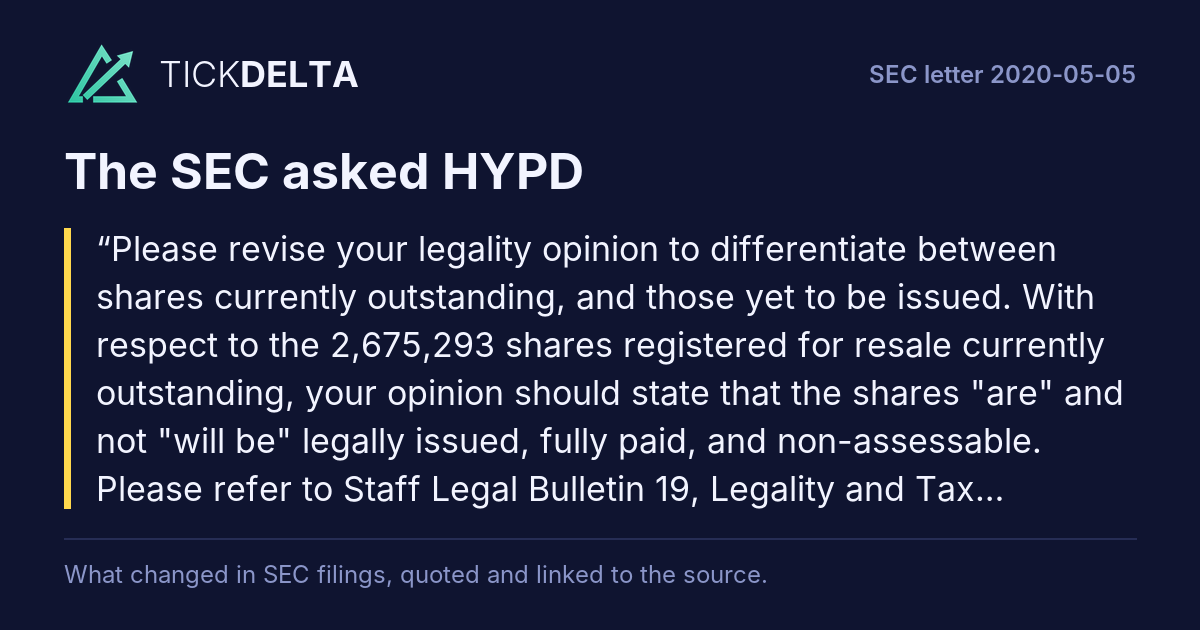
Please revise your legality opinion to differentiate between shares currently outstanding, and those yet to be issued. With respect to the 2,675,293 shares registered for resale currently outstanding, your opinion should state that the shares "are" and not "will be" legally issued, fully paid, and non-assessable. Please refer to Staff Legal Bulletin 19, Legality and Tax Opinions, Section II.2.h.
HYPD answered
to the Staff’s comment, Wyrick Robbins

Yates & Ponton LLP has revised its legality opinion to (a) differentiate between shares currently outstanding, and those yet to be issued, and (b) with respect to the 2,675,293 shares registered for resale currently outstanding, state that the shares “are” and not “will be” legally (or validly) issued, fully paid, and non-assessable. The

Company has filed such revised legality opinion with Amendment No. 1 to its Registration Statement on Form S-3 (File No.

333-237790) filed on May 8, 2020 (the “Amended Registration Statement”). Read in the reply ↗
General
SEC asked (2)
We note that Article X of your Third Amended and Restated Certificate of Incorporation provides for the Court of Chancery of the State of Delaware as the exclusive forum for certain litigation, including any “derivative action.” Please disclose whether this provision applies to actions arising under the Securities Act or Exchange Act.
Rest of the question

In that regard, we note that Section 27 of the Exchange Act creates exclusive federal jurisdiction over all suits brought to enforce any duty or liability created by the Exchange Act or the rules and regulations thereunder, and Section 22 of the Securities Act creates concurrent jurisdiction for federal and state courts over all suits brought to enforce any duty or liability created by the Securities Act or the rules and regulations thereunder. If the provision applies to Securities Act claims, please also revise your prospectus to state that there is uncertainty as to whether a court would enforce such provision and that investors cannot waive compliance with the federal securities laws and the rules and regulations thereunder. If this provision does not apply to actions arising under the Securities Act or Exchange Act, please also ensure that the exclusive forum provision in the governing documents states this clearly, or tell us how you will inform investors in future filings that the provision does not apply to any actions arising under the Securities Act or Exchange Act.

HYPD answered
The Company acknowledges the Staff’s comment and respectfully advises the Staff that the Company addresses the exclusive forum provision appearing in its Third Amended and

Restated Certificate of Incorporation in a risk factor in the Company’s Annual Report on Form 10-K, filed with the

Securities and Exchange Commission on March 30, 2020 (the “Form 10-K”), which is incorporated by reference into the Registration Statement on Form S-3 initially filed on April 22, 2020 and the Amended Registration Statement.
Rest of the answer

The Company intends to retain this risk factor in its set of comprehensive risk factors in future filings, in order to inform investors that the provision does not apply to any actions arising under the Securities Act or Exchange Act. The risk factor, appearing on page

59 of the Form 10-K, is copied here for reference:

Our certificate of incorporation provides that the Court of Chancery of the State of Delaware is, to the fullest extent permitted by law, the sole and exclusive forum for substantially all disputes between us and our stockholders. These choice of forum provisions could limit the ability of stockholders to obtain a favorable judicial forum for disputes with us or our directors, officers or employees.

Unless we consent to the selection of an alternative forum, our certificate of incorporation provides that the Court of Chancery of the State of Delaware, or the Court of Chancery, will be, to the fullest extent permitted by law, the sole and exclusive forum for any derivative action or proceeding brought on our behalf;

any action asserting a claim of breach of fiduciary duty owed by any of our directors, officers or other employees or agent to the Company or our stockholders; any action asserting a claim against us arising pursuant to the Delaware General Corporation Law, or DGCL, or our certificate of incorporation or bylaws; any action to enforce or determine the validity of our certificate of incorporation or bylaws; or any action asserting a claim against us that is governed by the internal affairs doctrine. Since the choice of forum provisions are only applicable to “the fullest extent permitted by law,” as provided in our certificate of incorporation, the provisions do not designate the Court of Chancery as the exclusive forum for any derivative action or other claim for which the applicable statute creates exclusive jurisdiction in another forum. As such, the choice of forum provisions do not apply to any actions arising under the Securities Act of 1933, as amended or the Exchange Act.

These choice of forum provisions may limit a stockholder’s ability to bring a claim in a judicial forum that it finds favorable for disputes with us or our directors, officers or other employees, which may discourage such lawsuits against us and our directors, officers and other employees. Alternatively, if a court were to find the choice of forum provisions contained in our certificate of incorporation to be inapplicable or unenforceable in an action, we may incur additional costs associated with resolving such action in other jurisdictions, which could materially adversely affect our business, financial condition and operating results.

* * * * *

The Company respectfully submits that the foregoing is appropriately responsive to the Staff’s comments. If the Staff has any further comments, please direct them to the undersigned.

Read in the reply ↗

Form S-1

2018-12-04 to 2018-12-12 · 2 questions · 1 letter from the SEC, 1 from the company
No closing letter
Derivatives and hedging
Cover Page
SEC asked (1)
Please revise your prospectus to disclose the number of shares of common stock being offered. For guidance, please refer to Rule 430A and Compliance and Disclosure Interpretations, Securities Act Rules, Question 227.02.
HYPD answered
We acknowledge the Staff’s comment and have updated the prospectus to disclose the number of shares of common stock being offered. Read in the reply ↗
Description of Securities, page 19
SEC asked (2)
We note that your certificate of incorporation provides that the Court of Chancery of the State of Delaware will be the sole and exclusive forum for any derivative action or proceeding brought on your behalf. Please revise this section to include disclosure regarding this provision.
Rest of the question

Your disclosure should include a discussion regarding whether your exclusive forum provision applies to actions arising under the federal securities laws. In this regard, we note that Section 27 of the Exchange Act creates exclusive federal jurisdiction over all suits brought to enforce any duty or liability created by the Exchange Act or the rules and regulations thereunder.

HYPD answered
disclosure on page 19 of the prospectus. The exclusive forum provisions contained in our certificate of incorporation only apply to “to the fullest extent permitted by law,” as provided in Article X. Accordingly, the provisions do not designate the Court of Chancery as the exclusive forum for any derivative action or other claim for which the applicable statute creates exclusive jurisdiction in another forum, such as the Exchange Act and the Securities Act.
Rest of the answer

We have updated the disclosure on page

19 of the prospectus to expressly reference this fact.

* * * * *

The Company respectfully submits that the foregoing is appropriately responsive to the Staff’s comments. If the Staff has any further comments, please direct them to the undersigned.

Read in the reply ↗

Form S-1

2017-12-14 to 2018-01-03 · 13 questions · 2 letters from the SEC, 2 from the company
No closing letter
Critical estimatesChinaLegal and contingenciesResults discussion (MD&A)
Prospectus Summary · Our Solution, page 3
SEC asked (1)
Please balance the stated advantages you believe your micro-therapeutic solution by expanding the discussion of the "Risks Associated with our Business" to provide a similar level of detail and relocating the discussion to immediately follow "Our Strategy."
HYPD answered
to the Staff’s comment, we have revised the prospectus summary in the Registration Statement to expand the discussion of the “Risks Associated with our Business” and relocated the discussion. Read in the reply ↗
Prospectus Summary · Our Solution, page 3
SEC asked (2)
Your product candidates appear to require a device for administering. Please clarify whether you have FDA approval for the device used for administration and the electronic system used to track administration. If you have not yet obtained FDA approval, please describe your plans to obtain approval. Additionally, expand your Business discussion to describe applicable government regulation of medical devices.
Rest of the question

If you believe you do not need FDA approval for the devices, please provide us with an analysis supporting your determination.

HYPD answered
We respectfully advise the Staff that following our

March 2017 meeting with the FDA, the FDA provided written feedback that our clinical programs will not be treated as a medical device or as a drug/device combination. All of our programs are treated as drug development programs because only the drug comes into contact with the eye. Consequently, we do not need separate FDA approval for the device or to comply with FDA regulations for medical devices. In response to the Staff’s comment, we have revised pages 2 and 64 of the

Registration Statement to include the requested disclosure. Read in the reply ↗
Nine Months Ended September 30, 2017 Compared with Nine Months Ended September 30, 2016 · Research and Development Expenses, page 54
SEC asked (3)
Please disclose the research and development expenses incurred by project for the periods presented. If you do not separately track certain costs (e.g. internal costs) by projects, disclose that fact and disclose those costs by type of costs (e.g. facilities, personnel, etc.).
HYPD answered
to the Staff’s comment, we have revised pages

55 and 56 of the Registration Statement to include the requested disclosure. Read in the reply ↗
Critical Accounting Policies · Stock-Based Compensation, page 57
SEC asked (4)
Please revise to disclose the following information. You may cross-reference to the extent that this, or other material information relevant to share-based compensation, is provided elsewhere in the preliminary prospectus. • The methods that management used to determine the fair value of the company’s shares and the nature of the material assumptions involved.
Rest of the question

• The extent to which the estimates are considered highly complex and subjective; and • The estimates will not be necessary to determine the fair value of new awards once the underlying shares begin trading.

HYPD answered
to the Staff’s comment, we have revised pages

57, 58, F-8, F-10 and F-26 of the Registration Statement to include the requested disclosure. Read in the reply ↗
Critical Accounting Policies · Stock-Based Compensation, page 57
SEC asked (5)
We may have additional comments on your accounting for equity issuances including stock based compensation and convertible instruments. Once you have an estimated offering price, please provide us an analysis explaining the reasons for the differences between the recent valuations of your common stock leading up to the IPO and the estimated offering price.
Rest of the question

Include the following in your analysis: • The issuance dates and the fair value of the underlying stock at each date; and • The significant factors, assumptions, methodologies used for each grant date. In addition, to the extent the common stock fair value significantly varies from the preferred stock issuance price, tell us the factors that contributed to the difference and explain how you considered the fact that the preferred stocks are convertible at a 1-for-1 ratio and are not redeemable.

HYPD answered
We acknowledge that the Staff may have additional comments on our accounting for equity issuances and undertake to supplementally provide the requested analysis under separate cover. Read in the reply ↗
Sales and Marketing, page 72
SEC asked (6)
Please expand your discussion regarding your license agreement with the Senju Pharmaceuticals Co., Ltd. with respect to your MicroStat program to disclose the material terms, including the term, any royalty term and termination provisions, as well as any royalty or other material payment provisions.
HYPD answered
to the Staff’s comment, we have revised page

74 of the Registration Statement to include the requested disclosure. Read in the reply ↗
Intellectual Property · Patents, page 73
SEC asked (7)
We note that your licensing partnership with Senju Pharmaceuticals is for Asia, including China. To the extent material to your business, please disclose the jurisdictions where you have been issued patents or pending patent applications.
HYPD answered
to the Staff’s comment, we have revised page

77 of the Registration Statement to include the requested disclosure. Read in the reply ↗
Management, page 89
SEC asked (8)
Please revise to clarify the description of the business experience for Jennifer Clasby, Luke Clauson, and Shuhei Yoshida so that it covers each person´s principal occupations and employment during the past five years and provides all the information required by Item 401(e) of Regulation S-K.
HYPD answered
to the Staff’s comment, we have revised pages

92 and 94 of the Registration Statement to include the requested disclosure. Read in the reply ↗
Note 7 – Commitments and Contingencies · License Agreement, page F-16
SEC asked (9)
Please confirm to us that you have no outstanding obligations and are not eligible to receive any milestones under the Senju license agreement. Otherwise, please disclose these terms.
HYPD answered
We hereby confirm that we have no outstanding obligations and are not currently eligible to receive any milestone payments under the Senju license agreement. Read in the reply ↗
General
SEC asked (10)
Please supplementally provide us with copies of all written communications, as defined in Rule 405 under the Securities Act, that you, or anyone authorized to do so on your behalf, present to potential investors in reliance on Section 5(d) of the Securities Act, whether or not they retain copies of the communications.
HYPD answered
We will supplementally provide the Staff with copies of all such written communications, if any, under separate cover. We further advise the Staff that investors will not retain copies of any such materials. Read in the reply ↗
General
SEC asked (11)
Please provide us proofs of any additional graphics, visual, or photographic information you will provide in the printed prospectus prior to its use, for example in a preliminary prospectus. Please note that we may have comments regarding this material.
HYPD answered
To the extent not already included, we will provide the Staff with copies of any graphics, visual, or photographic information that we intend to use in the printed prospectus prior to its use.

We acknowledge that the Staff may have comments regarding this material.

We thank the Staff in advance for its consideration of the Registration Statement. Should you have any questions regarding the foregoing, please contact Benjamin Reichel, Esq. of

Ellenoff Grossman & Schole LLP at (212) 370-1300. Read in the reply ↗
SEC letter of 2018-01-03 ↗ no reply letter on EDGAR (the company may have answered in an amended filing)
Results of Operations · Nine Months Ended September 30, 2017 Compared with Nine Months Ended September 30, 2016, page 55
SEC asked (1)
We have reviewed your revised disclosures in response to prior comment 3. Please revise to disclose, if true, that you do not track research and development costs by project.
HYPD answered

No reply letter found.

Critical Accounting Policies · Stock Based Compensation , page 58
SEC asked (2)
We have reviewed your revised disclosures in response to prior comment 4. In your disclosures, you indicate that you obtained a third-party valuation of your common stock that was done in accordance with the guidance outlined in the American Institute of Certified Public Accountants' Accounting and Valuation Guide, Valuation of Privately- Held-Company Equity Securities Issued as Compensation.
Rest of the question

Please revise to disclose the specific method(s) the third party used to determine the fair value of the company's shares and the nature of the material assumptions involved.

HYPD answered

No reply letter found.

Also in this review: company letter, 2017-12-29

17 other letters: notices that a filing will not be reviewed, requests to declare a registration effective, and the like

From the SEC's correspondence on EDGAR: staff letters (form UPLOAD) and company letters (form CORRESP), 32 letters filed since 2017-12-14. Questions and answers are matched by their numbers; topics come from words in each question. No AI.

Work on HYPD in a spreadsheet: Excel workbook (a sheet per section, ten years by column, charts, links to the filings) · CSV. For a Google Sheet that stays up to date, paste =IMPORTDATA("https://tickdelta.com/company/HYPD/export.csv") into a cell.