Screener / SEC EDGAR /CIK 0001980994 /10-K filed Feb 27, 2026, compared with Mar 5, 2025 /Numbers from the XBRL of the 10-Ks
Nasdaq Financials · Commodity Contracts Brokers & Dealers

iShares Bitcoin Trust ETF IBIT

Compare with peers Embed
New in the 10-K 13 paragraphs with nothing like them in the 10-K filed Mar 5, 2025 New in the 10-Q 16 paragraphs not in the 10-Q filed Aug 6, 2026 10-Q against the 10-K 34 risk factor paragraphs and sentences added or reworded

New risk paragraphs, branching off last year

Each branch is a paragraph in Risk Factors with nothing like it in the 10-K filed Mar 5, 2025. A box jumps to the paragraph as filed, below.

13 new

Paragraphs with nothing like them in last year's 10-K

Quoted exactly

13 paragraphs in Risk Factors of the 10-K filed Feb 27, 2026 with nothing like them in the 10-K filed Mar 5, 2025. Quoted exactly. Paragraphs that were only edited are under 10-K change.

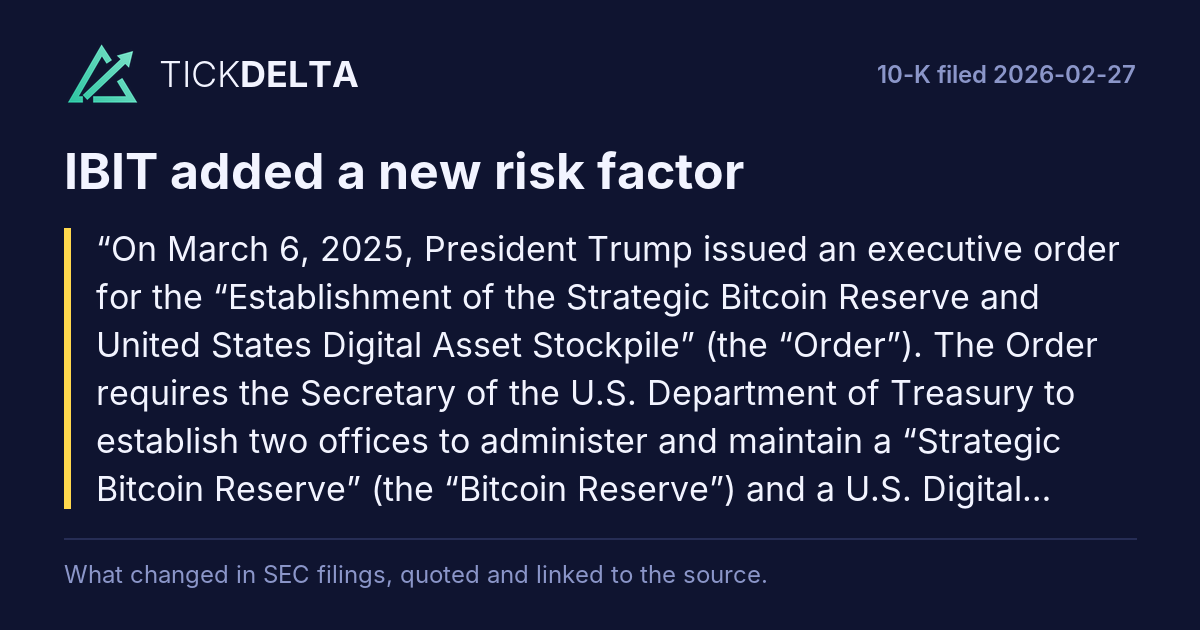
On March 6, 2025, President Trump issued an executive order for the “Establishment of the Strategic Bitcoin Reserve and United States Digital Asset Stockpile” (the “Order”). The Order requires the Secretary of the U.S. Department of Treasury to establish two offices to administer and maintain a “Strategic Bitcoin Reserve” (the “Bitcoin Reserve”) and a U.S. Digital Asset Stockpile (the “Digital Asset Stockpile”), respectively. The Bitcoin Reserve is intended to be capitalized with bitcoin forfeited as part of U.S. criminal or civil proceedings or in satisfaction of penalties imposed by executive agencies. The Digital Asset Stockpile is intended to be capitalized initially with other digital assets forfeited as part of criminal or civil asset forfeiture proceedings. Following the issuance of the Order, bitcoin markets developed expectations that the United States may begin acquiring and holding bitcoin, which many viewed as a positive development for bitcoin prices. The Order directs the Secretaries of the U.S. Treasury Department and the U.S. Department of Commerce to develop budget-neutral strategies for acquiring additional bitcoin for the Bitcoin Reserve. Legislation was introduced in the U.S. Senate and the U.S. House of Representatives that would direct the acquisition of one million bitcoin by the federal government over a five-year period, to be held in trust in secure storage by the U.S. Treasury. The bill proposed funding the bitcoin acquisition using remittances from the Federal Reserve, revaluations of Federal Reserve gold certificates, and other mechanisms characterized as budget-neutral (such as transfers from federal agencies using bitcoin acquired through asset forfeitures). Bills were also introduced in several state legislatures to authorize the acquisition of bitcoin by state governments or their instrumentalities, some of which have failed to pass. As of early 2026, these initiatives remain subject to significant uncertainty. While some administrative steps have reportedly been taken, there is no assurance that the federal government or any state government will announce or implement bitcoin acquisition plans, or that any such plans will meet market expectations. Even if government acquisitions occur or legislation requiring acquisitions is enacted, the price of bitcoin may decline if there are implementation challenges, unexpected difficulties, policy or legal reversals, or changes in political priorities, any of which may negatively impact Share value. Executive orders such as the Order are subject to change and can be reversed or overturned. The enduring existence and size of the Bitcoin Reserve and Digital Asset Stockpile, and the passage and implementation of legislation at the federal or state level, remain subject to complex challenges and uncertainty that make it difficult to evaluate their effect on the value of bitcoin and the Shares, now or in the future.

Read in the 10-K

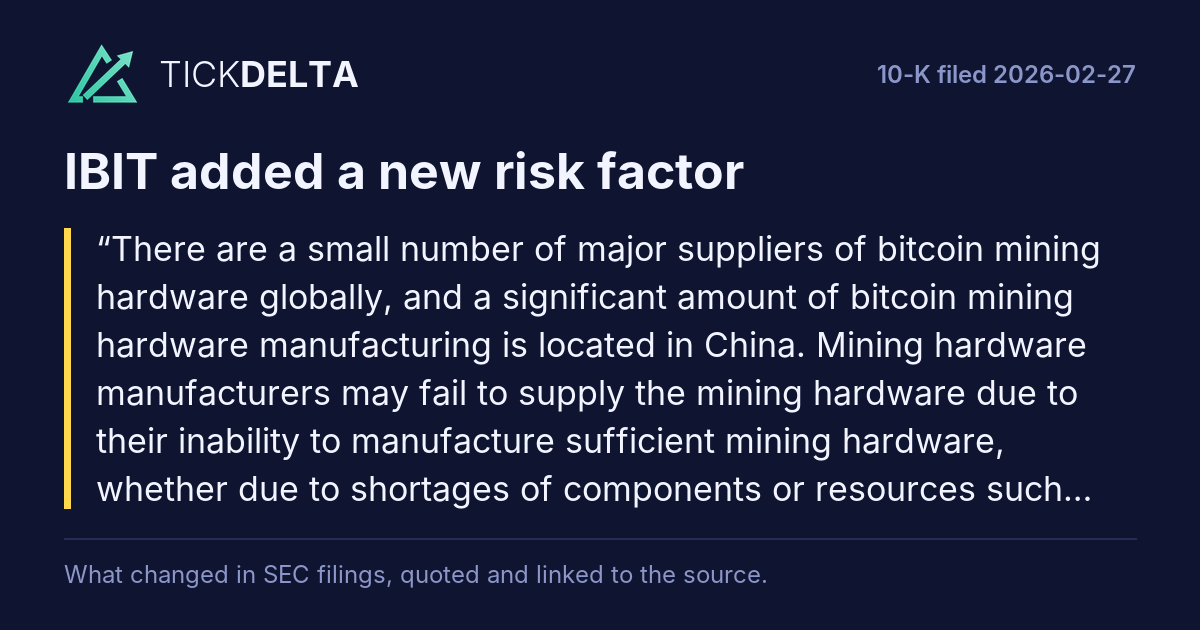
There are a small number of major suppliers of bitcoin mining hardware globally, and a significant amount of bitcoin mining hardware manufacturing is located in China. Mining hardware manufacturers may fail to supply the mining hardware due to their inability to manufacture sufficient mining hardware, whether due to shortages of components or resources such as semiconductors, or due to default, insolvency, or changes of laws and trade restrictions (including export/import restrictions, quotas or tariffs). Trade policies such as export/import restrictions, quotas or tariffs may reduce the ability of bitcoin mining hardware suppliers to supply miners with bitcoin mining hardware or create a shortage or lack of components necessary for their manufacture or repair. If bitcoin miners are unable to source mining hardware from those suppliers (for example due to overwhelming global demand for bitcoin miners, or due to trade restrictions, or other causes) at commercially reasonable prices, or at all, and replacement or substitute sources of bitcoin mining hardware prove to be unavailable, there could be a negative impact on bitcoin mining globally. These could affect the Bitcoin network by making it more difficult for transactions to be confirmed, increasing transaction costs, or affecting the Bitcoin network’s security, among other negative effects, any of which could negatively affect the value of bitcoin and consequently the Shares.

Read in the 10-K

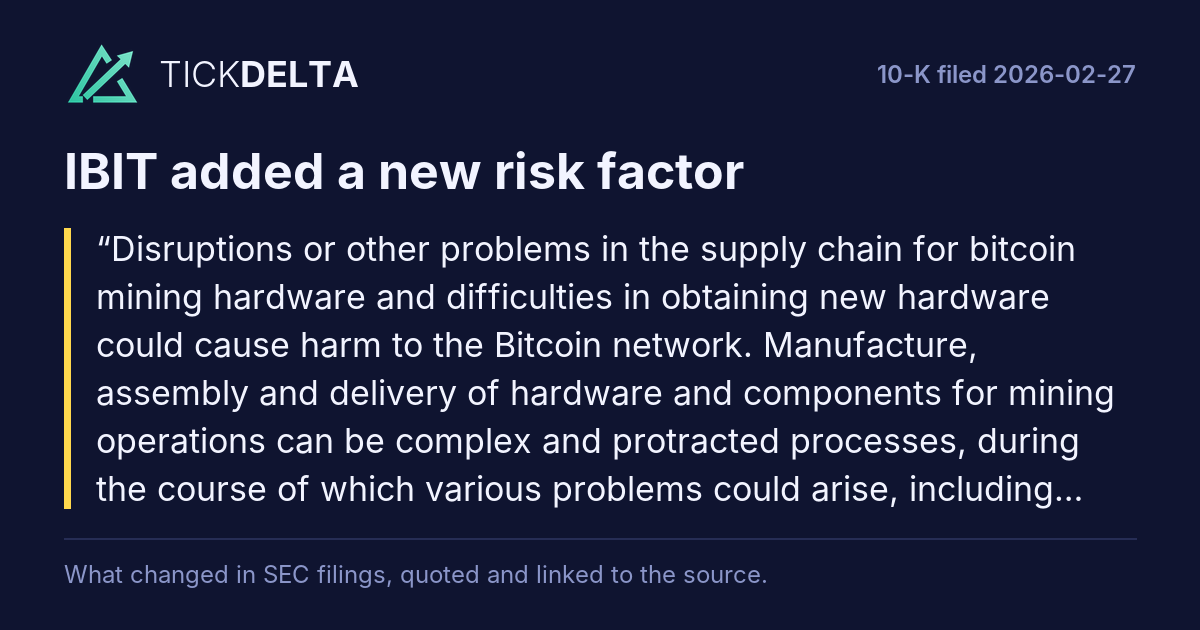
Disruptions or other problems in the supply chain for bitcoin mining hardware and difficulties in obtaining new hardware could cause harm to the Bitcoin network.

Manufacture, assembly and delivery of hardware and components for mining operations can be complex and protracted processes, during the course of which various problems could arise, including disruptions or delays in the supply chain, product quality control issues, as well as other external factors.

Mining operations can ordinarily only be profitable if the costs associated with bitcoin mining, including hardware costs, are lower than the price of bitcoin itself. During the course of the normal operation of bitcoin mining facilities, miners and other critical equipment and materials related to data center construction and maintenance, such as containers, switch gears, transformers and cables, will experience ordinary wear and tear and may also face more significant malfunctions. Declines in the condition of miners and other hardware will require bitcoin miners, over time, to repair or replace those miners.

Additionally, as the technology evolves, miners may be required to acquire newer models of mining hardware and machines to remain competitive in the market. Any upgrading process may require substantial capital investment, and miners may face challenges in doing so on a timely and cost-effective basis. The business of bitcoin miners will be subject to limitations inherent within the supply chain of their mining hardware equipment and components, including competitive, governmental, and legal limitations, and other events. For example, many miners will significantly rely on foreign imports to obtain mining hardware equipment and materials. Any global trade disruption, introductions of tariffs, trade barriers and bilateral trade frictions, together with any potential downturns in the global economy resulting therefrom, could adversely affect the necessary supply chains for mining hardware. Depending on the magnitude of such effects on the mining hardware supply chain, shipments of parts for mining hardware, or new mining hardware and equipment, may be delayed.

There are a small number of major suppliers of bitcoin mining hardware globally, and a significant amount of bitcoin mining hardware manufacturing is located in China. Mining hardware manufacturers may fail to supply the mining hardware due to their inability to manufacture sufficient mining hardware, whether due to shortages of components or resources such as semiconductors, or changes of laws and trade restrictions (including export/import restrictions, quotas or tariffs), or due to insolvency, or non-performance or default on their contracts. Trade policies such as export/import restrictions, quotas or tariffs may reduce the ability of bitcoin mining hardware suppliers to supply miners with bitcoin mining hardware or create a shortage or lack of components necessary for their manufacture or repair. If bitcoin miners are unable to source mining hardware from those suppliers (for example due to overwhelming global demand for bitcoin miners, or due to trade restrictions, or other causes) at commercially reasonable prices, or at all, and replacement or substitute sources of bitcoin mining hardware prove to be unavailable, there could be a negative impact on bitcoin mining globally. These could affect the Bitcoin network by making it more difficult for transactions to be confirmed, increase transaction costs, or affect the Bitcoin network’s security, among other negative effects, any of which could negatively affect the value of bitcoin and consequently the Shares.

Further, the first-generation ASIC chips and other critical components for mining equipment may be subject to price fluctuations or shortages. For example, the ASIC chip is the key component of a mining machine as it determines the efficiency of the device. The production of ASIC chips typically requires highly sophisticated silicon wafers, which currently only a small number of fabrication facilities, or wafer foundries, in the world are capable of producing. There have been previous microchip shortages which led to price fluctuations and disruption in the supply of key bitcoin mining hardware components. ASIC chips have recently been subject to supply and demand fluctuations, significant price increases and shortages. Shortages of ASIC chips could create problems in the supply chain for bitcoin mining equipment, negatively affecting the Bitcoin network by making it more difficult for transactions to be confirmed or increasing transaction costs, or even affecting network security, which again could cause the value of bitcoin and the Shares to decline.

Read in the 10-K

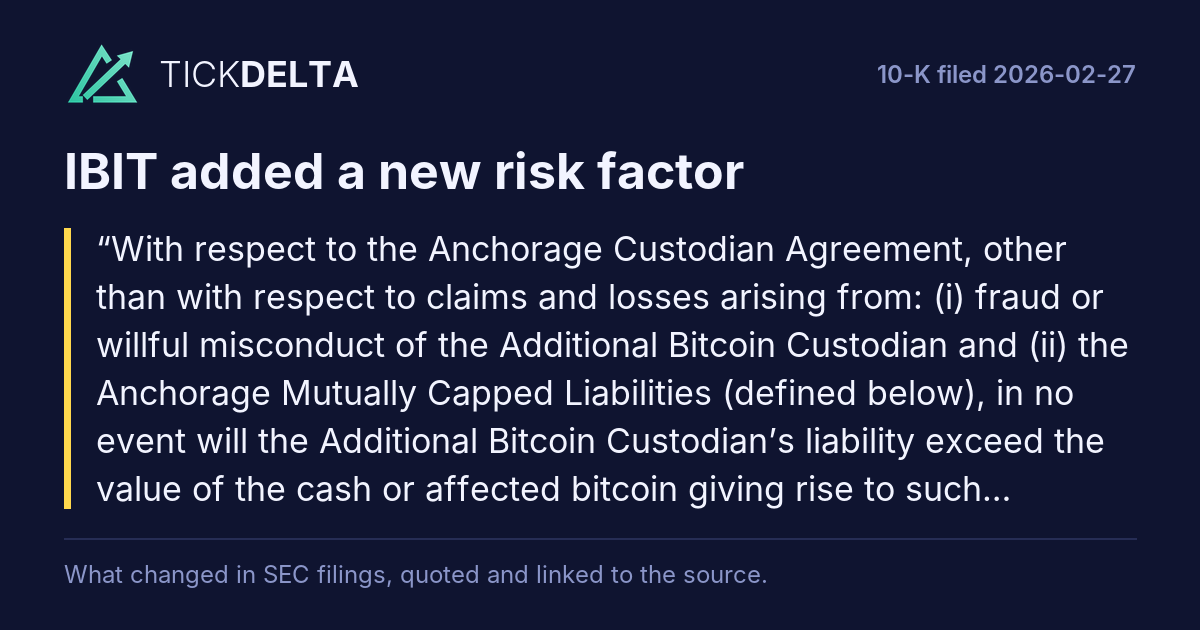
With respect to the Anchorage Custodian Agreement, other than with respect to claims and losses arising from: (i) fraud or willful misconduct of the Additional Bitcoin Custodian and (ii) the Anchorage Mutually Capped Liabilities (defined below), in no event will the Additional Bitcoin Custodian’s liability exceed the value of the cash or affected bitcoin giving rise to such liability. With respect to Anchorage Mutually Capped Liabilities, other than with respect to claims and losses arising from fraud or willful misconduct of the Additional Bitcoin Custodian, in no event will the Additional Bitcoin Custodian’s liability exceed the greater of $5 million and the aggregate amount of fees paid by client to the Additional Bitcoin Custodian in the 12-month period prior to the event giving rise to such liability. “Anchorage Mutually Capped Liabilities” means (i) claims and losses arising from a party’s breach of its confidentiality obligations under the Anchorage Custodian Agreement, (ii) a party’s indemnity obligations under the Anchorage Custodian Agreement (except with respect to the full amount of any Trust bitcoin lost, which shall not constitute an Anchorage Mutually Capped Liability), and (iii) claims and losses arising from the violation, misappropriation, or infringement by a party of any third-party intellectual and/or industrial property rights, including patent rights, copyrights, moral rights, trademarks, trade names, service marks, trade secrets, rights in inventions (including applications for, and registrations, extensions, renewals, and re-issuances of the foregoing).

With respect to claims and losses related to a withdrawal or transfer of bitcoin, if the Trust has operationalized Anchorage, the value of such digital assets shall be determined by reference to the benchmark valuation on the date delivery of such bitcoin in connection with such withdrawal or transfer is due in accordance with the terms of the Anchorage Custodian Agreement. In respect of any incidental, indirect, special, punitive, consequential or similar losses, the Additional Bitcoin Custodian is not liable, even if the Additional Bitcoin Custodian has been advised of or knew or should have known of the possibility thereof. The Additional Bitcoin Custodian is not liable for delays, suspension of operations, failure in performance, or interruption of service to the extent it is directly due to a cause or condition beyond the reasonable control of the Additional Bitcoin Custodian.

Read in the 10-K

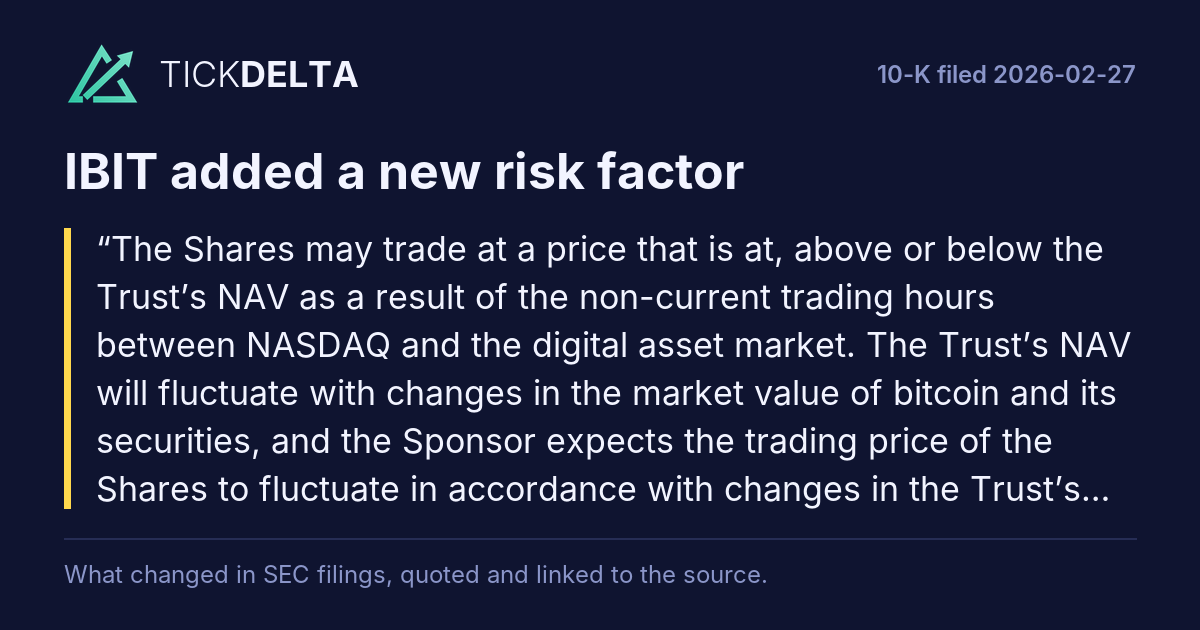
The Shares may trade at a price that is at, above or below the Trust’s NAV as a result of the non-current trading hours between NASDAQ and the digital asset market.

The Trust’s NAV will fluctuate with changes in the market value of bitcoin and its securities, and the Sponsor expects the trading price of the Shares to fluctuate in accordance with changes in the Trust’s NAV, as well as market supply and demand. However, the Shares may trade on NASDAQ at a price that is at, above or below the Trust’s NAV for a variety of reasons. For example, NASDAQ is open for trading in the Shares for a limited period each day, but the digital asset market is a 24-hour marketplace. During periods when NASDAQ is closed but constituent trading platforms are open, significant changes in the price of bitcoin on the digital asset market could result in a difference in performance between the value of bitcoin as measured by IBIT shares or the Bitcoin Index and the most recent NAV or closing trading price. For example, if the price of bitcoin on the digital asset market, and the value bitcoin as measured by the Bitcoin Index, move significantly in a negative direction after the close of NASDAQ, the trading price of the Shares may “gap” down to the full extent of such negative price shift when NASDAQ reopens. If the price of bitcoin on the digital asset market drops significantly during hours NASDAQ is closed, shareholders may not be able to sell their Shares until after the “gap” down has been fully realized, resulting in an inability to mitigate losses in a negative market. Even during periods when NASDAQ is open, large constituent trading platforms (or a substantial number of smaller constituent trading platforms) may be lightly traded or closed for any number of reasons, which could increase trading spreads and widen any premium or discount on the Shares.

Read in the 10-K
Show the other 1

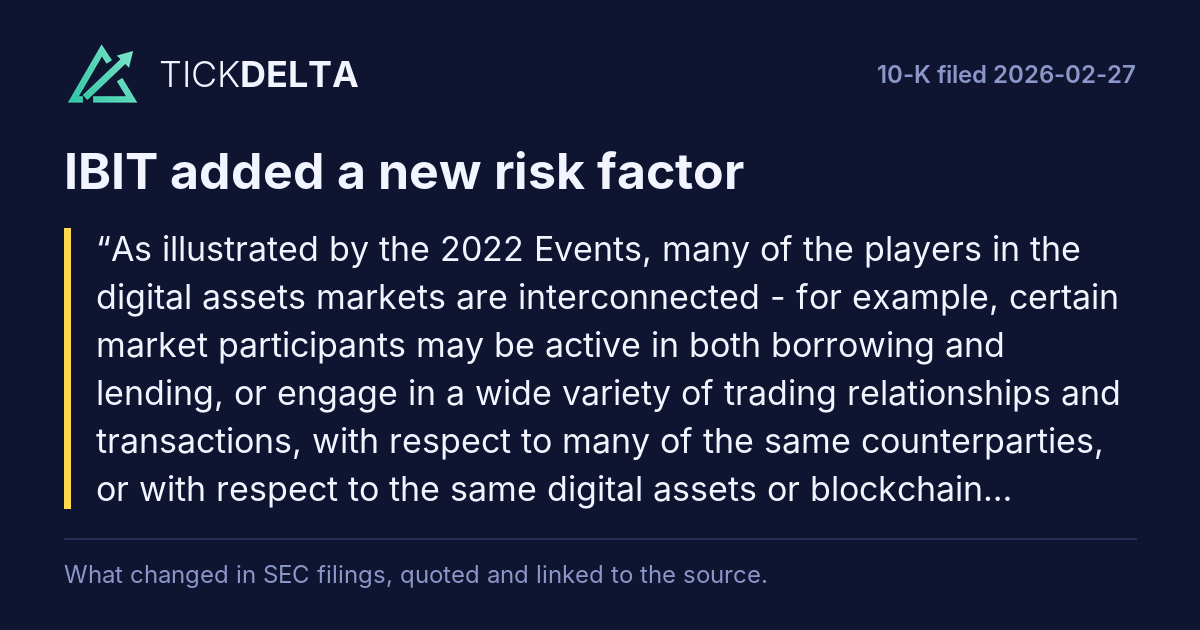
As illustrated by the 2022 Events, many of the players in the digital assets markets are interconnected - for example, certain market participants may be active in both borrowing and lending, or engage in a wide variety of trading relationships and transactions, with respect to many of the same counterparties, or with respect to the same digital assets or blockchain networks - which can heighten the contagion risks if one of them defaults on its obligations to others or a given digital blockchain network or digital asset were to stop functioning properly or lose substantial value, as applicable, leading to correlated failures in a wider market downturn or a disruption or market dislocation affecting that particular blockchain network or that particular digital asset, or losses. It is possible that, in circumstances similar to the 2022 Events, this interconnectedness risk affecting the Bitcoin Custodian, the Additional Bitcoin Custodian, the Prime Execution Agent, Authorized Participants, Bitcoin Trading Counterparties, or other service providers to the Trust could adversely affect the Trust or its Shareholders, for instance by disrupting creation and redemption processes, or (in the case of the Prime Execution Agent or the Bitcoin Custodian or Additional Bitcoin Custodian) resulting in a loss of funds, such as (in the event of a large scale system failure or cybersecurity breach) by exhausting available insurance funds.

Read in the 10-K

Paragraphs in the 10-Q filed Nov 6, 2026 that were not in the one before

New in the latest 10-Q

16 paragraphs in the 10-Q filed Nov 6, 2026 with nothing like them in the 10-Q filed Aug 6, 2026 (at least half the words must differ; new numbers alone do not count). Quoted exactly, grouped by the item heading above them. This is text that changed, not a judgement of how serious it is.

Risk Factors

In September 2026, Bitget, a digital asset platform, reported that a security breach resulted in unauthorized transfers of approximately $388 million in digital assets and the temporary suspension of withdrawals. According to reports from blockchain security firms, hacks and exploits across the digital asset industry resulted in approximately $768 million in reported gross losses during September 2026, some of which were subsequently recovered. According to the FBI, on October 29, 2026, unauthorized third parties transferred more than $6 billion in digital assets from wallets attributed to Binance, the largest digital asset trading platform by trading volume. Blockchain analytics firm TRM Labs characterized the incident as the largest theft of digital assets on record. A security incident involving a major trading platform may affect confidence in, and trading activity across, the broader bitcoin and crypto markets, including on the Constituent Platforms. Because the Index is based on prices from a limited number of Constituent Platforms, any resulting disruption on those platforms could affect the Index price. To the extent that bitcoin is compromised in a hack or is acquired by exchanging other stolen assets for bitcoin, that bitcoin cannot be frozen by an issuer, and any sale of that bitcoin in the market could exert downward pressure on the price of bitcoin. Such incidents, particularly one of this scale, may undermine confidence in digital asset platforms, networks and markets, adversely affect liquidity and trading activity, lead to withdrawal suspensions or other disruptions at digital asset platforms, increase regulatory and enforcement scrutiny, and contribute to volatility or declines in the price of bitcoin and the value of the Shares.

Read in the 10-Q

On March 6, 2025, President Trump issued an executive order for the “Establishment of the Strategic Bitcoin Reserve and United States Digital Asset Stockpile” (the “Order”). The Order requires the Secretary

Read in the 10-Q

Since 2020, a number of companies engaged in businesses outside the digital asset industry have begun to hold their corporate treasuries in digital assets instead of in fiat currency (“digital asset treasury companies”). In some cases, these companies have raised funds through financing or securities offerings and applied the proceeds to purchase digital assets, including bitcoin.

Read in the 10-Q

Digital asset treasury companies are a relatively new phenomenon and it is difficult to predict their long-term sustainability, and therefore their impact to digital asset markets, and to the Trust. In 2026, certain digital asset treasury companies have experienced significant declines in their market valuations, which may limit their ability to raise additional financing to acquire digital assets, including bitcoin, or increase pressure to sell their existing holdings. Digital asset treasury companies may increase procyclical dynamics in the market because they may purchase digital assets, such as bitcoin, when prices are rising and they may in certain circumstances be forced to sell such assets when prices are decreasing, potentially causing downward pressure on bitcoin prices in a falling market (causing prices to fall faster than they otherwise would). Digital asset treasury companies could cause greater volatility in digital asset markets, including markets for bitcoin. Negative events or sentiment surrounding digital asset treasury

Read in the 10-Q

companies could affect the market for bitcoin. The foregoing or similar events involving digital asset treasury companies could adversely affect holders of Shares in the Trust.

Read in the 10-Q
Show the other 11

Tokenization of the Shares by unaffiliated third parties could adversely affect the liquidity and trading price of the Shares.

Read in the 10-Q

On September 17, 2026, the SEC issued temporary, conditional exemptive relief permitting certain Tokenized Securities Venues (“TSVs”) to facilitate trading in tokenized NMS stocks, including exchange-traded products such as the Shares. Under this relief, the Shares may be tokenized by an unaffiliated third party and made available for trading on a TSV without the Trust’s or Sponsor’s affirmative consent, provided that the TSV gives the Trust prior written notice and the Trust does not object within 30 calendar days after receiving such notice. The Trust may not receive the notice sent by a TSV or may choose not to object to one or more of such notices. The Trust may also consider whether it will tokenize the Shares using an on-chain transfer agent. On September 1, 2026, the SEC also proposed amendments to its rules governing registered transfer agents, including changes addressing tokenized securities recordkeeping and the processing and safeguarding of securities. The proposal has not been adopted, and any final rules could affect the manner in which tokenized Shares are recorded or transferred, potentially creating additional costs or operational risks for the intermediaries involved.

Read in the 10-Q

Unaffiliated third parties, including issuers and trading platforms located outside the United States, also offer tokens and other digital instruments that are designed to track the price of, or provide economic exposure to, U.S.-listed equity securities, including exchange-traded products, and such instruments may reference the Shares. These instruments are not issued, sponsored or endorsed by the Trust or the Sponsor, are not subject to the notice and objection process that applies to TSVs, are generally not offered to U.S. persons and may not be registered with, or subject to oversight by, the SEC. As a result, the Trust and the Sponsor may not be aware that such instruments exist. Depending on their structure, they may take the form of derivative contracts with, or debt securities issued by, the third party, and they may or may not be backed by Shares held by a third party’s custodian. Such instruments may not confer any rights to assets held by the Trust or the Sponsor, and a holder’s rights instead are tied to the third party’s assets, custody and recordkeeping arrangements or its creditworthiness and performance.

Read in the 10-Q

If tokenized Shares were made available for trading on a TSV, or tokens referencing the Shares were offered outside the TSV framework, the Trust and the Sponsor would not control the trading or pricing mechanisms of the relevant venue or issuer or the custody arrangements for such tokens. Trading on separate venues, including at times when NASDAQ is closed, could fragment liquidity or cause such tokens to trade at prices that significantly differ from the market price of the Shares on NASDAQ or the Trust’s NAV, potentially adversely affecting the liquidity or trading price of the Shares. In addition, investors may not understand how such tokens differ from the Shares, and any failure, mispricing, insolvency, security breach, regulatory action or other adverse development involving such tokens or the venues or issuers that offer them, or any confusion about their relationship to the Trust, could adversely affect the reputation of the Trust or the Sponsor or the price or demand for the Shares.

Read in the 10-Q

exploited a firmware vulnerability affecting certain Coldcard hardware wallets to derive private keys and steal approximately $116 million in bitcoin without physically accessing the affected devices. The loss, theft, compromise or destruction of a private key required to access a digital asset may be irreversible. If a private key is lost, stolen, destroyed or otherwise compromised and no backup of the private key is accessible, the owner would be unable to access the digital asset corre...

Read in the 10-Q

making it more difficult for transactions to be confirmed, increasing transaction costs, or affecting the Bitcoin network’s security, among other negative effects, any of which could negatively affect the value of bitcoin and consequently the Shares.

Read in the 10-Q

could adversely affect the value of the Shares.” If any of the foregoing were to occur, it could result in losses to Shareholders. In any of these circumstances, a malicious actor may be able to compromise the security of the Bitcoin network or take the Trust’s bitcoin, which would adversely affect the value of the Shares. In addition, because a significant amount of bitcoin is held in addresses whose public keys have already been exposed, a sufficiently advanced quantum computer could be...

Read in the 10-Q

On August 18, 2026, the SEC proposed Regulation Crypto Assets, which would establish registration exemptions for certain investment contracts involving crypto assets and a conditional safe harbor addressing when a crypto asset ceases to be subject to an investment contract. The proposal has not been adopted, may be revised or withdrawn, and does not address exchange-traded products such as the Trust. The Sponsor cannot predict whether Regulation Crypto Assets will be adopted or how these or other regulatory developments could affect digital asset markets, the price of bitcoin or the value of the Shares.

Read in the 10-Q

Notwithstanding the SEC’s current interpretation that bitcoin is not itself a security, a court could reach a different conclusion under existing law, or future legislative or regulatory developments could result in bitcoin being treated as a security under the federal securities laws. Any such determination or development could materially adversely affect the Trust and the value of the Shares.

Read in the 10-Q

On October 5, 2026, the CFTC issued an advance notice of proposed rulemaking concerning Regulation Crypto Asset Transactions (“Regulation CTX”) and Regulation Crypto Asset Markets (“Regulation CAM”), seeking comment on potential rules governing certain retail crypto asset transactions and an optional federal registration framework for crypto asset trading venues. The CFTC has not proposed or adopted rules through this notice, and any subsequent rulemaking could affect the operation of digital asset trading platforms, trading activity or liquidity in bitcoin markets, which could adversely affect the price of bitcoin and the value of the Shares.

Read in the 10-Q

Other information

Pursuant to Section 219 of the Iran Threat Reduction and Syria Human Rights Act of 2012, which added Section 13(r) of the Exchange Act, the Trust hereby incorporates by reference herein Exhibit 99.1 of this report, which includes information provided by Malaysia Airports Holdings Berhad.

Read in the 10-Q

The 10-Q's risk factors against the 10-K

Item 1A of the 10-Q filed Nov 6, 2026 against Item 1A of the 10-K filed Feb 27, 2026. A 10-Q repeats only the risks that changed, so a 10-K paragraph that is missing from it is not counted as removed. Added is a paragraph with nothing like it in the 10-K, Reworded a sentence that is in both with several words changed, Quiet changes a sentence in both where one to four words changed and one is a hedge or a modal (cut words struck through, new words highlighted). Text on the page, not a score; each links to the filing at sec.gov.

What the 10-Q itself says about its risk factors:Except as set forth below, there have been no material changes to the Risk Factors last reported under Part I, Item 1A of the registrant’s Annual Report on Form 10-K for the year ended December 31, 2025, filed with the Securities and Exchange Commission on February 27, 2026.

Read in the 10-Q
Added10-Q Nov 6, 2026 vs 10-K Feb 27, 2026
in significant trading activity. If the liquidity of the digital asset markets continues to be negatively impacted by these events, digital asset prices, including bitcoin, may continue to experience significant volatility or price declines and confidence in the digital asset markets may be further undermined. In addition, following the 2022 Events, regulatory and enforcement scrutiny of the digital asset industry increased, including from, among others, the DOJ, the SEC, the CFTC, the White House and Congress, as well as state regulators and authorities, and the digital asset industry remains subject to significant attention from regulators, legislators and policymakers. These events are continuing to develop and the full facts are continuing to emerge. It is not possible to predict at this time all of the risks that they may pose to the Trust, its service providers or to the digital asset industry as a whole.

Read it in the 10-Q at sec.gov

Added10-Q Nov 6, 2026 vs 10-K Feb 27, 2026
In September 2026, Bitget, a digital asset platform, reported that a security breach resulted in unauthorized transfers of approximately $388 million in digital assets and the temporary suspension of withdrawals. According to reports from blockchain security firms, hacks and exploits across the digital asset industry resulted in approximately $768 million in reported gross losses during September 2026, some of which were subsequently recovered. According to the FBI, on October 29, 2026, unauthorized third parties transferred more than $6 billion in digital assets from wallets attributed to Binance, the largest digital asset trading platform by trading volume. Blockchain analytics firm TRM Labs characterized the incident as the largest theft of digital assets on record. A security incident involving a major trading platform may affect confidence in, and trading activity across, the broader bitcoin and crypto markets, including on the Constituent Platforms. Because the Index is based on prices from a limited number of Constituent Platforms, any resulting disruption on those platforms could affect the Index price. To the extent that bitcoin is compromised in a hack or is acquired by exchanging other stolen assets for bitcoin, that bitcoin cannot be frozen by an issuer, and any sale of that bitcoin in the market could exert downward pressure on the price of bitcoin. Such incidents, particularly one of this scale, may undermine confidence in digital asset platforms, networks and markets, adversely affect liquidity and trading activity, lead to withdrawal suspensions or other disruptions at digital asset platforms, increase regulatory and enforcement scrutiny, and contribute to volatility or declines in the price of bitcoin and the value of the Shares.

Read it in the 10-Q at sec.gov

Added10-Q Nov 6, 2026 vs 10-K Feb 27, 2026
The prices of some digital assets, including bitcoin, may continue to fluctuate in response to actual or perceived political, legislative, regulatory and enforcement developments in the United States. Following the 2024 U.S. presidential election, the current administration has stated policy positions and taken actions that some market participants may view as supportive of the digital asset industry, including actions directed at promoting U.S. leadership in digital assets and financial technology and encouraging greater regulatory clarity for blockchain technology and digital assets. In addition, the Guiding and Establishing National Innovation for U.S. Stablecoins Act of 2025 (“GENIUS Act”), which establishes a federal framework for payment stablecoins, was enacted in July 2025. Throughout 2026, proposed regulations implementing the GENIUS Act have been issued by the Office of the Comptroller of the Currency, the Federal Deposit Insurance Corporation, the Board of Governors of the Federal Reserve System, the U.S. Department of the Treasury and the Office of Foreign Assets Control addressing the requirements with respect to payment stablecoins and their issuers, including reserve, redemption, prudential risk and anti-money laundering requirements. As a result, the regulatory framework implementing the GENIUS Act remains pending and its final scope and effects are uncertain. The Digital Asset Market Clarity Act of 2025 (the “CLARITY Act”), which is intended to establish a federal market-structure framework for certain digital assets, passed the U.S. House of Representatives in July 2025 and was advanced by the U.S. Senate Committee on Banking, Housing, and Urban Affairs in May 2026. On September 15, 2026, the Senate failed to invoke cloture on a motion to proceed to consideration of the CLARITY Act by a vote of 49 - 50. The CLARITY Act has not been enacted, and its prospects remain uncertain. In the absence of comprehensive federal market-structure legislation, the SEC and CFTC have continued to pursue regulatory initiatives under their existing authorities, including rulemaking proposals, interpretations and guidance concerning digital assets. These initiatives may be revised, withdrawn or challenged and may not eliminate regulatory uncertainty for digital asset market participants.

Read it in the 10-Q at sec.gov

Added10-Q Nov 6, 2026 vs 10-K Feb 27, 2026
Market expectations regarding the administration, Congress, federal regulators, or future legislation or rulemaking may contribute to increases in digital asset prices or valuations. There can be no assurance that those expectations will be realized, that any enacted or proposed legislation or regulation will benefit the digital asset industry generally or bitcoin specifically, or that digital asset prices will rise or maintain their current levels. Delays in, changes to, or adverse developments relating to implementation of the GENIUS Act, enactment of the CLARITY Act or similar legislation, or other federal or state regulatory actions, including SEC and CFTC rulemaking, interpretations and guidance, could negatively affect market sentiment, liquidity, trading activity, or the prices of digital assets, including bitcoin. Any resulting decline in the price of bitcoin could cause a reduction in the value of the Shares and cause Shareholders to suffer losses. Moreover, there can be no assurance that political sentiments toward the digital asset industry, or market perceptions of those sentiments, will not shift over time.

Read it in the 10-Q at sec.gov

Added10-Q Nov 6, 2026 vs 10-K Feb 27, 2026
On March 6, 2025, President Trump issued an executive order for the “Establishment of the Strategic Bitcoin Reserve and United States Digital Asset Stockpile” (the “Order”). The Order requires the Secretary

Read it in the 10-Q at sec.gov

Show the other 20
Added10-Q Nov 6, 2026 vs 10-K Feb 27, 2026
Since 2020, a number of companies engaged in businesses outside the digital asset industry have begun to hold their corporate treasuries in digital assets instead of in fiat currency (“digital asset treasury companies”). In some cases, these companies have raised funds through financing or securities offerings and applied the proceeds to purchase digital assets, including bitcoin.

Read it in the 10-Q at sec.gov

Added10-Q Nov 6, 2026 vs 10-K Feb 27, 2026
Digital asset treasury companies are a relatively new phenomenon and it is difficult to predict their long-term sustainability, and therefore their impact to digital asset markets, and to the Trust. In 2026, certain digital asset treasury companies have experienced significant declines in their market valuations, which may limit their ability to raise additional financing to acquire digital assets, including bitcoin, or increase pressure to sell their existing holdings. Digital asset treasury companies may increase procyclical dynamics in the market because they may purchase digital assets, such as bitcoin, when prices are rising and they may in certain circumstances be forced to sell such assets when prices are decreasing, potentially causing downward pressure on bitcoin prices in a falling market (causing prices to fall faster than they otherwise would). Digital asset treasury companies could cause greater volatility in digital asset markets, including markets for bitcoin. Negative events or sentiment surrounding digital asset treasury

Read it in the 10-Q at sec.gov

Added10-Q Nov 6, 2026 vs 10-K Feb 27, 2026
companies could affect the market for bitcoin. The foregoing or similar events involving digital asset treasury companies could adversely affect holders of Shares in the Trust.

Read it in the 10-Q at sec.gov

Added10-Q Nov 6, 2026 vs 10-K Feb 27, 2026
Tokenization of the Shares by unaffiliated third parties could adversely affect the liquidity and trading price of the Shares.

Read it in the 10-Q at sec.gov

Added10-Q Nov 6, 2026 vs 10-K Feb 27, 2026
On September 17, 2026, the SEC issued temporary, conditional exemptive relief permitting certain Tokenized Securities Venues (“TSVs”) to facilitate trading in tokenized NMS stocks, including exchange-traded products such as the Shares. Under this relief, the Shares may be tokenized by an unaffiliated third party and made available for trading on a TSV without the Trust’s or Sponsor’s affirmative consent, provided that the TSV gives the Trust prior written notice and the Trust does not object within 30 calendar days after receiving such notice. The Trust may not receive the notice sent by a TSV or may choose not to object to one or more of such notices. The Trust may also consider whether it will tokenize the Shares using an on-chain transfer agent. On September 1, 2026, the SEC also proposed amendments to its rules governing registered transfer agents, including changes addressing tokenized securities recordkeeping and the processing and safeguarding of securities. The proposal has not been adopted, and any final rules could affect the manner in which tokenized Shares are recorded or transferred, potentially creating additional costs or operational risks for the intermediaries involved.

Read it in the 10-Q at sec.gov

Added10-Q Nov 6, 2026 vs 10-K Feb 27, 2026
Unaffiliated third parties, including issuers and trading platforms located outside the United States, also offer tokens and other digital instruments that are designed to track the price of, or provide economic exposure to, U.S.-listed equity securities, including exchange-traded products, and such instruments may reference the Shares. These instruments are not issued, sponsored or endorsed by the Trust or the Sponsor, are not subject to the notice and objection process that applies to TSVs, are generally not offered to U.S. persons and may not be registered with, or subject to oversight by, the SEC. As a result, the Trust and the Sponsor may not be aware that such instruments exist. Depending on their structure, they may take the form of derivative contracts with, or debt securities issued by, the third party, and they may or may not be backed by Shares held by a third party’s custodian. Such instruments may not confer any rights to assets held by the Trust or the Sponsor, and a holder’s rights instead are tied to the third party’s assets, custody and recordkeeping arrangements or its creditworthiness and performance.

Read it in the 10-Q at sec.gov

Added10-Q Nov 6, 2026 vs 10-K Feb 27, 2026
If tokenized Shares were made available for trading on a TSV, or tokens referencing the Shares were offered outside the TSV framework, the Trust and the Sponsor would not control the trading or pricing mechanisms of the relevant venue or issuer or the custody arrangements for such tokens. Trading on separate venues, including at times when NASDAQ is closed, could fragment liquidity or cause such tokens to trade at prices that significantly differ from the market price of the Shares on NASDAQ or the Trust’s NAV, potentially adversely affecting the liquidity or trading price of the Shares. In addition, investors may not understand how such tokens differ from the Shares, and any failure, mispricing, insolvency, security breach, regulatory action or other adverse development involving such tokens or the venues or issuers that offer them, or any confusion about their relationship to the Trust, could adversely affect the reputation of the Trust or the Sponsor or the price or demand for the Shares.

Read it in the 10-Q at sec.gov

Reworded10-Q Nov 6, 2026 vs 10-K Feb 27, 2026
If the profit margins of bitcoin mining operations are not sufficiently high, including due to an increase in electricity costs or a decline in the market price of bitcoin, or if bitcoin mining operations are unable to arrange alternative sources of financing (e.g., if lenders refuse to make loans to such miners), bitcoin miners are more likely to immediately sell more bitcoin than they otherwise would, resulting in an increase in liquid supply of bitcoin, which would generally tend to reduce bitcoin’s market price. ...

Read it in the 10-Q at sec.govThe 10-K sentence

Reworded10-Q Nov 6, 2026 vs 10-K Feb 27, 2026
In particular, although the Interpretive Release classified bitcoin as a digital commodity and not a security under U.S. federal securities laws, bitcoin may nonetheless in the future be classified by the CFTC as a “commodity interest” under the CEA or may be classified by the a court or a future SEC as administration could conclude that bitcoin is a “security” under U.S. federal securities laws. laws notwithstanding the Interpretive Release.

Read it in the 10-Q at sec.govThe 10-K sentence

Reworded10-Q Nov 6, 2026 vs 10-K Feb 27, 2026
If a private key is lost, stolen, destroyed or otherwise compromised and no backup of the private key is accessible, the owner would be unable to access the digital asset corresponding to that private key and the private key will not be capable of being restored by the digital asset network resulting in the total loss of the value of the digital asset linked to the private key. corre...

Read it in the 10-Q at sec.govThe 10-K sentence

Reworded10-Q Nov 6, 2026 vs 10-K Feb 27, 2026
Because bitcoin is a digital asset, the value of the Shares is subject to a number of factors relating to the fundamental investment characteristics of digital assets, including the fact that digital assets are bearer instruments and loss, theft, compromise, or destruction of the associated private keys could result in permanent loss of the asset. investmen...

Read it in the 10-Q at sec.govThe 10-K sentence

Reworded10-Q Nov 6, 2026 vs 10-K Feb 27, 2026
Because the legal tests for determining whether a digital asset is or is not a security often leave room for interpretation, and because the SEC has not taken a definitive position, for so long as the Sponsor believes there to be good faith grounds to conclude that the Trust’s bitcoin is not a security, the Sponsor does not intend to dissolve the Trust on the basis that bitcoin could at some future point be determined to be a security.

Read it in the 10-Q at sec.govThe 10-K sentence

Reworded10-Q Nov 6, 2026 vs 10-K Feb 27, 2026
In addition, the European Council Parliament of the European Union approved the text of the Markets in Crypto-Assets Regulation (“MiCA”) in October 2022, April 2023, establishing a regulatory framework for digital asset services across the European Union.

Read it in the 10-Q at sec.govThe 10-K sentence

The first 25 of 34 are shown (at most 12 of each type).

Phrases used for the first time

Two-word phrases in Risk Factors of the 10-K filed Feb 27, 2026 that are in none of the 1 earlier 10-Ks stored, back to Mar 5, 2025

additional bitcoin ×31mining hardware ×27anchor labs ×10anchorage custodian ×9sponsor authorized ×8bitcoin reserve ×6asset stockpile ×5supply chain ×5genius act ×5export import ×4import restrictions ×4restrictions quotas ×4asic chips ×4anchorage mutually ×4small number ×3transaction costs ×3
Where each one is used
  • additional bitcoin: On March 6, 2025, President Trump issued an executive order for the “Establishment of the Strategic Bitcoin Reserve and United States Digital Asset Stockpile” (the “Order”). The Order requires the Secretary of the U.S. Department of Treasury to establish two offices to administer and maintain a “Strategic Bitcoin...
  • mining hardware: There are a small number of major suppliers of bitcoin mining hardware globally, and a significant amount of bitcoin mining hardware manufacturing is located in China. Mining hardware manufacturers may fail to supply the mining hardware due to their inability to manufacture sufficient mining hardware, whether due...
  • anchor labs: If the Trustee operationalizes the Additional Bitcoin Custodian, the Trust’s holdings at the Additional Bitcoin Custodian would be covered by insurance held by Anchor Labs Inc., the parent company of the Additional Bitcoin Custodian (“Anchor Labs”). Anchor Labs maintains crime insurance coverage for a minimum limit...
  • anchorage custodian: Further, if the Trustee decides to operationalize the Additional Bitcoin Custodian, the Additional Bitcoin Custodian would perform essential functions in terms of safekeeping any of the Trust’s bitcoin that is held with Anchorage. The Anchorage Custodian Agreement provides the Trust with an available alternative...
  • sponsor authorized: If regulators subject the Trust, the Trustee, the Sponsor, Authorized Participants or Bitcoin Trading Counterparties to regulation as a money services business or money transmitter, this could result in extraordinary expenses to the Trust, the Trustee, the Sponsor or the Bitcoin Trading Counterparties and also...
  • bitcoin reserve: On March 6, 2025, President Trump issued an executive order for the “Establishment of the Strategic Bitcoin Reserve and United States Digital Asset Stockpile” (the “Order”). The Order requires the Secretary of the U.S. Department of Treasury to establish two offices to administer and maintain a “Strategic Bitcoin...
  • asset stockpile: On March 6, 2025, President Trump issued an executive order for the “Establishment of the Strategic Bitcoin Reserve and United States Digital Asset Stockpile” (the “Order”). The Order requires the Secretary of the U.S. Department of Treasury to establish two offices to administer and maintain a “Strategic Bitcoin...
  • supply chain: Disruptions or other problems in the supply chain for bitcoin mining hardware and difficulties in obtaining new hardware could cause harm to the Bitcoin network.

The 10-K at sec.gov

Used at least twice, small words left out. Counted, not picked: a phrase can be new because the company renamed something.

What was taken out

15 paragraphs of last year's Risk Factors with nothing like them now. The longest are quoted.

Across all companies
To the knowledge of the Sponsor, exchange-traded products for all spot-market commodities other than bitcoin, such as gold and silver, employ in-kind creations and redemptions with the underlying asset. The Sponsor believes that it is generally more efficient, and therefore less costly, for spot commodity exchange-traded products to utilize in-kind orders rather than cash orders, because there are fewer steps in the process and therefore there is less operational risk involved when an authorized participant can manage the buying and selling of the underlying asset itself, rather than...
In the 10-K filed Mar 5, 2025
The trading prices of many digital assets, including bitcoin, have experienced extreme volatility in recent periods and may continue to do so. The average one-year trailing volatility of bitcoin over the past ten years to date remains elevated at 66%. Over the course of 2021, there were steep increases in the value of certain digital assets, including bitcoin, and multiple market observers asserted that digital assets were experiencing a “bubble.” These increases were followed by steep drawdowns throughout 2022 in digital asset trading prices, including for bitcoin. In the 2021-2022 cycle,...
In the 10-K filed Mar 5, 2025
The Trust is dependent on the Bitcoin Custodian, which is Coinbase Custody, and the Prime Execution Agent, Coinbase Inc. to operate. Coinbase Custody performs essential functions in terms of safekeeping the Trust’s bitcoin in the Vault Balance, and its affiliate, Coinbase Inc., in its capacity as Prime Execution Agent, facilitates the buying and selling or settlement of bitcoin by the Trust in connection with cash creations and redemptions, the selling of bitcoin to pay the Sponsor’s Fee, any other Trust expenses, to the extent applicable, and in extraordinary circumstances, to liquidate...
In the 10-K filed Mar 5, 2025
The Trust could be an emerging growth company until the last day of the fiscal year following the fifth anniversary after its initial public offering, or until the earliest of (1) the last day of the fiscal year in which it has annual gross revenue of $1.235 billion or more, (2) the date on which it has, during the previous three year period, issued more than $1 billion in non-convertible debt or (3) the date on which it is deemed to be a large accelerated filer under the federal securities laws. The Trust will qualify as a large accelerated filer as of the first day of the first fiscal...
In the 10-K filed Mar 5, 2025

Sources

Item 1A of each 10-K and 10-Q on EDGAR, quoted exactly. Each paragraph links to the filing at sec.gov.

Also

10-K change: what was reworded or cut, section by section.

Work with it

Excel workbook · CSV. Google Sheet that stays up to date: paste =IMPORTDATA("https://tickdelta.com/company/IBIT/export.csv") into a cell.

Next:10-K change
Esc

Type a ticker such as AAPL, a name, an investor such as Buffett, or a topic such as tariffs. ↑ ↓ to move, Enter to open.