Form 10-K for the Year Ended December 31, 2023
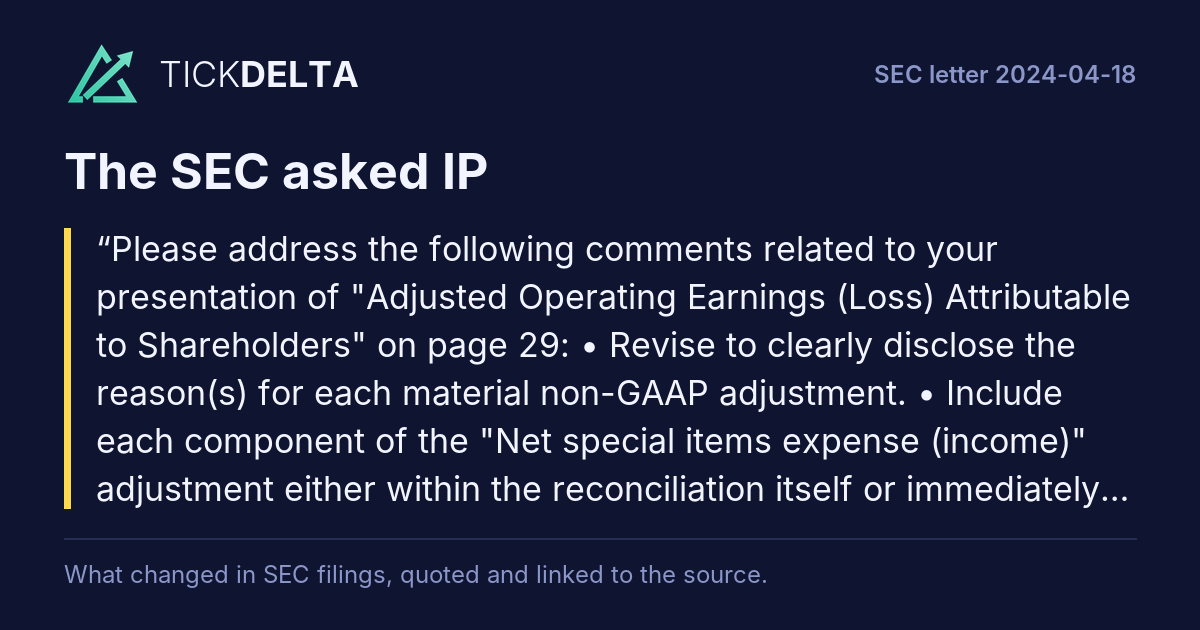
Please address the following comments related to your presentation of "Adjusted Operating Earnings (Loss) Attributable to Shareholders" on page 29: • Revise to clearly disclose the reason(s) for each material non-GAAP adjustment. • Include each component of the "Net special items expense (income)" adjustment either within the reconciliation itself or immediately following the reconciliation.Rest of the question
Although you provide a special items table on page 35, we note that the subtotals on page 35 do not agree with the non-GAAP adjustment in the reconciliation on page 29. Clarify for us what the difference represents. • Explain what "Non-operating pension expense (income)" represents and how you determined such adjustment is appropriate. • Revise future filings to remove the accelerated depreciation adjustments included within special items. Considering the underlying assets contribute to revenues, which have not been adjusted, it is not appropriate to remove the related depreciation. • Clarify if you consider operating income (loss) to be the most directly comparable GAAP measure. If so, ensure you present and reconcile to operating income (loss) within your non-GAAP presentation. • Clarify why you adjust for your environmental remediation reserve within special items when it appears as though such costs may be a normal part of your business. See Item 10(e)(1)(ii)(B) of Regulation S-K and Question 100.01 of the Staff’s Compliance and Disclosure Interpretations on Non-GAAP Financial Measures ("Non-GAAP C&DI's"). • Considering your adjustments represent “items considered by management to be unusual,” please clarify whether your non-GAAP measure adjusts for the tax benefits, disclosed on pages 34, 38-39, 66, 73, and 79, related to the settlement of the timber monetization restructuring and the Sylvamo tax-free exchange. To the extent such items are already included in the income tax effect line item of your reconciliation, please advise and ensure you revise future filings to sufficiently disclose the nature of your income tax adjustments.
In future, filings beginning with our Quarterly Report on Form 10-Q for the period ending
June 30, 2024, the Company will clearly disclose the reason(s) for each material non-GAAP adjustment, such as provided in the response relating to Non-operating pension expense (income) below.
Include each component of the “Net special items expense (income)” adjustment either within the reconciliation itself or immediately following the reconciliation.Read in the reply ↗Rest of the answer
Although you provide a special items table on page 35, we note that the subtotals on page 35 do not agree with the non-GAAP adjustment in the reconciliation on page 29. Clarify for us what the difference represents.
Response
Please note that the Special Items table presented on page 35 of the Form 10-K does not include special items associated with equity earnings and interest income/expense. Those special items are discussed in the Interest Expense and Equity Earnings, Net of Taxes section immediately preceding the table on page 35 of the Form 10-K.
The Company has revised its disclosure on page 22 of its Quarterly Report on Form 10-Q for the period ended March 31, 2024, filed on April 26, 2024, by adding a footnote directing investors to a table on page 29 for a reconciliation of Net special items expense (income). Please see below the revised disclosure.
The following arc reconciliations of Net earnings (loss) to Adjusted operating earnings (loss) on a total and per share basis. Additional detail is provided later in this Form 10-Q regarding the net special items expense (income) referenced in the charts below.
Three Months Ended
March 31,
December 31,
In millions
2024
Net earnings (less)
$
172
(284
)
Less - Discontinued operations (gain) loss
—
Earnings (loss) from continuing operations
Add back - Non-operating pension expense (income)
(12
Add back - Net special items expense (income) (a)
546
Income taxes - Non-operating pension and special items
(1
(5
(134
Adjusted operating earnings (loss)
185
142
(a)
See page 29 for details of Net special items expense (income).
Additionally, the Company revised its disclosure on page 29 of its Quarterly Report on Form 10-Q for the period ended March 31, 2024, filed on April 26, 2024, by including special items amounts related to interest income/expense and equity earnings previously disclosed in other sections of the MD&A to tie back to our reconciliation on page 22 of the Quarterly Report on Form 10-Q for the period ended March 31, 2024. Please see below the revised table.
Effects of Net Special Items Expense (Income) and Non-Operating Pension Expense
Details of net special items expense (income) and non-operating pension expense (income) for the three months ended are as follows:
December 31.
In million
Before Tax
After Tax
Business Segments
Accelerated depreciation
422
317
Severance and other costs
(b)
118
Building a Better IP
(11
(8
) (c)
Business Segments Total
529
398
Corporate
Legal reserve adjustments
DS Smith combination costs
Net loss on miscellaneous land sales
Equity method investment impairment
Environmental remediation reserve adjustment
(6
Corporate Total
Interest expense, net
Interest related to settlement of tax audits
(10
(7
Interest related to timber monetization settlement
Interest Total
Total net special items expense (income)
411
Non-operating pension expense (income)
(9
Total net special items and non-operating pension expense (income)
560
Additionally, please note that the Company’s revised disclosures in its Quarterly Report on Form 10-Q for the period ended March 31, 2024, filed on April 26, 2024, resolve the subtotal issue raised by the Staff.
In future filings, beginning with the Quarterly Report on Form 10-Q for the period ending
June 30, 2024, the Company will present this information immediately following the reconciliation of Net earnings (loss) to Adjusted Operating Earnings.
Explain what “Non-operating pension (income)” represents and how you determined such adjustment is appropriate.
Response
In response to the Staff’s comment, the Company will revise future filings, beginning with the Quarterly Report on Form 10-Q for the period ending June 30, 2024, to explain what “non-operating pension expense (income)” represents. The Company proposes to include the bolded disclosure below:
Page 2 of
“Non-operating pension expense
(income)” represents amortization of prior service cost, amortization of actuarial gains/losses, expected return on assets and interest cost. The Company excludes these amounts from our non-GAAP measure as the Company does not believe these items reflect ongoing operations. These particular pension cost elements are not directly attributable to current employee service. The Company includes service cost in our non-GAAP measure as it is directly attributable to employee service, and the corresponding employees’ other compensation elements, in connection with ongoing operations.
Revise future filings to remove the accelerated depreciation adjustments included within special items.
Considering the underlying assets contribute to revenues, which have not been adjusted, it is not appropriate to remove the related depreciation.
Response
The
Company believes that it is appropriate to include the accelerated depreciation adjustments within special items.
In October 2023, the
Company announced plans to permanently idle its Orange, Texas mill and also permanently idle a pulp machine at each of the Pensacola, Florida and Riegelwood, North Carolina mills by the fourth quarter 2023. Based on the Company’s plans to permanently abandon these long-lived assets before the end of their previously estimated useful life, we accelerated depreciation expense to reflect the use of these assets over shortened useful lives in accordance with ASC 360-10-35-47. Without the adjustment, the Company’s non-GAAP measures would not be representative of the ongoing operations of the impacted businesses and would lack comparability between current period results and prior periods presented. We believe these adjustments to our non-GAAP measure are reasonable as the accelerated depreciation from abandoned assets did not contribute to revenue generation. We did not remove depreciation expense associated with these assets from our non-GAAP measure for amounts that contributed to revenue generation.
Clarify if you consider operating income (loss) to be the most directly comparable GAAP measure. If so, ensure you present and reconcile to operating income (loss) within your non-GAAP presentation.
Response
Company clarifies that management considers net earnings (loss) to be the most directly comparable GAAP measure relative to adjusted operating earnings (loss), our non-GAAP measure. Our GAAP and non-GAAP earnings measures include elements beyond those specifically attributable to operations, including interest expense. We believe both measures align closer to the net earnings (loss) measure, which is more encompassing as opposed to focused solely on operating results. The Company included this disclosure on page 29 of its Form 10-K and on page 21 of our Quarterly Report on Form
10-Q for the period ended March 31, 2024, filed on April 26, 2024. The Company will continue this disclosure in future filings. Please see below for the relevant disclosure from page 21 of our
Quarterly Report on Form 10-Q for the period ended March 31, 2024, in bolded text.
Adjusted Operating Earnings and Adjusted Operating Earnings Per Share are non-GAAP measures defined as net earnings (loss) (a GAAP measure) excluding discontinued operations, net special items and non-operating pension expense (income). Net earnings (loss) and Diluted earnings (loss) per share are the most directly comparable GAAP measures. The Company calculates Adjusted Operating Earnings by excluding the after-tax effect of
Page 3 of discontinued operations, non-operating pension expense (income) and items considered by management to be unusual (net special items) from net earnings
(loss) reported under GAAP. Adjusted Operating Earnings Per Share is calculated by dividing Adjusted Operating Earnings by diluted average shares of common stock outstanding. Management uses this measure to focus on on-going operations and believes that it is useful to investors because it enables them to perform meaningful comparisons of past and present consolidated operating results from continuing operations. The
Company believes that using this information, along with the most direct comparable GAAP measure, provides for a more complete analysis of the results of operations.
Clarify why you adjust for your environmental remediation reserve within special items when it appears as though such costs may be a normal part of your business. See Item 10(e)(1)(ii)(B) of Regulation S-K and Question 100.01 of the Staff’s Compliance and Disclosure Interpretations on Non-GAAP Financial Measures (“Non-GAAP C&DI’s”).
Response
Company believes that its adjustment for the environmental remediation reserve within special items in our Form 10-K is reasonable and appropriate because the reserve is not reflective of the Company’s underlying business operations. The Company included the environmental remediation reserve adjustment in special items in our Form 10-K because it relates to remediation work at a waste pit site last utilized by the predecessor owner of this mill in 1966. The Company acquired this mill in an acquisition but never operated it or utilized the waste pit site subject to remediation. The costs recognized did not contribute to the ongoing revenues of the
Company and therefore are not deemed reflective of our underlying business. The Company subtracted the item from our non-GAAP measure to provide investors with a comparable basis relative to other periods presented to evaluate the performance of our ongoing business. Please note that the Company does not treat amounts relating to asset retirement obligations or environmental remediation at active manufacturing sites as special items in our non-GAAP measures.
Considering your adjustments represent “items considered by management to be unusual,” please clarify whether your non-GAAP measure adjusts for the tax benefits, disclosed on pages 34, 38-39, 66, 73, and 79, related to the settlement of the timber monetization restructuring and the Sylvamo tax-free exchange. To the extent such items are already included in the income tax effect line item of your reconciliation, please advise and ensure you revise future filings to sufficiently disclose the nature of your income tax adjustments.
Response
The Company clarifies that its non-GAAP measure adjustment for tax benefits related to the settlement of the timber monetization restructuring and the Sylvamo tax-free exchange are included in the income tax effect line items of the special items reconciliation tables on pages 29 and 34 of our Form 10-K. In response to the Staff’s comment, the Company will revise future filings, beginning with the Quarterly Report on Form 10-Q for the period ending June 30,
2024, to provide investors additional detail to ensure clarity. This will include specific details of the tax components of net special items. The Company proposes adding to the table below the footnote shown (for ease of reference) in bolded text:
Page 4 of
2022
Net Earnings (Loss) Attributable to Shareholders
288
1,504
Less - Discontinued operations, net of taxes (gain) loss
237
Earnings (Loss) from Continuing Operations
302
1,741
(192
Add back - Net special items expense (income)
572
233
Income tax effect - Non-operating pension and special items1
(173
(614
Adjusted Operating Earnings (Loss) Attributable to Shareholders
755
1,168
Special items for 2022 include tax benefits of $604 million and $66 million related to the settlement of the timber monetization restructuring and the Sylvamo tax-free exchange, respectively. This amount also includes $45 million tax expense related to a foreign deferred tax valuation allowance, $48 million tax expense on the non-operating pension expense adjustment and $37 million tax benefit associated with special items.
First report after the company's reply of 2024-05-17: 10-Q filed 2024-07-26 ↗, against the 10-Q filed 2023-10-27 ↗.
Tickdelta does not hold the text of both reports, so they are not compared here.
Since your "Free Cash Flow" measure on page 30 does not represent operating cash flows less capital expenditures, revise your description of this non-GAAP measure going forward to indicate that it represents adjusted free cash flow.
Company clarifies that its calculation of free cash flow represents cash provided by operations less cash invested in capital. As noted in the Consolidated Statement of Cash Flows of our Form 10-K, free cash flow is based on “Cash Provided By (Used For) Operations, less amounts included in the “Invested in capital projects, less insurance recoveries” line item. The term “Invested in capital projects, less insurance recoveries” is synonymous with capital expenditures.Read in the reply ↗Rest of the answer
In certain historical periods, the Company had insurance recoveries associated with the involuntary conversion of certain capital assets that we offset against the corresponding capital expenditure amount included in the total for that line item. There were no insurance recovery offsets in 2023. In future filings, beginning with the Quarterly Report on Form 10-Q for the period ending June 30, 2024, we propose the bolded text below.
Cash provided by operations, including discontinued operations, totaled $395 million and
$345 million for the first three months of 2024 and 2023, respectively. The Company generated free cash flow of approximately $144 million and $4 million in the first three months of 2024 and 2023, respectively. Free cash flow is a non-GAAP measure, which equals cash provided by operations less cash invested in capital projects, and the most directly comparable GAAP measure is cash provided by operations. Management utilizes this measure in connection with managing our business and believes that free cash flow is useful to investors as a liquidity measure because it measures the amount of cash generated that is available, after reinvesting in the business, to maintain a strong balance sheet, pay dividends, repurchase stock, service debt and make investments for future growth. It should not be inferred that the entire free cash flow amount is available for discretionary expenditures. By adjusting for certain items as set forth in the reconciliation table below that are not indicative of the Company’s ongoing performance, we believe that free cash flow also enables investors to perform meaningful comparisons between past and present periods.
The following is a reconciliation of cash provided by operations to free cash flow:
Cash provided by operations
395
345
Adjustments:
Cash invested in capital projects
(251
(341
First report after the company's reply of 2024-05-17: 10-Q filed 2024-07-26 ↗, against the 10-Q filed 2023-10-27 ↗.
Tickdelta does not hold the text of both reports, so they are not compared here.
Please revise your results of operations disclosures in future filings to discuss in sufficient detail changes in your financial statements line items on a consolidated basis. As noted in Item 303(b) of Regulation S-K, your presentation should discuss your business as a whole with segment information provided, as necessary, to supplement the consolidated discussion.Rest of the question
Accordingly, ensure you discuss, qualitatively and quantitatively, the factors resulting in material changes in your reported consolidated expense line items, including a discussion of material changes within a line item where several factors offset one another.
In future filings, beginning with our Quarterly Report on Form 10-Q for the period ending June 30,
2024, the Company will revise its results of operations disclosures to discuss changes in our financial statements line items on a consolidated basis. Our revised disclosure will include a discussion of the qualitative and quantitative factors resulting in material changes in reported consolidated expense line items and also a discussion of material changes within a line item where several factors offset one another. Read in the reply ↗
First report after the company's reply of 2024-05-17: 10-Q filed 2024-07-26 ↗, against the 10-Q filed 2023-10-27 ↗.
Tickdelta does not hold the text of both reports, so they are not compared here.
Although we note that "Business Segment Operating Profits (Loss)" at the segment level represents a required ASC 280 measure, please note that the measure on a total combined basis represents a non-GAAP measure. Accordingly, if you continue to present such measure outside of your consolidated financial statements, please label it as a non-GAAP financial measure and ensure that your presentation and disclosuresRest of the question
comply with non- GAAP rules, including Item 10(e) of Regulation S-K and the Non-GAAP C&DI's. Please note, for example, that the measure generally should not exclude normal, recurring, cash operating expenses necessary to operate your business. To the extent applicable, provide us with the proposed disclosures you intend to include in future filings. Also apply this comment to your Form 8-K earnings releases.
The Company will revise its disclosures in future filings, including in its Form 8-K earnings release, to clarify that the Company views total business segment operating profit (loss) as a non-GAAP financial measure. The Company will continue to disclose total business segment profit (loss) as a non-GAAP financial measure in compliance with Item 10(e) of Regulation S-K and the Non-GAAP C&DIs. Please see below for ease of reference, our proposed disclosure in bolded text for the additional disclosure presentation changes.
Total business segment operating profit (loss) is a non-GAAP measure.Read in the reply ↗Rest of the answer
The most directly comparable GAAP measure is net earnings from continuing operations. Total business segment operating profit (losses) is defined as earnings
(loss) from continuing operations before income taxes and equity earnings, but including the impact of less than wholly owned subsidiaries, and excluding interest expense, net, corporate expenses, net, corporate net special items, business net special items and non-operating pension expense. Total business segment operating profit (loss) is a measure reported to our management for purposes of making decisions about allocating resources to our business segments and assessing the performance of our business. Total business segment operating profits (losses) are used by International Paper’s management to measure the earnings performance of its businesses. Management uses this measure to focus on on-going operations and believes that it is useful to investors because it enables them to perform meaningful comparisons of past and present results. International Paper believes that using this information, along with net earnings, provides a more complete analysis of the results by quarter.
Page 6 of
The following table presents a reconciliation of Net earnings (loss) from continuing operations to its total business segment operating profit (loss):
Net Earnings (Loss) from Continuing Operations
Add back (deduct):
Income tax provision (benefit)
(61
Equity (earnings) loss. net of taxes
Earnings (Lass) from Continuing Operations Before Income Taxes and Equity Earnings
221
(326
Less than wholly owned subsidiaries included in operations
(2
Corporate expenses, net
Corporate net special items
Business net special items
Adjusted Operating Profit
169
306
257
Business Segment Operating Profit (Loss):
Industrial Packaging
216
322
315
Global Cellulose Fibers
(47
(16
(58
Total Business Segment Operating Profit (Loss)
Total business segment operating profits (losses) were $169 million in the first quarter of 2024, compared with $257 million in the fourth quarter of 2023 and $306 million in the first quarter of 2023.
Additionally, beginning with the Quarterly Report on Form 10-Q for the period ending June 30, 2024, we will remove the reference to “Adjusted Operating Profit” from this table.
First report after the company's reply of 2024-05-17: 10-Q filed 2024-07-26 ↗, against the 10-Q filed 2023-10-27 ↗.
Tickdelta does not hold the text of both reports, so they are not compared here.
Please provide a more informative discussion and analysis of cash flows from operating activities, including changes in working capital components, for the periods presented. In doing so, explain the underlying reasons and implications of material changes between periods to provide investors with an understanding of trends and variability in cash flows.Rest of the question
Also ensure that your disclosures are not merely a recitation of changes evident from the face of the financial statements. Please refer to Item 303(a) of Regulation S-K and Section IV.B of SEC Release No. 33-8350.
The Company has revised its disclosure on page 31 of its Quarterly Report on Form 10-Q for the period ended March 31, 2024, filed on April 26, 2024. Please see below for ease of reference, bolded text for the additional disclosure presentation changes. The Company will address material offsetting amounts, where applicable, in its discussion of operating cash flows. The Company will continue making these disclosures in future filings.
totaled $395 million for the first three months of 2024, compared with $345 million for the comparable 2023 three-month period.Read in the reply ↗Rest of the answer
Cash provided by working capital components (accounts receivable, contract assets and inventory less accounts payable and accrued liabilities, interest payable and other) totaled $32 million for the three months ended March 31, 2024, compared with cash used by working capital components of
$132 million for the three months ended March 31, 2023. The increase in cash provided by operations in the first three months of 2024 compared to the comparable 2023 three-month period was primarily due to the impact of the timing of mill outage spending on accounts payable and the related pull down of inventory balances, partially offset by lower accounts receivable collections driven by lower sales.
First report after the company's reply of 2024-05-17: 10-Q filed 2024-07-26 ↗, against the 10-Q filed 2023-10-27 ↗.
Tickdelta does not hold the text of both reports, so they are not compared here.
We note your disclosure that inflationary increases in certain input costs, such as energy, wood, recycled fiber, freight and chemical costs, had an adverse impact on your operating results in 2023 and 2022. Please revise your disclosures in future filings to expand upon the specific actions planned or taken, if any, to mitigate the inflationary pressures and to quantify the resulting impact of inflation on yourRest of the question
results of operations and financial condition.
In future annual and interim filings, to the extent that inflationary pressures do have a material impact, the Company will expand its disclosures to identify the specific actions planned or taken, if any, to mitigate the inflationary pressures and quantify and disclose material drivers of inflation on our results of operations and financial condition, where possible. Read in the reply ↗
First report after the company's reply of 2024-05-17: 10-Q filed 2024-07-26 ↗, against the 10-Q filed 2023-10-27 ↗.
Tickdelta does not hold the text of both reports, so they are not compared here.
You disclose that inventories are valued at the lower of cost or market value. Considering you utilize first-in, first-out or average cost methods for certain inventories, please clarify if you measure such inventories at the lower of cost and net realizable value as required by ASC 330-10-35-1B and revise your disclosures as necessary.
Company will enhance its discussion of inventory valuation and significant accounting policies in applicable future filings with the Commission to clarify that we measure such inventories at the lower of cost or net realizable value.
Using the disclosure on page 57 of the Form 10-K, this enhancement would appear in future applicable filings as the following disclosure, with changes noted in bolded text for ease of reference.
INVENTORIES
Inventories are valued at the lower of cost or net realizable value and include all costs directly associated with manufacturing products: materials, laborRead in the reply ↗Rest of the answer
and manufacturing overhead. In the United States, costs of raw materials and finished pulp and paper products, are generally determined using the last-in, first-out method. Other inventories are valued using the first-in, first-out or average cost methods. See Note 9 for further details.
Please note the Company will include similar disclosure updates in future annual reports within Item 8 Financial Statements and
Supplementary Data, Note 1 Summary of Business and Significant Accounting Policies.
First report after the company's reply of 2024-05-17: 10-Q filed 2024-07-26 ↗, against the 10-Q filed 2023-10-27 ↗.
Tickdelta does not hold the text of both reports, so they are not compared here.
We note that you disclose disaggregated revenue by reportable segment and geographical market. We further note from your fourth quarter 2023 earnings call transcript that you track other "segments," such as fresh foods, protein, and beverages. In addition, in your fourth quarter 2023 earnings release Form 8-K, you disclose sales volume by product.Rest of the question
Please tell us how you considered providing disaggregated revenue disclosures of such categories pursuant to ASC 606-10-50-5 and ASC 606-10-55-89 through 55-91. If you believe your current disclosures fully comply with such guidance, further clarify how your disclosures comply with the product and services disclosure requirement of ASC 280-10-50-40.
We have considered the guidance in ASC 606-10-50-5 and 50-6 with respect to disaggregated revenue disclosures in our filings. Under this guidance, we note that disaggregated revenue disclosures are required if the nature, amount, timing, and uncertainty of revenue and cash flows are impacted by different economic factors. Further, we note that
ASC 606-10-55-89 provides that the extent to which the disaggregated revenue information is provided depends on facts and circumstances pertaining to the underlying contracts with customers.Read in the reply ↗Rest of the answer
Finally, we considered the examples discussed in
ASC 606-10-55-91, acknowledging this is a non-exclusive list.
As disclosed in our Form 10-K financial statements Note 3, our revenue is derived from the manufacture and sale of fiber-based packaging and pulp goods. With respect to our Industrial Packaging segment, we generate revenue through the sale of various forms of fiber-based packaging and, to a lesser extent, containerboard for use by third-party customers. While our fiber-based packaging products can take various forms depending on the end use by our customers, it is all produced from a relatively homogeneous material in a consistent manner using similar inputs and processes to produce the finished goods, tailored to the customer’s specific needs. For example, customer needs might include specific labeling, tensile strength, weight, water resistance or use of recycled versus virgin fiber. Our products are not end-market specific but rather specific to customer needs. We have approximately 160 corrugated packaging facilities in the United States. The facilities are located in relative proximity to the customers they serve and are generally not specific to one type of packaging but instead are designed to serve various customer requirements. Generally, each facility can be used to respond to demand from a variety of customer segments (rather than just one or a few customer segments).
The Company acknowledges that it has periodically provided information related to customer end-markets we serve, often referred to as “customer segments” or “end-use segments” in this context. The customer end markets we address are considered standard for the fiber-based packaging industry and are consistent with how our competitors describe end markets. The Company has periodically provided this information to investors not as a means of evaluating historical performance but rather to help investors better understand current market trends and the current demand environment particularly during a low demand environment for fiber-based packaging. This enables investors to better understand our views on the outlook for the broader corrugated packaging industry because demand for our product is driven by the broader demand for packaging rather than any individual customer end market.
The Company generally does not enter into contracts by product or customer end-market, and as such the Company’s payment terms do not vary by product or end-market. Contracts with customers generally contain the same terms and conditions with respect to payment, delivery, supply and other rights for products sold into the various end-markets served by the Company. Sales are based on purchase orders and the revenue is recognized as the product is produced, in the case of products made to customer specifications, or upon shipment where not involving customized products. While demand for our product may change at a customer segment level episodically, the demand for our products is not uniquely tied to any customer segment but rather correlated to demand for packaging products broadly. Additionally, our products are similarly impacted by macro-economic factors, regardless of the end market, such as general business and consumer spending, gross domestic product growth and other broad measures of economic activity. These macro-economic factors often vary by geography further supporting our geographic approach to disaggregating revenues.
We include sale volumes by tons by market channel in our earnings release and in our annual reports on Form
10-K and quarterly reports on Form 10-Q. This information is presented as another data point to evaluate current market dynamics and current demand trends. These provide another view of where we are selling our fiber-based packaging with the preponderance of those sales being corrugated packaging.
Page 9 of
Based on the guidance and considerations set forth above, including the guidance set forth in
ASC 606-10-50-5 and 50-6 and ASC 606-10-55-89 to 55-91, we do not believe the Company is required to disaggregate revenue by customer or product type in the notes to our financial statements as we do not believe there is a significant level of disparity in the nature, amount, timing, and uncertainty of revenues and cash flows among our customers or products.
We also believe that our disclosures align with the requirements of ASC 280-10-50-40. We do not manage our Industrial Packaging segment at the end-market or product level but on a geographic basis between North America and Europe,
Middle East & Africa, our two operating segments within the Industrial Packaging reportable segment. Management teams are structured similarly along these geographic lines. Additionally, information is provided to the chief operating decision maker (the “CODM”) at this level for the purpose of assessing performance and allocating resources. The CODM is not routinely provided with information at an end-market or product line level. Finally, budgeting and capital allocation is focused at the operating segment level. This also includes consideration of the aggregation criteria outlined in ASC 280-10-50-11 particularly the view that our products are generally similar within each of the operating segments and are produced by similar means. Additionally, our products are focused on meeting specific customer packaging needs. Finally, our products are similarly distributed with container facilities serving customers based on geographic proximity to the customer facilities.
First report after the company's reply of 2024-05-17: 10-Q filed 2024-07-26 ↗, against the 10-Q filed 2023-10-27 ↗.
Tickdelta does not hold the text of both reports, so they are not compared here.
We note that you have recorded a $48 million liability pursuant to ASC 460 related to a Brazilian tax matter. Please clarify how you determined this matter was within the guarantee scope of ASC 460-10-15-4 as opposed to other guidance, such as the unrecognized tax benefit guidance of ASC 740.Rest of the question
Citing authoritative guidance, where applicable, clarify where you recorded the debit when you originally recorded the liability and whether the original and subsequent entries related to this liability qualify for continuing or discontinued operations classification. In addition, considering the assessments currently total approximately $393 million and the terms of your tax matters agreement, tell us how you determined the fair value of the liability was only $48 million.
The Company respectfully acknowledges the Staff’s comment and is providing the following commentary to explain our approach for determining the Brazilian tax matter was within the guarantee scope of ASC 460-10-15-4. Additionally, our commentary provides the requested clarifications and explains our determination of the fair value of the liability.
Sylvamo do Brasil Ltda. (“Sylvamo
Brazil”) was challenged by the tax authorities in Brazil on the deductibility of goodwill amortization related to a 2007 acquisition.Read in the reply ↗Rest of the answer
At the time the assessments were received, Sylvamo Brazil was a wholly owned subsidiary of the Company. The
Company divested Sylvamo Brazil on October 1, 2021, as part of the spin-off of our printing papers business. Sylvamo Brazil is now a wholly-owned subsidiary of Sylvamo Corporation (“Sylvamo”), the entity formed in connection with the spin-off. Prior to the spin-off, the Company did not record an uncertain tax liability as this position did not meet the recognition and measurement requirements of ASC 740. The Company concluded it was more likely than not, based on the technical merits, that the goodwill amortization deduction would be sustained when the legal process concludes.
This matter was specifically covered in the tax matters agreement entered into between Sylvamo and the Company at the time of the spin-off transaction. The tax matters agreement specifies that the Company will indemnify Sylvamo based on a 60%/40% split between the Company and Sylvamo, respectively, on up to $300 million of any assessment related to this matter, with the Company responsible for any amounts over $300 million. The tax indemnity arrangement is within the scope of ASC 460-10-15-4 because the Company does not have a potential obligation to the respective tax authority in this matter. Sylvamo retained that obligation as part of the spin-off. The Company is indemnifying Sylvamo for any future tax payments that may become due to the Brazilian tax authority related to this matter.
Page 10 of
The Company valued its guarantee at fair value in accordance with ASC 460-10-30-2 and ASC 820. The Company used an expected cash flow approach to value the indemnity to Sylvamo, specifically a Monte Carlo simulation that considered several possible scenarios ranging from acceptance of the current assessed taxes, interest, and penalties to a judicial court win with no resulting liability. These scenarios also considered varying levels of taxes, interest, and penalties for each unfavorable outcome. Approximately 65% of the total probability assessment was assigned to scenarios in which there was no tax, interest, and penalties associated with the particular outcomes. This aligns with our view prior to the spin-off transaction that it was more likely than not that our position with respect to deductibility of the goodwill amortization would ultimately be upheld. The probability weighted values for each scenario resulted in the $48 million recorded liability.
The $48 million liability was recorded as an adjustment to additional paid in capital, in accordance with ASC 845-10-30-45, along with the other offsetting entries made to record the spin-off of Sylvamo assets and liabilities from our balance sheet as of the October 1, 2021, spin-off date. Since the adjustment was recorded in shareholder’s equity, there was no impact on discontinued operations, which is where Sylvamo’s historical results were presented following the spin-off transaction.
First report after the company's reply of 2024-05-17: 10-Q filed 2024-07-26 ↗, against the 10-Q filed 2023-10-27 ↗.
Tickdelta does not hold the text of both reports, so they are not compared here.
Although you quantify your operational effective tax rate on page 3 and identify it as a non-GAAP measure, we do not note a reconciliation to the most comparable GAAP measure. Please revise future filings to provide a reconciliation in accordance with Item 10(e)(1)(i)(B) of Regulation S-K.
The Company removed this disclosure from its 8-K earnings release for the first quarter of 2024. The
Company revised its disclosure on page 28 of its Quarterly Report on Form 10-Q for the period ended March 31, 2024, filed on April 26, 2024. Please see below for ease of reference, bolded text for the additional disclosure presentation changes from the Quarterly Report on Form 10-Q for the period ended March 31, 2024.Read in the reply ↗Rest of the answer
Beginning with the Quarterly Report on Form
10-Q for the period ending June 30, 2024, we will also include a reconciliation of the effective tax rate to the operational tax rate.
The operational income tax provision and operational effective tax rate are non-GAAP financial measures and are calculated by adjusting the income tax provision from continuing operations and rate to exclude the tax effect of net special items and nonoperating pension expense (income). The most directly comparable GAAP measure is the reported effective income tax rate. Management believes that this presentation provides useful information to investors by providing a meaningful comparison of the income tax rate between past and present periods.
The following is a reconciliation of the net income tax provision (benefit) to the operational income tax provision and rate:
First report after the company's reply of 2024-05-17: 10-Q filed 2024-07-26 ↗, against the 10-Q filed 2023-10-27 ↗.
Tickdelta does not hold the text of both reports, so they are not compared here.
We note your response to comment 1. As previously requested, please revise future filings to remove accelerated depreciation adjustments from your non-GAAP measures.
In future filings, beginning with our Quarterly Report on Form 10-Q for the period ended June 30,
2024, the Company excluded accelerated depreciation from special items used in the determination of non-GAAP measures. Read in the reply ↗
First report after the company's reply of 2024-07-30: 10-Q filed 2024-11-01 ↗, against the 10-Q filed 2023-10-27 ↗.
Tickdelta does not hold the text of both reports, so they are not compared here.
We note your response to comment 2 and are unclear why you believe the term "Invested in capital projects, less insurance recoveries" is "synonymous with capital expenditures." Accordingly, to the extent that you include insurance recoveries in a non-GAAP free cash flow measure, please revise your description to indicate that it represents adjusted free cash flow or a similar title.Rest of the question
Within your statement of cash flows, also ensure that you present capital expenditures and insurance proceeds on a gross basis pursuant to ASC 23010-45-26. Tell us if you received material insurance proceeds during any annual period presented.
The Company revised its disclosures included in its Quarterly Reports on Form 10-Q for the periods ended March 31, 2024 and June 30, 2024, which were filed on April 26, 2024 and July 26, 2024, respectively, to remove the reference to “less insurance recoveries” on the Condensed Consolidated Statement of Cash Flows along with the page 25-26 discussion of free cash flow as a non-GAAP measure and reconciliation of cash from operations to free cash flow. There were no insurance recoveries in any of the periods presented in our March 31, 2024, and June 30, 2024 Form 10-Q or in all of 2023.Read in the reply ↗Rest of the answer
In future periods, when there are insurance recoveries, we will present those separately from the “Invested in Capital Projects” amount in the statement of cash flows, which represents our capital expenditures. We will continue to present the statement of cash flows and free cash flow consistent with the presentation used in our Quarterly Reports on Form 10-Q for the periods ended
March 31, 2024 and June 30, 2024.
First report after the company's reply of 2024-07-30: 10-Q filed 2024-11-01 ↗, against the 10-Q filed 2023-10-27 ↗.
Tickdelta does not hold the text of both reports, so they are not compared here.
We note your proposed disclosures in response to comment 4. As previously noted in our comment, since you identify "Business Segment Operating Profits (Loss)" as a non- GAAP measure, your presentation must fully comply with non-GAAP rules, including Item 10(e) of Regulation S-K and the Staff’s Compliance and Disclosure Interpretations on Non-GAAP Financial Measures ("Non-GAAP C&DI's").Rest of the question
Consistent with our comment above, please remove the "Accelerated depreciation" adjustment from your non-GAAP presentations. Also address how the "Legal reserve adjustments" and "Corporate expenses, net" adjustments included within this measure comply with Question 100.01 of the Non-GAAP C&DI's. Tell us the specific items included within these adjustments and your assessment regarding whether they represent normal, recurring, cash expenses necessary to operate your business.
In previous filings, we reported total business segment operating profits (loss) which was a non-GAAP measure and included a reconciliation of total business segment operating profit (loss) to the most comparable GAAP measure. The Company chose to remove “Total Business Operating Segment Profit (Loss)” as a non-GAAP measure from the Quarterly Report on Form 10-Q for the period ended June 30, 2024, and will also exclude this from future filings. In future filings, we will only report ASC 280 business segment operating profit (loss) measure in MD&A.Read in the reply ↗Rest of the answer
The Company excluded “Legal reserve adjustments” and “Corporate expense, net” from the determination of “Business Segment Operating Profits (Loss)” to provide investors with a comparable basis relative to other periods presented to evaluate the performance of our ongoing business. The “Legal reserve adjustments” which was excluded in the determination of “Business Segment Operating Profits (Loss)” via inclusion in our special items, relates to the settlement of claims pertaining to a line of business exited more than 20 years ago. The settlement cost does not contribute to the ongoing revenues of the Company, and therefore, is not deemed reflective of our current operations, revenue generating activities, business strategy, industry, and regulatory environment. It should be noted that we do not exclude legal costs associated with current business operations in our segment level performance measures. “Corporate Expense, net” is comprised of various expenses not associated with revenue generating activities of the Company. This amount primarily includes environmental remediation costs at closed facilities of businesses no longer part of our portfolio and costs associated with tax planning structures. These amounts are not allocated to the businesses on the basis that these costs do not contribute to or support the ongoing business segment operations. “Corporate expense, net” is not excluded from our determination of Adjusted Operating
Earnings, our consolidated non-GAAP earnings measure.
First report after the company's reply of 2024-07-30: 10-Q filed 2024-11-01 ↗, against the 10-Q filed 2023-10-27 ↗.
Tickdelta does not hold the text of both reports, so they are not compared here.
Your proposed revisions in response to comment 7 suggest that a lower of cost or net realizable value assessment is applied to all inventories, including inventory measured using the LIFO method. Since LIFO inventory should be valued at the lower of cost or market pursuant to ASC 330-10-35-1B and -2, please clarify for us how you historically accounted for the subsequent measurement of inventories determined usingRest of the question
the LIFO, FIFO, and average cost methods and revise your disclosures accordingly.
The Company accounts for most U.S. based inventory using the LIFO method and in turn that inventory has historically been and continues to be valued at the lower of cost or market based on ASC 330-10-35-1C. Approximately 81% of our total raw materials and finished goods inventory as of December 31, 2023, are valued using LIFO. The remainder of our inventories are accounted for using the average cost method and therefore has historically been and continues to be valued at the lower of cost or net realizable value in accordance with ASC 330-10-35-1B.Read in the reply ↗Rest of the answer
The Company has not historically had material adjustments under either the lower of cost or market / net realizable value models. The Company will enhance its disclosure of inventory measurement within the Summary of Business and Significant Accounting Policies footnote in applicable future filings with the Commission to clarify that we measure all non-LIFO inventories at the lower of cost or net realizable value and that we measure LIFO valued inventories at the lower of cost or market.
The Company will revise its disclosure beginning with its Annual Report on Form 10-K for the year ending December 31, 2024, discussing inventory within the Summary of Business and Significant Accounting Policies footnote, as follows:
“Inventories include all costs directly associated with manufacturing products: materials, labor, and manufacturing overhead. In the United States, costs of raw materials and finished pulp and paper products, are generally determined using the last-in, first-out method.
These inventories are measured at the lower of cost or market. Other inventories are valued using the first-in, first-out or average cost methods. These inventories are measured at the lower of cost or net realizable value.”
First report after the company's reply of 2024-07-30: 10-Q filed 2024-11-01 ↗, against the 10-Q filed 2023-10-27 ↗.
Tickdelta does not hold the text of both reports, so they are not compared here.
Your response to prior comment 8 indicates that you include sale volumes by market channel within earnings releases and annual and quarterly reports "as another data point to evaluate current market dynamics and current demand trends" and that your chief operating decision maker ("CODM") "is not routinely provided with information at an end-market or product line level." Although we understand you do not manage yourRest of the question
segments at such level, please further clarify why quantifying revenues of these or similar product categories is not required pursuant to ASC 280-10-50-40. In doing so, provide us with a summary of all revenue information provided to your CODM and the frequency such information is provided.
The Company acknowledges the Staff’s comment and advises the Staff that it considers and follows the provisions of ASC 280-10-50-40, “Information about Products and Services” (“ASC 280-10-50-40”), when preparing its financial statements. ASC
280-10-50-40 states that a public entity shall report the revenues from external customers for each product and service or each group of similar products and services unless it is impracticable to do so. The Company discloses revenues based on its reportable segments: Industrial Packaging (“IPG”) and Global Cellulose Fibers (“GCF”).Read in the reply ↗Rest of the answer
The Company believes that the products produced and sold by each of these segments, including the products noted in the Staff’s comment, in all material respects constitute groups of similar products, and that further disaggregation of revenues within these groups is therefore not required by ASC 280-10-50-40.
When evaluating if the product sales within our reporting segments should be further disaggregated pursuant to ASC 280-10-50-40, we considered if the nature of our products are sufficiently similar not requiring further disaggregation since doing so would not provide users with decision useful information. In making this assessment, we considered the general aggregation framework in
ASC 280-10-50-11 in evaluating whether the products produced and sold are similar within our IPG and GCF reportable segments.
Industrial Packaging
IPG is a vertically integrated business. Containerboard is produced at various mills, whether derived from recycled corrugated packaging or produced using virgin fiber. This containerboard is then utilized by corrugated packaging facilities to create corrugated packaging in line with customer specifications. The corrugated packaging facilities have minimal inputs beyond the containerboard produced by Company mills, mainly glue, wax and ink.
Fiber-based packaging products can take various forms depending on the end use by our customers and are produced from a homogeneous material in a consistent manner using similar inputs and processes to produce the finished goods. In addition, most of the Company’s fiber-based packaging products serve the same basic function regardless of the customer or end use. The distribution of products is similar due to the nature of our vertically integrated packaging business. For these reasons, the Company concluded that these products are a single group of similar products in the context of ASC 280-10-50-40 given their similar nature, end-use and common customer type.
Global Cellulose Fibers
Regarding GCF, the primary raw material used in this segment is cellulose fibers derived from softwood pulp. Cellulose fibers are processed at our GCF mills dependent on the ultimate application of that pulp for customers end-use, such as in baby diapers, feminine hygiene products, paper, or tissue. The production process used in producing various grades are consistent with any process variations based on the ultimate customer end use. There is not significant variation in the types or class of customers of the GCF segment with the product serving the same basic function with the only differentiation being different grades of pulp output. Additionally, our products are distributed through similar channels depending on the customer market: U.S.-based or export. For these reasons, the Company concluded that these products are a single group of similar products in the context of ASC 280-10-50-40 given their similar nature, end-use and common customer type.
Chief Operating Decision Maker package
In response to your letter dated June 26, 2024, we reviewed the CODM package for the fourth quarter 2023 and first quarter of 2024 to identify revenue specific information provided to the CODM. The CODM package is the combination of the three quarterly reporting packages for our three operating segments: North American IPG (“NA IPG”), EMEA IPG and GCF.
The IPG CODM package does not include direct reporting of sales revenue that corresponds to the level of detail included in the Sales Volume By Product table. Additionally, there was no discussion of recycling, saturated kraft or gypsum in the CODM materials. There are instances in which tonnage and price per ton information is provided for containerboard and corrugated packaging, but that information does not include sales dollars by that split as the CODM focus is on total integrated NA IPG and EMEA IPG revenue as opposed to levels below this. As mentioned in our initial response, sales volume by product information is presented to provide insight into market dynamics as opposed to use in evaluating performance or the strategic decision-making process. Information provided to the CODM supports the view that IPG is a vertically integrated business with a focus more on what is driving the overall profitability of the business as opposed to the sales performance of any individual grade. Total revenue information is presented in the CODM package on a combined basis and not at a level below this. The CODM package addresses top line performance in a limited manner through isolated volume, price or mix information. That information is presented to analyze our measure of business segment operating performance as opposed to changes in top line revenue. We have provided a summary, as an appendix to this letter, of the information provided to the CODM for NA IPG related to revenue (refer to Appendix A). Our summary is focused on NA IPG CODM revenue information based on it being the most material operating segment and the one that corresponds to the information in the Sales Volume by Product table referenced in your comment. The items noted in the summary are routinely provided to the CODM each quarter.
The approach to analysis of results in the CODM package aligns with our external approach to bridging earnings results from one period to the next using a standard set of drivers (price/mix, volume, operating costs, etc.). This aligns with our external focus of explaining bottom line results with limited discussion of top line revenue.
The Company will continue to evaluate the disclosure of disaggregated revenue in future filings, especially with a new CODM effective May 1, 2024. This could result in future changes to the CODM package as well as key performance metrics. Based on the current state of internal reporting, we believe our current disclosures provide the appropriate level of revenue information in accordance with ASC
280-10-50-40.
First report after the company's reply of 2024-07-30: 10-Q filed 2024-11-01 ↗, against the 10-Q filed 2023-10-27 ↗.
Tickdelta does not hold the text of both reports, so they are not compared here.
Your response to prior comment 1 indicates that you have "excluded accelerated depreciation from special items used in the determination of non-GAAP measures" beginning with your Form 10-Q for the period ended June 30, 2024.Rest of the question
However, the total amount of special items on page 3 of Exhibit 99.1 in your Form 8-K earnings release for June 30, 2024 furnished July 24, 2024 remains unchanged at $18 and $14 before and after tax, respectively, for the three months ended March 31, 2024. We further note the earnings release line item "Closure costs" is the same amount as the previous line item for "Accelerated depreciation" and that, within the Form 10-Q, the accelerated depreciation amounts may now be included in the "Severance and other closure costs" line item presented on page 25. Since it appears as though only the titles and descriptions of the adjustment may have changed, please clarify how you have excluded accelerated 1. depreciation.
The
Company permanently idled its Orange, Texas mill and permanently idled a pulp machine at each of the Pensacola, Florida and Riegelwood, North Carolina mills in the fourth quarter 2023. There was no accelerated depreciation associated with the permanently idled assets in the first or second quarter 2024. The $5 million amount reflected as accelerated depreciation in the first quarter 2024 represents additional asset write-downs based on further evaluation of remaining assets and their possible use elsewhere in the respective businesses.Read in the reply ↗Rest of the answer
There were no further costs associated with these restructuring actions after the first quarter 2024. We reclassified and changed the description of the first quarter 2024 expense to better describe the nature of the costs recognized in the first quarter 2024 and for the six months ended June 30, 2024. We intend to recast the fourth quarter 2023 presentation of Adjusted Operating Earnings and Adjusted Operating Earnings Per Share to exclude accelerated depreciation from special items in the calculation of these non-GAAP measures.
First report after the company's reply of 2024-08-23: 10-Q filed 2024-11-01 ↗, against the 10-Q filed 2023-10-27 ↗.
Tickdelta does not hold the text of both reports, so they are not compared here.
Also in this review: company letter, 2024-04-26, request for more time, 2024-07-03, closing letter, 2024-08-29