Rest of the answer
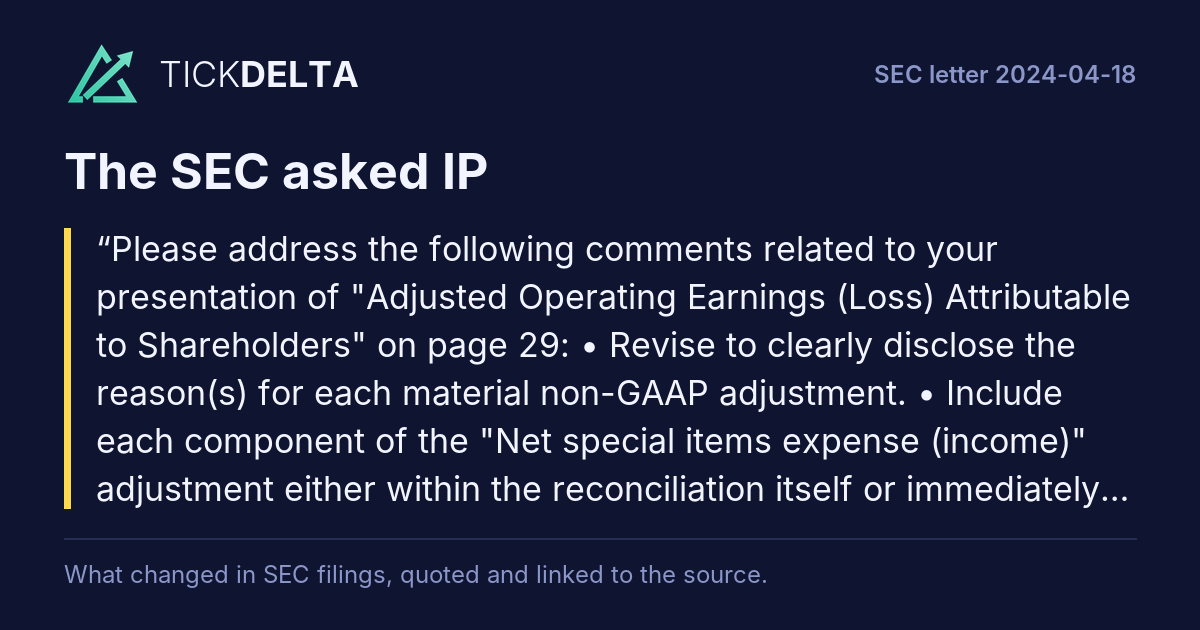
Although you provide a special items table on page 35, we note that the subtotals on page 35 do not agree with the non-GAAP adjustment in the reconciliation on page 29. Clarify for us what the difference represents.
Response
Please note that the Special Items table presented on page 35 of the Form 10-K does not include special items associated with equity earnings and interest income/expense. Those special items are discussed in the Interest Expense and Equity Earnings, Net of Taxes section immediately preceding the table on page 35 of the Form 10-K.
The Company has revised its disclosure on page 22 of its Quarterly Report on Form 10-Q for the period ended March 31, 2024, filed on April 26, 2024, by adding a footnote directing investors to a table on page 29 for a reconciliation of Net special items expense (income). Please see below the revised disclosure.
The following arc reconciliations of Net earnings (loss) to Adjusted operating earnings (loss) on a total and per share basis. Additional detail is provided later in this Form 10-Q regarding the net special items expense (income) referenced in the charts below.
Three Months Ended
March 31,
December 31,
In millions
2024
Net earnings (less)
$
172
(284
)
Less - Discontinued operations (gain) loss
—
Earnings (loss) from continuing operations
Add back - Non-operating pension expense (income)
(12
Add back - Net special items expense (income) (a)
546
Income taxes - Non-operating pension and special items
(1
(5
(134
Adjusted operating earnings (loss)
185
142
(a)
See page 29 for details of Net special items expense (income).
Additionally, the Company revised its disclosure on page 29 of its Quarterly Report on Form 10-Q for the period ended March 31, 2024, filed on April 26, 2024, by including special items amounts related to interest income/expense and equity earnings previously disclosed in other sections of the MD&A to tie back to our reconciliation on page 22 of the Quarterly Report on Form 10-Q for the period ended March 31, 2024. Please see below the revised table.
Effects of Net Special Items Expense (Income) and Non-Operating Pension Expense
Details of net special items expense (income) and non-operating pension expense (income) for the three months ended are as follows:
December 31.
In million
Before Tax
After Tax
Business Segments
Accelerated depreciation
422
317
Severance and other costs
(b)
118
Building a Better IP
(11
(8
) (c)
Business Segments Total
529
398
Corporate
Legal reserve adjustments
DS Smith combination costs
Net loss on miscellaneous land sales
Equity method investment impairment
Environmental remediation reserve adjustment
(6
Corporate Total
Interest expense, net
Interest related to settlement of tax audits
(10
(7
Interest related to timber monetization settlement
Interest Total
Total net special items expense (income)
411
Non-operating pension expense (income)
(9
Total net special items and non-operating pension expense (income)
560
Additionally, please note that the Company’s revised disclosures in its Quarterly Report on Form 10-Q for the period ended March 31, 2024, filed on April 26, 2024, resolve the subtotal issue raised by the Staff.
In future filings, beginning with the Quarterly Report on Form 10-Q for the period ending
June 30, 2024, the Company will present this information immediately following the reconciliation of Net earnings (loss) to Adjusted Operating Earnings.
Explain what “Non-operating pension (income)” represents and how you determined such adjustment is appropriate.
Response
In response to the Staff’s comment, the Company will revise future filings, beginning with the Quarterly Report on Form 10-Q for the period ending June 30, 2024, to explain what “non-operating pension expense (income)” represents. The Company proposes to include the bolded disclosure below:
Page 2 of
“Non-operating pension expense
(income)” represents amortization of prior service cost, amortization of actuarial gains/losses, expected return on assets and interest cost. The Company excludes these amounts from our non-GAAP measure as the Company does not believe these items reflect ongoing operations. These particular pension cost elements are not directly attributable to current employee service. The Company includes service cost in our non-GAAP measure as it is directly attributable to employee service, and the corresponding employees’ other compensation elements, in connection with ongoing operations.
Revise future filings to remove the accelerated depreciation adjustments included within special items.
Considering the underlying assets contribute to revenues, which have not been adjusted, it is not appropriate to remove the related depreciation.
Response
The
Company believes that it is appropriate to include the accelerated depreciation adjustments within special items.
In October 2023, the
Company announced plans to permanently idle its Orange, Texas mill and also permanently idle a pulp machine at each of the Pensacola, Florida and Riegelwood, North Carolina mills by the fourth quarter 2023. Based on the Company’s plans to permanently abandon these long-lived assets before the end of their previously estimated useful life, we accelerated depreciation expense to reflect the use of these assets over shortened useful lives in accordance with ASC 360-10-35-47. Without the adjustment, the Company’s non-GAAP measures would not be representative of the ongoing operations of the impacted businesses and would lack comparability between current period results and prior periods presented. We believe these adjustments to our non-GAAP measure are reasonable as the accelerated depreciation from abandoned assets did not contribute to revenue generation. We did not remove depreciation expense associated with these assets from our non-GAAP measure for amounts that contributed to revenue generation.
Clarify if you consider operating income (loss) to be the most directly comparable GAAP measure. If so, ensure you present and reconcile to operating income (loss) within your non-GAAP presentation.
Response
Company clarifies that management considers net earnings (loss) to be the most directly comparable GAAP measure relative to adjusted operating earnings (loss), our non-GAAP measure. Our GAAP and non-GAAP earnings measures include elements beyond those specifically attributable to operations, including interest expense. We believe both measures align closer to the net earnings (loss) measure, which is more encompassing as opposed to focused solely on operating results. The Company included this disclosure on page 29 of its Form 10-K and on page 21 of our Quarterly Report on Form
10-Q for the period ended March 31, 2024, filed on April 26, 2024. The Company will continue this disclosure in future filings. Please see below for the relevant disclosure from page 21 of our
Quarterly Report on Form 10-Q for the period ended March 31, 2024, in bolded text.
Adjusted Operating Earnings and Adjusted Operating Earnings Per Share are non-GAAP measures defined as net earnings (loss) (a GAAP measure) excluding discontinued operations, net special items and non-operating pension expense (income). Net earnings (loss) and Diluted earnings (loss) per share are the most directly comparable GAAP measures. The Company calculates Adjusted Operating Earnings by excluding the after-tax effect of
Page 3 of discontinued operations, non-operating pension expense (income) and items considered by management to be unusual (net special items) from net earnings
(loss) reported under GAAP. Adjusted Operating Earnings Per Share is calculated by dividing Adjusted Operating Earnings by diluted average shares of common stock outstanding. Management uses this measure to focus on on-going operations and believes that it is useful to investors because it enables them to perform meaningful comparisons of past and present consolidated operating results from continuing operations. The
Company believes that using this information, along with the most direct comparable GAAP measure, provides for a more complete analysis of the results of operations.
Clarify why you adjust for your environmental remediation reserve within special items when it appears as though such costs may be a normal part of your business. See Item 10(e)(1)(ii)(B) of Regulation S-K and Question 100.01 of the Staff’s Compliance and Disclosure Interpretations on Non-GAAP Financial Measures (“Non-GAAP C&DI’s”).
Response
Company believes that its adjustment for the environmental remediation reserve within special items in our Form 10-K is reasonable and appropriate because the reserve is not reflective of the Company’s underlying business operations. The Company included the environmental remediation reserve adjustment in special items in our Form 10-K because it relates to remediation work at a waste pit site last utilized by the predecessor owner of this mill in 1966. The Company acquired this mill in an acquisition but never operated it or utilized the waste pit site subject to remediation. The costs recognized did not contribute to the ongoing revenues of the
Company and therefore are not deemed reflective of our underlying business. The Company subtracted the item from our non-GAAP measure to provide investors with a comparable basis relative to other periods presented to evaluate the performance of our ongoing business. Please note that the Company does not treat amounts relating to asset retirement obligations or environmental remediation at active manufacturing sites as special items in our non-GAAP measures.
Considering your adjustments represent “items considered by management to be unusual,” please clarify whether your non-GAAP measure adjusts for the tax benefits, disclosed on pages 34, 38-39, 66, 73, and 79, related to the settlement of the timber monetization restructuring and the Sylvamo tax-free exchange. To the extent such items are already included in the income tax effect line item of your reconciliation, please advise and ensure you revise future filings to sufficiently disclose the nature of your income tax adjustments.
Response
The Company clarifies that its non-GAAP measure adjustment for tax benefits related to the settlement of the timber monetization restructuring and the Sylvamo tax-free exchange are included in the income tax effect line items of the special items reconciliation tables on pages 29 and 34 of our Form 10-K. In response to the Staff’s comment, the Company will revise future filings, beginning with the Quarterly Report on Form 10-Q for the period ending June 30,
2024, to provide investors additional detail to ensure clarity. This will include specific details of the tax components of net special items. The Company proposes adding to the table below the footnote shown (for ease of reference) in bolded text:
Page 4 of
2022
Net Earnings (Loss) Attributable to Shareholders
288
1,504
Less - Discontinued operations, net of taxes (gain) loss
237
Earnings (Loss) from Continuing Operations
302
1,741
(192
Add back - Net special items expense (income)
572
233
Income tax effect - Non-operating pension and special items1
(173
(614
Adjusted Operating Earnings (Loss) Attributable to Shareholders
755
1,168
Special items for 2022 include tax benefits of $604 million and $66 million related to the settlement of the timber monetization restructuring and the Sylvamo tax-free exchange, respectively. This amount also includes $45 million tax expense related to a foreign deferred tax valuation allowance, $48 million tax expense on the non-operating pension expense adjustment and $37 million tax benefit associated with special items.