IPG Photonics Corp IPGP
New risk paragraphs, branching off last year
Each branch is a paragraph in Risk Factors with nothing like it in the 10-K filed Feb 20, 2025. A box jumps to the paragraph as filed, below.
Paragraphs with nothing like them in last year's 10-K
14 paragraphs in Risk Factors of the 10-K filed Feb 23, 2026 with nothing like them in the 10-K filed Feb 20, 2025. Quoted exactly. Paragraphs that were only edited are under 10-K change.
investments, or increase costs associated with manufacturing and distributing products. An economic downturn could have a material adverse effect on our business, financial condition and results of operations.
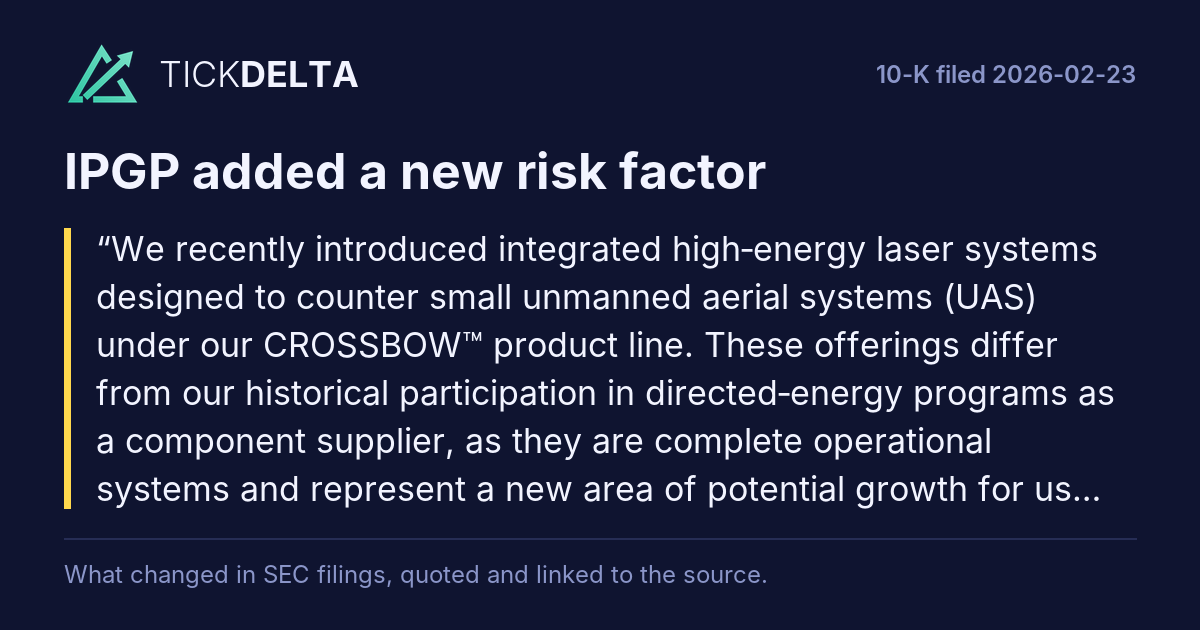
We recently introduced integrated high‑energy laser systems designed to counter small unmanned aerial systems (UAS) under our CROSSBOW™ product line. These offerings differ from our historical participation in directed‑energy programs as a
component supplier, as they are complete operational systems and represent a new area of potential growth for us. The commercial viability of this product line is uncertain, and it may not develop as we anticipate.
Adoption of counter‑UAS laser systems is still emerging. Defense and security procurement cycles can be long, unpredictable, and dependent on successful demonstrations, evaluations, and integration with existing architectures. Positive testing or customer interest may not lead to production contracts or sustained demand, and competing technologies from established defense contractors or alternative counter‑UAS providers could limit market opportunities.
If any of these risks materialize, our strategy to develop and commercialize the CROSSBOW product line may not be successful or generate the growth opportunities we anticipate.
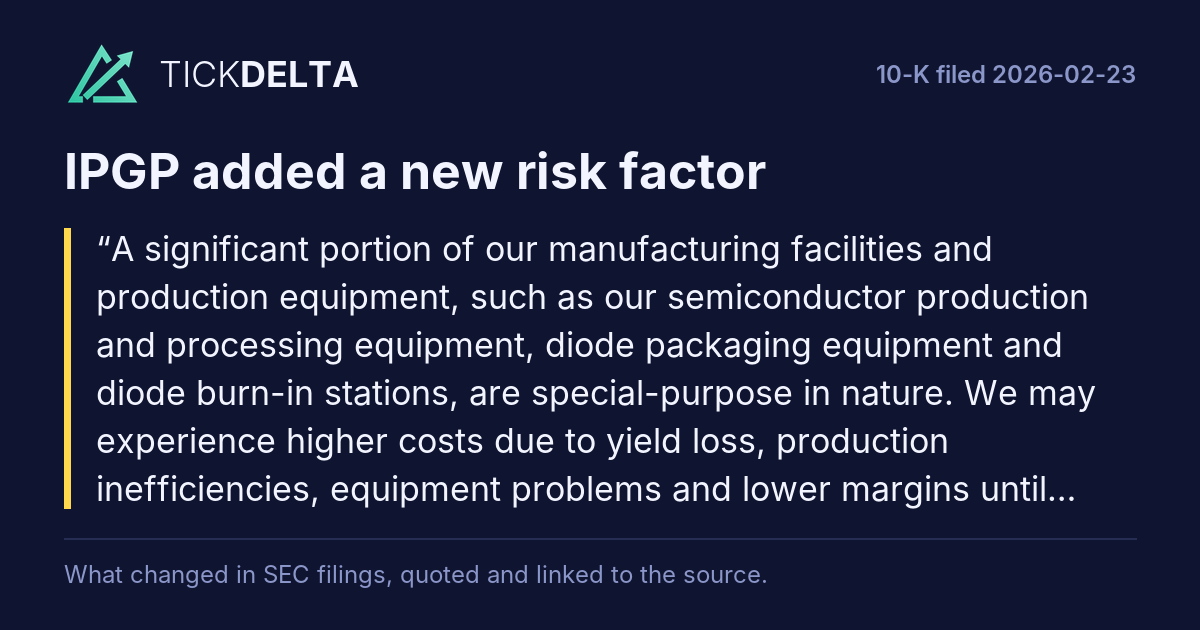
A significant portion of our manufacturing facilities and production equipment, such as our semiconductor production and processing equipment, diode packaging equipment and diode burn-in stations, are special-purpose in nature. We may experience higher costs due to yield loss, production inefficiencies, equipment problems and lower margins until any operational issues associated with the opening of new manufacturing facilities are resolved.
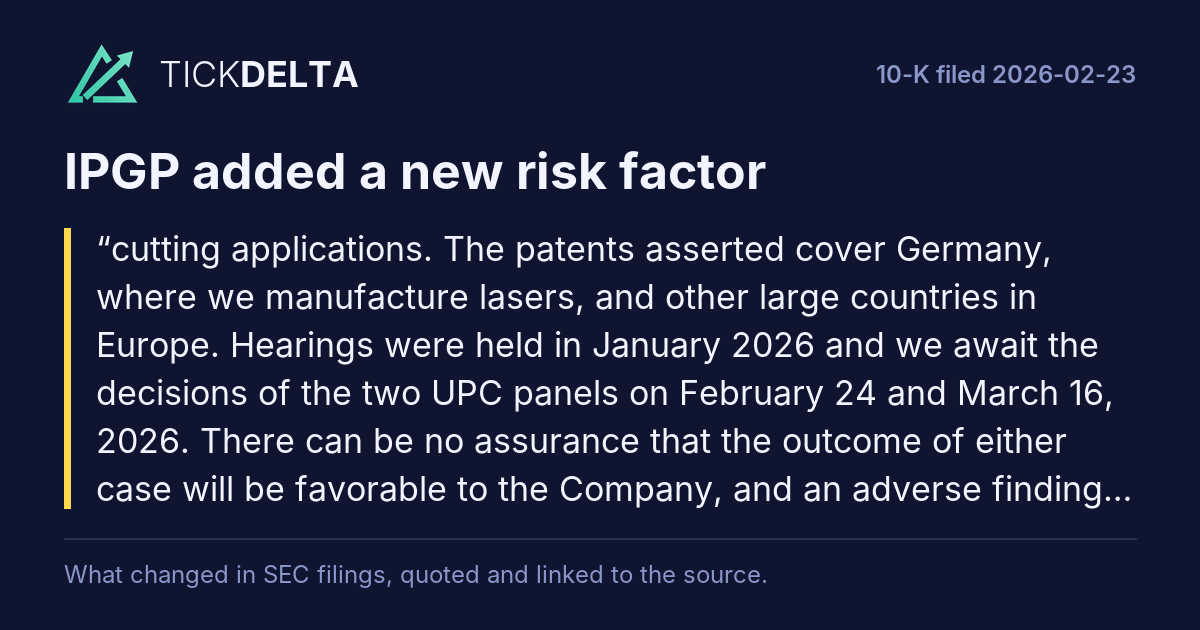
cutting applications. The patents asserted cover Germany, where we manufacture lasers, and other large countries in Europe. Hearings were held in January 2026 and we await the decisions of the two UPC panels on February 24 and March 16, 2026. There can be no assurance that the outcome of either case will be favorable to the Company, and an adverse finding that the Company infringed one or more of the patents‑in‑suit could have a material adverse effect on the Company and its business. The patents also have counterparts in the U.S., China and elsewhere, and there can be no assurance that Trumpf will not assert such patents in other jurisdictions.
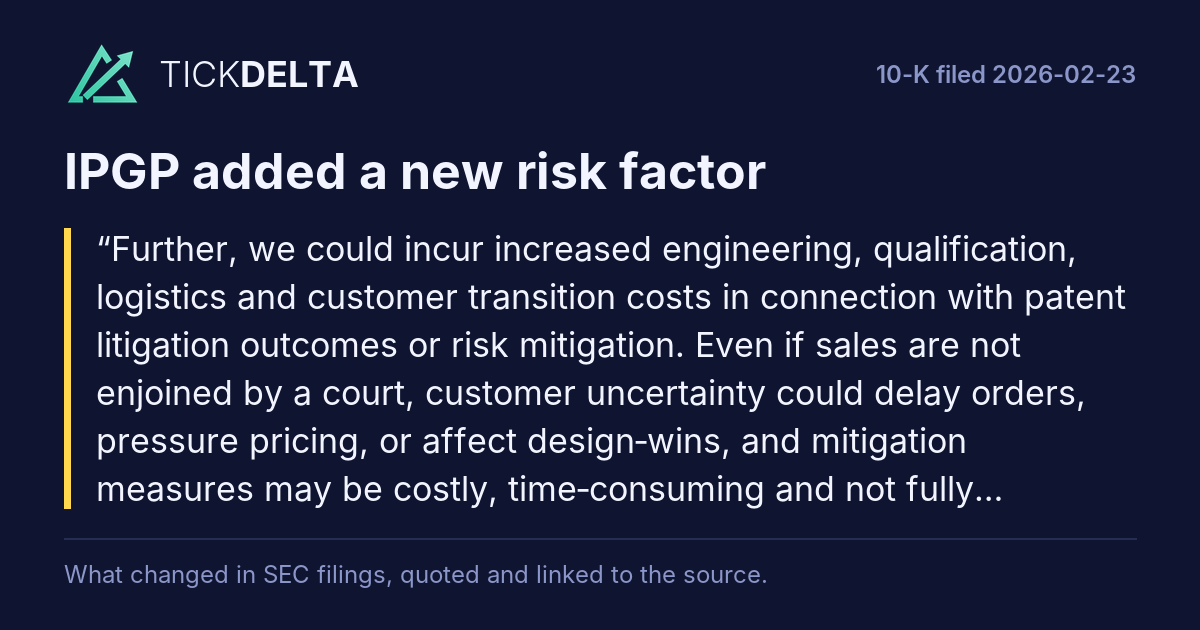
Further, we could incur increased engineering, qualification, logistics and customer transition costs in connection with patent litigation outcomes or risk mitigation. Even if sales are not enjoined by a court, customer uncertainty could delay orders, pressure pricing, or affect design‑wins, and mitigation measures may be costly, time‑consuming and not fully effective.
Show the other 5
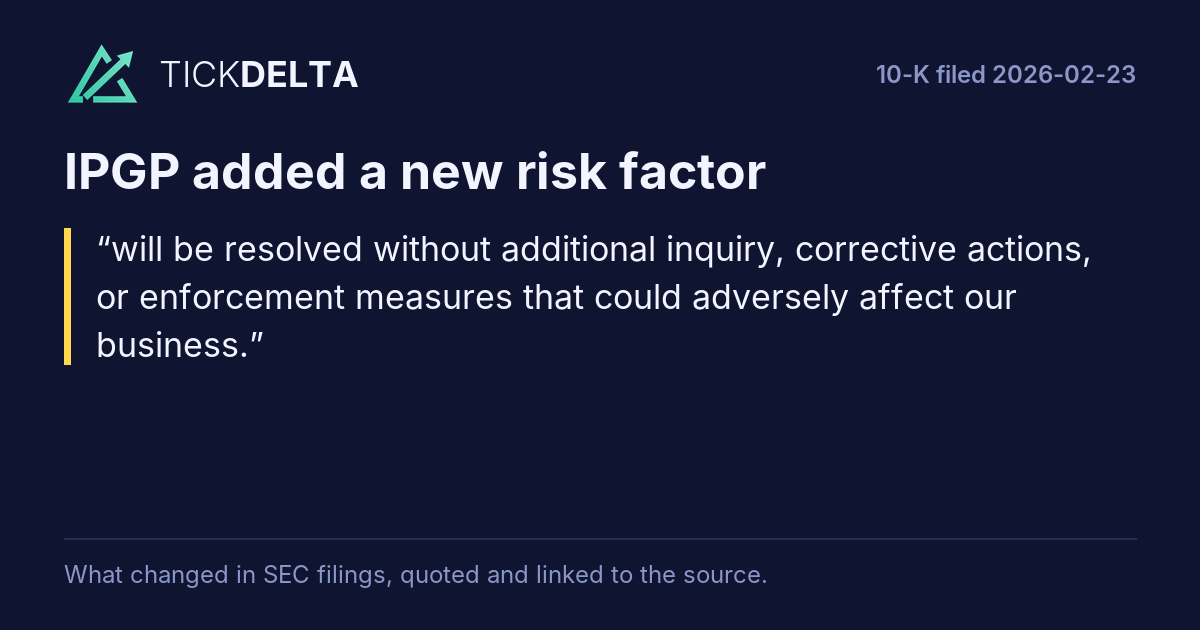
will be resolved without additional inquiry, corrective actions, or enforcement measures that could adversely affect our business.
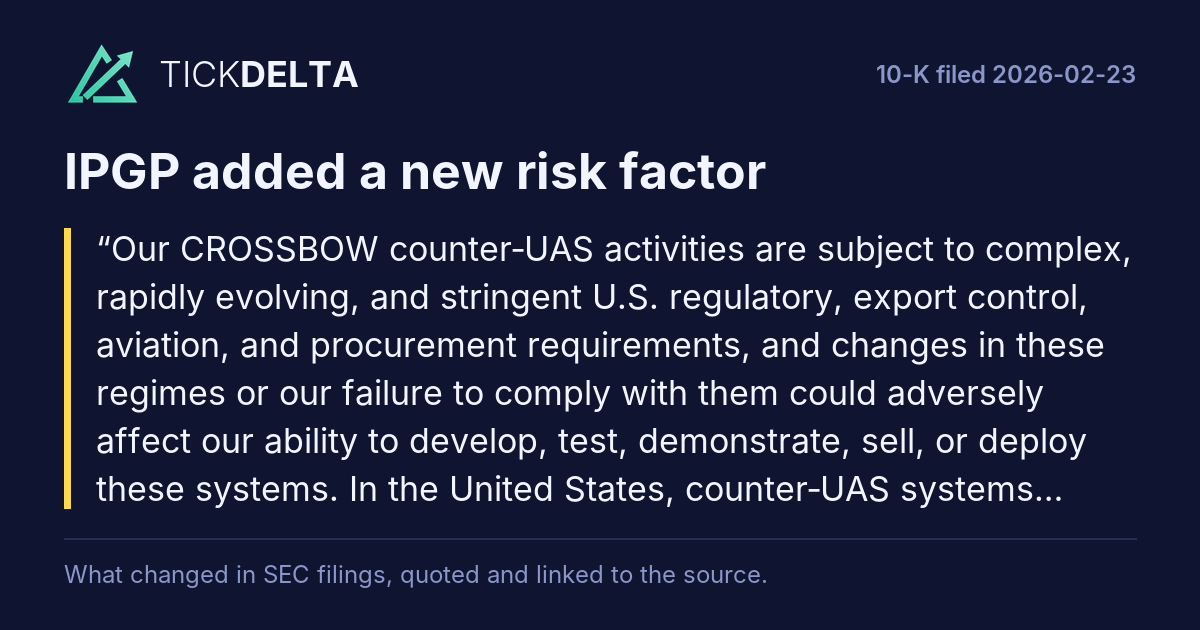
Our CROSSBOW counter‑UAS activities are subject to complex, rapidly evolving, and stringent U.S. regulatory, export control, aviation, and procurement requirements, and changes in these regimes or our failure to comply with them could adversely affect our ability to develop, test, demonstrate, sell, or deploy these systems.
In the United States, counter‑UAS systems operate within a highly regulated and rapidly evolving legal environment. The federal statutory and regulatory framework governing the development, use, sale and operation of counter‑UAS technologies continues to develop at a significant pace and is subject to change. We cannot predict the impact of future legal, regulatory, or policy changes by U.S. governmental entities relating to counter‑UAS technologies. New or amended laws, regulations, or policies could increase our compliance costs or restrict market opportunities for the testing, demonstration, sale, or use of counter‑UAS systems, including our CROSSBOW system. Our activities relating to CROSSBOW are also subject to stringent export control and government procurement requirements, including ITAR, EAR, and other domestic and international restrictions governing the classification, transfer, sale, end‑use, and end‑users of defense‑related technologies. Changes in these regulations, delays or difficulties in obtaining or maintaining required licenses or approvals, or adverse jurisdiction, classification, or end‑user determinations could restrict our ability to sell, deploy, or service CROSSBOW systems, particularly outside the United States. The development, testing and use of certain counter‑UAS laser systems in the United States may fall under the regulatory oversight of the Federal Aviation Administration (“FAA”) or other government agencies, depending on factors such as the operating environment and the nature of the customer. Although many of our potential U.S. government and defense customers operate pursuant to military or other federal authorizations outside the FAA’s civil regulatory framework, certain testing or demonstration activities may still require coordination with, or authorization from, the FAA and other agencies. Changes in applicable FAA or other governmental policies or requirements, or the inability to obtain or comply with any authorizations that may be required for particular testing or demonstration scenarios, or for the sale or deployment of CROSSBOW, could delay, limit, or prevent our ability to conduct such activities. Any of the foregoing regulatory developments, enforcement actions, or compliance challenges could restrict our ability to advance the CROSSBOW product line and limit its potential future contribution to our business.
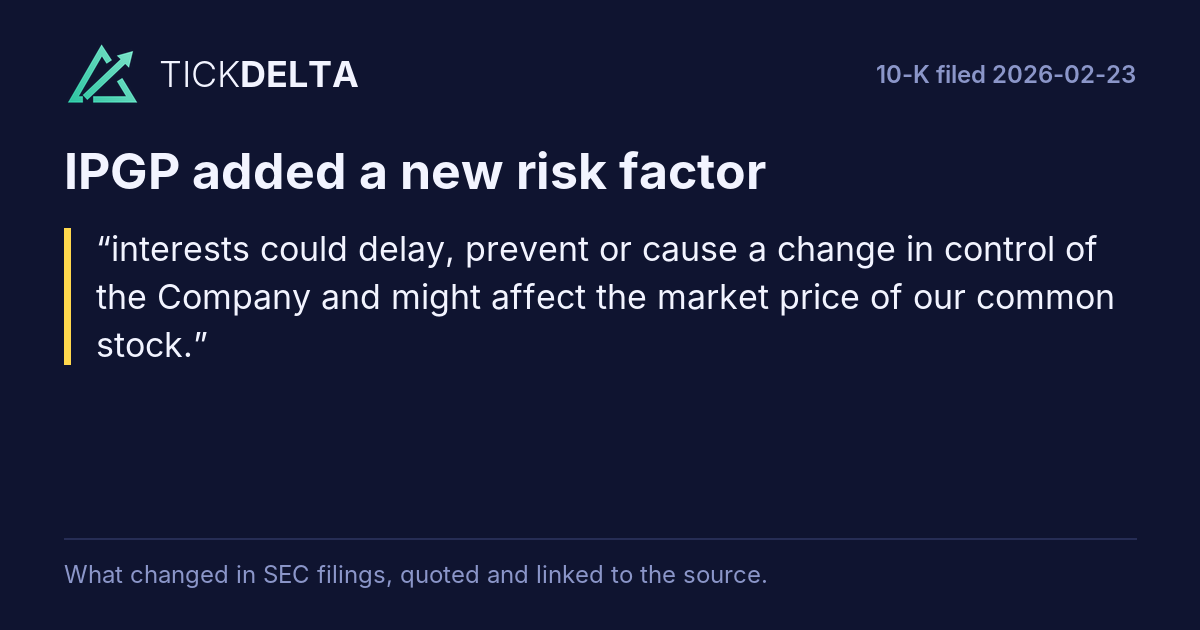
interests could delay, prevent or cause a change in control of the Company and might affect the market price of our common stock.
•prohibiting stockholder action by written consent after Dr. Gapontsev, together with his affiliates and associates, ceases to beneficially own an aggregate of 25% or more of our outstanding voting securities;
As of December 31, 2025, we had approximately $404 million of cash and cash equivalents, $436 million in short-term investments and $77 million in long-term investments. See Note 3, "Fair Value Measurements" in the Notes to Consolidated
Paragraphs in the 10-Q filed Nov 3, 2026 that were not in the one before
New in the latest 10-Q
18 paragraphs in the 10-Q filed Nov 3, 2026 with nothing like them in the 10-Q filed Aug 4, 2026 (at least half the words must differ; new numbers alone do not count). Quoted exactly, grouped by the item heading above them. This is text that changed, not a judgement of how serious it is.
Financial statements and notes
by $ 4,730 and $ 19,804, respectively, for the three and nine months ended September 30, 2025, respectively. This presentation change did not affect total sales. The following table presents the disaggregation of revenue under the new application framework:
Read in the 10-Q
In addition to the above, we hold certain equity investments that do not have readily determinable fair values for which we use the measurement alternative prescribed in FASB ASC Topic 321. Such investments are measured at cost, less any impairment, plus or minus changes resulting from observable price changes in orderly transactions for identical or similar investments of the same issuer. As of September 30, 2026, we held equity investments under the measurement alternative of $ 8,000, which are presented in Other assets in the Condensed Consolidated Balance Sheets. There were no equity investments under the measurement alternative as of December 31, 2025.
Read in the 10-Q
During the three months ended September 30, 2026, the Company entered into foreign exchange forward contracts, to mitigate the potential fluctuations of the purchase price of a foreign acquisition denominated in euros. The Company recognizes all derivative instruments as either assets or liabilities at fair value in the Consolidated Balance Sheets. The Company has not designated any derivatives as hedging instruments.
Read in the 10-Q
As of September 30, 2026, we had the following outstanding currency forward contracts.
Read in the 10-Q
The Company recognizes all derivative financial instruments as either assets or liabilities at fair value in the Consolidated Balance Sheets. The fair value amounts in the Consolidated Balance Sheets were:
Read in the 10-Q
Show the other 13
Prepaid expenses and other current assets Accrued Expenses and other current liabilities September 30, December 31, September 30, December 31, 2026 2025 2026 2025 $ $ $ 5,313 $
Read in the 10-Q
There were $5,313 of derivative losses presented in Loss on foreign exchange in the Consolidated Statements of Income for the three and nine months ended September 30, 2026. There were no derivative gains nor losses for the three and nine months ended September 30, 2025, as the Company did not hold any such instruments in 2025.
Read in the 10-Q
On October 14, 2026, the government of Belarus approved the sale of the Company's Belarusian operations to a third-party that previously signed a purchase and sale agreement with the Company. The Company currently expects the transaction to close in the fourth quarter of 2026, subject to the satisfaction of the remaining closing conditions. Future changes in estimated fair value less costs to sell, foreign currency exchange rates, or other developments related to the planned disposition through the closing date could result in additional charges or adjustments, however, the Company does not expect any such charges or adjustments to be material to the consolidated financial statements.
Read in the 10-Q
On October 30, 2026, the Company’s Board of Directors approved the sale of certain properties as part of the Company’s ongoing efforts to optimize its real estate footprint. As a result of the Board’s approval, the properties satisfy the assets held for sale criteria in the fourth quarter of 2026 resulting in an estimated pre-tax impairment charge of approximately $ 25,000 to adjust the carrying value of the properties to their estimated fair value less costs to sell. The estimate is preliminary and may change based on the Company’s final costs to sell and other factors. The sales of these properties are expected to be completed in 2027.
Read in the 10-Q
On October 14, 2026, subsequent to the end of the third quarter, the government of Belarus approved the sale of our Belarusian operations to a third-party that previously signed a purchase and sale agreement with us. We currently expect the transaction to close in the fourth quarter of 2026, subject to the satisfaction of the remaining closing conditions. Future changes in estimated fair value less costs to sell, foreign currency exchange rates, or other developments related to the planned disposition through the closing date could result in additional charges or adjustments, however, we do not expect any such charges or adjustments to be material to the consolidated financial statements.
Read in the 10-Q
Real estate footprint optimization. We periodically evaluate our global property portfolio and facility utilization to identify opportunities to improve operational efficiency, optimize capacity, consolidate operations and reduce operating costs. As these evaluations progress, we may determine that certain properties or other long-lived assets should be marketed for sale, leased or abandoned. Such actions could result in the recognition of material impairment charges, accelerated depreciation, disposal-related costs or other such charges in future reporting periods.
Read in the 10-Q
On October 30, 2026, our Board of Directors approved the sale of certain properties as part of our ongoing efforts to optimize our real estate footprint. As a result of the Board’s approval, the properties satisfy the assets held for sale criteria in the fourth quarter of 2026 resulting in a pre-tax impairment charge of approximately $25 million to adjust the carrying value of the properties to their estimated fair value less costs to sell. The estimate is preliminary and may change based on our final costs to sell and other factors. The sales of these properties are expected to be completed in 2027.
Read in the 10-Q
On September 8, 2026, we entered into a definitive agreement with Lumibird S.A., a French société anonyme ("the Seller"), to acquire 100% of the outstanding shares of Lumibird Medical, a French société par actions simplifiée and wholly-owned subsidiary of the Seller, for a purchase price of €300 million (approximately $340.3 million) on a cash-free, debt-free basis, payable in cash at closing and subject to customary adjustments as set forth in the agreement. The agreement also provides for contingent earn-out consideration of up to €50 million (approximately $56.7 million) in additional cash based on the achievement of certain 2026 and 2027 performance metrics. U.S. dollar equivalents of euro-denominated amounts are presented for convenience and are based on the exchange rate in effect on September 30, 2026. The Company has entered into foreign currency hedging arrangements with respect to a portion of the purchase price; accordingly, the ultimate U.S. dollar cash cost may differ from the amounts presented above.
Read in the 10-Q
Upon closing, this transaction will result in a material expected cash outflow of €300 million (approximately $340.3 million) to the Seller in the fourth quarter of 2026, plus potential additional cash payments to the Seller up to €50 million (approximately $56.7 million) in total related to contingent consideration in the second quarters of 2027 and 2028, which will significantly reduce our near-term cash balances.
Read in the 10-Q
• an increase in cash used by accrued expenses and other current liabilities, primarily due to an increase in cash bonus payments made in 2026 compared to 2025 based on improved financial performance, a decrease in billings in excess of cost and estimated earnings on customized systems under contract, higher warranty payments, and a reduction in customer deposits, partially offset by increases in cash due to the timing of payments for non-performance-based accrued personnel costs, lower lease payments, and an increase in deferred revenue;
Read in the 10-Q
Other information
• on August 27, 2026, Mr. Paulus Bucher, Senior Vice President, Global Operations of the Registrant, adopted a Rule 10b5-1 trading arrangement providing for the sale from time to time of an aggregate of up to 2,604 shares, including shares acquired upon vesting of restricted stock units. The trading arrangement is intended to satisfy the affirmative defense in Rule 10b5-1(c). The duration of the trading arrangement is until May 10, 2027, or earlier if all transactions under the trading arrangement are completed.
Read in the 10-Q
• on September 14, 2026, Ms. Mary Buttarazzi, Vice President, Corporate Controller and Chief Accounting Officer of the Registrant, adopted a Rule 10b5-1 trading arrangement providing for the sale from time to time of an aggregate of up to 2,257 shares, including shares acquired upon vesting of restricted stock units. The trading arrangement is intended to satisfy the affirmative defense in Rule 10b5-1(c). The duration of the trading arrangement is until December 31, 2027, or earlier if all transactions under the trading arrangement are completed.
Read in the 10-Q
Item 6
* Schedules and similar attachments have been omitted pursuant to Item 601(a)(5) of Regulation S-K. The Company will furnish a copy of any omitted schedule or attachment to the U.S. Securities and Exchange Commission upon request.
Read in the 10-Q
The 10-Q's risk factors against the 10-K
Item 1A of the 10-Q filed Nov 3, 2026 against Item 1A of the 10-K filed Feb 23, 2026.
A 10-Q repeats only the risks that changed, so a 10-K paragraph that is missing from it is not counted as removed.
Added is a paragraph with nothing like it in the 10-K, Reworded a sentence that is in both with several words changed,
Quiet changes a sentence in both where one to four words changed and one is a hedge or a modal
(cut words struck through, new words highlighted).
Text on the page, not a score; each links to the filing at sec.gov.
Phrases used for the first time
Two-word phrases in Risk Factors of the 10-K filed Feb 23, 2026 that are in none of the 1 earlier 10-Ks stored, back to Feb 20, 2025
Where each one is used
- counter uas: Adoption of counter‑UAS laser systems is still emerging. Defense and security procurement cycles can be long, unpredictable, and dependent on successful demonstrations, evaluations, and integration with existing architectures. Positive testing or customer interest may not lead to production contracts or sustained...
- crossbow product: We recently introduced integrated high‑energy laser systems designed to counter small unmanned aerial systems (UAS) under our CROSSBOW™ product line. These offerings differ from our historical participation in directed‑energy programs as a
- uas laser: Adoption of counter‑UAS laser systems is still emerging. Defense and security procurement cycles can be long, unpredictable, and dependent on successful demonstrations, evaluations, and integration with existing architectures. Positive testing or customer interest may not lead to production contracts or sustained...
- market opportunities: Adoption of counter‑UAS laser systems is still emerging. Defense and security procurement cycles can be long, unpredictable, and dependent on successful demonstrations, evaluations, and integration with existing architectures. Positive testing or customer interest may not lead to production contracts or sustained...
- uncertainty regarding: There can be no assurance that we will be able to resolve any claims or other allegations made or asserted against us without them having a material impact on our results of operations. Even if we ultimately are successful on the merits of any such litigation or re-examination, legal and administrative proceedings...
- trumpf litigation: If we do not prevail in any intellectual property litigation brought against us, it could affect our ability to sell our products and materially harm our business, financial condition and results of operations. These developments could adversely affect our ability to compete for customers and increase our revenues,...
- ipg medical: We design, manufacture and commercialize fiber laser systems and related accessories for specific medical applications. Through IPG Medical Corporation, we are the legal manufacturer of certain of these products and hold FDA clearances for their marketing and sale in the United States. As the legal manufacturer, we...
- medical corporation: We design, manufacture and commercialize fiber laser systems and related accessories for specific medical applications. Through IPG Medical Corporation, we are the legal manufacturer of certain of these products and hold FDA clearances for their marketing and sale in the United States. As the legal manufacturer, we...
Used at least twice, small words left out. Counted, not picked: a phrase can be new because the company renamed something.
What was taken out
4 paragraphs of last year's Risk Factors with nothing like them now. The longest are quoted.
Sources
Item 1A of each 10-K and 10-Q on EDGAR, quoted exactly. Each paragraph links to the filing at sec.gov.
Also
10-K change: what was reworded or cut, section by section.
Work with it
Excel workbook · CSV. Google Sheet that stays up to date: paste =IMPORTDATA("https://tickdelta.com/company/IPGP/export.csv") into a cell.