Form 10-K
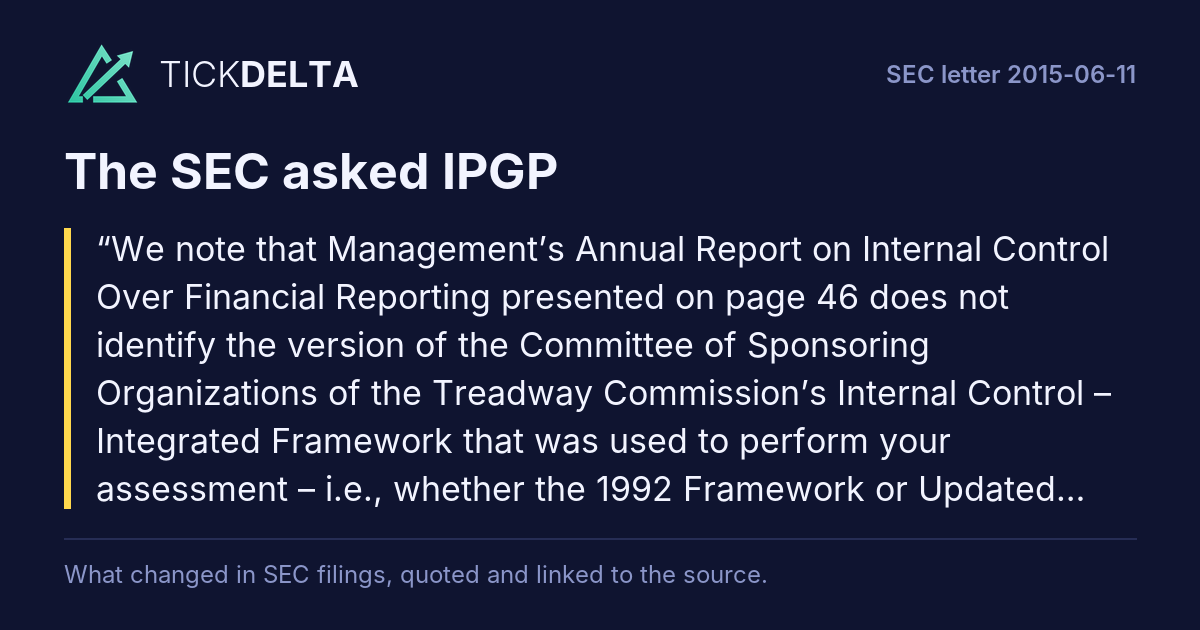
We note that Management’s Annual Report on Internal Control Over Financial Reporting presented on page 46 does not identify the version of the Committee of Sponsoring Organizations of the Treadway Commission’s Internal Control – Integrated Framework that was used to perform your assessment – i.e., whether the 1992 Framework or Updated Framework issued in 2013 was used.Rest of the question
In future filings, please identify the version of the COSO Integrated Framework you used in the assessment. Please refer to Item 308(a)(2) of Regulation S-K and paragraphs 167(l) and (m) of PCAOB Auditing Standard No. 2.
In assessing our internal controls over financial reporting for the year ended December 31, 2014, we used the COSO Updated Framework issued in 2013. In future filings we will disclose the specific version of the COSO Integrated Framework used in such assessment.Read in the reply
First report after the company's reply of Jun 23, 2015: 10-Q filed Aug 3, 2015 ↗, against the 10-Q filed May 6, 2015 ↗.
Tickdelta does not hold the text of both reports, so they are not compared here.
Please tell us why Dr. Valentin P. Gapontsev does not claim beneficial ownership of the shares held in each of the three trusts created by Dr. Gapontsev.
Under Rule 13d-3 of the Securities and Exchange Act of 1934, as amended, the determination of “beneficial ownership” has two primary components: that the person directly or indirectly has or shares (1) voting power and/or (2) investment power over the securities in question. Under this determination, “voting power” includes the power to vote, or to direct the voting of, the security. “Investment power” includes the power to dispose of, or to direct the disposition of, the security. Beneficial ownership can be shared by security holders and can arise directly or indirectly.Read in the replyRest of the answer
In addition, when calculating the number of securities beneficially owned, a person must include that person’s right to acquire beneficial ownership of securities within 60 days.
Dr. Gapontsev does not claim beneficial ownership of the shares owned by the three trusts he created because, as detailed below, he has neither sole nor shared voting or investment power over the Company securities held by such trusts and, further, he has no right to acquire such beneficial ownership within 60 days.
Dr. Gapontsev created The Valentin Gapontsev Trust I, The Valentin Gapontsev Trust II and The Valentin Gapontsev Trust III (each a “Trust” and collectively the “Trusts”) in 2010, 2010 and 2012, respectively, for estate planning purposes. The Trusts are irrevocable trusts into which he transferred shares of the Company. In addition, the Trusts each have four trustees who manage the affairs of the respective Trusts, have fiduciary duties to the beneficiaries of the Trusts and are charged with making decisions regarding the assets held by the Trusts (including, as applicable, voting and investment decisions), as further described below.
Neither Dr. Gapontsev nor any resident of his household is a beneficiary of any Trust. Further, neither Dr. Gapontsev nor any resident of his household is a trustee of any Trust. The trustees of each Trust meet periodically as a group to make both the voting decisions and the investment decisions with respect to the Company shares held by such Trust and are the only persons empowered to make such decisions on behalf of the Trusts. As Dr. Gapontsev is not a trustee, he does not participate as a decision-maker. As such, under the terms of the Trusts, Dr. Gapontsev has neither sole nor shared voting or investment power over any of the assets in the Trust, including the Company shares held by such Trusts. Furthermore, Dr. Gapontsev does not have the ability to remove the trustees.
The Trusts are irrevocable, which means that neither Dr. Gapontsev nor the trustees can terminate the Trusts. Also, Dr. Gapontsev cannot require the transfer of shares from any Trust to him under the Trust agreement terms. As a result, under the terms of the Trusts, he does not have the right to acquire beneficial ownership of the Company shares owned of record by the Trusts within 60 days.
First report after the company's reply of Jun 23, 2015: 10-Q filed Aug 3, 2015 ↗, against the 10-Q filed May 6, 2015 ↗.
Tickdelta does not hold the text of both reports, so they are not compared here.
We note from pages 7 through 9 that you offer a number of different products and in your earnings release you also discuss and quantify sales for different products. Please explain to us your consideration of the guidance in FASB ASC 280-10-50-40 with respect to revenues for each product.
Relative to disclosure of product information, ASC 280-10-50-40 states that a public entity shall report the revenues from external customers for each product and service or each group of similar products and services unless it is impracticable to do so. The amounts of revenues reported shall be based on the financial information used to produce the public entity's general-purpose financial statements.Read in the replyRest of the answer
If providing the information is impracticable, that fact shall be disclosed.
Our disclosure aggregates product disclosures into two components, Materials Processing products and Other Applications, due to the similarity of the products sold and the applications and end markets they address.
We aggregate our disclosure between Materials Processing Applications and Other Applications because they are similar in the following areas:
The Nature of the Products and Services. Fiber lasers are primarily distinguished by their output power, wavelength and pulse duration or beam profile. However, regardless of these distinctions, all fiber lasers use the same core components. Namely, their light sources are packaged semiconductor diodes, their amplification medium is fiber optics doped with rare earth elements and their output is comprised of optical processing fibers which are sometimes combined with optical accessories such as processing heads. A higher power laser uses more or higher capacity components than a lower power laser but is otherwise similar in design. A pulsed laser also uses these same components. Historically, all the lasers the Company sold for Materials Processing have been of the same wavelength (1 micron), while for Other Applications the wavelength can vary between 1 micron and 2 microns.
The Nature of the Production Process. All products are manufactured alongside each other at our three major manufacturing centers in the United States, Germany and Russia. Many optical components are manufactured in two or more facilities and each facility makes finished products for its geographic end market as well as for other geographies. For example, semiconductor chips-on-submount are exclusively manufactured in the Unites States but are packaged into semiconductor laser diodes at all three facilities.
The Types or Class of Customer for the Products and Services. Materials Processing customers are mostly engaged in industrial applications deploying the lasers in the core materials processing applications of metal cutting, welding, marking, engraving, metal deposition and ablation. It is not practicable to report on sales by end application because we are not always able to definitively determine the final use application by our customers and we are only able to determine broad trends for application sales growth. Sales to Other Applications include sales for Advanced Applications, Medical and Telecommunications. Other Application sales are in total less than 5% of all sales so we do not break them out between the separate Other Applications. However, historically we have done so when one or each of these Other Applications was a larger percentage of total sales.
First report after the company's reply of Jun 23, 2015: 10-Q filed Aug 3, 2015 ↗, against the 10-Q filed May 6, 2015 ↗.
Tickdelta does not hold the text of both reports, so they are not compared here.
Also in this review: closing letter, 2015-07-06