Screener / SEC EDGAR /CIK 0001111928 /10-K filed Feb 23, 2026, compared with Feb 20, 2025 /Numbers from the XBRL of the 10-Ks
Nasdaq Technology · Semiconductors

IPG Photonics Corp IPGP

Compare with peers Embed
The 10-K against last year's

123 changes: 25 added, 16 removed, 81 reworded, 1 quiet changes

10-K Feb 23, 2026 vs Feb 20, 2025

10-K 0001111928-26-000040 (Feb 23, 2026) vs 10-K 0001111928-25-000023 (Feb 20, 2025)

Every paragraph, and how much of it changed

One bar per paragraph, in the order of the 10-K. Height and colour show the share of its words not in the closest paragraph a year earlier; the tallest bars are new paragraphs.

Risk Factors

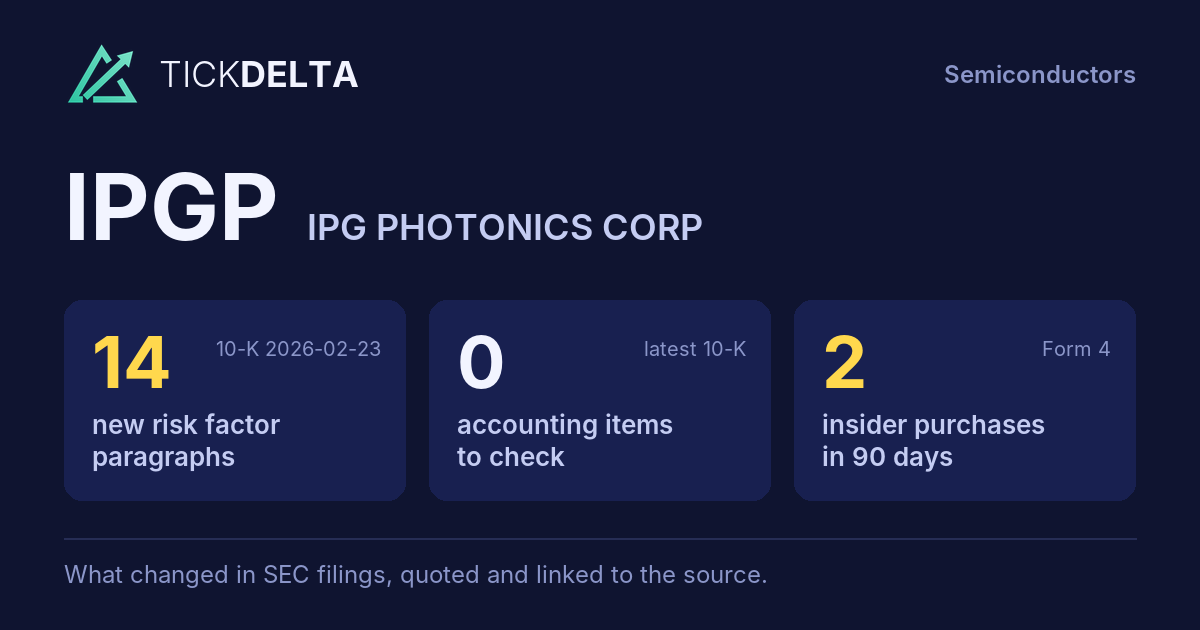
136 paragraphs · 14 new · 42 reworded · 4 gone · 10-K Feb 23, 2026 against Feb 20, 2025
New paragraph Reworded (5% of its words or more) Same or nearly
Paragraph 94 · 49% changed Every version of it
•establishing a classified board effective at the next annual meeting of stockholders after Dr. Gapontsev, together with his affiliates and associates, ceases to beneficially own an aggregate of 25% or more of our outstanding voting securities, and providing that directors thereon may only be removed for cause;
Paragraph 38 · 49% changed Every version of it
A significant part of our business involves the export and import of components and products among many countries, including the U.S., Germany and China. Historically, we also exported and imported a limited number of components and products in Russia and Belarus with entities we operated in those regions, and our subsidiary in India imports a limited number of medical devices from our former Russian subsidiary pursuant to an agreement entered into in connection with the disposition of such subsidiary in 2024. The U.S. government and governments of other countries in which we do business have Trade Controls that impact our ability to export, re-export or transfer products, software and technology originating in those countries. Trade Controls may require that we obtain a license before we can export, re-export or transfer certain products, software or technology. The requirement to obtain a license could put us at a competitive disadvantage by restricting our ability to sell products to customers in certain countries or by giving rise to delays or expenses related to obtaining a license. We have experienced and, in the future, may experience delays in obtaining export licenses based on issues solely within the control of the applicable government agency. Licenses may also include conditions that limit the use, resale, transfer, re-export, modification, disassembly, or transfer of a product, software or technology after it is exported without first obtaining permission from the relevant government agency. Delays in obtaining or failure to obtain required export licenses may require us to defer shipments for substantial periods or cancel orders. Any of these circumstances could adversely affect our operations and, as a result, our financial results could suffer. Although we have implemented compliance measures designed to prevent transactions prohibited by current or future Trade Controls, we have previously identified, and may continue to identify, instances in which we exported products without obtaining the required export authorizations and/or submitting the required requests. As a result, we have submitted a limited number of voluntary self-disclosures regarding compliance with export control laws and regulations with the U.S. Department of Commerce’s Bureau of Industry and Security (“BIS”). BIS issued warning letters to the Company in response to the self-disclosures. Our failure to comply with these laws and regulations could result in costly government investigations, government sanctions, including substantial monetary penalties, civil or criminal penalties, denial of export privileges, debarment from government contracts, and a loss of revenues and reputational harm.
Paragraph 60 · 48% changed Every version of it
Given our reliance on trade secret laws, others may independently develop similar or alternative technologies or duplicate our technologies and commercialize discoveries that we have made. Therefore, our intellectual property efforts may be insufficient to maintain our competitive advantage or to stop other parties from commercializing similar products or technologies. Many countries outside of the United States afford little or no protection to trade secrets and other intellectual property rights. Intellectual property litigation can be time-consuming and expensive, and there is no guarantee that we will have the resources to fully enforce our rights. If we are unable to prevent misappropriation or infringement of our intellectual property rights, or the independent development or design of similar technologies, our competitive position and operating results could suffer.
Paragraph 81 · 40% changed Every version of it
Policy changes and proposals could require time-consuming and expensive alterations to our business operations and may result in greater restrictions and economic uncertainty and disincentives on international trade, which could negatively impact our competitiveness in jurisdictions around the world as well as lead to an increase in costs in our supply chain. We are a multinational corporation, with manufacturing located both in the United States and internationally and with approximately 75% of our net sales arising from foreign customers. As such, we may be more susceptible to negative impacts from these tariffs or change in trade policies than other less internationally focused enterprises. In addition, new tariffs and other changes in U.S. trade policy could trigger retaliatory actions by affected countries, and certain foreign governments, including the Chinese government (which has imposed retaliatory tariffs on a range of U.S. goods including certain optical and electronic products and components), may impose trade sanctions on certain U.S. manufactured goods. Such changes by the United States and other countries have the potential to adversely impact U.S. and worldwide economic conditions, our industry and the global demand for our products, and as a result, could negatively affect our business, financial condition and results of operations.
Paragraph 32 · 40% changed Every version of it
We generally do not enter into long-term agreements with our customers obligating them to purchase our fiber lasers or amplifiers. Our business is characterized by short-term purchase orders and shipment schedules and, in some cases, orders may be canceled or delayed without significant penalty or any penalty. As a result, it is difficult to forecast our revenues and to determine the appropriate levels of inventory required to meet future demand. In addition, due to the absence of long-term volume purchase agreements, we forecast our revenues and plan our production and inventory levels based upon the demand forecasts of our OEM customers, end users and distributors, which are highly unpredictable and can fluctuate substantially. This could lead to increased inventory levels and increased carrying costs and risk of excess or obsolete inventory due to unanticipated reductions in purchases by our customers. In addition, provisions have been recorded as a result of changes in market prices of certain components, the value of those inventories that was realizable through finished product sales due to declines in certain end market demand and uncertainties related to the recoverability of the value of inventories due to technological and product changes, and excess quantities. If our OEM customers, end users or distributors fail to accurately forecast the demand for our products, fail to accurately forecast the timing of such demand, or are unable to consistently negotiate acceptable purchase order terms with customers, our results of operations may be adversely affected.
Paragraph 28 · 38% changed Every version of it
To maintain We have added manufacturing capacity at our competitive position and to meet anticipated demand for our products, we invest significantly facilities in the expansion of our manufacturing United States, Germany, Italy and operations throughout the world and may do so in the future. Recent expansions Poland. Expansion of capacity were was required to offset the loss of capacity at our the factories we operated in Russia and Belarus due to sanctions. In connection with these expansion projects, we may incur cost overruns, construction delays, project cancellations, labor difficulties cancellations or regulatory issues which could cause our capital expenditures to be higher than what we currently anticipate, possibly by a material amount, which would in turn adversely impact our operating results. Moreover, If our sales do not increase or if our revenue decreases from current levels, we may experience higher costs due to yield loss, production inefficiencies, equipment problems have significant excess manufacturing capacity and lower under-absorption of our fixed costs, which has adversely impacted and could adversely affect our gross margins until any operational issues associated with the opening of new manufacturing facilities are resolved. and profitability.
Paragraph 80 · 36% changed Every version of it
The United States, Germany, the European Union, China, Japan, South Korea and many other foreign governments impose tariffs and duties on the import of products, including some of those which we sell. In recent years, the U.S. instituted changes in trade policies that included the negotiation or termination of trade agreements, the imposition of higher tariffs on imports into the United States, including, in particular, on Russian and Chinese-made goods, economic sanctions on individuals, corporations or countries and other government regulations affecting trade between the United States and other countries where we conduct our business. On February 20, 2026, the U.S. Supreme Court rendered a decision invalidating tariffs imposed under the International Emergency Economic Powers Act. This decision introduces uncertainty regarding potential refund processes and future trade policy actions.
Paragraph 126 · 34% changed Every version of it
We may make acquisitions of and investments in new businesses, products, patents and technologies and expand into new geographic areas, or we may acquire operations, products or technologies that expand our current capabilities. Although we have pursued relatively small acquisitions in the past, we may pursue larger transactions in the future. Acquisitions present a number of potential risks and challenges that could, if not met, disrupt our business operations, increase our operating costs, reduce consolidated margins, cause us to incur impairment charges and reduce the value of the acquired company, asset or technology to us. We may not be able to effectively integrate acquired businesses, business cultures, products, patents or technologies into our existing business and products, or retain key employees. As a result of the rapid pace of technological change in our industry, we may misjudge the long-term potential of an acquired business, product, patent or technology, or the acquisition may not be complementary to our existing business. Furthermore, potential acquisitions and investments, whether or not consummated, may divert our management's attention, require considerable cash outlays at the expense of our existing operations, incur unanticipated costs or liabilities, including the costs associated with improving the internal controls of the acquired company. In addition, to complete future acquisitions, we may issue equity securities, incur debt, assume contingent liabilities or have amortization expenses and write-downs of acquired assets, which could adversely affect our profitability and result in dilution to our existing and future stockholders.

MD&A

108 paragraphs · 11 new · 51 reworded · 12 gone · 10-K Feb 23, 2026 against Feb 20, 2025
New paragraph Reworded (5% of its words or more) Same or nearly
Paragraph 76 · 48% changed
Restructuring charges (recoveries), net. We recorded incurred $0.6 million in restructuring charges during the year ended December 31, 2025, related to an assessment and further oversight of our Belarusian operations. There were no restructuring charges nor recoveries in 2024 as compared to a net restructuring gain of $0.3 million in 2023 primarily related to during the completion of our restructuring program at our Russian subsidiary. year ended December 31, 2024.
Paragraph 78 · 46% changed
Interest income, net. Interest income, net was $29.9 million in 2025 compared to $45.5 million in 2024 compared to $41.7 million in 2023. 2024. The change in interest income, net, net was driven by an increase primarily due to a reduction in yields on average cash equivalents and short term investments as a result of higher market investment balances, lower weighted average interest rates across our investment portfolio and geographic mix in the current period as compared to the prior year rates. year.
Paragraph 104 · 46% changed
•an increase in cash provided used by accounts receivable prepaid expenses and other assets due to the timing of collections bank acceptance drafts and lower sales; interest received.
Paragraph 102 · 45% changed
•an increase in cash provided used by accounts receivable due to higher sales at the timing end of collections and lower sales; 2025 not yet collected as compared to 2024;
Paragraph 42 · 42% changed
As noted above, during the year ended December 31, 2024, we completed an impairment analysis of the assets located in Belarus as a result of new EU sanctions that limited our ability to supply laser cabinets and other mechanical components from that facility. Based on this analysis, we recorded a $26.6 million impairment of long-lived assets included in Impairment of long-lived assets in our Consolidated Statements of Operations. After impairment, At December 31, 2025, the remaining carrying value of the long-lived assets in Belarus is $3.8 $4.4 million.
Paragraph 75 · 40% changed
Impairment of long-lived assets. We recorded a non-cash long-lived asset impairment charge of $27.0 million in 2024 as compared to $1.2 million in 2023. The impairment of long-lived assets in 2024 was primarily related to During the during the year ended December 31, 2024, we completed an impairment analysis of the assets located in Belarus of $26.6 million as a result of new EU sanctions that will limit limited our ability to supply laser cabinets and other mechanical components from our factory in Belarus. The that facility. Based on this analysis, we recorded $26.6 million of impairment of long-lived assets in 2023 assets. There was related to no impairment during the right-of-use ("ROU") asset for a leased building associated with our Submarine Network Division business that was previously divested. Attempts to sublease the space have been unsuccessful. As of year ended December 31, 2023, the ROU asset related to this lease has been reduced to zero. 2025.
Paragraph 77 · 37% changed
Loss (gain) on foreign exchange. We incurred a foreign exchange loss of $5.5 $9.4 million in 2024 2025 as compared to a gain loss of $1.4 $5.5 million in 2023. 2024. The losses loss in 2024 2025 was primarily attributable driven by unfavorable foreign currency movements relative to the U.S. dollar, including appreciation of the euro, depreciation of the Chinese yuan at certain points during the year and Korean won, partially offset by the gain from depreciation of the Euro, as compared to Indian rupee. These movements impacted the U.S. dollar. remeasurement and settlement of foreign currency-denominated monetary assets and liabilities.
Paragraph 103 · 36% changed
•an increase in cash used by income and other taxes payable due to the timing of estimated tax payments made made; and refunds received from filing tax returns, an installment due on the transition tax liability from the Tax Reform Act of 2017, and excise tax paid on our stock repurchase program.

A paragraph is matched with the one last year that shares the most of its words; under half in common makes it new. The paragraphs shown are the 8 reworded the most in each section.

The paragraph that changed most in each section

The redline

Marked against last year's 10-K: cut words struck through, new words highlighted.

Risk Factors320 words changed in this paragraph; it is 60% similar to last year's version.
We design, manufacture and commercialize fiber laser systems and related accessories for specific medical applications. Through IPG Medical Corporation, we are the legal manufacturer of certain of these products and hold FDA clearances for their marketing and sale in the United States. As the legal manufacturer, we are responsible for regulatory obligations across the product lifecycle, including establishment registration and device listing, compliance with applicable pre- and post-market requirements, submission of medical device reports for certain malfunctions and adverse events, and initiating corrections or recalls where necessary. We have distribution partners that market and distribute certain of these products on our behalf. We also continue to sell our commercial fiber and diode laser modules, subassemblies and systems to OEMs that incorporate them into their medical products. As a medical device manufacturer, we and certain of our facilities, as well as critical suppliers, are required to comply with the FDA’s Quality System Regulation and those of other countries (“QSR”), which sets forth minimum standards for the procedures, execution and documentation of the design, testing, production, control, quality assurance, labeling, packaging, sterilization, storage, and shipping of the products we sell in the medical industry, and related regulations, including Medical Device Reporting (“MDR”) regulations requirements regarding the reporting of certain malfunctions and adverse events potentially associated with our products. The FDA and other regulatory agencies may evaluate our compliance with the QSR, MDR and other regulations, among other ways, through periodic announced or unannounced inspections which could disrupt our operations and interrupt our manufacturing and sales. If in conducting an inspection of our manufacturing facilities, or the manufacturing facilities of any of our third-party component manufacturers or critical suppliers, an investigator from the FDA or another regulatory agency observes conditions or practices believed to violate the QSR, MDR or other applicable regulatory requirements, the investigator may document their observations on a Form FDA 483 that is which may be issued at the conclusion of the inspection. A manufacturer that receives an FDA 483 may respond in writing and explain or describe any corrective actions taken in response or planned to address the inspectional observations. The FDA will typically review the facility’s written response and may re-inspect or otherwise follow-up to determine the facility’s compliance with the QSR QSR, MDR and other applicable regulatory requirements. Failure to take adequate and timely corrective actions to remedy objectionable conditions listed on an FDA 483 could result in the FDA taking administrative or enforcement actions. Among these may be the FDA’s issuance of a Warning Letter to a manufacturer, which informs it that the FDA considers the observed violations to be of “regulatory significance” that, if not corrected, could result in further enforcement action. On November 4, 2025, the FDA issued an inspectional observation on Form FDA 483 at the conclusion of an on-site Electronic Product Radiation Control inspection at IPG Medical Corporation (“IPGM”). IPGM submitted a written response to the FDA on November 14, 2025 addressing the inspectional observation. A FDA Form 483 is not a final agency determination. IPGM has received no further communication from the FDA regarding this matter, and there is no specific date or deadline by which the FDA is required to respond or make a determination. We cannot predict the timing or outcome of the FDA’s review, and there can be no assurance that the matter

Source: Item 1A, 10-K 0001111928-26-000040 vs Item 1A, 10-K 0001111928-25-000023

Legal Proceedings155 words changed in this paragraph; it is 46% similar to last year's version.
Legal Proceedings - In December 2024, affiliates of Trumpf SE & Co. KG (“Trumpf”) filed patent lawsuits in two different Unified Patent Courts located in Germany against IPG Laser GmbH & Co. KG alleging infringement of two patents granted by the European Patent Office by the Company's adjustable mode beam (AMB) lasers. The Company's AMB lasers are used in certain welding and cutting applications. Hearings in the welding of electric vehicle batteries as well as structural welding. The matter is still two cases were held in its early stages January 2026 at Dusseldorf and Mannheim, Germany, and the courts announced their intent to issue decisions with respect to the Mannheim case on February 24, 2026 and with respect to the Dusseldorf case on March 16, 2026. The Company intends plans to vigorously defend it vigorously. No loss was deemed probable at December 31, 2024 this litigation. There can be no assurance that the outcome of either case will be favorable to the Company, and therefore no amounts an adverse finding that the Company infringed one or more of the patents‑in‑suit could have been accrued a material adverse effect on the Company and its business. The Company is unable to reasonably estimate possible losses, because, among other things, of the uncertainty of the findings and decisions in respect of this contingency. the two cases.

Source: Item 3, via Note 13 – COMMITMENTS AND CONTINGENCIES, 10-K 0001111928-26-000040 vs Item 3, via Note 14 – COMMITMENTS AND CONTINGENCIES, 10-K 0001111928-25-000023

MD&A127 words changed in this paragraph; it is 57% similar to last year's version.
Financing activities. Net cash used in financing activities was $54.2 million and $339.6 million in 2025 and $236.4 2024, respectively. The cash used in financing activities in 2025 was primarily related to the purchase of $53.1 million of treasury stock and the net cash outflow from amounts disbursed in 2024 relation to shares withheld to cover employee income taxes due upon the vesting and 2023, respectively. release of restricted stock units of $1.1 million. The cash used in financing activities in 2024 was primarily related to the purchase of $343.8 million of treasury stock, partially offset by net proceeds of $4.2 million from the exercise of stock options net of amounts disbursed in relation to shares withheld to cover employee income taxes due upon the vesting and release of restricted stock units and shares issued under our employee stock purchase plan. The cash used in financing activities in 2023 was primarily related to the purchase of $223.5 million of treasury stock, $16.0 million of principal payments on our long-term borrowings; partially offset by net proceeds of $3.1 million from the exercise of stock options net of amounts disbursed in relation to shares withheld to cover employee income taxes due upon the vesting and release of restricted stock units and shares issued under our employee stock purchase plan.

Source: Item 7, 10-K 0001111928-26-000040 vs Item 7, 10-K 0001111928-25-000023

Accounting Policies81 words changed in this paragraph; it is 63% similar to last year's version.
The Company often receives orders with the customer's schedule of delivery dates for products that may extend across several reporting periods. The Company allocates the transaction price of the contract to each delivery based on the product standalone selling price. As scheduled delivery dates are generally within one year, under the optional exemption provided by ASC 606-10-50-14 revenues allocated to future shipments of partially completed contracts are not disclosed. As the Company is typically required to fulfill customer orders within a year, the Company’s backlog of orders is generally not in excess of one year for products to be delivered. As allowed under ASC 606 - Revenue Contracts with Customers, the Company has elected not to disclose the Company’s remaining performance obligations, which represent the costs associated with the completion of the manufacturing process of in-process equipment related to contracts that have an original duration of one year or less.

Source: 10-K text, Note 1 – NATURE OF BUSINESS AND SUMMARY OF SIGNIFICANT ACCOUNTING POLICIES, 10-K 0001111928-26-000040 vs 10-K text, Note 1 – NATURE OF BUSINESS AND SUMMARY OF SIGNIFICANT ACCOUNTING POLICIES, 10-K 0001111928-25-000023

Sentences and paragraphs added, removed or reworded

Every change, by type

Sentences and paragraphs of IPGP's Risk Factors and MD&A, 10-K Feb 23, 2026 against 10-K Feb 20, 2025. Each links to the text at sec.gov.

Quiet changes are sentences kept from last year with one to four words changed, at least one of them a hedge, a modal or a qualifier (may, could, will, not, significant, material…). A year or date rolling forward is not counted.

The full word list

adverse, adversely, all, although, anticipate, anticipates, any, approximately, believe, believes, can, cannot, certain, could, expect, expects, generally, however, if, intend, intends, largely, likely, many, material, materially, may, might, most, must, never, no, not, possible, primarily, probable, should, significant, significantly, some, substantial, substantially, unlikely, will, would

AddedRisk Factors
investments, or increase costs associated with manufacturing and distributing products. An economic downturn could have a material adverse effect on our business, financial condition and results of operations.
Read it in 10-K Feb 23, 2026 at sec.gov
AddedRisk Factors
We recently introduced integrated high‑energy laser systems designed to counter small unmanned aerial systems (UAS) under our CROSSBOW™ product line. These offerings differ from our historical participation in directed‑energy programs as a
Read it in 10-K Feb 23, 2026 at sec.gov
AddedRisk Factors
component supplier, as they are complete operational systems and represent a new area of potential growth for us. The commercial viability of this product line is uncertain, and it may not develop as we anticipate.
Read it in 10-K Feb 23, 2026 at sec.gov
AddedRisk Factors
Adoption of counter‑UAS laser systems is still emerging. Defense and security procurement cycles can be long, unpredictable, and dependent on successful demonstrations, evaluations, and integration with existing architectures. Positive testing or customer interest may not lead to production contracts or sustained demand, and competing technologies from established defense contractors or alternative counter‑UAS providers could limit market opportunities.
Read it in 10-K Feb 23, 2026 at sec.gov
AddedRisk Factors
A significant portion of our manufacturing facilities and production equipment, such as our semiconductor production and processing equipment, diode packaging equipment and diode burn-in stations, are special-purpose in nature. We may experience higher costs due to yield loss, production inefficiencies, equipment problems and lower margins until any operational issues associated with the opening of new manufacturing facilities are resolved.
Read it in 10-K Feb 23, 2026 at sec.gov
AddedRisk Factors
cutting applications. The patents asserted cover Germany, where we manufacture lasers, and other large countries in Europe. Hearings were held in January 2026 and we await the decisions of the two UPC panels on February 24 and March 16, 2026. There can be no assurance that the outcome of either case will be favorable to the Company, and an adverse finding that the Company infringed one or more of the patents‑in‑suit could have a material adverse effect on the Company and its business. The patents also have counterparts in the U.S., China and elsewhere, and there can be no assurance that Trumpf will not assert such patents in other jurisdictions.
Read it in 10-K Feb 23, 2026 at sec.gov
AddedRisk Factors
Further, we could incur increased engineering, qualification, logistics and customer transition costs in connection with patent litigation outcomes or risk mitigation. Even if sales are not enjoined by a court, customer uncertainty could delay orders, pressure pricing, or affect design‑wins, and mitigation measures may be costly, time‑consuming and not fully effective.
Read it in 10-K Feb 23, 2026 at sec.gov
Show the other 56
AddedRisk Factors
Our CROSSBOW counter‑UAS activities are subject to complex, rapidly evolving, and stringent U.S. regulatory, export control, aviation, and procurement requirements, and changes in these regimes or our failure to comply with them could adversely affect our ability to develop, test, demonstrate, sell, or deploy these systems.
Read it in 10-K Feb 23, 2026 at sec.gov
AddedRisk Factors
In the United States, counter‑UAS systems operate within a highly regulated and rapidly evolving legal environment. The federal statutory and regulatory framework governing the development, use, sale and operation of counter‑UAS technologies continues to develop at a significant pace and is subject to change. We cannot predict the impact of future legal, regulatory, or policy changes by U.S. governmental entities relating to counter‑UAS technologies. New or amended laws, regulations, or policies could increase our compliance costs or restrict market opportunities for the testing, demonstration, sale, or use of counter‑UAS systems, including our CROSSBOW system. Our activities relating to CROSSBOW are also subject to stringent export control and government procurement requirements, including ITAR, EAR, and other domestic and international restrictions governing the classification, transfer, sale, end‑use, and end‑users of defense‑related technologies. Changes in these regulations, delays or difficulties in obtaining or maintaining required licenses or approvals, or adverse jurisdiction, classification, or end‑user determinations could restrict our ability to sell, deploy, or service CROSSBOW systems, particularly outside the United States. The development, testing and use of certain counter‑UAS laser systems in the United States may fall under the regulatory oversight of the Federal Aviation Administration (“FAA”) or other government agencies, depending on factors such as the operating environment and the nature of the customer. Although many of our potential U.S. government and defense customers operate pursuant to military or other federal authorizations outside the FAA’s civil regulatory framework, certain testing or demonstration activities may still require coordination with, or authorization from, the FAA and other agencies. Changes in applicable FAA or other governmental policies or requirements, or the inability to obtain or comply with any authorizations that may be required for particular testing or demonstration scenarios, or for the sale or deployment of CROSSBOW, could delay, limit, or prevent our ability to conduct such activities. Any of the foregoing regulatory developments, enforcement actions, or compliance challenges could restrict our ability to advance the CROSSBOW product line and limit its potential future contribution to our business.
Read it in 10-K Feb 23, 2026 at sec.gov
RemovedRisk Factors
We have a high fixed cost base due to our vertically integrated business model. Approximately 75% of our approximately 4,740 employees as of December 31, 2024 were employed in our manufacturing operations. We may not adjust these fixed costs quickly enough or sufficiently to adapt to rapidly changing market conditions. Our gross profit, in absolute dollars and as
Read it in 10-K Feb 20, 2025 at sec.gov
RemovedRisk Factors
We now make fiber laser systems and accessories targeted at specific medical applications. In addition, we sell our commercial fiber and diode laser modules, subassemblies and systems to OEMs that incorporate them into their medical products. With respect to such products, some of our manufacturing facilities, and the manufacturing facilities of any of our third-party component manufacturers or critical suppliers, are required to comply with the FDA’s Quality System Regulation and those of other countries (“QSR”), which sets forth minimum standards for the procedures, execution and documentation of the design, testing, production, control, quality assurance, labeling, packaging, sterilization, storage, and shipping of the
Read it in 10-K Feb 20, 2025 at sec.gov
RemovedRisk Factors
We are subject to risks of doing business in Belarus, which historically provided mechanical parts to our German subsidiary and former Russian subsidiary and which does not currently provide parts to our affiliates outside of Belarus. We are also subject to risks of doing business in China, as approximately 25% of our sales in 2024 were to Chinese customers. The results of our operations, business prospects and facilities in China and Belarus are subject to the economic and political
Read it in 10-K Feb 20, 2025 at sec.gov
RewordedRisk Factors
Additionally, such actions could result in significant costs associated with loss of our intellectual property, impairment of our ability to conduct our operations, rebuilding our network and systems, prosecuting and defending litigation, responding to regulatory inquiries or actions, paying damages or taking other remedial steps.
Read it in 10-K Feb 23, 2026 at sec.gov
RewordedRisk Factors
If we or our third-party vendors fail to comply with FDA regulations or similar legal requirements in foreign jurisdictions relating to the manufacturing, labeling design, manufacture, labeling, marketing, distribution or marketing post-market surveillance of our products or any component part, we may be subject to fines, injunctions and penalties, injunctions, product recalls, penalties or other enforcement actions, and our ability to commercially distribute and sell our products may be negatively impacted.
Read it in 10-K Feb 23, 2026 at sec.gov
RewordedRisk Factors
These include public and private companies such as Coherent, Inc., Laserline GmbH, Lumentum Holdings Inc., Maxphotonics Co., Ltd., MKS Instruments, Inc., nLight, Inc., Trumpf GmbH + JPT Opto-Electronics Co.
Read it in 10-K Feb 23, 2026 at sec.gov
RewordedRisk Factors
See Note 3, "Fair Value Measurements" in the Notes to Consolidated Financial Statements in Part IV, Annual Report for further information about our cash equivalents equivalents, short-term investments and short-term long-term investments.
Read it in 10-K Feb 23, 2026 at sec.gov
RewordedRisk Factors
In addition, the new U.S. presidential administration has articulated implemented new tariff policies that it may impose substantial new or substantially increased tariffs on foreign imports into the U.S.
Read it in 10-K Feb 23, 2026 at sec.gov
RewordedRisk Factors
If the ASPs of our products decline further and we are unable to increase our unit volumes, introduce new or enhanced products with higher margins or reduce manufacturing costs to offset anticipated decreases in the prices of our existing products, our operating results may be adversely affected.
Read it in 10-K Feb 23, 2026 at sec.gov
RewordedRisk Factors
Although we have implemented compliance measures designed to prevent transactions prohibited by current or future Trade Controls, we have previously identified, and may continue to identify, instances in which we exported products without obtaining the required export authorizations and/or submitting the required requests.
Read it in 10-K Feb 23, 2026 at sec.gov
RewordedRisk Factors
These developments could adversely affect our ability to compete for customers and increase our revenues. revenues, or could decrease our revenues or profits or increase our costs.
Read it in 10-K Feb 23, 2026 at sec.gov
RewordedRisk Factors
A significant portion of our sales are to customers in China, which accounted for 25%, 29%, 25% and 28% and 34% of net sales in 2024, 2023 2025, 2024 and 2022, 2023, respectively.
Read it in 10-K Feb 23, 2026 at sec.gov
RewordedRisk Factors
These include public and private companies such as Coherent, Inc., Ltd., Laserline GmbH, Lumentum Holdings Inc., Maxphotonics Co., Ltd., MKS Instruments, Inc., nLight, Inc., Trumpf GmbH + Co.
Read it in 10-K Feb 23, 2026 at sec.gov
AddedMD&A
Recently announced U.S. Government Tariffs. We continue to closely monitor changes in international trade relations and economic and monetary policies, including recently announced tariffs on imports into the U.S. from China, Germany and other countries, as well as retaliatory tariffs in affected countries, which could adversely impact the global economy and our operating results. On February 20, 2026, the U.S. Supreme Court rendered a decision invalidating tariffs imposed under the International Emergency Economic Powers Act. This decision introduces uncertainty regarding potential refund processes and future trade policy actions. We continue to monitor developments around the Supreme Court’s decision and evaluate its potential impact on our future financial results and business. The Supreme Court's ruling has no direct impact on the tariffs in place under Section 232, including tariffs on steel and aluminum. The impact to gross margin related to higher tariffs for the year ended December 31, 2025 was approximately 120 basis points, respectively, as compared to the year ended December 31, 2024.
Read it in 10-K Feb 23, 2026 at sec.gov
AddedMD&A
On January 5, 2026, the OECD released a comprehensive package introducing a “side-by-side arrangement” in relation to Pillar Two. Importantly, once implemented, this guidance is intended to prevent other jurisdictions from imposing tax on the U.S. profits of American companies. We will continue to monitor U.S. and international legislative developments, including additional guidance related to the Side-by-Side package, in order to evaluate any potential impact on our operations
Read it in 10-K Feb 23, 2026 at sec.gov
AddedMD&A
On July 4, 2025, the U.S. enacted H.R. 1 "A bill to provide for reconciliation pursuant to Title II of H. Con. Res. 14", commonly referred to as the One Big Beautiful Bill Act ("OBBBA"). OBBBA includes significant provisions, such as the permanent extension of certain expiring provisions of the 2017 Tax Cuts and Jobs Act, modifications to the international tax framework and the restoration of favorable tax treatment for certain business provisions. Changes in tax laws may affect recorded deferred tax assets and deferred tax liabilities and our effective tax rate in the future. The legislation does not have a material impact on our financial statements.
Read it in 10-K Feb 23, 2026 at sec.gov
AddedMD&A
(2)Revenue in Europe declined year over year primarily due to lower sales in cutting and welding applications and the impact of the divestiture of our Russian operations, partially offset by increased sales in cleaning applications, driven largely by the cleanLASER acquisition, as well as increased sales in additive manufacturing.
Read it in 10-K Feb 23, 2026 at sec.gov
AddedMD&A
Materials processing sales accounted for 85.7% of total revenue and increased 0.3% year over year, as a result of increased sales in cleaning, mainly due to the cleanLASER acquisition, additive manufacturing, micromachining, drilling, and annealing, partially offset by decreased sales in cutting, service and parts, and other material processing applications. Other applications sales increased 19.9% year over year driven by higher revenue in advanced applications and medical procedures.
Read it in 10-K Feb 23, 2026 at sec.gov
AddedMD&A
(5) The facility does not have a stated maturity date. The interest rate in effect as of December 31, 2025 is fixed through September 2026. After that date, the interest rate may be renegotiated and availability may be terminated in accordance with the terms of the facility.
Read it in 10-K Feb 23, 2026 at sec.gov
AddedMD&A
In addition to the financial covenants, the credit facility includes additional customary events of default, including non-payment of principal, interest or fees, violation of covenants, cross default to certain other indebtedness, invalidity of any loan document, material judgments, bankruptcy and insolvency events and change of control, subject, in certain instances, to cure periods. Upon the occurrence of an event of default, the lenders may elect to declare amounts outstanding under the Credit Agreement immediately due and payable.
Read it in 10-K Feb 23, 2026 at sec.gov
AddedMD&A
The financial covenants in our loan documents may cause us to not make or to delay investments and actions that we might otherwise undertake because of limits on capital expenditures and amounts that we can borrow or lease. In the event that we do not comply with any one of these covenants, we would be in default under the loan agreement or loan agreements, which may result in acceleration of the debt, cross-defaults on other debt or a reduction in available liquidity, any of which could harm our results of operations and financial condition.
Read it in 10-K Feb 23, 2026 at sec.gov
AddedMD&A
•an increase in cash provided by accrued expenses and other current liabilities due to timing of payments for accrued personnel costs, increase in cash provided by customer deposits, and an increase in billings in excess of cost and estimated earnings on customized systems under contract, partially offset by an increase in lease payments and other activities; and
Read it in 10-K Feb 23, 2026 at sec.gov
RemovedMD&A
Sale of our Russian Operations. On August 29, 2024, we completed the sale of our Russian subsidiary, Scientific and Technical Association “IRE-Polus”, pursuant to a share purchase agreement with a purchaser entity associated with Softline
Read it in 10-K Feb 20, 2025 at sec.gov
RemovedMD&A
Supply Chain. We experienced supply chain issues related to the Covid epidemic and related to sanctions that affected the flow of goods to and from our factories in Russia and Belarus. These issues caused us to maintain higher levels of inventory in order to minimize the risk of disruption in production. While these supply chain issues are no longer having a significant impact on our operations, we have experienced increases in our provisions for excess and obsolete inventory as a result of higher inventory levels. In 2024, we recorded additional inventory provisions of $29.5 million attributed to items previously considered safety stock and items that became technologically obsolete.
Read it in 10-K Feb 20, 2025 at sec.gov
RemovedMD&A
•High power CW laser sales decreased due to lower sales for cutting and welding applications, and were primarily impacted by softer industrial demand and a decrease in e-mobility investments. Pulsed laser sales decreased due to lower demand in foil cutting and micro-machining applications.
Read it in 10-K Feb 20, 2025 at sec.gov
RemovedMD&A
In 2025, we expect to incur approximately $105.0 million to $115.0 million in capital expenditures. Capital expenditures include investments in property, facilities and equipment to replace capacity in Russia or increase redundant capacity for critical components and upgrade or replace equipment at other facilities that is beyond its useful life. The timing and extent of any capital expenditures in and between periods can have a significant effect on our cash flow. Many of the capital expenditure projects that we undertake have long lead times and are difficult to cancel or defer to a later period. We intend to finance our capital expenditures with existing cash, cash equivalents and short term investments as well as with cash generated from operations.
Read it in 10-K Feb 20, 2025 at sec.gov
RewordedMD&A
Funded debt The net leverage covenant requires we maintain a trailing twelve-month ratio, which is decreased by our the sum of all indebtedness for borrowed money on a consolidated basis, less cash and available marketable securities not classified as long-term investments in the U.S. in excess of $50 million up to a maximum of $500 million. million, to consolidated EBITDA that is less than 3.0 times.
Read it in 10-K Feb 23, 2026 at sec.gov
RewordedMD&A
The impairment of long-lived assets in 2024 was primarily related to During the during the year ended December 31, 2024, we completed an impairment analysis of the assets located in Belarus of $26.6 million as a result of new EU sanctions that will limit limited our ability to supply laser cabinets and other mechanical components from our factory in Belarus. that facility.
Read it in 10-K Feb 23, 2026 at sec.gov
RewordedMD&A
Expenses related to provisions for excess or obsolete inventory and other valuation adjustments increased decreased by $37.0 $52.4 million to $30.1 million, or 3.0% of sales, for the year ended December 31, 2025, as compared to $82.5 million, or 8.4% of sales, for the year ended December 31, 2024.
Read it in 10-K Feb 23, 2026 at sec.gov
RewordedMD&A
This change was primarily a result of an increase of $3.5 $5.8 million in personnel and related costs and $2.3 million in premises expense, partially offset by $2.2 million in lower depreciation and amortization expense. costs, reflecting higher performance-based compensation associated with improved financials results.
Read it in 10-K Feb 23, 2026 at sec.gov
RewordedMD&A
As we continue to expand globally, there is a risk that, due to complexity within and diversity among the various jurisdictions in which we do business, a governmental agency may disagree with the manner in which we have computed our taxes.
Read it in 10-K Feb 23, 2026 at sec.gov
RewordedMD&A
Provision for income taxes was $14.0 million in 2025 compared to $19.6 million in 2024 compared to $56.0 million in 2023, 2024, representing an effective tax rate of 31.0% in 2025 and (12.1)% in 2024 and 20.4% in 2023. 2024.
Read it in 10-K Feb 23, 2026 at sec.gov
RewordedMD&A
At December 31, 2024, 2025, there was $1.1 million drawn on these lines; and there were no amounts drawn on this line, however, there were $2.1 $1.8 million of guarantees issued against the line lines which reduces total availability.
Read it in 10-K Feb 23, 2026 at sec.gov
RewordedMD&A
The following table presents our principal sources of liquidity:As of December 31, 2025 2024 2023 (In thousands) Cash and cash equivalents $ 403,790 $ 620,040 $ 514,674 Short-term investments 435,538 310,152 662,807 Unused credit lines and overdraft facilities 224,432 78,115 78,506 Working capital (excluding (defined as current assets, excluding cash and cash equivalents and short-term investments) investments, minus current liabilities) 350,075 295,784 522,312
Read it in 10-K Feb 23, 2026 at sec.gov
RewordedMD&A
Net loss attributable to IPG Photonics Corporation income (loss) as a percentage of our net sales decreased increased by 35.6% 21.6% to (18.6)% 3.1% in 2025 from (18.5)% in 2024 from 17.0% in 2023 due to the factors described above.
Read it in 10-K Feb 23, 2026 at sec.gov
RewordedMD&A
Gross margin decreased mainly due to increased provisions for excess and obsolete inventory, specifically The prior year costs of sales included additional inventory provisions of $29.5 million attributed to items previously considered safety stock and items that became technologically obsolete.
Read it in 10-K Feb 23, 2026 at sec.gov
RewordedMD&A
Net cash provided by operating activities decreased by $48.1 $172.6 million to $75.3 million in 2025 from $247.9 million in 2024 from $296.0 million in 2023 primarily due to a decrease in net income after adding back non-cash expenses, partially offset by expenses and an increase in cash provided used by working capital.
Read it in 10-K Feb 23, 2026 at sec.gov
Quiet changesMD&A
Gross margins generally decline if production volumes are lower as a result of a decrease in sales or a reduction in inventory because the absorption of fixed manufacturing costs will would be reduced.
Read it in 10-K Feb 23, 2026 at sec.gov

Sources

The two latest 10-Ks on EDGAR, section by section. Each change links to the text at sec.gov.

Also

New risk factors: paragraphs with nothing like them last year, quoted in full.

Work with it

Excel workbook · CSV. Google Sheet that stays up to date: paste =IMPORTDATA("https://tickdelta.com/company/IPGP/export.csv") into a cell.

Next:Related parties
Esc

Type a ticker such as AAPL, a name, an investor such as Buffett, or a topic such as tariffs. ↑ ↓ to move, Enter to open.