Screener / SEC EDGAR /CIK 0001433660 /10-K filed Mar 2, 2026, compared with Feb 28, 2025 /Numbers from the XBRL of the 10-Ks
NYSE Industrials · Industrial Machinery

JBT MAREL Corp JBTM

Compare with peers Embed
SEC comment letters, last 20 years

2 reviews of JBTM's filings by SEC staff

UPLOAD and CORRESP
Reviews 2 latest letter Oct 17, 2016
Questions asked 6 each answered in the company's own letter
No closing letter 0 reviews without a letter saying the staff completed it

When the SEC's staff reviews a filing, it writes to the company with numbered questions, and the company answers each one in a letter. SEC publishes the exchange once the review is over, at least 20 business days later. A question is not an accusation; most reviews end with the company adding detail to its next filing.

How the reviews went

Every review on EDGAR, from the first staff letter to the letter that closes it

  1. 1. Staff letters 3 UPLOAD
  2. 2. Questions in them 6 numbered comments
  3. 3. Company replies 3 CORRESP
  4. 4. Reviews closed 2 of 2 closing letter

Half the closed reviews took 57 days or less from the first letter to the closing letter.

Form 10-K for the Fiscal Year Ended December 31, 2015

2016-10-17 to 2016-11-09 · 4 questions · 1 letter from the SEC, 1 from the company
Review closed 2016-11-09
Results discussion (MD&A)Liquidity and cashCritical estimatesInventoryAcquisitionsIncome taxesSegments
Critical Accounting Estimates · Inventory Valuation, page 36
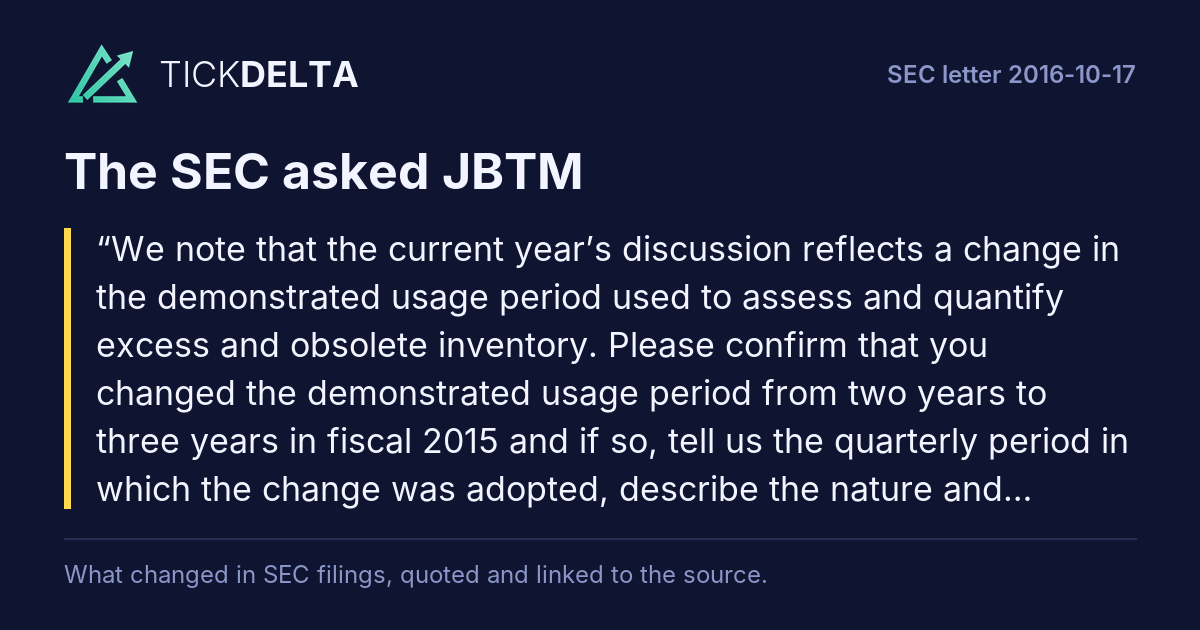
SEC asked (1)
We note that the current year’s discussion reflects a change in the demonstrated usage period used to assess and quantify excess and obsolete inventory. Please confirm that you changed the demonstrated usage period from two years to three years in fiscal 2015 and if so, tell us the quarterly period in which the change was adopted, describe the nature and timing of the changes in facts and circumstances that resulted
Rest of the question

in this change in estimate, and support your conclusion that the change is preferable. Quantify for us the impact of this change on your financial statements and tell us how you considered the disclosures required by ASC 250-10-50-4. Revise critical accounting policies in future filings to discuss this and similar changes in estimates.

JBTM answered
We are submitting this letter in response to comments received from the staff of the Division of Corporation Finance (the “Staff”) of the Securities and Exchange Commission (the “Commission”) by letter dated October 17, 2016, with respect to the Form 10-K, filed February 29, 2016 (the “Form 10-K”), and the Form 10-Q, filed July 28, 2016 (the “Form 10-Q”), of John Bean Technologies Corporation (“JBT”). The text of the Staff’s comments has been included in this letter in italics for ease of reference, and we have numbered the paragraphs below to correspond to the numbers in the Staff’s letter.
Rest of the letter

For your convenience, our response to each of the numbered comments is set forth immediately below each numbered comment. Item 7. Management ’s Discussion and Analysis of Financial Condition and Results of We note that the current year’s discussion reflects a change in the demonstrated usage period used to assess and quantify excess and obsolete inventory. Please confirm that you changed the demonstrated usage period from two years to three years in fiscal 2015 and if so, tell us the quarterly period in which the change was adopted, describe the nature and timing of the changes in facts and circumstances that resulted in this change in estimate, and support your conclusion that the change is preferable. Quantify for us the impact of this change on your financial statements and tell us how you considered the disclosures required by ASC 250-10-50-4. Revise critical accounting policies in future filings to discuss this and similar changes in estimates. We confirm to the Staff that we changed the demonstrated usage period from two years to three years in the fourth quarter of 2015. The change was driven by company-wide operational initiatives implemented as part of our Next Level strategy. One such initiative was to reduce the amount of inventory on hand through the sale or disposal of excess and obsolete (“E&O”) inventory. Previously our policy was to determine E&O inventory based on two years of usage, with a qualitative review of items in that category for purposes of determining the valuation allowance. In connection with these operational initiatives, we took a fresh look at the company’s historical usage patterns as well as the qualitative review process to reevaluate when we are truly incurring excess inventory. As a result of this review, we changed the usage period from two years to three years and significantly limited the qualitative review of items included in this category, which removed a certain amount of judgment previously applied when determining this valuation allowance. In addition, these operational initiatives instituted by new senior management have resulted in business and operational decisions to dispose of items in inventory that are considered excess or obsolete. This has been, and will continue to be, demonstrated by disposals of items that have been written off via the E&O valuation allowance. We believe this further supports the three year usage period as we do not intend to maintain inventory levels in excess of three years’ estimated demand. The total impact of these changes to our E&O policy was an increase in the E&O valuation allowance, and a resulting charge to earnings of $2.6 million in the fourth quarter of 2015. We do not believe that the change in usage period for determining our E&O valuation allowance had a material impact on our consolidated balance sheet as of December 31, 2015 or our consolidated statement of income for the year ended December 31, 2015. Therefore we did not provide the disclosures as set forth in ASC 250-10-50-4. If in the future should a change in usage period, or other management estimate, result in a material impact to our financial statements, we will provide the disclosure required by ASC 250-20-50-4. Item 8. Financial Statements and Supplementary Data In future filings please include the disclosures required by ASC 805-10-50-2(h)(1) and ASC 805-30-50-1(c) for contingent consideration. Refer to Example 5 in ASC 805-10- In response to the Staff’s comment regarding disclosures required by ASC 805-10-50-2(h)(1), we have determined that, to date, the amounts of revenue and earnings of acquirees have been immaterial to the consolidated revenues and earnings in our consolidated statement of income, and have therefore not included this disclosure. We have a policy to disclose the amounts of revenue and earnings of an acquiree since the acquisition date included in the consolidated income statement for the reporting period in accordance with ASC 805 10 50 2(h)(1) to the extent the impact to revenues or earnings is material either qualitatively or quantitatively. We will continue to evaluate the materiality for revenue and earnings attributable to future acquisitions, including the recently announced acquisitions of C.A.T. and Tipper Tie, and the need for disclosure of the revenue and earnings of acquired companies in the reporting period in accordance with this guidance. In response to the Staff’s comment regarding disclosures required by ASC 805-30-50-1(c) for contingent consideration, we expanded the footnote disclosures in our third quarter Form 10-Q filed on October 28, 2016 to read as follows (added items underlined): The A&B purchase agreement includes a payment due to the sellers for $3 million of consideration, contingent upon exceeding an earnings target for the period from May 1, 2015 through April 30, 2016. The contractual obligation associated with the contingent earnout provision recognized on the acquisition date was $3.0 million, which is included in Other current liabilities on the Condensed Consolidated Balance Sheet. Had the earnings target not been achieved, the payment would have been $0. However, the agreed upon financial targets were met and the Company expects to make the $3.0 million payment to the sellers in the fourth quarter of 2016. To the extent future acquisitions include contingent consideration in the purchase price, we will include similar disclosures in future filings. Please describe to us the transactions that resulted in the 6% impact reflected in your federal to effective income tax rate reconciliation relating to tax on foreign intercompany dividends and deemed dividends for tax purposes. Tell us whether this item relates to the short-term intercompany borrowings program discussed on page 33 and, if so, in future filings revise the income tax and liquidity discussions in MD&A to disclose the impact from similar transactions. Refer to Item 303(a) of Regulation S-K. The foreign intercompany dividend resulting in the 6% impact reflected in our federal to effective income tax reconciliation was not part of the short-term intercompany borrowing program described on page 33 of the Form 10-K. Unlike those short-term intercompany borrowings, which did not trigger taxable dividends to JBT, the dividend was taxable in the U.S. In 2015, JBT indirectly owned all of the shares of John Bean Technologies International AB (“International AB”) which, in turn, owned all of the shares of John Bean Technologies AB (“JBT AB”). International AB and JBT AB were both Swedish entities and controlled foreign corporations. On December 29, 2015, JBT AB distributed $9 million to its sole shareholder, International AB. On the same day, International AB then distributed $9 million to JBT, its sole shareholder, which is a U.S. corporation and U.S. taxpaying entity. The $9 million was a taxable dividend from International AB to its U.S. shareholder, JBT. As a result, JBT recognized income and paid tax on that amount, which was reduced by foreign tax credits that it was able to claim. Item 7. Management’s Discussion and Analysis of Financial Condition and Results of Consolidated Results of Operations, page 22 In future filings, please revise the discussions of your restructuring expenses related to your optimization program to quantify the anticipated future cost savings at the consolidated and reportable segment levels along with the timing of the future cost savings. With respect to your prior year restructuring activities, disclose if the anticipated cost savings were realized. If actual savings have not been achieved as expected or are achieved in periods other than as expected, disclose the reasons and estimated effects on your operating results and liquidity. Refer to SAB Topic 5:P.4 for guidance. We acknowledge the Staff’s comment and will expand our discussion of restructuring expenses related to our optimization program to quantify the anticipated future cost savings at the consolidated and reportable segment levels along with the timing of the future cost savings in accordance with SAB Topic 5:P.4. As it pertains to the 2014 restructuring plan, we expected and achieved cost savings related to employee costs of $4 million, $6 million and $2 million in 2014, 2015, and 2016, respectively. All of these cost savings are attributable to the FoodTech segment. A portion of the $12 million in savings were used to fund our JBT Next Level growth initiatives. As of December 31, 2016, we expect to be substantially complete with the 2014 restructuring plan. We intend to expand our disclosures for the 2014 restructuring plan in our 2016 Form 10-K consolidated results of operations section of MD&A substantially as follows (added or enhanced items underlined): In the first quarter of 2014, we implemented a plan to optimize the overall JBT cost structure on a global basis. The initiatives under this plan include streamlining operations, consolidating certain facilities and enhancing our general and administrative infrastructure. We released $0.9 million of the liability as of December 31, 2016 which we no longer expect to pay in connection with this plan due to actual severance payments differing from the original estimates and natural attrition of employees. All payments required under this plan were paid as of December 31, 2016. As of December 31, 2016 we have realized cumulative cost benefits of $12 million predominantly related to employee costs in the Foodtech segment. Of these savings, $8 million was reflected in Selling, General and Administrative expense and $4 million was reflected in Cost of Sales included in our consolidated statements of income. The amount and timing of these cost savings were materially consistent with our expectations. A portion of the $12 million in savings was used to fund our JBT Next Level growth initiatives. The release of the liability associated with the 2014 plan in 2016 did not have an impact on our realized cost savings because the number of employees who remained after terminations under the plan and natural attrition remained the same as our original estimates. As it pertains to the 2016 optimization plan, we expect a total of $8 million in cumulative cost benefits predominantly related to employee costs beginning in the second half of 2016 and through early 2018 pertaining to the FoodTech segment. We expect to invest a portion of these estimated savings to fund our JBT Elevate growth initiatives. We intend to expand our disclosures for the 2016 optimization plan in our 2016 Form 10-K consolidated results of operations section of MD&A substantially as follows (added items underlined): In the first quarter of 2016, we implemented our optimization plan to realign FoodTech’s Protein business in North America and Liquid Foods business in Europe, accelerate JBT’s strategic sourcing initiatives, and consolidate smaller facilities. The total estimated cost in connection with this plan is in the range of $11 million to $13 million. We recorded $7.5 million, $2.0 million, $0.8 million and $XXX million in the first, second, third and fourth quarters of 2016, respectively. All payments required under this plan are expected to be made during 2016 and 2017. We realized cumulative cost benefits of $3 million predominantly related to employee costs in the FoodTech segment during the second half of 2016. Of these savings, approximately $2 million are reflected in Selling, General and Administrative expense and $1 million is reflected in Cost of Sales included in our consolidated statements of income. We expect to realize an additional $4 million in cost savings predominantly related to employee costs in 2017. Of these savings, we expect approximately $3 million to be reflected in Selling, General and Administrative expense, and $1 million to be reflected in Cost of Sales. We expect to realize an additional $1 million in cost savings predominantly related to employee costs in 2018; split evenly between Selling, General and Administrative expense, and Cost of Sales. We expect to invest a portion of these estimated savings in our JBT Elevate growth initiatives. To the extent we incur material restructuring expense in the future, we will disclose the anticipated cost savings, along with the period in which the savings are expected to be realized. For the 2016 optimization plan, as well as any future plans if implemented, we will continue to disclose the rate at which we realize our anticipated cost savings and any changes to these savings from expectations. This will include the impact to our future operating results and liquidity to the extent the actual savings differ materially from original expectations. We hope that the foregoing is responsive to the Staff’s comments. Should you have any questions relating to any of the foregoing, please feel free to contact me by phone at (312) 861-5887 or by email at [email protected].

One letter for all the questions, without numbered answers. Read the reply
In its next report

First report after the company's reply of Nov 4, 2016: 10-K filed Feb 28, 2017 ↗, against the 10-K filed Feb 29, 2016 ↗.

Tickdelta does not hold the text of both reports, so they are not compared here.

Item 8. Financial Statements and Supplementary Data · Note 2. Acquisitions, page 49
SEC asked (2)
In future filings please include the disclosures required by ASC 805-10-50-2(h)(1) and ASC 805-30-50-1(c) for contingent consideration. Refer to Example 5 in ASC 805-1055-43.
JBTM answered

See the reply above.

In its next report

First report after the company's reply of Nov 4, 2016: 10-K filed Feb 28, 2017 ↗, against the 10-K filed Feb 29, 2016 ↗.

Tickdelta does not hold the text of both reports, so they are not compared here.

Note 7. Income taxes, page 57
SEC asked (3)
Please describe to us the transactions that resulted in the 6% impact reflected in your federal to effective income tax rate reconciliation relating to tax on foreign intercompany dividends and deemed dividends for tax purposes.
Rest of the question

Tell us whether this item relates to the short-term intercompany borrowings program discussed on page 33 and, if so, in future filings revise the income tax and liquidity discussions in MD&A to disclose the impact from similar transactions. Refer to Item 303(a) of Regulation S-K.

JBTM answered

See the reply above.

In its next report

First report after the company's reply of Nov 4, 2016: 10-K filed Feb 28, 2017 ↗, against the 10-K filed Feb 29, 2016 ↗.

Tickdelta does not hold the text of both reports, so they are not compared here.

Consolidated Results of Operations, page 22
SEC asked (4)
In future filings, please revise the discussions of your restructuring expenses related to your optimization program to quantify the anticipated future cost savings at the consolidated and reportable segment levels along with the timing of the future cost savings. With respect to your prior year restructuring activities, disclose if the anticipated cost savings were realized.
Rest of the question

If actual savings have not been achieved as expected or are achieved in periods other than as expected, disclose the reasons and estimated effects on your operating results and liquidity. Refer to SAB Topic 5:P.4 for guidance.

JBTM answered

See the reply above.

In its next report

First report after the company's reply of Nov 4, 2016: 10-K filed Feb 28, 2017 ↗, against the 10-K filed Feb 29, 2016 ↗.

Tickdelta does not hold the text of both reports, so they are not compared here.

Also in this review: closing letter, 2016-11-09
Form 10-K for the Fiscal Year Ended December 31, 2012

2013-11-13 to 2014-01-09 · 2 questions · 2 letters from the SEC, 2 from the company
Review closed 2014-01-09
Liquidity and cashRevenueDebt
Liquidity and Capital Resources, page 16
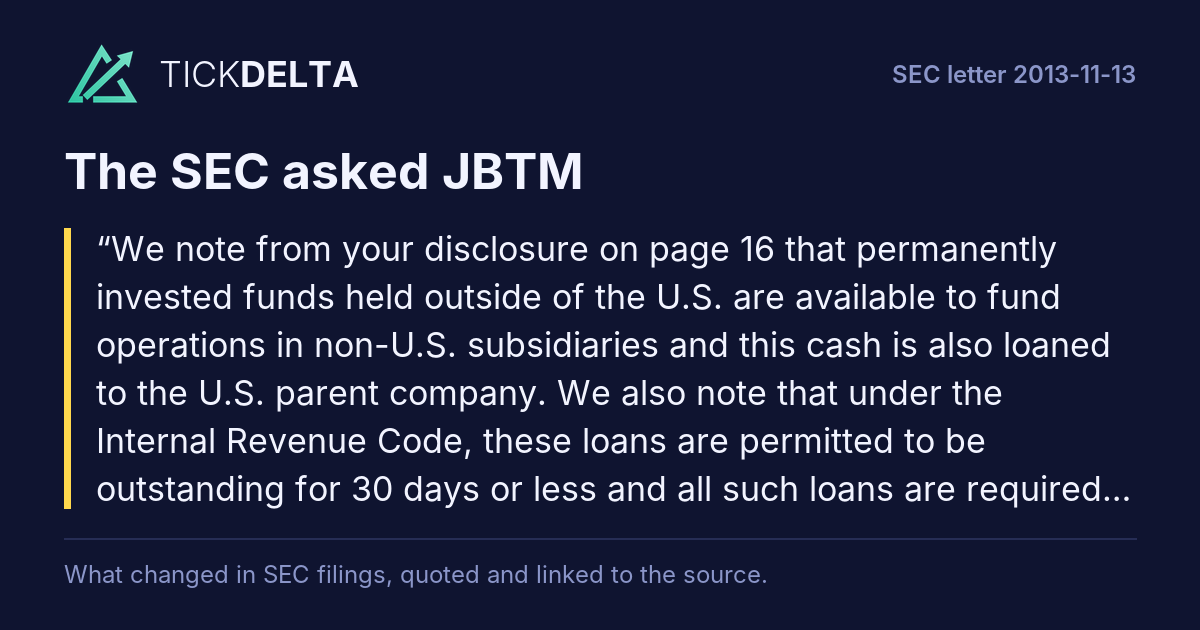
SEC asked
We note from your disclosure on page 16 that permanently invested funds held outside of the U.S. are available to fund operations in non-U.S. subsidiaries and this cash is also loaned to the U.S. parent company. We also note that under the Internal Revenue Code, these loans are permitted to be outstanding for 30 days or less and all such loans are required to be outstanding for a total of less than 60 days during
Rest of the question

the year. You disclose that amounts outstanding under this rule at September 30, 2013 were $97.3 million. With a view towards providing revised disclosure in future filings, please respond to the following:  Describe to us in further detail your cash management and funding strategies that make cash held outside the U.S. available in the U.S. on a short-term basis without being subject to U.S. Tax.  Tell us how long your loans have been outstanding. It appears that you had similar loans outstanding at March 31, June 30, and September 30, 2013.  Tell us where the $97.3 million outstanding under the rule are included in your balance sheets at September 30, 2013. We note that cash and cash equivalents in your balance sheets totaled $35.6 million at September 30, 2013.  Clarify whether the borrowings under the 5-year credit facility repaid during the interim period were at foreign or U.S. subsidiaries.

JBTM answered
Most of the earnings that we generate outside of the U.S. are considered to be permanently invested in our non-U.S. subsidiaries. As disclosed in the Form 10-K and Form 10-Q, we have significant operations outside of the U.S. and use our cash for working capital, capital expenditures and business acquisitions in these foreign subsidiaries as needed. If these funds were required to fund our operations or satisfy obligations in the U.S., they could be repatriated and their repatriation to the U.S. could give rise to additional tax liabilities.
Rest of the answer

However, we have no intention to repatriate any of the non-U.S. earnings that are considered to be permanently reinvested in our foreign subsidiaries.

Our U.S. subsidiaries generate cash from operations and we also have access to additional liquidity through our $300 million 5-year credit facility that expires in 2017. Accordingly, we believe our U.S. cash generation and borrowing capacity will be sufficient to satisfy our cash needs within the U.S. for the forseeable future, and support our assertion that non-U.S. earnings are permanently reinvested. Certain foreign subsidiaries may have cash balances that exceed their immediate working capital or other cash needs. Our primary cash management strategy is to utilize these funds to grow our business, generally in developing world economies.

Internal Revenue Service (IRS) Notice 88-108 provides a mechanism for accessing non-U.S. cash balances on a temporary basis subject to compliance with certain requirements. Under this IRS rule, loans from foreign subsidiaries to related U.S. companies will not give rise to a U.S. tax liability as long as each loan is outstanding for 30 days or less and all loans from each foreign subsidiary are outstanding for less than 60 days during the year. Therefore, we evaluate short-term cash requirements in foreign subsidiaries on a quarterly basis, and where cash in excess of current needs is present, consider these types of intercompany loans. The proceeds of such loans are used to repay outstanding borrowings under our 5-year credit facility. Reducing outstanding borrowings, even temporarily, serves both to reduce total interest expense as well as to reduce the interest rate charged upon outstanding borrowings.

For the three quarters in fiscal year 2013, we had the following loans outstanding with two separate foreign subsidiaries for the stated number of days:

Full term to repayment of loans outstanding as of

Outstanding at

March 31

Outstanding at June 30

September 30

Total days outstanding in

2013

Subsidiary A

12 days

6 days

24 days

Subsidiary B

5 days

3 days

1 day

9 days

As of September 30, 2013 the sum of the amounts advanced to the U.S parent company under the two outstanding intercompany loans was $97.3 million. The proceeds of these intercompany loans were used to repay a portion of our outstanding borrowings under the 5-year credit facility prior to September 30, 2013. The $97.3 million in intercompany loans is not included in our consolidated balance sheet at September 30, 2013, as the balances are fully eliminated in consolidation.

In addition to the cash advanced to the U.S. parent company on a short-term basis by the two foreign subsidiaries that we used to repay outstanding borrowings prior to the balance sheet date, there was $32.4 million of aggregate cash held by these two and our other non-U.S. subsidiaries as of September 30, 2013. We do not enter into short-term intercompany loans between our foreign subsidiaries and the U.S. parent if doing so would not be cost-effective, such as in cases where there are currency controls in place that limit our ability to transfer funds without incurring significant costs.

All of our borrowings under the 5-year credit facility during 2013 are obligations of our U.S. parent company.

In future filings, we believe the following disclosure may provide more clarity with respect to the matters raised by the Staff:

Funds held outside of the U.S. are permanently invested in our non-U.S. subsidiaries. At times, these foreign subsidiaries have cash balances that exceed their immediate working capital or other cash needs. In these circumstances, the foreign subsidiaries may loan funds to the U.S. parent company on a temporary basis; the U.S. parent company has in the past and may in the future use the proceeds of these temporary intercompany loans to reduce outstanding borrowings under our committed credit facilities. Under an Internal Revenue Service (IRS) rule, no incremental tax liability is incurred on the proceeds of these loans as long as each individual loan has a term of 30 days or less and all such loans from each subsidiary is outstanding for a total of less than 60 days during the year.

The amount outstanding subject to this IRS rule at September 30, 2013 was $97.3 million. Through the end of September 30, 2013, each such loan was outstanding for less than 30 days, and all such loans were outstanding for less than 60 days in the aggregate. The U.S. parent used the proceeds of these intercompany loans to reduce outstanding borrowings under our 5-year credit facility. We may choose to access such funds again in the future to the extent they are available and can be transferred without significant cost, and use them on a temporary basis to repay outstanding borrowings or for other corporate purposes, but intend to do so only as allowed under this IRS rule.

* * * * * * * *

JBT acknowledges that it is responsible for the adequacy and accuracy of the disclosure in the Form 10-K and the Form 10-Q, and that Staff comments or changes to disclosure in response to Staff comments do not foreclose the Commission from taking any action with respect to the Form 10-K or the Form 10-Q. JBT further acknowledges that it may not assert Staff comments as a defense in any proceeding initiated by the Commission or any person under the federal securities laws of the United States.

We hope that the foregoing is responsive to the Staff’s comments. Should you have any questions relating to any of the foregoing, please feel free to contact me by phone at (312) 861-6031 or by email at [email protected].

Read in the reply
In its next report

First report after the company's reply of Nov 27, 2013: 10-K filed Mar 7, 2014 ↗.

No earlier 10-K before the SEC's letter is in Tickdelta, so there is nothing to compare with.

Liquidity and Capital Resources, page 16
SEC asked
We note from your response to our prior comment number 1 that short-term intercompany loans from foreign subsidiaries are used to repay outstanding borrowings under your credit facility to reduce the interest rate charged on outstanding balances.
Rest of the question

Please respond to the following:  Explain to us how the intercompany loans that are used to reduce your outstanding borrowings for a few days at the end of the month reduce your interest rate on the credit facility. Please also tell us how these intercompany loans impact any debt covenants.  In future filings, disclose the reasons you use the intercompany loans, similar to your response.  Tell us your consideration of disclosing additional information about the intercompany loans, including the number of days these were outstanding and the average outstanding loan balance each period.  We note the discussion in your recent press release dated October 30, 2013 that the company has “record low debt.” Please explain to us and consider the need to clarify in future filings the extent to which this reduction relates to the use of the short-term intercompany loans rather than a long-term strategy for reducing your debt.  Please explain your long-term strategy with regards to funding your dividends with U.S. dollars as it appears that you could use all of the cash available in the U.S. for dividends payments within the next few quarters; similarly explain how you would fund any share buybacks that may be authorized.

JBTM answered
1.a.

In November 2012, we entered into a $300 million 5-year credit agreement with JP Morgan Chase Bank, N.A. as Administrative Agent (“the Agreement”). We filed a copy of the Agreement as an exhibit to the Form 8-K filed December 3, 2012, reporting our entry into a material definitive agreement. Under the terms of the Agreement, the interest rate charged on borrowings is reset quarterly, with the rate determined by our leverage ratio as of the end of the previous fiscal quarter (“Leverage Ratio”).
Rest of the answer

The Agreement provides stated spread rates that are to be added to the base rate in determining the interest rate to be applied in calculating interest payable on all outstanding borrowings. The applicable spread rate, as well as the facility fee rate, reset each quarter based on our actual Leverage Ratio. Specifically, the Agreement provides that higher rates are to be applied as the Leverage Ratio increases, as follows:

Leverage Ratio is defined in the Agreement as consolidated total indebtedness at a fiscal quarter end divided by consolidated EBITDA (earnings before interest, taxes, depreciation and amortization) for the preceding four fiscal quarters. Consolidated total indebtedness as defined in the Agreement is “calculated on a consolidated basis as of such time in accordance with GAAP”. The Agreement defines GAAP as generally accepted accounting principles in the U.S. As such, intercompany loans between subsidiaries, or between the parent company and its subsidiaries, are not included in the calculation of Leverage Ratio as such loans are eliminated in the determination of consolidated total indebtedness.

One of our cash management strategies is to minimize our borrowing costs. By using available non-U.S. cash on a short-term basis to reduce our consolidated total indebtedness we can effectively lower our interest costs.

The Agreement and our senior unsecured notes both include a restrictive covenant related to our Leverage Ratio. As noted, we use the proceeds of the short-term intercompany loans to repay consolidated total indebtedness at a fiscal quarter end, which has the effect of reducing the Leverage Ratio. No other debt covenants are impacted by these intercompany loans.

b.

In future filings, disclose the reasons you use the intercompany loans, similar to your response.

Response 1.b.

In future filings, we will make the following disclosures in order to provide more clarity with respect to matters raised by the Staff:

Funds held outside of the U.S. are permanently invested in our non-U.S. subsidiaries. At times, these foreign subsidiaries have cash balances that exceed their immediate working capital or other cash needs. In these circumstances, the foreign subsidiaries may loan funds to the U.S. parent company on a temporary basis; the U.S. parent company has in the past and may in the future use the proceeds of these temporary intercompany loans to reduce outstanding borrowings under our committed credit facilities. By using available non-U.S. cash to repay our debt on a short-term basis, we can optimize our leverage ratio, which has the effect of both lowering the rate we pay on certain of our borrowings and lowering our interest costs.

Under an Internal Revenue Service (IRS) rule, no incremental tax liability is incurred on the proceeds of these loans as long as each individual loan has a term of 30 days or less and all such loans from each subsidiary is outstanding for a total of less than 60 days during the year. The amount outstanding subject to this IRS rule at September 30, 2013 was $97.3 million. Through the end of September 30, 2013, each such loan was outstanding for less than 30 days, and all such loans were outstanding for less than 60 days in the aggregate. The U.S. parent used the proceeds of these intercompany loans to reduce outstanding borrowings under our 5-year credit facility. We may choose to access such funds again in the future to the extent they are available and can be transferred without significant cost, and use them on a temporary basis to repay outstanding borrowings or for other corporate purposes, but intend to do so only as allowed under this IRS rule.

c.

Tell us your consideration of disclosing additional information about the intercompany loans, including the number of days these were outstanding and the average outstanding loan balance each period.

Response 1.c.

We have not historically disclosed detailed information about these intercompany loans as such transactions, including the interest income and expense thereon, are eliminated in consolidation. Therefore, the transactions have no reportable impact on the consolidated balance sheet, income statement, or statement of cash flows included in our filings. The proposed disclosure in Response 1.b. describes the purpose of the intercompany loans, the outstanding balance, and the fact that each loan is outstanding for less than 30 days and less than 60 days in the aggregate during the fiscal year. We believe that disclosing additional information beyond that proposed could cause a reader to mistakenly conclude that such transactions do give rise to balances that are included in our consolidated financial statements.

d.

We note the discussion in your recent press release dated October 30, 2013 that the company has “record low debt.” Please explain to us and consider the need to clarify in future filings the extent to which this reduction relates to the use of the short-term intercompany loans rather than a long-term strategy for reducing your debt.

Response 1.d.

We regularly report debt, net of cash, in our earnings releases. We believe that debt, net of cash, is a measure that provides valuable information about the Company’s ability to generate cash. At September 30, 2013, our debt, net of cash, was at a record low.

The Company’s debt, net of cash, would have been at a record low at September 30, 2013, regardless of whether or not we elected to enter into the short-term intercompany loans and to pay-down external debt. We would have made the same disclosure in our earnings release had we not elected to enter into such loans if, for instance, the change in Leverage Ratio would not have allowed us to utilize a lower interest rate as shown in the table in Response 1.a. These elections are business decisions which affect the reported balances in cash and debt, but do not affect the overall measure of debt, net of cash, which has declined due to the Company’s overall cash generation.

We believe the proposed disclosure in Response 1.b. clearly describes the purpose of the intercompany loans, the outstanding balance, and indicates that intercompany loans for this purposes are short-term in nature given the fact that they are described as being repayable in less than 30 days.

e.

Please explain your long-term strategy with regards to funding your dividends with U.S. dollars as it appears that you could use all of the cash available in the U.S. for dividends payments within the next few quarters; similarly explain how you would fund any share buybacks that may be authorized.

Response 1.e.

Our cash management strategy includes utilizing all cash reasonably available to pay down outstanding borrowings under the Agreement in order to reduce borrowing costs. This applies to cash held by non-U.S. subsidiaries that can be accessed without triggering U.S. tax liability, as well as cash held in the U.S. Therefore, the reported balance of cash in the U.S. is always kept to a minimum. As a result, the U.S. cash balance is only a minor component of our total U.S. liquidity and is not, by itself, indicative of the actual level of liquidity that is available to fund U.S. obligations and/or other U.S. expenditures.

Since our inception as a standalone company in 2008, we have generated a significant amount of cash flows from operating activities in the U.S. These cash flows have been more than adequate to satisfy our dividend requirements, which have been approximately $8 million to $9 million per year.

To the extent our U.S. quarterly operating cash flows are not sufficient to fund a dividend payment, we can borrow funds under the Agreement.

As of September 30, 2013, we had $269 million of available capacity under the Agreement, after considering outstanding borrowings and other items that reduce borrowing capacity. Of that amount $97 million was earmarked to repay the outstanding short-term loans discussed in this Response. The remaining $172 million in borrowing capacity is available, if needed, to fund dividend payments when declared by the Board of Directors, as well as to fund the repurchase of shares as authorized. Approximately $26 million remains authorized for share repurchases through the program’s expiration in December 2014.

We believe that our current disclosures regarding cash requirements and liquidity fully describe our plans to utilize the capacity under the Agreement to fund dividends and share repurchases, if needed.

* * * * * * * *

JBT acknowledges that it is responsible for the adequacy and accuracy of the disclosure in the Form 10-K and the Form 10-Q, and that Staff comments or changes to disclosure in response to Staff comments do not foreclose the Commission from taking any action with respect to the Form 10-K or the Form 10-Q. JBT further acknowledges that it may not assert Staff comments as a defense in any proceeding initiated by the Commission or any person under the federal securities laws of the United States.

We hope that the foregoing is responsive to the Staff’s comments. Should you have any questions relating to any of the foregoing, please feel free to contact me by phone at (312) 861-6031 or by email at [email protected].

Read in the reply
In its next report

First report after the company's reply of Dec 26, 2013: 10-K filed Mar 7, 2014 ↗.

No earlier 10-K before the SEC's letter is in Tickdelta, so there is nothing to compare with.

Also in this review: closing letter, 2014-01-09

Letters without questions

Other letters

UPLOAD and CORRESP
2 other letters: notices that a filing will not be reviewed, requests to declare a registration effective, and the like

From the SEC's correspondence on EDGAR: staff letters (form UPLOAD) and company letters (form CORRESP), 10 letters filed since 2013-11-14. Questions and answers are matched by their numbers; topics come from words in each question. The reports are compared word for word (same form, before the first SEC letter against the first report after the company's reply). No AI.

Sources

The SEC's correspondence on EDGAR: staff letters (form UPLOAD) and company letters (form CORRESP), matched question by question. No AI.

Also

Filings: the letters in the filing list.

Work with it

Excel workbook · CSV. Google Sheet that stays up to date: paste =IMPORTDATA("https://tickdelta.com/company/JBTM/export.csv") into a cell.

Next in Owners and insiders:Insider trades
Esc

Type a ticker such as AAPL, a name, an investor such as Buffett, or a topic such as tariffs. ↑ ↓ to move, Enter to open.