JBT MAREL Corp JBTM
New risk paragraphs, branching off last year
Each branch is a paragraph in Risk Factors with nothing like it in the 10-K filed Feb 28, 2025. A box jumps to the paragraph as filed, below.
Paragraphs with nothing like them in last year's 10-K
13 paragraphs in Risk Factors of the 10-K filed Mar 2, 2026 with nothing like them in the 10-K filed Feb 28, 2025. Quoted exactly. Paragraphs that were only edited are under 10-K change.
overtime, double shifts and temporary workforce, we may fail to align our staffing with our production requirements, which would expose us to increased costs and negatively affect our profitability.
Material weaknesses were identified in Marel’s internal control over financial reporting and we may identify additional material weaknesses in the future or fail to maintain an effective system of internal control over financial reporting, which could result in material misstatements of Marel’s accounts and disclosures.
As discussed in Item 9A., prior to the acquisition of Marel, its management identified two material weaknesses in its internal control over financial reporting, which remained unremediated as of December 31, 2025. Specifically, its management identified that 1) Marel did not design and maintain effective information technology general controls for information systems that are relevant to financial reporting. Specifically, Marel did not design and maintain: (i) program change management controls to ensure that information technology program and data changes are identified, tested, authorized, and implemented appropriately; (ii) user access controls to ensure appropriate segregation of duties and to adequately restrict user and privileged access to appropriate personnel; (iii) computer operations controls to ensure that processing and transfer of data, and data backups and recovery are monitored; and (iv) program development controls to ensure that new software development is tested, authorized and implemented appropriately. These IT deficiencies did not result in a material misstatement to the financial statements, however, the deficiencies, when aggregated, could impact maintaining effective segregation of duties, as well as the effectiveness of IT-dependent controls (such as automated controls that address the risk of material misstatement to one or more assertions, along with the IT controls and underlying data that support the effectiveness of system-generated data and reports) that could result in misstatements potentially impacting all financial statement accounts and disclosures that would not be prevented or detected, and 2) Marel did not design or maintain effective controls over the recording and review of journal entries for validity, accuracy, and completeness. Specifically, certain key accounting personnel have the ability to prepare and post journal entries without an appropriately designed independent review. This material weakness did not result in a material misstatement to the financial statements; however, it could result in a potential misstatement of Marel’s accounts or disclosures that could result in a material misstatement to the annual or interim consolidated financial statements that would not be prevented or detected. If we experience a delay in successfully remediating any identified control deficiencies, including current or future material weaknesses in our internal control over financial reporting, the accuracy and timing of our financial reporting may be adversely affected; our liquidity, access to capital markets and perceptions of our creditworthiness may be adversely affected; we could face difficulty forecasting our financial results accurately, impacting decision-making by investors and analysts; we may be unable to maintain compliance with securities laws, stock exchange listing requirements and debt instruments’ covenants regarding the timely filing of periodic reports; we may be subject to regulatory investigations and penalties; investors may lose confidence in our financial reporting; we may suffer defaults under our debt instruments; and our common stock price may decline.
In addition, our customers’ operations are subject to extensive regulations, including those that relate to animal welfare, food safety, and the processing, packaging, and storage of food products. These regulations could become more restrictive, which could lead to increased costs for our customers, or could require our customers to change their processes. If we are unable to timely modify or create new products that comply with regulatory requirements at attractive prices, demand for our products could fall.
Our business has been, and may continue to be, adversely affected by tariffs, trade sanctions or similar government actions, as well as overall uncertainty surrounding international trade relations.
Our operations in various countries and jurisdictions subject us to the legal, political, regulatory, and social requirements and economic conditions in these jurisdictions. The imposition by the United States of tariffs, sanctions or other restrictions on goods exported from the United States or imported into the United States, and countermeasures imposed in response to such actions, have introduced uncertainty in the market and increased the cost of goods for our products and could reduce our ability to sell our products globally, which may adversely affect our operating results and financial condition. The materials subject to these tariffs or proposed tariffs have impacted the cost and availability of raw materials used by our suppliers or in our customers’ products. We may not be able to fully mitigate the impact of these increased costs or pass price increases on to our customers. The situation around tariffs is
Show the other 4
Additionally, the imposition of further tariffs by the United States on a broader range of imports, or further retaliatory trade measures taken by other countries’ governments in response to additional tariffs imposed by the United States, could increase costs in our supply chain, which may cause us to increase prices in certain markets in order to mitigate the impact of these trade-related increases on our costs of products sold, and reduce demand for our and/or our customers’ products, either of which could adversely affect our results of operations. Any increase in trade-related costs associated with such measures may impair the profitability of our international production, may strain our suppliers’ ability to reliably provide inputs necessary to produce our products, and may otherwise affect our ability to provide our products at previously contracted prices. We may, over the longer term, make changes in our supply chain and our global manufacturing strategy to mitigate the negative impacts of changing U.S. and foreign trade policies, which may not be successful. Tariffs may also indirectly impair our business by causing a negative effect on global economic conditions and financial markets. The ultimate impact of these trade measures on our business operations and financial results is uncertain and may be affected by various factors, including whether and when such trade measures are implemented, the timing when such measures may become effective, and the amount, scope, or nature of such trade measures, and our ability to execute strategies to mitigate the negative impacts. Our inability to effectively manage the negative impacts of changing U.S. and foreign trade policies could materially adversely impact our results of operations, financial conditions and cash flows.
From time to time we may be a party to litigation and investigations, which may require significant management time and attention and result in significant legal expenses.
Investor and public perception related to our sustainability performance as well as current and future sustainability reporting requirements may affect our business and our operating results.
From time to time, in alignment with our sustainability strategy, we may establish and publicly announce climate-related goals. If we fail or are perceived to fail to achieve or improperly report on our progress toward achieving our sustainability goals and commitments, the resulting negative publicity could adversely affect our business, financial condition, results of operations, reputation and our access to capital. In addition, our continuing efforts to research, establish, accomplish and accurately report on the implementation of our sustainability strategy may also create additional operational risks and expenses and expose us to reputational, legal and other risks. While we create and publish voluntary disclosures regarding sustainability matters from time to time, some of the statements in those voluntary disclosures may be based on hypothetical expectations and assumptions that may or may not be representative of current or actual risks or events or forecasts of expected risks or events, including the costs associated therewith. Such expectations and assumptions are necessarily uncertain and may be prone to error or subject to misinterpretation given the long timelines involved and the lack of an established single approach to identifying, measuring and reporting on many sustainability matters.
Our voluntary disclosures of sustainability data are evaluated and rated by various organizations that assess corporate sustainability performance. These organizations provide information to investors on corporate governance and related matters and have developed ratings processes for evaluating companies on their approach to sustainability matters. Unfavorable sustainability ratings, or our inability to meet the sustainability standards set by specific investors, may lead to negative investor sentiment and reputational damage, which could have an adverse impact, among other things, on our stock price and cost of capital.
Further, our business and growth opportunities require us to have strong relationships with various key stakeholders, including our investors, employees, suppliers, customers and others. We may face pressures from stakeholders, many of whom are increasingly focused on climate change, to prioritize sustainable energy practices and carbon reduction initiatives in addition to our business objectives. At the same time, stakeholders and regulators have increasingly expressed or pursued divergent and evolving views, legislation and investment expectations with respect to sustainability, including the enactment or proposal of “anti-ESG” legislation or policies. We may also face negative impacts from consumers who do not support climate-related initiatives or concerns. If we do not successfully manage expectations across these varied stakeholder interests, it could erode our stakeholder trust and thereby affect our brand and reputation. Such erosion of confidence could negatively impact our business through decreased demand and growth opportunities, adverse publicity, difficulty hiring and retaining top talent, difficulty obtaining necessary approvals and permits from governments and regulatory agencies and difficulty securing investors and access to debt or capital.
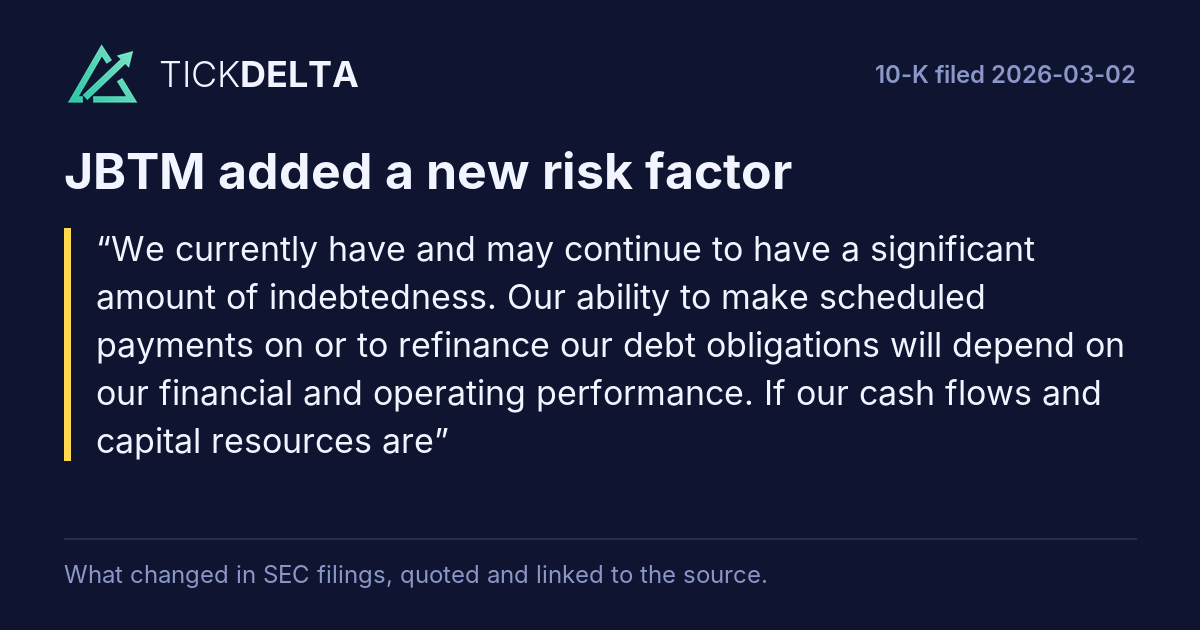
We currently have and may continue to have a significant amount of indebtedness. Our ability to make scheduled payments on or to refinance our debt obligations will depend on our financial and operating performance. If our cash flows and capital resources are
Paragraphs in the 10-Q filed Nov 3, 2026 that were not in the one before
New in the latest 10-Q
17 paragraphs in the 10-Q filed Nov 3, 2026 with nothing like them in the 10-Q filed Aug 5, 2026 (at least half the words must differ; new numbers alone do not count). Quoted exactly, grouped by the item heading above them. This is text that changed, not a judgement of how serious it is.
Financial statements and notes
Amounts reclassified from accumulated other comprehensive income into earnings, net of tax — (1) (4) (5)
Read in the 10-Q
Amounts reclassified from accumulated other comprehensive income into earnings, net of tax — (2) (5) (7)
Read in the 10-Q
Amounts reclassified from accumulated other comprehensive income into earnings, net of tax — (2) (5) (7)
Read in the 10-Q
Foreign Exchange: The Company uses forward foreign exchange contracts to manage exposures to foreign currency exchange rate fluctuations associated with anticipated purchases and sales in the normal course of business. These contracts generally have maturities of less than one year. Certain forward contracts are designated as cash flow hedges of forecasted transactions, while other forward contracts are not designated as accounting hedges. Changes in the fair value of contracts not designated as accounting hedges are recognized in earnings as incurred. The notional amount of outstanding foreign exchange forward contracts was $ 686 million and $ 444 million as of September 30, 2026 and December 31, 2025, respectively.
Read in the 10-Q
The Company enters into master netting arrangements with certain derivative counterparties; however, derivatives assets and liabilities are presented on a gross basis in the Condensed Consolidated Balance Sheets. As of September 30, 2026 and December 31, 2025, derivative assets and liabilities subject to enforceable master netting arrangements were $ 5 million and $ 2 million, respectively.
Read in the 10-Q
Show the other 12
Derivatives Not Designated as Hedging Instruments Location of Gain (Loss) Recognized in Earnings Three Months Ended September 30, Nine Months Ended September 30, (In millions) 2026 2025 2026 2025 Foreign exchange contracts Revenue $ (3) $ 1 $ (4) $ 7 Foreign exchange contracts Cost of sales 2 — 3 (4) Foreign exchange contracts Selling, general and administrative expense — (2) (1) 2 Total derivative gain (loss) (1) (1) (2) 5
Read in the 10-Q
Derivatives Designated as Hedging Instruments Location of Gain (Loss) Recognized in Earnings Three Months Ended September 30, Nine Months Ended September 30, (In millions) 2026 2025 2026 2025 Foreign currency derivatives Other income $ 1 $ 3 $ 5 $ 8 Foreign currency derivatives Interest expense 6 4 12 4 Interest rate swaps Interest expense — — — 2 Total derivative gain (loss) $ 7 $ 7 $ 17 $ 14
Read in the 10-Q
During the third quarter of 2026, the Company terminated all previously outstanding cross-currency swaps designated as net investment hedges and received cash proceeds of $ 18 million upon settlement, which did not have an impact on earnings. Concurrently, the Company entered into new cross-currency swaps and designated these instruments as net investment hedges.
Read in the 10-Q
As of September 30, 2026, the newly-entered cross-currency swaps had an aggregate notional amount of $ 1.9 billion, maturing between 2029 and 2031. The fair value of these swaps was a liability of $ 22 million, which was recorded in Other liabilities in the Condensed Consolidated Balance Sheets. Consistent with net investment hedge accounting, the effective portion of gains and losses on the swaps is recognized in the cumulative translation adjustment component of AOCI.
Read in the 10-Q
Third quarter 2026 results included year-over-year growth in orders, profitability and earnings per share. Order growth was primarily driven by demand for recurring parts and service and equipment solutions across certain food processing end markets, including ready meals, pork, prepared foods and poultry, particularly secondary processing. Net income margin increased 30 bps and Adjusted EBITDA margin increased 90 bps compared with the prior-year period.
Read in the 10-Q
Gross profit margin decreased 40 bps to 35.5% compared with 35.9% in 2025, primarily reflecting the alignment of certain expenses between cost of sales and selling, general and administrative expense implemented in the fourth quarter of 2025. This alignment had no impact on operating income.
Read in the 10-Q
(5) Includes non-cash charges for unamortized debt issuance costs related to debt repayments and financing terminations.
Read in the 10-Q
Cash flows for the nine months ended September 30, 2026 and 2025 were as follows:
Read in the 10-Q
Controls and procedures
During the three months ended September 30, 2026, the Company continued to advance its remediation efforts through the following remediation activities:
Read in the 10-Q
• Significantly advanced the design and implementation of information technology general controls impacting financial reporting, including logical access, change management, and computer operations.
Read in the 10-Q
• Evaluated the operating effectiveness of certain implemented journal entry processing controls, including system‑based workflow and approval.
Read in the 10-Q
• Performed incremental procedures during the remediation period designed to mitigate risks with the material weaknesses.
Read in the 10-Q
The 10-Q's risk factors against the 10-K
Item 1A of the 10-Q filed Nov 3, 2026 against Item 1A of the 10-K filed Mar 2, 2026.
A 10-Q repeats only the risks that changed, so a 10-K paragraph that is missing from it is not counted as removed.
Added is a paragraph with nothing like it in the 10-K, Reworded a sentence that is in both with several words changed,
Quiet changes a sentence in both where one to four words changed and one is a hedge or a modal
(cut words struck through, new words highlighted).
Text on the page, not a score; each links to the filing at sec.gov.
What the 10-Q itself says about its risk factors:There have been no material changes in reported risk factors from the information reported in Item 1A. “Risk Factors” in the Company’s Annual Report on Form 10-K for the year ended December 31, 2025.
Read in the 10-Q
1 paragraph in the 10-Q's Item 1A, and none of them adds, rewords or quietly edits a paragraph of the 10-K's.
Phrases used for the first time
Two-word phrases in Risk Factors of the 10-K filed Mar 2, 2026 that are in none of the 1 earlier 10-Ks stored, back to Feb 28, 2025
Where each one is used
- trade measures: Additionally, the imposition of further tariffs by the United States on a broader range of imports, or further retaliatory trade measures taken by other countries’ governments in response to additional tariffs imposed by the United States, could increase costs in our supply chain, which may cause us to increase...
- negative impacts: Additionally, the imposition of further tariffs by the United States on a broader range of imports, or further retaliatory trade measures taken by other countries’ governments in response to additional tariffs imposed by the United States, could increase costs in our supply chain, which may cause us to increase...
- marel’s accounts: Material weaknesses were identified in Marel’s internal control over financial reporting and we may identify additional material weaknesses in the future or fail to maintain an effective system of internal control over financial reporting, which could result in material misstatements of Marel’s accounts and disclosures.
- trade policies: •trade policies, including the imposition of tariffs or other trade restrictions, and other trade protection measures, or price controls;
- voluntary disclosures: From time to time, in alignment with our sustainability strategy, we may establish and publicly announce climate-related goals. If we fail or are perceived to fail to achieve or improperly report on our progress toward achieving our sustainability goals and commitments, the resulting negative publicity could...
- sustainability matters: From time to time, in alignment with our sustainability strategy, we may establish and publicly announce climate-related goals. If we fail or are perceived to fail to achieve or improperly report on our progress toward achieving our sustainability goals and commitments, the resulting negative publicity could...
- iceland india: We manufacture our products at facilities in the United States, Brazil, Belgium, China, Denmark, Germany, Iceland, India, Italy, Slovakia, Spain, Sweden, the Netherlands, and the United Kingdom. An interruption in production or service capabilities at any of our facilities as a result of equipment failure or any...
- india italy: We manufacture our products at facilities in the United States, Brazil, Belgium, China, Denmark, Germany, Iceland, India, Italy, Slovakia, Spain, Sweden, the Netherlands, and the United Kingdom. An interruption in production or service capabilities at any of our facilities as a result of equipment failure or any...
Used at least twice, small words left out. Counted, not picked: a phrase can be new because the company renamed something.
What was taken out
46 paragraphs of last year's Risk Factors with nothing like them now. The longest are quoted.
Sources
Item 1A of each 10-K and 10-Q on EDGAR, quoted exactly. Each paragraph links to the filing at sec.gov.
Also
10-K change: what was reworded or cut, section by section.
Work with it
Excel workbook · CSV. Google Sheet that stays up to date: paste =IMPORTDATA("https://tickdelta.com/company/JBTM/export.csv") into a cell.