Screener / SEC EDGAR /CIK 0000785956 /Numbers from the XBRL of the 10-Ks
Nasdaq Consumer staples · Cookies & Crackers

J&J Snack Foods Corp JJSF

Compare with peers Embed
SEC comment letters, last 20 years

3 reviews of JJSF's filings by SEC staff

UPLOAD and CORRESP
Reviews 3 latest letter Mar 18, 2014
Questions asked 38 each answered in the company's own letter
No closing letter 0 reviews without a letter saying the staff completed it

When the SEC's staff reviews a filing, it writes to the company with numbered questions, and the company answers each one in a letter. SEC publishes the exchange once the review is over, at least 20 business days later. A question is not an accusation; most reviews end with the company adding detail to its next filing.

How the reviews went

Every review on EDGAR, from the first staff letter to the letter that closes it

  1. 1. Staff letters 6 UPLOAD
  2. 2. Questions in them 38 numbered comments
  3. 3. Company replies 7 CORRESP
  4. 4. Reviews closed 3 of 3 closing letter

Half the closed reviews took 105 days or less from the first letter to the closing letter.

Form 10-K

2014-03-18 to 2014-03-26 · 2 questions · 1 letter from the SEC, 1 from the company
Review closed 2014-03-26
General
SEC asked (1)
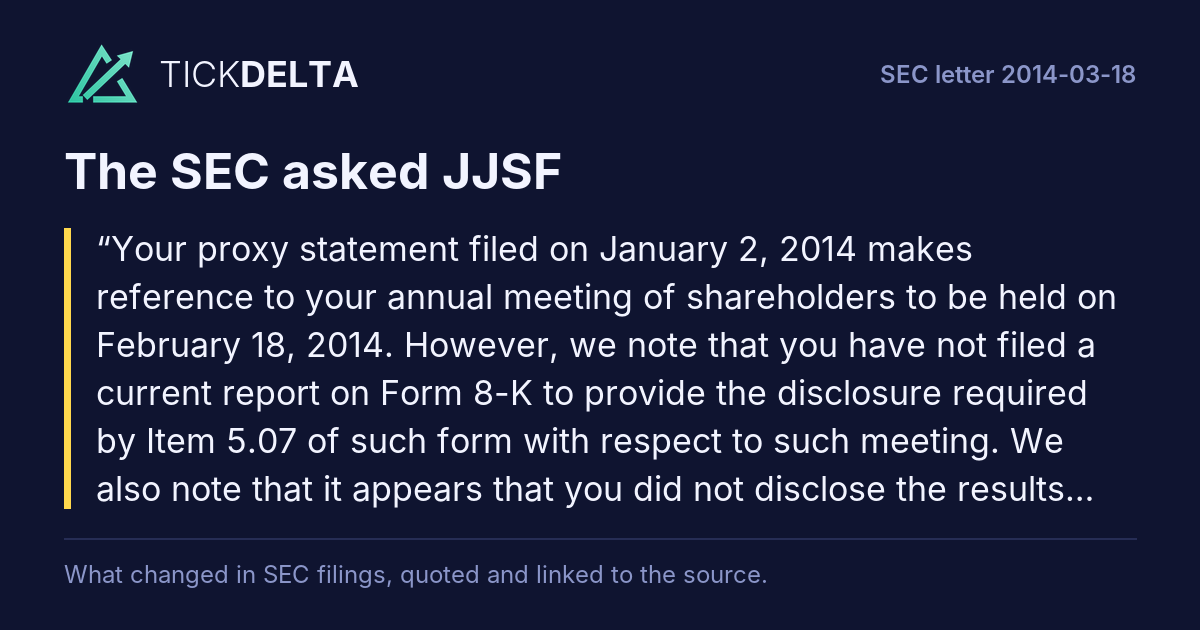
Your proxy statement filed on January 2, 2014 makes reference to your annual meeting of shareholders to be held on February 18, 2014. However, we note that you have not filed a current report on Form 8-K to provide the disclosure required by Item 5.07 of such form with respect to such meeting.
Rest of the question

We also note that it appears that you did not disclose the results of your February 7, 2013 annual meeting until you filed your quarterly report for the period ended March 30, 2013, on April 29, 2013. Please advise. Refer to SEC Release No. 33-9089 (December 16, 2009).

JJSF answered
We filed a report on Form 8-K on March 19, 2014 to comply with this year’s requirement and will file a timely Form 8-K in future years.
Read in the reply
In its next report

First report after the company's reply of Mar 25, 2014: 10-Q filed Apr 28, 2014 ↗, against the 10-Q filed Jan 27, 2014 ↗.

Tickdelta does not hold the text of both reports, so they are not compared here.
Certain Transactions, page 16
SEC asked (2)
Please provide the disclosure required by Item 404(b) of Regulation S-K.
JJSF answered
We propose not to amend this year’s filing but would include the following disclosure (or adjusted if there are changes to any of the policies) in future filings. Please note that the disclosure related to Director Brown is also disclosed on page 6 of the proxy statement filed on January 2, 2014.

TRANSACTIONS WITH RELATED PERSONS

The Compensation Committee is required to approve the compensation payable to executive officers and directors and to family members of executive officers and directors.
Rest of the answer

The Company’s Code of Business Conduct and Ethics applies to all officers, directors and employees of the Company. This code requires that if any director or executive officer or their family members or friends seek to provide goods or services to the Company or has or will have any transaction that is expected to exceed $120,000, they must notify the Company’s Chief Financial Officer, who reviews the proposed transaction and notifies the Nominating and Corporate Governance Committee for review and action as it sees fit.

The Charter of the Nominating and Corporate Governance Committee provides that the Committee shall review the material terms of the transaction including the approximate dollar amount, and the material facts and the related persons direct or indirect interest in, or relationship to, the transaction. In determining whether to approve or ratify a transaction, the Committee is directed to consider, among other factors it may deem appropriate, whether the transaction was or will be on terms no less favorable that those generally available to an unaffiliated third party under the same or similar circumstances. No director may participate in the discussion or approval of a transaction in which he or she, or a member of his or her immediate family, has a direct or indirect interest.

The Committee’s Charter provides that it is deemed to have approved any transaction, even if exceeding $120,000, in which a related person’s only interest is as a holder of the Company’s stock, and all holders received or will receive proportional benefits (such as the payment of regular quarterly dividends).

The directors and executive officers annually complete a proxy questionnaire in which they are asked to describe any transactions they or their immediate family have with the company in an amount that exceeds $120,000.

CERTAIN TRANSACTIONS

Robyn Shreiber, daughter of Gerald B. Shreiber, is Vice President, National Account Sales of J & J Snack Foods Sales Corp., a subsidiary of J & J. During fiscal 2013 she received $239,668 in total compensation. Frank Shreiber, brother of Gerald B. Shreiber, is Director of Purchasing. During fiscal 2013, he received $143,669 in total compensation. Director Brown's company, NFI Industries, provided transportation services to the Company totaling approximately $1,257,000 in 2013.

Please review our responses and contact me if you have any further questions or comments.

We acknowledge that the Company is responsible for the adequacy and accuracy of disclosures in our filings; that staff comments or changes to disclosures in response to staff comments do not foreclose the Commission from taking any action with respect to the filing; and the Company may not assert staff comments as a defense in any proceeding initiated by the Commission or any person under the federal securities laws of the United States.

Read in the reply
In its next report

First report after the company's reply of Mar 25, 2014: 10-Q filed Apr 28, 2014 ↗, against the 10-Q filed Jan 27, 2014 ↗.

Tickdelta does not hold the text of both reports, so they are not compared here.

Also in this review: closing letter, 2014-03-26
Form 10-K for the Fiscal Year Ended September 26, 2009

2010-02-26 to 2010-06-11 · 17 questions · 3 letters from the SEC, 3 from the company
Review closed 2010-06-11
RevenueSegmentsResults discussion (MD&A)Critical estimates
Schedule 14 A Definitive Proxy Statement, filed December 22, 2009 · General
SEC asked (1)
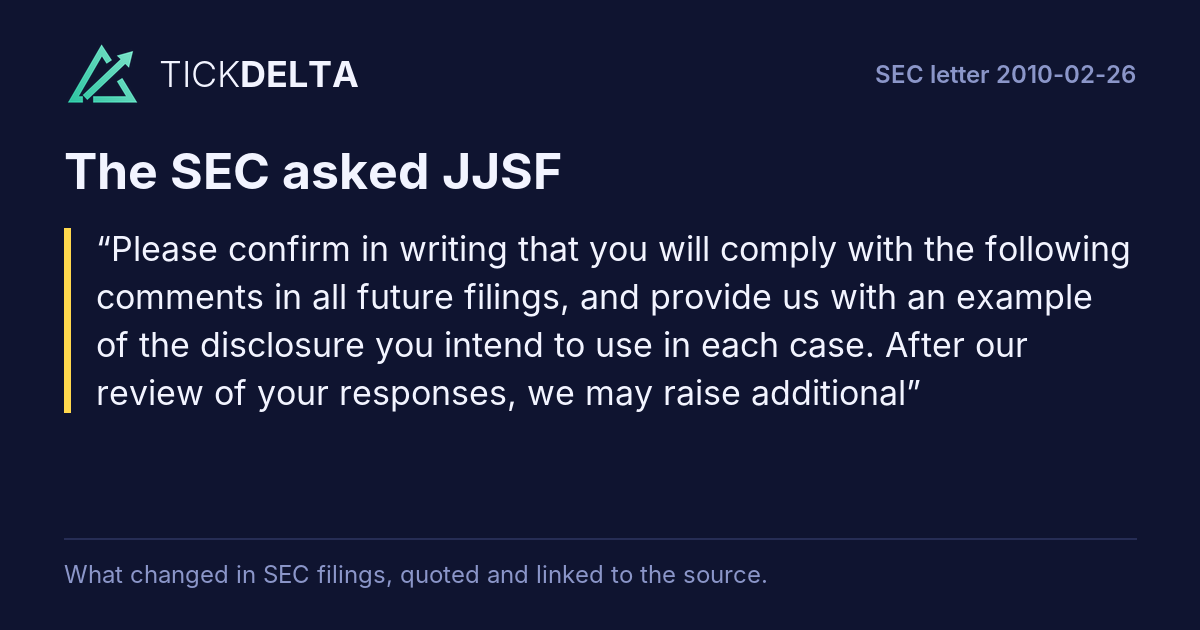
Please confirm in writing that you will comply with the following comments in all future filings, and provide us with an example of the disclosure you intend to use in each case. After our review of your responses, we may raise additional
JJSF answered
We confirm that we will comply with the following comments in all future filings.
Read in the reply
Annual Cash Incentive, page 10
SEC asked (2)
We note your disclosure that, in addition to the recommendation of the CEO and the annual results of the Company, you reviewed the “published reports of salaries and bonus given to CFO’s of 100 local Philadelphia companies” when determining the amount of Mr. Moore’s annual cash incentive.
Rest of the question

Related disclosure on page 9 states that you strive to deliver competitive compensation as compared to companies with whom you compete for executive talent and that your “Compensation Committee reviews reports of compensation of 100 local Philadelphia companies.” We further note your response letter to us dated May 8, 2008, which stated that your Compensation Committee uses these reports, with a “focus on companies with similar earnings and sales” as a source of information when making compensation decisions. Please identify the comparison group of companies used when determining Mr. Moore’s annual cash incentive. Refer to Item 402(b)(2)(xiv) of Regulation S-K.

JJSF answered
The

Committee reviewed the information included in the Philadelphia Business

Journal report on the 100 largest public companies in the region. The Committee did not use this information to create any specific comparison groups or as a benchmarking tool when determining any specific individual’s compensation, including Mr. Moore.
Read in the reply
In its next report

First report after the company's reply of Mar 18, 2010: 10-Q filed Apr 22, 2010 ↗, against the 10-Q filed Jan 21, 2010 ↗.

Tickdelta does not hold the text of both reports, so they are not compared here.

Annual Cash Incentive, page 10
SEC asked (3)
In addition, disclose the actual percentile in comparison to this group of companies with respect to the annual cash incentive paid to Mr. Moore.
JJSF answered
See our response to #2.
Read in the reply
In its next report

First report after the company's reply of Mar 18, 2010: 10-Q filed Apr 22, 2010 ↗, against the 10-Q filed Jan 21, 2010 ↗.

Tickdelta does not hold the text of both reports, so they are not compared here.

Summary Compensation Table, page 13
SEC asked (4)
Provide summary compensation information for the last three completed fiscal years. Refer to Item 402(c)(1) of Regulation S-K.
JJSF answered
The Company proposes to change its disclosure going forward. The following disclosure illustrates the changes the

Company will make in its future filings (although we note that required information has changed for future filings):

EXECUTIVE

COMPENSATION

SUMMARY

COMPENSATION TABLE

The following table summarizes compensation paid or earned for the three fiscal years ending September 26, 2009 for the Company’s Chief Executive Officer, Chief Financial Officer and the three other most highly compensated executive officers (the “Named Executive

Officers”).

Name and Principal
Rest of the answer

Position

Year

Salary

___$__

Bonus

Stock

Awards(1)

____$__

Option

Awards

($)

(1)

All

Other

Compensation

_____$_____

Total

__$__

Gerald

B. Shreiber

Chairman of the

Board

Chief

Executive

Officer

Director

2009

2008

2007

700,000

675,000

650,000

1,032,811

697,702

802,790

338,150

306,400

262,133

13,886

13,038

11,098

2,084,847

1,692,140

1,726,021

Robert

M. Radano

Senior

Vice

President

Operating

318,777

307,763

295,000

150,000

100,000

20,279

26,223

39,710

13,332

11,614

7,488

502,388

445,600

442,198

Dennis

G. Moore

Financial

Secretary

Treasurer

336,271

323,769

311,317

220,000

185,000

16,626

16,251

15,192

593,176

551,243

551,219

Daniel

Fachner

ICEE Company

316,137

304,497

293,230

273,482

261,446

276,200

19,408

18,684

15,880

629,306

610,850

625,020

Vincent

Melchiorre

Food

Group

300,243

288,860

88,000

230,000

180,000

251,000

133,178

163,334

50,256

46,948

54,677

13,922

13,890

8,218

1,912

724,259

695,089

405,090

---------------------------------- amounts reported in these columns correspond to amounts recorded for financial statement purposes. For a discussion of 2009 valuation assumptions, see Note A 13 to J & J’s Consolidated Financial

Statements included in J & J’s Annual Report on Form 10-K for the fiscal year ended September 26,

2009.

Form 10-K for the Fiscal

Year Ended September 26, 2009

Item

7. Management’s Discussion and Analysis of Financial Condition and

Read in the reply
In its next report

First report after the company's reply of Mar 18, 2010: 10-Q filed Apr 22, 2010 ↗, against the 10-Q filed Jan 21, 2010 ↗.

Tickdelta does not hold the text of both reports, so they are not compared here.

Operations · Critical Accounting Policies, Judgments and Estimates, page 12
SEC asked (5)
Your disclosure indicates that you recognize revenue from equipment service and from equipment service contracts. Please clarify the nature of each type of service that you provide to your customers and how you have determined that your accounting policy for each type of service complies with SAB Topic 13.
Rest of the question

In addition, please revise the discussion within your business disclosure in Item 1 of your filing to disclose the nature of the services that you provide to your customers.

JJSF answered
Service provided is the repair and maintenance of customers’ equipment and can be billed on a time and material basis or on a contract basis which provides for repair and maintenance over a fixed period of time. With regard to adherence to SAB Topic 13, revenue from billing on a time and material basis is recorded when the service is performed and revenue from service contracts is recorded on a straight line basis over the term of the contracts since service is performed regularly over the term of the contract.

Company proposes to change its disclosure going forward.
Rest of the answer

Note that underlines below and throughout these responses are for emphasis and are not intended to be included in future filings. The following disclosure illustrates the changes the Company will make in its future filings:

Item 1 disclosure:

Under the

Company’s principal marketing program for frozen carbonated beverages, it installs frozen beverage dispensers for its ICEE and ARCTIC BLAST brands at customer locations and thereafter services the machines, arranges to supply customers with ingredients required for production of the frozen beverages, and supports customer retail sales efforts with in-store promotions and point-of-sale materials. In most cases, the Company retains ownership of its dispensers, and as a result, customers are not required to make an investment in equipment or arrange for the ingredients and supplies necessary to produce and market the frozen beverages. The Company also provides repair and maintenance service to customers for customers’ owned equipment and sells equipment in its Frozen Beverages segment, revenue from which amounted to 9% of sales in 2009, 9% of sales in 2008 and 8% of the Company’s sales in fiscal year 2007. The Company sells frozen uncarbonated beverages under the SLUSH PUPPIE brand through a distributor network.

Polices, Judgments and Estimates Disclosure:

Revenue Recognition - We recognize revenue from our products when the products are shipped to our customers. Repair and maintenance equipment service revenue is recorded when it is performed provided the customer terms are that the customer is to be charged on a time and material basis or on a straight-line basis over the term of the contract when the customer has signed a service contract. Revenue is recognized only where persuasive evidence of an arrangement exists, our price is fixed or estimable and collectability is reasonably assured. We record offsets to revenue for allowances, end-user pricing adjustments, trade spending, coupon redemption costs and returned product. Customers generally do not have the right to return product unless it is damaged or defective. Off-invoice allowances are deducted directly from the amount invoiced to our customer when our products are shipped to the customer. Offsets to revenue for allowances, end-user pricing adjustments and trade spending are recorded primarily as a reduction of accounts receivable based on our estimates of liability which are based on customer programs and historical experience. These offsets to revenue are based primarily on the quantity of product purchased over specific time periods. For our Retail Supermarket and Frozen Beverages segments, we accrue for the liability based on products sold multiplied by per product offsets. Offsets to revenue for our Food Service segment are calculated in a similar manner for offsets owed to our direct customers; however, because shipments to end-users are unknown to us until reported by our direct customers or by the end-users, there is a greater degree of uncertainty as to the accuracy of the amounts accrued for end-user offsets. Additional uncertainty may occur as customers take deductions when they make payments to us. This creates complexities because our customers do not always provide reasons for the deductions taken. Additionally, customers may take deductions to which they are not entitled and the length of time customers take deductions to which they are entitled can vary from two weeks to well over a year. Because of the aforementioned uncertainties, the process to determine these estimates requires judgment. We feel that due to constant monitoring of the process, including but not limited to comparing actual results to estimates made on a monthly basis, these estimates are reasonable in all material respects. Our recorded liability for allowances, end-user pricing adjustments and trade spending was approximately $14,000,000 and $12,090,000 at September 26, 2009 and September

27, 2008, respectively.

Read in the reply
In its next report

First report after the company's reply of Mar 18, 2010: 10-Q filed Apr 22, 2010 ↗, against the 10-Q filed Jan 21, 2010 ↗.

Tickdelta does not hold the text of both reports, so they are not compared here.

Operations · Critical Accounting Policies, Judgments and Estimates, page 12
SEC asked (6)
We note that you record offsets to revenue for allowances, end-user pricing adjustments, trade spending, coupon redemption costs and returned products. Please provide a detailed explanation of each customer program that creates each of revenue offset that you have disclosed, and provide your accounting policy for each individual program.
JJSF answered
The Company does not have customer programs which are general to all customers or groups of companies with respect to revenue offsets. Allowances, end-user pricing adjustments and trade spending are individually negotiated with each customer.

Coupon redemption costs are paid to a third party who manages coupon redemption costs among many manufacturers and retailers. Returned products are approved individually with each customer. Our accounting policy is to estimate or record these offsets at the time of sale.
Rest of the answer

We believe that our current disclosure as shown in our response to #5 as to accounting policies on this subject is proper and adequate.

Read in the reply
In its next report

First report after the company's reply of Mar 18, 2010: 10-Q filed Apr 22, 2010 ↗, against the 10-Q filed Jan 21, 2010 ↗.

Tickdelta does not hold the text of both reports, so they are not compared here.

Operations · Critical Accounting Policies, Judgments and Estimates, page 12
SEC asked (7)
We note your disclosure surrounding the uncertainty in estimating revenue in your Food Service segment. Please clarify how you have determined that your revenue is fixed or determinable and collectible upon shipment when shipments to end users are unknown to you, customers take deductions from the sales price when they pay you, and take deductions that they are not contractually entitled to take.
JJSF answered
disclosure going forward. Please see our proposed changes to our revenue recognition discussion at our response to #5.
Read in the reply
In its next report

First report after the company's reply of Mar 18, 2010: 10-Q filed Apr 22, 2010 ↗, against the 10-Q filed Jan 21, 2010 ↗.

Tickdelta does not hold the text of both reports, so they are not compared here.

Results of Operations, page 14
SEC asked (8)
Your disclosure does not provide a discussion of the key indicators of financial condition and operating performance that management uses to analyze the short and long-term condition and results of the business. Your MD&A discussion should “identify and address those key variables and other quantitative and qualitative factors which are peculiar to and necessary for an understanding and evaluation of the individual
Rest of the question

company.” We refer you to Financial Reporting Codification 501.12.b.1. Therefore, please tell us the all the significant key variables that management uses to manage the business, both consolidated and by reportable segment, and revise your MD&A to disclose those key variables.

JJSF answered
Company proposes to change its disclosure going forward. The following disclosure illustrates the changes the Company will make in its future

RESULTS

OF OPERATIONS

Fiscal

2009 (52 weeks) Compared to Fiscal 2008 (52 weeks)

Net sales increased $23,688,000, or 4%, to $653,047,000 in fiscal 2009 from $629,359,000 in fiscal 2008.

We have four reportable segments, as disclosed in the accompanying notes to the consolidated financial statements: Food Service, Retail Supermarkets, The

Restaurant Group and Frozen Beverages.

The Chief

Operating Decision Maker for Food Service, Retail
Rest of the answer

Supermarkets and The

Restaurant Group and the Chief Operating Decision Maker for Frozen Beverages monthly review detailed operating income statements and sales reports in order to assess performance and allocate resources to each individual segment.

In addition, the Chief Operating Decision Makers review and evaluate depreciation, capital spending and assets of each segment on a quarterly basis to monitor cash flow and asset needs of each segment.

Sales to food service customers increased $17,559,000, or 4%, to $417,753,000 in fiscal

2009. Soft pretzel sales to the food service market decreased

$313,000, or about 1/3 of one percent, to $99,471,000 for the year. Unit sales of soft pretzels were down 3% for the year which is a continuation of a multi-year trend of flat or modestly up or down sales. Sales of bakery products excluding biscuit and dumpling sales and fruit and fig bar sales, increased $6,607,000, or 4%, for the year. Biscuit and dumpling sales were up 8% to $32,845,000 due to increased distribution and new product offerings. Sales of fig and fruit bars increased 11% to

$29,497,000 due to strong volume growth spread across our customer base. Churro sales were up 16% for the year with $29,404,000 of sales in 2009 with over 80% of the sales increase coming from sales to one customer who previously had not been a purchaser of churros. Frozen juice bar and ices sales decreased $934,000 or 2% to $50,272,000 for the year. Our sales of frozen juice bar and ices to school foodservice have been impacted and we expect them to continue to be impacted by nutritional concerns. Sales of our funnel cake products were up $2,872,000, or 49%, with sales to one customer who previously had not been a purchaser of funnel cake products accounting for about one-half of the increase and sales of funnel cake fries, a product introduced in the fourth quarter of fiscal 2008, accounting for the balance. Sales of new products in the first twelve months since their introduction were approximately $12,600,000 in fiscal year

2009. Price increases accounted for estimated sales of $13,700,000 in fiscal year 2009 and net volume increases, including new product sales as defined above, accounted for approximately $3,900,000 of sales in fiscal 2009.

Operating Income in our Food Service segment increased from $24,784,000 in 2008 to $45,024,000 in 2009 primarily as a result of price increases and increased volume as discussed above and lower commodity costs of approximately

$10,000,000.

Retail

Supermarkets

Sales of products to retail supermarkets increased $8,046,000 or 14% to $65,158,000 in fiscal 2009. Total soft pretzel sales to retail supermarkets were $30,506,000, an increase of 11% from fiscal 2008, on a unit volume decrease of 2%. Sales of frozen juice bars and ices increased

19% to $37,819,000 in 2009 on a case volume increase of

25%. Increased trade spending of $1.3 million for the introduction of new frozen novelty items and a shift in product mix reduced sales dollars in relation to the unit volume increases. Coupon redemption costs, a reduction of sales, increased 38% or about $1,029,000 for the year as we increased couponing in light of a trend toward increased use of coupons by shoppers. Sales of products in the first twelve months since their introduction were approximately

$6,300,000 in fiscal year 2009. Price increases accounted for estimated sales of $2,400,000 in fiscal year 2009 and net volume increases, including new product sales as defined above and net of increased coupon costs, accounted for approximately $5,600,000 of sales in fiscal

2009. Operating Income in our Retail Supermarkets segment increased from $4,665,000 in 2008 to $7,442,000 in 2009 primarily as a result of price and volume increases.

Restaurant Group our Restaurant Group, which operates BAVARIAN PRETZEL BAKERY and PRETZEL GOURMET retail stores in the Mid-Atlantic region, declined by 23% primarily due to closings or licensings of stores in the past year. At September 26,

2009, we had 4 stores open. Sales of stores open for both years were down 7% for the year. Operating Loss in our

Restaurant Group segment decreased from $140,000 in 2008 to $64,000 in 2009 primarily resulting from a decline in store closing costs.

Frozen

Beverages beverage and related product sales decreased $1,539,000 or 1% to $168,879,000 in fiscal 2009. Beverage sales alone were down

1% for the year. Gallon sales were down 2% for the year in our base ICEE business which is a continuation of a multi-year trend. Service revenue increased $3,210,000, or 8%, to

$42,013,000 for the year as we continue to grow this part of our business to new and existing customers. Frozen carbonated machine sales, which tend to fluctuate from year to year while following no specific trend, decreased $2,834,000 to $10,004,000 for the year. The estimated number of company owned frozen beverage dispensers was 38,700 and 36,400 at September 26,

2009 and September 27, 2008, respectively. Operating Income in our Frozen

Beverages segment increased from $14,027,000 in 2008 to $14,536,000 in

Consolidated than as commented upon above by segment, there are no material specific reasons for the reported sales increases or decreases. Sales levels can be impacted by the appeal of our products to our customers and consumers and their changing tastes, competitive and pricing pressures, sales execution, marketing programs, seasonal weather, customer stability and general economic conditions.

Gross profit as a percent of sales increased 2.28 percentage points in 2009 from 2008 to 32%.

Lower commodity costs in excess of $11,000,000 and higher pricing partially offset by higher workers’ compensation and group health benefit expense were the primary drivers causing the gross profit percentage increase. We presently expect commodity costs to be lower on a year to year comparison basis over the next several quarters; however, commodity costs can be extremely volatile and may be significantly different from what we are presently expecting. As we are self insured for most of our workers compensation costs and group health benefit costs, they may go up or down without notice.

operating expenses decreased $1,665,000 to $141,906,000 in fiscal

2009 and as a percentage of sales decreased 1.08 percentage points to 22% of sales in 2009. Other general income was $5,000 this year. Other general income of $375,000 last year primarily consisted of gains on the disposition of assets and insurance gains in our Food Service and Frozen Beverages segments offset by store closing costs in our Restaurant

Group segment of $102,000. Marketing expenses decreased .45 percentage points and remained at 11% of sales. Controlled spending in our Food Service and Frozen Beverages segments accounted for the overall decline. Distribution expenses decreased .75 of a percentage point and remained at 8% of sales due to lower freight and fuel costs. Administrative expenses were about 3-1/2% of sales in both years.

income increased $23,602,000, or 54%, to $66,938,000 in fiscal 2009 as a result of the aforementioned items.

Investment income decreased by $1,279,000 to $1,386,000 due to the general decline in the level of interest rates.

effective income tax rate was 39% in both fiscal years.

Net earnings increased $13,404,000, or 48%, in fiscal 2009 to $41,312,000, or $2.21 per diluted share as a result of the aforementioned items.

There are many factors which can impact our net earnings from year to year and in the long run, among which are the supply and cost of raw materials and labor, insurance costs, factors impacting sales as noted above, the continuing consolidation of our customers, our ability to manage our manufacturing, marketing and distribution activities, our ability to make and integrate acquisitions and changes in tax laws and interest rates.

Read in the reply
In its next report

First report after the company's reply of Mar 18, 2010: 10-Q filed Apr 22, 2010 ↗, against the 10-Q filed Jan 21, 2010 ↗.

Tickdelta does not hold the text of both reports, so they are not compared here.

Results of Operations, page 14
SEC asked (9)
Your disclosure within your Food Service results of operations discussion states, “[t]he changes in sales throughout the Food Service Segment were from a combination of volume changes and price increases.” This disclosure does not comply with the disclosure requirement in Regulation S-K, Rule 303(a)(3)(iii).
Rest of the question

Therefore, please revise to disclose the extent to which increases in revenue in the Food Service segment were attributable to increases in price, volume or the introduction of new products and services. You should revise your Retail Supermarkets results of operations discussion to provide similar disclosure.

JJSF answered
our response to #8.
Read in the reply
In its next report

First report after the company's reply of Mar 18, 2010: 10-Q filed Apr 22, 2010 ↗, against the 10-Q filed Jan 21, 2010 ↗.

Tickdelta does not hold the text of both reports, so they are not compared here.

Results of Operations, page 14
SEC asked (10)
You provide disclosure about the current period increase or decrease in sales of your various products within your Food Service, Retail Supermarkets and Frozen Beverage segments. However, you have not provided an analysis as to the reason(s) why the sales of the products have increased or decreased in the current period or provided a discussion of any known or expected trends that management has observed based upon
Rest of the question

the results of your product sales. Please revise your discussion accordingly. We refer you to Financial Reporting Codification 501.12.b.4.

JJSF answered
our response to #8.
Read in the reply
In its next report

First report after the company's reply of Mar 18, 2010: 10-Q filed Apr 22, 2010 ↗, against the 10-Q filed Jan 21, 2010 ↗.

Tickdelta does not hold the text of both reports, so they are not compared here.

Results of Operations, page 14
SEC asked (11)
In addition to discussing the results of revenue by reportable segment, provide a discussion of the results of operating income by segment.
JJSF answered
See our response to #8.
Read in the reply
In its next report

First report after the company's reply of Mar 18, 2010: 10-Q filed Apr 22, 2010 ↗, against the 10-Q filed Jan 21, 2010 ↗.

Tickdelta does not hold the text of both reports, so they are not compared here.

Consolidated Statements of Earnings, page F-4
SEC asked (12)
Please tell us what consideration you have given to separate presentation of product and services revenue and related cost of revenue in your income statements pursuant to Regulation S-X, Rules 5-03.1 and 2. As part of your response, please quantify the amount of service revenue recognized for each year reported.
JJSF answered
The amount of repair and maintenance service revenue recognized for each period is:

$42,013,000

, or 6% , of consolidated net sales of $653,047,000

$38,803,000, or 6% , of consolidated net sales of $629,359,000

$31,249,000, or 5% , of consolidated net sales of $568,901,000

Since the revenue is less than 10% of the total of product and services revenue, we have not reported product and services revenue separately in accordance with

Regulation S-X, Rules 5-03.1 and 2.
Read in the reply
In its next report

First report after the company's reply of Mar 18, 2010: 10-Q filed Apr 22, 2010 ↗, against the 10-Q filed Jan 21, 2010 ↗.

Tickdelta does not hold the text of both reports, so they are not compared here.

Note O – Segment Reporting, page F-23
SEC asked (13)
Please revise to provide disclosure of your products and services pursuant to ASC Topic 280-10-50-40. Closing Comments As appropriate, please amend your filing and respond to these comments within 10 business days or tell us when you will provide us with a response. You may wish to provide us with marked copies of the amendment to expedite our review.
Rest of the question

Please furnish a cover letter with your amendment that keys your responses to our comments and provides any requested information. Detailed cover letters greatly facilitate our review. Please understand that we may have additional comments after reviewing your amendment and responses to our comments.

JJSF answered
note that products sold within our Food Service, Retail Supermarket and

Restaurant Group segments are similar products and sales of such are appropriately disclosed in Note O pursuant to ASC Topic 280-10-50

40. However, proposed revisions to be made to Note O in future filings relative to the Frozen Beverage segment are:

NOTE

O – SEGMENT REPORTING

We sell frozen beverages and related products to the food service industry, including our restaurant group, primarily under the names ICEE, SLUSH PUPPIE and ARCTIC BLAST in the

United States, Mexico and Canada.
Rest of the answer

We also provide repair and maintenance service to customers for customers’ owned equipment, which revenue was $42,013,000, $38,803,000 and $31,249,000 in fiscal years 2009, 2008 and

2007, respectively. Additionally, we sell frozen carbonated machines, which revenue was $10,004,000, $12,838,000 and $13,778,000 in fiscal years 2009, 2008 and 2007, respectively.

Please review our responses and contact me if you have any further questions or comments.

acknowledge that the Company is responsible for the adequacy and accuracy of disclosures in our filings; that staff comments or changes to disclosures in response to staff comments do not foreclose the Commission from taking any action with respect to the filing; and the Company may not assert staff comments as a defense in any proceeding initiated by the Commission or any person under the federal securities laws of the United States.

Read in the reply
In its next report

First report after the company's reply of Mar 18, 2010: 10-Q filed Apr 22, 2010 ↗, against the 10-Q filed Jan 21, 2010 ↗.

Tickdelta does not hold the text of both reports, so they are not compared here.

Critical Accounting Policies, Judgments and Estimates, page 12
SEC asked (1)
We note the revised disclosure that you have provided in response, in part, to prior comment number 7. However, this disclosure did provide the analysis that we requested and therefore we reissue prior comment number 7.
Rest of the question

Please clarify how you have determined that your revenue is fixed or determinable and collectible upon shipment when shipments to end users are unknown to you, customers take deductions from the sales price when they pay you, and take deductions that they are not contractually entitled to take.

JJSF answered
As a further clarification to our prior response, unauthorized deductions, or deductions that customers are not contractually entitled to take, of any meaningful amount are almost always paid back. This rarely provides a complication in estimating our revenue and we will delete this reference from future disclosures.
Rest of the answer

In accordance with our telephone discussion, with regard to shipments to end users being unknown to us and customers taking deductions when they pay us, while this is true, our estimates of offsets to revenue for future deductions are based on a wide range of experience and are monitored monthly. As an example, we may have a contract to sell our product to a school system in Florida (end user) for

$8/case. We sell our product for $10/case to a distributor

(customer who we invoice) who delivers to the school system and to other of its own customers. When the distributor pays our invoice, which was at $10/case, the distributor will deduct $2/case and an additional agreed to amount from the amount of our invoice for the deliveries made to the school system. While we do not estimate these deductions on an end user by end user basis or on a distributor by distributor basis, our estimate is based on averages of past deductions as a percentage of revenue adjusted for knowledge of any factors that may affect the percentage going forward. Based upon this knowledge and our methodology discussed above, we believe our revenue recognition policies allow for appropriate revenue recognition.

Read in the reply
In its next report

First report after the company's reply of May 5, 2010: 10-Q filed Jul 22, 2010 ↗, against the 10-Q filed Jan 21, 2010 ↗.

Tickdelta does not hold the text of both reports, so they are not compared here.

Results of Operations, page 14
SEC asked (2)
We note your revised disclosure in connection with prior comment number 8 does not provide a discussion of the key indicators of financial condition and operating performance that management uses to analyze the short and long-term condition and results of the business.
Rest of the question

Therefore we reissue prior comment number 8 and request that you tell us the all the significant key variables that management uses to manage the business, both consolidated and by reportable segment. Please explain how the significant key variables that management uses to manage the business are fully disclosed in your MD&A discussion.

JJSF answered
There is one key variable that management monitors to manage our business and that is sales. Related to sales is our placements of frozen beverage machines, which, because of their significant costs, is routinely monitored and has been added to our disclosures. While there are other variables that are indicators of the company’s financial condition and operating performance such as gross margins, commodity costs and operating expenses, management does not put particular emphasis on any of these other variables or costs.
Rest of the answer

We believe that management of every single aspect of our business with the same diligence is important to the success of our company. We believe that our current disclosures express management’s views on the key variables as well as the other variables and costs mentioned above although we propose to modify our disclosures going forward as follows:

RESULTS OF

OPERATIONS

Fiscal

2009 (52 weeks) Compared to Fiscal 2008 (52 weeks)

Net sales increased $23,688,000, or 4%, to $653,047,000 in fiscal 2009 from $629,359,000 in fiscal 2008.

We have four reportable segments, as disclosed in the accompanying notes to the consolidated financial statements: Food Service, Retail Supermarkets, The

Restaurant Group and Frozen Beverages.

The Chief

Operating Decision Maker for Food Service, Retail Supermarkets and The

Restaurant Group and the Chief Operating Decision Maker for Frozen Beverages monthly review detailed operating income statements and sales reports in order to assess performance and allocate resources to each individual segment. Sales is considered to be the one and only key variable monitored by the Chief Operating Decision Makers and management when determining each segment’s and the company’s financial condition and operating performance. In addition, the Chief Operating

Decision Makers review and evaluate depreciation, capital spending and assets of each segment on a quarterly basis to monitor cash flow and asset needs of each segment.

Read in the reply
In its next report

First report after the company's reply of May 5, 2010: 10-Q filed Jul 22, 2010 ↗, against the 10-Q filed Jan 21, 2010 ↗.

Tickdelta does not hold the text of both reports, so they are not compared here.

Financial Statements · Note O – Segment Reporting, page F-23
SEC asked (3)
Your response to prior comment number 13 states that you believe that the products sold within your Food Service, Retail Supermarket and Restaurant Group segments are similar products. Please clarify how you determined that the various food and beverage products that you sell are similar in nature, and hence why you do not believe that revenue disclosure by product is necessary pursuant to FASB ASC Topic
Rest of the question

280-10-50-40. Closing Comments Please respond to these comments within 10 business days or tell us when you will provide us with a response. Please furnish a letter that keys your responses to our comments and provides any requested information. Detailed letters greatly facilitate our review. Please understand that we may have additional comments after reviewing your responses to our comments.

JJSF answered
After additional review of FASB ASC Topic 280-10-50-40, we have determined that the products in our Food

Service, Retail Supermarket and Restaurant Group are similar in nature because they are considered snack foods.
Read in the reply
In its next report

First report after the company's reply of May 5, 2010: 10-Q filed Jul 22, 2010 ↗, against the 10-Q filed Jan 21, 2010 ↗.

Tickdelta does not hold the text of both reports, so they are not compared here.

Note O – Segment Reporting, page F-23
SEC asked
We have considered your response to comment 3 in our letter dated April 23, 2010, whereby you have stated that you do not believe that information about your products is necessary as you have concluded that all of your products are snack foods and are therefore, similar in nature. However, we are unable to agree with your conclusions.
Rest of the question

Based on the information in your filing, including your President’s letter to your shareholders, it appears that you sell products to various segments within the food industry, including snack foods, frozen beverages, desserts and bakery products. Therefore, for each period reported, please disclose total revenues for each of your primary products pursuant to FASB ASC Topic 280-10-50-40. Based on your disclosure on pages 2 and 3 of your filing, your primary products appear to be, Soft Pretzels, Frozen Juice Treats and Desserts, Churros, Bakery Products and Frozen Beverages. We will not object to your complying with this comment on a prospective basis beginning with your next Form 10-Q. Closing Comments Please respond to this comment within 10 business days or tell us when you will provide us with a response. Please furnish a letter that keys your responses to our comments and provides any requested information. Detailed letters greatly facilitate our review. Please understand that we may have additional comments after reviewing your response to our comment.

JJSF answered
will comply with this comment on a prospective basis beginning with our next

Form 10-Q.
Read in the reply
In its next report

First report after the company's reply of May 27, 2010: 10-Q filed Jul 22, 2010 ↗, against the 10-Q filed Jan 21, 2010 ↗.

Tickdelta does not hold the text of both reports, so they are not compared here.

Also in this review: request for more time, Mar 10, 2010, closing letter, 2010-06-11

Form 10-K

2008-02-29 to 2008-07-11 · 19 questions · 2 letters from the SEC, 3 from the company
Review closed 2008-07-11
Executive payGoodwill and impairmentAcquisitionsRevenueCritical estimatesInventory
Compensation Discussion and Analysis, page 8
SEC asked (1)
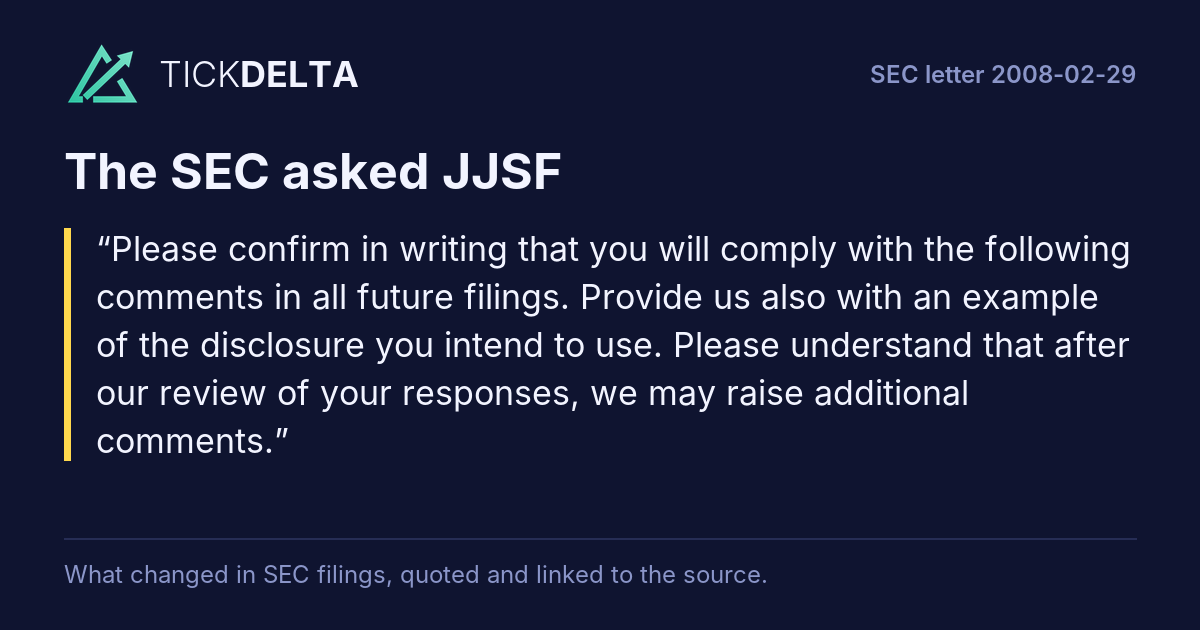
Please confirm in writing that you will comply with the following comments in all future filings. Provide us also with an example of the disclosure you intend to use. Please understand that after our review of your responses, we may raise additional comments.
JJSF answered
We confirm that we will comply with the following comments in all future filings.
Read in the reply
In its next report

First report after the company's reply of Mar 13, 2008: 10-Q filed Apr 24, 2008 ↗, against the 10-Q filed Jan 24, 2008 ↗.

Tickdelta does not hold the text of both reports, so they are not compared here.

Compensation Discussion and Analysis, page 8
SEC asked (2)
Identify the specific items or measurements of corporate performance utilized in determining whether corporate performance standards are met for the various forms of performance based compensation.
JJSF answered
Annual Cash Incentives are the only form of performance based compensation determined by measures of corporate performance. We believe that the specific items of corporate performance are identified in the below excerpt from Compensation

Discussion and Analysis:

Annual Cash Incentive

The Annual Cash Incentive or Bonus for each Named Executive Officer is handled in a variety of ways. Certain executives are governed by various formula described below which have been developed over the years.
Rest of the answer

The Compensation Committee reviews the formula annually and has determined that it is producing results that it considers fair and appropriate.

Gerald B. Shreiber — CEO. At our 2004 Annual Meeting, the Shareholders approved a bonus formula for Mr. Shreiber whereby he receives annually a bonus equal to 2.5 percent of the Company’s

Net Earnings. This formula produced a bonus of $651,000 in fiscal year 2005, $736,000 in fiscal year 2006 and $802,790 in fiscal year 2007.

Dennis G. Moore’s, Senior Vice President and CFO, bonus is not determined by formula. In determining his bonus the Compensation Committee reviews published reports of salaries and bonus given to CFO’s of 100 local Philadelphia companies and considers the recommendation of the CEO and the annual results of the Company.

Robert Radano’s, Senior Vice President and COO, bonus is established by a formula which provided him a bonus equal to six percent (6%) of the increase in earnings for the current fiscal year over the average earnings of the prior two years for certain J & J companies in which Mr. Radano is directly involved. Under this formula Mr. Radano would not earn a bonus. However, the Committee recognized that this formula was affected by the sudden and unexpected increase in commodity prices. Upon the recommendation of the CEO the Committee approved a discretionary bonus of $100,000.

Daniel Fachner’s annual bonus is equal to two percent (2%) of the earnings before taxes and foreign currency adjustments for the ICEE Company.

Vincent Melchiorre’s bonus for fiscal 2007 was determined by his Employment contract discussed below.

Read in the reply
In its next report

First report after the company's reply of Mar 13, 2008: 10-Q filed Apr 24, 2008 ↗, against the 10-Q filed Jan 24, 2008 ↗.

Tickdelta does not hold the text of both reports, so they are not compared here.

Compensation Discussion and Analysis, page 8
SEC asked (3)
Indicate specifically whether you engage in the “benchmarking” of total compensation or any material component thereof, and if so, please identify the benchmark and its components. For example, we note that while you indicate in the first paragraph under “Determining Compensation” that “we need not set compensation levels at a targeted percentile or rely solely on such data to make our compensation decisions,” you
Rest of the question

also indicate in your discussion of Mr. Moore’s annual cash incentive (page 10) that the Compensation Committee “reviews published reports of salaries and bonuses.”

JJSF answered
The Company proposes to change its disclosure going forward. The following disclosure illustrates the changes the Company will make in its future filings:

Determining Compensation

The Compensation Committee’s process for determining compensation levels for executive officers differs depending upon the compensation element and the position of the individual being considered. For each executive officer other than the CEO; the Compensation Committee annually reviews each element of compensation described below in consultation with the CEO.
Rest of the answer

A number of factors are considered in determining individual compensation level, including performance of the individual and the business unit or function under his or her leadership, the Company’s performance, and economic and business conditions affecting J & J at the time of the review.

Management and external sources provide relevant information and analyses as the Compensation

Committee deems appropriate. Competitive market data (compensation of 100 local Philadelphia

Companies) is considered from time to time, but we need not set compensation levels at a targeted percentile or rely solely on such data to make compensation decisions. While substantially guided by the applicable performance metrics of our programs, the Compensation Committee retains authority to exercise its judgment when approving individual awards. The Committee does not engage in the benchmarking of total compensation or any material component thereof.

Read in the reply
In its next report

First report after the company's reply of Mar 13, 2008: 10-Q filed Apr 24, 2008 ↗, against the 10-Q filed Jan 24, 2008 ↗.

Tickdelta does not hold the text of both reports, so they are not compared here.

Executive Compensation Objectives, page 8
SEC asked (4)
Reference is made in the last bullet point on page 8 to a “peer group” of companies considered in determining compensation levels. Please identify the companies that constitute this “peer group” for purposes of determining compensation.
JJSF answered
Compensation should reward Company and individual performance. Our programs should strive to deliver competitive compensation for exceptional individual and Company performance to companies with whom we compete for executive talent. The Compensation Committee reviews reports of compensation of 100 local Philadelphia companies.
Read in the reply
In its next report

First report after the company's reply of Mar 13, 2008: 10-Q filed Apr 24, 2008 ↗, against the 10-Q filed Jan 24, 2008 ↗.

Tickdelta does not hold the text of both reports, so they are not compared here.

Annual Cash Incentive, page 10
SEC asked (5)
Identify the “comparable companies” utilized in determining Mr. Moore’s cash bonus amounts.
JJSF answered
determining his bonus the Compensation Committee reviews published reports of salaries and bonus given to CFO’s of 100 local Philadelphia companies and considers the recommendation of the CEO and the annual results of the Company.
Read in the reply
In its next report

First report after the company's reply of Mar 13, 2008: 10-Q filed Apr 24, 2008 ↗, against the 10-Q filed Jan 24, 2008 ↗.

Tickdelta does not hold the text of both reports, so they are not compared here.

Long Term Incentives, page 10
SEC asked (6)
What is the basis upon which the allocation between current compensation and long term incentives is made in determining an employee’s total compensation? How is the allocation among the various forms of long term incentive compensation determined?
JJSF answered
Long-Term Incentives. Long-term incentive compensation is designed to:

• align executive officer and stockholder interests;

facilitate stock ownership among executive officers;

reward achievement of long-term performance goals; and provide incentives for executive retention;

Mr. Shreiber’s annual grant of stock options is fixed by the Stock Option Plan at 20,000 options per year. Mr. Melchiorre’s grants of stock options are set forth in his Employment

Contract discussed above.
Rest of the answer

The Compensation Committee has determined that Other Named

Executive Officers should receive annual grants of stock options to acquire $100,000 in stock value because this is the limit above which options no longer qualify as Incentive

Stock Options under Internal Revenue Service regulations.

The Compensation Committee’s decision to limit the use of long term compensation to the stock options described above is because the Named Executive Officers, other than Mr. Melchiorre, have already accumulated substantial stock ownership over their long periods of service. As a result compensation of the Named Executive Officers is primarily current compensation. The Compensation Committee did not consider any other forms of long-term incentives since its opinion is that the stock option grants are sufficient long-term incentives.

The terms of the long-term incentive awards granted to Named Executive Officers are described in the narrative to Summary Compensation Table and Grants of Plan-Based Awards table. In accordance with the Stock Option Plan, Mr. Shreiber’s options are granted at the end of the Company’s fiscal year. With the exception of options granted to recently hired employees at time of hire or to employees hired in connection with an acquisition, stock options are granted in December of each year on a date selected by the Board at its

November meeting.

Additionally, we would remove the following bullet point from the discussion of Executive

Compensation Objectives:

Executive Compensation Objectives

Compensation should foster the long-term focus required for success in the snack food industry. We believe that long-term incentive compensation will motivate executive officers to deliver long-term value to our stockholders. Executives at higher levels in our Company should have a greater proportion of their compensation tied to longer-term performance because they are in a better position to influence longer-term results. This approach supports strategic decision-making and actions that will serve the long-term interest of J & J and aligns the interest of executive officers and stockholders.

Read in the reply
In its next report

First report after the company's reply of Mar 13, 2008: 10-Q filed Apr 24, 2008 ↗, against the 10-Q filed Jan 24, 2008 ↗.

Tickdelta does not hold the text of both reports, so they are not compared here.

Perquisites, page 11
SEC asked (7)
Please confirm that none of the items exceed the $25,000 limit set forth in Item 402(k)(2)(vii) of Regulation S-K.
JJSF answered
Perquisites. J & J provides a limited number of perquisites, none of which exceed

$25,000 in value, to its Named Executive Officers. The most significant of these perquisites is the use of a Company automobile. Mr. Fachner is provided with an allowance to defray the cost of his Country Club membership.
Read in the reply
Critical Accounting Policies, Judgments and Estimates, page 13
SEC asked (8)
You have identified that your estimate of th e useful lives of intangible assets is a critical policy. Expand you discussion to address, for each class of amortizable intangibles, the pertinent factors you consider to determine the useful life, the uncertainties involved, and why such estimates bear the risk of change.
JJSF answered
Asset Impairment - In 2006, goodwill of our frozen beverages reporting unit increased by

$3,487,000 as a result of the acquisitions of ICEE of Hawaii and SLUSH PUPPIE and the goodwill of our food service reporting unit increased by $839,000 as a result of a smaller acquisition. In

2007, goodwill of our food service reporting unit increased by $1,323,000 as a result of the acquisitions of Hom/Ade Foods and DADDY RAY’S.
Rest of the answer

In 2007, goodwill of our frozen beverages reporting unit increased by $603,000 as the result of the Kansas ICEE acquisition.

We have three reporting units with goodwill totaling $60,314,000 as of September 29, 2007. We utilize historical reporting unit cash flows (defined as reporting unit operating income plus depreciation and amortization) as a proxy for expected future reporting unit cash flows to evaluate the fair value of these reporting units. If the fair value estimated substantially exceeds the carrying value of the reporting unit, including the goodwill, if any, associated with that unit, we do not recognize any impairment loss. We do not engage a third party to assist in this analysis as we believe that our in-house expertise is adequate to perform the analysis.

Licenses and rights, customer relationships and non compete agreements are being amortized by the straight-line method over periods ranging from 4 to 20 years and amortization expense is reflected throughout operating expenses. The gross carrying amount of intangible assets increased by $17,034,000 in 2006 primarily as a result of the acquisition of $15,188,000 of intangible assets of the SLUSH PUPPIE business. The gross carrying amount of intangibles increased by $39,633,000 in

2007 primarily as a result of the acquisitions of $23,771,000 and $12,799,000 of intangible assets of Hom/Ade Foods and DADDY RAY’S, respectively. Long-lived assets, including fixed assets and intangibles, are reviewed for impairment as events or changes in circumstances occur indicating that the carrying amount of the asset may not be recoverable. Cash flow analyses are used to assess impairment. The estimates of future cash flows involve considerable management judgment and are based upon assumptions about expected future operating performance. Assumptions used in these forecasts are consistent with internal planning. The actual cash flows could differ from management’s estimates due to changes in business conditions, operating performance, economic conditions, competition and consumer preferences.

Useful lives of intangible assets - Most of our trade names which have carrying value have been assigned an indefinite life and are not amortized because we plan to receive the benefit from them indefinitely. If we decide to curtail or eliminate the use of any of the trade names or if sales that are generated from any particular trade name do not support the carrying value of the trade name, then we would record an impairment or assign an estimated useful life and amortize over the remaining useful life. Rights such as prepaid licenses and non compete agreements are amortized over contractual periods. The useful lives of customer relationships are based on the discounted cash flows expected to be received from sales to the customers adjusted for an attrition rate. The loss of a major customer or declining sales in general could create an impairment charge.

Read in the reply
In its next report

First report after the company's reply of Mar 13, 2008: 10-Q filed Apr 24, 2008 ↗, against the 10-Q filed Jan 24, 2008 ↗.

Tickdelta does not hold the text of both reports, so they are not compared here.

Consolidated Statements of Earnings, pro forma F-5
SEC asked (9)
We note your presentation of shared-based compensation expense at the bottom of your statements of earnings. Please tell us how you believe this presentation complies with the guidance at SAB Topic 14:F.
JJSF answered
The guidance at SAB Topic 14:F is, “The staff believes a company could consider disclosing the amount of expense related to share-based payment arrangements included in specific line items in the financial statements. Disclosure of this information might be appropriate in a parenthetical note to the appropriate income statement line items, on the cash flow statement, in the footnotes to the financial statements, or within MD&A.” Our opinion is that our presentation is consistent with this guidance and clearly provides the reader of the financial statements with information that is
Rest of the answer

understandable.

Read in the reply
In its next report

First report after the company's reply of Mar 13, 2008: 10-Q filed Apr 24, 2008 ↗, against the 10-Q filed Jan 24, 2008 ↗.

Tickdelta does not hold the text of both reports, so they are not compared here.

Notes to Consolidated Financial Statements · Note A –Summary of Significant Accounting Policies, page F-8
SEC asked (10)
Revise this footnote to disclose what your significant accounting policies actually are, rather than only stating that your policies comply with or follow a particular accounting standard or Staff Accounting Bulletin. In particular, address this comment with regard to revenue recognition, impairment policies for long-term and intangible assets, and charges against inventories.
JJSF answered
illustrates the changes the Company will make in its future filings as relates to impairment policies for long-term and intangible assets and charges against inventories:

7. Inventories

Inventories are valued at the lower of cost (determined by the first-in, first-out method) or market. We follow FASB Statement 151, “Inventory Costs, an amendment of Accounting Research

Bulletin (ARB) No. 43, Chapter 4,” (Statement 151).
Rest of the answer

Statement 151 retains the general principle of

ARB 43, Chapter 4, “Inventory Pricing”, that inventories are presumed to be stated at cost;

however, it amends ARB 43 to clarify that abnormal amounts of idle facilities, freight, handling costs, and spoilage should be recognized as charges of the current period and allocation of fixed production overheads to inventories should be based on the normal capacity of the production facilities.

Statement 151 defines normal capacity as the production expected to be achieved over a number of periods or seasons under normal circumstances, taking into account the loss of capacity resulting from planned maintenance. The Board concluded that normal capacity refers to a range of production levels that will vary based on businessand industry-specific factors. Accordingly, an entity will have to use judgment to determine when production is outside the range of expected variation in production (either abnormally low or abnormally high). In periods of abnormally low production (for example, periods in which there is significantly lower demand, labor and material shortages exist, or there is unplanned equipment downtime) the amount of fixed overhead allocated to each unit of production should not be increased. However, in periods of abnormally high production the amount of fixed overhead allocated to each unit of production is decreased to assure inventories are not measured above cost.

We review for slow moving and obsolete inventory and a reserve is established for the value of inventory that we estimate will not be used. At September 29, 2007 and September 30, 2006, our reserve for inventory was $2,864,000 and $2,330,000, respectively.

9. Depreciation and Amortization

Depreciation of equipment and buildings is provided for by the straight-line method over the assets’ estimated useful lives. Amortization of improvements is provided for by the straight-line method over the term of the lease or the assets’ estimated useful lives, whichever is shorter.

Licenses and rights arising from acquisitions are amortized by the straight-line method over periods ranging from 4 to 20 years. We follow SFAS No. 144, “Accounting for the Impairment or

Disposal of Long-Lived Assets,” (SFAS No. 144) and SFAS No. 142, “Goodwill and Other Intangible

Assets,” (SFAS No. 142).

We review our equipment and buildings to ensure that they provide economic benefit. We recorded an impairment charge of $1,193,000 in 2006 in the food service segment for the writedown of robotic packaging equipment based on a determination made during the year that we would not be able to make the equipment work as intended. We use market value tests and discounted cash flow models to test goodwill and other intangible assets for impairment. These assets are reviewed for impairment annually or more frequently as a triggering event, such as the loss of a major customer, might occur.

We believe that our discussion on page F-8 discloses what our significant accounting policies are with regard to revenue recognition.

Read in the reply
In its next report

First report after the company's reply of Mar 13, 2008: 10-Q filed Apr 24, 2008 ↗, against the 10-Q filed Jan 24, 2008 ↗.

Tickdelta does not hold the text of both reports, so they are not compared here.

Notes to Consolidated Financial Statements · Note A –Summary of Significant Accounting Policies, page F-8
SEC asked (11)
You state that revenue from the sale of products is recognized at the time the products are shipped to third parties. Please confirm that recognizing revenue at the time of shipment, rather than at the time of delivery, is consistent with the terms of your agreements with customers. In other words, confirm that the terms of your product shipments are FOB shipping point rather than FOB destination.
JJSF answered
Our customers place legally binding orders for product, and therefore, absent quality issues, are legally obligated to accept product once it has been shipped. Customer rejections for quality issues are rare. Based on these facts, we believe that recognizing revenue when product is shipped is proper revenue recognition.
Read in the reply
In its next report

First report after the company's reply of Mar 13, 2008: 10-Q filed Apr 24, 2008 ↗, against the 10-Q filed Jan 24, 2008 ↗.

Tickdelta does not hold the text of both reports, so they are not compared here.

Commodity Price Risk Management, page F-13
SEC asked (12)
Disclose your policy for net losses on firm purchase commitments and separately disclose such losses if material. Refer to ARB 47, Chapter 4, paragraph 17.
JJSF answered
15. Commodity Price Risk Management

Our most significant raw material requirements include flour, shortening, corn syrup, sugar, raisins, juice, cheese, chocolate, and macadamia nuts. We attempt to minimize the effect of future price fluctuations related to the purchase of raw materials primarily through forward purchasing to cover future manufacturing requirements, generally for periods from 1 to 12 months. As of September

29, 2007, we have approximately $31,000,000 of such commitments. Futures contracts are not used in combination with forward purchasing of these raw materials.
Rest of the answer

Our procurement practices are intended to reduce the risk of future price increases, but also may potentially limit the ability to benefit from possible price decreases. Our policy is to recognize estimated losses on purchase commitments when they occur. At each of the last three fiscal year ends, we did not have any material losses on our purchase commitments.

Read in the reply
In its next report

First report after the company's reply of Mar 13, 2008: 10-Q filed Apr 24, 2008 ↗, against the 10-Q filed Jan 24, 2008 ↗.

Tickdelta does not hold the text of both reports, so they are not compared here.

Note B – Acquisitions, page F-15
SEC asked (13)
Please explain to us why your pro forma earnings chart on page F-16 excludes the impact of the Home/Ade and Radar acquisitions. Clarify in your footnote disclosure which business combinations are included in the pro forma disclosure. We note that paragraph 54 of SFAS No.
Rest of the question

141 requires that the results of material businesses acquired or a series of individually immaterial business combinations that are material in the aggregate should be included, not excluded, for the current and prior periods.

JJSF answered
The pro forma earnings chart on page F-16 does include the impact of the Hom/Ade and Radar acquisitions by removing the beneficial impact of Hom/Ade and Radar on sales, net earnings, earnings per diluted share and earnings per basic share from our consolidated results for the year ended September 29, 2007.
Rest of the answer

Since our results for the years ended

September 30, 2006 and September 24, 2005 do not include Hom/Ade and Radar, we are providing a like comparison of the three years’ results.

In our disclosure, we state, “The following pro forma information discloses net sales, net earnings and earnings per share for the year ended September 29, 2007 excluding the impact of the Hom/Ade and Radar acquisitions.

Although this may be contrary to the specific requirements of paragraph 54 of SFAS No. 141, we believe our chart provides a more meaningful comparison for the reader of our financial statements and is therefore within the spirit of paragraph 54 of SFAS No. 141.

Additionally, we do not have audited financial statements for Hom/Ade and Radar for the prior years and if we did, they would likely include charges that are not representative of an ongoing public company and their inclusion would likely distort the comparison for the reader. Due to the lack of reliable historical audited financial statements, we do not feel it would be prudent to present such information to the public.

We are comfortable that our chart, although contrary to paragraph 54 of SFAS No. 141, does not mislead the reader and in our opinion provides the reader with a better and clearer comparison of results.

Read in the reply
In its next report

First report after the company's reply of Mar 13, 2008: 10-Q filed Apr 24, 2008 ↗, against the 10-Q filed Jan 24, 2008 ↗.

Tickdelta does not hold the text of both reports, so they are not compared here.

Note C – Investment Securities, page F-16
SEC asked (14)
Expand your disclosure to describe the nature of your equity securities. In particular, address why you consider the equity securities to be short-term in nature and why such securities would not fluctuate from their par value. We may have further comment.
JJSF answered
Equity securities are comprised of auction market preferred shares which are saleable at auction at auction intervals ranging from 7 to 49 days. Auction market preferred shares have historically been bought and sold at par. The auction market preferred shares which we own are minimally 200 % collateralized, as required by the Investment Company Act of

1940, by assets which are equity and fixed income securities.
Read in the reply
In its next report

First report after the company's reply of Mar 13, 2008: 10-Q filed Apr 24, 2008 ↗, against the 10-Q filed Jan 24, 2008 ↗.

Tickdelta does not hold the text of both reports, so they are not compared here.

Note F – Goodwill and Intangible Assets, page F-18
SEC asked (15)
It appears you have classified the value assigned to customer relationships from your disclosed acquisitions in Note B as “licenses and rights” in this table. Tell us why you consider customer relationships to be part of the same intangible asset class as licenses and rights, as defined in Statement of Financial Accounting Standards 142.
JJSF answered
The carrying amount of acquired intangible assets for the reportable segments are as follows:

September 29, 2007

September 30, 2006

Gross

Carrying

Accumulated

Amount

Amortization

(in thousands)
Read in the reply
In its next report

First report after the company's reply of Mar 13, 2008: 10-Q filed Apr 24, 2008 ↗, against the 10-Q filed Jan 24, 2008 ↗.

Tickdelta does not hold the text of both reports, so they are not compared here.

Note F – Goodwill and Intangible Assets, page F-18
SEC asked (16)
Disclose the accounting policy for each of your amortized and indefinite life assets such as trade names and goodwill. In particular, disclose the basis for determining the recorded carrying amount and, if applicable, the amortization period used.
JJSF answered
The gross carrying amount of intangible assets is determined by applying a discounted cash flow model to the future sales and earnings associated with each intangible asset or is set by contract cost. The amortization period used for definite lived intangible assets is set by contract period or by the period over which the bulk of the discounted cash flow is expected to be generated.
Rest of the answer

We currently believe that we will receive the benefit from the use of the trade names classified as indefinite lived intangible assets indefinitely and they are therefore not amortized.

The carrying value of goodwill is determined based on the excess of the purchase price of acquisitions over the estimated fair value of tangible and intangible net assets. Goodwill is not amortized but is evaluated annually by management for impairment. There were no impairment charges in 2007, 2006 or 2005.

Note J

– Commitments

Read in the reply
In its next report

First report after the company's reply of Mar 13, 2008: 10-Q filed Apr 24, 2008 ↗, against the 10-Q filed Jan 24, 2008 ↗.

Tickdelta does not hold the text of both reports, so they are not compared here.

Note J – Commitments · Other Commitments, page F-21
SEC asked (17)
Tell us your accounting policy for incurred but not reported (IBNR) claims and how such policy conforms to generally accepted accounting principles, including references to applicable accounting standards. We may have further comment. Closing Comments As appropriate, please amend your filing and respond to these comments within 10 business days or tell us when you will provide us with a response.
Rest of the question

You may wish to provide us with marked copies of the amendment to expedite our review. Please furnish a cover letter with your amendment that keys your responses to our comments and provides any requested information. Detailed cover letters greatly facilitate our review. Please understand that we may have additional comments after reviewing your amendment and responses to our comments.

JJSF answered
The Company proposes to change its disclosure on page 15 going forward. The following disclosure illustrates the changes the Company will make in its future filings:

Insurance Reserves — We have a self-insured medical plan which covers approximately 1,100 of our employees. We record a liability for incurred but not yet reported or paid claims based on our historical experience of claims payments and a calculated lag time period. We maintain a spreadsheet that includes claims payments made each month according to the date the claim was incurred.
Rest of the answer

This enables us to have an historical record of claims incurred but not yet paid at any point in the past. We then compare our accrued liability to the more recent claims incurred but not yet paid amounts and adjust our recorded liability up or down accordingly. Our recorded liability at September 29, 2007 and September 30, 2006 was $801,000 and $1,101,000, respectively. Considering that we have stop loss coverage of $125,000 for each individual plan subscriber, the general consistency of claims payments and the short time lag, we believe that there is not a material exposure for this liability. Because of the foregoing, we do not engage a third party actuary to assist in this analysis.

We self-insure, up to loss limits, worker’s compensation and automobile liability claims.

Accruals for claims under our self-insurance program are recorded on a claims-incurred basis.

Under this program, the estimated liability for claims incurred but unpaid in fiscal years 2007 and

2006 was $1,900,000 and $2,800,000, respectively. Our total recorded liability for all years’ claims incurred but not yet paid was $6,800,000 and $7,650,000 at September 29, 2007 and September

30, 2006, respectively. We estimate the liability based on total incurred claims and paid claims adjusting for loss development factors which account for the development of open claims over time.

We estimate the amounts we expect to pay for some insurance years by multiplying incurred losses by a loss development factor which is based on insurance industry averages and the age of the incurred claims; our estimated liability is then the difference between the amounts we expect to pay and the amounts we have already paid for those years. Loss development factors that we use range from 1.0 to 2.0. However, for some years, the estimated liability is the difference between the amounts we have already paid for that year and the maximum we could pay under the program in effect for that particular year because the calculated amount we expect to pay is higher than the maximum. For other years, where there are few claims open, the estimated liability we record is the amount the insurance company has reserved for those claims. We evaluate our estimated liability on a continuing basis and adjust it accordingly. Due to the multi-year length of these insurance programs, there is exposure to claims coming in lower or higher than anticipated; however, due to constant monitoring and stop loss coverage on individual claims, we believe our exposure is not material. Because of the foregoing, we do not engage a third party actuary to assist in this analysis. In connection with these self-insurance agreements, we customarily enter into letters of credit arrangements with our insurers. At September 29, 2007 and September 30, 2006, we had outstanding letters of credit totaling $9,595,000 and $8,620,000, respectively.

Also, page 15-Insurance Reserves includes a detailed discussion of our accounting policy for incurred but not reported (IBNR) claims. We record an accrual based on an estimate of claims not yet paid and not yet reported which is in conformity with applicable accounting standards.

Please review our responses and contact me if you have any further questions or comments.

We acknowledge that the Company is responsible for the adequacy and accuracy of disclosures in our filings; that staff comments or changes to disclosures in response to staff comments do not foreclose the Commission from taking any action with respect to the filing; and the Company may not assert staff comments as a defense in any proceeding initiated by the Commission or any person under the federal securities laws of the United States.

Read in the reply
In its next report

First report after the company's reply of Mar 13, 2008: 10-Q filed Apr 24, 2008 ↗, against the 10-Q filed Jan 24, 2008 ↗.

Tickdelta does not hold the text of both reports, so they are not compared here.

Form 10-K for the Fiscal Year Ended September 29, 2007 · Executive Compensation Objectives
SEC asked (1)
We note in your response number 4 that you indicate that your Compensation Committee “reviews reports of compensation of 100 local Philadelphia companies.” Explain to us how the Committee “reviews” that information. Tell us also why these companies were selected. If these are not public companies, tell us how you obtain that information.
JJSF answered
The information is gathered by The Philadelphia Business Journal from reports by public companies in the Philadelphia metropolitan area. It is published annually. The selection of companies is the 150 largest public companies in the region. The paper lists the 100 highest paid executives. These criteria were determined solely by the newspaper. The

Committee uses this report as a source of information about what other companies are paying its executives with the committee being able to focus on companies with similar earnings and sales.
Read in the reply
In its next report

First report after the company's reply of May 8, 2008: 10-Q filed Jul 24, 2008 ↗, against the 10-Q filed Jan 24, 2008 ↗.

Tickdelta does not hold the text of both reports, so they are not compared here.

Note B – Acquisitions, page F-15
SEC asked (2)
We note your response to prior comment 13 and disagree with your conclusion that it is appropriate to provide disclosure that is contrary to the specific requirements of paragraph 54 of SFAS 141. Please revise your financial statement footnotes accordingly. We note that pro forma information need not be audited.
Rest of the question

If you believe that an amended filing is not necessary, explain to us why you believe it is not necessary. Include in your response the quantified information required by paragraph 54. Closing Comments As appropriate, please amend your filing and respond to these comments within 10 business days or tell us when you will provide us with a response. You may wish to provide us with marked copies of the amendment to expedite our review. Please furnish a cover letter with your amendment that keys your responses to our comments and provides any requested information. Detailed cover letters greatly facilitate our review. Please understand that we may have additional comments after reviewing your amendment and responses to our comments. All accounting comments should be directed to Gary Newberry at (202) 551-3761 or, in his absence, to Sandra Eisen at (202) 551-3864. With respect to all legal comments, you may contact Michael E. Karney at (202) 551-3847 or, in his absence, me at (202) 551-3740 with any other questions. Direct all correspondence to the following ZIP code: 20549-7010.

JJSF answered
The following disclosure meets the specific requirements of paragraph 54 of SFAS 141.

“The following pro forma information discloses net sales, net earnings and earnings per share for the three years ended September 29, 2007 including the sales and net earnings of

Hom/Ade and Radar.

Pro Forma

Fiscal year ended

September 29,

September 30,

2007

2006

(52 weeks)

(53 weeks)

(unaudited)

(in thousands except per share information)

Net Sales

$

581,024

556,228

Net Earnings

33,235

33,404

Earnings per diluted share

1.75

1.78

Earnings per basic share

1.81

Included in net earnings
Rest of the answer

for the fiscal year ended September 29, 2007 is amortization of intangible assets acquired in the Hom/Ade and Radar acquisitions of $1,305,000, net of income tax benefit of $827,000, or $.07/share.

The impact of the other acquisitions made during the year on net sales, net earnings and earnings per share was not significant.

These acquisitions were accounted for under the purchase method of accounting, and their operations are included in the accompanying consolidated financial statements from their acquisition dates.”

The pro forma disclosure for the acquisitions has been removed from the Company’s current Form

10-Q as it no longer provides material or meaningful information to the readers of the financial statements because these acquisitions are now fully consolidated in the Company’s consolidated statements of financial position, operations and cash flows. Pro forma disclosures for acquisitions are intended to be made in the period in which an acquisition has taken place and the most recent acquisition information has been removed from the

Company’s most recent filing. The Company proposes to correct the application of FAS 141 related to the pro forma disclosures in the period in which its next acquisition takes place and not amend its Form 10-K for the fiscal year ended September 29, 2007.

We believe the differences between pro forma disclosures as originally reported versus those shown above on an earnings per diluted share basis are not material to the readers of the financial statements as demonstrated below.

Variance

As originally reported

1.59

1.57

.02

As shown above

(.03

)

Please review our responses and contact me if you have any further questions or comments.

Read in the reply
In its next report

First report after the company's reply of May 8, 2008: 10-Q filed Jul 24, 2008 ↗, against the 10-Q filed Jan 24, 2008 ↗.

Tickdelta does not hold the text of both reports, so they are not compared here.

Also in this review: company letter, Jun 17, 2008, closing letter, 2008-07-11

From the SEC's correspondence on EDGAR: staff letters (form UPLOAD) and company letters (form CORRESP), 17 letters filed since 2008-03-07. Questions and answers are matched by their numbers; topics come from words in each question. The reports are compared word for word (same form, before the first SEC letter against the first report after the company's reply). No AI.

Sources

The SEC's correspondence on EDGAR: staff letters (form UPLOAD) and company letters (form CORRESP), matched question by question. No AI.

Also

Filings: the letters in the filing list.

Work with it

Excel workbook · CSV. Google Sheet that stays up to date: paste =IMPORTDATA("https://tickdelta.com/company/JJSF/export.csv") into a cell.

Next in Owners and insiders:Insider trades
Esc

Type a ticker such as AAPL, a name, an investor such as Buffett, or a topic such as tariffs. ↑ ↓ to move, Enter to open.