Screener / SEC EDGAR /CIK 0001357615 /10-K filed Feb 26, 2026, compared with Feb 25, 2025 /Numbers from the XBRL of the 10-Ks
NYSE Industrials · Engineering & Construction

KBR, Inc. KBR

Compare with peers Embed
The 10-K against last year's

138 changes: 42 added, 11 removed, 84 reworded, 1 quiet changes

10-K Feb 26, 2026 vs Feb 25, 2025

10-K 0001357615-26-000051 (Feb 26, 2026) vs 10-K 0001357615-25-000018 (Feb 25, 2025) Not compared: Legal Proceedings.

Every paragraph, and how much of it changed

One bar per paragraph, in the order of the 10-K. Height and colour show the share of its words not in the closest paragraph a year earlier; the tallest bars are new paragraphs.

Risk Factors

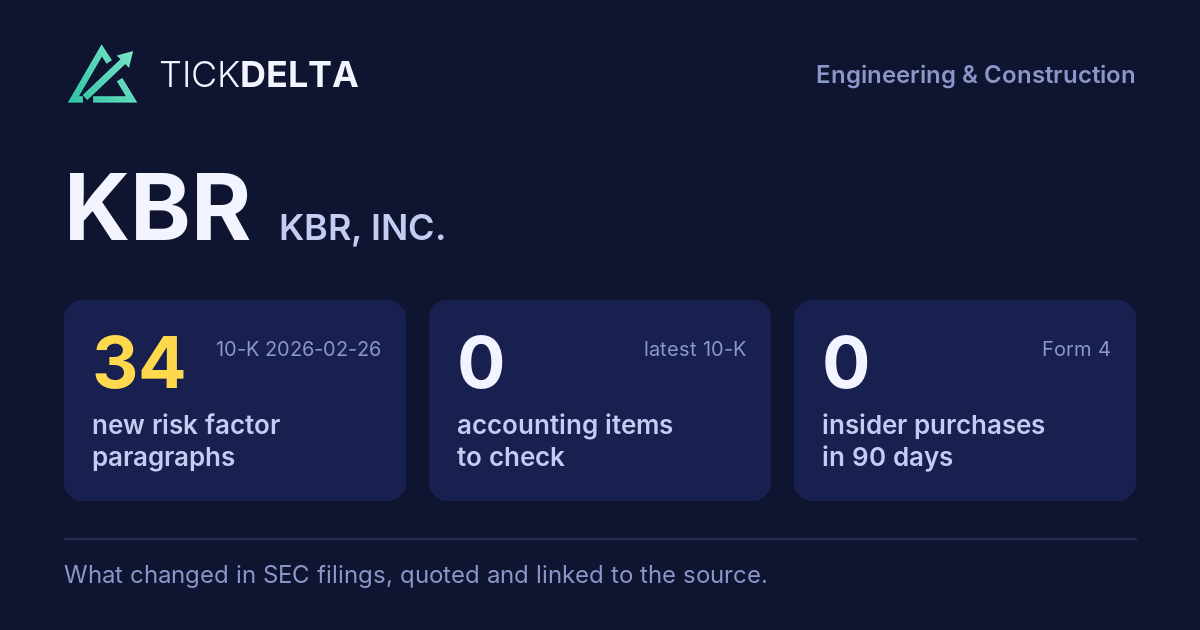
186 paragraphs · 34 new · 48 reworded · 2 gone · 10-K Feb 26, 2026 against Feb 25, 2025
New paragraph Reworded (5% of its words or more) Same or nearly
Paragraph 74 · 47% changed Every version of it
Additionally, we work with the defense industrial base industry and the U.S. government U.S., U.K. and Australian governments to gather and share threat intelligence and promote increased awareness and enhanced protections against cybersecurity threats. However, because of the evolving nature of these security threats, there can be no assurance that our policies, procedures and other controls will detect or prevent them, and we cannot predict their full impact. We may experience similar security threats to the IT systems that we
Paragraph 181 · 46% changed Every version of it
In addition, standards for tracking and reporting corporate responsibility matters continue to evolve. New laws, regulations, policies and international accords relating to such matters, including sustainability, climate-related risks, human capital and anti-discrimination, are being developed and formalized in Europe, the United States, Asia and elsewhere, which may entail specific, target-driven frameworks and/or disclosure requirements. Our selection of voluntary disclosure frameworks and standards, and the interpretation or application of those frameworks and standards, may change from time to time or differ from those of others, and may not be in line with any new and forthcoming related disclosure rules in the United States and abroad. For example, in January 2025, President Trump signed several executive orders signaling ongoing oversight of diversity initiatives. These orders may lead to further investigations of private entities, including publicly-traded companies. Methodologies for reporting data in these areas (e.g., sustainability and climate-related impacts, or human capital data) may also be updated and previously reported data may be adjusted to reflect improvement in availability and quality of internal and third-party data, changing assumptions, changes in the nature and scope of our operations and other changes in circumstances. Our processes and controls for reporting such matters across our operations and supply chain are evolving along with multiple disparate standards for identifying, measuring and reporting metrics, including related disclosures that may be required by the SEC, European and other regulators, and such standards may change over time, which could result in significant revisions to our current goals, reported progress in achieving such goals or ability to achieve such goals in the future. Any failure, or perceived failure, by us to comply fully with developing interpretations of such laws and regulations could harm our business, reputation, financial condition and operating results and require significant time and resources to make the necessary adjustments. If our corporate responsibility practices do not meet evolving investor or other stakeholder expectations and standards, then our reputation or our attractiveness as an investment, business partner, acquirer, service provider or employer could be negatively impacted.
Paragraph 17 · 44% changed Every version of it
If we there are unable to enforce our any successful intellectual property rights, or if our intellectual property rights are challenged or become obsolete, infringement proceedings against us, our competitive position could be adversely impacted.
Paragraph 117 · 40% changed Every version of it
U.S. government contracts are subject to specific regulations such as the FAR, the Truthful Cost or Pricing Data Statute, CAS, the Service Contract Act and DoD DoW security regulations. Failure to comply with any of these regulations, requirements or statutes may result in contract price adjustments, financial penalties or contract termination. Our U.S. government contracts are subject to audits, cost reviews and investigations by U.S. government contracting oversight agencies such as the DCAA. The DCAA reviews the adequacy of, and our compliance with, our internal control systems and policies, including our labor, billing, accounting, purchasing, property, estimating, compensation and management information systems. The DCAA has the authority to conduct audits and reviews to determine if we are complying with the requirements under the FAR and CAS, pertaining to the allocation, period assignment and allowability of costs assigned to U.S. government contracts. The DCAA presents its report findings to the DCMA. Should the DCMA determine that we have not complied with the terms of our contract or applicable statutes and regulations, payments to us may be disallowed, which could result in adjustments to previously reported revenues and refunding of previously collected cash proceeds. Additionally, we previously have been, and may in the future be subject to additional qui tam litigation brought by private individuals on behalf of the U.S. government under the Federal False Claims Act, which could include claims for treble damages. These suits may remain under seal (and hence, be unknown to us) for some time while the U.S. government decides whether to intervene on behalf of the qui tam plaintiff. For more information, see Note 14. "U.S. Government Matters" to our consolidated financial statements in Part II, Item 8 of this Annual Report on Form 10-K.
Paragraph 108 · 39% changed Every version of it
We face rigorous competition and pricing pressures for any additional contract awards from the U.S. government. Our industry has experienced, and we expect it will continue to experience, significant changes to business practices as a result of an increased focus on affordability, efficiencies and recovery of costs, among other items. From time to time, new laws laws, executive orders and regulations are enacted, and government agencies adopt new interpretations and enforcement priorities relative to laws and regulations already in effect. U.S. government agencies have and may continue to face restrictions or pressure regarding the type and amount of services that they may obtain from private contractors. Legislation, regulations and initiatives dealing with procurement reform as well as any resulting shifts in the buying practices of U.S. government agencies, such as increased usage of fixed-price contracts, multiple-award contracts and small business set-aside contracts, could have adverse effects on government contractors, including us. In addition, U.S. government procurement practices sometimes emphasize price over qualitative factors, such as technical capability and past performance. As a result of these competitive pricing pressures, our profit margins on future U.S. government contracts may be reduced and may require us to make sustained efforts to reduce costs to remain competitive.
Paragraph 98 · 38% changed Every version of it
The U.S. government conducts a rigorous competitive process for awarding most contracts. In the services arena, the U.S. government uses multiple contracting approaches. Historically, omnibus contract vehicles have been used for work that is done on a contingency or as-needed basis. In more predictable “sustainment” environments, contracts may include fixed-price, cost-reimbursable and time-and-materials elements. The U.S. government also favors multiple award task order contracts in which several contractors are selected as eligible bidders for future work. Such processes require successful contractors to continually anticipate customer requirements and develop rapid-response bid and proposal teams as well as maintain supplier relationships and delivery systems to react to emerging needs. In addition, U.S. government procurement practices sometimes emphasize price over qualitative factors, such as technical capability and past performance. As a result of these competitive pricing pressures, our profit margins on future U.S. government contracts may be reduced and may require us to make sustained efforts to reduce costs to remain competitive.
Paragraph 2 · 37% changed Every version of it
A considerable percentage of our revenues, particularly in our GS MTS business segment, is generated under contracts with certain significant customers. Revenues from the U.S. government represented 57% of our total consolidated revenues for fiscal 2024. 2025. Budget uncertainty, the potential for U.S. government shutdowns, the use of continuing resolutions and the federal debt ceiling can adversely affect our industry and the funding for our contracts. In addition, government acquisition reform and spending cut initiatives, including executive orders, may impact our business. For example, on January 20, 2025, an executive order was signed to create an advisory commission, DOGE, to reform federal government processes and reduce expenditures. Although DOGE was disbanded in November 2025, we cannot rule out the possibility of similar initiatives occurring in the future. Further, on April 15, 2025, Executive Order 14275, “Restoring Common Sense to Federal Procurement,” was signed, directing major revisions to the FAR to make the government’s procurement process more efficient, and on November 7, 2025, the U.S. DoW released a memorandum and strategy on defense acquisition reform titled “Transforming the Warfighting Acquisition System” that aims to overhaul the procurement landscape and prioritizes speed to capability delivery. If appropriations are delayed or delayed, a government shutdown were to occur and were to continue for an extended period of time, or changes in budgetary priorities or U.S. government spending levels were to occur, we could be at risk of contract cancellations cancellations, contract options not being exercised, funding shortages, nonpayment, increased uncertainty in the conversion of our book to bill to revenue and other disruptions and nonpayment. nonrepayment. When the U.S. government operates under a continuing resolution, new contract starts are restricted and funding for our programs may be unavailable, reduced or delayed. Shifting funding priorities or federal budget compromises also could result in reductions in overall defense spending on an absolute or inflation-adjusted basis, which could negatively affect our business, financial performance and condition. In addition, if we are unable to effectively respond to proposed acquisition reform in the U.S., our ability to secure and perform government contracts could be adversely affected, which may negatively impact our business. business, financial condition and results of operations. If we are deemed to be underperforming on our contracts, our business, financial condition and results of operations may likewise be adversely impacted.
Paragraph 118 · 25% changed Every version of it
U.S. government contracts are subject to specific regulations such as the FAR, the Truthful Cost or Pricing Data Statute, CAS, the Service Contract Act and DoD security regulations. Failure to comply with any of these regulations, requirements or statutes may result in contract price adjustments, financial penalties or contract termination. Our U.S. government contracts are subject to audits, cost reviews and investigations by U.S. government contracting oversight agencies such as the DCAA. The DCAA reviews the adequacy of, and our compliance with, our internal control systems and policies, including our labor, billing, accounting, purchasing, property, estimating, compensation and management information systems. The DCAA has the authority to conduct audits and reviews to determine if we are complying with the requirements under the FAR and CAS, pertaining to the allocation, period assignment and allowability of costs assigned to U.S. government contracts. The DCAA presents its report findings to the DCMA. Should the DCMA determine that we have not complied with the terms of our contract or applicable statutes and regulations, payments to us may be disallowed, which could result in adjustments to previously reported revenues and refunding of previously collected cash proceeds. Additionally, we previously have been, and may in the future be subject to additional qui tam litigation brought by private individuals on behalf of the U.S. government under the Federal False Claims Act, which could include claims for treble damages. These suits may remain under seal (and hence, be unknown to us) for some time while the U.S. government decides whether to intervene on behalf of the qui tam plaintiff. For more information, see Note 14. "U.S. Government Matters" to our consolidated financial statements in Part II, Item 8 of this Annual Report on Form 10-K.

MD&A

100 paragraphs · 8 new · 53 reworded · 9 gone · 10-K Feb 26, 2026 against Feb 25, 2025
New paragraph Reworded (5% of its words or more) Same or nearly
Paragraph 23 · 43% changed
GS MTS revenues increased by $518 million, or 10%, $26 million to $5,871 $5,581 million in fiscal 2024 2025 compared to $5,353 $5,555 million in fiscal 2023. The increase 2024. In fiscal 2025, we had revenue increases in defense and intel programs associated with the acquisition of LinQuest (in August 2024), offset by revenue is primarily decreases due to growth on high-end defense engineering, classified intelligence reduced activity within the European command and international programs science and $181 space programs. Additionally, revenues increased by $26 million in revenue associated with LinQuest. The increase was offset by fiscal 2025 due to the final resolution of an outstanding legacy claim associated with a U.S. government program, resulting in a $26 million decrease project in fiscal 2024. 2024 that did not recur in fiscal 2025.
Paragraph 7 · 42% changed
From October 1, 2025 through November 11, 2025 the U.S. government was shut down because Congress was unable to pass legislation providing appropriations authority for the government to continue to operate. Subsequent to the U.S. government shutdown starting on October 1, 2025, we experienced delays in project execution, collection of payments and contract awards. On November 12, 2025, a continuing resolution funding measure was enacted to finance all U.S. government activities through January 30, 2026. On February 3, 2026, the Consolidated Appropriations Act of 2026 was passed, which finalized defense appropriations for fiscal year 2026. This legislation provides for $839 billion in discretionary defense spending. In December 2024, 2025, the National Defense Authorization Act ("NDAA") for fiscal year 2025 was signed into law. The NDAA authorizes programs, projects and policies to be carried out with funds appropriated by Congress as part of the annual budgetary process. The NDAA supports up to approximately $884 $901 billion in fiscal year 2025 2026 funding for national defense, $850 billion of which is for defense. Additionally, the DoD. The requested amount is an increase of $9 billion when compared to the authorized defense spending for approved fiscal year 2024. 2026 budget for NASA is $24 billion.
Paragraph 53 · 41% changed
Financing Activities - continuing operations. Cash used in financing activities totaled $359 million in fiscal 2023 and was primarily due to a net cash outflow of $567 $403 million for the settlement and maturity fiscal 2025. The primary uses of our outstanding Convertible Notes, corresponding note hedge and warrants settled and paid during the year. Cash used cash in financing activities also included $72 were $505 million of dividend in payments to common shareholders, $125 on the Revolver, $26 million in payments on our Term Loan A, $10 million in payments on our Term Loan B, $323 million for the repurchase of common stock under our share repurchase program, $13 $6 million for the repurchase of common stock under our "withhold to cover" program, $340 million in payments on our revolving credit facility program and $17 $84 million of principal dividend payments related to our Senior Credit Facility. common shareholders. These decreases were partially offset by $785 $555 million in borrowings related to on our Revolver. See Note 11 "Debt and Other Credit Facilities" for further discussion of our Senior Credit Facility.
Paragraph 46 · 41% changed
Joint venture cash and Aspire Defence project cash balances reflect the amounts held by joint venture entities that we consolidate for financial reporting purposes. These amounts are limited to those entities' activities and are not readily available for general corporate purposes; however, portions of such amounts may become available to us in the future should there be a distribution of dividends to the joint venture partners. We expect that the majority of the joint venture cash balances will be utilized for the corresponding joint venture purposes or for paying dividends. In fiscal 2025 a contractual repayment was made by the Aspire Defence subcontracting entities.
Paragraph 32 · 40% changed
The following table summarizes our backlog by business segment as of January 2, 2026 and January 3, 2025, respectively. The disposal of HomeSafe met the requirements to be reported as discontinued operations. Backlog as of January 2, 2026 and January 3, 2025 and December 29, 2023, respectively: does not include any amounts related to HomeSafe.
Paragraph 10 · 36% changed
Labour Party becoming Internationally, our government work is performed primarily for the primary governing party U.K. MoD and the Australian Department of Defence. In June 2025, leaders of the House North Atlantic Treaty Organization agreed to invest 5% of Commons. The Labour Party has committed to increasing their countries' gross domestic product ("GDP") on defense and security-related spending to 2.5% of GDP by 2035. Additionally, in June 2025, the Strategic Defence Review was completed in the future, which is an increase from the previous commitment U.K. with plans to increase defense spending to 2.25%. The Labour Party has commissioned a strategic defense review 2.50% of GDP by 2027 and additional increases in following years to determine future reach defense spending priorities. of 3.00% of GDP. Recognizing the importance of strong defense and the role the U.K. plays across the globe, the U.K. has prioritized investment in military research and investment in key areas to advance and develop capabilities around artificial intelligence, cyber security and space superiority. The Australian government continues to invest in defense spending, with particular focus on enhancing regional security, modernizing defense capabilities, strengthening cyber defenses and promoting broader economic stability. The fiscal year budget for Australia for the 2024 - 2025 financial year was finalized, with In March 2025, the Australian government increasing Minister for Defence announced that the Australian defense spending budget is expected to AUD 55.7 billion, or approximately 2.00% of GDP. increase over the next four years.
Paragraph 15 · 36% changed
Gross profit. The increase in overall gross profit of $126 $51 million, or 13%, 5%, was primarily driven by items increasing revenues discussed above and $32 million in gross profit associated with LinQuest. This was partially offset by favorable resolutions on various legacy matters in fiscal 2023 that did not recur in fiscal 2024. above.
Paragraph 50 · 34% changed
The increase in operating cash flows in fiscal 2024 2025 compared to fiscal 2023 2024 is primarily related due to the $144 million payment made in fiscal 2023 related to the settlement resolution of a legacy legal matter that did not recur in fiscal 2024 and increased distributions of earnings from unconsolidated affiliates. In fiscal 2024, we received $163 million in distributions of earnings from unconsolidated affiliates compared to $74 million in fiscal 2023. The an outstanding unapproved change order within our Mission Technology Solutions segment. This increase in operating cash flows was offset primarily offset by increased employer pension contributions in fiscal 2024. In fiscal 2024, we made an advance payment to our U.K. defined benefit pension plan for approximately £17 million ($21 million at the current exchange rate). Additionally, we made an advance payment to our U.K pension plan in fiscal 2022 that resulted in decreased employer pension contributions in fiscal 2023. Further, there were decreases in operating cash flows in fiscal 2024 from changes in the primary components of our working capital. The primary components of our working capital accounts are accounts receivable, contract assets, accounts payable and contract liabilities. These In fiscal 2025, the accounts payable cash outflow included a contractual repayment made by the Aspire Defence subcontracting entities. The working capital components are also impacted by the size and changes in the mix of our cost-reimbursable and time-and-materials projects versus fixed price projects, and as a result, fluctuations in these components are not uncommon in our business. Additionally, in fiscal 2025 there were decreases in pension funding that resulted in additional operating cash flows.

A paragraph is matched with the one last year that shares the most of its words; under half in common makes it new. The paragraphs shown are the 8 reworded the most in each section.

The paragraph that changed most in each section

The redline

Marked against last year's 10-K: cut words struck through, new words highlighted.

Risk Factors240 words changed in this paragraph; it is 54% similar to last year's version.
A considerable percentage of our revenues, particularly in our GS MTS business segment, is generated under contracts with certain significant customers. Revenues from the U.S. government represented 57% of our total consolidated revenues for fiscal 2024. 2025. Budget uncertainty, the potential for U.S. government shutdowns, the use of continuing resolutions and the federal debt ceiling can adversely affect our industry and the funding for our contracts. In addition, government acquisition reform and spending cut initiatives, including executive orders, may impact our business. For example, on January 20, 2025, an executive order was signed to create an advisory commission, DOGE, to reform federal government processes and reduce expenditures. Although DOGE was disbanded in November 2025, we cannot rule out the possibility of similar initiatives occurring in the future. Further, on April 15, 2025, Executive Order 14275, “Restoring Common Sense to Federal Procurement,” was signed, directing major revisions to the FAR to make the government’s procurement process more efficient, and on November 7, 2025, the U.S. DoW released a memorandum and strategy on defense acquisition reform titled “Transforming the Warfighting Acquisition System” that aims to overhaul the procurement landscape and prioritizes speed to capability delivery. If appropriations are delayed or delayed, a government shutdown were to occur and were to continue for an extended period of time, or changes in budgetary priorities or U.S. government spending levels were to occur, we could be at risk of contract cancellations cancellations, contract options not being exercised, funding shortages, nonpayment, increased uncertainty in the conversion of our book to bill to revenue and other disruptions and nonpayment. nonrepayment. When the U.S. government operates under a continuing resolution, new contract starts are restricted and funding for our programs may be unavailable, reduced or delayed. Shifting funding priorities or federal budget compromises also could result in reductions in overall defense spending on an absolute or inflation-adjusted basis, which could negatively affect our business, financial performance and condition. In addition, if we are unable to effectively respond to proposed acquisition reform in the U.S., our ability to secure and perform government contracts could be adversely affected, which may negatively impact our business. business, financial condition and results of operations. If we are deemed to be underperforming on our contracts, our business, financial condition and results of operations may likewise be adversely impacted.

Source: Item 1A, 10-K 0001357615-26-000051 vs Item 1A, 10-K 0001357615-25-000018

MD&A183 words changed in this paragraph; it is 48% similar to last year's version.
The increase in operating cash flows in fiscal 2024 2025 compared to fiscal 2023 2024 is primarily related due to the $144 million payment made in fiscal 2023 related to the settlement resolution of a legacy legal matter that did not recur in fiscal 2024 and increased distributions of earnings from unconsolidated affiliates. In fiscal 2024, we received $163 million in distributions of earnings from unconsolidated affiliates compared to $74 million in fiscal 2023. The an outstanding unapproved change order within our Mission Technology Solutions segment. This increase in operating cash flows was offset primarily offset by increased employer pension contributions in fiscal 2024. In fiscal 2024, we made an advance payment to our U.K. defined benefit pension plan for approximately £17 million ($21 million at the current exchange rate). Additionally, we made an advance payment to our U.K pension plan in fiscal 2022 that resulted in decreased employer pension contributions in fiscal 2023. Further, there were decreases in operating cash flows in fiscal 2024 from changes in the primary components of our working capital. The primary components of our working capital accounts are accounts receivable, contract assets, accounts payable and contract liabilities. These In fiscal 2025, the accounts payable cash outflow included a contractual repayment made by the Aspire Defence subcontracting entities. The working capital components are also impacted by the size and changes in the mix of our cost-reimbursable and time-and-materials projects versus fixed price projects, and as a result, fluctuations in these components are not uncommon in our business. Additionally, in fiscal 2025 there were decreases in pension funding that resulted in additional operating cash flows.

Source: Item 7, 10-K 0001357615-26-000051 vs Item 7, 10-K 0001357615-25-000018

Accounting Policies105 words changed in this paragraph; it is 42% similar to last year's version.
We enter into derivative financial transactions to hedge existing or forecasted risk to changing foreign currency exchange rates and interest rate risk on variable rate debt. We do not enter into derivative transactions for speculative or trading purposes. We recognize all derivatives at fair value on the balance sheet. Derivatives that are not designated as hedges in accordance with Derivatives and Hedging (Topic 815), are adjusted to fair value and such changes are reflected in the results of operations. If the derivative is designated as a cash flow hedge, all changes in the fair value of derivatives are recognized in other comprehensive income (loss) and are subsequently reclassified into earnings in the period in which the hedged forecasted transaction affects earnings. See Note 20. "Fair Value of Financial Instruments and Risk Management" to our consolidated financial statements for our discussion on derivative instruments.

Source: Item 8, Note 1 – Significant Accounting Policies, 10-K 0001357615-26-000051 vs Item 8, Note 1 – Significant Accounting Policies, 10-K 0001357615-25-000018

Sentences and paragraphs added, removed or reworded

Every change, by type

Sentences and paragraphs of KBR's Risk Factors and MD&A, 10-K Feb 26, 2026 against 10-K Feb 25, 2025. Each links to the text at sec.gov.

Quiet changes are sentences kept from last year with one to four words changed, at least one of them a hedge, a modal or a qualifier (may, could, will, not, significant, material…). A year or date rolling forward is not counted.

The full word list

adverse, adversely, all, although, anticipate, anticipates, any, approximately, believe, believes, can, cannot, certain, could, expect, expects, generally, however, if, intend, intends, largely, likely, many, material, materially, may, might, most, must, never, no, not, possible, primarily, probable, should, significant, significantly, some, substantial, substantially, unlikely, will, would

AddedRisk Factors
We depend on U.S. and foreign government agencies as our primary customers in our MTS business segment and, if our reputation or relationships with these agencies were to be harmed, it could adversely impact our financial performance.
Read it in 10-K Feb 26, 2026 at sec.gov
AddedRisk Factors
We derive a considerable portion of our revenues in our MTS business segment from contracts with agencies and departments of the U.S., the U.K. and Australia governments, either as a prime contractor or as a subcontractor to other companies performing prime contracts for these governments. We expect to continue to derive a significant portion of our revenues from work performed under or relating to U.S. and foreign government contracts. Our relationship with the U.S. and foreign governments is key to maintaining these contracts, winning new work, and growing our revenues. Negative press reports or publicity, regardless of accuracy, could harm our reputation and jeopardize our business with our customers, potentially adversely affecting our business, financial condition, results of operations and cash flows.
Read it in 10-K Feb 26, 2026 at sec.gov
AddedRisk Factors
or termination. For example, HomeSafe, a joint venture with Tier One Relocation, informed us on June 18, 2025, that U.S. Transportation Command unexpectedly terminated HomeSafe’s role in the Global Household Goods Contract. KBR owns a 72% interest in HomeSafe. As of January 2, 2026, all of HomeSafe's operations, including run-off operations, have ceased.
Read it in 10-K Feb 26, 2026 at sec.gov
AddedRisk Factors
Our business and results of operations could be adversely impacted by trade restrictions imposed by the U.S. and other governments globally, as well as by changes in these governments’ approaches to tariffs and other trade policies. New or increased tariffs or trade bans could have an adverse effect on both our U.S. and international operations due to increased costs of materials, disruptions or delays in deliveries, and greater difficulty in planning and operating our business. While our business in the U.S. primarily provides labor services to our customers, some of our U.S. work involves procuring goods, equipment or materials that may be subject to tariffs. Our non-U.S. work could also be impacted by greater costs for goods sourced from the U.S. due to increased tariffs imposed by other countries. Although we plan to continue to monitor trade policy developments closely and to mitigate the adverse impacts of any changes where possible, we may not be able to fully mitigate such impacts in all situations.
Read it in 10-K Feb 26, 2026 at sec.gov
AddedRisk Factors
Employee, agent or partner misconduct, or our overall failure to comply with laws or regulations, could weaken our ability to win contracts, which could result in reduced revenues and profits.
Read it in 10-K Feb 26, 2026 at sec.gov
Show the other 48
AddedRisk Factors
We are subject to the risk of misconduct, fraud, non-compliance with applicable laws and regulations, or other improper activities by our employees, agents or partners, which could have a significant negative impact on our business and reputation. Such misconduct includes the failure to comply with government procurement regulations, regulations regarding the protection of classified information, regulations prohibiting bribery and other corrupt practices, regulations regarding the pricing of labor and other costs in government contracts, regulations on lobbying or similar activities, regulations pertaining to the internal controls over financial reporting, regulations pertaining to export control, environmental laws, employee wages, pay and benefits, and any other applicable laws or regulations. For example, we routinely provide services that may be highly sensitive or that relate to critical national security matters and, if a security breach were to occur, our ability to receive future government contracts could be severely limited. The precautions we take to prevent and detect these activities may not be effective and we could face unknown risks or losses. Our failure to comply with applicable laws or regulations or acts of misconduct subject us to the risk of civil or criminal fines and penalties, cancellation of contracts, loss of security clearance and suspension or debarment from contracting, any of which could damage our reputation, weaken our ability to win contracts and result in reduced revenues and profits and could have a material adverse impact on our business, financial condition and results of operations.
Read it in 10-K Feb 26, 2026 at sec.gov
AddedRisk Factors
We depend on our teaming arrangements and relationships with other contractors and subcontractors. If we are not able to maintain these relationships, or if these parties fail to satisfy their obligations to us or the customer, our business, financial condition and results of operations could be adversely affected.
Read it in 10-K Feb 26, 2026 at sec.gov
AddedRisk Factors
We rely on teaming relationships with other prime contractors and subcontractors to bid on large procurements and other opportunities when we believe the combination of services, products and solutions we can offer with teammates will help us win and perform the contract. Our future revenues and growth could be adversely affected if our partners reduce or end their contract relationships with us, or if the U.S. government terminates or reduces programs of prime contractors to which we subcontract, does not award them new contracts, or refuses to pay under a contract. We may contract with subcontractors that
Read it in 10-K Feb 26, 2026 at sec.gov
AddedRisk Factors
do not have experience on U.S. government contracts or with our customers, providing them with the experience, relationships, and past performance to compete with us on future contracts and potential result in contract losses. If subcontractors fail to timely meet their contractual obligations or have regulatory compliance or other problems, our ability to fulfill our obligations as a prime contractor or higher tier subcontractor may be jeopardized.
Read it in 10-K Feb 26, 2026 at sec.gov
RemovedRisk Factors
contractor, our financial performance is affected by the allocation and prioritization of government spending. Factors that could affect current and future government spending include:
Read it in 10-K Feb 25, 2025 at sec.gov
RewordedRisk Factors
If appropriations are delayed or delayed, a government shutdown were to occur and were to continue for an extended period of time, or changes in budgetary priorities or U.S. government spending levels were to occur, we could be at risk of contract cancellations cancellations, contract options not being exercised, funding shortages, nonpayment, increased uncertainty in the conversion of our book to bill to revenue and other disruptions and nonpayment. nonrepayment.
Read it in 10-K Feb 26, 2026 at sec.gov
RewordedRisk Factors
As such, a potential disruption to our and our customer's businesses from a natural disaster may cause us to experience work stoppages, project delays, financial losses and additional costs to resume operations such as increased insurance costs or loss of coverage, legal liability and reputational damage.
Read it in 10-K Feb 26, 2026 at sec.gov
RewordedRisk Factors
Our competitors or other third parties may incorporate AI into their product development, product offerings, technology and infrastructure products more quickly or more successfully than us, which could impair our ability to compete effectively and adversely affect our business, financial condition and results of operations.
Read it in 10-K Feb 26, 2026 at sec.gov
RewordedRisk Factors
An inability to obtain or retain our facility security clearances or engage employees with the required security clearances for a particular contract could disqualify us from bidding for and winning new contracts with security requirements. requirements or result in negative consequences for current contracts, including termination for default if security concerns are not remedied.
Read it in 10-K Feb 26, 2026 at sec.gov
RewordedRisk Factors
Our processes and controls for reporting such matters across our operations and supply chain are evolving along with multiple disparate standards for identifying, measuring and reporting metrics, including related disclosures that may be required by the SEC, European and other regulators, and such standards may change over time, which could result in significant revisions to our current goals, reported progress in achieving such goals or ability to achieve such goals in the future.
Read it in 10-K Feb 26, 2026 at sec.gov
RewordedRisk Factors
We engage in activities for large facilities where design, construction or systems failures can result in substantial injury or damage to employees or other third parties or delays in completion or commencement of commercial operations, service delivery impacts, exposing us to legal proceedings, investigations and disputes.
Read it in 10-K Feb 26, 2026 at sec.gov
RewordedRisk Factors
GAAP requires us to make estimates and assumptions that affect the reported amounts of certain assets, liabilities, revenues and expenses for the periods covered and certain amounts disclosed in the notes to our consolidated financial statements. statements statements in Part II, Item 8 of this Annual Report on Form 10-K.
Read it in 10-K Feb 26, 2026 at sec.gov
RewordedRisk Factors
To the extent that we export products, technical data and services outside of the U.S., we are subject to laws and regulations governing trade trade, exports and exports, sanctions including, but not limited to, the International Traffic in Arms Regulations and Regulations, the Export Administration Regulations, Regulations and trade sanctions against embargoed countries, entities and individuals, including sanctions and export restrictions related to Russia's invasion of Ukraine, which are administered by the Office of Foreign Asset Control within the Department of the Treasury.
Read it in 10-K Feb 26, 2026 at sec.gov
RewordedRisk Factors
We currently hold U.S. government-issued facility security clearances and a large number of our employees have qualified for and hold U.S. U.S., U.K. and Australian government-issued personal security clearances necessary to perform certain U.S. U.S., U.K. and Australian government contracts.
Read it in 10-K Feb 26, 2026 at sec.gov
RewordedRisk Factors
Shifting funding priorities or federal budget compromises also could result in reductions in overall defense spending on an absolute or inflation-adjusted basis, which could adversely impact negatively affect our business. business, financial performance and condition.
Read it in 10-K Feb 26, 2026 at sec.gov
RewordedRisk Factors
From time to time, new laws laws, executive orders and regulations are enacted, and government agencies adopt new interpretations and enforcement priorities relative to laws and regulations already in effect.
Read it in 10-K Feb 26, 2026 at sec.gov
AddedMD&A
HomeSafe, a joint venture with Tier One Relocation, informed us on June 18, 2025, that U.S. Transportation Command unexpectedly terminated HomeSafe's role in the Global Household Goods Contract. KBR owns a 72% interest in HomeSafe. As of January 2, 2026 all of HomeSafe operations, including run-off operations, have ceased. The financial results and financial position of HomeSafe are presented as discontinued operations in the consolidated statements of operations, consolidated balance sheets and consolidated statements of cash flows for all periods presented. See Note 21. "Discontinued Operations" to our consolidated financial statements in Part II, Item 8 of this Annual Report on Form 10-K for more information. Unless otherwise indicated, any reference to statements of operations items in this "Management's Discussion and Analysis of Financial Condition and Results of Operations" refers to results from continuing operations.
Read it in 10-K Feb 26, 2026 at sec.gov
AddedMD&A
On November 10, 2025, the DoW announced the Acquisition Transformation Strategy which aims to accelerate the delivery of operational capabilities by implementing organizational changes that enable acquisition speed, including greater flexibility and authority for trade-off decisions among speed, performance and cost and commercial-first preference to streamline solicitation approaches. The strategy validates the critical market need we seek to address for trusted vendors who can act as capability integrators independent of original equipment manufacturers (OEMs). It also reinforces our value to the DoW's priority for rapid delivery of warfighting capability.
Read it in 10-K Feb 26, 2026 at sec.gov
AddedMD&A
Despite the Administration indicating its desire for a significant increase in defense spending for fiscal year 2027 to $1.5 trillion, we anticipate the federal budget will continue to be subject to debate and compromise shaped by, among other things, the Administration and Congress, efficiency initiatives, the global security environment, inflationary pressures including tariffs and macroeconomic conditions. Thus far, the Administration's directives and actions of the DOGE have resulted in federal government staff reductions and hiring freezes and may result in delays in contract awards.
Read it in 10-K Feb 26, 2026 at sec.gov
AddedMD&A
Net income (loss) from discontinued operations, net of tax. Net income (loss) from discontinued operations, net of tax, was $(55) million and $2 million during fiscal 2025 and fiscal 2024, respectively, due to the disposal of HomeSafe.
Read it in 10-K Feb 26, 2026 at sec.gov
AddedMD&A
Net income (loss) attributable to noncontrolling interests included in discontinued operations. Net income (loss) attributable to noncontrolling interests included in discontinued operations was $(19) million and $1 million during fiscal 2025 and fiscal 2024, respectively, due to the disposal of HomeSafe.
Read it in 10-K Feb 26, 2026 at sec.gov
AddedMD&A
Cash provided by financing activities totaled $374 million in fiscal 2024 and was primarily related to $393 million in borrowings on our Revolver and $574 million in borrowings associated with Amendment No. 11 and No. 13 to our Credit
Read it in 10-K Feb 26, 2026 at sec.gov
AddedMD&A
Cash flows from discontinued operations. Cash flows from discontinued operations are associated with the disposal of HomeSafe. Cash used in operations totaled $33 million for fiscal 2025 and cash provided by operations totaled $12 million for fiscal 2024. Changes in HomeSafe's working capital accounts were the primary components of operating cash flows for fiscal 2025 and fiscal 2024. Cash used in investing activities totaled $12 million and $25 million for fiscal 2025 and fiscal 2024, respectively, which is related to capital expenditures. Cash provided by financing activities totaled $12 million for fiscal 2025 due to investments from the noncontrolling interest partner. See Note 21. "Discontinued Operations" to our consolidated financial statements for additional information.
Read it in 10-K Feb 26, 2026 at sec.gov
AddedMD&A
We anticipate that, in connection with and prior to the completion of the Planned Spin-Off, the Mission Technology Solutions business will make a cash distribution to KBR using proceeds received from its anticipated financing transactions to be undertaken as part of its transition to an independent, publicly traded company. We intend to use the cash distributed to KBR by the Mission Technology Solutions business to reduce our level of indebtedness.
Read it in 10-K Feb 26, 2026 at sec.gov
RemovedMD&A
The U.S. government has not yet enacted an annual budget for its fiscal year 2025. To avert a government shutdown, a continuing resolution funding measure has been enacted to finance all U.S. government activities through March 14, 2025. Under the continuing resolution, partial-year funding at amounts consistent with appropriated levels for fiscal year 2024 are available, subject to certain restrictions, but new spending initiatives are not authorized. Uncertainty continues to exist regarding the 2025 fiscal year budget and the impacts that the new legislative and executive branch will have on the final fiscal year 2025 budget. We believe our key programs will continue to be supported and funded in the continuing resolution financing mechanism. The effect of a potential government shutdown or the ultimate fiscal year 2025 budget on KBR or our individual programs cannot be predicted at this time. However, if a government shutdown were to occur and were to continue for an extended period, we could be at risk of program cancellations, schedule delays and other disruptions and nonpayment, which could adversely affect our results of operations. We anticipate the federal budget will continue to be subject to debate and compromise shaped by, among other things, the new Administration and Congress, efficiency initiatives such as the Department of Government Efficiency, the global security environment, inflationary pressures and macroeconomic conditions. The result may be shifting funding priorities, which could have material impacts on defense spending broadly and our programs.
Read it in 10-K Feb 25, 2025 at sec.gov
RemovedMD&A
Internationally, our Government Solutions work is performed primarily for the U.K. MoD and the Australian Department of Defence. In March 2024, the U.K. government announced the defense budget, with the defense budget remaining consistent with the defense budget from the prior fiscal year. A general election was held in the United Kingdom in July 2024, with the
Read it in 10-K Feb 25, 2025 at sec.gov
RemovedMD&A
Gain (loss) on disposition of assets and investments. In fiscal 2024, we recognized a gain on disposition of assets and investments of $7 million primarily due to the sale of our investment interest in a joint venture within our GS segment. In fiscal 2023, we recognized a loss on disposition of assets and investments of $7 million related to the sale of our operations in Russia. This loss was primarily due to $10 million in accumulated foreign currency adjustments that were reclassified from AOCL.
Read it in 10-K Feb 25, 2025 at sec.gov
RemovedMD&A
Charges associated with Convertible Notes. In fiscal 2023, we recognized a loss of $494 million related to the cash election and repurchase of our Convertible Notes and the agreements to terminate and settle our outstanding warrants in fiscal 2023 that did not recur in fiscal 2024.
Read it in 10-K Feb 25, 2025 at sec.gov
RemovedMD&A
As discussed in Note 11 "Debt and Other Credit Facilities" of our consolidated financial statements, we entered into Amendment No.11 to our Credit Agreement on January 19, 2024. This amendment provided for an incremental Term Loan B facility in an aggregate principal amount of $1 billion and extended the Term Loan B maturity date to January 2031. We borrowed the full $1 billion principal amount available under this loan. We received $24 million in cash proceeds from this borrowing to pay accrued interest and financing fees, $501 million was applied to the outstanding principal under the Term Loan B facility and the remaining $475 million was applied to the outstanding principal under the Revolver. In addition, Amendment No. 11 reduced the interest rate margin applicable to Term Loan B. During fiscal 2024, $7 million in cash was paid on the outstanding Term Loan B principal.
Read it in 10-K Feb 25, 2025 at sec.gov
RemovedMD&A
We entered into Amendment No.12 to our Credit Agreement on February 7, 2024. This amendment consolidated all USD denominated Term Loans A including: Term A-1, Term A-2 and Term A-4 loan facilities under our Credit Agreement into the amended singular USD denominated Term A-1 loan facility and continued the GBP denominated Term A-3 loan facility outstanding at December 29, 2023. During fiscal 2024, $117 million in cash was paid on the outstanding Term Loan A principal and accrued interest and $20 million was applied to the Term Loan A principal using proceeds of a borrowing on our Revolver. Additionally, this amendment extended the maturity date of the $1 billion Revolver, amended Term A-1 loan facility and Term A-3 loan facility to February 2029.
Read it in 10-K Feb 25, 2025 at sec.gov
RemovedMD&A
We entered into Amendment No. 13 to our Credit Agreement on August 14, 2024. This amendment allowed for an incremental delayed draw Term A-2 loan in an aggregate principal amount up to $550 million, which remained available for 180 days to fund the acquisition of LinQuest, maturing August 2027. On August 30, 2024, we borrowed the entire $550 million available under the delayed draw Term A-2 loan upon closing of the LinQuest acquisition. Additionally, under Amendment No. 13, we refinanced outstanding principal amounts under the Company's existing Term B loan facility via a cashless roll into a new Term B loan facility to reduce the interest rate margin applicable to Term Loan B. The applicable interest rate per annum of the new Term B loan facility is term SOFR plus 2.00% (or base rate plus 1.00%) and the maturity date is January 2031. See Note 4. "Acquisition of LinQuest Corporation" to our consolidated financial statements for further discussion around the acquisition of LinQuest.
Read it in 10-K Feb 25, 2025 at sec.gov
RemovedMD&A
complete the contracted work, less amounts remaining to be billed to the client under the contract. Remaining billable amounts could be greater or less than the cost to complete the project. If costs exceed the remaining amounts payable under the contract, we may have recourse to third parties, such as owners, subcontractors or vendors for claims.
Read it in 10-K Feb 25, 2025 at sec.gov
RewordedMD&A
Cash used The primary uses of cash in financing activities also included $72 were $505 million of dividend in payments to common shareholders, $125 on the Revolver, $26 million in payments on our Term Loan A, $10 million in payments on our Term Loan B, $323 million for the repurchase of common stock under our share repurchase program, $13 $6 million for the repurchase of common stock under our "withhold to cover" program, $340 million in payments on our revolving credit facility program and $17 $84 million of principal dividend payments related to our Senior Credit Facility. common shareholders.
Read it in 10-K Feb 26, 2026 at sec.gov
RewordedMD&A
Years ended, January 3, December 29, December 31, Year ended Dollars in millions January 2, 2026 January 3, 2025 December 29, 2023 2022 Cash flows provided by operating activities - continuing operations $ 462 557 $ 331 450 $ 396 301 Cash flows provided by (used in) investing activities (776) (70) 37 - continuing operations 16 (751) (52) Cash flows provided by (used in) financing activities - continuing operations (403) 374 (359) (399) Total cash flows from discontinued operations (33) (13) 12 Effect of exchange rate changes on cash 18 (14) 13 (15) Increase (decrease) in cash and cash equivalents $ 155 $ 46 $ (85) $ 19
Read it in 10-K Feb 26, 2026 at sec.gov
RewordedMD&A
Selling, general and administrative expenses were $56 $35 million higher higher, or 6%, in fiscal 2024 2025 compared to fiscal 2023, 2024, which was primarily driven by additional expenses incurred to support the growth in both our GS MTS and STS business segments. segments, expenses incurred related to the implementation of a new enterprise resource planning system and expenses incurred related to the Planned Spin-Off of MTS.
Read it in 10-K Feb 26, 2026 at sec.gov
RewordedMD&A
These increases were offset Additionally, operating income increased by $26 million in fiscal 2025 due to the final resolution of an outstanding legacy claim associated with a U.S. government project, resulting in a $26 million decrease project in fiscal 2024. 2024 that did not recur in fiscal 2025.
Read it in 10-K Feb 26, 2026 at sec.gov
RewordedMD&A
The increase was offset Additionally, revenues increased by $26 million in fiscal 2025 due to the final resolution of an outstanding legacy claim associated with a U.S. government project, resulting in a $26 million decrease project in fiscal 2024. 2024 that did not recur in fiscal 2025.
Read it in 10-K Feb 26, 2026 at sec.gov
RewordedMD&A
The increase was offset Additionally, revenues increased by $26 million in fiscal 2025 due to the final resolution of an outstanding legacy claim associated with a U.S. government program, resulting in a $26 million decrease project in fiscal 2024. 2024 that did not recur in fiscal 2025.
Read it in 10-K Feb 26, 2026 at sec.gov
RewordedMD&A
Additionally, The increase in fiscal 2024, we recognized operating income was offset by a $6 million gain related to the sale of our investment interest in a joint venture. venture during fiscal 2024 that did not recur in fiscal 2025.
Read it in 10-K Feb 26, 2026 at sec.gov
RewordedMD&A
Cash provided by operations totaled $462 $557 million and $331 $450 million in fiscal 2024 2025 and fiscal 2023, 2024, respectively, as compared to net income from continuing operations of $381 $458 million and net loss of $261 $379 million in fiscal 2024 2025 and fiscal 2023, 2024, respectively.
Read it in 10-K Feb 26, 2026 at sec.gov
RewordedMD&A
January 2, January 3, December 29, Dollars in millions 2026 2025 2023 Domestic U.S. cash $ 210 $ 24 $ 44 International cash 238 207 128 Joint venture and Aspire Defence project cash 119 132 52 111 Total $ 350 500 $ 304 342
Read it in 10-K Feb 26, 2026 at sec.gov
RewordedMD&A
Our expected long-term rates of return on plan assets utilized at the measurement date of January 2, 2026 and January 3, 2025 was 6.24% and December 29, 2023 was 6.64% for our U.S. pension plans plans, respectively, and 7.97% and 6.80% and 6.79% for our U.K. pension plans, respectively.
Read it in 10-K Feb 26, 2026 at sec.gov
Quiet changesMD&A
The effective tax rate of 25%, as compared to the U.S. statutory rate of 21%, for fiscal 2024 was primarily impacted affected by the rate differential on our foreign earnings and the impact of state and local taxes in the U.S.
Read it in 10-K Feb 26, 2026 at sec.gov

Sources

The two latest 10-Ks on EDGAR, section by section. Each change links to the text at sec.gov.

Also

New risk factors: paragraphs with nothing like them last year, quoted in full.

Work with it

Excel workbook · CSV. Google Sheet that stays up to date: paste =IMPORTDATA("https://tickdelta.com/company/KBR/export.csv") into a cell.

Next:Related parties
Esc

Type a ticker such as AAPL, a name, an investor such as Buffett, or a topic such as tariffs. ↑ ↓ to move, Enter to open.